Ordering Among Premodifiers
J a m e s S h a w a n d V a s i l e i o s H a t z i v a s s i l o g l o u
Department of Computer Science
Columbia University
N e w York, N.Y. 10027, U S A
{shaw, vh}@cs, columbia, edu
A b s t r a c t
We present a corpus-based s t u d y of the se- quential ordering among premodifiers in noun phrases. This information is important for the fluency of generated text in practical appli- cations. We propose and evaluate three ap- proaches to identify sequential order among pre- modifiers: direct evidence, transitive closure, and clustering. Our implemented system can make over 94% of such ordering decisions cor- rectly, as evaluated o n a large, previously un- seen test corpus.
1 I n t r o d u c t i o n
Sequential ordering among premodifiers affects the fluency of text, e.g., "large foreign finan- cial firms" or "zero-coupon global bonds" are desirable, while "foreign large financial firms" or "global zero-coupon bonds" sound odd. T h e difficulties in specifying a consistent ordering of adjectives have already been noted by linguists [Whorf 1956; Vendler 1968]. During the process of generating complex sentences by combining multiple clauses, there are situations where mul- tiple adjectives or nouns modify the same head noun. T h e text generation system must order these modifiers in a similar way as domain ex- perts use t h e m to ensure fluency of the text. For example, the description of the age of a patient precedes his ethnicity and gender in medical do- main as in % 50 year-old white female patient". Yet, general lexicons such as WordNet [Miller et al. 1990] and C O M L E X [Grishman et al. 1994], do not store such information.
In this paper, we present a u t o m a t e d tech- niques for addressing this problem of determin- ing, given two premodifiers A and B, the pre- ferred ordering between them. Our methods rely on and generalize empirical evidence ob- tained from large corpora, and are evaluated
objectively on such corpora. T h e y are informed and motivated by our practical need for order- ing multiple premodifiers in the MAGIC system [Dalal et al. 1996]. MAGIC utilizes co-ordinated text, speech, and graphics to convey informa- tion about a patient's status after coronary by- pass surgery; it generates concise but complex descriptions t h a t frequently involve four or more premodifiers in the same noun phrase.
To demonstrate that a significant portion of noun phrases have multiple premodifiers, we extracted all the noun phrases (NPs, exclud- ing pronouns) in a two million word corpus of medical discharge summaries and a 1.5 million word Wall Street Journal (WSJ) corpus (see Section 4 for a more detailed description of the corpora). In the medical corpus, out of 612,718 NPs, 12% have multiple premodifiers and 6% contain solely multiple adjectival premodifiers. In the WSJ corpus, the percentages are a little lower, 8% and 2%, respectively. These percent- ages imply that one in ten NPs contains mul- tiple premodifiers while one in 25 contains just multiple adjectives.
rect evidence, provides answers for many more premodifier orderings, and is portable to differ- ent domains.
In the next section, we briefly describe prior linguistic research on this topic. Sections 3 and 4 describe the methodology and corpus used in our analysis, while the results of our experi- ments are presented in Section 5. In Section 6, we d e m o n s t r a t e how we incorporated our or- dering results in a general text generation sys- tem. Finally, Section 7 discusses possible im- provements to our current approach.
2 R e l a t e d W o r k
T h e order of adjectives (and, by analogy, nom- inal premodifiers) seems to be outside of the grammar; it is influenced by factors such as polarity [Malkiel 1959], scope, and colloca- tional restrictions [Bache 1978]. Linguists [Goy- vaerts 1968; Vendler 1968; Quirk and Green- b a u m 1973; Bache 1978; Dixon 1982] have per- formed manual analyses of (small) corpora and pointed out various tendencies, such as the facts t h a t underived adjectives often precede derived adjectives, and shorter modifiers precede longer ones. Given the difficulty of adequately describ- ing all factors that influence the order of pre- modifiers, most earlier work is based on plac- ing the premodifiers into broad semantic classes, and specifying an order among these classes. More t h a n t e n classes have been proposed, with some of t h e m further broken down into sub- classes. T h o u g h not all these studies agree on the details, they demonstrate t h a t there is fairly rigid regularity in the ordering of adjectives. For example, Goyvaerts [1968, p. 27] proposed the order q u a l i t y -< s i z e / l e n g t h / s h a p e -< o l d / n e w / y o u n g -< color -< n a t i o n a l i t y -< style -< g e r u n d -< denominall; Quirk and Greenbaum [1973, p. 404] the order g e n e r a l -< age -< color -< p a r t i c i p l e -< p r o v e n a n c e -< n o u n -< denominal; and Dixon [1982, p. 24] the order value -< d i m e n s i o n -< physical p r o p e r t y -< speed -< h u m a n p r o p e n s i t y -< age -< color.
Researchers have also looked at adjective or- dering across languages [Dixon 1982; Frawley 1992]. Frawley [1992], for example, observed that English, German, Hungarian, Polish, Turk- ish, Hindi, Persian, Indonesian, and Basque, all
1Where A ~ B stands for "A precedes B'.
order value before size and b o t h of those before color.
As with most manual analyses, t h e corpora used in these analyses are relatively small com- pared with m o d e r n corpora-based studies. Fur- thermore, different criteria were used to ar- rive at the classes. To illustrate, the adjec- tive "beautiful" can be classified into at least two different classes because the phrase "beau- tiful dancer" can be transformed from either the phrase "dancer who is beautiful", or "dancer who dances beautifully".
Several deep semantic features have been pro- posed to explain the regularity among the po- sitional behavior of adjectives. Teyssier [1968] first proposed that adjectival functions, i.e. identification, characterization, and classifica- tion, affect adjective order. Martin [1970] car- ried out psycholinguistic studies of adjective ordering. Frawley [1992] extended t h e work by K a m p [1975] and proposed t h a t intensional modifiers precede extensional ones. However, while these studies offer insights at the complex p h e n o m e n o n of adjective ordering, they cannot be directly m a p p e d to a computational proce- dure.
On the other hand, recent computational work on sentence planning [Bateman et al. 1998; Shaw 1998b] indicates t h a t generation re- search has progressed to a point where hard problems such as ellipsis, conjunctions, and or- dering of paradigmatically related constituents are addressed. C o m p u t a t i o n a l corpus stud- ies related to adjectives were performed by [Justeson and Katz 1991; Hatzivassiloglou and McKeown 1993; Hatzivassiloglou and McKeown 1997], b u t none was directly on t h e ordering problem. [Knight and Hatzivassiloglou 1995] and [Langkilde and Knight 1998] have proposed models for incorporating statistical information into a text generation system, an approach t h a t is similar to our way of using t h e evidence ob- tained from corpus in our actual generator.
3 M e t h o d o l o g y
function,
compute_order(A, B), which returns
the sequential ordering between two premodi- tiers, word A and word B.To identify orderings among premodifiers, premodifier sequences are extracted from sim- plex NPs. A simplex N P is a maximal n o u n phrase t h a t includes premodifiers such as de- terminers and possessives but not post-nominal constituents such as prepositional phrases or relative clauses. W e use a part-of-speech tag- ger [Brill 1992] a n d a finite-state g r a m m a r to extract simplex N P s . T h e n o u n phrases w e ex- tract start w i t h a n optional determiner ( D T ) or possessive p r o n o u n ( P R P $ ) , followed b y a se- q u e n c e of cardinal n u m b e r s (CDs), adjectives (JJs), n o u n s (NNs), a n d e n d with a noun. W e include cardinal n u m b e r s in N P s to capture the ordering of numerical information such as age a n d a m o u n t s . G e r u n d s (tagged as V B G ) or past participles (tagged as
VBN),
such as "heated" in "heated debate", are considered as adjectives if the w o r d in front of t h e m is a determiner, possessive p r o n o u n , or adjective, thus separat- ing adjectival a n d verbal forms that are con- flared b y the tagger. A m o r p h o l o g y m o d u l e transforms plural n o u n s a n d c o m p a r a t i v e a n d superlative adjectives into their base forms to ensure m a x i m i z a t i o n of our frequency counts. T h e r e is a regular expression filter w h i c h re- m o v e s obvious concatenations of simplex N P s such as "takeover bid last w e e k " a n d "Tylenol 40 milligrams".After simplex N P s are extracted, sequences of premodifiers are obtained b y d r o p p i n g deter- miners, genitives, cardinal n u m b e r s a n d h e a d nouns. O u r s u b s e q u e n t analysis operates o n the resulting premodifier sequences, a n d involves three stages: direct evidence, transitive closure, a n d clustering. W e describe each stage in m o r e detail in the following subsections.
3.1 D i r e c t E v i d e n c e
O u r analysis proceeds o n the hypothesis that the relative order of t w o premodifiers is fixed a n d i n d e p e n d e n t of context. G i v e n t w o p r e m o d - ifiers A a n d B, there are three possible under- lying orderings, a n d our s y s t e m should strive to find w h i c h is true in this particular case: ei- ther A c o m e s before B, B c o m e s before A, or the order b e t w e e n A a n d B is truly u n i m p o r - tant. O u r first stage relies o n frequency data collected f r o m a training corpus to predict the
order of adjective and n o u n premodifiers in an unseen test corpus.
To collect direct evidence on the order of premodifiers, we extract all t h e premodifiers from the corpus as described in t h e previous subsection. We first transform the premodi- tier sequences into
ordered pairs.
For example, the phrase "well-known traditional b r a n d - n a m e drug" has three ordered pairs, "well-known -< traditional", "well-known -~ b r a n d - n a m e " , and "traditional -~ b r a n d - n a m e " . A phrase with n premodifiers will have (~) ordered pairs. From these ordered pairs, we construct a w x w m a t r i xCount,
where w the n u m b e r of distinct modi- fiers. T h e cell [A, B] in this m a t r i x represents the n u m b e r of occurrences of t h e pair "A -~ B", in t h a t order, in t h e corpus.Assuming t h a t there is a preferred ordering between premodifiers A and B, one of the cells
Count[A,B]
andCount[B,A]
should be much larger t h a n t h e other, at least if t h e corpus be- comes arbitrarily large. However, given a corpus of a fixed size there will be m a n y cases where t h e frequency counts will b o t h be small. This d a t a sparseness problem is exacerbated by t h e inevitable occurrence of errors during the d a t a extraction process, w h i c h will introduce s o m e spurious pairs (and orderings) of premodifiers. W e therefore apply probabilistic reasoning to d e t e r m i n e w h e n the d a t a is strong e n o u g h to decide that A -~ B or B -~ A. U n d e r the null hypothesis that the t w o premoditiers order is ar- bitrary, the n u m b e r of times w e have seen o n e of t h e m follows the binomial distribution w i t h pa- rameter p -- 0.5. T h e probability that w e w o u l d see the actually observed n u m b e r of cases w i t h A ~ B, say m , a m o n g n pairs involving A a n d B isk----m
which for the special case p = 0.5 becomes
(0
(0
k=m
k=rn
3.2 T r a n s i t i v i t y
As we mentioned before, sparse data is a seri- ous problem in our analysis. For example, the matrix of frequencies for adjectives in our train- ing corpus from the medical domain is 99.8% e m p t y - - o n l y 9,106 entries in the 2,232 x 2,232 matrix contain non-zero values. To compen- sate for this problem, we explore the transi- tive properties between ordered pairs by com- puting the transitive closure of the ordering re- lation. Utilizing transitivity information corre- sponds to making the inference that A -< C fol- lows from A -~ B and B -< C, even if we have no direct evidence for the pair (A, C) but provided that there is no contradictory evidence to this inference either. This approach allows us to fill from 15% (WSJ) to 30% (medical corpus) of the entries in the matrix.
To compute the transitive closure of the order relation, we map our underlying data to special cases of commutative semirings [Pereira and Ri- ley 1997]. Each word is represented as a node of a graph, while arcs between nodes correspond to ordering relationships and are labeled with ele- ments from the chosen semiring. This formal- ism can be used for a variety of problems, us- ing appropriate definitions of the two binary op- erators (collection and extension) that operate on the semiring's elements. For example, the all-pairs shortest-paths problem in graph the- ory can be formulated in a rain-plus semiring over the real numbers with the operators rain
for collection and + for extension. Similarly, finding the transitive closure of a binary relation can be formulated in a max-rain semi-ring or a
or-and semiring over the set {0, 1}. Once the proper operators have been chosen, the generic Floyd-Warshall algorithm [Aho et al. 1974] can solve the corresponding problem without modi- fications.
We explored three semirings appropriate to our problem. First, we apply the statistical de- cision procedure of the previous subsection and assign to each pair of premodifiers either 0 (if we don't have enough information about their preferred ordering) or 1 (if we do). Then we use the or-and semiring over the {0,1} set; in the transitive closure, the ordering A -~ B will be present if at least one path connecting A and B via ordered pairs exists. Note that it is possible for both A -~ B and B -~ A to be present in the
transitive closure.
This model involves conversions of the corpus evidence for each pair into hard decisions on whether one of the words in the pair precedes the other. To avoid such early commitments, we use a second, refined model for transitive closure where the arc from A to B is labeled with the probability that A precedes indeed B. The natural extension of the ({0, 1}, or, and)
semiring when the set of labels is replaced with the interval [0, 1] is then ([0, 1], max, rain).
We estimate the probability that A precedes B as one minus the probability of reaching that conclusion in error, according to the statistical test of the previous subsection (i.e., one minus the sum specified in equation (2). We obtained similar results with this estimator and with the maximal likelihood estimator (the ratio of the number of times A appeared before B to the total number of pairs involving A and B).
Finally, we consider a third model in which we explore an alternative to transitive closure. Rather than treating the number attached to each arc as a probability, we treat it as a cost,
the cost of erroneously assuming t h a t the corre- sponding ordering exists. We assign to an edge (A, B) the negative logarithm of the probability that A precedes B; probabilities are estimated as in the previous paragraph. T h e n our prob- lem becomes identical to the all-pairs shortest- path problem in graph theory; the correspond- ing semiring is ((0, +c~), rain, +). We use log- arithms to address computational precision is- sues stemming from the multiplication of small probabilities, and negate the logarithms so that we cast the problem as a minimization task (i.e., we find the path in the graph the minimizes the total sum of negative log probabilities, and therefore maximizes the product of the original probabilities).
3.3 C l u s t e r i n g
tern of relative order with other premodifiers for which we have sufficient evidence. For each pair of premodifiers A and B, we examine ev- ery other premodifier in the corpus, X; if both A -~ X and B -~ X , or b o t h A ~- X and B ~- X , one point is added to the similarity score be- tween A and B. If on the other h a n d A -~ X and B ~- X , or A ~- X and B -~ X , one point is sub- tracted. X does not contribute to the similarity score if there is not sufficient prior evidence for t h e relative o r d e r of X and A, or of X and B. This procedure closely parallels non-parametric distributional tests such as Kendall's T [Kendall 1938].
T h e similarity scores are t h e n converted into dissimilarities and fed into a non-hierarchical clustering algorithm [Sp~th 1985], which sep- arates t h e premodifiers in groups. This is achieved by minimizing an objective function,
defined as the sum of within-group dissimilari- ties over all groups. In this m a n n e r , premodi- tiers t h a t are closely similar in t e r m s of sharing t h e same relative order with other premodifiers are placed in t h e same group.
Once classes of premodifiers have been in- duced, we examine every pair of classes and de- cide which precedes the other. For two classes C1 and C2, we extract all pairs of premodifiers (x, y) with x E C1 and y E C2. If we have evi- dence (either direct or t h r o u g h transitivity) t h a t x -~ y, one point is added in favor of C1 -~ C2; similarly, one point is s u b t r a c t e d if x ~- y. After all such pairs have been considered, we can t h e n predict t h e relative order between words in the two clusters which we haven't seen together ear- lier. This m e t h o d makes (weak) predictions for any pair (A, B) of words, except if (a) b o t h A and B axe placed in t h e same cluster; (b) no or- dered pairs (x, y) with one element in the class of A and one in t h e class of B have been identi- fied; or (c) t h e evidence for one class preceding t h e other is in t h e aggregate equally strong in b o t h directions.
4 T h e C o r p u s
We used two corpora for our analysis: hospi- tal discharge summaries from 1991 to 1997 from t h e Columbia-Presbyterian Medical Center, and t h e J a n u a r y 1996 p a r t of t h e Wall Street Jour- nal corpus from the P e n n TreeBank [Marcus et
al. 1993]. To facilitate comparisons across the
two corpora, we intentionally limited ourselves to only one m o n t h of t h e W S J corpus, so t h a t approximately t h e same a m o u n t of d a t a would be examined in each case. T h e text in each cor- pus is divided into a training p a r t (2.3 million words for the medical corpus and 1.5 million words for the WSJ) and a test p a r t (1.2 million words for t h e medical corpus and 1.6 million words for the WSJ).
All domain-specific m a r k u p was removed, and the text was processed by t h e MXTERMINATOR sentence b o u n d a r y detector [Reynar and Rat- naparkhi 1997] and Brill's part-of-speech tag- ger [Brill 1992]. Noun phrases and pairs of pre- modifiers were e x t r a c t e d from the tagged corpus according to the m e t h o d s of Section 3. From the medical corpus, we retrieved 934,823 sim- plex NPs, of which 115,411 have multiple pre- modifiers and 53,235 multiple adjectives only. T h e corresponding n u m b e r s for t h e W S J cor- pus were 839,921 NPs, 68,153 NPs with multiple premodifiers, and 16,325 NPs with just multiple adjectives.
We separately analyze two groups of premodi- tiers: adjectives, and adjectives plus nouns mod- ifying t h e head noun. A l t h o u g h our techniques are identical in b o t h cases, t h e division is moti- vated by our expectation t h a t t h e task will be easier w h e n modifiers are limited to adjectives, because nouns t e n d to be h a r d e r to m a t c h cor- rectly with our finite-state g r a m m a r and t h e in- put d a t a is sparser for nouns.
5 R e s u l t s
We applied t h e three ordering algorithms pro- posed in this paper to t h e two corpora sepa- rately for adjectives and adjectives plus nouns. For our first technique of directly using evidence from a separate training corpus, we filled t h e
Corpus Test pairs Medical/
adjectives 27,670 Financial/
adjectives 9,925 Medical/
adjectives 74,664 and nouns
Financial/
adjectives 62,383 and nouns
Direct evidence Transitivity Transitivity
(maxomin) (min-plus)
92.67% (88.20%-98.47%) 89.60% (94.94%-91.79%) 94.93% (97.20%-96.16%)
75.41% (53.85%-98.37%) 79.92% (72.76%-90.79%) 80.77% (76.36%-90.18%)
88.79% (80.38%-98.35%) 87.69% (90.86%-91.50%) 90.67% (91.90%-94.27%)
65.93% (35.76%-95.27%) 69.61% (56.63%-84.51%) 71.04% (62.48%-83.55%)
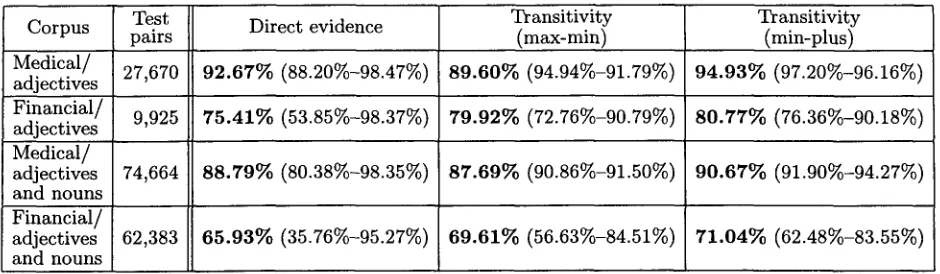
Table 1: Accuracy of direct-evidence and transitivity methods on different data strata of our test corpora. In each case, overall accuracy is listed first in bold, and then, in parentheses, the percentage of the test pairs t h a t the m e t h o d has an opinion for (rather t h a n randomly assign a decision because of lack of evidence) and the accuracy of the m e t h o d within t h a t subset of test cases.
times as B -< A, no prediction m e t h o d can get all those instances correct. We elected to follow this evaluation approach, which lowers the ap- parent scores of our method, rather t h a n forcing each pair in the test corpus to one unambiguous category (A -< B, B -< A, or arbitrary).
Under this evaluation m e t h o d , stage one of our system achieves on adjectives in the medi- cal domain 98.47% correct decisions on pairs for which a determination of order could be made. Since 11.80% of the total pairs in the test corpus involve previously unseen combinations of ad- jectives a n d / o r new adjectives, the overall accu- racy is 92.67%. T h e corresponding accuracy on d a t a for which we can make a prediction and the overall accuracy is 98.35% and 88.79% for adjec- tives plus nouns in the medical domain, 98.37% and 75.41% for adjectives in the W S J data, and 95.27% and 65.93% for adjectives plus nouns in the W S J data. Note t h a t the W S J corpus is considerably more sparse, with 64.24% unseen combinations of adjective and n o u n premodi- tiers in the test part. Using lower thresholds in equation (2) results in a lower percentage of cases for which the system has an opinion b u t a higher accuracy for those decisions. For exam- ple, a threshold of 25% results in the ability to predict 83.72% of the test adjective pairs in the medical corpus with 99.01% accuracy for these c a s e s .
We subsequently applied the transitivity stage, testing the three semiring models dis- cussed in Section 3.2. Early experimentation indicated that the or-and model performed
poorly, which we attribute to the extensive propagation of decisions (once a decision in fa- vor of the existence of an ordering relationship is made, it cannot be revised even in the presence of conflicting evidence). Therefore we report re- sults below for the other two semiring models. Of those, the min-plus semiring achieved higher performance. T h a t model offers additional pre- dictions for 9.00% of adjective pairs and 11.52% of adjective-plus-noun pairs in t h e medical cor- pus, raising overall accuracy of our predictions to 94.93% and 90.67% respectively. Overall ac- curacy in the W S J test d a t a was 80.77% for ad- jectives and 71.04% for adjectives plus nouns. Table 1 summarizes the results of these two stages.
[image:6.612.77.547.73.210.2]The clustering technique makes ordering pre- dictions for a part of the remaining pairs--on average, depending on how many clusters are created, this method produces answers for 80% of the ordering cases that remained unanswered after the first two stages in the medical corpus, and for 54% of the unanswered cases in the WSJ corpus. Its accuracy on these predictions is 56% on the medical corpus, and slightly worse than the baseline 50% on the WSJ corpus; this lat- ter, aberrant result is due to a single, very fie- quent pair,
chief executive,
in whichexecutive
is consistently mistagged as an adjective by the part-of-speech tagger.Qualitative analysis of the third stage's out- put indicates that it identifies many interest- ing relationships between premodifiers; for ex- ample, the pair of most similar premodifiers on the basis of positional information is
left
andright,
which clearly fall in a class similar to the semantic classes manually constructed by lin- guists. Other sets of adjectives with strongly similar members include{mild, severe, signifi-
cant}
and{cardiac, pulmonary, respiratory}.
We conclude our empirical analysis by test- ing whether a separate model is needed for pre- dicting adjective order in each different domain. We trained the first two stages of our system on the medical corpus and tested them on the WSJ corpus, obtaining an overall prediction ac- curacy of 54% for adjectives and 52% for adjec- rives plus nouns. Similar results were obtained when we trained on the financial domain and tested on medical data (58% and 56%). These results are not much better than what would have been obtained by chance, and are clearly inferior to those reported in Table 1. Although the two corpora share a large number of ad- jectives (1,438 out of 5,703 total adjectives in the medical corpus and 8,240 in the WSJ cor- pus), they share only 2 to 5% of the adjective
pairs.
This empirical evidence indicates that ad- jectives are used differently in the two domains, and hence domain-specific probabilities must be estimated, which increases the value of an au- tomated procedure for the prediction task.6 U s i n g O r d e r e d P r e m o d i f i e r s i n T e x t G e n e r a t i o n
Extracting sequential ordering information of premodifiers is an off-line process, the results of
(a) "John is a diabetic male white 74- year-old hypertensive patient with a red swollen mass in the left groin."
(b) "John is a 74-year-old
hypertensive diabetic white male patient with a swollen red mass in the left groin."
Figure 1: (a) Output of the generator without our ordering module, containing several errors. (b) Output of the generator with our ordering module.
which can be easily incorporated into the over- all generation architecture. We have integrated the function
compute_order(A, B)
into our mul- timedia presentation system M A G I C [Dalaiet
al.
1996] in the medical domain and resolved numerous premodifier ordering tasks correctly. Example cases where the statistical prediction module was helpful in producing a more fluent description in MAGIC include placing age infor- mation before ethnicity information and the lat- ter before gender information, as well as spe- cific ordering preferences, such as "thick" before "yellow" and "acute" before "severe". MAGIC'Soutput is being evaluated by medical doctors, who provide us with feedback on different com- ponents of the system, including the fluency of t h e generated text and its similarity to human-
produced reports.
ator with and without the ordering component.
7 C o n c l u s i o n s a n d F u t u r e W o r k
We have presented three techniques for explor- ing prior corpus evidence in predicting the order of premodifiers within noun phrases. Our meth- ods expand on observable data, by inferring new relationships between premodifiers even for combinations of premodifiers that do not occur in the training corpus. We have empirically val- idated our approach, showing that we can pre- dict order with more than 94% accuracy when enough corpus data is available. We have also implemented our procedure in a text generator, producing more fluent output sentences.
We are currently exploring alternative ways to integrate the classes constructed by the third stage of our system into our generator. In the future, we will experiment with semantic (rather than positional) clustering of premodi- tiers, using techniques such as those proposed in [Hatzivassiloglou and McKeown 1993; Pereira et al. 1993]. The qualitative analysis of the output of our clustering module shows that frequently positional and semantic classes overlap, and we are interested in measuring the extent of this phenomenon quantitatively. Conditioning the premodifier ordering on the head noun is an- other promising approach, at least for very fre- quent nouns.
8 A c k n o w l e d g m e n t s
We are grateful to Kathy McKeown for numer- ous discussions during the development of this work. The research is supported in part by the National Library of Medicine under grant R01-LM06593-01 and the Columbia University Center for Advanced Technology in High Per- formance Computing and Communications in Healthcaxe (funded by the New York State Sci- ence and Technology Foundation). Any opin- ions, findings, or recommendations expressed in this paper are those of the authors and do not necessarily reflect the views of the above agen- cies.
R e f e r e n c e s
Alfred V. Aho, John E. Hopcroft, and Jeffrey D. Ullman. The Design and Analysis of Com-
puter Algorithms. Addison-Wesley, Reading, Massachusetts, 1974.
Carl Bache: The Order of Premodifying Adjec- tives in Present-Day English. Odense Univer- sity Press, 1978.
John A. Bateman; Thomas Kamps, Jorg Kleinz, and Klaus Reichenberger. Communicative Goal-Driven NL Generation and Data-Driven Graphics Generation: An ArchitecturM Syn- thesis for Multimedia Page Generation. In Proceedings of the 9th International Work- shop on Natural Language Generation., pages 8-17, 1998.
Eric Brill. A Simple Rule-Based Part of Speech Tagger. In Proceedings of the Third Confer- ence on Applied Natural Language Process- ing, Trento, Italy, 1992. Association for Com- putational Linguistics.
Mukesh Dalal, Steven K. Feiner, Kathleen R. McKeown, Desmond A. Jordan, Barry Allen, and Yasser al Safadi. MAGIC: An Exper- imental System for Generating Multimedia Briefings about Post-Bypass Patient Status. In Proceedings of the 1996 Annual Fall Sym- posium of the American Medical Informat- ics Association (AMIA-96), pages 684-688, Washington, D.C., October 26-30 1996. R. M. W. Dixon. Where Have All the Adjectives
Gone? Mouton, New York, 1982.
William Frawley. Linguistic Semantics. Lawrence Erlbaum Associates, Hillsdale, New Jersey, 1992.
D. L. Goyvaerts. An Introductory Study on the Ordering of a String of Adjectives in Present- Day English. Philologica Pragensia, 11:12- 28, 1968.
Ralph Grishman, Catherine Macleod, and Adam Meyers. COMLEX Syntax: Building a Computational Lexicon. In Proceedings of the 15th International Conference on Com- putational Linguistics (COLING-9~), Kyoto, Japan, 1994.
182, Columbus, Ohio, June 1993. Association for Computational Linguistics.
Vasileios Hatzivassiloglou and Kathleen McKe. own. Predicting the Semantic Orientation of Adjectives. In
Proceedings of the 35th Annual
Meeting of the A CL,
pages 174-181, Madrid, Spain, July 1997. Association for Computa- tional Linguistics.J o h n S. Justeson a n d Slava M . Katz. Co- occurrences of A n t o n y m o u s Adjectives a n d
Their Contexts.
Computational Linguistics,
17(1):1-19, 1991.
J. A. W. Kamp. Two Theories of Adjectives. In E. L. Keenan, editor,
Formal Semantics
of Natural Language.
Cambridge University Press, Cambridge, England, 1975.Maurice G. Kendall. A New Measure of Rank Correlation.
Biometrika,
30(1-2):81- 93, June 1938.Kevin Knight and Vasileios Hatzivassiloglou. Two-Level, Many-Paths Generation. In
Pro-
ceedings of the 33rd Annual Meeting of the
A CL,
pages 252-260, Boston, Massachusetts, June 1995. Association for Computational Linguistics.Irene Langkilde and Kevin Knight. Genera- tion that Exploits Corpus-Based Statistical Knowledge. In
Proceedings of the 36th An-
nual Meeting of the A CL and the 17th Inter-
national Conference on Computational Lin-
guistics (ACL//COLING-98),
pages 704-710, Montreal, Canada, 1998.Yakov Malkiel. Studies in Irreversible Bino- mials.
Lingua,
8(2):113-160, May 1959. Reprinted in [Malkiel 1968].Yakov Malkiel.
Essays on Linguistic Themes.
Blackwell, Oxford, 1968.
Mitchell P. Marcus, Beatrice Santorini, and Mary Ann Marcinkiewicz. Building a large annotated corpus of English: The Penn Tree- bank.
Computational Linguistics,
19:313- 330, 1993.J. E. Martin. Adjective Order and Juncture.
Journal of Verbal Learning and Verbal Behav-
ior,
9:379-384, 1970.George A. Miller, Richard Beckwith, Christiane Fellbaum, Derek Gross, and Katherine J.
Miller. Introduction to WordNet: An On- Line LexicM Database.
International Journal
of Lexicography (special issue),
3(4):235-312, 1990.Fernando C. N. Pereira and Michael D. Ri- ley. Speech Recognition by Composition of Weighted Finite Automata. In Emmanuel Roche and Yves Schabes, editors,
Finite-
State Language Processing,
pages 431-453. MIT Press, Cambridge, Massachusetts, 1997. Fernando Pereira, Naftali Tishby, and Lillian Lee. Distributional Clustering of English Words. InProceedings of the 31st Annual
Meeting of the ACL,
pages 183-190, Colum- bus, Ohio, June 1993. Association for Com- putational Linguistics.Randolph Quirk and Sidney Greenbaum. A
Concise Grammar of Contemporary English.
Harcourt Brace Jovanovich, Inc., London, 1973.
Jeffrey C. Reynar and Adwait Ratnaparkhi. A Maximum Entropy Approach to Identifying Sentence Boundaries. In
Proc. of the 5th Ap-
plied Natural Language Conference (ANLP-
97),
Washington, D.C., April 1997.James Shaw. Clause Aggregation Using Lin- guistic Knowledge. In
Proceedings of the 9th
International Workshop on Natural Language
Generation.,
pages 138-147, 1998.James Shaw. Segregatory Coordination and El- lipsis in Text Generation. In
Proceedings of
the 36th Annual Meeting of the ACL and the
17th International Conference on Computa-
tional Linguistics (A CL/COLING-98),
pages 1220-1226, Montreal, Canada, 1998.Helmuth Sp~th.
Cluster Dissection and Anal-
ysis: Theory, FORTRAN Programs, Exam-
ples.
Ellis Horwood, Chichester, England,1985.
J. Teyssier. Notes on the Syntax of the Adjec- tive in Modern English.
Behavioral Science,
20:225-249, 1968.
Zeno Vendler.
Adjectives and Nominalizations.
Mouton and Co., The Netherlands, 1968. Benjamin Lee Whorf.