A Sense-Based Translation Model for Statistical Machine Translation
Deyi Xiong and Min Zhang∗
Provincial Key Laboratory for Computer Information Processing Technology Soochow University, Suzhou, China 215006
{dyxiong, minzhang}@suda.edu.cn
Abstract
The sense in which a word is used deter-mines the translation of the word. In this paper, we propose a sense-based transla-tion model to integrate word senses into statistical machine translation. We build a broad-coverage sense tagger based on a nonparametric Bayesian topic model that automatically learns sense clusters for words in the source language. The pro-posed sense-based translation model en-ables the decoder to select appropriate translations for source words according to the inferred senses for these words us-ing maximum entropy classifiers. Our method is significantly different from pre-vious word sense disambiguation reformu-lated for machine translation in that the lat-ter neglects word senses in nature. We test the effectiveness of the proposed sense-based translation model on a large-scale Chinese-to-English translation task. Re-sults show that the proposed model sub-stantially outperforms not only the base-line but also the previous reformulated word sense disambiguation.
1 Introduction
One of very common phenomena in language is that a plenty of words have multiple meanings. In the context of machine translation, such dif-ferent meanings normally produce difdif-ferent target translations. Therefore a natural assumption is that word sense disambiguation (WSD) may contribute to statistical machine translation (SMT) by provid-ing appropriate word senses for target translation selection with context features (Carpuat and Wu, 2005).
∗Corresponding author
This assumption, however, has not been em-pirically verified in the early days. Carpuat and Wu (2005) adopt a standard formulation of WSD: predicting word senses that are defined on an ontology for ambiguous words. As they apply WSD to Chinese-to-English translation, they pre-dict word senses from a Chinese ontology HowNet and project the predicted senses to English glosses provided by HowNet. These glosses, used as the sense predictions of their WSD system, are inte-grated into a word-based SMT system either to substitute for translation candidates of their trans-lation model or to postedit the output of their SMT system. They report that WSD degenerates the translation quality of SMT.
In contrast to the standard WSD formulation, Vickrey et al. (2005) reformulate the task of WSD for SMT as predicting possible target translations rather than senses for ambiguous source words. They show that such a reformulated WSD can im-prove the accuracy of a simplified word translation task.
Following this WSD reformulation for SMT, Chan et al. (2007) integrate a state-of-the-art WSD system into a hierarchical phrase-based sys-tem (Chiang, 2005). Carpuat and Wu (2007) also use this reformulated WSD and further adapt it to multi-word phrasal disambiguation. They both re-port that the redefined WSD can significantly im-prove SMT.
Although this reformulated WSD has proved helpful for SMT, one question is not answered yet: are pure word senses useful for SMT? The early WSD for SMT (Carpuat and Wu, 2005) uses projected word senses while the reformu-lated WSD sidesteps word senses. In this pa-per we would like to re-investigate this question by resorting to word sense induction (WSI) that is related to but different from WSD.1 We use
1We will discuss the relation and difference between WSI and WSD in Section 2.
WSI to obtain word senses for large-scale data. With these word senses, we study in particular: 1) whether word senses can be directly integrated to SMT to improve translation quality and 2) whether WSI-based model can outperform the reformu-lated WSD in the context of SMT.
In order to incorporate word senses into SMT, we propose a sense-based translation model that is built on maximum entropy classifiers. We use a nonparametric Bayesian topic model based WSI to infer word senses for source words in our training, development and test set. We collect training in-stances from the sense-tagged training data to train the proposed sense-based translation model. Spe-cially,
• Instead of predicting target translations for ambiguous source words as the previous re-formulated WSD does, we first predict word senses for ambiguous source words. The pre-dicted word senses together with other con-text features are then used to predict possible target translations for these words.
• Instead of using word senses defined by a prespecified sense inventory as the standard WSD does, we incorporate word senses that are automatically learned from data into our sense-based translation model.
We integrate the proposed sense-based transla-tion model into a state-of-the-art SMT system and conduct experiments on Chines-to-English trans-lation using large-scale training data. Results show that automatically learned word senses are able to improve translation quality and the sense-based translation model is better than the previous reformulated WSD.
The remainder of this paper proceeds as fol-lows. Section 2 introduces how we obtain word senses for our large-scale training data via a WSI-based broad-coverage sense tagger. Section 3 presents our sense-based translation model. Sec-tion 4 describes how we integrate the sense-based translation model into SMT. Section 5 elaborates our experiments on the large-scale Chinese-to-English translation task. Section 6 introduces re-lated studies and highlights significant differences from them. Finally, we conclude in Section 7 with future directions.
2 WSI-Based Broad-Coverage Sense Tagger
In order to obtain word senses for any source words, we build a broad-coverage sense tagger that relies on the nonparametric Bayesian model based word sense induction. We first describe WSI, especially WSI based on the Hierarchical Dirichlet Process (HDP) (Teh et al., 2004), a non-parametric version of Latent Dirichlet Allocation (LDA) (Blei et al., 2003). We then elaborate how we use the HDP-based WSI to predict sense clus-ters and to annotate source words in our train-ing/development/test sets with these sense clus-ters.
2.1 Word Sense Induction
Before we introduce WSI, we differentiateword type fromword token. A word type refers to a unique word as a vocabulary entry while a word token is an occurrence of a word type. Take the first sentence of this paragraph as an example, it has 11 word tokens but 9 word types as there are two word tokens of the word type “we” and two tokens of the word type “word”.
Word sense induction is a task of automatically inducing the underlying senses of word tokens given the surrounding contexts where the word tokens occur. The biggest difference from word sense disambiguation lies in that WSI does not rely on a predefined sense inventory. Such a pre-specified list of senses is normally assumed by WSD which predicts senses of word tokens using this given inventory. From this perspective, WSI can be treated as a clustering problem while WSD a classification one.
Various clustering algorithms, such ask-means, have been previously used for WSI. Recently, we have also witnessed that WSI is cast as a topic modeling problem where the sense clusters of a word type are considered as underlying topics (Brody and Lapata, 2009; Yao and Durme, 2011; Lau et al., 2012). We follow this line to tailor a topic modeling framework to induce word senses for our large-scale training data.
In the topic-based WSI, surrounding context of a word token is considered as apseudo document
document as±N neighboring words centered on a given word token. Table 1 shows examples of pseudo documents for a Chinese word “wǎngluò” (network). These two pseudo documents are ex-tracted from a sentence listed in the first row of Ta-ble 1. Here we setN = 5. We can extract as many pseudo documents as the number of word tokens of a given word type that occur in training data. The collection of all these extracted pseudo docu-ments of the given word type forms a corpus. We can induce topics on this corpus for each pseudo document via topic modeling approaches.
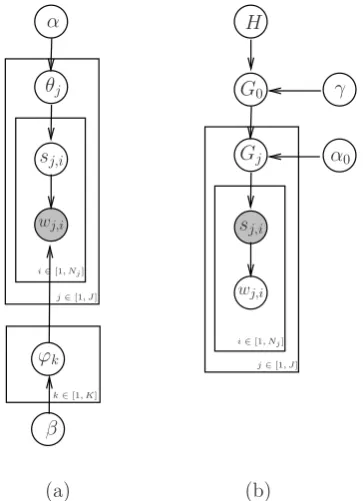
Figure 1(a) shows the LDA-based WSI for a given word type W. The outer plate represents replicates of pseudo documents which consist of N neighboring words centered on the tokens of the given word type W. wj,i is thei-th word of
thej-th pseudo document of the given word type W. sj,i is the sense assigned to the word wj,i.
The conventional topic distribution θj for the j
-th pseudo document is taken as -the -the distribu-tion over senses for the given word typeW. The LDA generative process for sense induction is as follows: 1) for each pseudo documentDj, draw a
per-document sense distributionθj from a
Dirich-let distribution Dir(α); 2) for each itemwj,iin the
pseudo document Dj, 2.1) draw a sense cluster
sj,i ∼ Multinomial(θj); and 2.2) draw a word
wj,i ∼ φsj,i where φsj,i is the distribution of
sensesj,i over words drawn from a Dirichlet
dis-tribution Dir(β).
As LDA needs to manually specify the num-ber of senses (topics), a better idea is to let the training data automatically determine the number of senses for each word type. Therefore we re-sort to the HDP, a natural nonparametric gener-alization of LDA, for the inference of both sense clusters and the number of sense clusters follow-ing Lau et al. (2012) and Yao and Durme (2011). The HDP for WSI is shown in Figure 1(b). The HDP generative process for word sense induction is as follows: 1) sample a base distribution G0
from a Dirichlet process DP(γ, H) with a con-centration parameterγ and a base distributionH; 2) for each pseudo document Dj, sample a
dis-tribution Gj ∼ DP(α0, G0); 3) for each item
wj,i in the pseudo document Dj, 3.1) sample a
sense clustersj,i ∼ Gj; and 3.2) sample a word
wj,i ∼ φsj,i. Here G0 is a global distribution
over sense clusters that are shared by allGj.Gjis
a per-document sense distribution over these sense
wj,i
α
θj
sj,i
j∈[1, J]
ϕk
k∈[1, K]
β
G0
Gj
sj,i
j∈[1, J] wj,i
H
γ
α0
(a) (b)
i∈[1, Nj]
[image:3.595.309.491.65.316.2]i∈[1, Nj]
Figure 1: Graphical model representations of (a) Latent Dirichlet Allocation for WSI, (b) Hierar-chical Dirichlet Process for WSI.
clusters, which has its own document-specific pro-portions of these sense clusters. The hyperparam-eterγ, α0 in the HDP are both concentration
pa-rameters which control the variability of senses in the global distribution G0 and document-specific
distributionGj.
The HDP/LDA-based WSI complies with the distributional hypothesis that states that words oc-curring in the same contexts tend to have similar meanings. We want to extend this hypothesis to machine translation by building sense-based trans-lation model upon the HDP-based word sense in-duction: words with the same meanings tend to be translated in the same way.
2.2 Word Sense Tagging
We adopt the HDP-based WSI to automatically predict word senses and use these predicted senses to annotate source words. We individually build a HDP-based WSI model per word type and train these models on the training data. The sense for a word token is defined as the most probable sense according to the per-document sense distribution Gj estimated for the corresponding pseudo
tātíxǐng wǒguówǎngluòyùnyíng zhězhùyìfángfàn hēikègōngjī ,quèbǎo wǎngluò ānquán。 Pseudo Documents for word “wǎngluò”
tātíxǐng wǒguówǎngluòyùnyíng zhězhùyìfángfàn hēikè fángfàn hēikègōngjī ,quèbǎo wǎngluò ānquán。
Table 1: Examples of pseudo documents extracted from a Chinese sentence (written in Chinese Pinyin).
• Data preprocessing We preprocess the source side of our bilingual training data as well as development and test set by removing stop words and rare words.
• Training Data Sense Annotation From the preprocessed training data, we extract all possible pseudo documents for each source word type. The collection of these extracted pseudo documents is used as a corpus to train a HDP-based WSI model for the source word type. In this way, we can train as many HDP-based WSI models as the number of word types kept after preprocessing. The sense with the highest probability output by the HDP-based WSI model for each pseudo doc-ument is used as the sense cluster to label the corresponding word token.
• Test/Dev Data Sense AnnotationFrom the preprocessed test data, we can also extract pseudo documents for each source word type that occur in the test/dev set. Using the trained HDP-based WSI model that corre-spond to the source word type in question, we can obtain the best sense assignment for each pseudo document of the word type, which in turn is used to annotate the corresponding word token in the test/dev data.
3 Sense-Based Translation Model
In this section we present our sense-based transla-tion model and describe the features that we use as well as the training process of this model.
3.1 Model
The sense-based translation model estimates the probability that a source wordcis translated into a target phrase ˜e given contextual information, in-cluding word senses that are obtained using the HDP-based WSI as described in the last section. We allow the target phrase˜eto be either a phrase of length up to 3 words or NULL so that we can capture both multi-word and null translations. The essential component of the model is a maximum
entropy (MaxEnt) based classifier that is used to predict the translation probabilityp(˜e|C(c)). The MaxEnt classifier can be formulated as follows.
p(˜e|C(c)) = exp(
∑
iθihi(˜e,C(c))) ∑
˜
e′exp(∑iθihi(˜e′,C(c))) (1)
where his are binary features, θis are weights of
these features,C(c) is the surrounding context of c.
We define two groups of binary features: 1) lex-icon featuresand 2)sense features. All these fea-tures take the following form.
h(˜e,C(c)) =
{
1, if˜e=2andC(c).µ=ν
0, else
(2) where 2 is a placeholder for a possible target translation (up to 3 words or NULL),µis the name of a contextual (lexicon or sense) feature for the source word c, and the symbol ν represents the value of the featureµ.
We extract both the lexicon and sense features from a±k-word window centered on the wordc. The lexicon features are defined as the preceding kwords, the succeedingk words and the wordc itself: {c−k, ..., c−1, c, c1, ..., ck}. The sense
fea-tures are defined as the predicted senses for these words:{sc−k, ..., sc−1, sc, sc1, ..., sck}.
in Section 5. One model only uses the lexicon fea-tures while the other integrates both the lexicon and sense features. The former model can be con-sidered as a reformulated WSD for SMT as we de-scribed in Section 1.
Given a source sentence {ci}I1, the proposed
sense-based translation modelMs can be denoted
as
Ms= ∏
ci∈W
( ˜ei|C(ci)) (3)
where W is a set of words for which we build MaxEnt classifiers (see the next subsection for the discussion on how we build MaxEnt classifiers for our sense-based translation model).
3.2 Training
The training of the proposed sense-based transla-tion model is a process of estimating the feature weights θs in the equation (1). There are two strategies that we can use to obtain these weights. We can either build an all-in-one MaxEnt clas-sifier that integrates all source word types c and their possible target translationse˜or build multi-ple MaxEnt classifiers. If we train the all-in-one classifier, we have to predict millions of classes (target translations of length up to 3 words). This is normally intractable in practice. Therefore we take the second strategy: building multiple Max-Ent classifiers with one classifier per source word type.
In order to train these classifiers, we have to col-lect training events from our word-aligned bilin-gual training data where source words are anno-tated with their corresponding sense clusters pre-dicted by the HDP-based WSI as described in Section 2. A training event for a source word c consists of all contextual elements in the form of
C(c).µ =ν defined in the last subsection and the target translatione˜. Using these collected events, we can train our multiple classifiers. In prac-tice, we do not build MaxEnt classifiers for source words that occur less than 10 times in the train-ing data and run the MaxEnt toolkit in a parallel manner in order to expedite the training process.
4 Decoding with Sense-Based Translation Model
The sense-based translation model described above is integrated into the log-linear translation model of SMT as a sense-based knowledge source. The weight of this model is tuned by the minimum
source sentences
HDP-based WSI
sense-tagged source sentences
MaxEnt classifiers
sense-based translation model decoder
target sentences other
[image:5.595.306.525.63.233.2]models
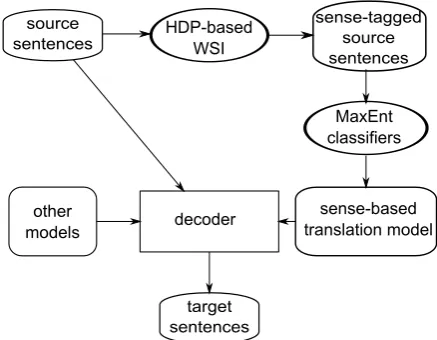
Figure 2: Architecture of SMT system with the sense-based translation model.
error rate training (MERT) (Och, 2003) together with other models such as the language model.
Figure 2 shows the architecture of the SMT system enhanced with the sense-based translation model. Before we translate a source sentence, we use the HDP-based WSI models trained on the training data to predict senses for word tokens oc-curring in the source sentence as discussed in Sec-tion 2.2. Note that the HDP-based WSI does not predict senses for all words due to the following two reasons.
• We do not train HDP-based WSI models for word types for which we extract more thanT pseudo documents.2
• In the test/dev set, there are some words that are unseen in the training data. These un-seen words, of course, do not have their HDP-based WSI models.
For these words, we set a default sense (i.e. sc =
s1).
Sense tagging on test sentences can be done in a preprocessing step. Once we get sense clus-ters for word tokens in test sentences, we load pre-trained MaxEnt classifiers of the correspond-ing word types. Durcorrespond-ing decodcorrespond-ing, we keep word alignments for each translation rule. Whenever a new source wordcis translated, we find its trans-lation e˜via the kept word alignments. We then calculate the translation probabilityp(˜e|C(c)) ac-cording to the equation (1) using the correspond-ing loaded classifier. In this way, we can easily calculate the sense-based translation model score.
5 Experiments
In this section, we carried out a series of ex-periments on Chinese-to-English translation us-ing large-scale bilus-ingual trainus-ing data. In order to build the proposed sense-based translation model, we annotated the source part of the bilingual train-ing data with word senses induced by the HDP-based WSI. With the trained sense-HDP-based transla-tion model, we would like to investigate the fol-lowing two questions:
• Do word senses automatically induced by the HDP-based WSI improve translation quality?
• Does the sense-based translation model out-perform the reformulated WSD for SMT?
5.1 Setup
Our baseline system is a state-of-the-art SMT system which adapts Bracketing Transduction Grammars (Wu, 1997) to phrasal translation and equips itself with a maximum entropy based reordering model (Xiong et al., 2006). We used LDC corpora LDC2004E12, LDC2004T08, LDC2005T10, LDC2003E14, LDC2002E18, LDC2005T06, LDC2003E07, LDC2004T07 as our bilingual training data which consists of 3.84M bilingual sentences, 109.5M English word tokens and 96.9M Chinese word tokens. We ran Giza++ on the training data in two directions and applied the “grow-diag-final” refinement rule (Koehn et al., 2003) to obtain word align-ments. From the word-aligned data, we extracted weighted phrase pairs to generate our phrase table. We trained a 5-gram language model on the Xinhua section of the English Gigaword corpus (306 million words) using the SRILM toolkit (Stolcke, 2002) with the modified Kneser-Ney smoothing (Chen and Goodman, 1996).
We trained our HDP-based WSI models via the C++ HDP toolkit3 (Wang and Blei, 2012). We set the hyperparameters γ = 0.1 and α0 = 1.0
following Lau et al. (2012).We extracted pseudo documents from a±10-word window centered on the corresponding word token for each word type following Brody and Lapata (2009). As described in Section 2.2, we preprocessed the source part of our bilingual training data by removing stop words and infrequent words that occurs less than
3http://www.cs.cmu.edu/˜chongw/ resource.html
Training Test
# Word Types 67,723 4,348
# Total Pseudo Documents 27.73M 11,777 # Avg Pseudo Documents 427.79 2.71 # Total Senses 271,770 24,162
[image:6.595.310.527.62.149.2]# Avg Senses 4.01 5.56
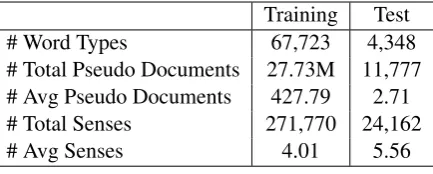
Table 2: Statistics of the HDP-based word sense induction on the training and test data.
10 times in the training data. From the prepro-cessed data, we extracted pseudo documents for each word type to train a HDP-based WSI model per word type. Note that we do not build WSI models for highly frequent words that occur more than 20,000 times in order to expedite the HDP training process.
We trained our MaxEnt classifiers with the off-the-shelf MaxEnt tool.4 We performed 100 iter-ations of the L-BFGS algorithm implemented in the training toolkit on the collected training events from the sense-annotated data as described in Sec-tion 3.2. We set the Gaussian prior to 1 to avoid overfitting. On average, we obtained 346 classes (target translations) per source word type with the maximum number of classes being 256,243. It took an average of 57.5 seconds for training a Maxent classifier.
We used the NIST MT03 evaluation test data as our development set, and the NIST MT05 as the test set. We evaluated translation quality with the case-insensitive BLEU-4 (Papineni et al., 2002) and NIST (Doddington, 2002). In order to al-leviate the impact of MERT (Och, 2003) insta-bility, we followed the suggestion of Clark et al. (2011) to run MERT three times and report aver-age BLEU/NIST scores over the three runs for all our experiments.
5.2 Statistics and Examples of Word Senses
Before we present our experiment results of the sense-based translation model, we study some statistics of the HDP-based WSI on the training and test data. We show these statistics in Table 2. There are 67,723 and 4,348 unique word types in the training and test data after the preprocessing step. For these word types, we extract 27.73M and 11,777 pseudo documents from the training and test set respectively. On average, there are 427.79
System BLEU(%) NIST STM (±5w) 34.64 9.4346 STM (±10w) 34.76 9.5114
STM (±15w) -
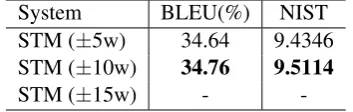
-Table 4: Experiment results of the sense-based translation model (STM) with lexicon and sense features extracted from a window of size varying from±5 to±15 words on the development set.
pseudo documents per word type in the training data and 2.71 in the test set. The HDP-based WSI learns 271,770 word senses in total using the pseudo documents collected from the training data and infers 24,162 word senses using the pseudo documents extracted from the test set. There are 4.01 different senses per word type in the training data and 5.56 in the test set on average.
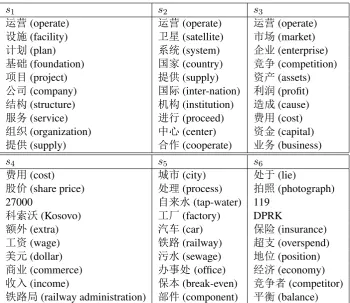
Table 3 illustrates six different senses of the word “运营(operate)” learned by the HDP-based WSI in the training data. We also show the most probable 10 words for each sense cluster. Senses1
represents the operations of company or organi-zation, sense s2 denotes
country/institution/inter-nation operations, senses3refers to market
opera-tions, senses4corresponds to business operations,
sense s5 to public facility operations, and finally
s6to economy operations.
5.3 Impact of Window Sizekused in MaxEnt Classifiers
Our first group of experiments were conducted to investigate the impact of the window size k on translation performance in terms of BLEU/NIST on the development set. We extracted both the lex-icon and sense features from a±k-word window for our MaxEnt classifiers. We varied k from 5 to 15. Experiment results are shown in Table 4. We achieve the best performance when k = 10. This suggests that a±10-word window context is sufficient for predicting target translations for am-biguous source words. We therefore set k = 10
for all experiments thereafter.
5.4 Effect of the Sense-Based Translation Model
Our second group of experiments were carried out to investigate whether the sense-base translation model is able to improve translation quality by comparing the system enhanced with our sense-based translation model against the baseline. We also studied the impact of word senses induced by
System BLEU(%) NIST
Base 33.53 9.0561
STM (sense) 34.15 9.2596
[image:7.595.309.522.62.118.2]STM (sense+lexicon) 34.73 9.4184 Table 5: Experiment results of the sense-based translation model (STM) against the baseline.
System BLEU(%) NIST
Base 33.53 9.0561
Reformulated WSD 34.16 9.3820
[image:7.595.93.270.63.119.2]STM 34.73 9.4184
Table 6: Comparison results of the sense-based translation model vs. the reformulated WSD for SMT.
the HDP-based WSI on translation performance by enforcing the sense-based translation model to use only sense features. Table 5 shows the experi-ment results. From the table, we can observe that
• Our sense-based translation model achieves a substantial improvement of 1.2 BLEU points over the baseline. This indicates that the sense-based translation model is able to help select correct translations for ambiguous source words.
• If we only integrate sense features into the sense-based translation model, we can still outperform the baseline by 0.62 BLEU points. This suggests that automatically in-duced word senses alone are indeed useful for machine translation.
5.5 Comparison to Word Sense Disambiguation
As we mentioned in Section 3.1, our sense-based translation model can be degenerated to a reformu-lated WSD model for SMT if we only use lexicon features in MaxEnt classifiers. This allows us to directly compare our method against the reformu-lated WSD for SMT. Table 6 shows the compari-son result.
[image:7.595.318.516.163.220.2]s1 s2 s3
运营(operate) 运营(operate) 运营(operate)
设施(facility) 卫星(satellite) 市场(market)
计划(plan) 系统(system) 企业(enterprise)
基础(foundation) 国家(country) 竞争(competition)
项目(project) 提供(supply) 资产(assets)
公司(company) 国际(inter-nation) 利润(profit) 结构(structure) 机构(institution) 造成(cause)
服务(service) 进行(proceed) 费用(cost)
组织(organization) 中心(center) 资金(capital) 提供(supply) 合作(cooperate) 业务(business)
s4 s5 s6
费用(cost) 城市(city) 处于(lie)
股价(share price) 处理(process) 拍照(photograph)
27000 自来水(tap-water) 119
科索沃(Kosovo) 工厂(factory) DPRK
额外(extra) 汽车(car) 保险(insurance)
工资(wage) 铁路(railway) 超支(overspend)
美元(dollar) 污水(sewage) 地位(position)
商业(commerce) 办事处(office) 经济(economy)
[image:8.595.124.475.60.363.2]收入(income) 保本(break-even) 竞争者(competitor) 铁路局(railway administration) 部件(component) 平衡(balance)
Table 3: Six different senses learned for the word “运营” from the training data.
the sense features used in our model do provide new information that can not be obtained by the lexicon features.
6 Related Work
In this section we introduce previous studies that are related to our work. For ease of comparison, we roughly divide them into 4 categories: 1) WSD for SMT, 2) topic-based WSI, 3) topic model for SMT and 4) lexical selection.
WSD for SMT As we mentioned in Section 1, WSD has been successfully reformulated and adapted to SMT (Vickrey et al., 2005; Carpuat and Wu, 2007; Chan et al., 2007). Rather than predict-ing word senses for ambiguous words, the refor-mulated WSD directly predicts target translations for source words with context information. Our sense-based translation model also predicts target translations for SMT. The significant difference is that we predict word senses automatically learned from data and incorporate these predicted senses into SMT. Our experiments show that such word senses are able to improve translation quality.
Topic-based WSI Topic-based WSI can be considered as the foundation of our work as we use it to obtain broad-coverage word senses to
an-notate our large-scale training data. Brody and La-pata (2009)’s work is the first attempt to approach WSI via topic modeling. They adapt LDA to word sense induction by building one topic model per word type. According to them, there are 3 sig-nificant differences between topic-based WSI and generic topic modeling.
• First, the goal of topic-based WSI is to di-vide contexts of a word type into different categories, each representing a sense cluster. However generic topic models aim at topic distributions of documents.
• Second, generic topic modeling explores whole documents for topic inference while topic-based WSI uses much smaller units in a document (e.g., surrounding words of a tar-get word) for word sense induction.
• Finally, the number of induced word senses in WSI is usually less than 10 while the num-ber of inferred topics in generic topic model-ing is tens or hundreds.
determining the number of senses for each word type according to training data. Lau et al. (2012) adopt the HDP-based WSI for novel sense de-tection and empirically show that the HDP-based WSI is better than the LDA-based WSI. We follow them to set the hyperparameters of HDP for train-ing and incorporate automatically induced word senses into SMT in our work.
Topic model for SMT Generic topic models are also explored for SMT. Zhao and Xing (2007) propose a bilingual topic model and integrate a topic-specific lexicon translation model into SMT. Tam et al. (2007) also explore a bilingual topic model for translation and language model adapta-tion. Foster and Kunh (2007) introduce a mixture model approach for translation model adaptation. Xiao et al. (2012) propose a topic-based similar-ity model for rule selection in hierarchical phrase-based translation. Xiong and Zhang (2013) em-ploy a sentence-level topic model to capture co-herence for document-level machine translation. The difference between our work and these pre-vious studies on topic model for SMT lies in that we adopt topic-based WSI to obtain word senses rather than generic topics and integrate induced word senses into machine translation.
Lexical selection Our work is also related to lexical selection in SMT where appropriate target lexical items for source words are selected by a statistical model with context information (Banga-lore et al., 2007; Mauser et al., 2009). The refor-mulated WSD discussed before can also be con-sidered as a lexical selection model. The signif-icant difference from these studies is that we per-form lexical selection using automatically induced word senses by the HDP on the source side.
7 Conclusion
We have presented a sense-based translation model that integrates word senses into machine translation. We capitalize on the broad-coverage word sense induction system that is built on the nonparametric Bayesian HDP to learn sense clus-ters for words in the source language. We gen-erate pseudo documents for word tokens in the training/test data for the HDP-based WSI system to infer topics. The most probable topic inferred for a pseudo document is taken as the sense of the corresponding word token. We incorporate these learned word senses as translation evidences into maximum entropy classifiers which form the
foundation of the proposed sense-based translation model.
We carried out a series of experiments to vali-date the effectiveness of the sense-based transla-tion by comparing the model against the baseline and the previous reformulated WSD. Our experi-ment results show that
• The sense-based translation model is able to substantially improve translation quality in terms of both BLEU and NIST.
• The sense-based translation model is also better than the previous reformulated WSD for SMT.
• Word senses automatically induced by the HDP-based WSI on large-scale training data are very useful for machine translation. To the best of our knowledge, this is the first at-tempt to empirically verify the positive im-pact of word senses on translation quality.
Comparing with macro topics of documents in-ferred by LDA with bag of words from the whole documents, word senses inferred by the HDP-based WSI can be considered as micro topics. In the future, we would like to explore both the micro and macro topics for machine translation. Addi-tionally, we also want to induce sense clusters for words in the target language so that we can build sense-based language model and integrate it into SMT. We would like to investigate whether auto-matically learned senses of proceeding words are helpful for predicting succeeding words.
Acknowledgement
The work was sponsored by the National Natu-ral Science Foundation of China under projects 61373095 and 61333018. We would like to thank three anonymous reviewers for their insightful comments.
References
Adam L. Berger, Stephen A. Della Pietra, and Vincent J. Della Pietra. 1996. A Maximum Entropy Ap-proach to Natural Language Processing. Computa-tional Linguistics, 22(1):39–71.
David M. Blei, Andrew Y. Ng, Michael I. Jordan, and John Lafferty. 2003. Latent Dirichlet Al-location. Journal of Machine Learning Research, 3:993–1022.
Samuel Brody and Mirella Lapata. 2009. Bayesian Word Sense Induction. In Proceedings of the 12th Conference of the European Chapter of the ACL (EACL 2009), pages 103–111, Athens, Greece, March. Association for Computational Linguistics. Marine Carpuat and Dekai Wu. 2005. Word Sense
Disambiguation vs. Statistical Machine Transla-tion. In Proceedings of the 43rd Annual Meet-ing of the Association for Computational LMeet-inguis- Linguis-tics (ACL’05), pages 387–394, Ann Arbor, Michi-gan, June. Association for Computational Linguis-tics.
Marine Carpuat and Dekai Wu. 2007. Improving Statistical Machine Translation Using Word Sense Disambiguation. InProceedings of the 2007 Joint Conference on Empirical Methods in Natural guage Processing and Computational Natural Lan-guage Learning (EMNLP-CoNLL), pages 61–72. Yee Seng Chan, Hwee Tou Ng, and David Chiang.
2007. Word Sense Disambiguation Improves Sta-tistical Machine Translation. InProceedings of the 45th Annual Meeting of the Association of Com-putational Linguistics, pages 33–40, Prague, Czech Republic, June. Association for Computational Lin-guistics.
Stanley F. Chen and Joshua Goodman. 1996. An Empirical Study of Smoothing Techniques for Lan-guage Modeling. In Proceedings of the 34th An-nual Meeting on Association for Computational Lin-guistics, ACL ’96, pages 310–318, Stroudsburg, PA, USA. Association for Computational Linguistics. David Chiang. 2005. A Hierarchical Phrase-Based
Model for Statistical Machine Translation. In Pro-ceedings of the 43rd Annual Meeting of the Associa-tion for ComputaAssocia-tional Linguistics (ACL’05), pages 263–270, Ann Arbor, Michigan, June. Association for Computational Linguistics.
Jonathan H. Clark, Chris Dyer, Alon Lavie, and Noah A. Smith. 2011. Better Hypothesis Testing for Statistical Machine Translation: Controlling for Op-timizer Instability. In Proceedings of the 49th An-nual Meeting of the Association for Computational Linguistics: Human Language Technologies, pages 176–181, Portland, Oregon, USA, June.
George Doddington. 2002. Automatic Evaluation of Machine Translation Quality Using N-gram Co-occurrence Statistics. In Proceedings of the Sec-ond International Conference on Human Language
Technology Research, HLT ’02, pages 138–145, San Francisco, CA, USA. Morgan Kaufmann Publishers Inc.
George Foster and Roland Kuhn. 2007. Mixture-Model Adaptation for SMT. InProc. of the Second Workshop on Statistical Machine Translation, pages 128–135, Prague, Czech Republic, June.
Philipp Koehn, Franz Joseph Och, and Daniel Marcu. 2003. Statistical Phrase-Based Translation. In Pro-ceedings of the 2003 Human Language Technology Conference of the North American Chapter of the Association for Computational Linguistics, pages 58–54, Edmonton, Canada, May-June.
Jey Han Lau, Paul Cook, Diana McCarthy, David New-man, and Timothy Baldwin. 2012. Word Sense Induction for Novel Sense Detection. In Proceed-ings of the 13th Conference of the European Chap-ter of the Association for Computational Linguistics, pages 591–601, Avignon, France, April. Association for Computational Linguistics.
Arne Mauser, Saˇsa Hasan, and Hermann Ney. 2009. Extending Statistical Machine Translation with Dis-criminative and Trigger-Based Lexicon Models. In
Proceedings of the 2009 Conference on Empirical Methods in Natural Language Processing, pages 210–218, Singapore, August. Association for Com-putational Linguistics.
Franz Josef Och. 2003. Minimum Error Rate Train-ing in Statistical Machine Translation. In Proceed-ings of the 41st Annual Meeting of the Association for Computational Linguistics, pages 160–167, Sap-poro, Japan, July. Association for Computational Linguistics.
Kishore Papineni, Salim Roukos, Todd Ward, and Wei-Jing Zhu. 2002. Bleu: a Method for Automatic Evaluation of Machine Translation. InProceedings of 40th Annual Meeting of the Association for Com-putational Linguistics, pages 311–318, Philadelphia, Pennsylvania, USA, July.
Yik-Cheung Tam, Ian R. Lane, and Tanja Schultz. 2007. Bilingual LSA-based adaptation for statis-tical machine translation. Machine Translation, 21(4):187–207.
Yee Whye Teh, Michael I. Jordan, Matthew J. Beal, and David M. Blei. 2004. Hierarchical Dirichlet processes. Journal of the American Statistical Asso-ciation, 101.
David Vickrey, Luke Biewald, Marc Teyssier, and Daphne Koller. 2005. Word-Sense Disambiguation for Machine Translation. InHLT/EMNLP. The As-sociation for Computational Linguistics.
C. Wang and D. M. Blei. 2012. A Split-Merge MCMC Algorithm for the Hierarchical Dirichlet Process.
Dekai Wu. 1997. Stochastic inversion transduction grammars and bilingual parsing of parallel corpora.
Computational Linguistics, 23(3):377–403.
Xinyan Xiao, Deyi Xiong, Min Zhang, Qun Liu, and Shouxun Lin. 2012. A Topic Similarity Model for Hierarchical Phrase-based Translation. In Proceed-ings of the 50th Annual Meeting of the Association for Computational Linguistics (Volume 1: Long Pa-pers), pages 750–758, Jeju Island, Korea, July. As-sociation for Computational Linguistics.
Deyi Xiong and Min Zhang. 2013. A Topic-Based Co-herence Model for Statistical Machine Translation. InProceedings of the Twenty-Seventh AAAI Confer-ence on Artificial IntelligConfer-ence (AAAI-13), Bellevue, Washington, USA, July.
Deyi Xiong, Qun Liu, and Shouxun Lin. 2006. Max-imum Entropy Based Phrase Reordering Model for Statistical Machine Translation. In Proceedings of the 21st International Conference on Computational Linguistics and 44th Annual Meeting of the Associa-tion for ComputaAssocia-tional Linguistics, pages 521–528, Sydney, Australia, July.
Xuchen Yao and Benjamin Van Durme. 2011. Non-parametric Bayesian Word Sense Induction. In
Proceedings of TextGraphs-6: Graph-based Meth-ods for Natural Language Processing, pages 10–14, Portland, Oregon, June. Association for Computa-tional Linguistics.