Nanomaterials Section, Graduate School of Science and Technology, Shizuoka University, Hamamatsu 432-8561, Japan 4National Institute of Advanced Industrial Science and Technology, Tsukuba 305-8563, Japan
We present systematic ab-initio calculations for nonmagnetic (NM), ferromagnetic (FM), and antiferromagnetic (AFM) states of full-Heusler alloys (X2YZ) such as Co2MnSi (X = Co, Y = Mn, Z = Si), Ni2MnAl (X = Ni, Y = Mn, Z = Al), and Ru2MnSi (X = Ru,
Y = Mn, Z = Si). The calculations are based on the all-electron full-potential (FP) screened Korringa-Kohn-Rostoker (KKR) Green’s-function method combined with the generalized-gradient approximation in the density-functional formalism. We show that the present calculations reproduce very well the experimental ground states of these alloys (FM of Co2MnSi and Ni2MnAl, AFM of Ru2MnSi) and the available
measured values for lattice parameters and magnetic moments. It is also shown that the fundamental features of the magnetism of Co2MnSi
(strong FM) and Ni2MnAl (weak FM) are understood by using the Mn spin-flip energies and the Mn-Mn exchange interaction energies in X
(= Co, Ni), both of which are obtained by the present FP-KKR calculations for the impurity systems. We can show that the magnetism of Ni2MnAl may be changed from FM to AFM by atomic disorder (B2-structure) occurring at elevated temperatures.
[doi:10.2320/matertrans.MRA2008100]
(Received April 3, 2008; Accepted May 28, 2008; Published July 9, 2008)
Keywords: electronic structure of full-Heusler alloys, magnetism, point defects, ab-initio calculations
1. Introduction
Intermetallic full-Heusler alloys of L21 structure have
attracted a great deal of interest during the last century because of high possibilities as materials of various high qualities.1,2)
For examples, Co2MnSi is expected as half-metallic
(100% spin polarization at the Fermi level) ferromagnetic (FM) alloys with high Curie temperatures. The band-structure calculations without the spin-orbit interaction predicted 100% spin polarization for this material.3,4) There-fore the Co-based full-Heusler alloys such as Co2MnSi were
considered as the ideal materials for spin electronics. However, the spin polarizations of only 50–60% were experimentally obtained for Co2MnSi.5–7) The decrease
may be attributed to defects in the materials, such as antisites and swaps.8)
On the other hand, Ni2MnAl is expected as FM
shape-memory alloys.9,10)However, it is also known experimentally that the magnetism of Ni2MnAl changes easily from the FM
state to antiferromagnetic (AFM) state at elevated temper-atures.11,12)This change of magnetism may be caused by the change of the atomic structure, from the L21structure to the
B2-disordererd structure, which occurs at elevated temper-atures.11,12)The fabrication of Ni
2MnAl at the L21structure
seems to be very difficult. The electronic structures and magnetism of these full-Heusler alloys may be unstable for the defects and the substitutional disordering. The stability of Ni2YAl (Y = V, Cr, Mn) were investigated experimentally
and also by using the thermodynamic calculations on the basis of the Bragg-Williams-Gorsky approximation.13) The magnetism of a new Heusler alloy Ru2MnSi was also
investigated both experimentally14–16) and theoretically.17) The experimental results showed that the ground state of Ru2MnSi is AFM and that the atomic structure is in partially
disordered form (Ru-Si disorder).
Thus, the development of the electronic devices of high qualities needs the study of the magnetism of the full-Heusler alloys with and without defects. The simple band calculations such as the linear muffin-tin orbital method combined with the atomic sphere approximation (LMTO-ASA) have already been performed in order to study the host magnetism of many full-Heusler alloys.4,17) The calculations are based on the local spin density approximation (LSDA) in the density functional formalism (DFT) and the spherical potentials, and the ratios of Muffin-tin radii were determined empirically. Although these calculations are useful for the preliminary discussions, they sometimes fail to reproduce the exper-imental ground states.18) It was recently discussed that the ab-initio calculations based on the full-potential (FP) and the generalized-gradient approximation (GGA) in the DFT are needed to reproduce correctly the experimental results for the ground states for the full-Heusler alloys together with the equilibrium lattice parameters,18,19)although the gap widths of the half-metallic alloys may be underestimated.
Using the LSDA-FPSKKR calculations, Galanakis et al.
have already succeeded in elucidating the fundamental features of many half-metallic full-Heusler alloys, such as the relation for magnetic moments (MMs) with valence-electron numbers per unit cell, called ‘‘the Slater-Pauling rule’’.1,23)They used the experimental values for the lattice parameters and restricted to the FM states. The Slater-Pauling rule is very useful for the prediction of MMs of a variety of half-metallic full-Heulsler alloys (X2YZ) and also
for the quaternary half-metallic full-Heusler alloys such as Co2(Cr1xFex)Al.
In the present paper, as the first result of our project, we show the calculated results for NM, FM, and AFM states of Co2MnSi, Ni2MnAl, and Ru2MnSi. The reason for
choosing these alloys is a variety of the magnetism of these alloys, being known experimentally, such as strong FM of Co2MnSi,5) weak FM of Ni2MnAl,11,12) and (presumably
weak) AFM of Ru2MnSi.16) We show: (1) the present
calculations reproduce the experimental ground states of magnetism, the measured values for the lattice parameters and the available values for the MMs of these alloys, and elucidate the fundamental features of magnetism; (2) the change from the FM to the AFM state of Ni2MnAl at
elevated temperatures, being known experimentally, is understood by the Mn spin-flip energies and the Mn-Mn exchange interaction energies in X (= Co, Ni), both of which are also calculated in the present work; (3) the Co2MnZ (Z = sp-element) at the L21 structure shows the
half-metallicity if the valence-electron number of Z is between 3 and 5. The calculated results for the defect energies in these alloys, such as swap and antisite energies, will be published in the following paper.24)
2. Method of Calculations
The calculations for the total energies of full-Heusler alloys are based on the density functional formalism in the generalized gradient approximation (GGA) and the scalar-relativistic approximation.20,25)In order to solve the Kohn-Sham equations we use a multiple scattering theory in the form of the KKR Green’s function method for full potentials (FP). We use the screened version of KKR calculations (SKKR) for ordered alloys, which simplifies very much the numerical calculations by introducing the short-range structural Green’s functions.26) The accuracy of FPSKKR calculations are discussed in Ref. 27).
In order to calculate the total energies in the GGA formalism, we use the electronic densities obtained self-consistently by the LSDA calculations for simplicity. The accuracy of the present GGA calculations is discussed in Refs. 20) and 25).
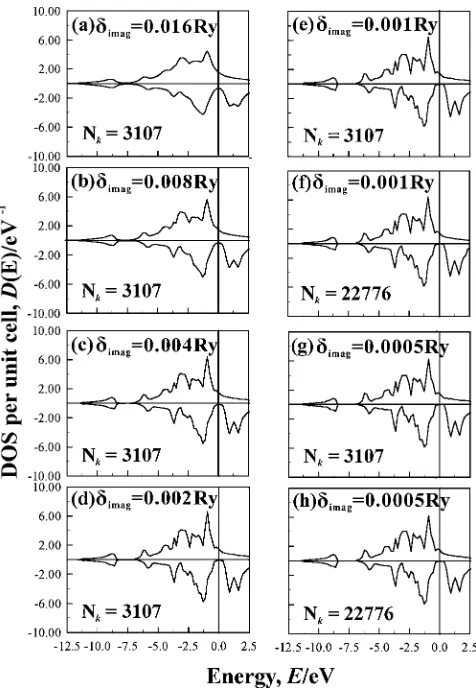
It is also noted that an imaginary part of the small energy (0.001 Ry) was added to the energy when calculating the density of states (DOS) by means of the Green function. As a result, the very small, non-vanishing density emerges in the half-metallic gap of minority states at the Fermi level. However, we must remember that the complete half-metallic gap is impossible because a coupling between majority (up) and minority (down) spin states is always expected in the full relativistic calculations.3) It is also noted that the temperature effect above 0 K may destroy the half-metallic gap, due to the smearing of the DOS around the Fermi level. Therefore, the small error due to the present treatment for calculating the DOS may be neglected for the discussions of the possibility of half-metallicity of the realistic alloys, as discussed in Appendix.
3. Calculated Results for Co2MnSi, Ni2MnAl, and
Ru2MnSi
The crystal and magnetic structures of the full-Heusler alloys X2MnZ are shown in Figs. 1. In the present
calcu-lations we treat the four kinds of states for magnetism; (a) NM, (b) FM, (c) AFM type I (AFM-I), and (d) AFM type II (AFM-II). AFM-I and AFM-II are characterized by alternat-ing ferromagnetic planes of up- and down-Mn-moments, being perpendicular to the [001] and [111] directions, respectively. There are differences in numbers of parallel and antiparallel Mn-Mn coupling pairs. In AFM-I, one moment interacts with the 1st-neighboring four up-Mn-moments and eight down-Mn-up-Mn-moments, while in AFM-II with the 1st-neighboring six up-Mn-moments and six down-Mn-moments.
3.1 Lattice parameter dependence of total energies and
magnetic moments
Figures 2 show the theoretical results for the lattice parameter dependence of total energies of Co2MnSi,
Ni2MnAl, and Ru2MnSi, obtained by the GGA-SFPKKR
and LSDA-FPSKKR calculations. The four kinds of mag-netic (NM, FM, AFM-I, AFM-II) states are treated in the present paper. The measured lattice parameters are shown by Fig. 1 (a) Crystal structure of full-Heusler alloys (L21). The arrangements of Mn-moment for (b) FM, (c) AFM-I, and (d) AFM-II are also
shown.
[image:2.595.124.476.75.191.2]the vertical lines in Figs. 2.2,5,16) The calculated results are listed in Table 1. It is obvious that the present calculations (both of the LSDA and GGA) reproduce the ground states of these full-Heusler alloys: FM for Co2MnSi5)and Ni2MnAl,11)
and AFM-II for Ru2MnSi.16,17) It is also obvious that the
GGA calculations correct the deficiencies of the LSDA (the underestimation of lattice parameters): the errors for the lattice parameters in the GGA calculations are within 1%, as have been shown for most of elemental fcc and bcc metals (Li-Au).20)
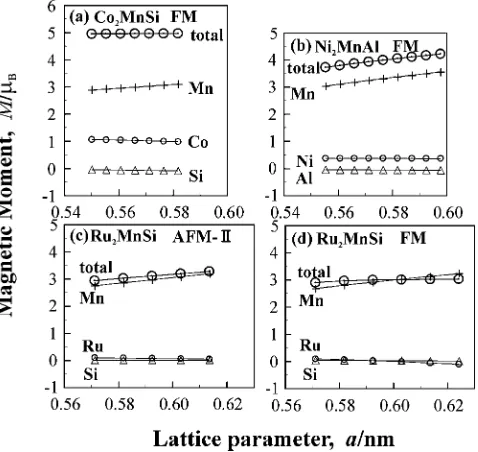
The lattice parameter dependence of total magnetic moments (MMs) of the ground states and their components are shown in Figs. 3. The local Mn MMs in the FM, AFM-I, AFM-II states are compared in Figs. 4. It is noted that for Ru2MnSi (AFM-II, Fig. 3(c)) only the MMs of one kind of
molecular unit (Ru2MnSi) are shown. Since the MMs for
another kind of molecular unit in the AFM-II unit cell are opposite sign, the total MM is zero. As seen in Fig. 3(a), the calculated results for total MMs per unit cell of Co2MnSi do
not depend on the lattice parameter and are kept to be 4.95B(almost an integer as a character of half-metallicity), corresponding to the measured value 5:100:04B.5)
It is also noted that the calculated value (or the measured value) is predicted very well by the Slater-Pauling rule.1,23) Although the local Mn MM increases with the lattice parameters, its increase is cancelled out by the decreases of Co and Si moments. For Ni2MnAl (FM, Fig. 3(b)), the total
and local Mn MM increase very much with the lattice parameter. It may be a signal that Ni2MnAl is not an alloy of
half-metallicity, as discussed in 3.3 and shown in Fig. 7(b). For Ru2MnSi (AFM-II, Fig. 3(c)), the total and local Mn
Fig. 2 Lattice parameter dependence of total energies per molecular unit for the different magnetic states of Co2MnSi, Ni2MnAl, and
[image:3.595.125.470.69.338.2]Ru2MnSi, obtained by the present GGA-FPSKKR (a)–(c) and LSDA-FPSKKR (d)–(f) calculations.
Table 1 Equilibrium lattice parameters of the ground states of Co2MnSi,
Ni2MnAl, and Ru2MnSi, obatiend by the GGA-FPSKKR and
LSDA-FPSKKR calculations, together with the available experimental results (Refs. 2), 7), 16)).
Equilibrium lattice parameter,a/nm
Experiment GGA LSDA
Co2MnSi 0.565 0.565 0.553
Ni2MnAl 0.582 0.580 0.566
Ru2MnSi 0.589 0.592 0.582
Fig. 3 Total magnetic moments per molecular unit cell for (a) Co2MnSi,
(b) Ni2MnAl, (c) Ru2MnSi (AFM-II). For (d) Ru2MnSi (FM), the
[image:3.595.309.548.394.620.2] [image:3.595.47.290.436.502.2]MMs for the sublattice increase with the lattice parameter and the MM of Ru is almost zero. The effective total MM obtained from the temperature dependence of magnetization is 2.8B,16) corresponding to the calculated result 2.96B. It is also noted that the total MM (2.99B) in the FM state of Ru2MnSi (Fig. 3(d)) do not depend on the lattice
parameter. We will show in 3.3 that the Ru2MnSi in the
FM state is an alloy of half-metallicity.
Now we examine the fundamental features of magnetism of these alloys, using the calculated results. First we summarize the calculated results for the characteristic features of magnetism.
(1) The FM of Co2MnSi is the ground state and very
stable. The energy difference between FM and AFM is as large as 0.453 eV per unit cell. The local MMs of Co and Mn at the FM state are 1.02 and 2.99B, respectively.
(2) The FM of Ni2MnAl is the ground state, but not so
stable. The energy difference between AFM and FM states is as small as 0.070 eV per molecular unit (Ni2MnAl). The local magnetic moments of Ni and
Mn at the FM state are 0.37 and 3.4B, respectively. (3) The AFM-II of Ru2MnSi is the ground state, but not
so stable. The energy difference between AFM-II and FM is as small as 0.035 eV per molecular unit. The local MM of Mn in the AFM-II is the largest among the FM, AFM-I, and AFM-II, as seen in Fig. 4(c): 2.961Bfor AFM-II, 2.926Bfor AFM-I, and 2.915B for FM.
These fundamental features are qualitatively understood by considering the magnetism of the constituent elements, such as strong FM of Co (large MM), weak FM of Ni (small MM), NM of Ru, and AFM of Mn.28)The difference between the FM and AFM states of 3d-tranistion-metals is funda-mentally understood by the 3d-electron numbers. The stable magnetism becomes AFM around the half-filled 3d bands because the energy gain due to the band shift overcomes the energy gain due to the band broadening.29)The strong FM state of Co2MnSi is mainly due to the strong FM of Co. The
weak FM state of Ni2MnAl is due to the weak FM of Ni,
which is further weakened by the AFM of Mn. The difference on the stability of FM between Co2MnSi and Ni2MnAl is
understood by using the Mn spin-filp energies and the Mn-Mn exchange interaction energies in X (= Co, Ni), as discussed in 3.2. The stability of AFM-II of Ru2MnSi may
be due to the AFM of Mn. The difference on AFM-I and
AFM-II may be due to the numbers of AFM-coupling and FM-coupling Mn-Mn pairs: the pair numbers of AFM-coupling and FM-AFM-coupling are (6, 6) for AFM-II config-uration, while (8, 4) for AFM-I configuration. The AFM state of Mn in Ru2MnSi may be the strongest in the magnetic
configuration of Mn in the AFM-II state, because the Mn MM is the largest in the AFM-II state, as shown in Fig. 4(c).
3.2 Spin-flip energies of Mn and distance-dependence
of Mn-Mn exchange interaction energies in X (= Co, Ni)
We try to understand qualitatively the difference on the FM between Co2MnSi and Ni2MnAl by using the
calcu-lated results for the Mn spin-flip energies and the Mn-Mn exchange interaction energies in X (= Co, Ni). They are the 1st- and 2nd-lowest order (one-body and two-body of Mn impurities) terms in the cluster expansion (from a dilute limit) of the internal energies of alloys30) and may be im-portant to study the characteristic features of magnetism of alloys. The definition and accuracy of the cluster expansion from a dilute limit are discussed in Ref. 30). By using these impurity interaction energies, we have already succeeded in understanding the physical mechanism of the NMR ex-perimental results of Mn impurities in NiMn and NiFe alloys.31,32)
3.2.1 Spin-flip energy (one-body interaction of Mn)
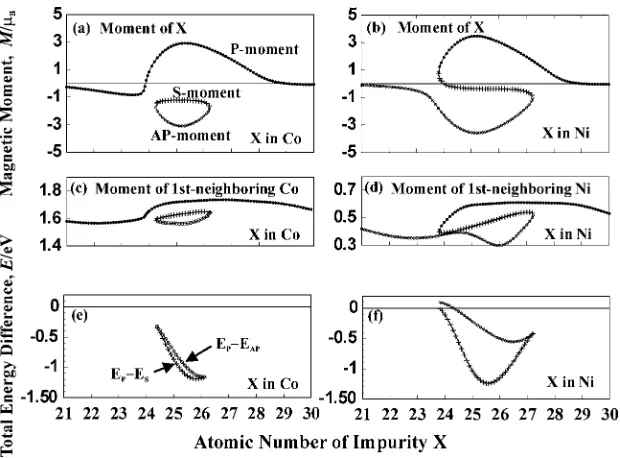
First we show the calculated results for the spin-flip energies of 3d impurities in X (= Co, Ni). There exist three magnetic solutions for 3d impurities in Co and Ni, as shown in Figs. 5(a) and 5(b). The calculations were performed for 3d impurities of non-integer nuclear charge. For 3d impuri-ties in a NM host such as Cu, it is well known that there are three solutions; one is NM (unstable) and two are doubly degenerated magnetic (MMs of equal magnitude in the opposite direction). On the other hand, for 3d impurities in FM metals such as Co and Ni, a NM solution shifts to a solution of a very small (S)-MMs and the degeneracy of the magnetic solutions is lifted, as seen in Figs. 5(a) and 5(b), resulting in two solutions of parallel (P, corresponding to the FM) and anti-parallel (AP, corresponding to the AFM) MMs to the bulk magnetization. The three solutions exist around
Z ¼23:9{27:2 (Z is a nuclear charge of X) for Ni-host,31) while aroundZ¼24:3{26:1for Co-host.
The change of the MMs of Co and Ni atoms at nearest-neighboring sites of 3d impurities is shown in Figs. 5(c) and 5(d). The change depends strongly on the magnetic states Fig. 4 Magnitude of local magnetic moments of Mn for (a) Co2MnSi, (b) Ni2MnAl, (c) Ru2MnSi.
[image:4.595.131.465.80.199.2]of 3d impurities. It is noted that for the solutions of AP and S states of 3d impurities the decrease of MM’s of nearest-neighboring Co and Ni becomes very large and leads to the large magnetic energy loss. The total-energy differences between the P and AP states, and those between the P and S states are shown in Figs. 5(e) and 5(f). The total-energy change is very large for 3d impurities in Co. For example, it costs 0.729 eV to excite one Mn-MM from P to AP. This spin-flip energy, being defined by the different sign of the total energy difference between the P and AP states, may be an important part of the energy difference (0.453 eV, see Fig. 3(a)) between the AFM and FM states of Co2MnSi.
The difference (0.266 eV) between two values (0.729 and 0.453 eV) should be understood by the pair (Mn-Mn) and many-body (of Mn and Si) interaction energies which are the higher-order terms in the cluster expansion of the total energy difference obtained by the (AFM-I, FM) band calculations of Co2MnSi, as discussed in the following paragraphs.
How-ever, it may be obvious that the large value of the spin-flip energy corresponds to the strong stability of the P state of 3d impurities in Co.
On the other hand, for 3d impurities in Ni the spin-flip energy is small. For example, the spin-flip energy of Mn impurity in Ni is 0.220 eV. This energy may be an important part of the energy difference (0.070 eV) between the AFM and FM states of Ni2MnAl. The difference between two
values (0.220, 0.070 eV) is not small and may be understood by the Mn-Mn exchange interaction energies (two-body of Mn) and many-body interaction energies of Mn and Al. However, by comparing the Mn spin-flip (one-body) energies in Ni and Co, we can at least qualitatively understand that the FM of Ni2MnAl is very weak compared with that of
Co2MnSi.
3.2.2 Mn-Mn exchange interaction energy (two body
interaction of Mn)
Now we discuss the Mn-Mn exchange interaction energies
Eexc(Mn-Mn), which may be the next important term in the
cluster expansion of the total energy differences obtained by the band calculations. By considering the distance depend-ence of Eexc(Mn-Mn), we can show that the FM state of Ni2MnAl may be easily changed to the AFM state by the
atomic disorder (of Mn and Al) occurring at elevated temperatures.
First we give the definition ofEexc(Mn-Mn). It is written as follows,
EexcðMn-MnÞ ¼Eup-downEup-up
ðspin-flip energy of MnÞ ð1Þ
where Eup-down (Eup-up) represents the total energy of the impurity system with the Mn pair of up-down(up-up) configurations. The spin-flip energy is substracted in the eq. (1). Thus, Eexc(Mn-Mn) becomes zero at the infinite interatomic distance of a Mn-Mn pair. Figures 6 show the distance dependence of theEexc(Mn-Mn) in X (= Co, Ni). Fig. 5 Local magnetic moments (MMs) for 3d impurities in (a) Co and (b) Ni, MMs of 1st-neighboring Co (c) and Ni (d), total energy
differences between the parallel and anti-parallel states, and those between the parallel and small states in (e) Co and (f) Ni.
[image:5.595.143.453.70.299.2] [image:5.595.346.503.344.539.2]It is noted that the distance dependences ofEexc(Mn-Mn) in Co and Ni are very similar to each other.
The important feature of Eexc(Mn-Mn) is that the AFM-coupling of Mn-Mn is stable up to the 4th neighbor and very strong at the 1st and 2nd-neighbors. If one Mn atom at the L21 structure is spin-flipped, the twelve Mn-Mn
AFM-coupling pairs at the 3rd neighbor are created (see Fig. 1(b)). Thus, the energy gain ofEexc(Mn-Mn) due to this spin-flip is 0:0112¼ 0:12eV and 0:00512¼ 0:06eV for Co and Ni hosts. Thus, the total energy differences obtained by considering the spin-flip and Eexc(Mn-Mn) energies are 0.609 eV (¼0:729{0:120) and 0.160 eV (¼0:220{0:06), which become a little bit close to the values 0.453 and 0.070 eV for Co2MnSi and Ni2MnAl, obtained by the band
calculations. The remaining differences should be due to the pair interactions at the long interatomic distance of Mn-Mn and the many-body interactions of Mn and sp-elements (Si for Co2MnSi or Al for Ni2MnAl). The effect of sp-elements
may be qualitatively important. We will examine the sp-element effect by calculating the Mn spin-flip energies and the Mn-Mn exchange interaction energies in Co3Si (X = Co,
Y = Co, Z = Si) and Ni3Al (X = Ni, Y = Ni, Z = Al).
Now we can show how the AFM of Ni2MnAl becomes
stable at elevated temperatures. According to the experiment, the L21 structure of Ni2MnAl is changed to the B2 (the
disordering of Mn and Al). It is important that the 2nd-neighboring Mn-Mn pairs are created at the B2 structure. The AFM-coupling at the 2nd-neighbor is stable by 0:05eV, compared with the FM-coupling. Thus, the energy change due to the atomic rearrangement of one Mn with one Al and the spin-flip of one Mn atom is0:3 ð¼ 0:056Þ þ
0:22¼ 0:08eV. The negative value means that the AFM state is more stable than the FM state. Thus, the magnetism of Ni2MnAl may change from FM to AFM at elevated
temperatures because the AFM is stable at the B2 structure (the disordering of Mn and Al) which occurs at elevated temperatures. On the other hand, for Co2MnSi, the total
energy change, due to the disordering of Mn and Si and the spin-flip of Mn, is 0:3þ0:729¼0:429eV. This large positive value means that the FM state is still stable for the B2 structure of Co2MnSi.
We may conclude that the fundamental features of the magnetism, such as the strong FM of Co2MnSi compared
with the FM of Ni2MnSi, and the change from FM to AFM
of Ni2MnAl at elevated temperatures are understood by
considering the Mn spin-flip energies (one-body of Mn) and the Mn-Mn exchange interaction energies (two-body of Mn)
in X (= Co, Ni), which are the 1st- and 2nd-lowest order terms in the cluster expansion (from a dilute limit) for the total energy differences between the FM and AFM-I states of Co2MnSi and Ni2MnAl.
3.3 Half-metallicity
Figures 7 show the DOSs of the FM states of (a) Co2MnSi,
(b) Ni2MnAl, and (c) Ru2MnSi. The FM is the ground state of
Co2MnSi and Ni2MnAl, but the excited state for Ru2MnSi. It
is obvious that Co2MnSi shows half-metallicity (Fig. 7(a)),
while Ni2MnAl does not (Fig. 7(b)). These results were
successfully understood by analyzing the partial DOSs obtained by the LSDA-FPSKKR calculation results.23)The gap in the down-spin (minority-spin) band of Co2MnSi is
located at the middle of the antibonding states between Co-Co d-orbitals, and the electrons are occupied up to the states just below the gap, the energy of which corresponds to the Fermi level. For the Ni2MnAl, the states above the gap are
also occupied by electrons. As a result, the Ni2MnAl alloy
does not show the half-metallicity. The DOS of Ru2MnSi
(FM) shows half-metallicity (Fig. 7(c)). This result may be easily understood because Ru is almost isoelectronic to Co. It is obvious that the DOS of the Ru2MnSi (AFM) does not
show the half-metallicity because the DOSs of up and down spin states per unit cell of the AFM are the same to each other and may be approximated by the superposition of DOSs of up and down spin states of the FM of Ru2MnSi (Fig. 7(c)).
4. Half-Metallicity and Slater-Pauling Behavior in
Co2MnZ (Z = NaP)
The Co2MnZ (Z = sp-element) alloys are expected as the
ideal materials for spin electronics. Thus, we study the half-metallicity of Co2MnZ (Z = NaS). We also examine the
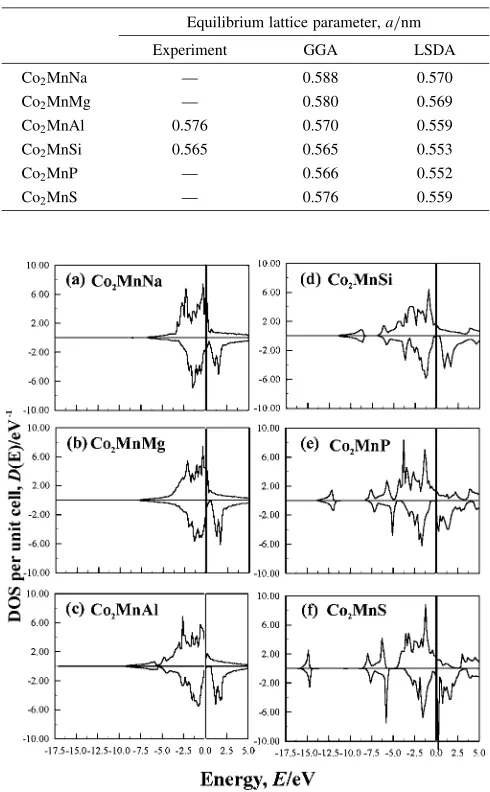
Slater-Pauling rule for these alloys.1,23)We determined the lattice parameters by the present GGA-FPSKKR calcula-tions. The calculated results and the available experimental values are listed in Table 2. The calculated DOSs are shown in Figs. 8. We can expect the half-metallicity for Co2MnZ
(Z = Al, Si, P). It is noted that the valence-electron numbers are 3, 4 and 5 for Al, Si and P. Thus, the MMs increase from 4 to 6 for Z = Al, Si and P. The relations of MMs with valence-electron number per unit cell are shown in Fig. 9. We can see very well the Slater-Pauling behavior (the linear relation of MMs with valence-electron numbers per unit cell) around Al, Si, P: from Z = Al to Z = P, the added electrons are occupied by the up-spin (majority) band, because there is Fig. 7 DOS of (a) Co2MnSi (FM), (b) Ni2MnAl (FM), and (c) Ru2MnSi (FM).
[image:6.595.118.481.83.192.2]a gap in the down-spin (minority) band. It is noted that the calculated results for Z of non-integer nuclear charge are also shown in Fig. 9. For Z = Na, Mg, S, we can not expect the Slater-Pauling behavior because the Fermi level is located outside of the gap, as shown in Figs. 8(a), (b) and (f). As a
of these alloys is strongly requested.
5. Conclusions
We have shown that the present GGA-FPSKKR calcu-lations reproduce the experimental ground states of Co2
Mn-Si, Ni2MnAl, Ru2MnSi and the equilibrium lattice
parame-ters within the error of 1% of the experimental values. The fundamental features of Co2MnSi (strong FM) and Ni2MnAl
(weak FM) may be understood by the Mn spin-flip and the Mn-Mn exchange interaction energies in X (= Co, Ni). We have also shown that for Ni2MnAl, the magnetism changes
from FM to AFM at elevated temperatures because the energy gain due to the 2nd neighboring Mn-Mn exchange interaction, which is induced by the atomic disordering of Mn and Al (B2-structure) at elevated temperatures, over-comes the energy loss due to the spin-flip energy of Mn impurity in Ni. This result explains the experimental results11,12) very well. The possibility of half-metallicity of Co2MnZ (Z = NaS) was examined qualitatively. The
Co2MnZ (Z = Al, Si, P) without defects show the
half-metallicity. The quaternary alloys Co2Mn (Z11xZ2x) may also show the half-metallicity if the number of valence electrons of sp-elements (Z11xZ2x) is between 3 and 5. However, the decrease of the spin-polarization at the Fermi level may occur by the existence of the defects. We are now calculating the defect energies of Co2MnZ (Z = NaS),
such as antisites and swaps, by using the impurity GGA-FPKKR calculations. The results will be published in the following paper.24)
Acknowledgements
One of the authors (T. Hoshino) thanks Prof. R. Kainuma for useful discussions. This work was supported by Grand-in-Aid for Scientific Research on the Priority Area Inves-tigation of ‘‘Materials Science of Bulk Metallic Glasses’’ (No. 15074206) from the Ministry of Education, Culture, Sports, Science and Technology, Japan.
REFERENCES
1) Half-metallic alloys: fundamentals and applications(Lecture Notes in Physics Vol. 676), ed by Galanakis and P. H. Dederichs (Springer, Berlin, 2005).
2) P. J. Webster and K. R. A. Ziebeck:Heusler Alloys and Compounds of d-Elements with Main Group Elements(Landolt-Bornstein-Group III Condensed Matter. Part 2 vol. 19c), ed by H. R. J. Wijn (Springer, Berlin, 1988).
3) As the spin-orbit interaction induce the mixing of up-spin and down-spin electrons, it is impossible to obtain the down-spintronics devise of Fig. 8 DOS for Co2MnZ (Z = NaS). The number of valence electrons
changes from 26 (Z = Na) to 31 (Z = S).
Fig. 9 Valence-electron number dependence of local magnetic moments per unit cell for Co2MnZ (Z = NaS).
[image:7.595.46.291.91.487.2] [image:7.595.58.278.535.681.2]complete (100%) spin-polarization. However, it was shown by Marvropouloset al.(Phys. Rev. B69(2004), 054424) that the effect due to the spin-orbit interaction is very small for the materials such as 3d element-based alloys. For example, the 100% spin-polarization for the NiMnSb, obtained by the calculations without the spin-orbit interaction, decreases only by1% by taking into account the spin-orbit interaction.
4) S. Fujii, S. Sugimura, S. Ishida and S. Asano: J. Phys.: Condens. Matter
2(1990) 8583.
5) M. P. Raphael, B. Ravel, M. A. Willard, S. F. Cheng, B. N. Das, R. M. Stroud, K. M. Bussmann, J. H. Claassen and V. G. Harris: Appl. Phys. Lett.79(2001) 4396.
6) B. Ravel, J. O. Cross, M. P. Rapahael, V. G. Harris, R. Ramesh and V. Saraf: Appl. Phys. Lett.81(2002) 2812.
7) M. P. Raphael, B. Ravel, Q. Huang, M. A. Willard, S. F. Cheng, B. N. Das, R. M. Stroud, K. M. Bussmann, J. H. Claassen and V. G. Harris: Phys. Rev. B66(2002) 104429.
8) S. Picozzi, A. Continenza and A. J. Freeman: Phys. Rev. B66(2002) 094421.
9) A. Fujita, K. Fukamachi, F. Gejima, R. Kainuma and K. Ishida: Appl. Phys. Lett.77(2000) 3054.
10) T. Bu¨sgen, J. Feydt, R. Hassdorf, S. Thienhaus and M. Moske: Phys. Rev. B70(2004) 014111.
11) Y. Sutou, I. Ohnuma, R. Kainuma and K. Ishida: Metall. Mater. Trans. A29A(1998) 2225.
12) J. Soltys: Phys. Stat. Sol. (a)66(1981) 485.
13) K. Ishikawa, I. Ohnuma, R. Kainuma, K. Aoki and K. Ishida: J. Alloys. Comp.367(2004) 2.
14) T. Kanomata, M. Kikuchi, H. Yamauchi and T. Kaneko: Jpn. J. Appl. Phys. 32 Suppl32–33(1993) 292.
15) M. Gotoh, M. Ohashi, T. Kanomata and Y. Yamaguchi: Physica B
213–214(1995) 306.
16) T. Kanomata, M. Kikuchi and H. Yamauchi: J. Alloys. Comp.414
(2006) 1.
17) S. Ishida, S. Kashiwagi, S. Fujii and S. Asano: Physica B210(1995) 140.
18) P. Larson, S. D. Mahanti and M. G. Kanatzidis: Phys. Rev. B62(2000) 12754.
19) H. C. Kandpal, G. H. Fecher and G. Felser: J. Phys. D: Appl. Phys.40
(2007) 1507.
20) T. Hoshino, T. Mizuno, M. Asato and H. Fukushima: Mater. Trans.42
(2001) 2206.
21) T. Hoshino, M. Asato, R. Zeller and P. H. Dederichs: Phys. Rev. B70
(2004) 094118.
22) N. Fujima, M. Asato, R. Tamura and T. Hoshino: Mater. Trans.48
(2007) 1734.
23) I. Galanakis, P. H. Dederichs and N. Papanikolaou: Phys. Rev. B66
(2002) 174429.
24) M. Asatoet al., in preparation.
25) M. Asato, A. Settles, T. Hoshino, T. Asada, S. Blu¨gel, R. Zeller and P. H. Dederichs: Phys. Rev. B60(1999) 5202.
26) R. Zeller: Phys. Rev. B55(1997) 9400.
27) R. Zeller, M. Asato, T. Hoshino, J. Zabloudil, P. Weinberger and P. H. Dederichs: Philos. Mag. B78(1998) 417.
28) T. Asada and K. Terakura: Phys. Rev. B47(1993) 15992.
29) P. H. Dederichs, H. Akai, S. Blu¨gel, N. Stefanou and R. Zeller: Alloys Phase Stability, ed by G. M. Stocks and A. Gonis: (Series E: Applied Sciences 163, 1989) 377.
30) M. Asato, H. Takahashi, T. Inagaki, N. Fujima, R. Tamura and T. Hoshino: Mater. Trans.48(2007) 1711.
31) T. Hoshino, R. Zeller and P. H. Dederichs: J. Magn. Magn. Matter.
140–144(1995) 113.
32) T. Hoshino, R. Zeller, P. H. Dederichs and T. Asada: J. Magn. Magn. Matter.156–158(1996) 717.
Appendix: Dependence on an Imaginary Part of Energy
and on a Number ofk-points for DOS
We calculate the DOS as a function of the complex energy with an imaginary part of the small energy (imag). It is
obvious that the large imaginary part of energy induces the large densities in the gap region. For example, the DOS at the complex energies with imag¼0:016Ry and a number of k-points in the irreducible Brillouin zoneðNkÞ ¼3107is shown in Fig. A·1(a). We can see the densities in the gap region. It is noted that, for the smallerimag, the larger number of Nkis needed to get the converged DOS.
Thus, we examine the dependence of the DOSs on imag with the convergence ofk-point number. Figures A·1 show the dependences on the imaginary energy (imag¼0:016, 0.008, 0.004, 0.002, 0.0005 Ry). We used the k-point numbers (Nk¼1140{22776) on the basis of nnn (n¼35{100: n is a number of kx, ky, and kz) mesh. We may conclude from the comparison of the calculation results with different k-point numbers that for imag0:0005Ry,
Nk¼3107is enough to get the converged result for DOS: for example, compare Figs. A·1(e) and (f) for imag¼
0:001Ry, and Figs. A·1(g) and (h) forimag¼0:0005Ry. Now we discuss the imag-dependence for DOS. As shown in Fig. A·1, the densities in the gap decrease with the decreasing value of imag, and the DOS obtained with
imag¼0:001Ry and Nk¼3107 is almost converged and shows the half-metallicity very well. The spin-polarizations at the Fermi level are 71, 82, 90, 95, 97, 99% for
imag¼0:0016, 0.008, 0.004, 0.002, 0.001, 0.0005 Ry. The error for the spin-polarization is as small as 3% for
imag¼0:001Ry.
Fig. A1 Dependence on a imaginary part of energy for calculating DOS. Thek-number dependence is also shown.
[image:8.595.308.546.70.417.2]