Study on the Reduction of Molybdenum Dioxide by Hydrogen
Byung-Su Kim
1, Eun-young Kim
2, Ho-Suck Jeon
1, Hoo-In Lee
1;*and Jae-Chun Lee
11Minerals & Materials Processing Division, Korea Institute of Geoscience & Mineral Resources, Daejeon, Korea
2Department of Resources Recycling, University of Science and Technology, Daejeon, Korea
The reduction of MoO2 powder by hydrogen is one of the most important steps for manufacturing ferromolybdenum alloy and molybdenum powder. The results of experiments on the kinetics of this reaction are presented in this paper. The experiments were carried out under nonisothermal condition in hydrogen atmosphere using TGA equipment. The nonisothermal experiments were carried out at various linear heating rates up to 1273 K. It was found that the reduction reaction is very fast under the whole heating rate until the reduction ratio of MoO2 approaches to about 0.92. The reduction ratio of MoO2was about 0.98 after finishing the reduction reaction at a heating rate of 4 K/min. Kinetics of the reaction was analyzed from the dynamic TGA data by means of Coats and Redfern equation. The nucleation and growth model yielded a satisfactory fit to these experimental data. [doi:10.2320/matertrans.MER2008103]
(Received March 27, 2008; Accepted June 25, 2008; Published August 25, 2008)
Keywords: molybdenum, ferromolybdenum alloy, molybdenum oxides, hydrogen reduction, nucleation and growth model
1. Introduction
Molybdenum is a refractory metal mainly used as an alloying agent for manufacturing steels, cast irons, and superalloys to increase their mechanical strength, hardness, stiffness, and their resistance to corrosion and wearing. Specially, as an alternative additive of molybdenum in the steel industries, ferromolybdenum alloy which is an alloy of iron and molybdenum has been used primarily.1)
The two most common grades of ferromolybdenum alloy are low-carbon ferromolybdenum alloy and high-carbon ferromolybdenum alloy.1,2) The high-carbon ferromolybde-num alloy is made by reducing technical grade molybdeferromolybde-num oxide (MoO3), calcium molybdate (CaMoO4), or sodium
molybdate (NaMoO4) with carbon in the presence of iron in
an electric furnace (carbon reduction process). The low-carbon ferromolybdenum alloy is more common than the high-carbon alloy, and it is produced by mixing MoO3,
aluminum, ferrosilicon, iron oxide, limestone, lime, and fluorspar, and igniting the aluminum (thermite process). However, in the processes large amounts of slag and dust which cause environmental problems are inevitably gener-ated. Specially, the thermite process uses high cost aluminum and silicon as reducing agents of MoO3.3,4)
Therefore, it would be highly desirable to develop an alternative process to manufacture ferromolybdenum alloy. Generally, the two-step hydrogen reduction process to produce pure molybdenum powders is well known: The first step is to reduce MoO3 powders to MoO2 powders at the
temperature of below 923 K and the second step is to produce molybdenum powders from MoO2 powders at the
temper-ature of around 1373 K.1,5) Although hydrogen used as a reducing agent of MoO3 is expensive now, the process has
many advantages because slag and dust are not generated in the process and additional additives are not needed. For these reasons, the hydrogen reduction process for manufacturing ferromolybdenum alloy by using MoO3-iron mixtures was
investigated by Gasik and Ostrik.6) However, scientific
literatures offer little information about kinetic data on the hydrogen reduction process.
The major objective of this research was to determine the kinetics of the reduction of MoO2by hydrogen. The kinetics
of the reduction reaction would offer fundamental data to understand the influence of employed conditions such as temperature and heating rate on the manufacturing process of ferromolybdenum alloy or molybdenum metal powder. In the present study, a kinetic study on the hydrogen reduction of MoO2 powder was experimentally investigated under
non-isothermal condition using TGA equipment.
2. Thermodynamics
In general, the reaction between MoO2 and H2(g) in the
hydrogen reduction process to produce molybdenum pow-ders can be represented by
MoO2þ2H2(g)¼Moþ2H2O(g): ð1Þ
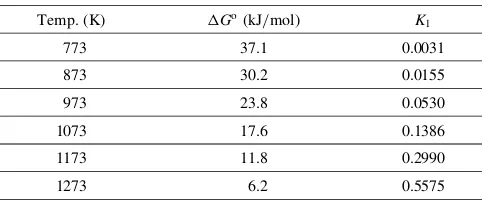
The standard Gibbs free energy change (Go) and equilibrium constants (K1) of the reaction (1) are summarized
[image:1.595.306.547.685.785.2]in Table 1 using HSC Chemistry 5.1 (A. Roine, Outokumpu, 2002) version. The reaction is not favorable thermodynami-cally under the considered temperature range between 773 and 1273 K since all theGovalues are positive as shown in the table. However, the reaction might take place because the equilibrium constant is relatively large at the temperature range, i.e., the reaction of the hydrogen reduction of MoO2
Table 1 GoandK
1values of the reaction (1).
Temp. (K) Go(kJ/mol) K
1
773 37.1 0.0031
873 30.2 0.0155
973 23.8 0.0530
1073 17.6 0.1386
1173 11.8 0.2990
1273 6.2 0.5575
might happen if the partial pressure of water vapor produced from the reaction (1) is relatively low. Figure 1 shows a plot of lnðpH2O=pH2Þ versus T calculated from the K1 values of
the reaction (1). In this figure, the solid line displays the equilibrium state of the reaction (1), and the area below the line indicates that the reaction proceeds to the right side, while the area above the line does that the reaction proceeds to the left side. Thus, Fig. 1 points out the fact that the driving force of the reaction (1) for an arbitrary atmosphere of flue gas in the reaction system increases with increase in the reaction temperature. Figure 2 presents the reduction ratio of MoO2calculated from the mass change of oxygen occurred
by the reaction of MoO2 and hydrogen with the amount of
hydrogen at the temperature range of 773 to 1273 K. The reduction ratios were obtained by the equilibrium composi-tions at each temperature calculated using HSC Chemistry 5.1. It is shown in Fig. 2 that the reduction ratio of MoO2
by hydrogen is relatively low below 900 K compared to that over 900 K. Therefore, it might be expected under a non-isothermal condition that the reaction rate of the hydrogen reduction of MoO2 will become to be fast at around over
900 K.
3. Experimental
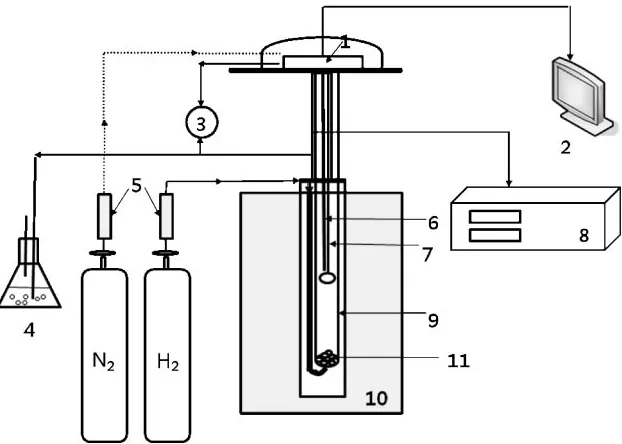
Experiments for measuring the reaction rates of the hydrogen reduction of MoO2 were carried out in a typical
thermogravimetic analysis (TGA) unit. Figure 3 shows a schematic diagram of the apparatus. The apparatus consisted of a recording microbalance from one arm of which a shallow silica tray for MoO2 powders was suspended by a platinum
chain into a reactor tube located within vertical tubular furnace. The reactor tube was an Inconel tube of 5.0 cm i.d. and 65 cm length. The microbalance continuously recorded
800 900 1000 1100 1200 -3.0
-2.5 -2.0 -1.5 -1.0 -0.5
MoO2 + 2H2(g) Mo + 2H2O(g)
ln (p
H2
O
/p
H2
)
Temperature, T/K
MoO2 + 2H2(g) Mo + 2H2O(g)
Fig. 1 Plot oflnðpH2O=pH2ÞversusTcalculated from theK1values of the reaction (1).
800 900 1000 1100 1200 1300 0.0
0.2 0.4 0.6
Reduction ratio of MoO
2
Temperature, T/K Amount of H2(g)
1 mol 2 mol 3 mol
Fig. 2 Reduction ratio of MoO2calculated from the equilibrium compo-sitions of the reduction reaction of MoO2(1 mol) with H2(g) at a total pressure of 1 atm.
[image:2.595.55.283.68.244.2] [image:2.595.313.540.71.241.2] [image:2.595.143.454.302.524.2]the mass changes taking place during the reaction. By means of a gas delivery system, mass flow controllers of hydrogen and nitrogen were also used. The gas temperature in the reactor was measured by chromel-alumel thermocouples. A uniform temperature profile of4K was achieved over 2 cm length of the reaction tube. Dry hydrogen gas was used as a reducing agent, and dry nitrogen was used as an inert gas. A commercial MoO2powder (99.0%) of<48mmsize obtained
from Aldrich Chemical Co. was used as a raw material. The experiments were conducted at three heating rates of 4, 8, 12 K/min from room temperature to 1273 K. A sample mass of about 500 mg (20mg) of MoO2powders was used
for each run. During heating, a steady flow of 0.5 L/min of dry hydrogen was maintained through the reactor tube, the microbalance protected from hot gases by flushing it with a dry nitrogen gas of 1 L/min. In order to measure the rates of the hydrogen reduction of MoO2 in the negligible level of
external mass transfer effects, sufficiently high flow rate (0.5 L/min) of hydrogen and bed height (below 1 mm which is obtained by spreading 500 mg of MoO2 powders as a thin
layer on a shallow sample tray) were chosen through preliminary experiments.
The morphological characterization of the samples was performed using a scanning electron microscope (JSM-6380LV, JEOL Ltd, Tokyo, Japan) equipped with an energy dispersive X-ray spectrometer (Link Isis 3.0, Oxford Instru-ment plc, Oxon, U.K). The XRD patterns were obtained using a X-ray diffractometer (Rigaku D-max-2500PC,
Rigaku/MSC, Inc., TX, U.S.A) with Cu K radiation
( ¼0:154nm) operated at 40 kV and 30 mA. Samples before and after the hydrogen reduction were analyzed by the inductively coupled plasma (ICP) method (JY-38 plus, Horiba Ltd, Kyoto, Japan).
4. Results and Discussion
Figure 4 shows the TGA curve of the hydrogen reduction of MoO2 obtained at a heating rate of 8 K/min under dry
hydrogen atmosphere. The hydrogen reduction pattern obtained at the other heating rates was very similar. It was shown in the figure that the rate of hydrogen reduction of MoO2 is significantly fast until around 1023 K at which the
reduction ratio of MoO2 is about 0.92. Although not shown
here, the reduction ratio of MoO2 was about 0.98 after
finishing the reduction reaction at a heating rate of 4 K/min.
Here, the reduction ratio of MoO2 powder at a particular
temperature during the reduction reaction was determined by dividing the mass change of the solid sample up to that temperature by the total mass change at complete reaction calculated from stoichiometry. It was however found that the rate is very slow during the final stage of reduction. This rate decrease might be the reason why a dense molybdenum shell forms around the particles and subsequently inhibits gaseous transport during the reaction. The phenomenon was indi-rectly verified by scanning electron microscopy (SEM) analysis of samples before and after heating up to 1273 K. Figure 5 presents the SEM pictures. Figure 5(a) shows a MoO2 particle before reacting, Fig. 5(b) showing a Mo
particle reduced from MoO2 powder after heating up to
1273 K at a heating rate of 4 K/min. Based on an increase in density during the transformation of MoO2 to Mo, it is
considered that the crystallites grow to form a relatively dense layer, as shown in Fig. 5(b). Thus, Fig. 5 indicates that the surface of Mo particles after reacting is much more impervious than that of MoO2 particle. Also, the samples
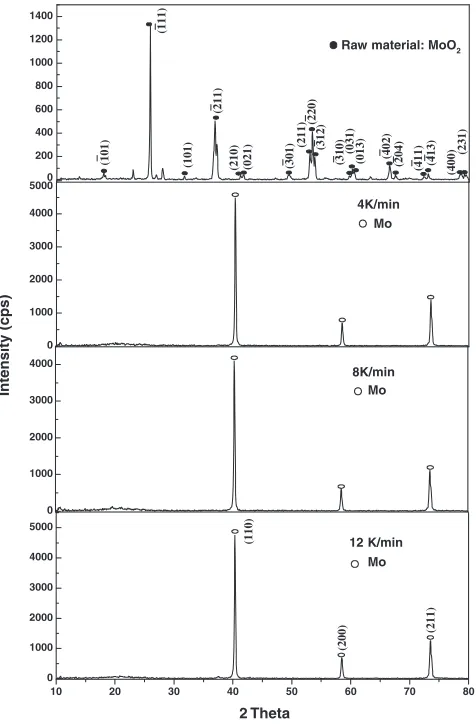
before and after reacting were examined by X-ray analysis, which is shown in Fig. 6. XRD pattern of Mo metal was only detected at samples after heating up to 1273 K as shown in the figure.
Kinetic analysis of the thermal data obtained from the reaction of the hydrogen reduction of MoO2 were done in
600 700 800 900 1000 1100 1200 1300 380
400 420 440 460 480 500 520
Mass (mg)
Temperature, T/K
Fig. 4 TGA curve for the reaction of MoO2with H2(g) at a heating rate of 8 K/min in hydrogen atmosphere.
(b) (a)
[image:3.595.312.541.73.247.2] [image:3.595.120.484.634.769.2]order to interpret the mechanism of the reaction and to deduce the kinetic parameters. Figure 7 shows changes in the reduction ratio of MoO2with three different heating rates as a
function of temperature. In the kinetic analysis, the degree of reduction ratio between 0.12 and 0.92 was investigated. Here, the reduction ratio of MoO2 was calculated as
explained previously. It was shown in Fig. 7 that the rate of the hydrogen reduction of MoO2 becomes fast at around
900 K, although the reaction temperature is slightly different with heating rate. Such phenomenon could be explained by Fig. 2 that presents the dependence of reaction temperature for the reduction ratio of MoO2 calculated from equilibrium
compositions.
In the present study, kinetic analysis of the reaction rate of the hydrogen reduction of MoO2 powder under
nonisother-mal condition was evaluated employing the model fitting method.7,8)The rate equation can be generally expressed by the following relation:7–9)
d
dT ¼
kðTÞ
fðÞ ð2Þ
whereis the reduction ratio of MoO2at temperatureT,fðÞ
the conversion (the reduction ratio of MoO2) function which
is dependent on the mechanism of the reaction,the heating rate employed in the experiment, andkðTÞis the rate constant
as a function of temperature. The temperature dependence of the rate constant is described by the Arrhenius equation,
kðTÞ ¼Aexp E
RT
ð3Þ
whereA is the pre-exponential factor (frequency factor),E
the activation energy, and R is the gas constant. And, substituting eq. (3) into eq. (2) gives,
d dT ¼ A exp E RT
fðÞ: ð4Þ
Thus, eq. (4) can be represented by its integral form as follows:7–9)
gðÞ ¼
Z
0
d
fðÞ¼
ZT 0 A exp E RT dT; If E
RT ¼x)gðÞ ¼
AE
R
Z 1
x
eX
x2 dx: ð5Þ
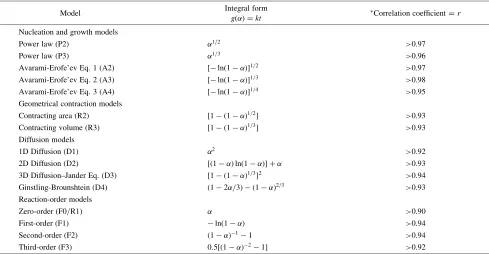
The algebraic expression of the integral gðÞfunctions that are tested in this work are listed in Table 2.10–12) These expressions are generally applied for the kinetic analysis of gas-solid state reactions and encompass most common mechanism. However, eq. (5) has no analytic solution, and thus, several approximations were made. One of the most widely used approximations has been given by Coats and Redfern approximation which gives the expression:7–9)
lngðÞ
T2 ¼ln
AR
E 1
2RTT
E
E
RT
If : 2R
T T
E
1)lngðÞ
T2 ¼ln
AR
E
E
RT ð6Þ
whereTTis the mean experimental temperature. Thus, eq. (6) was used to analyze the thermal data shown in Fig. 7. It is clear from eq. (6) that a plot oflnðgðÞ=T2Þversus1=Tgives
a straight line when the adequate gðÞ function is chosen. As explained previously, the gðÞ function describes the mechanism of the reaction.
The best fit for the thermal data obtained from the reaction of the hydrogen reduction of MoO2powder at the reduction
ratio range of 0.12 to 0.92 is obtained using nucleation and growth model (A3) with considering all models listed in
200 400 600 800 1000 1200 1400 0 0 1000 2000 3000 4000 5000
10 20 30 40 50 60 70 80
0 1000 2000 3000 4000 5000 0 1000 2000 3000 4000 (101) (101) (301) (231) (400) (411) (204) (413) (013) (031) (310) (402) (021) (210) (211) (312) (220) (211) (111)
Raw material: MoO2
Mo 4K/min (211) (200) 2 Theta 12 K/min Mo (110) Intensity (cps) 8K/min Mo
Fig. 6 XRD pattern of the products formed after heating up to 1273 K at various heating rates in hydrogen atmosphere.
850 900 950 1000 1050 1100 0.0 0.2 0.4 0.6 0.8 1.0 Reduction ratio, α Temperature, T/K Heating rate 4 K/min 8 K/mn 12 K/min
[image:4.595.51.289.72.434.2] [image:4.595.313.540.73.246.2]Table 2, which is shown in Fig. 8. Figure 8 shows plots of lnf½lnð1Þ1=3=T2gversus1=Tusing the thermal data of
Fig. 7 according to eq. (6). It was thus verified that the nucleation and growth model was applicable as shown in Fig. 8. From Fig. 8, straight lines with high-correlation coefficient (r>0:98) were selected to represent the possible controlling mechanism. Here, the activation energy can be calculated from the slope, the frequency factor from the intercept. The corresponding kinetic parameters are shown in Table 3. Theoretically, the activation energy of a reaction is expected not to change with change in heating rate. But, the activation energy was found to decrease with increase in heating rate, as shown in Table 3. In the study, the reason was
not verified. It was only considered that the variation might be deduced to the experimental error. Similarly the frequency factor was also found to be change with heating rate. However, similar trends at nonisotermal condition have been reported in literatures.8,12,13) As shown in Table 3, the activation energy of the reaction of the hydrogen reduction of MoO2 powder was calculated to be 50.2–65.9 kJ/mol,
which is similar with that observed in the hydrogen reduction of MoO3 obtained under stepwise differential isothermal
analysis.6)
5. Conclusion
A kinetic study on the reduction reaction of MoO2
powder with hydrogen was experimentally investigated under nonisothermal condition using TGA equipment. The experiments were carried out at three heating rates of 4, 8, 12 K/min from room temperature to 1273 K. It was found that the reduction reaction is very fast under the whole heating rate until the reduction ratio of MoO2 is about 0.92,
and after that the rate becomes very slow. The rate decrease might be because a dense molybdenum shell forms around the particles and subsequently inhibits gaseous transport during the reaction. The reduction ratio of MoO2 was about
[image:5.595.53.291.373.572.2]0.98 after finishing the reduction reaction at a heating rate of 4 K/min. It was also investigated that the reduction reaction Table 2 List of the rate expressions of reaction models used in the study.10{12Þ
Model Integral form
gðÞ ¼kt
Correlation coefficient =r
Nucleation and growth models
Power law (P2) 1=2 >0.97
Power law (P3) 1=3 >0.96
Avarami-Erofe’ev Eq. 1 (A2) ½lnð1Þ1=2 >0.97
Avarami-Erofe’ev Eq. 2 (A3) ½lnð1Þ1=3 >0.98
Avarami-Erofe’ev Eq. 3 (A4) ½lnð1Þ1=4 >0.95
Geometrical contraction models
Contracting area (R2) ½1 ð1Þ1=2 >0.93
Contracting volume (R3) ½1 ð1Þ1=3 >0.93
Diffusion models
1D Diffusion (D1) 2 >0.92
2D Diffusion (D2) ½ð1Þlnð1Þ þ >0.93
3D Diffusion–Jander Eq. (D3) ½1 ð1Þ1=32 >0.94
Ginstling-Brounshtein (D4) ð12=3Þ ð1Þ2=3 >0.93
Reaction-order models
Zero-order (F0/R1) >0.90
First-order (F1) lnð1Þ >0.94
Second-order (F2) ð1Þ11 >0.94
Third-order (F3) 0:5½ð1Þ21 >0.92
The correlation coefficients are calculated by fitting the rate data obtained in the experiments into each model equation.
9.4 9.6 9.8 10.0 10.2 10.4 10.6 10.8 11.0
-14.4 -14.0 -13.6
9.4 9.6 9.8 10.0 10.2 10.4 10.6 10.8 11.0
-14.4 -14.0 -13.6
9.8 10.0 10.2 10.4 10.6 10.8 11.0
-14.4 -14.0 -13.6
Heating rate, 8K/min E = 57.9 KJ/mol
T-1/10-4 K-1
Heating rate, 12K/min E = 50.2 KJ/mol
ln {
[
-ln
(
1-α
)]
1/3
/
T
2 }
Heating rate, 4K/min E = 65.9 KJ/mol
Fig. 8 Plots oflnf½lnð1Þ1=3=T2gversus1=Tusing the thermal data of Fig. 7 according to eq. (6).
Table 3 Kinetic parameters of the reaction for the hydrogen reduction of MoO2powder under nonisothermal condition.
Heating rate (K/min) E(kJ/mol) log A/min
4 65.9 4.73
8 57.9 4.10
[image:5.595.302.549.396.454.2]of the MoO2 powder by hydrogen follows nucleation and
growth model, and the activation energy of the reaction was calculated to be 50.2–65.9 kJ/mol with heating rate.
REFERENCES
1) H. F. Market al.:Kirk-Othmer Encyclopedia of Chemical Technology
(America: John Wiley & Sons, vol. 15, 3rded., 1981), pp. 670–682.
2) Samsun Logix Corp., Soosong-dong, Seoul, Korea, private communi-cation (February, 2008).
3) K. Jamshidi, H. Abdizadeh, S. A. Seyyed Ebrahimi and K. Hanai: International Journal of Refractory Metals & Hard Materials22(2004) 243–245.
4) G. Li, D. Wang, X. Jin and G. Z. Chen: Electrochemistry Communi-cations9(2007) 1951–1957.
5) W. V. Schulmeyer and H. M. Ortner: International Journal of Refractory Metals & Hard Materials20(2002) 261–269.
6) M. M. Gasik and P. N. Ostrik: J. Thermal Analysis 40 (1993) 313–319.
7) S. Vyazovkin and C. A. Wight: Thermochim Acta340–341(1999) 53–68.
8) A. Khawam and D. R. Flanagan: Thermochimica Acta 436(2005) 101–112.
9) S. Vyazovkin: J. Thermal Analysis49(1997) 1493–1499.
10) F. Habashi: Extractive Metallurgy, (Gordon and breach, science publishers Inc.,1–2, 1969) pp. 111–307.
11) P. Pourghahramani and E. Forssberg: Thermochimica Acta454(2007) 69–77.
12) P. K. Heda, D. Dollimore, K. S. Alexander, D. Chen, E. Law and P. Bicknell: Thermochimica Acta255(1995) 255–272.