A F O U N D A T I O N F O R S E M A N T I C I N T E R P R E T A T I O N
G r a e m e Hirst
Department of C o m p u t e r Science B r o w n University
Providence, RI 02912
A b s t r a c t
Traditionally, translation from the parse tree repre- senting a sentence to a semantic representation (such
as frames or procedural semantics) has a/ways been the m o s t a d h o c p a r t of n a t u r a l language understand-
•ng (NLU) systems. However, recent advances in lin-
guistics, m o s t notably the system of formal semantics
k n o w n as M o n t a g u e semantics, suggest ways of putting N L U semantics onto a cleaner and firmer foundation. W e are using a Montague-inspired approach to seman- tics in an integrated NL U and pro blem-solving system t h a t we are building. Like Montague's, our semantics
are compositional by design and strongly typed, with
semantic rules in one-to-one correspondence with the
meaning-affecting rules of a Marcus-style parser. We
have replaced Montague's semantic objects, functors
and truth conditions, with the elements of the frame
language Frail, and added a word sense and case slot
disambiguation system. The result is a foundation for
semantic interpretation that we believe to be superior ~o previous approaches.
I. I n t r o d u c t i o n
By semantic interpretation we mean the process of
m a p p i n g from a syntactically analyzed sentence of natural language to a representation of its meaning. We exclude from semantic interpretation any con- sideration of discourse pragmatics; rather, discourse pragmatics operate upon the o u t p u t of the semantic interpreter. We also exclude syntactic analysis; the integration of syntactic and semantic analysis becomes very messy when c o m p l e x syntactic constructions are considered, and, moreover, it is our observation t h a t those who argue for the integration of the two are usually arguing for subordinating the role of syntax, a position we reject. This is not to say t h a t parsing can get by without semantic help; indirect object finding,
This work was supported by the Oflfice of Naval Research under contract number N00014-79-C-0592.
and prepositional phrase and relative clause attach- ment, for example, often require semantic knowledge. Below we will show t h a t syntax and semantics m a y work well together while remaining distinct modules.
Research on semantic i n t e r p r e t a t i o n in artificial intelligence goes b a c k to Woods's dissertation (1967, 1968), which introduced procedural semantics in a natural-language front-end for an airline reservation system. Woods's system had rules with patterns that, w h e n they matched part of the parsed input sentence, contributed a string to the semantic representation of the sentence. This string was usually constructed from the terminals of the matched parse tree frag- ment. T h e strings were combined to form a procedure call that, w h e n evaluated, entered or retrieved the ap- propriate database information. This approach is still the predominant one today, and even though it has been refined over the years, semantic interpretation remains perhaps the least understood and most ad hoc area of natural language understanding (NLU).I
However, recent advances in linguistics, most not- ably Montague semantics (Montague 1973; Dowry, Wall and Peters 1981), suggest ways of p u t t i n g NLU semantic interpretation on a cleaner and firmer foun- dation t h a n it now is. In this paper, we describe such a foundation. 2
2. M o n t a g u e s e m a n t i c s
In his well-known " P T Q " paper (Montague 1973), Richard Montague presented the complete syntax and semantics for a small fragment of English. Although it was limited in vocabulary and syntactic com- plexity, Montague's fragment dealt with such impor- lit is also philosophically controversial. For discussion, see
Fodor 1978, Johnson-Laird 1978, Fodor 1979, and Wilks 1982.
2Ours is not the only current w o r k with this Ko~tl; in Section 7
t a n t semantic problems as opaque contexts, different types of predication with the word be, and the "the t e m p e r a t u r e is 90" problem; 3 for details of these, see Dowty, Wall and Peters (1981).
Montague's semantic rules correspond to what we have been calling semantic interpretation. T h a t is, in conjunction with a syntactic process, they produce a semantic representation, or translation, of a sentence. There are four i m p o r t a n t properties of Montague semantics t h a t we will examine here. Below, we will carry three of these properties over into our own semantics.
The first property, the one t h a t we will later drop, is t h a t for Montague, semantic objects, the results of the semantic translation, were such things as in- dividual concepts (which are functions to individuals from the cartesian product of points in time and pos- sible worlds), properties of individual concepts, and functions of functions of functions of functions. At the top level, the meaning, of a sentence was a t r u t h con- dition relative to a possible world and point in time. These semantic objects were represented by expres- sions of intensional logic; t h a t is, instead of translat- ing English directly into these objects, a sentence was first translated to an expression of intensional logic, for which, in turn, there existed an interpretation in terms of these semantic objects.
Second, Montague had a strong theory of types for his semantic objects: a set of types t h a t corresponded to types of syntactic constituents. Thus, given a par- ticular syntactic category, such as proper noun or ad- verb, Montague was able to say t h a t the meaning of a constituent of t h a t category was a semantic object of such and such a type. 4 Montague's system of types was recursively defined, with entities, t r u t h values and intensions as primitives, and other types defined as functions from one type to another in such a manner t h a t if syntactic category X was formed by adding category Y to category Z, then the type correspond- ing to g would be functions from senses of the type of
3 T h a t is, t o e n s u r e t h a t " T h e t e m p e r a t u r e is ~0 a n d the t e m - p e r a t u r e is rising* c a n n o t l e a d to t h e i n f e r e n c e t h a t "90 is ris- ing".
4To be precise: t h e s e m a n t i c t y p e of a p r o p e r n o u n is set of p r o p e r t i e s of i n d i v i d u a l c o n c e p t s ; t h a t of a n a d v e r b is f u n c t i o n b e t w e e n set~ v[ i n d i v i d u a l c o n c e p t s ( D o w r y ¢~ a l Ig81: 183, 187).
Y to the type of X . 5
Third, in Montague's system the syntactic rules and semantic rules are in one-to-one correspondence. Each time a particular syntactic rule applies, so does the corresponding semantic rule; while the one operates on some syntactic elements to create a new element, the other operates on the corresponding semantic objects to create a new object t h a t will cor- respond to the new syntactic element. Thus the two sets of rules operate in tandem.
Fourth, Montague's semantics is compositional, which is to say t h a t the meaning of the whole is a systematic function of the meaning of the parts. At first glance this sounds trivial; if the noun phrase m y pet penguin denotes by itself some particular entity, namely the one sitting on my lap as I write this paper, then we do not expect it to refer to a different entity when it is embedded in the sentence [ love my pet penguin, and a semantic system t h a t did not reflect this would be a loser indeed. Yet there are alternatives to compositional semantics.
The first alternative is t h a t the meaning of the whole is a function of not just the parts but also the situation in which the sentence is uttered. For ex- ample, the possessive in English is highly dependent upon pragmatics; the phrase Nadia's penguin could refer, in different circumstances, to the penguin t h a t Nadia owns, to the one t h a t she is carrying but doesn't actually own, or to the one t h a t she just bet on at the penguin races. Our definition above of semantic inter- pretation excluded this sort of consideration, but this should not be regarded as uncontroversial.
The second alternative to compositional semantics is t h a t the meaning of the whole is not a systematic function of the parts in any reasonable sense of the word. This is exemplified by the interpretation of the word depart in Woods's original system, which varied greatly depending on the preposition it dominated (Woods 1967:A-43-A-46). For example, the interpreta- tion of the sentence:
AA-57 departs from Boston.
is, not unreasonably:
d e p a r ~ (as-57, b o s t o n ) .
That is, the semantic object into which
depart
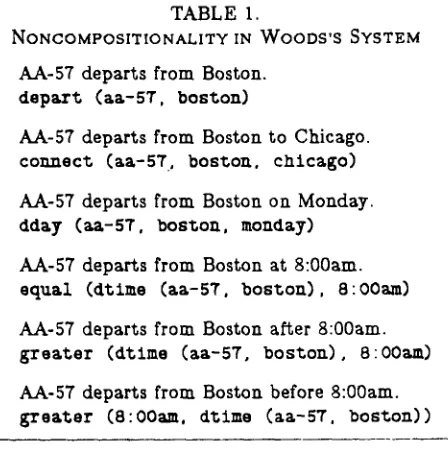
is translated is the procedure d e p a r t . (AA-57 is an air- line Right.) However, the addition of a prepositional phrase changes this; Table 1 shows the interpreta- tion of the same sentence after wrious prepositional phrases have been appended. For example, the addi- tion of ~oChicago
changes the translation ofdepart;
to connect, though the intended sense of the word is clearly unchanged, s
This is necessitated by the particular set of database primitives that W o o d s used, selected for
their being %tom/c" (1967:7-4-7-11) rather than for promoting compositions/Sty. Rules in the system axe able to generate non-compositional representations be- cause they have the power to set an arbitrarily complex parse tree as their trigger, and to return an axbitrary representation that could modify or completely ignore the components of the parse trees they are supposed to be interpreting/ For example, a rule can say (1967:A- 44):
If you have a sentence whose subject is a flight, whose verb is leave or depart, and which has two (or more) prepositional phrases modifying
t h e verb, one with /from and a place name, the other with a~ and a time, then the interpretation is equal (dtime (a, b), c), where a is the flight, b is the place, and c is the time.
Thus while Woods's semantics could probably be m a d e • reasonably compositional simply by appropriate ad-
justment of the procedure calls into which sentences are translated, it would still not be compositional by
design
the way Montague semantics is.8~Ve h a v e simplified a Little h e r e in order to m a k e our point. In fact, s e n t e n c e s like t h o s e in Table I w i t h p r e p o s i t i o n a l p h r a s e s will ~ c t u a l l y c a u s e t h e e x e c u t i o n of t w o s e m a n t i c rules: o n e for t h e c o m p l e t e s e n t e n c e , a n d o n e for t h e s e n t e n c e it h a p p e n s to c o n t a i n , A.A-57 d e p c r t s f r o m 8 o s ~ o ~ . T h e r e s u l t i n g i n t e r p r e t a - t i o n will be t h e c o n j u n c t i o n of t h e o u t p u t f r o m e a c h rule ( W o o d s 1967~9-5):
A A - 5 7 depLrts from B o s t o n to C h i c a g o .
depar~ (aa-ST, boston) and connec~ (aa-57. boston, c~icago) W o o d s l e a v e s it open ( 1 9 6 7 : 9 - 7 ) a,s to h o w the s e m a n t i c r e d u n - d a n c y in s u c h e x p r e s s i o n s s h o u l d be h a n d l e d , thou~,h one of hie s u g g e s t i o n s is a filter t h a t w o u l d r e m o v e c o n j u n c t s i m p l i e d b y others, g i v i n g , in this case, t h e i n t e r p r e t a t i o n s h o w n in Table 1.
7 N o r is t h e r e &nything t h a t p r e v e n t s t h e c o n s t r u c t i o n of rules t h a t w o u l d r e s u l t in c o n j u n c t i o n s w i t h conflicting, r a t h e r t h a n merely redund~tnt, terms.
T A B L E 1.
NONCOMPOSITIONALITY IN WOODS'S SYSTEM AA-57 departs from Boston.
d e p a r t (aa-57, bos~on)
A.A-57 departs from Boston to Chicago. conltecT, (aa-5T, besT, on. chicago) AA-57 departs from Boston on Monday. dday (aa-57, boston, monday) A A - 5 7 departs from Boston at 8:00am. equal (dtlme (aa-5T. boston), 8:00am) AA-57 departs from Boston after 8:00am. greater (dtime (aa-5T, boston), 8:00am) A.A-57 departs from Boston before 8:00am. greater (8:00am, dtlme (aa-5T. boston))
Although Montague semantics has m u c h to recom- m e n d it, it is not possible, ho~vever, to implement it directly in a practical N L U system, for two reasons. The first is that Montague semantics as currently for- mulated is computationally impractical. It throws around huge sets, infinite objects, functions of func- tions, and piles of possible worlds with great abandon. Friedman, M o r a n and Warren (1978a) point out that in the smallest possible Montague system, one with. two entities and two points of reference, there are, for example, 22"s= elements in the class of possible denota- tions of prepositions, each element being a set contain-
ing
2512
ordered pairs, sT h e second reason we can't use Montague seman- tics directly is that truth-conditional semantics are not useful in AI; A/uses
know/edge
semant.ics (Tarnawksy 1982) in which semantic objects tend to be symbols or expressions in a declarative or procedural knowledge representation system. Moreover, truth-conditional semantics really only deals with declarative sentences (Dowry eC al 1981:13) (though there has been work attempting to extend Montague's work to questions; e.g. Hamblin 1973); a practical N L U system needs to be able to deal with c o m m a n d s and questions as well as declarative sentences. [image:3.612.331.555.50.275.2]There have, however, been attempts to take the intensional logic t h a t Montague uses as an inter- mediate step in his translations, and give it a new in- terpretation in terms of A I - t y p e semantic objects, thus preserving all other aspects of Montague's approach; see, for example, Hobbs and Rosenschein 1977, and Smith's (1979) objections to their approach. There has also been interest in using the intensional logic itself (or something similar) as an AI representation ~ (e.g. Moore 1981). But while it may be possible to make limited use of intensional logic expressions, I° there are many problems that need to be solved before inten- sional logic or other flavors of logical forms could sup- port the type of inference and problem solving that AI requires of its semantic representations; see Moore 1981 for a useful discussion. Moreover, Gallin (1975) has shown Montague's intensional logic to be incom- plete. (See also the discussion in Section 7 of work using logical forms.)
Nevertheless, it is possible to use many aspects of Montague's approach in semantics in AI. The seman- tic interpreter that we describe below maintains three of the four properties of Montague semantics that we described above, and we therefore refer to it as
"Montague-inspired".
TABLE 2.
TYPES IN THE AHSITY SEMANTIC INTERPRETER BASIC TYPES
Frame a
( p e n g u i n ?x), Clove ?x) Slot
color, agent Frame determiner b
(t~e ?x), Ca ?x)
O T H E R TYPES
Slot-filler pair = slot ~ frame statement (color=red), (agent=(the ?x (f±sh ?x))) Frame descriptor = frame ~ slot-filler pair*
(pen~uln ?x (owner=Nadla)),
(love ?x (agent=Ross) (patient=Nadla)), (dog ?x)
Frame statement [or instance c]
= frame determiner -~ frame descriptor (the ?x (penguin ?x (owner=Nadla))), (a ?x (love ?x (agent=Ross)
(pail ent=Nadl a) ) ), ( t h e ?x (dog ? x ) ) .
p e n ~ l n 8 7 [an instancel
3. Our semantic interpreter
Our semantic interpreter is a component of a system that uses a frame-like representation for both story comprehension and problem-solving. The system in- cludes a frame language, n a m e d Frail, a problem sol- ver, and a discourse pragmatics component; further details m a y be found in Charniak 1981, W o n g 1981a, and W o n g 1981b. The natural language front-end in- cludes Paragram, a deterministic parser based on that of Marcus (1980). Unlike Marcus's parser, Paragram has two types of rule: base phrase structure rules and transformational rules. It is also able to parse un- grammatical sentences; it always uses the rule that matches best, even if none match exactly. Paragram is described in Charniak 1983.
9 1 t o n i c a l l y , M o n t a g u e r e g a r d e d i n t e n s i o n a l l o g i c m e r e l y as a c o n - v e n i e n c e in s p e c i f y i n K his t r a n s l a t i o n , a n d o n e t h a t w a s c o m - p l e t e l y i r r e l e v a n t t o t h e s u b s t a n c e of his s e m a n t i c t h e o r i e s .
l O G o d d e n ( 1 9 8 1 ) in f ~ c t u s e s t h e m for s i m p l e t r a n s l a t i o n b e t - w e e n T h a i a n d E n g l i s h .
a T h e q u e J t i o n - m ~ r k p r e f i x i n d i c a t e s & v a r i a b l e . W h e n e v e r a f r e e v ~ i a b l e i n a f r a m e is b o u n d t o a v ~ i a b l e in a f r a m e d e t e r m i n e r , a u n i q u e n e w n a m e is g e n e r a t e d for t h a t v a r i a b l e a n d its b i n d i n g s . In t h i s p a p e r , we s h a l l a s s u m e for s i m p l i c i t y t h a t v a x i a b l e n a m e s ~ r e m a K i c a l l y ~ c o r r e c t " f r o m t h e s t a r t .
bDo n o t be m i s l e d b y t h e f a c t t h a t f r a m e s a n d f r a m e d e t e r m i n e r s l o o k s i m i l a r . T h e y H e a c t u a l l y v e r y d i f f e r e n t : t h e first is a g t a t i c d a t a s t r u c t u r e ; t h e s e c o n d is a f r a m e retrieva~l p r o c e d u r e . CAn i n s t a n c e is t h e r e s u l t of e v a l u a t i n g a f r a m e s t a t e m e n t in F r a i l . It is a s y m b o l t h a t d e n o t e s t h e o b j e c t r e f e r e n c e d b y t h e f r a m e s t a t e m e n t . To A b s i t y , t h e r e is n o d i s t i n c t i o n b e t w e e n t h e t w o ; ~n i n s t a n . c e c a n b e u s e d w h e r e v e r ~ f r a m e I t a t e m e n t c~n.
T A B L E 3.
T Y P E C O R R E S P O N D E N C E S IN ABSITY
S Y N T A C T I C T Y P E S E M A N T I C T Y P E
Major sentence
Sentence
Noun Adjective Determiner Noun phrase Preposition
Prepositional Phrase Verb
Adverb Auxiliary Verb phrase Clause end
F r a m e statement, instance Frame descriptor
Frame
Slot-filler pair F r a m e determiner
F r a m e statement, instance Slot name
Slot-filler pair (Action) frame Slot-filler pair Slot-filler pair F r a m e descriptor Frame d e t e r m i n e r .
which are components of the frame language Frail. 11 We do, however, retain a strong typing upon our semantic objects, t h a t is, each syntactic category has an associated semantic type. Table 2 shows the types of components of Frail, how t h e y m a y be combined, and examples of each; the nature of the components listed will become clearer with the examples in the next section. Table 3 gives the component of Frail t h a t corresponds to each syntactic type. As a consequence of the kind of semantic objects we are dealing with, the system of types is not recursively defined in the Montague style, but we retain the idea t h a t the type of a semantic object should be a function of the types of the components of t h a t object.
We have also carried over from Montague seman- tics the operation of syntactic and semantic rules in t a n d e m upon corresponding objects. However, it is not possible to maintain the one-to-one correspondence of rules when we replace Montague's simple syntax with the much larger English g r a m m a r of the P a r a g r a m parser. This is because in Montague's system each syn- tactic rule either creates a new node from old o n e s - - for example, forming an intransitive verb phrase from a transitive verb and a noun p h r a s e - - o r places a new
l l A l t h o u ~ h t h e o b j e c t t h a t r e p r e s e n t s a S e n t e n c e is • p r o c e d u r e call in Frail u p o n a knowledge basej this is n o t p r o c e d u r ~ l s e m ~ n - tics in t h e s t r i c t W o o d s s e n s e , as t h e mes~aing i n h e r e s n o t in t h e p r o c e d u r e s b u t in the o b j e c t s t h e y m a n i p u l a t e .
node under an existing o n e - - s u c h as adding an adverb to an existing intransitive verb phrase. These are" ac- tions t h a t clearly have semantic counterparts. W h e n we s t a r t to add m o v e m e n t rules such as passivizatioa and dative m o v e m e n t to the g r a m m a r , we find our- selves with rules t h a t have no clear semantic counter- part; indeed with rules t h a t , it is often claimed (e.g. C h o m s k y 1965:132), leave the meaning of a sentence quite unchanged.
We therefore distinguish between parser rules t h a t should have corresponding semantic rules and those t h a t should not. As the above discussion suggests, rules t h a t a t t a c h nodes are the ones t h a t have seman- tic counterparts. In P a r a g r a m , these are the base structure rules. For this subset of the syntactic rules, semantic rules run in t a n d e m , j u s t as in Montague's semantics, m
It is a consequence of the above properties of our semantic interpreter t h a t we have also retained the p r o p e r t y of compositionaiity by design. This fol- lows from the uniform typing; the correspondence bet- ween syntactic and semantic rules t h a t maintains this uniformity; and there being a unique semantic object corresponding to each word of English i~ (see Dowty e~ al 1981:180-181). Unlike those of Woods's (1967) air- line reservation system front-end discussed in Section 2, our semantic rules are very weak: t h e y cannot change or ignore the components upon which t h e y operate, nor can more t h a n one rule volunteer an inter- pretation for any node of the parse tree. The power of the system comes from the nature of the semantic ob- jects and the syntax-directed application of semantic rules, rather t h a n from the semantic rules themselves.
4. Examples
Some examples will make our semantic interpreter clearer. First, let's consider a simple noun phrase, the book. From Table 3, the semantic type for the determiner She is a frame determiner function, in this case ( t h e ? x ) , and the type for the noun book is a kind of frame, here (book ?x). These are combined
12In her s y n t h e s i s of t r a n s f o r m a t i o n a . l s y n t a x w i t h Monta6,ue a c r o s t i c s , P a r t e e (1973, 1975) observes t h a t the s e m a n t i c rule c o r r e s p o n d i n g to m a n y t r a n s f o r m a t i o n s will simply be the iden- tity m a p p i n g .
in the canonical w a y - - t h e frame name is added as an
argument to the frame determiner f u n c t i o n - - a n d the result, ( t h e ?x (book ? x ) ) , is a Frail frame state-
ment (which evaluates to an instance) that represents
the unique book referred to. 14
A descriptive adjective corresponds to a slot-filler
pair; for example, red is represented by ( c o l o r = r e d ) ,
where c o l o r is the name of a slot and r e d is a frame
instance, the name of a frame. A slot-filler pair can be added as an argument to a frame, so the red
book would have the semantic interpretation ( t h e ?x
(book ?x (color=red))).
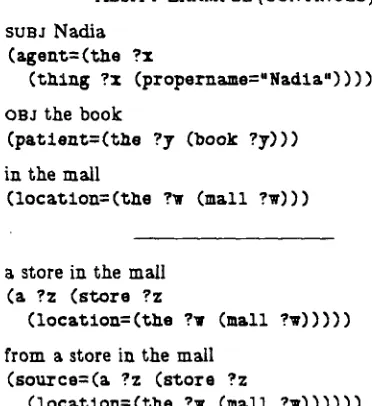
Now let's consider a complete sentence:
Nadia bought the book from a store in the mall.
Table 4 shows the representation for each component
of the sentence; note t h a t the basic noun phrases
have already been formed in the manner described
above. Note also that we have inserted the pseudo-
prepositional subject and object markers s u s J and
osJ, which are then treated as if they were real
prepositions; see Hirer and Charniak 1982 or Hirst 1983 for details of this. For simplicity, we assume that
each word is unambiguous (we discuss our disambigua- tion procedures in Section 6); we also ignore the tense cn the verb. Table 5 shows the next four stages in the
interpretation. First, noun phrases and their preposi-
tions are combined, forming slot-filler pairs. Then the
prepositional phrase in the mall can be attached to a
store (since a noun phrase, being a frame, can have
a slot-filler pair added to it), and the prepositional phrase from a store in the marl is formed. The third
stage shown in the Table is the attachment of the slot-
filler pairs for the three top-level prepositional phrases to the frame representing the verb. Finally, the period,
which is translated as a frame determiner function, causes instantiation of the buy frame, and the trans-
lation is complete.
5. Semantic help for the parser
As we mentioned earlier, any parser will occasionally
need semantic help. In Marcus-type parsers, this need
occurs in rules that have the form "If semantics prefers
1 4 N o t e ~ h a t i t is t h e r e s p o n s i b i l i t y " of t h e f r a m e s y s t e m t o d e t e r - m i n e w i t h t h e h e l p of t h e p r a g m a t i c s m o d u l e w h i c h o n e o f t h e
b o o k s t h a t i t m~ty k n o w a b o u t is t h e c o r r e c t o n e i n c o n t e x t .
TABLE 4.
ABSITY EXAMPL E
W O R D O R P H R A S E S E M A N T I C O B J E C T
S U B J agent
Nadia ( t h e ?x ( t h i n g ?x
(propername="Nadla")))
bought (buy ?x)
oBJ pa~len~
the book (the ?y (book ?y))
from source
a store (a ?z (el;ore ?z))
in loca~lon
the mall (the ?w (mall ?w)) • [period I (a ?u)
X over Y then do X ' ; otherwise do Y " . To answer
such questions, we have a Semantic Enquiry Desk r, hat operates upon the same semantic objects as the seman-
tic interpreter. Because these objects are components
of the Frail frame language, the Enquiry Desk can use the full retrieval and inference power of Frail in answering the enquiry.
6. Word sense disambiguation
O n e problem that Montague semantics does not ad- dress is that of word disambiguation. Rather, there is assumed to exist a function that m a p s each word to a unique sense, and the semantic formalism operates on the values of this function.Is Clearly, however, a prac-
tical NLU system must take account of word sense am- biguity, and so we must add a disambiguation facility
to our interpreter. Fortunately, the word translation function allows us to ~dd this facility transparently.
Instead of simply mapping a word to an invariant
unique sense, the function can map it to whatever sense is correct for a particular instance.
Our disambiguation facility is called Polaroid
Words. Is Each word in the system is represented by
15This is not quite true. Specified unique translations axe given
for p r o p e r n a m e s a n d f o r a f e w i m p o r t a n t f u n c t i o n w o r d s , s u c h as
t h e a n d be; s e e M o n t a ~ e 1 9 7 3 1 2 ] : 2 6 1 , o r D o w r y ~ ~l 1 9 8 1 : 1 9 2 f f .
T A B L E 5.
A B S I T Y E X A M P L E (CONTINUED) SUBJ N a d i a
( a g e n t , = ( t h e ?x
(thlng ?x (propername="Nadla")))) OSJ the book
( p a t l e n l ; = ( t h e ? y ( b o o k ? y ) ) )
in t h e m a l l
(loca~lon:C1;he ?~ (mall ?w)))
a store in the mall (a ?z (s~core ?z
(loca~ion=C~he ?w (mall ?w))))) from a store in the mall
(source=Ca ?z (s~ore ?z
(locatlon=(the ?w (mall ?W))))))
N a S a b o u g h t t h e b o o k f r o m a s t o r e i n t h e m a l l ( b u y ? u
( a g e n t = ( t h e ?x ( t h l n g ?x (propername="Sadia")))) (patient=(the ?y (book ?y))) (source=(a ?z (store ?z
(location=(the ?w (m~ll ?w)))))))
Nadia bought the book from a store in the mail. (a ?u
(buy ?u
( a g e n r , = ( t h e ? x (thing ? x (propername=" N adla" ) ) ) ) ( p a t i e n t = ( t h e ? y ( b o o k ? y ) ) ) (source=(a ?z (store ?z
(locatlon=(1;he ?w (marl ?w)))))))
a separate process that, by talking to other processes and by looking at paths m a d e by spreading activation in the knowledge base, figures out the word's mean- ing. Each word is like a self-developing photograph that can be manipulated by the semantic interpreter even while the picture is forming; and if some other process needs to look at the picture (e.g. if the Semantic Enquiry Desk has an "if semantics prefers ~ question from the parser), then a half-developed pic- ture m a y provide enough information. Exactly the same process, without the spreading-activation phase,
is used to disambiguate case roles as well. Polaroid W o r d s are described more fully in Hirst and Charniak 1982 and Hirst 1983.
7. Comparison with other work
O u r approach to semantic interpretation m a y usefully be compared with other recent work with similar goals to ours.
O n e such project is that of Jones and W a r r e n (1982), w h o attempt a conciliation between Montague semantics and a conceptual dependency representation (Schank 1975). Their approach is to modify Montague's translation from English to intensional logic so that the resulting expressions have a canonical interpreta- tion in conceptual dependency. T h e y do not ad- dress such issues as extending Montague's syntax, nor whether their approach can be extended to deal with more m o d e r n Schankian representations (e.g. Schank 1982). Nevertheless, their work, which they describe as a hesitant first step, is similar in spirit to ours, and it will be interesting to see h o w it develops.
Important recent work that extends the syntac- tic complexity of Montague's work is that on general- ized phrase structure g r a m m a r ( G P S G ) (Gazdar 1982). Such g r a m m a r s combine a complex transformation- free syntax with Montague's semantics, the rules again operating in tandem. G a w r o n et al (1982) have imple- mented a database interface based on G F S G . In their system, the intensional logic of the semantic com- ponent is replaced by a simplified extensional logic,
which, in turn, is translated into a query for database access. Schubert and Peiletier (1982) have also sought to simplify the semantic output of a G P S G to a more ~conventional" logical form; and Rosenschein and Shieber (1982) describe a similar translation process into extensional logical forms, using a context-free g r a m m a r intended to be similar to a G P S G . Iv
[image:7.612.55.241.82.285.2]provides an i n t e r p r e t a t i o n of the logical form, but only in a weak sense, as the form must first pass t h r o u g h another ( a p p a r e n t l y somewhat ad hoc) trans- lation and disambiguati0n process. Nor do these ap- proaches provide any semantic feedback to the par- set. is These differences, however, are independent of the choice of GPSG; it should be easy, at least in prin- ciple, to modify these approaches to give Frail output, or, conversely, to replace P a r a g r a m in our system with a G P S G parser. 19
The PSX-KLON~- system of Bobrow and Webber (1980a, 1980b) also has a close coupling between syn- t a x and semantics. R a t h e r t h a n operating in tandem, though, the two are described as " c a s c a d e d ' , with an ATN parser handing constituents to a semantic in- terpreter, which is allowed to return t h e m (causing the ATN to back up) if the purser's choice is found to be semantically untenable. Otherwise, a process
of incremental description r e f i n e m e n t is used to in-
t e r p r e t the constituent; this relies on the fact t h a t the syntactic constituents are represented in the same formalism, KL-OSZ (Brachman 1978), as the system's knowledge base. The semantic interpreter uses projec-
tion rules to form an interpretation in a language
called JAaGON, which is then translated into KL-ONZ. Bobrow and Webber are particularly concerned with using this framework to determine the combinatoric relationship between quantifiers in a sentence.
Bobrow and Webber's approach addresses several of the issues t h a t we do, in particular the relationship between syntax and semantics. The information feed- back to the parser is similar to our Semantic Enquiry Desk, though in our system, because the parser is deterministic, semantic feedback cannot be con fluted with syntactic success or failure. Both approaches rely on the fact t h a t the objects manipulated are objects of a knowledge representation t h a t permits appropriate judgments to be made, though in rather a different manner.
Hendler and Phillips (1981; Phillips and Hendler 1982) have implemented a control structure for NLU 18Gawron et al p r o d u c e all p o s l i b l e t r e e s a n d t h e i r t r a n i l a t i o n s for t h e i n p u t s e n t e n c e , s.nd t h e n t h r o w a w a y a n y t h a t d o n ' t m a k e s e n s e t o t h e d a t a b a s e .
I f ' O u r c h o i c e o f P a r a g r a m w a s l a r g e l y p r a g m a t i c ~ i t w&s avL/l- • b l e - - a n d d o e s n o t r e p r e s e n t &ny p a r t i c u l a r c o m m i t m e n t t o t r a n s f o r m a t i o n a l g ~ a m m a r s.
based on message passing, with the goal of running syntax and semantics in parallel a n d providing seman- tic feedback to the parser. A ~moderator" trans- lates between syntactic constructs and semantic repre- sentations. However, their a p p r o a c h to interpretation is essentially ad hoc (James Hendler, persoaoi cum- munication), and they do not a t t e m p t to put syntactic and semantic rules in strict correspondence, nor type their semantic objects.
None of the work mentioned above addresses issues of lexical ambiguity as ours does, t h o u g h Bobrow and Webber's incremental description refine- ment could possibly be extended to cover it. Also, Gawron et al have a process to disambiguate case roles in the logical form after it is complete, which operates in a manner not dissimilar to the case-slot part of Polaroid Words.
8 . C o n c l u s i o n
We have described a new a p p r o a c h to semantic inter- pretation, one suggested by the semantic formalism of Richard Montague. We believe this work to be a clean and elegant foundation for semantic interpreta- tion, in contrast to previous ad hoc approaches. At the moment, though, the work is only a foundation; the test of a foundation is w h a t can be constructed on top of it. We do not expect the construction to be unproblematic; here are some of the problems we will have to solve.
First, the approach is not just compositional but almost too compositional. At present, noun phrases are taken to be invariably and unalterably specific and extensional, t h a t is to imply the existence of the unique entity or set of entities t h a t they specify. In English, this is not always correct. A sentence such as:
Nadia owns a unicorn.
implies t h a t a unicorn exists, but this is not true of:
Nadia talked abou~ a unicorn.
to Absity. 2° Similarly, a sentence such as: The lion is not a beast to be trifled w/th. can be a generic statement intended to be true of all lions; Montague did not treat generics.
Second, the approach is heavily dependent upon the expressive power of the underlying frame language. For example, our language, Frail, is yet deficient in its handling of time, and this is clearly reflected in Absity. Further, the approach makes certain claims about the nature of frame representations~that a descriptive adjective in some sense is a slot-filler pair, for example that might be shown to be untenable.
W e will also have to deal with problems in quantification, anaphoric reference, and m a n y other areas. Nevertheless, we believe that this approach to semantic interpretation shows considerable promise.
Acknowledgemems
I am grateful to Eugene Charniak, C~role Chaski, Jim Hendler, Polly Jacobson, and Nadia Talent for their comments upon earlier versions of this paper.
References
B O B R O W , R o b e r t J ~nd W E B B E R , B o n n i e L y n n (1980&). =PSI- K L O N E : Pa.rsing a n d s e m a n t i c i n t e r p r e t a t i o n in t h e BBN n a t u r a l l a n g u a g e u n d e r s t a . n d i n g s y s t e m . ~ l~oceedings
O~ th.c T~ird ~iennial Conference, Co.nadio.n Society
/or Computational Studies o[ [nte|llgenee / Soei~t~ C a n a d i e n n e pour ~ t ~ d e s d'Inte~ligence par Ordinateur, Victoria., Ma.y 1980. 131-142.
B O B R O W , R o b e r t J a n d W E B B E R , B o n n i e L y n n (1980b). " K n o w l e d g e r e p r e s e n t a t i o n for s y n t a c t i c / s e m a n t i c process- i~g." P~ociedin~s o f ~&e First Anr~a~ lVationa~l C o n f e r - ence 0~ A r t i f i c i a l Intelligence, Stanford, A u g u s t 1980. 316-323.
B R A C H M A N , R o n a l d J (1978). =A s t r u c t u r a l pArs.ditto for rep- r e s e n t i n g knowledge. ~ R e p o r t 3605, Bolt, B e r a n e k a n d NewmaJ~, C a m b r i d g e , MA 02138. M a y 1978.
C H A R N I A K , E u g e n e (1981). "A c o m m o n r e p r e s e n t a t i o n for p r o b l e m - s o l v i n g a n d l a n g u a . g e - c o m p r e h e n s i o n i n f o r m a t i o n . " A r t i f i c i a l [ntelli.gence, 16(3), July 1981, 225-255. C H A R N I A K , E u g e n e (1983). ~A p~urser w i t h ~ o m e t h i n g for
everyone. ~ [11 in: King, M ~ g a x e t ( e d i t o r ) . P~rsingnatt~ral language, L o n d o n : A c a d e m i c Press, 1983. [2] Tech~ic~l r e p o r t CS-70, D e p a r t m e n t of C o m p u t e r Science, Brown University, Providence, R[ 02912. April 1981.
C H O M S K Y , A v r ~ m Noa.m (1965). Aspects of the theOr~l Of synta=. Ca.mbridge, MA: T h e MIT Press, 1965.
20He h ~ n d l e d s u c h s e n t e n c e s by h a v i n g two d i s t i n c t parsee, one for e a c h rea.dinK; a mea.ning p o s t u l a t e equa.tes t h e repre- s e n t a t i o n s of the two p a r s e s w h e r e t h e verb ma.kes it a p p r o p r i a t e to do so.
D O W T Y , D a v i d R; W A L L , R o b e r t E u g e n e a n d P E T E R S , S t a a l e y (1981). [ntrodt*ction to M o n t a g u e s e m a n t i c s (-~-
S y n t h e s e l~n~u~ge library 11). D o r d r e c h t : D. Reidel, 1981. F O D O R , J e r r y AlAn (1978). " T o m Swift a n d his p r o c e d u r a l g r ~ n d ~ o t h e r . " Cognition, 6(3), S e p t e m b e r 1978, 229-247. F O D O R , Jerry AlaJ1 (1970). "In r e p l y to Philip J o h n s o n - L a i r d . "
Cognition, T(1), Maxch 1979, 03-95.
F R I E D M A N , Joyce; M O R A N , Dougla.s Bailey ~nd W A R R E N , De.rid S c o t t (1978a.). " E x p l i c i t finite i n t e n s i o n a l models for P T Q . ~ [I] American jo~rn¢l o/ computational linguistics,
1978:1, microfiche 74, 3-22. [2] Paper N - 3 , Computer S~udies in Formal Linguistics, D e p z r t m e n t of Computer amd Communion.lion Sciences, U n i v e r s i t y of Michigan, Ann
Arbor, MI 48109.
F R I E D M A N , Joyce; M O R A N , D o u g l a s Ba~ley a n d W A R R E N , Da.vid Scott, (1978b). =An i n t e r p r e t a t i o n s y s t e m for Montague Kr,~mmar." [11 A m e r i c a n yournal of compura- tional linguistics, 1078:1, microfiche 74, 23-96. (21 Pa.per N - 4 , C o m p u t e r S t u d i e s in F o r m a l L i n g u i s t i c s , D e p a r t m e n t of C o m p u t e r ~nd C o m m u n i c a t i o n Sciences, U n i v e r s i t y of M i c h i g a n , A n n Arbor, MI 48109.
F R I E D M A N , Joyce; M O R A N , D o u g l a s Bailey a ~ d W A R R E N , D~vid Scott, (1978c). = E v M u a t m g E n g l i s h s e n t e n c e s in a. logical mode[: A process v e r s i o n of M o n t ~ g u e ~ a m - max." {1] P~oceed~ngs of the 7th I n t e r n a t i o n a l Cor~ferene¢
on C o m p u t a t i o n a l LingtListics, Bergen, Norway, A u g u s t 1978. [2} P a p e r N-15, C o m p u t e r S t u d i e s in Forma.l L i n g u i s t i c s , D e p a c t m e n t of C o m p u t e r c u d C o m m u n i c a t i o n Sciences, U n i v e r s i t y of M i c h i g a n , A n n Arbor, MI ~8109. A u g u s t 1978.
G A L L I N , Daniel (1975). [ n t e n s i o n a l a n d ~igher-order modal
logic ~uith ~pplic~tions ~o Montague sernan~t'cs ( ~ N o r t h - H o l l a n d M a t h e m a t i c s Series 9). A m s t e r d a m : N o r t h - Holland, 1975. {Revised f r o m the a.uthor's d o c t o r a l d i s s e r t a t i o n , D e p a r t m e n t of M a t h e m a t i c s , U n i v e r s i t y of Caaifornia, Berkeley, September 1972.]
G A W R O N , Jea.n Mark; K I N G , Jona.thon J; L A M P [ N G , John; L O E B N E R , E g o n E; P A U L S O N , E Anne; P U L L U M , Geoffrey K; SAG, Ivan A a n d W A S O W , T h o m a s A (1982). " P r o c e s s i n g E n g l i s h w i t h a. genera.lized p h r a s e s t r u c t u r e g r a m m a r . ° Ii[ Proceedings, gOCh Ann~cL~ 3v[ee~t'ng o f
ihe Association for Computational Linguistics, Toronto, June 1982. 74--81. [21 T e c h n i c a l note C S L - 8 2 - 5 , C o m p u t e r Science Labors.tory, Hewiett-Packard, Palo Alto, C A 94304. A p r i l ~982.
C A Z D A R , Gera~d (1982). " P h r a s e s t r u c t u r e g r a m m a r . " in: J A C O B S O N , Pa.uline Ida a n d P U L L U M , Geoffrey K. The
~attLre Of syntactic representation. Dordrecht: D. Reidel, 1982.
G O D D E N , K u r t Sterling (1081). Montag~¢ grgmmar ~nd m a c h i n e er~nslation between E n g l i s h and Thai. Doctoral d i s s e r t a t i o n , D e p a r t m e n t of L i n g u i s t i c s , U n i v e r s i t y of K ansa.s, 1981.
H A M B L I N , C L (1973). = Q u e s t i o n s in M o n t a g u e English." [1[ F o u n d a t i o n s o/ langt~=g¢, 10(1), M a y 1073, 41-53. {2] in Partee 1976, 247-259.
H E N D L E R , Ja.mes A l e x a n d e r a n d P H I L L I P S , B r i a n (1981). =A flexible control s t r u c t u r e for t h e c o n c e p t u a l a n a l y s i s of n a t u r a l l ~ n g u a g e u s i n g m e s s a g e - p a s s i n g . ~ T e c h n i c a l r e p o r t T R - 0 8 - 8 1 - 0 3 , C o m p u t e r Science Labors.tory, Texas I n s t r u m e n t s I n c o r p o r a t e d , Define, T X 75266, 1981. H I R S T , G r a e m e (1983). A fot~ndation for se~nantic interp~'eta-
tlon, ~ i t h toord ~nd c~s¢ disambigt~ation. Doctoral disser- t a t i o n , D e p a r t m e n t of C o m p u t e r Science, Brown U n i v e r s i t y ( f o r t h c o m i n g t.
sense ~nd case slot d i s a m b / g ~ a t i o n . " Proceedings o f t h e National Conference on A r t i f i c i a l Intelligence, P i t t s b u r g h , A u g u s t 1982. 95-98.
HOBBS, J e r r y R o b e r t and R O S E N S C H E I N , Stanley J o s h u a (1977). =Making c o m p u t a t i o n a l sense of Monta4~ue'l inten- sional logic." A r t i f i c i a l Intelligence, 9(3), December 1977,
287-306.
J O H N S O N - L A I R D , Philip Nicholas (1978). " W h a t ' s w r o n g w i t h G r a n d m a ' s guide to p r o c e d u r a l semantics: A reply to Jerry Fodor. ~ Cognition, 6(3), S e p t e m b e r 1978, 249-261. J O N E S , Mark A ~nd W A R R E N , David Scott (1982). "Concep-
tual dependency and M o n t a g n e ~ r a m m a r : A step t o w a r d conciliation." Proceedings o f the N~tion¢l Conference on A r t i f i c i a l [n$elligence, P i t t s b u r g h , A u g n s t 1982. 79-83. L E H N E R T , Wendy Grace ~nd R I N G L E , Martin H (1982).
Strategies for natural language processing. Hlllsdale, N J:
Lawrence E r l b a u m Associates, 1982.
MARCUS, Mitchell P (1980). A theory o f sgntactic recognition
for natv.ral l~nguag¢. Cambridge, MA: The MIT P r e u ,
1980.
MONTAGUE, Richard (1973). "The proper t r e a t m e n t of quantification in o r d i n a r y English." [I I in: H I N T I K K A ,
Ka~rlo Jaakko Jnhani; M O R A V C S I K , Julius M a t t h e w
Emil ~nd S U P P E S , Patrick Colonel (editors). Approaches
to ~ t u r ~ l lang.~age: Proceedings o f tAe 1970 S t a n f o r d workshop on g r a m m a r ~nd semantics. Dordrecht: D. Reide|, 1973. 221-242. [2] in: T H O M A S O N , R i c h m o n d
Hunt (editor). Formal philosophll: Selected papers o f
R i c h a r d Mont~gae. New Haven: Yale University Press, 1974. 247-270.
MOORE, R o b e r t C (1981). "Problems in logical form. ~ l~'ocsedings, 191h A n n u a l Meeting o f th, e Association f o r C o m p u t a t i o n a l L i n g u i s t i c s , Stanford, July 1981. 117-124. PARTEE, Baabara Hall (1973). "Some t r a n s f o r m a t i o n a l exten- sions of Montagne ~ a m m a r . " [11 J'o~rnal o f Philosophical Logic, 2, 1973, 509--534. [2] in Psatee 1976, 51-76. PARTEE, B a r b a r a Hall (1975). "Montagne g r a m m a r and trxns-
form&tional 6 r a m m a r . " L i n g u i s t i c [nquirF, 6(2), Spring 1975, 203-300.
PARTEE, B a r b a r a Hall (editor) (1976) . Montag~,e g r a m m a r . New York: Academic Press, 1976.
P H I L L I P S , Brian and H E N D L E R , James Alexander (1982). =A message-passing control s t r u c t u r e for t e x t u n d e r s t a n d i n 8 . "
in: H O R E C K ~ ' , J~n (editor). C O L I N G 8£: Proceedings
o f the N i n t A I n t e r n a t i o n a l Conference on C o m p u t a t i o n a l L in g u ist i cs, Prague, July 5--10, 198£ ( = N o r t h - H o l l a n d
Linguistic Series 47). Amsterdam: North-Holland, 1982.
307-312.
R O S E N S C H E I N , Stanley Joshua ~nd S H I E B E R , Stuart M
(1982). " T r a n s l a t i n g English into logical form." P~oceedin~s, ~O~h A n n u a l Meeting o f the Association for Computational Linguistics, Toronto, J u n e 1982. i - 8 .
SCHANK, Roger Carl (editor) (1975). Conceptual i n f o r m a t i o n processing ( ~ F u n d a m e n t a l studies in c o m p u t e r science 3). A m s t e r d a m : North-Holland, 1975.
SCHANK, Roger Carl (1982). "Reminding and m e m o r y or- ganization: An i n t r o d u c t i o n to MOPs." [I] in Lehnert and Ringle 1982, 455-494. [2] Research R e p o r t 170, D e p a r t m e n t of C o m p u t e r Science, Yale University, New Haven, C T 06520. December 1979.
SCHUBERT, Lenhaxt K and P E L L E T I E R , Francis Jeffry (1982). "From English to logic: Context-free c o m p u t a t i o n of
'conventional' logical translation." A m e r i c a n Journal of
Computational Linguistics, 8(1), January-March 1982, 26--44.
SMITH, Brian Cantwell (1979). "Intensionality in c o m p u t a - tional c o n t e x t s . " U n p u b l i s h e d MS, Artificial intelligence L a b o r a t o r y , M a s s a c h u s e t t s I n s t i t u t e of Technology, C a m - bridge, MA 02139. December 1979.
TARNAWSKY; George O r e s t (1982). Kno~oledgs s e m a n t i c s . Doctoral dissertation, D e p a r t m e n t of Linguistics, New York University, 1982.
WILKS, Yorick Alexander (1982). "Some t h o u g h t s on proce- dural semantics." [I] in L e h n e r t and Ringle 1982, 494- 518. {21 Technical r e p o r t C S C M - I , Cognitive Studies Centre, University of Essex, Wivenhoe Park, Colchester. November 1980.
W O N G , Douglas (1981~). =Language c o m p r e h e n s i o n in a problem solver." l~roceedings o f the 7th I n t e r n a t i o n a l Joint Conference on A r t i f i c i a l [ntelligence, Vancouver, A u g u s t 1981. 7-12.
W O N G , Douglas (1981b). O n the ~ n i f l e a t i o n of language
comprehension ~oitA problem solving. Doctoral dissertae tion [ava41able as technical r e p o r t CS-78], D e p a r t m e n t of C o m p u t e r Science, Brown University, 1981.
W O O D S , William Aaron Jr (1967). S e m a n t i c s for a qucs~ion- ~ n s t o s r i n g s y s t e m . {1] Doctoral dissertation, Harvard University, A u g u s t 1967. [2] r e p r i n t e d as a volume in the series O u t s t a n d i n g dissertations in the C o m p u t e r Sciences, New York: G a r l a n d Publishing, 1979.