Munich Personal RePEc Archive
Does Studying Ethics Affect Moral
Views? An Application to Distributive
Justice
Konow, James
Kiel University, Loyola Marymount University
September 2016
September 2016
Does Studying Ethics Affect Moral Views?
An Application to Distributive Justice
James Konow
Chair of Economics and Ethics Kiel University, Germany
and
Department of Economics
Loyola Marymount University, USA
Abstract
Recent years have witnessed a rapid increase in initiatives to expand ethics instruction in higher education. Numerous empirical studies have examined the possible effects on students of discipline-based ethics instruction, such business ethics and medical ethics. Nevertheless, the largest share of college ethics instruction has traditionally fallen to
philosophy departments, and there is a paucity of empirical research on the individual effects of that approach. This paper examines possible effects of exposure to readings and lectures in mandatory philosophy classes on student views of morality. Specifically, it focuses on an ethical topic of importance to both economics and philosophy, viz., economic (or
distributive) justice. The questionnaire study is designed to avoid features suspected of generating false positives in past research while calibrating the measurement so as to increase the likelihood of detecting even a modest true effect. The results provide little evidence that the philosophical ethics approach studied here systematically affects the fairness views of students. The possible implications for future research and for ethics instruction are briefly discussed.
I certify that I have the right to deposit the contribution with MPRA.
Acknowledgements: I wish to thank Jim Hanink, Joe Earley, Hauke Jelschen and Thomas Herndon for assistance with the data collection or analysis. I am also grateful for very helpful comments and suggestions on an earlier related paper from Colin Camerer, C. Monica Capra, Uri Gneezy, Astri Hole, John Ifcher, Hartmut Kliemt, Jack Knetsch, Alexander Koch, Erzo F.P. Luttmer, Stephan Meier, Axel Ockenfels, Tommaso Reggiani, Eric Schwitzgebel, Erte Xiao, and seminar participants at Aarhus University, Caltech, Claremont Graduate
1
1.Introduction
Recent years have witnessed a rapid increase in initiatives to expand ethics instruction, notably in higher education. These efforts have focused mostly on approaches tailored to different disciplines, including courses in business ethics, medical ethics, legal ethics, engineering ethics and media ethics, among others. There is also a growing discourse on returning economics to its
origins as a “moral science” and on strengthening the emphasis on ethics in economics teaching and research, e.g., see Atkinson (2011), Bruni and Sugden (2013), DeMartino (2011), Sandel (2013), and Shiller and Shiller (2011). Nevertheless, the largest share of college ethics instruction has traditionally fallen to philosophy departments. There have been studies of the possible effects of the more recent disciplinary approaches to ethics training, but there is a remarkable paucity of empirical research on possible effects of traditional philosophical ethics instruction on college students, indeed, none, to the author’s knowledge. This paper reports the results of a questionnaire study that takes a first step to fill that gap. Specifically, it focuses on an ethical topic of importance to both economics and philosophy, viz., economic (or distributive) justice, and examines possible effects on fairness views of exposure to readings and lectures in mandatory philosophy classes.
In order to put the design and contribution of the current study in context, section 2 reviews briefly previous empirical research on the effects of ethics instruction. Section 3 presents a detailed discussion of the method and procedures used here. Section 4 gives details of the questionnaire and reports its results, which provide little evidence that the ethics instruction studied here affects moral views. Finally, section 5 discusses the results and concludes.
2.Literature Review
Our review begins with a few examples from a now large literature in economics on factors that might affect moral views or behavior, which is loosely related to our topic. The natural
2
Empirical research on ethics instruction has been limited to training within disciplines, as opposed to philosophy courses.1 The disciplinary approaches are frequently constructed around psychological, rather than philosophical, approaches to ethics that often propose different stages of moral development, such as those found in the theoretical frameworks of Kohlberg (1969) or Rest (1986). Almost all of this quite extensive research is based on questionnaires, including tests or self-reported measures of ethical awareness, sensitivity, reasoning, judgment, intentions, behavior, or beliefs. I am aware of two fairly recent meta-analyses of this literature, which both draw disappointing conclusions. Waples, et al. (2009) analyze 25 studies of business ethics
programs and find “the overall effectiveness of business ethics instruction was minimal.” Antes,
et al. (2009) focus on 26 ethics programs in the sciences and, similar to Waples, et al., conclude
“the results showed that the overall effectiveness of ethics instruction was modest.”
The goals, design and methods of these questionnaire studies differ widely, but important questions arise about their various limitations. There is the general “file-drawer problem” (Rosenthal, 1979), i.e., negative findings seem more likely to go unreported, which creates a positive bias among disseminated studies as well as the meta-analyses that draw on them. In addition, ethics instruction might simply trigger a “social desirability bias” rather than a true change in the students, i.e., ethics students perhaps become more sensitive to giving socially desirable (i.e., ethical) responses. There are also numerous concerns that vary with the specific study. Often the ethics training is voluntary, raising questions of selection bias. Frequently, there is no group against which to compare treated subjects (i.e., the “control group” in experiments). The researcher is sometimes the instructor, which raises at least two questions. First, the
instructor might teach to the test or, similarly, design the test to be essentially a measure of learning of the course material rather than an indication of any kind of moral transformation. Second, demand effects become an increased concern, i.e., respondents might seek to offer the instructor/researcher the “desired” response. Response formats sometimes require subjective scoring, and, in addition, this is sometimes carried out by the researcher him/herself. Many are based on some theory of moral development, which requires acceptance of the relevance of the theoretical framework. Moreover, such theories involve stages of moral development, and most studies focus on just one, or at best a subset, of the theorized stages. Discipline-based ethics training presumably seeks to effect behavioral changes, but most research in this area does not study student behavior per se. Those survey studies that do address behavior rely on respondent self-reports, which accentuates the aforementioned doubts about social desirability bias and demand effects.
3
There are only three studies, to my knowledge, that measure actual (rather than self-reported) behavior related to ethics instruction, and all involve business ethics. Bloodgood, Turnley and Mudrack (2008) study undergraduate business students who had either already taken or not yet taken a full term business ethics course required by their program. Students in both groups participate in an experiment in which they are compensated based on their self-reported performance on a word search task. The experimenters, who identify surreptitiously
discrepancies between actual and reported performance, find no main effect on cheating between the two groups. Nevertheless, they find that less religious and more intelligent students who had taken the ethics course cheated less than similar students who had not taken the course. Mayhew and Murphy (2009) compare fourth year Masters of Accounting students, who are required to participate in a newly implemented no-credit ethics education program (which is less involved than a full course), with fifth year students pursuing the same degree who are not subject to this requirement. Compensation is related to self-reported performance on a quiz based on the board game Trivial Pursuit, whereby there is a random chance of cheating being detected and
penalized. The authors find no significant difference between cheating among the two groups, when reporting is anonymous, but cheating does decrease among the ethics, but not non-ethics, students, when subjects and their self-reported performances are publicly revealed to the experimenter and other subjects. In Konow (2016), students in introductory economics classes are exposed to one of three lectures: either by one of two different business ethics professors, who adopt different motivational strategies, or by a statistics professor, who serves as a control. The students then participate in an incentivized, double-blind experiment that includes a dictator game and a prisoner’s dilemma. Relative to the control, the ethics lectures suggest differential,
and favorable, effects on generosity and cooperation that depend on the ethics professor’s
strategy, although only one of the two effects of interest is statistically significant.
To summarize the literature review, existing questionnaire studies provide weak evidence of effects of ethics instruction, but given various concerns about design and methods, even these weak effects are suspect. Behavioral experiments find mixed or no effects. Bloodgood et al. report no main effect – significant effects require parsing the data. Mayhew and Murphy find no effects on intrinsically motivated behavior: significant effects appear only when subjects and their decisions are made public, which presumably primes extrinsic and self-interested motives,
such as a concern for one’s reputation. Konow (2016) finds favorable effects of ethics lectures on intrinsically motivated behavior, but only one effect is statistically significant. No existing
4
3.Methods and Procedures
What would be a suitable test of the question posed here? One might imagine that the ideal study assigns students randomly to treatment and control with incentivized measures of their behavior years later. It would indeed be interesting and informative to know the results of such an
ambitious study, but there are numerous reasons to believe it would not be the best method for the subject of this study. The reasons go beyond the many practical challenges, such as obtaining institutional consent for curriculum changes to permit such random assignment, concealing the experiment from student subjects during the institutional approval process and subsequent random assignment and data collection, locating subjects after years, securing the willingness of working age individuals to participate in an experiment, avoiding selection biases, etc. Even if these obstacles could be overcome, the weak results from most prior research suggest that this
“ideal” experiment is based on unrealistic expectations for the strength of effect existing ethics education is capable of producing. Most importantly, although the aim of ethics instruction in disciplines is often some behavioral outcome, it is not at all clear that this is the goal of
philosophy courses on ethics. Even though some moral philosophers might hope for behavioral effects, a more modest, and presumably widely shared, objective is that their conceptually centered instruction will alter, and presumably improve, moral reasoning. If such training is to have any practical import, one manifestation of this should be at least some changes in moral views. Thus, this study focuses on effects on student moral views, specifically, of fairness.
The present focus on moral views is, nevertheless, not unrelated to behavior. Here I will make a practical distinction between two forces that drive moral behavior: views of what is right and the motivation to act on such views. Suppose we accept one of the critical justifications for moral education, viz., that people sometimes fail to conduct themselves as they should. Then we can point to two forces that account for such shortfalls, both of which are important to narrowing the gap between actual and desired behavior: moral views and moral motivation. Even if a
person has the “correct” view of what is right (however one defines that), this does not necessarily mean the person is (sufficiently) motivated to act on that view. On the other hand, even if the person is strongly motivated to act on a moral view, the desired behavior will not
materialize, if the person’s view of right conduct is off. A single behavioral measure, such as the
5
interests, an agent must have both sufficient inequity aversion and the right concept of fairness in his/her objective function.2 Although motivation is important, I focus on views for several reasons, including for their importance on their own account and for their suitability for the type of ethics education examined here.
More specifically, this study examines possible effects on fairness views of exposure to five weeks of readings and lectures on distributive justice in a mandatory ethics course. Students subsequently completed questionnaires that elicited fairness views about circumstances
described in vignettes, i.e., hypothetical scenarios. The aim was to explore possible repercussions of ethics instruction for impartial views, and vignettes eliminate personal stakes that can
contribute to biased expression of views. This method also allows the flexibility to include numerous and very different concepts of justice with the contextual richness that is often helpful for exploring a complex fairness concept, let alone a whole set of them. Moreover, vignettes have proven better at aiding reasoning about complex concepts than presentation of problems in abstract form (Goldstein and Weber, 1995). As detailed below, the questionnaire was designed and administered to elicit thoughtful responses.
The current study was additionally designed to avoid, to the extent possible, pitfalls of previous questionnaire studies of ethics education discussed in the prior section. Perhaps the most important challenge for such research is, of course, to avoid selection bias. In the current context, those who choose to enroll in an ethics course might differ from those who do not, either in their preconceived fairness views or in how they respond to course material. This study
addresses this issue by exploiting the fact that the university where the study was conducted required all students to take an ethics course offered by the philosophy department.
A second shortcoming of some prior studies was the absence of a comparison group or control. One possibility for the current study was to conduct the study within subjects, i.e., to take before and after measures of views. This has the advantage of involving mostly the same subjects, although some problems could still be expected because of students adding, dropping or being absent from the class. On the other hand, a within subjects design would likely increase other concerns we discussed. For one, additional measures would be needed to ensure
anonymity, which might make students suspicious and, consequently, prime social desirability motives. In addition, demand effects seem more likely, e.g., some respondents might be
prompted to change their responses to the identical survey that is repeated after covering course material on the very topic of the survey. Alternately, the survey could be conducted between
subjects, and the curriculum requirements of the university also delivered a solution along these
6
lines: students were not permitted to take the ethics course until they reached Junior (i.e., third year) status. This created a treated group free of selection biases to set beside a comparison group drawn from a wide variety of first and second year courses whose only systematic
observable difference was age. Of course, one cannot rule out that views differ because of age or class status, but several arguments, including those based on regression analysis, count against this.3
The roles of researcher and instructor were separated in this study in order to avoid teaching to the test. The instructor of the ethics course did not see the fairness survey prior to its
administration. And the content of the fairness questionnaire was chosen before the researcher knew anything about the ethics course, except that it contained a section concentrating on justice. Importantly, the goal of the questionnaire was not, in any case, to test knowledge of ethical theories. Although some vignettes were inspired by theories of justice, the research aim was to examine whether ethics instruction affected fairness views about practical situations, so the content of the vignettes was contextually rich rather than being transparently related to abstract theories. In fact, unlike many prior studies, the results can be judged without any commitment to a particular psychological or philosophical theory of justice. At the same time, this approach of distancing theoretical course material from practical vignette content should simultaneously lessen the aforementioned concerns about social desirability bias and demand effects. Finally, the response format for all questions was objective, averting the need for any subjective scoring of responses.
Beyond these issues, the questionnaire was administered according to good design principles and so as to encourage thoughtful and candid responses while minimizing extraneous effects. Specifically, the questionnaire was brief so as not to overtax respondents’ attention, respondents were given up to twenty minutes in-class (or as long as they wished for surveys mailed to some respondents), responses were anonymous, contrasting or similar versions of questions were never presented to the same subject, and questions were sequenced according to a randomized Latin-square design to address order effects.
As discussed above, the general suspicion with previous questionnaire studies on the effects of ethics education, and the clear expectation in the case of some, is that there is a positive bias
7
in favor of finding an effect. The measures just detailed were undertaken precisely in order to reduce the likelihood of such type I errors. On the other hand, the overall conclusion from most previous studies is that the effect sizes are modest to non-existent. This suggests the need to guard against a type II error, as well. That is, perhaps there is a true effect, but great care is needed in selecting the outcome and calibrating the measurement so as to be able to detect it. Rather than starting with the strongest possible effect, therefore, the approach of this study is to proceed from the opposite direction and exploring a low threshold for a true but meaningful effect. This formulation of the question informed several additional choices I now discuss.
First, both the course material and the survey were focused on the same topic, viz., fairness. The instruction and questionnaire were designed independently for the aforementioned reasons. But maintaining a common topic is not only an appropriate test for our question but should also increase the likelihood of an effect, as opposed, say, to teaching about justice and testing a different aspect of morality such as honesty (even though honesty preferences are significant, e.g., see Gneezy, 2005). Nevertheless, justice has proven to be one of the most important
economic forces in the laboratory, labor markets, taxation, education policy, and the provision of health care (e.g., see Konow, 2003) and is arguably the largest single topic in philosophical ethics.
Second, the effect investigated is a possible change in moral views, which, as previously discussed, is important to moral behavior. But this effect only requires expressing a different view in an attitudinal survey and not a change in behavior that potentially requires incurring a personal cost. On a related point, fairness views elicited in surveys have proven responsive to even minor, but critical, changes in content, such as the stated effort or income of parties. So, why would respondents not alter views as a result of instruction? As a further step, we remain agnostic about what direction the change may take. Since a vignette can encompass conflicting fairness principles and the ethics instruction might affect the trade-off between them in different ways, for the purposes of this study, we withhold judgment on which direction is the “correct” one and consider only whether views differ significantly with ethics instruction.
Third, ethics classes were selected that included an intensive treatment of distributive justice. Specifically, the first five weeks of these classes were dedicated to readings and in-class discussions of this topic that included concepts of equality, desert, libertarianism,
consequentialism, Kantianism, Rawlsianism, and natural law.
8
examine the duration of any effects. Nevertheless, the responses of the two groups of ethics students rarely differed significantly. Although long-term changes would always seem
preferable, many real world interventions specifically target the short- or intermediate-term in apparent recognition of diminishing effects over time. For example, some policies to promote compliance with moral and legal norms in the workplace are implemented repeatedly and at regular intervals, e.g., California law AB1825 mandates sexual harassment training for most people in supervisory capacities at least every two years. Other ethics-related activities have even shorter-term goals, such as the common practices of charitable organizations to call door-to-door or to employ mailed solicitations, telethons, and televised advertisements that exhort potential donors to immediate action.
To summarize, the questionnaire for this study is designed to reduce various potential sources of false positives that are often a concern with previous studies while calibrating other features, e.g., outcome, instruction and duration, so as to detect even a weak effect and to avoid the opposite problem of a false negative. The next section discusses the content of the
questionnaire and reviews the results of the responses to it.
4.Questionnaire and Results
Fifteen vignettes were selected to represent major schools of thought about distributive justice, specifically, they are organized into the four families of theories that structure the treatment of justice in Konow (2003). Indeed, the results for the non-ethics sample are drawn from that publication and others of the author, which were based on surveys conducted in a wide range of introductory classes at the same university. Most questions involve simple binary responses, e.g., Fair or Unfair, but five offer more than two ordered response categories, e.g., Very Fair, Fair, Unfair, and Very Unfair. To simplify the initial presentation, all results have been converted to binary categories, but I will subsequently analyze more fully the results for the five questions with more than two response categories and discuss briefly the content of all questions.
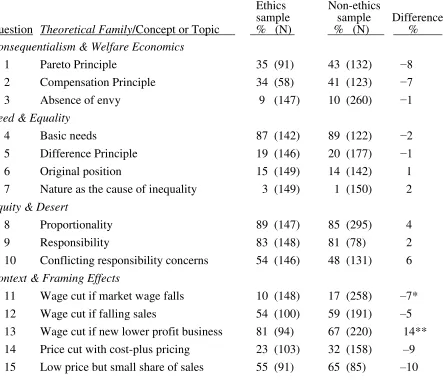
Table 1 summarizes the results for the questions, ordering them into one of the four families of theories and displaying the ethics and non-ethics samples separately. The percentages
represent those respondents expressing a fairness view consistent with endorsement of the theory or approval of some price/salary described in the scenario, and the sample sizes appear in
9
[image:11.612.68.511.146.526.2]common topic (i.e., fairness) for the survey and class, classes that covered the topic intensely, a seemingly pliable outcome, and a very short effect duration.
Table 1
Fairness Views of Ethics and Non-ethics Students
Ethics Non-ethics
sample sample Difference Question Theoretical Family/Concept or Topic % (N) % (N) %
Consequentialism & Welfare Economics
1 Pareto Principle 35 (91) 43 (132) −8 2 Compensation Principle 34 (58) 41 (123) −7 3 Absence of envy 9 (147) 10 (260) −1
Need & Equality
4 Basic needs 87 (142) 89 (122) −2 5 Difference Principle 19 (146) 20 (177) −1 6 Original position 15 (149) 14 (142) 1 7 Nature as the cause of inequality 3 (149) 1 (150) 2
Equity & Desert
8 Proportionality 89 (147) 85 (295) 4 9 Responsibility 83 (148) 81 (78) 2 10 Conflicting responsibility concerns 54 (146) 48 (131) 6
Context & Framing Effects
11 Wage cut if market wage falls 10 (148) 17 (258) –7* 12 Wage cut if falling sales 54 (100) 59 (191) –5 13 Wage cut if new lower profit business 81 (94) 67 (220) 14** 14 Price cut with cost-plus pricing 23 (103) 32 (158) –9 15 Low price but small share of sales 55 (91) 65 (85) –10
Notes: Percentages are the fraction of respondents judging the justice concept or some price/salary as fair. Sample sizes (N) are in parentheses and (apart from non-responses) differ for the non-ethics groups, since results were collected in various waves; in the ethics sample, some questions have fewer observations given the aim to avoid presenting too many similar questions or contrasting versions of the same question (e.g., questions 1 and 2) to the same respondents. Difference is the percentage of ethics students minus the percentage of non-ethics students. Results of two-tail tests of differences in proportions are reported as *p<.10, **p<.05.
10
deficient as a representation or test of the theory or concept associated with it. Such criticisms might be well taken, but, for present research question, they are of absolutely no consequence. The goal here is not to test whether views comply with theories but rather to examine whether views differ as a result of ethics instruction, and the theories serve merely as one source of inspiration for scenarios. Indeed, the scenarios should be such that the theories or concepts are not transparently recognizable so as to avoid simply testing knowledge instead of moral views. Nevertheless, those readers interested in a more extensive treatment of the concepts themselves are referred to the Appendix for the complete questions and the original sources referenced there.
Most of normative economics, including welfare economics, is consequentialist, i.e., it judges the rightness of acts or states based on their consequences or outcomes. The central concept in economics is, of course, the Pareto Principle, which endorses gains, as long as no one loses. Question 1 asks which is fairer: an equal allocation between two parties or one that makes one party better off and the other the same. Most respondents in both samples go against the Pareto Principle and find the equal allocation fairer. The results to question 2 reveal a similar level of opposition to the related Compensation Principle, which allows for losers, as long as winners could theoretically compensate losers (even if they do not). In welfare economics, fairness per se is usually associated with Absence of envy (or envy freeness) which defines an allocation as fair, if no agent prefers (i.e., envies) the bundle of another. Only 9-10% of respondents to question 3 judge an allocation as fair that is envy-free according to a simple version of this concept.
Other theories of justice emphasize equality and/or basic needs. Question 4 reveals that large majorities of both groups of respondents support allocating enough of a grant to satisfy the basic
needs of some people temporarily, even if doing so reduces the ability to raise the living standard
of others permanently. Probably the most influential justice theory of the twentieth century was
due to John Rawls (1971). Rawls’s full blown theory is too complex to tackle in short questions, so a partial and piecemeal approach was adopted: questions 5 to 7 seek to represent in stylized form some assumptions or conclusions of his theory. Large majorities of respondents go against
Rawls’s Difference Principle (question 5), a distributive rule that requires any inequalities to benefit the poorest, his central thought experiment (the Original position in question 6) that Rawls claims leads to the Difference Principle, and the insignificant role he, according to some critics, allows for non-random factors in life (Nature in question 7).
Another school of thought, based on equity and desert, associates justice with inequality rather than equality. Inspired by Aristotle (1925) and formulated and refined in social
11
of agents for the benefits or burdens that have occurred. Unequal allocations are fair, if agents are responsible for underlying differences, but are equal, if agents are not responsible for any differences, consistent with the majority view in question 9. Additional survey questions and economics experiments (e.g., see Konow, 2000, 2001) corroborate desert and support the accountability principle, which combines proportionality and responsibility: fair allocations are in proportion to the contributions individuals control but ignore differences which they do not. Despite evidence of broad support for the accountability principle, views are sometimes closely divided, as when there are multiple and Conflicting responsibility concerns. That is the case in question 10, where there is tension between fair earnings from a single transaction versus fair overall earnings between two parties.
Question 10 also draws attention to a broader issue. The large percentage of respondents answering similarly to some questions might be viewed by a justice scholar as an auspicious indication of consensus about fairness. For the present purposes, however, they raise potential concerns about ceiling and floor effects due to the absence of sufficient controversy.
Nevertheless, the results for other questions help dispel this suspicion, e.g., the splits for questions 1 and 2 are less extreme but similar across samples. And the differences across
samples are insignificant even in the knife-edge cases of questions 4, 10, 12 and 15 (as discussed below, the original non-binary responses to 4 are close to the midpoint of the permissible range). Much justice research has focused on the effects on fairness judgments of context, including the variable allocated, the set of individuals involved and the presentation of facts (or framing effects), which questions 11 to 15 address. It is seen as unfair for an employer to cut employee wages merely because of a fall in the market wage (question 11), although it is more acceptable,
if the employer’s sales are falling (12), and even fair, according to most respondents, if the
employer switches to a new business where its profits fall (13). Most respondents do not think fairness requires a factory to cut its price with its costs by the amount called for by cost-plus pricing (14). Finally, a small majority accepts an unfairly low price on one product, if the product comprises a small fraction of sales and the seller can show a profit on other items (15).
With question 13, we see the first and only difference in responses between ethics and non-ethics students that is statistically significant at conventional levels (11 is marginally significant). If this were the only judgment affected by ethics instruction, the overall conclusion would
12
students who took ethics in a past semester, and those who took ethics previously and have subsequently graduated, only this last group differs significantly from the non-ethics sample: 13 of 14 graduates find it fair for the employer to cut wages in its new, low profit business.
As previously stated, the response formats for five questions allow more than two
categories. Question 4 involves the hypothetical allocation of any amount of $100 million to the project that addresses basic needs, viz., project X rather than Y. The percentage in Table 1 represents those allocating to project X the $50 million or more that is necessary in order to satisfy basic needs fully. Analyzing the original responses, we find the mean allocation of ethics students is 54.1 and of non-ethics students 53.4, an insignificant difference (p>.70). Questions 8, 10 and 14 each present three ordered numerical answers, and question 15 has the four categories Very Fair, Fair, Unfair and Very Unfair. The split points for these questions in Table 1 were chosen so as to create the least extreme splits. Applying the Mann-Whitney rank-sum test to the original full sets of responses, the differences between the ethics and non-ethics students are insignificant for questions 8 (p=.22), 10 (p=.30) and 15 (p=.18) and significant for question 14 (p=.01). Thus, the findings using the complete data for these five questions are consistent with the simple test of differences in proportions in Table 1 except for question 14, where ethics students are slightly less supportive than non-ethics students of cutting prices when costs fall. If we break down the ethics sample into current and former students, we find the first evidence consistent with an effect of ethics instruction on current ethics students: their responses to question 14 differ significantly from non-ethics students (p=.01), although the responses of
former ethics students do not differ significantly from those of non-ethics students (p=.23).
5.Discussion and Conclusions
The results reported in the previous section provide little evidence that traditional instruction in philosophical ethics affects fairness views in concrete, contextually rich situations. Out of fifteen questions, the two samples differed significantly in at most two cases. Indeed, we are left with only one case, if we maintain a consistent assumption about timing, i.e., that the effect be either immediate, which leaves a significant difference only in the case of question 14, or lagged, which leaves only question 13. One significant difference is roughly what is to be expected by chance and in the absence of any difference in the populations.
13
considerations that temper conclusions from any single study and that point to the need for replications and extensions. Nevertheless, although various features set this study apart from others, its findings can also be viewed against the background of a large empirical literature on ethics instruction within disciplines that points to weak overall effects. Indeed, the results of the current study make even a weak effect appear optimistic, given the measures employed here both to avoid false positives and to heighten detection of any true effect.
Suppose we are justified in concluding that philosophical ethics does not, in fact,
systematically affect moral views, or, for that matter, individual moral behavior. What are we to conclude from that? Are moral views immutable? Should one abandon efforts to teach
prescriptive ethics? Although I do not claim to have conclusive answers to these questions, I offer the following considerations.
First, on the question of stability, previous studies have shown that fairness views can change significantly in response to small, but critical, changes in the content of scenarios. This might be taken as an indication that such views are labile. On the other hand, many results have been replicated across different respondent pools as with the ethics and non-ethics samples in the present study as well as with quite different subject pools, e.g., see examples in Konow (2001), Konow (2003), and the Appendix to this paper. One interpretation of these seemingly
contradictory findings goes along the following lines. Perhaps moral intuitions are widely shared, deeply ingrained and embedded in familiar contexts. Thus, there is considerable similarity of fairness views about identical scenarios across different groups of moral judges. Moreover, being based on intuitions that are both deep and stable, these views are not easily swayed by abstract arguments, such as those typically presented in philosophical ethics. Nevertheless, fairness views do respond to differences in the content of scenarios that differentially affect the importance or salience of competing intuitions. In fact, much empirical research on fairness, such as that just cited, argues that distributive justice is plural and based on multiple criteria. This suggests the further implication that the different theories presented in an ethics class might well resonate with different moral intuitions without, in the end, convincing the student of the need to declare one theory or intuition as the victor. Indeed, stability of moral views across samples and in response to ethics instruction might not only be a reasonable expectation but even a reassuring finding, if one holds such views to have some normative value.
14
economics. The field of economics and ethics typically focuses on delivering tools that can inform reflection on normative issues, which, in turn, might improve the formation and evaluation of economic policies. But students of economics and ethics are not necessarily
expected to become more moral, at least no more than students of health economics are expected to become healthier, as a result of their participation in a course of study. In both cases, the principal targeted effect is social: students should acquire tools that can aid them in formulating or evaluating measures that promote ethical ends or improved health, respectively. Thus, the absence of an individual effect does not necessarily mean that ethics instruction is ineffective in a broader sense, a point that might well apply to the teaching of philosophical ethics. These
questions are left for future research.
References
Almås, Ingvild, Alexander Cappelen, Erik Ø. Sørensen, and Bertil Tungodden. 2010.
“Fairness and the Development of Inequality Acceptance.” Science 328 (5982): 1176-1178.
Antes, Alison L., Stephen T. Murphy, Ethan P. Waples, Michael D. Mumford, Ryan P. Brown, Shane Connelly, and Lynn D. Devenport. 2009. “A Meta-analysis of Ethics
Instruction Effectiveness in the Sciences.” Ethics & Behavior 19 (5): 379-402.
Aristotle. 1925. Ethica Nicomachea. Trans W.D. Ross. London: Oxford U. Press.
Atkinson, Anthony B.. 2011.“Economics as a Moral Science. The Restoration of Welfare
Economics,” American Economic Review: Papers & Proceedings 101(3): 157-161
Bloodgood, James M., William H.Turnley, and Peter Mudrack. 2008. “The Influence of
Ethics Instruction, Religiosity, and Intelligence on Cheating Behavior.” Journal of Business
Ethics 82: 557-571.
Bruni, Luigino, and Robert Sugden. 2013. "Reclaiming Virtue Ethics for Economics,"
Journal of Economic Perspectives27(4): 141-164.
DeMartino, George F. 2011. The Economist’s Oath: On the Need for and Content of
Professional Economic Ethics, Oxford: Oxford University Press.
15
Frey, Bruno S., and Stephan Meier. 2003. "Are Political Economists Selfish and Indoctrinated? Evidence from a Natural Experiment," Economic Inquiry41(3): 448-462.
Gneezy, Uri. 2005. “Deception: The Role of Consequences,” American Economic Review
95(1): 384-394.
Goldstein, William M., and Elke U. Weber. 1995. “Content and Discontent: Indication
and Implications of Domain Specificity in Preferential Decision Making,” Psych. Learning
Motivation 32: 83-163.
Hole, Astri Drange. 2013. "How Do Economists Differ from Others in Distributive Situations?" Nordic Journal of Political Economy 38(4): 1-30.
Kohlberg, Lawrence. 1969. “Stage and Sequence: The Cognitive Development Approach
to Socialization,” in D.A. Goslin (ed.), Handbook of Socialization Theory. Chicago: Rand McNally, pp. 347-480.
Konow, James. 1996. “A Positive Theory of Economic Fairness,” Journal of Economic
Behavior and Organization 31(1): 13-35.
Konow, James. 2000. “Fair Shares: Accountability and Cognitive Dissonance in Allocation
Decisions,” American Economic Review 90(4): 1072-1091.
Konow, James. 2001. “Fair and square: the four sides of distributive justice,” Journal of
Economic Behavior and Organization 46(2): 137-164.
Konow, James. 2003. “Which Is the Fairest One Of All? A Positive Analysis of Justice
Theories.” Journal of Economic Literature 41(4): 1188-1239.
Konow, James. 2016. “Teaching Ethics in the Economics Classroom: An Experimental Study,” manuscript.
Mayhew, Brian W., and Pamela R. Murphy. 2009. “The Impact of Ethics Education on
Reporting Behavior.” Journal of Business Ethics 86: 397-416.
Rawls, John. 1971. A Theory of Justice. Cambridge, MA: Harvard University Press.
Rest, James R. 1986. “An Overview of the Psychology of Morality,” in J.R. Rest (ed.),
Moral Development and Behavior: Theory, Research, and Social Issues. New York: Praeger, pp.
16
Rosenthal, Robert. 1979. “The ‘file drawer problem’ and tolerance for null results,”
Psychological Bulletin 86: 638-641.
Sandel, Michael J.. 2013. "Market Reasoning as Moral Reasoning: Why Economists Should Re-engage with Political Philosophy," Journal of Economic Perspectives27(4): 121-140.
Schwitzgebel, Eric. 2013. “Do Ethics Classes Influence Student Behavior?” manuscript.
University of California, Riverside.
Shiller, Robert J., and Virginia Shiller. 2011. “Economists as Worldly Philosophers,”
American Economic Review101(3): 171-175.
Waples, Ethan P., Alison L. Antes, Stephen T. Murphy, Shane Connelly, and Michael D. Mumford. 2009. “A Meta-analytic Investigation of Business Ethics Instruction.” Journal of
Business Ethics 87 (June): 133-151.
Xiao, Erte, and Daniel Houser. 2015. “Sign Me Up! A Model and Field Experiment On
1
APPENDIX – NOT FOR PUBLICATION
Fairness Questionnaire
1. A small newly independent island nation is considering how to allocate its one banana plantation and its one sugar plantation. There are only two farmers on the island interested in these plantations. The government chooses among the following two plans either of which would result in the same total production of both bananas and sugar.
Plan X. Both farmers receive one-half of each plantation. Each farmer earns an average profit
of $100 per day from bananas and sugar combined. Therefore, the total of both farmers’ profits is $200 per day.
Plan Y. One farmer receives the banana plantation and the other farmer receives the sugar
plantation. The farmers’ profits are unequal since the sugar plantation is more profitable than
the banana plantation: average daily profit of the banana farmer is $100 and that of the sugar farmer is $200. At $300 per day, combined profits are greater under this plan because
specialization reduces production costs.
Please circle the plan which you consider fairer:
Plan X Plan Y
(2: 5C; Plan Y)
2. A small newly independent island nation is considering how to allocate its one banana plantation and its one sugar plantation. There are only two farmers on the island interested in these plantations. The government chooses among the following two plans either of which would result in the same total production of both bananas and sugar.
Plan X. Both farmers receive one-half of each plantation. Each farmer earns an average profit
of $100 per day from bananas and sugar combined. Therefore, the total of both farmers’ profits is $200 per day.
Plan Y. One farmer receives the banana plantation and the other farmer receives the sugar
plantation. The farmers’ profits are unequal since the sugar plantation is more profitable than
the banana plantation: average daily profit of the banana farmer is $90 and that of the sugar farmer is $160. At $250 per day, combined profits are greater under this plan because specialization reduces production costs.
Please circle the plan which you consider fairer:
Plan X Plan Y
(2: 5B; Plan Y)
3. Chris, who is blind, does not like TV and Pat, who is a vegetarian, does not like hamburger. Suppose that Chris and Pat work for the same company in the same capacity and earn the same base salary. The time comes for the end of the year bonus. Chris, who works much harder than Pat, receives a $2 coupon for a hamburger. The less productive Pat, on the other hand, receives as a bonus a $2000 wide screen television. Please rate this as:
Fair Unfair (1: 5; Fair)
4. Parador is an underdeveloped country whose people live at subsistence level: only their basic needs for food, shelter and clothing are satisfied. The only assistance available is a one time grant of $100 million which the government of Parador has received. It can
2
Project X. In eastern Parador there is malnutrition due to a drought. To prevent the starvation
of the 500,000 people affected and to return them to subsistence level would require $100 per person, or $50 million.
Project Y. In western Parador there is an agricultural development program awaiting funding
which would permanently raise its participants from subsistence level to a moderate standard of living. Its cost is also $100 per person.
What do you think is the fairest distribution of the $100 million between Projects X and Y (express in millions of dollars and make sure the total is $100 million)?
Project X: ______ million Project Y: ______ million
(2: 6A; % giving Project X ≥$50M)
5. Suppose Mike and Bill begin working for a computer software company at the same time and in the same capacity. Initially they both earn a salary of $50,000 per year. After a trial period Mike demonstrates that he is hard working, productive and performs far beyond initial expectations. Bill, on the other hand, is lazy, unproductive and performs far below initial expectations. Their supervisor decides to give Mike a $10,000 per year raise and to cut
Bill’s salary by $1000. Please rate the supervisor's decision to raise Mike’s salary and to cut Bill’s as:
Fair Unfair (1: 1B; Fair)
6. The owner of a small office supply store has two employees, Mike and Bill. They are equally productive and hardworking and are both currently earning $7 per hour. The owner decides to move his store to a new location nearby where he knows business will be better. He lets his workers know that if they wish to continue at the new location he will be able to raise their wage. He explains that they will continue to have the same responsibilities but that one worker will earn $8 per hour and the other $12 per hour. He also explains that which worker gets the higher wage will be determined later on the basis of a coin toss. The workers can choose to go with the owner to the new location under these terms or to find similar work elsewhere for their current $7 per hour. They both choose to go with the owner. Please rate the store owner's terms for the new wages as:
Fair Unfair (1: 1A; Fair)
7. Mike and Bill are identical twins who were reared in an identical family and educational environment. They are the same in terms of physical and mental abilities, but Mike is more industrious than Bill. For that reason, after they begin their careers Mike ends up earning more than Bill. Please indicate whether you view such a difference in their earnings as:
Fair Unfair (1: 1C; Fair)
8. Bill and Sam manage a small grocery store at different times and on different days. The manager's duties are always the same and the days and times which each work vary pretty much randomly, but Bill works 40 hours per week while Sam works 20 hours per week. Suppose the manager's salary for a 60 hour week is $1200. Which of the following is the fairest division of this salary?
3 (3: 5; C)
9. Bob and John become shipwrecked on an uninhabited island where the only food is bananas. They can collect as many bananas as they want by climbing up a tree, picking them before they fall into the ocean and throwing them into a pile. Bob and John are identical in terms of physical and mental abilities except that Bob was born with one hand and John with two. Together they pick a total of 20 bananas per day, but because of his condition Bob picks fewer bananas per day than John. John takes 12 bananas from the pile leaving 8 for Bob. Please rate this as:
Fair Unfair (3: 1B; Unfair)
10. Davis and Thompson have restaurants in a shopping mall. Davis owns a video game
machine with which he breaks even: it costs $40 per week to maintain and, in Davis’ restaurant, generates $40 per week in revenue. In Thompson’s restaurant maintenance costs
would still be $40 but, because of the younger clientele there, weekly revenue would be $80. Davis decides to rent the video game machine to Thompson and continues to pay for the $40 weekly maintenance costs. Because Davis is related to the owner of the mall, he got a much more favorable location, and solely for that reason Davis runs a highly profitable business whereas Thompson operates on a very small profit. Please circle the weekly rent you consider fair for Davis to charge Thompson.
A. $50 B. $60 C. $70 (2: 2B; A)
11. A small photocopying shop has one employee who has worked in the shop for six months and earns $9 per hour. Business continues to be satisfactory, but a factory in the area has closed and unemployment has increased. Other small shops have now hired reliable workers a $7 an hour to perform jobs similar to those done by the photocopy shop employee. The owner of the photocopying shop reduces the employee's wage to $7. Please rate this as:
Fair Unfair (2: 11A; Fair)
12. A moderate sized company in a small community is the major local employer. The workers of the company are represented by their own independent local labor union. Sales of the company's product fall significantly, so the company cuts pay by 10%. Please rate this as:
Fair Unfair (2: 10A; Fair)
13. A house painter employs two assistants and pays them $9 per hour. The painter decides to quit house painting and go into the business of providing landscape services. With about the same time and effort, the former house painter's profits fall significantly in his new business. In landscape services the going wage is lower so he reduces the workers' wages to $7 per hour for the landscaping work. Please rate this as:
Fair Unfair (1: 9B; Fair)
4
has now found a supplier who charges $20 less for the materials needed to make each table. What price is now fair to the factory and to the wholesalers?:
A. $150 B. $140 C. $130 (2: 7B; C)
15. Suppose a furniture manufacturer is the single supplier of chairs to a retail store, and both firms have similar sales volume and profits. Suppose that both firms would agree that $100 is a fair price for the retail store to pay the furniture manufacturer for each chair: this price gives a fair return to the furniture manufacturer on its investment of time and money. Nevertheless, through government price controls the price is set very much lower. This leaves the furniture manufacturer with a very small profit on the chairs. Nevertheless, chair sales represent a small fraction of the furniture manufacturer's business since it produces many other profitable goods. Please rate this price as:
Very Fair Fair Unfair Very Unfair (2: 8G; Fair or Very Fair)
Notes: The information in parentheses following each question indicates the publication in which the question originally appeared (1=Konow, 2003; 2=Konow, 2001; 3=Konow, 1996), the original question number, and the response category/categories reflected in the