Early Atomic Models – From Mechanical to Quantum (1904-1913)
The European Physical Journal H (2012) DOI: 10.1140/epjh/e2012-30009-7 http://www.springerlink.com/content/4k0287t45lu61536/Charles Baily
Department of Physics University of Colorado
Boulder, CO 80309-‐0390, USA
Abstract
A complete history of early atomic models would fill volumes, but a reasonably coherent tale of the path from mechanical atoms to the quantum can be told by focusing on the relevant work of three great contributors to atomic physics, in the critically important years between 1904 and 1913: J. J. Thomson, Ernest Rutherford and Niels Bohr. We first examine the origins of Thomson's mechanical atomic models, from his ethereal vortex atoms in the early 1880's, to the myriad "corpuscular" atoms he proposed following the discovery of the electron in 1897. Beyond qualitative predictions for the periodicity of the elements, the application of Thomson's atoms to problems in scattering and absorption led to quantitative predictions that were confirmed by experiments with high-‐velocity electrons traversing thin sheets of metal. Still, the much more massive and energetic α-‐particles being studied by Rutherford were better suited for exploring the interior of the atom, and careful measurements on the angular dependence of their scattering eventually allowed him to infer the existence of an atomic nucleus. Niels Bohr was particularly troubled by the radiative instability inherent to any mechanical atom, and succeeded in 1913 where others had failed in the prediction of emission spectra, by making two bold hypotheses that were in contradiction to the laws of classical physics, but necessary in order to account for experimental facts.
Contents
1 Introduction 1
2 The mechanical atoms of J. J. Thomson
2.1 Rings of Saturn and ethereal vortices 5 2.2 A corpuscular theory of matter 9 2.3 The number of corpuscles in the atom 19
3 The nuclear atom of Ernest Rutherford
3.1. Fundamental properties of α-‐particles 26 3.2. The angular dependence of α-‐scattering 31 3.3. Competing theories and experimental data 37
4 The quantum atom of Niels Bohr
4.1 Absorption and atomic oscillators 43 4.2 Hypotheses without mechanical foundation 46 4.3 Ionized helium and lithium 54
1
Introduction
Tremendous strides were made in the nascent field of atomic physics during the relatively short time between the discovery of the electron in 1897, and the birth of the quantum atom in 1913. Beginning with almost no understanding of atoms other than their chemical and spectral properties, physicists were handed important clues to their internal structure with the discovery of spontaneous radiation, first identified by Becquerel in 1896 by its ability to produce a photographic effect. The very existence of atomic radiation strongly suggested that atoms were not indivisible after all, and when Joseph John Thomson (1856–1940) announced in 1897 that cathode rays were actually comprised of negatively charged particles, he was already convinced that these “corpuscles” must be fundamental constituents of matter.
It had been known for some time from Maxwell's theory that accelerated charges were responsible for the production of electromagnetic waves, and there seemed to be no doubt that atomic spectra must be due to the motion of these discrete charges within the atom. The corpuscular model proposed by Thomson in 1904 was poorly suited for predicting spectral lines, but he demonstrated that his mechanical atom, a uniformly charged sphere embedded with rotating rings of electrons, had an amazing explanatory power for the observed periodicity in the elements. Thomson later applied modified versions of this model to a variety of physical phenomena, such as the dispersion of light by dilute gases, and developed methods for estimating the actual number of electrons in an atom, which he concluded must be roughly equal to its atomic weight, and not the "thousands" suggested by the small mass-‐to-‐charge ratio of an electron. By 1910, experiments had confirmed many of his model's predictions for the absorption and scattering of electrons in thin materials.
ignorance of their basic nature, Rutherford gradually increased the complexity of the experimental questions he posed. Are the α-‐rays deflected by a magnetic field? Are the α-‐particles positively or negatively charged? What is the magnitude of their charge? How much kinetic energy do they lose when passing through thin sheets of aluminum? The scattering of α-‐particles by matter was significantly less pronounced than for β-‐particles, but ultimately noticeable, and Rutherford's ongoing experiments inspired a series of careful measurements by Hans Geiger and Ernest Marsden on the degree of scattering and reflection caused by various types and thicknesses of metal. Rutherford used this data in 1911 to show that large-‐ angle scattering could be explained in terms of single encounters with a massive nuclear core, but not by multiple encounters with a positively charged sphere of atomic dimensions, as was Thomson's view. The formula derived by Thomson assuming small-‐angle compound scattering would only generate appropriate numbers if the radius of the sphere were reduced by several orders of magnitude.
terms of fundamental constants, no less) eventually led to its widespread adoption, sowing the seeds of the quantum revolution. Today, mechanical atoms are little more than historical curiosities.
When exploring the early development of mechanical models of the atom, one is naturally interested in learning what originally inspired their salient features, and what mathematical techniques were employed to deduce their properties based on those features. Thomson's first foray into atomic modeling came in his 1882 Adams Prize-‐winning essay on the dynamics of vortices in an ideal fluid, wherein he articulated a sophisticated theory of atoms as stable vortices in the electromagnetic ether. The concept of ethereal vortex atoms had been proposed in 1867 by Sir William Thomson (later, Lord Kelvin), and he was indebted to Helmholtz1 for the
mathematics he used to describe them. Interestingly, even authoritative histories typically fail to mention the remarkable similarities between Thomson's investigation into the stability of rotating vortex rings and the methods used by James Clerk Maxwell (1831–1879) in his treatise on the dynamics of Saturn's rings (also awarded the Adams Prize in 1857). The omission of this one fact seems entirely arbitrary, considering the way historians of atomic modeling generally acknowledge the pervasive influence of Maxwell in so many aspects of modern physics.
For example, Kragh mentions Maxwell only twice in the introductory chapter (on pre-‐quantum atoms) of his recent book about the Bohr model;2 first, for his
written praise of Kelvin's vortex models in the 1875 Encyclopaedia Britannica; [Kragh, p. 6] second, and most naturally for this context, in connection with the "Saturnian" atomic model proposed by Hantaro Nagaoka in 1904, which was based on Maxwell's calculations. [Kragh, p. 23] In a collection of historical essays on atomic structure,3 Heilbron calls attention to the influence on an entire era of Victorian
physics of Maxwell's predilection for mechanical analogies. A scientific biography
1 Thomson, W., p. 15. An English translation by Tait had recently appeared [Phil. Mag.33: 485-512] of
Helmholtz, H. 1858. Ueber Integrale der hydrodynamischen Gleichungen, welche den Wirbelbewegungen entsprechen. Journal für die reine und angewandte Mathematik 55: 25-55. William Thomson also makes mention of papers from Rankine (1849-50) on "Molecular Vortices".
2 Kragh, H. 2012. Niels Bohr and the Quantum Atom, Oxford University Press, Oxford.
by Davis and Falconer4 describes J. J. Thomson's youthful devotion to Maxwellian
electrodynamics and the mechanical ether.
Moreover, Maxwell's legacy as the visionary founder of the Cavendish Laboratory in Cambridge is one of the many threads that bind the three main actors in the story that follows. This is the place where Thomson was appointed as director in 1884, where Rutherford worked as Thomson's first research student from 1895 to 1898, and where Bohr stopped over in 1911 before moving on to join Rutherford at the University of Manchester. There is an old adage that most lines of research in modern physics, when traced back far enough, will eventually lead to James Clerk Maxwell, and this is no less true when delving into the origins of mechanical models of the atom.
4 Davis, E. A. and Falconer, I. J. 1997. J. J. Thomson and the Discovery of the Electron, Taylor & Francis,
2
The mechanical atoms of J. J. Thomson
2.1 Rings of Saturn and ethereal vortices
The introduction to Maxwell's 1857 essay, "On the Stability of the Motion of Saturn's Rings," contains a concise statement of the central theme of his analysis, but also that of an entire research program yet to come on mechanical models of the atom.
"Having found a particular solution of the equations of motion of any material system, to determine whether a slight disturbance of the motion indicated by the solution would cause a small periodic variation, or a total derangement of the motion." [Maxwell 1859, p. 5]
The prize committee for that year had asked if the long-‐term stability of Saturn's rings could be explained on dynamical principles, under the assumption they were either solid, liquid, or made up from particulate matter. In answer to this challenge, Maxwell simultaneously brought to bear a number of mathematical techniques (in particular, Fourier analysis and Lagrangian mechanics) to first show that a uniformly solid ring would be dynamically unstable,5 and that a liquid ring must
ultimately break apart into disconnected droplets.
The remaining possibility was for the rings to be comprised of independent particles (whether solid or liquid), each moving under the gravitational influence of the central mass, as well as that of all the other orbiting particles. Maxwell approximated a single planetary ring as a collection of point masses distributed at equal-‐angle intervals around a circle, derived the equations of motion for two masses in stable orbit, then stepwise let the number of satellites grow until arbitrarily large. Upon determining the conditions for steady-‐state motion, he considered the effect of any small deviation of the particles from their orbits, in the
5 There would be an insufficient restoring force if the centers of mass for the uniform ring and the planet
radial and tangential directions, as well as perpendicular to the plane of rotation. If the motion of the particles were to be permanent, the solutions to these sets of differential equations would have to all be sinusoidal (the particles would oscillate about their equilibrium positions); exponential solutions corresponded to the ring breaking apart. This placed basic constraints on the properties of the system – most notably, the mass of the central body would have to be substantially larger than the sum of the orbiting masses. [Maxwell 1859, p. 25]
The influence of Maxwell is readily apparent in Thomson's own 1882 Adams Prize essay. This time, the committee had called for a "general investigation of the action upon each other of two closed vortices in a perfect incompressible fluid," a topic that was of current interest to mathematical physicists, particularly since Maxwell had described Faraday's lines of force in terms of vortices in an electromagnetic medium.6 The fundamental simplicity of Kelvin's more recent ideas
appealed to J. J. Thomson, that all the various properties of materials might be explained in terms of the dynamics of ethereal vortices.
"The equations which determined this motion were known from the laws of hydrodynamics, so that if the theory were true the solution of the problem of the universe would be reduced to the solution of certain differential equations, and would be entirely a matter of developing mathematical methods powerful enough to deal with what would no doubt be very complex distributions of vortex motion in the fluid. […] The investigation … involved long and complicated mathematical analysis and took a long time. It yielded, however, some interesting results and ideas which I afterwards found valuable in connection with the theory of the structure of the atom…" [Thomson 1936, p. 94-‐5]
The first two parts of Thomson's essay dealt with the mathematics describing a single vortex in an ideal fluid, and then two vortices separated by a distance large compared to their radii, which alone might have been sufficient to satisfy the
requirements of the committee. The third and fourth parts developed a comprehensive theory of vortex atoms, where Thomson first considered the interaction of two vortices in close proximity, finding that stable uniform motion was possible when they were of equal strength and revolved about a common center. For three or more identical vortices, all arranged in a plane at regular intervals around the circumference of a circle (he made clear this was not the most general configuration), any small disturbance would cause them to execute stable oscillations about their equilibrium positions, but only if there were less than seven of them. Thomson calculated the periods of these oscillations for each case, and demonstrated that the system would be dynamically unstable if there were more than six vortices in a ring. [Thomson 1883a, p. 107-‐8]
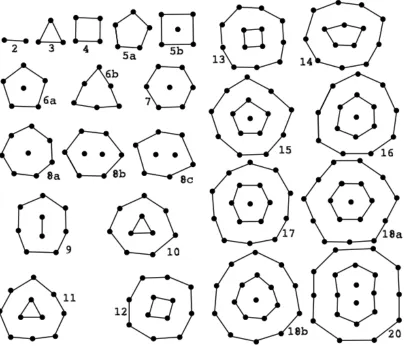
Beyond mathematical expediency, Thomson's choice to work with symmetrically distributed vortices could be physically motivated with an analogy to the static arrangements of floating magnets under the influence of a central force, as reported by Alfred Mayer in 1878. Mayer had stuck magnetized needles into pieces of cork with the south ends pointing upward, so that they were all mutually repelled, but each attracted to the north end of a bar magnet placed at the center. This combination of push and pull caused the floating needles to rearrange themselves into regular polygons, just like Thomson's vortices. [Fig. 1] With n = 5, two static arrangements were possible: a pentagon [5a] and a square with a needle at the center [5b]; but only the pentagon was stable against external perturbations. Static rings of six, seven and more were possible with additional interior needles, which themselves settled into stable patterns as their numbers grew (i.e., the configuration for 5a could form the core of n = 14, whereas 5b could not). [Mayer, p. 251] Mayer himself thought these simple rules might provide insight into various molecular properties (such as allotropy and isomerism), but it was the future Lord Kelvin who first made the connection between the static configurations of the magnets and those for vortex atoms in a state of mechanical equilibrium.7
Figure 1. Static arrangements for n = 2 – 20 floating magnetic needles (all with their south poles oriented vertical), under the attractive influence of a central bar magnet. If multiple static configurations were possible for a given n, only those denoted by an "a" were stable against perturbations. [From Mayer, p. 248-9]
[image:9.612.108.512.74.420.2]
strength, and that there not be more than six of them on a ring. This latter finding also agreed with chemical facts, Thomson claimed, in that there were no known gaseous compounds of one element combined with more than six atoms of another. [Thomson 1883a, p. 120-‐21]
By the time of his appointment as Cavendish Professor in 1884, Thomson had already turned to the study of electrical discharges in gases, which he thought could also be explained in terms of vortices and ethereal strains. In 1883, he described an externally applied electric field as a velocity gradient in the ether directed along the lines of force. The overall effect of this non-‐uniform velocity field would be to separate paired vortices, with the resulting relaxation in the ether corresponding to electricity passing through the gas (much like Maxwell's notion of an ethereal displacement current). [Thomson 1883b, p. 428-‐29]
Thomson's early vortex theory of electrical discharge was based on the concept of energy dissipation, but at the time there was mounting experimental evidence for the existence of discrete charges, and he eventually began to think about the electrical breakdown of a gas as the separation and transfer of charge.8 In
the ensuing years prior to 1897, his continuing investigations ultimately led to a series of experiments on the rays emitted by the cathode during a spark. The deflection of their trajectories by a magnetic field showed that they were not like X-‐rays, but rather high velocity, negatively charged 'corpuscles' of matter. [Thomson, 1897]
2.2 A corpuscular theory of matter
“After long consideration of the experiments it seemed to me that there was no escape from the following conclusions: (1) That atoms are not indivisible, for negatively electrified particles can be torn from them by the action of electrical forces, impact of rapidly moving atoms, ultraviolet light or heat.
8 His first conceptions were in analogy with electrolysis. [Davis and Falconer, p. 77-8; see also p. 77-138
(2) That these particles are all of the same mass, and carry the same charge of negative electricity from whatever kind of atom they may be derived, and are a constituent of all atoms. (3) That the mass of these particles is less than one-‐thousandth part of the mass of an atom of hydrogen.” [Thomson 1936, p. 338-‐9]
Convinced that these corpuscles were universal components of matter, Thomson decided to relate what he already knew about vortex atoms to bound systems of discrete charges. He again drew attention to Mayer's magnets, asserting that the periodicity in the configurations of concentric rings suggested an analogy with the periodicity in the chemical and spectral properties of the elements; but in 1897 he had yet to propose anything more than a qualitative picture of corpuscular atoms. Being all of the same charge, a dynamically stable system of corpuscles would be impossible without some kind of compensating positive charge to hold them all together (like Mayer's bar magnet to the needles).9 Unable to explain the
electrical neutrality of an atom as a manifestation of its negatively charged constituents, Thomson was left with no choice but to concoct a hypothetical smear of positive atomic charge, which he likened (crudely) to "a liquid with a certain amount of cohesion, enough to keep it from flying to bits under its own repulsion."10
Thomson never believed in the literal truth of his mechanical analogies, and preferred to de-‐emphasize any physical interpretation of this "positive electrification." [Davis and Falconer, p. 195]
Regardless of whether the positive charge were supposed to have any substance (or even reality), the equations he derived in 1904 described the periodic motion of corpuscles in a positively charged region of space, and contained no viscous damping terms, meaning the electrons were free to move about his atom without resistance. Thomson's dynamic model could therefore be viewed as a
9 Positively charged subatomic particles had been proposed but never observed. Goldstein had
discovered positively charged rays during cathode experiments reported in 1886, but they were only known at the time to have a charge-to-mass ratio similar to ionized hydrogen. [Davis and Falconer, p. 199] It was not until after the concept of isotopy was developed that physicists could identify these "positive rays" as singly-ionized tritium (an isotope of hydrogen, with one proton and two neutrons), and not triatomic hydrogen (as proposed by Thomson in 1913). [Kragh, p. 96-100]
generalization of the atom expounded by Kelvin in an article from 1902, where he revisited the “one fluid theory of electricity” of Franz Aepinus (1724–1802). As described by Kelvin, Aepinus proposed the existence of a negatively charged electric fluid that permeated all of space, and flowed freely “among the atoms of ponderable matter.” Negative (and positive) charge distributions could thus be viewed as regions of space with an excess (or deficiency) of this ideal fluid. Kelvin’s proposal was that such a fluid could actually be made up from a multitude of tiny, negatively charged “atoms of electricity”11 that moved without resistance inside of positively
charged, spherical atoms. [Kelvin, p. 257]
Kelvin's aim was to deduce the spatial configurations of negative point charges12 in a state of static equilibrium within a positively charged atom. Two of
his explicit assumptions13 were that: (A) positively charged atoms repel each other
according to an inverse square law (in accordance with the discoveries of Cavendish and Coulomb); and (B) negatively charged particles within an atom are attracted to its center by a force that is directly proportional to their radial distance. [Kelvin, p. 258] A straightforward application of Gauss' law would show that the interior field of this atom could only be radially outward and linearly increasing if the positive charge were spherically symmetric and uniformly distributed.
Kelvin’s model was static, but Thomson was interested in the dynamic stability of atomic corpuscles executing orbital motion, which he physically motivated by suggesting a connection with radioactivity:
“…suppose the atoms of a substance, like the atoms of radio-‐active substances, were continually emitting corpuscles; the velocity of the corpuscles under consideration being, however, insufficient to carry them clear of the atom, so that the corpuscles describe orbits round the centre of the atom…” [Thomson 1903, p. 689]
11 Hence the title of his paper, "Aepinus Atomized."
12 Kelvin asserted that these negatively charged electrions “no doubt occupy finite spaces, although at
present we are dealing with them as if they were mere mathematical points…” [Kelvin, p. 258]
In 1903, Thomson had rigorously investigated the electromagnetic fields produced by a steadily rotating system of charges, arranged in a plane at equal intervals around a ring (but in the absence of any positive charge). This was explicitly done in anticipation of future work, and his results would have important implications for the radiative stability of his atoms.
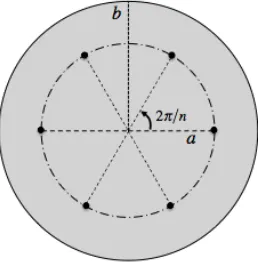
The dynamical atom initially proposed by Thomson in March 1904 consisted of a uniform sphere of positive charge and a single ring of negatively charged corpuscles14 (arranged symmetrically, as before). [Fig. 2] The large charge-‐to-‐mass
ratio for electrons, as well as the numerous spectral lines showing the Zeeman effect,15 had certainly implied the presence of thousands of atomic corpuscles, 16 but
none of the atoms in this paper had more than a few hundred, and the majority of his calculations were devoted to rings with less than seven charges. Similar to Mayer's magnets and the particulates of Saturn's rings (but with a different central force law), the motion of each charge was governed only by its electrostatic attraction toward the center of the sphere, and by the repulsion from each of the other negative charges.
Figure 2. Diagram of Thomson’s 1904 atomic model.17 A uniform sphere of positive charge (shaded region, of radius b) contains n negative point charges arranged at equal intervals around a circle (of radius a). The ratio a/b = 0.6726 for a static ring of n = 6 charges (see below).
14 Thomson continued to refer to negative atomic charges as “corpuscles” throughout the article, and for
many years after. George Stoney claimed in 1894 to have coined the term electron; Kelvin used the term
electrions for his 'atoms of electricity'. Rutherford’s 1911 nuclear model was agnostic on the actual form and distribution of the negative charge. Nagaoka (1904), Haas (1910), Nicholson (1912) and Bohr (1913) all identified their negative atomic charges as electrons.
15The splitting of spectral lines emitted by excited atoms in a magnetic field. It was assumed that
there was a one-‐to-‐one correspondence between each Zeeman line and an orbiting electron.
16 If the positive charge distribution had no inertial mass, there would be no constraint on the amount of
positive charge available to neutralize an atom filled with thousands of electrons.
17 He did not reproduce any illustrations of his model, perhaps because it was so simple that a picture would
[image:13.612.385.514.412.543.2]After briefly introducing his model, Thomson quickly set about analyzing a system of n particles (mass m and charge –e), arranged on a ring of radius a, centered within a positive sphere of radius b. For static equilibrium, the radially attractive force on each charge (equal to ne2a/b3 for an electrically neutral atom) must balance the net repulsive force of the other n – 1 charges. The azimuthal component of this repulsive force would be zero due to symmetry, and the radial component Fr given by:18
. (1)
He then considered the restoring forces on the rotating charges when slightly perturbed, and found the necessary conditions for them to oscillate with frequencies q about their equilibrium positions; for the specific case of small displacements in the plane of rotation, these frequencies were given by the roots to a set of n equations:19
(2)
Through a series of lengthy calculations, Thomson showed one-‐by-‐one that for n < 6, the 2n solutions to these equations would all be real numbers (corresponding to stable oscillations), as long as the rotational speed of the ring exceeded some minimum value. However, in the case of n = 6, the k = 3 equation from (2) reads as:
18 Thomson did not explicitly derive this formula in his paper, but the derivation is presented here as an
example of the numerous trigonometric quantities that appeared throughout.
19 The indexed quantities L, M & N appearing in (2) represent various sums of trigonometric functions,
similar to the quantity S defined in (1).
Fr =
Fk sin
(
kπ n)
k=1n−1
∑
= e2
sin
(
kπ n)
a−acos 2
(
kπ n)
(
)
2+a2sin2
(
2kπ n)
k=1n−1
∑
= e2 2a2
sin
(
kπ n)
1−cos 2(
πk n)
=e2 2a2
sin
(
kπ n)
2 sin2kπ n
(
)
k=1 n−1
∑
k=1n−1
∑
= e2
4a2 k=1csc
(
kπ n)
n−1∑
≡ e24a2 Sn
3e2
4a3Sk+Lk−L0−mq 2
⎛ ⎝⎜
⎞
⎠⎟ N0−Nk−mq 2
(
)
=(
Mk −2mωq)
2
. (3)
For this equation, one of the roots for q2 will be negative (making q imaginary),
resulting in a pair of solutions with exponential time dependence. Thus, a ring of six charges would be mechanically unstable, no matter its angular velocity, unless an additional negative charge were placed at the center of the sphere.20 With six
charges in a ring and a seventh located at the center, the roots to the suitably modified frequency equations would all be positive in q2, and therefore oscillatory.
[image:15.612.88.529.351.396.2]He further found that if the number of outer charges increased beyond eight, more and more interior charges would be required for the dynamic stability of the system. [Table I]
5 6 7 8 9 10 15 20 30 40
0 1 1 1 2 3 15 39 101 232
Table I. Number of charges n contained in a single atomic ring, and the minimum number of interior charges p required for the dynamic stability of that ring. [From Thomson 1904, p. 254.] The last entries represent the largest number of electrons in a single atom mentioned by Thomson in this paper.
Thomson thought these interior charges would (like Mayer's magnets) also arrange themselves into closed, stable orbits, and that atoms with n > 8 ought to be made up by a series of concentric rings. The number of charges would vary from ring to ring, with the greatest number in the outermost ring, and a decreasing number of charges occupying each of the inner rings. [Table II] Thomson then proceeded to argue how the periodicity of these configurations (and their resultant properties, determined by the number occupation and stability of the rings) closely matched the periodicity of the natural elements. Noticing, for example, that the interior configuration for an atom with N = 60 charges would be identical to that of
20 A single negative charge added at the center introduced a positive quantity to the first term in parentheses
of (2) & (3), so that the offending term in (3) would be manifestly positive. [Thomson 1904, p. 251-2]
−14−8 3
8
e2
a3 −mq 2
⎛ ⎝⎜
⎞ ⎠⎟ 58
e2 8a3 −mq
2
⎛ ⎝⎜
⎞ ⎠⎟ =4m
2ω2
q2
n
N = 40, Thomson proposed that groups of such atoms [each one derived from the previous by the addition of a single ring, as with the N = 3, 11, 24, 40 & 60 atoms in Table II] would have similar chemical and spectral properties, and should therefore fall into the same vertical column in the Periodic Table. [Thomson 1904, p. 259]
3 11 15 20 24 30 35 40 45 50 55 60
3 3
8 5 10 1 7 12 3 8 13 5 10 15 1 6 12 16 3 8 13 16 4 10 14 17 1 5 11 15 18 1 7 12 16 19 3 8 13 16 20
Table II. Sampling of charge arrangements for a number of different atoms, from the inner rings (upper rows) to the outer rings (lower rows), where N represents the total number of charges in each atom. The N = 3, 11, 24, 40 & 60 atoms would form a single vertical column in the Periodic Table, each member of the group derived from the previous member by the addition of a single ring. [Adapted from Thomson 1904, p. 257.]
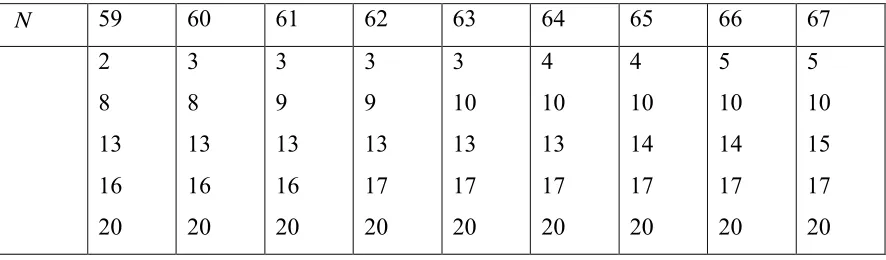
In a similar vein, atoms in the group N = 59 – 67 each had 20 charges in their outermost rings. [Table III] The greater the number of interior charges, the more stable the outer rings would be, making the outer ring for N = 59 the least stable of the group. Thomson characterized this ring as “very near the edge of stability,” so that it might easily lose one of its charges, perhaps due to some external force. Having done so, it would then behave like a strongly electropositive atom and immediately attract any negative charges in its vicinity, so that it would be unable to maintain its charged state, and act in the long term as though it were chemically inert. [Thomson 1904, p. 261]
[image:16.612.90.529.177.304.2]Table III. Distribution of charges from inner rings (top rows) to outer rings (bottom rows) for the group of atoms containing N = 59 – 67 charges. Each has 20 charges in its outermost ring, placing them all in a single horizontal row of the Periodic Table. [From Thomson 1904, p. 258]
With additional interior charges, successive atoms in this group would be less and less electropositive,21 eventually to the point where they could accept one
or two extra charges while still maintaining stability; these atoms would have an increasingly electronegative character. Maximum stability would occur for N = 67, which wouldn't be able to retain any extra charges for long because N = 68 corresponded to a quasi-‐stable outer ring of 21 charges. Similar to N = 59, this atom would quickly lose any additional charge it had gained, and also act as though it had no valency. Thomson argued that the atomic properties predicted by his model were reflected in a series of known elements, when arranged as:
He Li Be B C N O F Ne
Ne Na Mg Al Si P S Cl Arg
The first and last elements in each row have no valency, the second are monovalent electropositive, the second-‐to-‐last monovalent electronegative, and so on. [Thomson 1904, p. 260-‐62]
He also drew attention to there being two sets of vibrations associated with his model: one corresponding to the angular rotation of the rings, the other arising from the oscillation of the charges about their equilibrium positions. Though he'd
21 The outer rings would become more stable, so that they would be less likely to lose a charge and behave
like an electropositive atom.
59 60 61 62 63 64 65 66 67
[image:17.612.85.528.74.204.2]taken great pains to derive formulas for each of these allowed frequencies (for n ≤ 6), he made no mention of any attempt at quantitative comparisons with atomic spectra. After all, his model placed no constraints on the angular velocities of the rings (other than exceeding some minimum value), the charge and mass of an electron were not separately known with precision, and he had no way of determining the absolute number of charges contained within an atom.22
Thomson waited until the very last of his paper to finally address the problem of radiative instability. As mentioned previously, classical electrodynamics predicts that any accelerated charge will radiate energy in the form of electromagnetic waves. The kinetic energy of a system of point charges in periodic motion would therefore be dissipated by the resulting radiation until exhausted. Thomson imagined a ring of charges initially rotating with sufficient angular speed, but that
“… in consequence of the radiation from the moving corpuscles, their velocities will slowly – very slowly – diminish; when, after a long interval, the velocity reaches the critical velocity, there will be what is equivalent to an explosion of the corpuscles […] The kinetic energy gained in this way might be sufficient to carry the system out of the atom, and we should have, as in the case of radium, a part of the atom shot off. In consequence of the very slow dissipation of energy by radiation the life of the atom would be very long.” [Thomson 1904, p. 265]
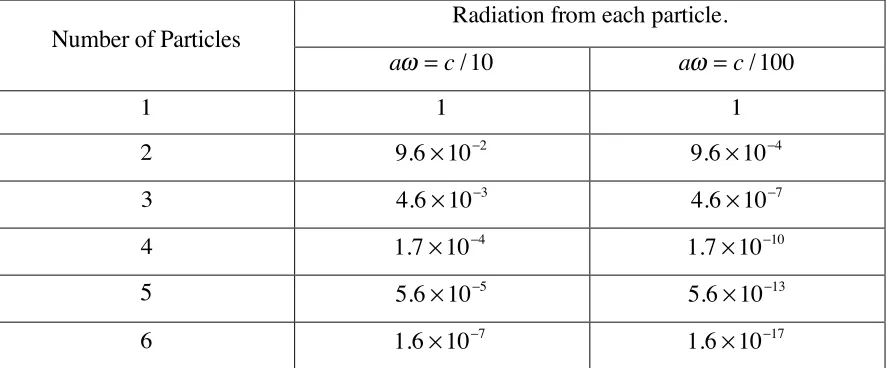
Radiative instability might therefore be a mechanism for the production of beta radiation, but Thomson provided no further rationale here for why this would be a “slow” process. Justification can be found, however, in his paper from the previous year, detailing the fields produced by symmetrically arranged point charges constrained to rotate in a circle. His conclusion had been that if the velocities of the particles were small compared to the speed of light, the rate of
22 Elements were identified at the time by their atomic weights; there wasn't sufficiently convincing
radiative energy loss would dramatically decrease as the number of discrete charges on the ring increased. [Thomson 1903, p. 681; see Table IV] This result may at first seem counterintuitive, but recall that a steady loop of current produces time-‐ independent fields, and does not radiate electromagnetic waves. Thomson found that the circular motion of discrete charges would produce oscillatory fields that, due to the spatial symmetry, had an increasing tendency to cancel out as the number of orbiting charges increased.
Thomson mentioned atomic mass only once in his 1904 article, in connection with the number of charges in an atom: “We suppose that the mass of an atom is the sum of the masses of the corpuscles it contains, so that the atomic weight of an element is measured by the number of corpuscles in its atom.” [Thomson 1904, p. 258] This implied that the positive charge contributed nothing to the atomic mass. With no experimental method for determining whether this was indeed true, the question remained open of whether an atom actually contained many thousands of electrons – perhaps all but one or two of them were too tightly bound to be stripped in a standard discharge lamp.
[image:19.612.85.528.431.615.2]
Table IV. Average radiation per particle for n ≤ 6 charges rotating at constant angular speed ω, at a distance a from the center, relative to the case of a single orbiting charge (taken as unity). The middle column represents charges moving at 1/10 the speed of light, the other at 1/100 the speed of light. [From Thomson 1903, p. 681.]
Number of Particles Radiation from each particle.
aω =c/ 10 aω =c/ 100
1 1 1
2 9.6×10⁻² 9.6×10⁻⁴
3 4.6×10⁻³ 4.6×10⁻⁷
4 1.7×10⁻⁴ 1.7×10⁻¹⁰
5 5.6×10⁻⁵
5.6×10⁻¹³
2.3 The number of corpuscles in the atom
In a paper published just two years later, Thomson used a modified version of his model to propose several methods for determining the total number of negative charges in an atom, based on experimental data for three different phenomena: the dispersion of light and the scattering of X-‐rays by dilute gases; and the absorption of β-‐rays when traversing matter. In each case he was led to the same conclusion: the number of charges in an atom should be on the same order of magnitude as its atomic weight.
“It will be seen that the methods are very different and deal with widely separated physical phenomena; and although no one of the methods can, I think, be regarded as quite conclusive by itself, the evidence becomes very strong when we find that such different methods lead to practically identical results.” [Thomson 1906, p. 769]
Thomson first derived a formula for the refractive index of a dilute monatomic gas, by considering the effect of a sinusoidal electric field on a uniformly charged sphere containing n negative point charges of mass m (distributed uniformly throughout the atom). The external field would cause the positive and negative charges to be displaced in opposite directions, thereby polarizing the atoms and increasing the relative permittivity of the gas, as measured by the index of refraction μ. He immediately conceded that the positive charge must contribute some amount M to the total mass of the atom, otherwise the induced polarization would have no frequency dependence, making dispersion impossible.23 His final
expression for the index of refraction was written in terms of the quantities P0 (the net volume occupied by atoms per cubic centimeter of gas), N (the number of atoms per unit volume) and the incident wavelength λ:
23 Thomson considered only wavelengths that were long compared to atomic distances, so that the external
, (4)
where E' and e' are respectively the total charge of the positive sphere and a negative corpuscle, expressed in electromagnetic units. [Thomson 1906, p. 771] Thomson was unaware of any experimental data on the dispersive power of monatomic gases, but he used a finding by Lord Rayleigh (that the dispersion of helium is of the same order as a diatomic gas) to justify comparing his theory with data published by E. Ketteler on the refractive index of molecular hydrogen. At atmospheric pressure, Ketteler’s measurements yielded the expression:
. (5)
Comparing this with (4), and using e'/m = 1.7×10⁷ and Ne' = 0.8, Thomson found
that, approximately:
. (6)
Therefore, the number of negative charges n per hydrogen atom should not be much different from one, and the mass of the positive charge M must be large compared to nm, the total mass of all the negative charges. [Thomson 1906, p. 771]
The second experimental method, concerning the scattering of X-‐rays, was given considerably less attention by Thomson in this paper, because the theory had already been developed in his recent book, “Conduction of Electricity through Gases.”24 He compared a previously derived expression for the relative amount of
X-‐rays scattered by a gas of N electrons per cubic centimeter with data from C. G. Barkla, who had measured the ratio of scattered to incident energy for X-‐rays passing through air to be 2.4×10-‐4. Setting these equal:
, (7)
24 Published by Cambridge University Press in 1903, second edition appearing in 1906.
µ2 − 1 µ2+
2 =P0+P 2 0 M ′ E m ′ e 1 N M
(
+nm)
3π λ2
µ2 − 1
µ2+
2 =
1
3 2.8014×10
−4 +2×10
−14 λ2 ⎧ ⎨ ⎩ ⎫ ⎬ ⎭ M M +nm
1
n 1
8π 3
Ne4
and putting in e/m = 1.7×10⁷ and e = 1.1×10-‐20, he found that the number of negative
charges in each molecule of air should be around 25, very close to the molecular mass of nitrogen at approximately 28. [Thomson 1906, p. 772-‐3]
The third method involved the absorption of β-‐rays, and is of particular interest as an initial theoretical treatment by Thomson of a topic that would play an important role in deciding between his atomic model and Rutherford's nuclear atom – the scattering of high-‐velocity electrons by matter. Thomson believed the loss of kinetic energy for β-‐particles in an absorbing substance, and their deflection when passing through thin sheets of metal, could both be explained as resulting from a series of multiple encounters with the individual atoms in the material. [Thomson 1906, p. 773] In order to greatly simplify the problem, he assumed that the change in energy for a β-‐particle deflected by a single atom would be small (corresponding to a small deflection), and due only to interactions with the negative point charges, again modeled as being at rest and uniformly distributed. For a succession of such encounters, his calculations indicated that the number of transmitted particles would decrease exponentially25 with the thickness of the scatterer, as characterized
by the coefficient of absorption λ. Solving for λ/δ (the ratio of the absorption coefficient to the density of the medium, which Thomson knew to be approximately constant for any absorbing material), he arrived at:
. (8)
Here, V is the velocity of the incident particles, V0 the speed of light, and the undetermined quantity a is a length comparable to the distance between atomic charges. Since the logarithmic term would be slowly varying, he reasoned that n/M (the ratio of the number of charges to the total mass of the atom) should also be roughly constant. [Thomson 1906, p. 773]
25 There was considerable debate at the time, and for long after, whether the absorption law for
monoenergetic electrons should be linear or exponential. For details, see Chapter 1 of Franklin, 2001.
λ δ =4π
e4
m2 n M
V4 0
V4log
1 2
aV2
V0 2
m e2 −1
⎛ ⎝⎜
To find an expression for the actual number of corpuscles per atom, he set V = 1.7×10¹⁰ (for β-‐particles from a uranium source, according to Becquerel) and λ/δ = 7 (for copper and silver, according to Rutherford), and substituted e/M' = 104
(the charge-‐to-‐mass ratio for ionized hydrogen):
. (9)
Once again, the number of charges per atom was roughly proportional to the atomic weight. One final interpretation of this result was that e/M for the positive charge must be of the order 104, over 1000 times smaller than the charge-‐to-‐mass ratio for
an electron. [Thomson 1906, p. 774]
Thomson stated only one “obvious” objection to the number of charges in an atom being as low as its atomic weight: the large number of spectral lines exhibited by excited atoms in a magnetic field (the Zeeman effect). Thomson admitted this objection might be well founded if the charges excited by a flame, or by an electrical discharge, were simply vibrating within a normal atom, but he argued there was no evidence of this actually being the case, for the free electrons in an ionized gas might be capable of making a number of temporary combinations, which could also explain the existence of so many spectral lines. [Thomson 1906, p. 774]
It seems that Thomson would only run into difficulties if he tried to reconcile his model with the widely accepted view of every spectral line corresponding to an oscillating atomic electron, but he was beginning to find self-‐consistent results when comparing his theoretical predictions with data from scattering and absorption experiments. By 1910, Thomson had generalized his earlier calculations to take into account the deflection of β-‐particles by encounters with both the positive and negative charge inside an atom. Citing a simple probability argument by Lord Rayleigh,26 he set the mean total deflection ϕm of a high-‐energy β-‐particle, resulting
from n atomic encounters (each producing a small average deflection θ) equal to
26 He cited Rayleigh, Theory of Sound, Second Edition, Vol. I, p. 35 (1894). This is a “random walk”
argument for the average resultant of n displacements of arbitrary phase and constant amplitude θ.
n= M ′ M
1.4
log mV
2
V20
a e2 −1 ⎛
⎝⎜
n⋅θ, which translates into φm = NπR 2
t⋅θ for scattering in a plate of thickness t
having N atoms of radius R per unit volume. The remaining task would be to find a theoretical value for θ using the assumptions of his latest scattering models. [Thomson 1910, p. 465]
He first derived an expression for the mean deflection θ1 due to intra-‐atomic
encounters with the N0 negatively charged point particles per atom (again, distributed uniformly). This led to the expression
(10)
for β-‐particles with an initial kinetic energy of 1/2mv2. As for the positive charge (equal to eN0 for a neutral atom), if it took the form of a uniform sphere with radius
R, the mean deflection from a single encounter would be
. (11)
However, if the positive charge in an atom happened to instead be made up from tiny particles (distributed in the same way as the negative charges), the mean deflection would become
, (12)
where σ is the ratio of the net volume occupied by positive charges to the volume of an atom. The total mean deflection per atomic encounter would then be either
or , depending on how the positive charge was
distributed. [Thomson 1910, p. 466-‐7]
There are two points worth noticing about these expressions. First, if σ turned out to be negligible, then ϕ2 would be exactly equal to θ1 (the mean
deflection due to negative point charges, as would be expected if the positive and negative charges existed in similar states). Because σ has a maximum value of one,
θ1 =
16 5
e2
mv2
1
R
3N0
2
φ1 =π
4
e2
mv2 N0
R
φ2 =θ1⋅ 1− 1−
π
8
⎛
⎝⎜ ⎞⎠⎟σ1 3
φm= θ1 2 +φ2
1
(
)
1 2φm = θ1 2 +φ2
2

![Table
II]
would
have
similar
chemical
and
spectral
properties,
and
should
therefore](https://thumb-us.123doks.com/thumbv2/123dok_us/8691359.379921/16.612.90.529.177.304/table-ii-similar-chemical-spectral-properties.webp)