FIRST DETERMINATION OF 2D SPEED DISTRIBUTION WITHIN THE BODIES OF CORONAL MASS EJECTIONS WITH CROSS-CORRELATION ANALYSIS
Beili Ying1,2,a, Alessandro Bemporad3, Silvio Giordano3, Paolo Pagano4, Li Feng1,2, Lei Lu1,2, Hui Li1,2, Weiqun Gan1,2
1
Key Laboratory of Dark Matter and Space Astronomy, Purple Mountain Observatory, Chinese Academy of Sciences, 210032 Nanjing, China 2School of Astronomy and Space Science, University of Science and Technology of China, Hefei, Anhui 230026, People’s Republic of China
3INAF-Turin Astrophysical Observatory, via Osservatorio 20, 10025 Pino Torinese (TO), Italy 4
School of Mathematics and Statistics, University of St. Andrews, North Haugh, St. Andrews, Fife, KY16 9SS, UK
ABSTRACT
The determination of the speed of Coronal Mass Ejections (CMEs) is usually done by tracking brighter features (such as the CME front and core) in visible light coronagraphic images and by deriving unidimensional profiles of the CME speed as a function of altitude or time. Nevertheless, CMEs are usually characterized by the presence of significant density inhomogeneities propagating outward with different radial and latitudinal projected speeds, resulting in a complex evolution eventually forming the Interplanetary CME. In this work, we demonstrate for the first time how coronagraphic image sequences can be analyzed with cross-correlation technique to derive 2D maps of the almost instantaneous plasma speed distribution within the body of CMEs. The technique is first tested with the analysis of synthetic data, and then applied to real observations. Results from this work allow to characterize the distribution and time evolution of kinetic energy inside CMEs, as well as the mechanical energy (combined with the kinetic and potential energy) partition between the core and front of the CME. In the future, CMEs will be observed by two channels (VL and UV Ly-α) coronagraphs, such as Metis on-board ESA Solar Orbiter mission as well as Ly-α Solar Telescope (LST) on-board Chinese Advanced Space-based Solar Observatory (ASO-S) mission. Our results will help the analysis of these future observations, helping in particular to take into account the 2D distribution of Ly-αDoppler dimming effect.
Keywords: Sun: coronal mass ejections (CMEs) − Sun: UV radiation − methods: data analysis
−magnetohydrodynamics (MHD)−techniques: polarimetric
1. INTRODUCTION
Coronal Mass Ejections (CMEs) are large scale phenomena related with huge magnetic plasma explosions from the Sun. With high speeds even up to 3500 km s−1(Gopalswamy et al. 2009), these eruptions can release a large amount of energy (1029-1032 ergs) and plasma (1015-1016 g) ejected into the interplanetary space. When the accelerated plasma
and the energetic particles propagate towards the Earth, geomagnetic storms can be caused.
In recent decades, many different instruments have been designed to observe different layers of the Sun and to reveal different physical phenomena, such as space-based visible light (VL) coronagraphs able to monitor the lower corona 24 hours per day. The Large Angle Spectroscopic Coronagraph (LASCO;Brueckner et al. 1995) on-board theSolar and Heliospheric Observatory (SOHO)mission successfully demonstrated that these coronagraphic instruments are capable to provide real-time information on the properties of solar eruptions, such as kinematics, masses, evolution of CMEs and other parameters. The COR1 and COR2 coronagraphs on-board the Solar TErrestrial RElations Observatory (STEREO) mission (Kaiser et al. 2008) have a big advantage to observe the propagation of CMEs simultaneously from two different perspectives, thanks to the STEREO twin spacecraft. These coronagraphs have offered the best way to investigate the geometrical structure of CMEs. Many methods to reconstruct CME’s three-dimensional (3D) geometrical structure have been developed, such as mask fitting (Feng et al. 2012), forward modeling, triangulation
aThis work was mainly carried out at INAF-Turin Astrophysical Observatory, via Osservatorio 20, 10025 Pino Torinese (TO), Italy.
method, polarization ratio method (Lu et al. 2017) and the graduated cylindrical shell (GCS) model (Thernisien et al. 2006,2009).
The UV Coronagraph Spectrometer (UVCS; Kohl et al. 1995) on-board SOHO also allowed to investigate great details of CME events by using the UV emission lines (such asH I Ly-α121.6 nm, O VI 103.2 and O VI 103.7 nm spectral lines), but its field of view (FOV) was limited to the spectrometer entrance slit (42 arcmin). Observations from UVCS have been used to derive plasma proton and electron temperatures, heavy ion kinetic temperatures, and elemental distributions (e.g. Akmal et al. 2001; Bemporad et al. 2007; Ciaravella et al. 2003, 2006; Susino & Bemporad 2016; Bemporad et al. 2018), while all of these information cannot be obtained from VL coronagraphs alone. Unfortunately, after almost 17 years of successful observations of CMEs, solar wind, and other phenomena, the UVCS instrument has been no longer operational since 2012. A lot of previous studies based on the analysis of VL coronagraphic observations concentrate on the estimate of CMEs masses, and subsequently on deriving the kinetic and potential energies (e.g.Vourlidas et al. 2000; Colaninno & Vourlidas 2009;Carley et al. 2012;Feng et al. 2013). Nevertheless, when researchers estimate the kinetic energy of a CME, they always use the unidimensional speed measured for the front or the core of the CME, and ignore its anisotropic kinematical properties.
Despite the importance of this topic, the 2D distribution of kinematical properties of CME plasma was studied only in a few previous works, and with many different techniques. Low & Hundhausen (1987) calculated the velocity field of a CME based on visual tracking of features in subsequent images. Tappin et al. (1999) calculated the outflow speeds of the solar wind by using a cross-correlation method, but they did not apply this method to CMEs. Robbrecht & Berghmans (2004) used the modified Hough transform to filter the most significant signals of CMEs, and calculated their average speed while regarding the CMEs as bright ridges in (time, height) maps. They did not generate a velocity field over the whole CME.Colaninno & Vourlidas(2006) used optical flow methods to estimate the velocity fields of whole CMEs’ bodies. Feng et al. (2015a) provided a method to investigate the CME kinematics via determining the radial mass transport process throughout the entire CME, which is capable of the estimation of the radial flow speed inside the CME. Braga et al. (2017) used the CORSET3D to determine the tie-points along the CME front automatically in three-dimensional (3D) space and derived the average two-dimensional (2D) speed of CMEs’ fronts in the Stonyhurst coordinate system. Compared with these studies, all of these results have never shown the 2D kinetic and potential energy distributions of CMEs.
In this paper, we successfully use the VL coronagraphic images to obtain the 2D speed map ofthe plasma within the body of a CME using a cross-correlation method, and to derive the first kinetic energy distribution of the CME. In the next few years, new coronagraphic instruments with new channels will be launched in space. The Metis instrument (Antonucci et al. 2017) on-board ESA Solar Orbiter mission (to be launched in 2020) will provide the first-ever simultaneous observations of the solar corona with FOV of 1.6-2.9◦ (the corresponding projected altitudes in solar radii from 1.7 to 3.1 R when the spacecraft will be at closest approach at 0.28 AU), combining two different spectral bands: broad-band (580-640 nm) in the VL, and narrow-band in the UV emission from the neutral H I atoms (121.6 nm Ly-αline, the most intense line in the UV solar spectrum). Similar to Metis, the LST instrument (Ly-αSolar Telescope;Li 2015) on-board the future ChineseAdvanced Space-based Solar Observatory (ASO-S) mission(Gan et al. 2015, to be launched in 2022) will also observe the corona in the VL and in the UV H I Ly-αline, with FOVs from solar disk to 1.2 R and 1.1 R to 2.5 R. As we will discuss, CMEs’ analysis
technique being presented here will be very important to support future observations of solar eruptions that will be acquired by these instruments.
The mechanism of formation of the H I Ly-α line from an optically thin corona is a combination of radiative and collisional excitations. The radiative component is generated by resonant scattering of the chromospheric and photospheric radiation by coronal neutral H I atoms, while the collisional component is due to the de-excitation of a coronal atom previously excited by collision with a free electron. When the CME moves outward from the sun, the intensity of H I Ly-αline due to radiative excitation will decrease due to the Doppler dimming effect. According to Noci et al.(1987), the Doppler dimming factor is defined as follows:
FD(vr) =
Z +∞
0
Iex(λ−δλ)Φ(λ−λ0)dλ, (1)
whereIex(λ−δλ) is the intensity line profile of the chromospheric radiation. δλ= λc0vris the wavelength shift of the
exciting profile due to the radial velocity of the moving plasma vr, and c is the light speed. Φ(λ−λ0) is the
of the line transition. If the Doppler dimming factor can be estimated in advance, we could be able to obtain the electron temperature by the combination of the VL images and the UV H I Ly-αintensity observations. Without spectroscopic observations, our method to derive the velocity distribution of the CME can be considered as a useful diagnostic technique to estimate the 2D distribution of Doppler dimming factors of the observed CME in the future data.
Susino & Bemporad(2016) have first combined polarized VL images from LASCO/C2 and simultaneous data in the UV H I Ly-αline (1216 ˚A) acquired by the UVCS spectrometer to estimate the CME plasma electron temperature, given the CME speed measured from LASCO images. The purpose of that work was to test the possible determination of CME plasma temperatures from the analysis of VL images and UVH I Ly-αintensities, without spectroscopic data. Subsequently, Bemporad et al. (2018) has rebuilt the synthetic images of total brightness (tB), polarized brightness (pB) and H I Ly-α intensities by using the output parameters from a numerical 3D MHD simulation of a CME. These synthetic images have been analyzed to measure the CME plasma temperatures, constrained by the simulated parameters, while taking into account Doppler dimming effect. In our paper, we calculate the velocity distribution of simulated CME (on the basis of the method described inBemporad et al. 2018) and apply the same technique to a real event.
[image:3.612.100.517.339.504.2]In particular in this paper, we first estimate the measurement error of the speed obtained from our method by using the MHD simulated results in Section 2. Then we apply the cross-correlation method to a real CME event and obtain the first 2D speed and the Doppler dimming factor distribution of the CME in Section 3, and also the first kinetic energy distribution in 2D map. Moreover, we also derive the the partition and evolution of the mechanical energy, combined with the kinetic and potential energies, between the core and front of the CME. Discussions and conclusions are described in Section 4.
Figure 1: Resulting simulated tB intensities of a CME in coronagraphic images acquired in the VL channel. Tn−1= 23.2
minutes (left panel),Tn = 26.1 minutes (middle panel) andTn+1 = 29.0 minutes (right panel). The time interval in
the MHD simulation between single frames is 174 seconds. The dotted line represents the region of the CME core.
2. MEASUREMENT OF THE RADIAL SPEED OF THE CME FROM SYNTHETIC VL IMAGES
In the first part of this work we generate synthetic VL images of a CME using the same parameters from the MHD simulation ofPagano et al.(2014). We refer to this work for details. The advantage to use VL synthetic images to test the technique for radial speed determination is that in these images the measured intensities are independent on the plasma outflow speed, different from what happens in the UV H I Ly-αimages. Here we compute the visible-light tB from each simulated plasma element by integrating the contribution along a given line of sight (LOS) and then obtain the synthetic tB images. These have been derived from the computation of the Thomson scattered light from a single electron in each cell, multiplied by the electron number density of each cell, as the Thomson scattered light only depends on the position with respect to the solar disk and the scattering angle (Billings 1966).
Figure 2: 2D images of the measured radial velocities of the CME from the VL images by FS (left), BS (middle) and AS (right) methods. The dotted line represents the region of the CME core.
Figure 3: Two reference velocities obtained from the MHD simulation. Left: 2D image of the simulated radial velocity averaged with the electron number density (obtained by integrating along the LOS). Right: the cut of radial velocity in the POS. The simulation time is at T = 26.1 minutes. The dotted line represents the region of the CME core.
The resulting sequence of VL coronagraphic intensity images is shown in Figure 1. These three synthetic VL images are at three simulated times Tn−1 = 23.2, Tn = 26.1, Tn+1 = 29.0 minutes, respectively. We use these
three VL images ( at Tn−1 , Tn, Tn+1 times) of the CME to measure its radial velocity at the Tn time. Details
of the method are listed: first, we use the normalized running-difference image (normalized by the previous image) to enhance the faint structures of the CME through a radial filter convolving with a Gaussian kernel (the SolarSoft routinefilter image.pro). Second, in order to measure the radial component of the plasma speed, we convert each VL filtered image from Cartesian to polar coordinates. This step allows us to extract the radial VL intensities at the three times at each fixedposition angle, the angle going from 0 to 90 degrees and measured from the equatorial plane (corresponding to the East-West direction). Then, the radial intensity distributions at three different times are analyzed in three steps: forward step (FS), backward step (BS) and average step(AS). In the FS, we determine pixel by pixel the radial shift by maximizing the cross-correlation between the signal in the actual frame (at Tn) extracted in a symmetric radial window centred on the considered point and the signal in a shifted radial window
extracted in the next frame (atTn+1). This first step is analogous to the method described inBemporad et al.(2018),
but is improved here as we are going to describe. According to the assumption that the CME plasma is expanding faster in the front with respect to the core, we assume that the size of the shifted radial window increases linearly with the radial distance in the frame at Tn+1, so that we can obtain more corresponding signals, while the window atTn
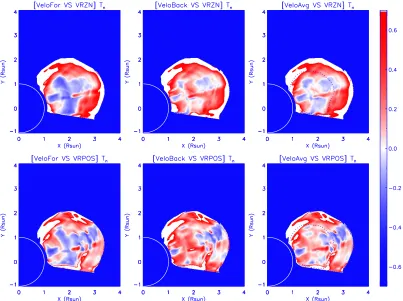
[image:4.612.155.474.266.436.2]Figure 4: Top: relative comparisons between the measured radial velocities from the VL images and the simulated radial velocities averaged with density (FS, BS and AS, respectively). Bottom: relative comparison between the measured radial velocities and the simulated radial velocities in the POS (FS, BS and AS, respectively). The dotted lines represent the region of the CME core.
(174 s), the displacement can be converted to the radial speed at the considered point. The BS analysis is similar, but with two differences with respect to the FS: 1) in the BS, we determine the maximal value of cross-correlation between the frame at the Tn and the frame at the Tn−1; 2) the shifted radial window atTn−1 is shrinking linearly, while the
window size at Tn moment is fixed. Finally, the average speed value obtained from FS and BS is considered as the
AS.Figure 2 shows the 2D radial velocity images as obtained with these three steps. From Figure 2 it is clear that overall the speed maximizes at the CME front and decreases at lower heliocentric distances, as expected. Moreover, the plasma speed distribution within the CME body displays significant spatial inhomogeneities, due to the fact that different parts of the CME plasma are propagating with different speeds and accelerations.
2.2. Uncertainties in CME radial velocity
In order to discuss results from our method, we first choose two input velocities (t = 26.1 minutes) obtained from the MHD simulation as reference velocities. In fact, due to LOS integration, the result of any kind of analysis applied to 2D coronagraphic images will be a 2D velocity map, while the MHD simulation provides us with 3D data cubes. Here, following the analysis performed byBemporad et al.(2018) for the optimization of plasma temperature determination in CMEs, we consider two reference velocities. The first one is simply the 2D cut of the radial velocity data cube in the POS. The second one is the average LOS velocity weighted over the electron number densityvLOS=
R+∞
−∞ nevrdz/
R+∞
−∞ nedz, considering that the VL brightness is proportional to the electron number density,ne, of each
cell, wherene=ρ/(0.83mp) andmp is the proton mass. Here, we assume that the typical coronal plasma condition of
fully ionized atoms with He abundance equal to 10%. These two different velocity distributions are shown inFigure 3 with the same color scale for comparison. It shows that significant differences between the two velocity distributions are present only around the nose of the CME front, where integration along the LOS are more significant. In the right panel ofFigure 3, the speed distribution maximizes around the nose region, while it is not the case in the left panel.
BS and AS) and the two reference velocities mentioned above, subsequently normalized to the reference velocities, are so-called ‘relative comparisons’, as shown inFigure 4. In particular, the top three panels in this Figure represent the relative comparisons between the measured radial velocities (from the FS, BS and AS, respectively) and the reference radial velocities averaged with the density, while the bottom panels show the relative comparisons between the measured velocities and the simulated velocities in the POS (FS, BS and AS, respectively). Considering in particular the comparison between the two AS maps and reference velocities (Figure 4, right column), it turns out that the measured radial velocities conforms better with respect to the reference speed weighted with the number density in the core of the CME (within 20% of uncertainty on average). On the other hand, the relative comparison with the POS speed (Figure 4, right bottom) shows a more uniform distribution, with a good velocity estimate (within 30% of uncertainty on average) of the plasma speed distribution in the POS all over the CME body, except for the flanks (where large errors up to about 100% are present). In general, we expect that the method described above provide us with a good uncertainty the radial velocity distribution within the CME body, with the exception of the regions located near the flanks of the eruption.
Figure 5: Examples of base-difference STEREO A/COR1 images acquired at three different times (∼11:00, ∼11:50 and∼12:40 UT) selected here with the purpose to show the CME early expansion. The pre-event background image acquired at 9:45 UT was subtracted. The white solid line and plus symbol denote the position of solar limb and center of the Sun, respectively, behind the COR1 occulter.
Figure 6: STEREO A/COR1 normalized running-difference images (acquired at∼12:35,∼12:40, and∼12:45 UT). The position of a dotted line is atr= 2.5 R.
3. ANALYSIS OF A REAL EVENT
[image:6.612.96.521.489.637.2]To test the techniques described above on a real event, we selected a CME that was observed by STEREO corona-graphs. They have better time cadences with respect to SOHO coronacorona-graphs. We decided to focus on a limb event in order to minimize possible projection effects due to plasma expansion out of the POS. On 2010 October 28, a CME with a classical three-part structure started to erupt at around ∼10:00 UT. The source region of this eruption was located in active region (AR) NOAA 11115, where a transient flare occurred. The CME, rising up from a streamer, was then observed both above the solar limb in the FOV of COR1 and COR2 coronagraphs on board the STEREO. COR1 images reach a lower heliocentric distance with a FOV going from 1.4 to 4 R, while COR2 FOV goes from
2.5 to 15 R. We fitted the Graduated Cylindrical Shell (GCS) model (Thernisien et al. 2009) to the CME observed by COR1 A and B, and find that the propagation of the CME deviates from the POS with an angle of about 10 degrees as seen from STEREO A. Therefore, we assume that this limb CME propagates approximately in the POS of STEREO A.
[image:7.612.71.534.305.630.2]In order to show the CME early expansion, three pB images of the CME acquired at three different times are shown in Figure 5. All images were processed by standard SolarSoft routinessecchi prep.pro. To better show the CME, these images are subtracted by the pre-event background image at around 09:45 UT, henceFigure 5shows the evolution of the CME excess brightness. The dark region in the core part of the CME is due to the presence of a streamer in the pre-event images. At the initial stage, the evolution of the CME shows only a slow change of local dynamics in the streamer. Then, with the acceleration phase, the CME structure separates from the streamer, evolving into a typical bubble shape.
Figure 8: Superposition between STEREO A/EUVI, COR1 and COR2 images acquired on October 28, 2010 at 15:06,
15:05 and 14:54 UT, respectively. This Figure shows the difference between the source AR latitude at 29◦S (yellow dashed line) and the CME propagation latitude around∼15◦S (cyan dashed line).
3.2. 2D maps of the CME velocities
To test the velocity measurement technique described insubsection 2.1, we selected here only three subsequent images observed from STEREO A/COR1 at three different times. The advantage of the STEREO COR1 data (compared with other coronagraphs) is that its high temporal resolution of 5 minutes is close to the time interval of the simulated VL image. We use the normalized running-difference images and subsequently enhance the contrast of the CME structure to measure the radial velocities of the CME in each pixel. As shown inFigure 6, many detail structures in the CME body can be observed in the resulting images. We mark these three sequential images (acquired at ∼12:35, ∼12:40,
∼12:45 UT) asTn−1,Tn andTn+1times, respectively. Through three steps (FS, BS and AS) in our method, the radial
velocity maps have been derived, which are shown inFigure 7(top row). It turns out that around 12:40 UT the speed of the CME body is not larger than 400 km s−1, and the front speed is higher than the core, as expected. Moreover, the radial speed also maximizes around the northward flank of the CME, suggesting a significant latitudinal asymmetry in the CME propagation. The interpretation of this asymmetry is shown in Figure 8: while the source AR was located at a latitude of 29◦S, the nose of the CME front (representing the most likely CME propagation direction) was centered around∼15◦S. The CME was deflected northward with respect to the source AR. Comparing the shape of the CME front between that observed at 12:40 UT (Figure 5, right panel) and at 14:54 UT (Figure 8), it is almost circular at 12:40 UT, while that is not the case in the FOV of COR2, the front in the northward part of the CME seems moved further, this is well reproduced by the faster radial speed we derived in the 2D velocity distribution.
As we are going to show, the 2D maps of CME radial velocity derived in the previous Sections can be used to estimate the 2D distribution of further parameters that can be of interest. First of all, the velocity map can be employed to derive the 2D distribution of Doppler dimming factors for the UV H I Ly-α intensity, a parameter that will be very important for the future analysis of CME coronagraphic observations acquired in this band (seesubsection 3.3). Moreover, these velocity maps can be used to investigate the 2D distribution and time evolution of the plasma kinetic energy in the CME body, that can provide interesting information on the energetic of the CME (seesubsection 3.4).
Figure 9: The distribution maps of the Doppler dimming factors (FS, BS and AS).The dotted line represents the region of the CME core, shown in Figure 10.
3.3. Doppler dimming factor
In the UV spectral range, the primary physical processes responsible for atomic excitation (followed by spontaneous emission) are the collisional excitation and the photo-excitation. These are also the main contributions of the H I Ly-αemission in the optically thin corona, while other mechanisms could be neglected, such as the Thomson scattering of chromospheric radiation by free coronal electrons. The observations from the coronagraphs only provide 2D images, according toSusino & Bemporad(2016), the radiative component of theH I Ly-αcan be expressed as
Ne≡
Z
LOS
nedz≈< ne> L (2)
Irad∝R(Te)·FD(vr)< ne> L, (3)
where Ne is the column density which can be obtained from VL images, < ne >is the average electron density of
the CME plasma along the LOS, and L is the thickness of the CME plasma along the LOS. If the thickness L of emitting plasma is known, the column density Ne can be converted to volume density< ne >in units of cm−3. In
equation 3,R(Te) is the element ionization fraction, which is a function of the electron temperatureTe, andFD(vr) is
the Doppler dimming factor, as defined inequation 1. In the future, if the Doppler dimming factor and the thickness of the plasma along LOS can be determined, combining the observations of VL and UV intensities, we could estimate the temperature distribution of the CME plasma, according toequation 3. For instance with a similar analysis (based only on VL and UV H I Ly-αintensities) Susino & Bemporad(2016) recently found that CME cores are usually associated with cooler plasma (T ∼106 K), and that a significant increase of the electron temperatures is observed
from the core to the front of the CME (where T >106.3K).
However, in the analysis described above the Doppler dimming factor will be affected not only by the radial velocity of the CME plasma, but also by the shape of normalized coronal absorption profile, Φ(λ), and by the intensity spectrum of incident profile,Iex, as described byequation 1. The normalized coronal absorption profile, here, has been assumed
to be Gaussian with a widthσλ, under the assumption of a Maxwellian velocity distribution of the absorbing particles,
where
σλ=
λ0
c
s
kBTk
mp
Inequation 4,kB is the Boltzmann constant, andTk is the kinetic temperature. To calculate theFD, we assumed here
an averaged value of the exciting radiation coming from the solar disk, and adopted the SOHO/SUMER chromospheric spectral profile observed at solar minimum in July 1996 (Lemaire et al. 2002). The kinetic temperature is assumed Tk= 106K for the normalized coronal absorption profile. The resulting 2D distribution of the Doppler dimming factors
is shown inFigure 9. Due to the low speed of the CME body, the distribution of theFDfactors reflect the anisotropies
in the 2D distribution of CME velocity, whileFDdecreases sharply in the pixels where the CME plasma is expanding
faster than ∼300 km s−1. Resulting 2D distribution of theFD factors further confirms that (as recently shown by
[image:10.612.154.439.245.536.2]Bemporad et al. 2018) the UV intensity in the CME front will be severely attenuated due to the larger plasma radial speed, as can be also revealed by comparing the distribution of the Doppler dimming factors inFigure 9with the radial speed distribution of the CME in Figure 7. In the future, when we will estimate the electron temperature of CMEs propagating with a very large speed, it will even possible to neglect the contribution of the radiative component, and to consider only the collisional component of H I Ly-αintensity.
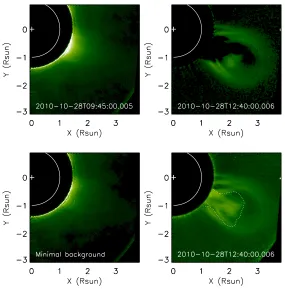
Figure 10: Left column: comparison between two different background event images. The upper one is the pre-event background image acquired at∼09:45 UT, while the lower one is the 24 hr minimum background image. Right column: base-difference images at∼12:40 UT obtained by subtracting the two different background images shown in the left column. The dotted line represents the region of the CME core, which is defined insubsection 3.4.
3.4. Energies of the CME
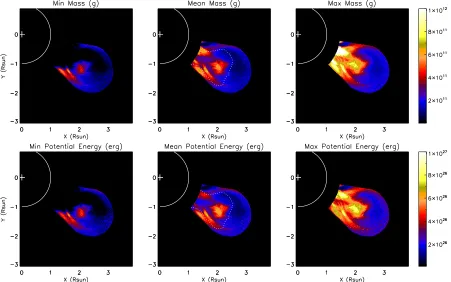
Figure 11: Top: The mass distribution images of the CME obtained by subtracting the pre-event image, the average between the pre-event and the 24 hr minimum image as well as the 24 hr minimum image, respectively. Bottom: The potential energy distributions of the CME obtained by subtracting to the same image the different background images shown in the top panels. The dotted lines represent the region of the CME core.
into the FOV of COR1 instrument, thus the contribution of Hαemission can be ignored and the mass measured from COR1 can be considered as reliable.
The major part of the signal of white-light coronagraph images, yielded by Thomson scattering, is linked linearly to the density of the scattering free electrons. The major non-Thomson scattered contributions, like stray light and dust scattering (the F-corona), are usually removed by subtracting the pre-event background image. The remaining image brightness then should contain the CME intensity distribution produced by Thomson scattering alone by electron in the CME plasma. In our event, however, before the appearance of the CME, there exists a dense streamer for a long time, and subtracting the pre-event background image (Figure 10, top left), which also includes the streamer structure, will result in negative values appearing in many pixels of the difference image (Figure 10, top right), causing a large underestimate of the CME mass. Therefore, here we consider the image resulting from the subtraction of the pre-event image as the lower limit estimate of the CME mass. Alternatively, a different approach is also possible by subtracting the 24 hr minimum background image (Figure 10, bottom left), in which each pixel has the minimal brightness observed from∼00:00 UT to∼23:55 UT; in this way we obtained the new difference image shown in Figure 10(bottom right). This image containing some streamer structure can be then converted to the mass image and then be regarded as the upper limit of the CME mass. The mass distributions of the CME, derived from the pB images via the SolarSoft routineeltheory.pro, are presented in Figure 11. Here, we derived two different mass distributions by subtracting the two different background images mentioned above. The region of interest we consider to estimate the CME mass corresponds to the region where we measured the radial velocity, while the remaining part is ignored here. Then we can calculate the potential energy distribution of the CME, hence the energy required to lift the CME plasma from the solar surface to its positionR, according to the equation
Ep =
Z R
R
GMmCME
r2 dr (erg), (5)
whereGis Gravitational constant,M is the solar mass, mCM E is the mass of the CME plasma, andR is the radial
Figure 12: Top: 2D images of the kinetic energy of the CME at 12:40 UT, using the average speed (obtained from the AS method) with the different background subtractions. Bottom: 2D images of the CME total mechanical (kinetic plus potential) energy at 12:40 UT.The dotted lines represent the region of the CME core.
On the other hand, the CME kinetic energy distribution is given by
Ek=
1
2 mCME v
2 (erg), (6)
where, by indicating withvθ the plasma velocity along the latitudinal direction in the POS, and withvφ the plasma
velocity along the longitudinal direction, the total velocityv is given by v=qv2
r+vθ2+vφ2. As we mentioned in subsection 3.1, this CME was almost propagating in the POS, so the measured radial velocity in the POS can be used as an approximate to its 3D radial speed vr, in space. Unfortunately, we cannot estimate
the latitudinal and longitudinal velocities directly from our method. Here, we choose two ways to estimate the total kinetic energy of the CME: 1) by only considering the radial velocity; 2) by measuring the tangential speed of the CME plasma with latitudinal slices in the VL images (such as the dotted line shown in Figure 6), and by assuming that the longitudinal velocity of the CME plasma is equal to the measured latitudinal velocity. By using the polar coordinate data mentioned above, it is easy to make slices along latitude at the same radial altitude; in particular we use a width of the slices of 0.125 R. For example, to analyze this CME at 12:40 UT, we make around 20 latitudinal
slices and obtain time-distance plots at different positions. Subsequently, by comparing all velocity results, we acquire the maximal latitudinal speed of the CME flank, and regard it as the average speed of a packet of plasma in each pixel cell, by assuming an equality between the longitudinal and latitudinal speeds. The kinetic energy will be overestimated when the latitudinal speed distribution should be inhomogeneous and small.
just calculate the kinetic energy by the radial velocity, the result is only 7% less than the kinetic energy with all the three components of velocity taken into account.
We obtain the CME’s mechanical energy, EM, combining its potential and total kinetic energy. The evolution of
totalEM,Ek andEp from 11:25 UT to 12:50 UT is shown inFigure 13. Notice that during this period the structure
of the CME, still in the FOV of STEREO A/COR1, can be distinguished and be used to measure its velocities with our method. InFigure 13(top panel), the total mechanical energy of the CME enhances around from 1.7×1030to 3.9 ×1030 erg with a stable energy increasing rate of 4.3 ×1026 erg s−1, the blue dots represent the average mechanical energy, while the blue shadow indicates uncertainties propagated from the mass measurements. For this CME, due to its low speed movement, the kinetic energy is far smaller than its potential energy, as shown inFigure 13(bottom panel). The increase of the kinetic energy is due to both the mass and the speed increase. The dots and shadow regions also represent the average value and error of potential and kinetic energy in blue and red (pink) color, respectively. Vourlidas et al.(2000) analyzed the energy budget of 11 CMEs and found that the kinetic energy is smaller than the potential energy for relatively small CMEs, but larger for fast CMEs (vcme≥600 km s−1). Due to
the conservation of the total energy (consisting of the kinetic, potential and magnetic energies, and neglecting other energy forms such as thermal energy and wave energy), the author thought that this result indicates that slow CMEs are magnetically driven, a conclusion which is reinforced by the small magnitude of the plasmaβ parameter.
It is well-known that a typical CME has a three-part structure, consisting of (1) a bright leading edge, (2) a dark cavity, and (3) a bright dense core (Illing & Hundhausen 1985), originated from the explosive magnetic flux rope system. Many authors believe that the dark void and the bright core correspond to the whole flux rope and the magnetic dips of the flux rope (e.g.,Low & Hundhausen 1995;Chen 1996; Gibson & Fan 2006; Cheng et al. 2012), respctively. Cheng et al.(2012) has analysed the density and temperature of the CME leading front and revealed that the CME bright front is resulted from the compression of ambient plasma when the CME expands its core region. Thus, in our work, we also discuss the energy distribution of the CME’s core and front. In order to define these two “core” and “front” regions in a more quantitative way, we follow this procedure: for each VL base-difference image subtracting the 24 hr minimum background, we define “by hand” a region of interest where the core should be located, taking this region as big as possible. Then, in this region we identify the maximum intensityImax and define as pixels
belonging to the CME core those with an intensity being between 1 and a fractionf ofImax(optimizing the value of
f, heref = 0.07). Then, once we identified all the pixels belonging to the core in this way, we assume that all the rest of the CME region belong to the “front+void” instead. In this way we make a separation between the CME “core” on one hand, and the CME “front+void” on the other hand, as done byHoward(2015a,b). The CME core is marked by the dotted line in Figure 10 (bottom right).
The relationship between the mass of the CME and the calculated centroid distance is shown in Figure 14 (top panel). InFigure 14 the blue signs indicate the mass evolution of the CME core, which is almost constant with the centroid distance (or with the time), while the mass of the CME front, marked by the pink symbols, increases with its propagation toward the interplanetary space. The centroid distance is calculated byrc=
Pm
iri
Pm
i , wheremi andri
In Figure 14 (bottom panel), red and blue dots represent the average mechanical energy of the CME core and front, respectively, while the shadows indicate the upper and lower limits of the mechanical energy due to the mass measurement with different background subtractions. This Figure shows that at the initial stage of the CME the
[image:14.612.181.424.192.475.2]mechanicalenergy of the core is higher than that of the front. Then, with the propagation of the CME, the energy of the front rises more rapidly, reaching up that of the core. This is likely an indirect consequence of the CME formation: at the early stages the eruption is driven by the expansion of the CME flux rope, thus containing the larger fraction of mechanical energy; then, as the front plasma is dragged by the expanding flux rope and progressively accelerated, its mechanical energy progressively increases with time, reaching a final stage where both core and front contain approximately the same amount of mechanical energy.
Figure 13: Top: Evolution of the mechanical energy of the CME with the time. Bottom: Evolution of the kinetic and potential energy of the CME with time. Pink (blue) region is the range of the kinetic (potential) energy. Red (blue) dots show the average value of the kinetic (potential) energy.
4. DISCUSSIONS AND CONCLUSIONS
The purpose of our work is to to measure the radial velocity distribution of the CME plasma in the POS. The radial velocity distribution of the CME plasma can provide an important information, while combining the VL and UV channels coronagraph observations. These observations will be provided in the next few years by the Metis coronagraph on-board Solar Orbiter, and by the LST coronagraph on-board the ASO-S. The results presented here will be really useful for the diagnostics of the temperature distribution of CMEs, in combination with the temperature diagnostics discussed byBemporad et al.(2018). In this work, we develop a new method based on the cross-correlation method to measure the 2D radial speed distribution of the CME body through synthetic VL coronagraphic images from the MHD simulation. While Tappin et al. (1999) only applied this method to calculate the outflow speeds of the solar wind without considering the variations of speeds at different position angles (and structures) in the images. Comparing with the actual radial velocity from the MHD simulation, we can estimate the measured error, and thus apply this method to a real event. Main results are listed below:
Figure 14: Top: Mass vs. centroid distance measurements of the core (blue) and its front (pink) components of the CME. Error bars are estimated by subtracting the different backgrounds. Bottom: Evolution of the mechanical energy measured from the CME core (blue shadow) and front (pink shadow) parts. Blue and red dots represent the average mechanical energy of the CME core and front, respectively. The shadows show the error ranges of the mechanical energy.
along the LOS and averaged with density, the other one is the cut of radial velocity in the POS), we compare the measured radial velocity with these two reference velocities and estimate the measured error between these two velocity distributions. The result shows that the measured velocity obtained from the synthetic VL images is well matched with the reference velocity integrated along the LOS and averaged with the electron number density in the core with no more than 20% uncertainty, while it is matched better with the simulated radial velocity in the POS in the front within 30% uncertainty. On the other hand large uncertainties are present in the CME’s flanks.
2. We apply the same method to a real CME event observed by STEREO A/COR1propagatingwith a low speed of∼320 km s−1 at the nose. The 2D radial velocity distribution of this CME shows the anisotropic kinematic feature of the CME plasma when this CME is propagating along the POS. The major velocity of the CME body is slower than the speed of the CME nose, while some parts, especially in the CME flank, have higher speed which is still less than∼400 km s−1.
3. Owing to the low speed of the CME, here, we could estimate the 2D distribution of the Doppler dimming factors for the UV H I Ly-αspectral line, because this factor is really sensitive to the radial component of outflow velocity. If the plasma speed is larger than 300 km s−1, this factor is almost zero. This character of the Doppler dimming factor indirectly confirms that (as recently shown by Bemporad et al. 2018) the UV intensity in the CME front will be severely attenuated due to the larger plasma radial speed.
flux rope leading to subsequent acceleration of plasma embedded in the front.
5. During the CME propagation, the mass of the core almost keeps constant, while that of the CME front increases with the rising of the CME. This is consistent with the classical picture for the formation of the three-part structure of the CME: the dark cavity corresponds to the whole flux rope, and the core, which is more magnetically isolated, is not increasing significantly its mass during the CME expansion,while the front forms by the mass supplement from the dimming region in the low corona and/or pile-up of the ambient plasma, leading to a progressive mass increase.
In our work, we have compared the difference between the kinetic energy with and without considering the latitudinal and longitudinal speed of the CME. The comparison ratio between these two kinds of kinetic energies is no more than 10% during the evolution of the CME from 11:25 to 12:50 UT. Given the mechanical energy evolution and distribution of the CME core and front, the influence made by these two additional kinetic energy components is thus negligible, because the energy difference between these two kinetic energies is no more than 2% of the total mechanical energy. The largest uncertainty of the energy is related with the estimate of the CME mass, that was performed here with two different background subtractions, providing upper and lower limit estimates of the CME mass. This is important because MHD simulations (Lugaz et al. 2005) and other works dealing with the CME mass measurement (e.g.Vourlidas et al. 2000,2010;Howard 2015b) have shown that the estimate of the CME masses based on Thomson scattering method may be underestimated by a factor of∼2.
Doppler dimming factorFDplays a significant role in calculating the radiative emission due to the resonant scattering
of the chromospheric H I Ly-α emission by very few remaining neutral hydrogen atoms in the hot corona. This parameter will be affected by the radial velocity of the plasma, the normalized coronal absorption profile, and the intensity spectrum of incident profile, as mentioned above. In our work, we do not consider the velocity projection effect due to the propagation of the real CME along the POS. It is possible to correct the projection effect via the polarization-ratio technique mentioned bySusino & Bemporad(2016). The purpose of our work is to provide a good tool to derive the 2D radial velocity distribution of the CME, so that in the future we could combine theVL and UV coronagraphic observations, thanks to the future Solar Orbiter/Metis and ASO-S/LST instruments, to diagnose the characteristics of the CMEs, such as the kinetic energy distribution, temperature distribution, and so on. Bemporad et al.(2018) tested three different hypothesis to estimate the CME plasma temperatures by taking the Doppler dimming factor into account: (1) full collisional excitation assumption, (2) full radiative excitation assumption and (3) radiative and collisional excitation assumption. The results in Bemporad et al.(2018) showed that all temperature estimated by the synthetic VL and UV images were underestimated, whatever method is considered to take into account LOS integration effects.
As we all know, the Sun is variable, constantly evolving in time. For the UV intensity observations from the future coronagraphs, whether there are active region or not in the solar disk will lead to an immeasurable different intensity measurement of the resonant radiative contributions from the chromosphere. In the era of ASO-S, LST will first supply the full disk observation of the H I Ly-αline, which can allow us to constrain the incident radiation intensity from the chromosphere layer, and enhance the accuracy of the calculation of the Doppler dimming factor, subsequently decreasing the uncertainty of the CME temperature estimation.
flares. Furthermore, combining with the analysis of the energy partition between the flares and CMEs among the various components would provide valuable constraints on the fundamental energy release process(es) (Reeves et al. 2010;Reeves & Moats 2010), thus helping to understand the origin of CMEs.
Thanks to the host of Dr Thomas Wiegelmann and Dr Bernd Inhester at the Max-Planck-Institut for Solar System Research, laying the foundation for the preparation of the article. STEREO is a project of NASA. The SECCHI data used here were produced by an international consortium of the Naval Research Laboratory (USA), Lockheed Martin Solar and Astrophysics Lab (USA), NASA Goddard Space Flight Center (USA), Rutherford Appleton Laboratory (UK), University of Birmingham (UK), Max-Planck-Institut for Solar System Research (Germany), Centre Spatiale de Li`ege (Belgium), Institut d’Optique Th´eorique et Applique´e (France), Institut d’Astrophysique Spatiale (France). This work is supported by NSFC (Grant Nos. 11522328, 11473070, 11427803 and U1731241), by CAS Strategic Pioneer Program on Space Science (Grant Nos. XDA15010600, XDA15052200, XDA15320103 and XDA15320301), and by the National Key R&D Program of China (2018YFA0404200). This research has received funding from the the European Union Horizon 2020 research and innovation programme (grant agreement No. 647214). This work used the DiRAC@Durham facility managed by the Institute for Computational Cosmology on behalf of the STFC DiRAC HPC Facility (www.dirac.ac.uk). The equipment was funded by BEIS capital funding via STFC capital grants ST/P002293/1, ST/R002371/1 and ST/S002502/1, Durham University and STFC operations grant ST/R000832/1. DiRAC is part of the National e-Infrastructure. We acknowledge the use of the open source (gitorious.org/amrvac) MPI-AMRVAC software, relying on coding efforts from C. Xia, O. Porth, R. Keppens.
REFERENCES
Akmal, A., Raymond, J. C., Vourlidas, A., et al. 2001, ApJ, 553, 922
Antonucci, E., Andretta, V., Cesare, S., et al. 2017, in Society of Photo-Optical Instrumentation Engineers (SPIE) Conference Series, Vol. 10566, Society of Photo-Optical Instrumentation Engineers (SPIE) Conference Series, 105660L
Aschwanden, M. J. 2016, ApJ, 831, 105
Aschwanden, M. J., Nitta, N. V., Wuelser, J.-P., et al. 2009, ApJ, 706, 376
Aschwanden, M. J., & Parnell, C. E. 2002, ApJ, 572, 1048 Bemporad, A., Pagano, P., & Giordano, S. 2018, A&A, 619, A25 Bemporad, A., Raymond, J., Poletto, G., & Romoli, M. 2007,
ApJ, 655, 576
Billings, D. E. 1966, A guide to the solar corona (New York: Academic Press)
Braga, C. R., Dal Lago, A., Echer, E., Stenborg, G., & Rodrigues Souza de Mendon¸ca, R. 2017, ApJ, 842, 134 Brueckner, G. E., Howard, R. a., Koomen, M. J., et al. 1995,
Solar Physics, 162, 357
Carley, E. P., McAteer, R. T. J., & Gallagher, P. T. 2012, The Astrophysical Journal, 752, 36
Chen, J. 1996, J. Geophys. Res., 101, 27499
Cheng, X., Zhang, J., Saar, S. H., & Ding, M. D. 2012, ApJ, 761, 62
Ciaravella, A., Raymond, J. C., & Kahler, S. W. 2006, ApJ, 652, 774
Ciaravella, A., Raymond, J. C., van Ballegooijen, A., et al. 2003, ApJ, 597, 1118
Colaninno, R. C., & Vourlidas, A. 2006, ApJ, 652, 1747 Colaninno, R. C., & Vourlidas, A. 2009, The Astrophysical
Journal, 698, 852
Emslie, A. G., Dennis, B. R., Holman, G. D., & Hudson, H. S. 2005, Journal of Geophysical Research (Space Physics), 110, A11103
Emslie, A. G., Kucharek, H., Dennis, B. R., et al. 2004, Journal of Geophysical Research (Space Physics), 109, A10104 Feng, L., Inhester, B., & Gan, W. 2015a, ApJ, 805, 113 Feng, L., Inhester, B., Wei, Y., et al. 2012, ApJ, 751, 18 Feng, L., Wang, Y., Shen, F., et al. 2015b, ApJ, 812, 70
Feng, L., Wiegelmann, T., Su, Y., et al. 2013, ApJ, 765, 37 Gan, W., Deng, Y., Li, H., et al. 2015, in Proc. SPIE, Vol. 9604,
Solar Physics and Space Weather Instrumentation VI, 96040T Gibson, S. E., & Fan, Y. 2006, Journal of Geophysical Research
(Space Physics), 111, A12103
Gopalswamy, N., Yashiro, S., Michalek, G., et al. 2009, Earth, Moon, and Planets, 104, 295
Howard, R. A., & Vourlidas, A. 2018, SoPh, 293, 55 Howard, T. A. 2015a, ApJ, 806, 175
—. 2015b, ApJ, 806, 176
Illing, R. M. E., & Hundhausen, A. J. 1985, J. Geophys. Res., 90, 275
Jin, M., Ding, M. D., Chen, P. F., Fang, C., & Imada, S. 2009, ApJ, 702, 27
Kaiser, M. L., Kucera, T. A., Davila, J. M., et al. 2008, Space Science Reviews, 136, 5
Kohl, J. L., Esser, R., Gardner, L. D., et al. 1995, Solar Physics, 162, 313
Landi, E., Raymond, J. C., Miralles, M. P., & Hara, H. 2010, ApJ, 711, 75
Lee, J.-Y., Raymond, J. C., Ko, Y.-K., & Kim, K.-S. 2009, ApJ, 692, 1271
Lemaire, P., Emerich, C., Vial, J.-C., et al. 2002, in ESA Special Publication, Vol. 508, From Solar Min to Max: Half a Solar Cycle with SOHO, ed. A. Wilson, 219–222
Li, H. 2015, Proceedings of the International Astronomical Union, 11, 436:438
Low, B. C., & Hundhausen, A. J. 1987, Journal of Geophysical Research: Space Physics, 92, 2221
Low, B. C., & Hundhausen, J. R. 1995, The Astrophysical Journal, 443, 818
Lu, L., Inhester, B., Feng, L., Liu, S., & Zhao, X. 2017, ApJ, 835, 188
Lugaz, N., Manchester, IV, W. B., & Gombosi, T. I. 2005, ApJ, 627, 1019
Mierla, M., Chifu, I., Inhester, B., Rodriguez, L., & Zhukov, A. 2011, A&A, 530, L1
Noci, G., Kohl, J. L., & Withbroe, G. L. 1987, ApJ, 315, 706
Pagano, P., Mackay, D. H., & Poedts, S. 2014, A&A, 568, A120
Raymond, J. C., Ciaravella, A., Dobrzycka, D., et al. 2003, ApJ,
597, 1106
Reeves, K. K., Linker, J. A., Miki´c, Z., & Forbes, T. G. 2010,
The Astrophysical Journal, 721, 1547
Reeves, K. K., & Moats, S. J. 2010, ApJ, 712, 429
Robbrecht, E., & Berghmans, D. 2004, A&A, 425, 1097
Susino, R., & Bemporad, A. 2016, The Astrophysical Journal,
830, 58
Tappin, S. J., Simnett, G. M., & Lyons, M. A. 1999, A&A, 350, 302
Thernisien, A., Vourlidas, A., & Howard, R. A. 2009, SoPh, 256, 111
Thernisien, A. F. R., Howard, R. A., & Vourlidas, A. 2006, ApJ, 652, 763
Tian, H., McIntosh, S. W., Xia, L., He, J., & Wang, X. 2012, ApJ, 748, 106
Vourlidas, A., Howard, R. A., Esfandiari, E., et al. 2010, ApJ, 722, 1522