Comparative analysis of internal and
external-hex crown connection systems - a finite element
study
Comparative analysis of internal and
external-hex crown connection systems - a finite element
study
1 1 1 1 2
Rudi C. Van Staden , Hong Guan , Yew-Chaye Loo , Newell W. Johnson & Meredith Nell
1 2
Griffith School of Engineering/Dentistry and Oral Health, Griffith University, Gold Coast Campus, Queensland 4222, Australia. Neoss Pty Ltd,Harrogate HG1 2PW, United Kingdom.* Correspondence should be addressed to Rudi C. Van Staden ([email protected]).
has reduced stress concentrations in the
ABSTRACT
crown. However, because the torque is trans-ferred through the abutment screw to the abut-Objectives: The abutment connection with
ment contact, changing the torque has greater the crown is fundamental to the structural
effect on this hex system than the masticatory stabil ity of the implant system and to the
pre-force. Overall the masticatory force is more vention of mechanical exertion that can
com-influential on the stress within the crown for promise the success of the implant treatment.
the external-hex system and the torque is more The aim of this study is to clarify the difference
influential on the internal-hex system. in the stress distribution patterns between
implants with internal and external-hex con-nections with the crown using the Finite Ele-ment Method (FEM). Material and Methods: The internal and external-hex connections of the
Neoss and 3i implant systems respectively, are
1. INTRODUCTION
considered. The geometrical properties of the Dental implants are a consistently accepted form of
implant systems are modeled using three- dental treatment. Clinical research in oral implantology
dimensional (3D) brick elements. Loading con- has led to advancements in the biom echan ical as pects
ditions include a masticatory force of 200, 500 of implants, implant surface features and implant
and 1000N applied to the occlusal surface of c o m p o n e n t r y . T h e s e a d v a n c e m e n t s i n i m p l a n t
the crown along with an abutment screw torque componentry include the modification of the
exter-of 110, 320 and 550Nmm. The von Mises stress nal-hex connection between the abutment and crown
distribution in the crown is examined for all to the currently used internal-hex ( )).
loading conditions. Assumptions made in the Although both internal and external-hex connected
modeling include: 1. half of the implant system implant systems are extensively used, distinctly
dif-is modeled and symmetrical boundary condi- ferent performances are on offer in terms of the stress
tions applied; 2. temperature sensitive ele- characteristics produced within the crown.
Observa-ments are used to replicate the torque within tions by practitioners have aided the identification of
the abutment screw. Results: The connection implant components which lead to mechanical failure
type strongly influences the resulting stress of the crown and implant [1-3]. Failure may be defined as the point at which the material exceeds the
characteristics within the crown. The
magni-fracture stress, as indicated by its stress strain
rela-tude of stress produced by the internal-hex
tionship. There are two major factors which can
implant system is generally lower than that of
c a u s e t h e c r o w n a n d i m p l a n t t o f a i l . T h e s e a r e
the external-hex system. The internal-hex
sys-described below;
tem held an advantage by including the use of
- typically, over tightening of the abutment screw
an abutment between the abutment screw and
causes failure of the crown for internal and
external-the crown. Conclusions: The geometrical
hex systems.
design of the external-hex system tends to
- failure of the implant may also be a result of over
induce stress concentrations in the crown at a
t i g h t e n i n g o f t h e a b u t m e n t s c r e w o r e x c e s s i v e
distance of 2.89mm from the apex. At this
loca-masticatory loads being transferred from the occlusal
tion the torque applied to the abutment screw
plane of the crown to an area of stress concentration
also affects the stresses, so that the
compres-at the interface between the abutment and implant
sive stresses on the right hand side of the
body.
crown are increased. The internal-hex system
Keywords: Component; Biomedical modelling; Dental implant; Finite element technique
Figure 1b
J. Biomedical Science and Engineering, 2008, 1, 10-14 Research Publishing
SciRes
Copyright
©
Using theoretical techniques, such as the FEM, all mechanical aspects that could affect the implant suc-cess can be evaluated. FEM has been used exten-sively to evaluate the performance of dental implant prosthesis [4-15]. Studies by Maeda et al. (2006), Merzet al. (2000) and Khraisat et al. (2002) have all considered the behavior of the stress within the abut-ment screw however disregarding the stress within the crown. To date no published research appears to have investigated the stress characteristics in the crown due to an internal or external-hex system. Ulti-mately, the outcome of this study will facilitate den-tal practitioners to identify locations within the implant system that are susceptible to stress concen-trations.
2. METHODOLOGY
The modeling and simulation herein are performed using the Strand7 Finite Element Analysis (FEA) Sys-tem (2004). The first step of the modeling is to define the geometry of the implant system. This is then fol-lowed by specifying the material behavior in terms of the Young's modulus, Poisson's ratio and density for the implant and componentry. After applying the appropriate loading and restraint conditions, the
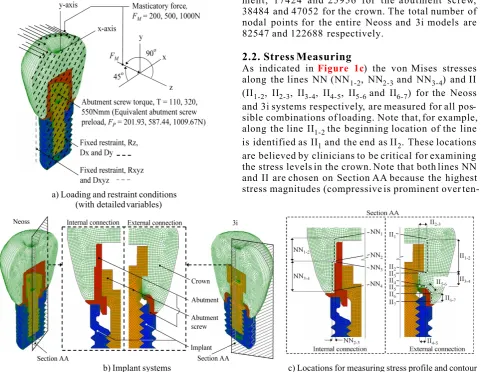
c) Locations for measuring stress profile and contour a) Loading and restraint conditions
[image:2.595.61.544.369.741.2](with detailed variables)
Figure 1. Finite element model of internal and external-hex systems.
internal and external-hex systems can be evaluated for their contributions to the stress characteristics within the crown.
2.1. Modelling
Data acquisition for the internal and external-hex sys-tems are obtained from the manufacturer's data. Shown in ) are details of the Neoss (2006) and 3i (2006) systems.
Shown in ) are the detailed variables con-sidered in this study. The implant is conical with 2 degrees of taperage, a helical thread, diameter of 4 . 5 m m , a n d l e n g t h o f 1 1 m m . D i f f e r e n t f i x e d restraints are applied to the symmetrical edge of the implant system as compared to the outer edge of implant thread. The symmetrical edge is restrained f r o m r o t a t i n g a r o u n d t h e z - a x i s a n d t r a n s l a t i n g through the x- and y-axis. The outer edge of the implant thread is restrained from deforming in any direction. Note that these loading and restraint condi-tions are the same for both internal and external-hex systems.
For the Neoss and 3i finite element models, the total numbers of elements are respectively 13464 and 30420 for the implant, 3564 and 9108 for the abut-ment, 17424 and 25956 for the abutment screw, 38484 and 47052 for the crown. The total number of nodal points for the entire Neoss and 3i models are 82547 and 122688 respectively.
2.2. Stress Measuring
As indicated in ) the von Mises stresses along the lines NN (NN1-2, NN2-3 3-4and NN ) and II (II1-2, II2-3, II3-4, II4-5, II5-6and II6-7) for the Neoss and 3i systems respectively, are measured for all pos-sible combinations of loading. Note that, for example, along the line II1-2the beginning location of the line is identified as II and the end as II . These locations 1 2 are believed by clinicians to be critical for examining the stress levels in the crown. Note that both lines NN and II are chosen on Section AA because the highest stress magnitudes (compressive is prominent over
ten-Figure 1b
Figure 1a
Figure 1c
R.C. Van Staden et al./J. Biomedical Science and Engineering 1 (2008) 10-14
sile) occur on this plane due to the masticatory load-ing characteristics.
2.3. Loading Conditions
Masticatory force, FM, is applied to the occlusal
sur-o
face of the crown at 100, 250 or 500N, inclined at 45 along the x- and y-axis ( ). The preload, FP, of 100.97, 293.72 or 504.84N is applied to the abut-ment screw through the use of temperature sensitive elements ( )). Note thatFM and FP are set to half of the total magnitude because only half of the implant system is modelled. Therefore the total FM
modelled is 200, 500, 1000N andFP is 201.93, 587.44, 1009.67N. The manner of modelling the masticatory forces and the preload applied to the abutment screw is described by van Staden et al. (2008). In this study both the abutment screw preload, FP, and surface area between abutment and abutment screw are halved when compared with that used by van Staden et al. (2008) due to the modelling assumption aforemen-tioned. Calculations for the abutment screw surface pressure,q, confer identical results than that found by van Staden et al. (2008).
[image:3.595.304.538.99.194.2]For the present study a negative temperature (-10 Kelvin, K) is applied to all the nodal points within the abutment screw, causing each element to shrink. A trial and error process is applied to determine the tem-perature coefficient,C, for both the Neoss and 3i sys-tems (i.e. CNeoss and C3i) that can yield an equivalent
Figure 1a
[image:3.595.302.533.421.742.2]Figure 1a
Figure 2. Stress characteristics when varying F .M Figure 3.Stress characteristics when varying F .P
a) Stress profile b) Stress contour
c) Stress profile d) Stress contour
a) Stress profile b) Stress contour
c) Stress profile d) Stress contour
q. It is found that when FP=201.93, 587.44 and 1009.67N
-4 -4 -4
then CNeoss=-3.51×10 , -9.28×10 and -15.60×10 /K,
-4 -4 -4
and C =-0.983i ×10 , -1.80×10 and -2.68×10 /K, respec-tively.
2.4. Material Properties
The material properties used are specified in terms of Young's modulus, Poisson's ratio and the density for the implant and all associated components ( ). All material properties are assumed to be linear, homogeneous and elastic in behavior.
3. RESULTS DISCUSSION
Zirconia typically used as a dielectric material has proven adequate for application in dentistry. With its typical white appearance and high Young's moduli it is ideal to be used in the manufacturing of sub frames
Table 1
Table 1. Material propertles.
Component
Implantand abutment
Abutment screw
Crown
Description
Titanium (grade4)
Gold(prec-isionalloy)
Zirconia(Y-TZP)
Young's mo-dulus, E (Gpa)
105.00
93.00
172.00
Poisons ratio, v
0.37
0.30
0.33
Density, p (g/cm3)
4.51
16.30
6.05
R.C. Van Staden et al./J. Biomedical Science and Engineering 1 (2008) 10-14
V
o
n
M
ises
stress(MPa)
V
o
n
M
ises
stress(MPa)
V
o
n
M
ises
stress(MPa)
V
o
n
M
ises
stress(MPa)
NN1-2,2-3,3-4(mm)
II1-2,2-3,3-4,4-5,5-6,6-7(mm) II1-2,2-3,3-4,4-5,5-6,6-7(mm)
[image:3.595.70.428.422.740.2]stresses along the lines NN and II for all values ofFP
for the construction of dental restorations such as
are shown in . crowns and bridges, which are then veneered with
As found forF , when F increases the stresses conventional feldspathic porcelain. Zirconia has a M P
fracture strength that exceeds that of Titanium there- calculated along the line NN increase, showing two fore it may be considered as a high strength material. peaks along the line NN3-4(refer to ) and However with cyclic preload and masticatory loads )). Also, as found for F , elevated stress
M
the compressive strength of 2.1GPa (Curtis et al. peaks are identified at the beginning of the line II
3-4
2005) can easily be exceeded especially for implant
( ) and )). Overall, all values of systems with external-hex connections, as confirmed
FM cause greater stresses along lines NN and II, than during this study.
do varying values ofF . The distribution of von Mises stresses in the crown P
is discussed for both the internal and external-hex
sys-tems for all combinations of masticatory and preload
4. DISCUSSION
forces. Shown in ), are the von Mises FEA has been used extensively to predict the s t r e s s e s m e a s u r e d b e t w e e n l o c a t i o n s N N1 - 2 ( 0 - biomechanical performance of the jawbone sur-1.76mm), NN2-3 (1.76-1.87mm) and NN3-4 (1.87- rounding a dental implant [21, 22]. Previous research
considered the influence of the implant dimensions 3.96mm) for the Neoss system. For the 3i system the
and the bone-implant bond on the stress in the sur-von Mises stresses are measured between locations
rounding bone. However, to date no research has II1-2(0-2.38mm), II2-3(2.38-2.78mm), II3-4
(2.78-been conducted to evaluate the stress produced by dif-3.67mm), II4-5 (3.67-4.06mm), II5-6(4.06-4.65mm)
ferent implant to crown connections (i.e. internal and and II6-7(4.65-5.27mm), as shown in ).
external-hex). The analysis completed in this paper uses the FEM to replicate internal and external-hex systems when subjected to both FM and FP loading
3.1. Masticatory Force, FM
conditions. As shown in , two stress peaks The distributions of von Mises stresses along the
were revealed along the lines NN and II at locations lines NN and II for all values ofFM are shown in
3.76 and 2.89mm from the top. The stress values Note that the preload,Fp, is set at its medium shown were calculated with the other variables (i.e. value, i.e. 587.44N. FM or FP) set to its average.
In general, when the applied masticatory force, FM, The mastication force F is applied on the
M
is increased, the von Mises stresses also increase pro- occlusal surface of the crown, evenly distributed portionally, because the system being analysed is lin- along 378 nodal locations ( ), and
orien-o
ear elastic. When FM increases the stress along the tated at 45 in the x-y plane. This induces compres-line NN increases showing two peaks along the compres-line sive stresses in the right hand side of the crown and NN3-4(refer to )). The larger of these two tensile in the left. VaryingFMfrom 200 to 1000N for peaks occurs at a distance of±3.8mm in length from the internal and external-hex systems results in a NN . This stress peak (as can be identified in 1 change in von Mises stress of 545.64
(818.47-272.82MPa) and 698.09MPa (1047.14-349.05MPa) )) is caused by a sharp corner and sudden change in
respectively. The geometrical design of the external-section at this point.
hex system tends to induce stress concentrations, Elevated stress concentrations are identified at the
located 2.89mm from the apex in this study. For this beginning of the line II3-4 ( ) and )).
system, a stress concentration at this point is also This stress peak, as can be identified in ), is
induced by FP, increasing the compressive stresses caused by a sharp corner at this point. For the 3i
sys-on the right hand side of the crown. Increasing F
tem, the volume of the crown exceeds that of the P
Neoss system, thereby suggesting that the 3i crown from its minimum to maximum values, for the exter-m a y e n d e a v o r g r e a t e r r e s i s t a n c e t o t h e a p p l i e d nal-hex system, increases the stress by 485.46MPa masticatory forces. However, even though the Neoss (951.67-466.21MPa).
crown has a thinner wall thickness along the line The internal-hex system has reduced stress concen-NN3-4, reduced stresses are still evident due to the
abutments high Young's modulus. Overall, the design differences between the Neoss and 3i systems ulti-mately results in the 3i system having higher stresses whenFM is increased.
3.2. Preload Force, FP
To investigate the effect of different preload FP,FM
is kept as a constant and its medium value, i.e. 500N is considered herein. The distributions of von Mises
Figure 3
Figure 3a Figure 3b
Figure 3c Figure 3d
Figure 1c
Figure 1c
Table 2
Fig-ure 2.
Figure 1a
Figure 2a
Figure 2b
Figure 2c Figure 2d
Figure 2c
Table 2. Von Mises stress (MPa) in crown (location of stress recording in brackets).
Variables
Line
NN (3.76mm)
II (2.89mm)
FM(N) FP(N)
200
272.82
349.05 500
545.64
698.09 1000
818.47
1047.14 201.93
231.55
466.21 587.44
545.64
698.09
1009.67
891.83
951.67
Clinical Implant Dentistry and Related Research 2005,
trations, demonstrating that this design is less
sus-7(4):221-228.
ceptible to stress concentrations within the crown. [7]F. H. G. Butz, M. Okutan & J. R. Strub. Survival rate, fracture However, because of the transfer of the preload strength and failure mode of ceramic implant abutments after through the abutment screw to abutment contact, chewing simulation. Journal of Oral Rehabilitation 2005,
32(11):838-843.
changing FP is more influential on this hex system
[8]K. J. Anusavice & P. H. Dehoff. Influence of metal thickness on
than FM. Overall FMis more influential on the stress stress distribution in metal-ceramic crowns. Journal of Dental
Research1986, 65(9):1173-1178.
within the crown for the external-hex system andFP
[9]K. J. Anusavice. Stress distribution in metal-ceramic crowns
is more influential on the internal-hex system. with a facial porcelain margin. Journal of Dental Research
1987, 66(9):1493-1498.
[10]K. J. Anusavice. Influence of incisal length of ceramic and
5. CONCLUSION
loading orientation on stress distribution in ceramic crowns.Journal of Dental Research 1988, 67(11):1371-1375.
This research is a pilot study aimed at offering an
ini-[11]H. Y. Suzuki. Finite element stress analysis of ceramics crown
tial understanding of the stress distribution
charac-on premolar. Relaticharac-on between ceramics materials and
abut-teristics in the crown under different loading condi- ment materials. Nippon Hotetsu Shika Gakkai Zasshi 1989, tions. Realistic geometries, material properties, load- 33(2):283-293.
[12]T. Hino. A mechanical study on new ceramic crowns and
ing and support conditions for the implant system
bridges for clinical use. Osaka Daigaku Shigaku Zasshi 1990,
were considered in this study. The geometrical design
35(1):240-267.
of the external-hex system tends to induce stress con- [13]Zhang, B. & Wang , H. Three-dimensional finite element anal-centrations in the crown at a distance of 2.89mm from ysis of all-ceramic crowns of the posterior teeth. Hua Xi Yi Ke
Da Xue Xue Bao 2000, 31(2):147-148.
the apex. At this location,FP also affects the stresses,
[14]K. A. Proos, J. Ironside & G. P. Steven. Finite element analysis
so that the compressive stresses on the right hand side studies of an all-ceramic crown on a first premolar. Interna-of the crown are increased. The internal-hex system tionalJournal of Prosthodontics2002, 15(4):404-412.
[15]A. Imanishi, T. Ohyama & T. Nakamura. 3-D Finite element
has reduced stress concentrations in the crown.
How-analysis of all-ceramic posterior crowns. Journal of Oral
ever, because the preload is transferred through the
Rehabilitation2003, 30(8):818-822.
abutment screw to the abutment contact, changing FP [16]Strand7 Pty Ltd.Strand7 Theoretical Manual 2004. Sydney,
Australia.
has greater effect on this hex system thanFM. Overall
[17]Neoss Pty Ltd, Neoss Implant System Surgical Guidelines
FMis more influential on the stress within the crown 2006. United Kingdom.
th
[18]http://www.3i-online.com.htm (accessed 12 July 2006).
for the external-hex system and FP is more
influen-[19]R. C. van Staden, H. Guan, Y. C. Loo, N. W. Johnson & N.
tial on the internal-hex system. Meredith. Stress Evaluation of Dental Implant Wall Thickness Future recommendations include the evaluation using Numerical Techniques.Applied Osseointegration
Research2008, (In Press).
of other implant variables such as the implant wall
[20]A. R. Curtis, A. J. Wright & G. J. Fleming. The influence of
thickness and thread design. Ultimately, all implant
simulated masticatory loading regimes on the bi-axial flexure
components can be understood in terms of their influ- strength and reliability of a Y-TZP dental ceramic. Journal of ence on the stress produced within the implant itself. Dentistry2005, 34(5):317-325.
[21]D. H. DeTolla, S. Andreana, A. Patra, R. Buhite & B. Comella.
Role of the finite element model in dental implants.Journal of
Oral Implantology 2000, 26(2):77-81.
[22]J. P. Geng, K. B. Tan & G. R. Liu. Application of finite element
ACKNOWLEDGEMENTS
analysis in implant dentistry: a review of the literature.
Jour-This work was made possible by the collaborative support from
nal of Prosthetic Dentistry 2001, 85(6):585-598. griffith's school of engineering and school of dentistry and oral
health. A special thank you goes to messer john divitini and fredrik engman from neoss pty ltd for their continual contribution.
REFERENCE
[1]Y. Maeda, T. Satoh & M. Sogo. In vitro differences of stress centrations for internal and external hex implantabutment
con-nections: a short communication. Journal of Oral
Rehabilita-tion2006, 33:75-78.
[2]B. R. Merz, S. Hunenbart & U. C. Belser. Mechanics of the implantabutment connection: an 8-degree taper compared to a
butt joint connection. International Journal of Oral and
Maxillofacial Implants 2000, 15:519-526.
[3]A. Khraisat, R. Stegaroiu, S. Nomura & O. Miyakawa. Fatigue
resistance of two implant/abutment joint designs.Journal of
Prosthetic Dentistry2002, 88:604-610.
[4]S. Capodiferro, G. Favia, M. Scivetti, G. De Frenza & R. Grassi. Clinical management and microscopic characterisation of
fatique-induced failure of a dental implant.Case report. Head
and Face Medicine 2006, 22, 2:18.
[5]P. Gehrke, G. Dhom, J. Brunner, D. Wolf, M. Degidi & A. Piattelli. Zirconium implant abutments: fracture strength and
influence of cyclic loading on retaining-screw loosening.
Quin-tessence International 2006, 37, 1:19-26.
[6]A. Khraisat. Stability of implant-abutment interface with a hexa-gon-mediated butt joint: failure mode and bending resistance.