A Network Intrusion Detection Model Based on
Immune Multi-Agent
Nian LIU1,2, Sunjun LIU3, Rui LI3, Yong LIU4
1College of Computer Science, Sichuan University, Chengdu, Sichuan, China
2School of Electrical Engineering and Information, Sichuan University, Chengdu, Sichuan, China
3The software engineering college of Chengdu University of Information Technology, Chengdu, Sichuan,China
4Chengdu Institute of Computer Applications, Chinese Academy of Sciences, Chengdu Sichuan, China
Email: liusunjun@163.com
Received March 18, 2009; revised May 5, 2009; accepted June 18, 2009
ABSTRACT
A new network intrusion detection model based on immune multi-agent theory is established and the concept of multi-agents is advanced to realize the logical structure and running mechanism of immune multi-agent as well as multi-level and distributed detection mechanism against network intrusion, using the adaptability, diversity and memory properties of artificial immune algorithm and combing the robustness and distributed character of multi-agents system structure. The experiment results conclude that this system is working pretty well in network security detection.
Keywords: Artificial Immune, Intrusion Detection, Multi-Agent System,
1. Introduction
Along with the rapid development of network technology and fast upgrade of network attack technologies network security has become the focus of this age. However, cur-rent intrusion detection technologies [1,2], like statistical analysis, characteristics analysis and expert system etc, can not meet well all the needs. Firstly, the lack of adaptability makes it difficult to detect unknown attacks; Secondly, the lack of robustness leaves each part isolated without communication. Therefore, the building of a detection system with adaptability and robustness is in pressing needs.
Biological Immune System [3] identifies and elimi-nates foreign bodies intruding into the organism by immune cells. From the aspect of information process-ing, BIS is a distributed autonomic system and its self- learning, adaptability and robustness serve as important inspirations for the solving of network security prob-lems. In 1974, Jerne [3] brought forth the first mathe-matical model in immune system, later in 1994, Forrest [4] put forward the concept of computer immune sys-tem for the detection of network intrusion, and up to now the artificial immune system based on biological immune theory has been applied extensively in network security.
Agent [5] refers to such entity as possessing
perceiv-ing, analyzing and reasoning mechanism. Multi-agent [5,6] system, with fairly strong distributed character, robustness and coordination, realizes problem solving under complicated environment by harmonizing the interaction and cooperation among various separate Agents.
In this article, a new network intrusion detection model based on immune multi-agent (NIDIMA) is estab-lished and the concept of immune multi-agent is ad-vanced in the building of logical structure and running mechanism of immune multi-agent to realize multi-level and distributed detection mechanism against network intrusion. This model provides a new way in network safeguard and proves to be an effective solution to net-work security detection throughout the experiment.
2. System Principles of the Detection Model
Based on Immune Multi-Agent
Apart from inheriting the original characteristics of Agent, immune agent also has the characters of evolution, diversity, tolerance and detection [7,8] properties etc.
2) Diversity: The matching of antibodies and antigens adopts fuzzy matching [9], with just the need to meet the preset value. The incomplete matching, which realizes the diversity of recognition, enables immune antibodies to recognize various kinds of antigens and in this way, it can produce antibodies covering the whole form space in theory.
3) Tolerability: Immune tolerability refers to the non-response status of immune cells towards the peculi-arities revealed by certain kinds of antigens [10]. The tolerability of IA is of great significance in the maintain-ing and balancmaintain-ing of the model.
4) Detection property: The immune system transmits the produced immune cells within each organ in vivo to increase immunologic competence. Network security model based on this mechanism is of great detection ability.
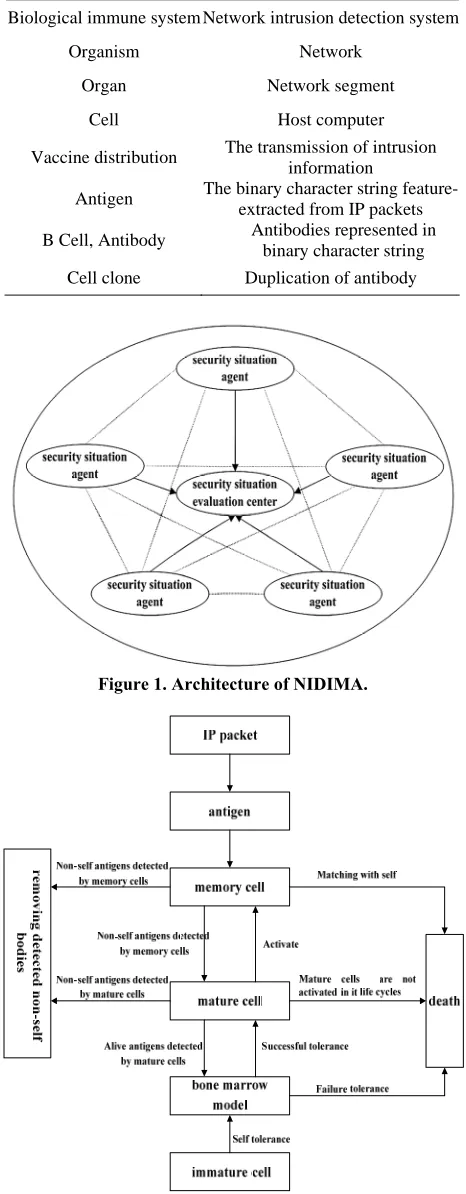
Combined with multi-agent and AIS technology, the detection model constitutes a multi-direction and multi-level intelligent network security model, with its mapping re-lationship with BIS model as shown in Table 1, and its system structure diagram as shown in Figure 1.
The model adopts large-scale and distributed system structure, and a series of network situation awareness agents and a network security situation evaluation agent is deployed in target networks and its host computer firstly.
Security situation evaluation agent gathers information about the security situation of subordinate subnets and host computers from each security situation awareness agent to evaluate about the whole integrated risks to the whole network, and the information includes the type, quantity, strength and harmfulness of the attacks.
The network security situation awareness agent shown in Figure 1 is itself a sub-network security situation awareness system, defined by recursion, and it mainly monitors on the sub-network security situation within its control, and specifically speaking, real-time monitor on the type, strength and harmfulness of attacks suffered by sub-network. Because there might as well be subnets under subnets, sub-network security situation awareness agents may be composed of sub-network security situa-tion awareness agents at lower level. Eventually, security situation awareness agents, that monitor the specific host computer, are made up of intrusion detection and secu-rity situation evaluation of the host computer.
In this architecture, IA distributed at host computer node starts to recognize the intruded events at first, and in case unknown attacks are discovered through learning and memory, information will then be sent to corre-sponding SMC, while vaccines that has identified new attacks will be distributed to each node within the same network segment to improve the intrusion defense capa-bility of each node. SMC makes analysis on the intrusion information sent by each IA in the network segment and SMC of suffered network segment will send vaccines to
Table 1. The relationship between the BIS and the NIDIMA.
Biological immune system Network intrusion detection system
Organism Network
Organ Network segment
Cell Host computer
Vaccine distribution The transmission of intrusion information
Antigen The binary character string feature-extracted from IP packets
[image:2.595.307.540.102.699.2]B Cell, Antibody Antibodies represented in binary character string Cell clone Duplication of antibody
Figure 1. Architecture of NIDIMA.
other non-intruded network segments for early warnings for the realization of whole detection.
3. System Mechanism of the Network
Intrusion Model Based on Immune
Multi-Agent
In Figure 2, the logical structure of IA is shown, which includes self antigens, immature immune antibodies, mature immune antibodies and memory immune anti-bodies etc. The working procedures involve two inter-playing and concurrent circulations, which are the circu-lation of immune antibodies’ detection of external anti-gens and the circulation of immune antibodies’ evolution.
3.1. The Definition of Immune Elements
Definition 1: Antigens are binary character strings in the length of l that are feature-extracted from network IP data packets. Let U={0, 1}l (l>0),antigen assembly Ag
U, it mainly includes IP address, port and protocol type etc.
{ , |
( )}
Ag a b a D b Ψ a
l a APCs b
(1)
Definition 2: The antigen assembly Ag is classified into two substes of self assembly Self (normal network behavior) and non-self assembly Nonself (abnormal net-work behavior):
SelfNonSelf = Ag, SelfNonself =
Antibodies and antigens have binary character strings of the same features and length, the definition of anti-body assembly BU:
} , , , | {
Ab Ab sagecountag
B (2)
Antibody Ab is a quadruple, among which s means binary string in the length of l, age is the age of antibody,
count is the quantity of antigens matched with antibodies,
ag is the antigens that are detected by the antibodies. Antibodies are classified into three categories: mature antibodies, memory antibodies and immature antibodies. Mature antibodies, tolerable to self bodies, refer to the antibodies that are not activated by antigens, mature an-tibodies assembly TAb U; memory antibodies evolve from mature antibodies that are not activated, memory antibodies assembly MAb U; immature antibodies are antibodies that have not undergone self-tolerance, im-mature antibodies assembly IAb D.
Definition 3: Affinity serves as the main evidence to judge the matching state between antibodiesand antigens, and the calculation formula is as Formula (3), equaling to 1 means matching, or else non-matching. In the formula,
xAg, yB, xi, yi are the i-th characters of x, y
respec-tively, l is the length of character string, is the thresh-old value of affinity matching.
1 ( ( ) / ) ( , )
0 h_dis match
, f x, y l
f x y
, otherwise
(3)
2 _
1
( , ) ( )
l
h dis i i i
f x y x y
3.2. The Changing Process of Immature Antibodies
Let I be the number of immature antibodies included in
IAb at certain time, the dynamic changing formula of im-mature antibodies assembly is:
( ) ( ) new ( mature dead mature dead
I I
I t t I t I t t
x x
t
(4)
The Formula (4) indicates that the changing process of
IAb assembly is divided into 2, that is, inflow and outflow. Inflow is the process of newly produced immature anti-bodies’ joining in IAb assembly: I = Inew×△t,Inew means the production rate of immature antibodies per unit of time. Outflow is the process of removing immature anti-bodies from IAb assembly, and there are two directions of outflow: the quantity of immature antibodies decreased out of successful tolerance and evolution into mature antibodies is presented by
mature mature I t x
, and
dead dead I t x
presents the quantity of immature antibodies decreased out of tolerance failure.
In order to avoid matching between antibodies and self bodies, newly produced immature antibodies can only match with antigens after passing self tolerance. The tolerance process is shown as in Formula (5), and 1 means passing self tolerance, 0 means failure of self tol-erance, x∈IAb.
0 ( , ) 1
( ) 1
match tolerate
y Self f x y
f x
otherwise
(5)
3.3. The Changing Process of Mature Antibodies
Let T represent the number of mature antibodies in-cluded in TAb at certain time, and the dynamic changing formula of mature antibodies assembly is:
( ) ( ) new ( mature dead mature dead
I I
)
I t t I t I t t t
x x
(6)
and there are two ways: The number increased out of immature antibodies’ successful tolerance and evolution is represented by
tolerate
tolerate T
t x
; cloneclone T
t x
means the number increase out of clonal selection of memory antibodies. Outflow is the process of removing mature antibodies, it also has two directions: the number of memory antibodies that have been evolved from acti-vation is presented as
active
active T
t x
, while
dead
dead T
t x
represents the number that die from failed activation. The mature antibodies assembly Tactive that have been activated and evolved into memory antibodies is shown in Formula (8), and the mature antibodies assembly Tdead that have failed in activation is shown in Formula (9), among which is activation threshold, and is the life cycle of mature antibodies.
: { | . . }
active Ab
T x x T x count x age (7)
: { | . . }
dead Ab
T x x T x count x age (8)
3.4. The Changing Process of Memory Antibodies
Let M as the memory antibodies quantity contained in
MAb at certain time, and the dynamic changing formula of memory antibodies assembly is:
( ) ( ) active bacterin active bacterin
M M
M t t M t t
x x
t (9)
Because memory antibodies have infinite life cycle, the change of Mb assembly only has the process of inflow, without the outflow process of dead memory cells. The inflow of memory antibodies is conversed by activated mature antibodies Tactive,
active active
active active
M T
t t
x x
3.5. Immune Surveillance
During the detection process of IA on network behaviors, it mainly adopts mature cells and memory cells to detect antigens, and it is capable to detect non-self antigens efficiently and rapidly, what follow are the detailed steps:
1) Antigen presentation: The feature information of IP packet is extracted from actual network data flow to con-stitute a binary string in the length of l, which is then put in the antigen assembly Ag as antigen regularly.
2) Using memory antibodies MAb to detect antigens: N
TAb to detect antigens: The no
de: After detection, the le
. Simulation Experiment and Result Analyse
.1. Experiment Environment and Parameter
he experiment environment is classified into two
net-d of source, net- des-tin
.2. Experiment Results and Performance
ctivation threshold value βand life cycleλbear large on-self bodies that match with memory antibodies are removed, and memory antibodies that have detected self bodies in are also removed.
3) Using mature antibodies
n-self antibodies that match with TAb are removed, and the TAb that has detected enough antigens in the life cycle is then activated and evolved into memory antibodies
MAb; The MAb that has not been activated or detected self elements in life cycle will die.
4) Self body assembly upgra
ft antigens will join in self body assembly, maintain dynamic self body upgrading, undergo self tolerance with immature antibodies and maintain dynamic evolu-tion of antibodies.
4
4
Settings
T
work segments of A, B, and composed of 20 host com-puters of the same configuration. Ai, Bi (1≤i≤20) means
the i-th host computer in A, B segments respectively.
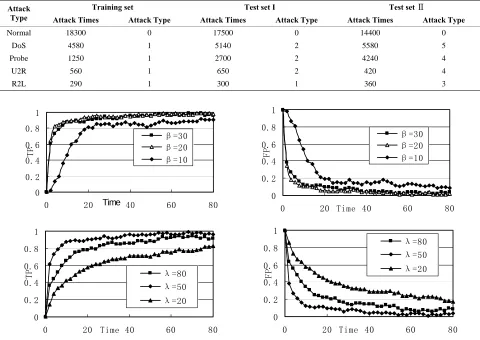
The experiment applies part of the data from KDDCUP99 [11] in MIT LINCOLN lab as training and test data. The training set is normal network data without any attack, and the test set includes normal data and at-tack data. The atat-tack data is classified into 4 categories: DoS, Probe, U2R, R2L. The test data I includes guess_ passwd, buffer_overflow and other attacks, 7 in total, and the test set Ⅱ includes the attacks in test set I and other 10 attacks or more, e.g. land, spy, perl.
Antigen data architecture is compose
ation IP address, port number, protocol type, IP tag field, IP packet length and TCP/UDP/ICMP domain etc,
l = 172, affinity matching threshold valueθ=0.7.
4
Analysis
A
Table 2. Experiment data list.
Training set Test set I Test set Ⅱ
Attack
Type Attack Times Attack Type Attack Times Attack Type Attack Times Attack Type
Normal 18300 0 17500 0 14400 0
DoS 4580 1 5140 2 5580 5
Probe 1250 1 2700 2 4240 4
U2R 560 1 650 2 420 4
R2L 290 1 300 1 360 3
0 0.2 0.4 0.6 0.8 1
0 20 Time 40 60 8
TP
0 β=30 β=20 β=10
0 0.2 0.4 0.6 0.8 1
0 20 Time 40 60 8
FP
0 β=30 β=20 β=10
0 0.2 0.4 0.6 0.8 1
0 20 Time 40 60 8
TP
0 λ=80 λ=50 λ=20
0 0.2 0.4 0.6 0.8 1
0 20 Time 40 60 8
FP
0 λ=80 λ=50 λ=20
Figure 3. Effect of the activation threshold β and the lifecycle λ.
4. Conclusions
out that whenβ=20, λ=50, FP<6%, TP>93%,theeffect is better.
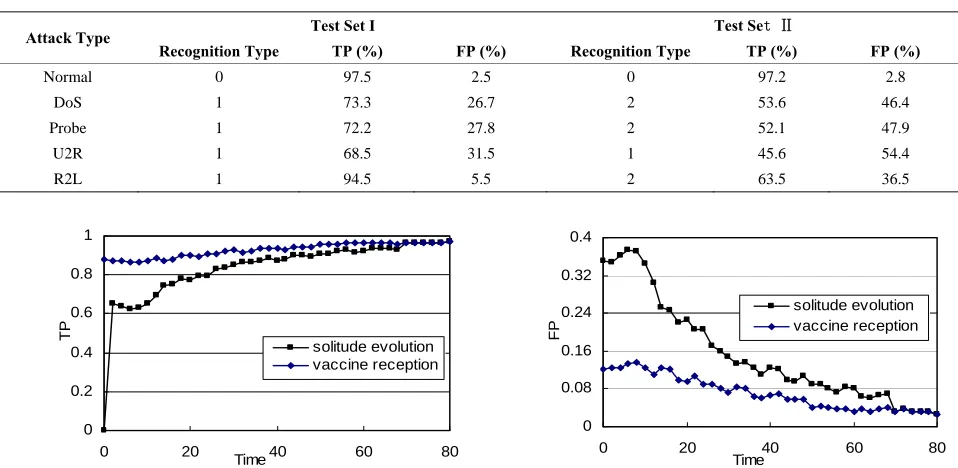
In Table 3 and Table 4, the comparison test results of this model and the detection tools matched with the pat-terns based on, BRO [12], are listed, and from the tables we can infer that the detection model is of higher TP and lower FP, and the types of recognized unknown attacks are more than that of BRO, which demonstrates that this model is of high self-learning and adaptability.
The active defense model for network intrusion based on artificial immune multi-agent put forth in this article has following advantages compared with other network in-trusion defense techniques: 1) Self-learning; The mem-ory mechanism and antibodies generation mechanism can not only detect well-known attacks, but also bear recognition ability towards unknown attacks. 2) Multi-level; The model has introduced in the concept of vaccine, which can strengthen network nodes and con-nection between each network segment. 3) Robustness; The model applies distributed system structure so that a single node under attack does not impact the detection abilities of other nodes. In a word, the experiment results reveal that the model differs greatly from the isolated and passive defense situation of traditional network security model, and it is a better solution to network security de-tection.
Table 3. Detection results of ADNIIMA model experiment.
Test Set I Test Set Ⅱ
Attack Type
Recognition Type TP (%) FP (%) Recognition Type TP (%) FP (%)
Normal 0 98.6 0 0 97.2 0
DoS 2 97.2 2.8 5 97.1 2.9
Probe 2 96.5 3.5 4 94.3 5.7
U2R 2 94.5 5.5 4 95.4 4.6
R2L 1 95.2 4.8 3 94.3 5.7
Table 4. Detection results of BRO experiment.
Test Set I Test Set Ⅱ
Attack Type
Recognition Type TP (%) FP (%) Recognition Type TP (%) FP (%)
Normal 0 97.5 2.5 0 97.2 2.8
DoS 1 73.3 26.7 2 53.6 46.4
Probe 1 72.2 27.8 2 52.1 47.9
U2R 1 68.5 31.5 1 45.6 54.4
R2L 1 94.5 5.5 2 63.5 36.5
0 0.2 0.4 0.6 0.8 1
0 20 Time40 60
T
80
P
solitude evolution vaccine reception
0 0.08 0.16 0.24 0.32 0.4
0 20 40 60 8
Time
F
0
P
solitude evolution vaccine reception
Figure 4. Comparison of detecting effect between solitude evolution and vaccine reception.
5. References
[1] Y. Bai, and H. Kobayashi, “Intrusion detection systems: Technology and development,” IEEE Advanced Informa-tion Networking and ApplicaInforma-tions, pp. 710–715, 2003.
[2] A. Pilz and J. Swoboda, “Network management informa-tion models,” Aeu-Internainforma-tional Journal of Electronics and Communications, Vol. 58, pp. 165–171, 2004.
[3] Y. L. Dong, J. Qian, M. L. Shi, “A cooperative intrusion detection system based on autonomous agents,” IEEE CCECE 2003, Vol. 2, pp. 861– 863, 2003.
[4] P. D’haeseleer and S. Forrest, “An immunological ap-proach to change detection: Algorithm, analysis and im-plication,” in Proceedings of IEEE Symposium on Re-search in Security and Privacy, Oakland, pp. 110–119, 1996.
[5] J. Kim and P. Bentley, “The artificial immune model for network intrusion detection,” 7th European Congress on Intelligent Techniques and Soft Computing, 1999.
[6] P. K. Harmer and G. B.Lamont, “An agent based
archi-tecture for a computer virus immune system,” Proceed-ings of the Genetic and Evolutionary Computation Con-ference, Orlando, Florida, USA, 1999.
[7] F. Esponda, S. Forrest, and P. Helman, “A formal frame work for positive and negative detection schemes,” IEEE Transactions on Systems Man and Cybernetics Part B-Cybernetics, Vol. 34, No. 1, pp. 357–373, 2004.
[8] I. M. Hegazy, H. M. Faheem, T. Al-Arif, and T. Ahmed, “Evaluating how well agent-based IDS perform,” Poten-tials, Digital Object Identifier, IEEE, Vol. 24, 27–30, 2005.
[9] P. Ballet and V. Rodin, “Immune mechanisms to regulate multi-agents systems,” GECCO 2000, Las Vegas, Nevada, USA, July 2000.
[10] Z. Z. Shi, “Intelligent agent and its Application [M],” Science Press, Beijing, 2000.
[11] A Hofmeyr and S. Forrest, “Architecture for an artificial immune system,” Evolutionary Computation, Vol. 7, No. 1, 2000.
[image:6.595.58.537.227.461.2]