ISSN Online: 2151-4771 ISSN Print: 2151-4755
DOI: 10.4236/ce.2019.1012192 Nov. 28, 2019 2649 Creative Education
Using Google Apps as Learning Strategy to
Enhance ESL Writing
Hasniza Basri
1, Harwati Hashim
2*, Melor Md. Yunus
21SK Bebuloh, Labuan, Malaysia
2Faculty of Education, Universiti Kebangsaan Malaysia, Bangi, Malaysia
Abstract
ICT has given a lot of assistance to advance teachers’ pedagogical approaches. Every moment our education strategies have been evolving with the advent of new technology that simplifies teachers’ workload in preparing materials and aids students engaged in their learning. In fact, there are lots of research pa-pers about the effectiveness of using ICT that could engage students in their learning. Writing, known as the hardest skills to master by students as it could be a boring and labouring task. Furthermore, the lack of vocabulary had contributed little confidence and high level of anxiety that made them struggle to write. Based on Krashen’s Affective Filter Hypothesis, learners with low affective filter, high motivation, self-confidence and a low level of anxiety are better equipped for success in second language acquisition. It is believed that ICT integration using Google Apps in the learning process would enhance students’ writing skills. Thus, this conceptual paper attempts to discuss the potential benefits of using Google Apps as learning strategy to enhance ESL writing. Some implications and recommendations are also dis-cussed in the conclusion.
Keywords
ICT, Affective Filter Hypothesis, Learning Strategy, Anxiety, Google Apps
1. Introduction
ESL writing difficulty among students seems a non-stop issue as far back as I can remember. Huang (2008) reported differences in scores between ESL and native English students in the provincial English examinations in Canada. This result supported the idea that ESL writers might encounter certain hardship when at-tempting to write in English. Gilmore (2009) posited that it is a painful for many How to cite this paper: Basri, H., Hashim,
H., & Yunus, M. Md. (2019). Using Google Apps as Learning Strategy to Enhance ESL Writing. Creative Education, 10, 2649-2657. https://doi.org/10.4236/ce.2019.1012192
Received: October 16, 2019 Accepted: November 25, 2019 Published: November 28, 2019
Copyright © 2019 by author(s) and Scientific Research Publishing Inc. This work is licensed under the Creative Commons Attribution International License (CC BY 4.0).
DOI: 10.4236/ce.2019.1012192 2650 Creative Education students writing in their mother tongue and their hardship are worsening when writing in the second language.
In Malaysia, poor ESL writing among students is a continuous debatable issue
(Hashim & Isa, 2012). In Malaysian education context particularly primary school
ESL setting, a competent English writer could be generally described as an indi-vidual who has good penmanship skills (Kementerian Pendidikan Malaysia, 2012). He or she also would be seen as one who could write confidently especially at expressing the critical thoughts in clear manner. However, at the current sce-nario in certain Malaysian ESL classrooms, the learning situations might not re-flect as comprehensive as the description in Malaysian English syllabus such as
“Kurikulum StandardSekolah Rendah” (KSSR). Moreover, many studies have
clearly shown persistent weakness in written English of Malaysian ESL students. According to Jalaludin, Ibrahim, & Awal (2013), students’ interest toward Eng-lish writing was declining especially students in rural area. Siti Hamin Stapa et al. (2007), in their study reported a very weak writing literacy level among the Form two students in rural schools in Johor. The issue is prominent as English is now the language of instruction at all level of education in Malaysia from pri-mary to tertiary level. This language skill assumed to be of great importance to academic success since it is the commonest assessment measure for academics to evaluate their students, and students’ weak writing ability may put their aca-demic success considerable at risk (Tan, 2011 as cited in Azim 2018). Thus, it is prevalent to find ways to improve students’ writing skill.
2. Intricacy of English Subject
In Malaysian education context particularly primary school ESL setting, a com-petent English writer could be generally described as an individual who has good penmanship skills (Kementerian Pendidikan Malaysia, 2012). Students’ poor performances in ESL writing are due to many factors. Nonetheless, this paper focuses only on the intricacy of the subject that leads to poor ESL writing. Writ-ing, known as the hardest skills to master by students as it could be a boring and labouring task. The lack of vocabulary and grammar knowledge had contributed little confidence that made them struggle to write. Azimah (1998), Maros et al. (2007) and Vahdatinejad (2008) are among the researchers who have verified that students are still having difficulty in using correct English grammar in their writings. Darus et al. (2012) also verified on students having difficulty in doing writing task and have resulted that they disliked doing it. In addition, through the interview sessions with some lecturers, they claimed that their findings indi-cated majority of students have some negative attitude towards writing. This probably occurs due to the inappropriate selection of learning techniques besides the use of teaching methodology in the classroom.
Gupta & Woldemariam (2011) emphasised teachers’ prominent role in
DOI: 10.4236/ce.2019.1012192 2651 Creative Education to organize efficient writing courses that help improving students acquire the skill and knowledge in writing strategies. Darus et al. (2012) have also suggested a special online writing program which can help to enhance learners’ writing ability and interest.
Therefore, intricacy of English subject can be solved through appropriate use of Information Communication technology (ICT). It is trusted that ICT usage could entice students’ interest towards writing and improve students’ ESL writing.
3. Information Communication Technology (ICT)
Conventionally, teaching and learning was teacher-centred where face to face contact with teacher’s matters as opposed to current practises whereby stu-dent-centred learning is encouraged. KPM (2017) has stated that 21st Century Learning is a student-centred approach in the learning process based on ele-ments of communication, collaboration, critical thinking, creativity and values and ethical applications. Hence, it emphasized the need to redesign the educa-tion system and transform the learning and teaching delivery. Reigeluth (2012)
considered this change as a paradigm change; from existing situation need change in the mind set of not only stakeholders and community but teacher and student. There is an argument that it isn’t necessary to use ICT in the 21st cen-tury learning. Indeed, using ICT is not necessary in the 21st century classroom. As long as the teacher integrates the element of 4Cs and value in the lesson.
However, a number of studies have proved that ICT integration in the 21st century classroom is benefited (Hashim & Yunus, 2010; Hashim, Yunus, & Embi, 2018; Yunus, Hashim, & Hashim, 2019; Yunus, Salehi, & Chenzi, 2012; Yunus,
Hashim, Embi, & Lubis, 2010). Omar et al. (2012) pointed out that the social
media used in their study as a promising virtual tool and conducive enough to promote constructive interaction among ESL learners that lead them to play active role. Barr & Miller (2013) emphasized the need of technology-rich environment that foster interaction and connectedness to the international community. The apps used in the lesson was able to keep the students engaged with the attractive features provided and kept them abreast with new knowledge in an interesting manner (Mohamad et al., 2018). Moreover, it is able to address students acquired skills like critical thinking and problem solving. The list of ICT components is ex-haustive. One of the components that relevant to this study is cloud computing.
4. Cloud Computing
DOI: 10.4236/ce.2019.1012192 2652 Creative Education
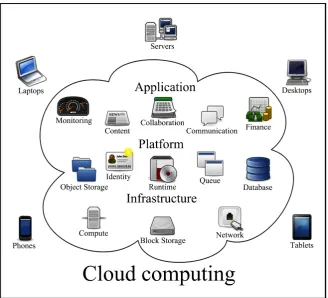
in Figure 1 (Gartner, 2013). Cloud computing is being applied in education by
outsourcing their student email provision (Sclater, 2010). It is known that both Google and Microsoft offer email services for free to the educational sector in many countries. These two companies provide email as a part of larger applica-tions suites which are usually made available to students alongside email. Google Apps for Education and Microsoft Live@edu contain tools for communication and collaboration, office tools for working with documents, and space to store and synchronize data on demand. Nonetheless, Google Applications for educa-tion will be the focus in this paper.
5. Previous Studies in Using Google Apps in Education
There are several studies related to Google Apps in education. The studies in-volved using Google Apps for various settings that includes higher educations, medical course and school (Al-Emran & Iqbal, 2016; Lawrence & Lee, 2016;
Zhou et al. 2012; Railean, 2012). It reported positive impact and was proposed as
a pedagogical model that established student-centred and collaborative learning
(Ferreira, 2014). Whilst, Railean (2012) posited it as a powerful tool to develop
knowledge and social skills. Google Apps have a notably impact on performing the work in the higher educational settings (Al-Emran & Iqbal, 2016). Students also showed positive participation in their learning (Zhou et al., 2012; Lawrence
& Lee, 2016). Google Apps offer to learners and teachers’ communicational tools
that can be used as collaborative scenarios to introduce, practice and assess any language topic (Railean, 2012).
6. Current Use of Google Apps in Education
Many free applications such as Google doc, Google classroom, Google Form, Google Drive, YouTube and etc. are available through Google and can be ac-cessed using appliances such as desktop, laptop, smart phone, tablet and Chromebook. With the rise of online learning and technology, Revere & Kovach
(2011) posited that innovative programs and activities developed to create
learner-centered environment and to enhance learning outcomes as many educa-tors believe that their role is to add value to their students’ learning experience.
Widodo (2017) mentioned that Google Apps for Education (GAFE) is an
informa-tion technology soluinforma-tion that can be utilized by schools/colleges to communicate and collaborate in real time. Ideas can be shared by students and lecturers/teacher more quickly and effectively in obtaining information. In his study, Widodo ana-lyzed and designed a learning management system for math education to imple-ment online learning allocated by Google Apps for Educations. In another study
by Lindh & Nolin (2016) they reiterated that GAFE is a dynamic tool for teachers
DOI: 10.4236/ce.2019.1012192 2653 Creative Education Figure 1. Representation of cloud computing.
(source: https://en.wikipedia.org/wiki/Cloud_computing).
Railean (2012) claimed that Google Apps can be useful to develop
metasys-tems thinking, an approach that represents an alternative paradigm to sysmetasys-tems approach through collaborative learning and self, peer and group assessment. Although lots of study emphasized the Google Apps for study Math, Science and Technology, a study on how these apps could enhance ESL students’ writing skill need to be emphasized too.
7. Related Theories
It is inevitable to apply learning theories and strategies in developing means of learning instruction. Application that are developed based on strong educational theories would increase the application potential in helping students to learn.
7.1. Effectiveness of Strategy Intervention
Writing is a daunting task for ESL learners and it is a demanding skill that has also generated interventions aiming to enhance learners’ strategic repertoires and capacities. Sengupta (2000) emphasized on revision strategies that had measurable influences on L2 secondary school learners’ writing performance.
DOI: 10.4236/ce.2019.1012192 2654 Creative Education paper with Google Docs enables users to share their work so that another person can monitor, comment or make changes. Other features include chat, and col-laborative emailing. Another advantage is the feature see revision history, which permits viewers to observe all of the changes made to a paper over time with no separate drafts needed (Denton, 2012). Amongst the apps, Google Docs is be-lieved to be able to enhance students’ writing skill and further research would be conducted to study on students’ perceptions in doing writing using the said apps.
Therefore, Google Apps have the potential to be used as learning strategies provided that the educators know the unique features of the apps and are crea-tive enough on the usage.
7.2. Krashen’s Affective Filters Hypothesis
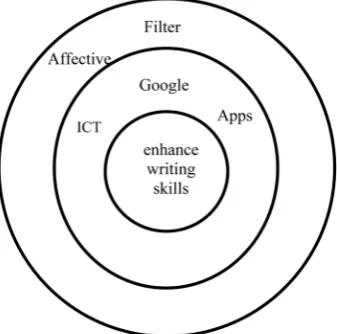
Krashen’s five hypotheses in learning process are the Acquisition/Learning pothesis, the Natural Order Hypothesis, the Monitor Hypothesis, the Input Hy-pothesis, and the Affective Filter Hypothesis. In this paper, a conceptual frame-work of using Google Apps for ESL writing task as illustrated in Figure 2, is taking into consideration the fifth hypothesis of Krashen’s theory of second lan-guage acquisition which is the Affective Filter hypothesis. The outer layer repre-sents conducive learning environment where the students feel comfort without any worries towards the learning. The second layer shows ICT tools and apps are used which provide fun elements and ultimately the objective could be achieved as it is said that learners with low affective filter, high motivation, self-confidence and a low level of anxiety are better equipped for success in second language ac-quisition thus, could enhance their writing skills.
Lightbrown & Spada (1993) reiterated that acquisition won’t happen if a
[image:6.595.290.459.523.690.2]learner is in the state of tense, angry, anxious or bored in which the filter will be up. Consequently, it will be down when the learner is relaxed or motivated. ICT integration in learning seem to reduce the level of anxiety among the students.
Figure 2. A conceptual framework of using
DOI: 10.4236/ce.2019.1012192 2655 Creative Education
Huang & Huang (2013) suggested that student anxiety can be reduced with a
multimedia environment. Besides, it provides a less stressful classroom envi-ronment. Revere & Kovach (2011) claimed that student engagement in the learning process could be fostered when the technology is used appropriately. This is supported by Sharif et al. (2018) where an interactive learning using Youtube could foster confidence among ESL students in fun learning environ-ment.
8. Implication and Conclusion
This concept paper had aimed to describe issues and factors that lead to Google Apps integration in overcoming the challenging task in ESL writing. Notably this study had identified and discussed the capacity of ICT as a useful tool that could be a learning strategy to enhance learning. A conceptual framework of Google Apps has been proposed based on selected theories. The proposed conceptual framework could be used to execute ESL writing task in a comfortable and con-ducive environment. Nonetheless, further studies will be conducted using one of the apps to implement and investigate the proposed framework.
Funding
This research was supported by the grant from Universiti Kebangsaan Malaysia KRA-2018-044 and PP-FPEND-2019.
Conflicts of Interest
The authors declare no conflicts of interest regarding the publication of this pa-per.
References
Al-Emran, M., & Iqbal, S. (2016). The Impact of Google Apps at Work: Higher Education Perspective. International Journal of Interactive Mobile Technologies, 10, 85-88.
https://doi.org/10.3991/ijim.v10i4.6181
Barr, B. A., & Miller, S. F. (2013). Higher Education: The Online Teaching and Learning Experience. Phoenix, AZ: University of Phoenix Faculty School of Advanced Studies. Darus, S., Hussin, S., & Ismail, N. (2012). ESL Students’ Attitude, Learning Problems, and
Needs for Online Writing. GEMA Online Journal of Language Studies, 12, 1089-1107. Denton, D. W. (2012). Enhancing Instruction through Constructivism, Cooperative
Learn-ing, and Cloud Computing. TechTrends, 56, 34-41.
https://doi.org/10.1007/s11528-012-0585-1
Ferreira, J. M. M. (2014). Flipped Classroom: From Concept to Reality Using Google Apps. In 11th International Conference on Remote Engineering and Virtual Instrumen-tation (pp. 204-208). Piscataway, NJ: IEEE.
Gartner, I. T. (2013). Gartner IT Glossary. Technology Research.
Graham, S., & Perin, D. (2007). A Meta-Analysis of Writing Instruction for Adolescent Students. Journal of Educational Psychology, 99, 445-476.
DOI: 10.4236/ce.2019.1012192 2656 Creative Education
Gupta, D., & Woldemariam, G. S. (2011). The Influence of Motivation and Attitude on Writing Strategy Use of Undergraduate EFL Students: Quantitative and Qualitative Perspectives. Asian EFL Journal, 13, 34-89.
http://www.asian-efl-journal.com/PDF/June_2011.pdf
Hashim, H., & Isa, I. S. M. (2012). Students’ Anxiety Level towards Speaking in English: Malaysia Polytechnic Experience. In IEEE Symposium on Business, Engineering and Industrial Applications (pp. 595-599). Piscataway, NJ: IEEE.
https://doi.org/10.1109/ISBEIA.2012.6422957
Hashim, H., & Yunus, M. M. (2010). Learning via ICT: “Tell Me More”. International Journal of Learning, 17.
Hashim, H., Yunus, M. M., & Embi, M. A. (2018). Factors Influencing Polytechnic Eng-lish as Second Language (ESL) Learners’ Attitude and Intention for Using Mobile Learn-ing. Asian ESP Journal, 14, 195-208.
Huang, P., & Huang, P. (2013). An Exploration of EFL Learners’ Anxiety and E-Learning Environments. Journal of Language Teaching and Research, 4, 27-35.
https://doi.org/10.4304/jltr.4.1.27-35
Jalaludin, N. H., Ibrahim, N., & Awal, N. M. (2013). LinguistikDanLiterasiBahasa Ing-geris:IsudanCabaran. Bangi: Penerbit Universiti Kebangsaan Malaysia.
Lawrence, D., & Lee, K. W. (2016). Collaborative Writing among Second Language Learners Using Google Docs in a Secondary School Context. International Journal on E-Learning Practices, 3, 64-81.
Lightbown, P. M., & Spada, N. (1993). How Languages Are Learned. Oxford: Oxford University Press.
Lindh, M., & Nolin, J. (2016). Information We Collect: Surveillance and Privacy in the Implementation of Google Apps for Education. European Educational Research Jour-nal, 15, 644-663.https://doi.org/10.1177/1474904116654917
Mohamad, M., Ghazali, N., & Hashim, H. (2018). Secondary School Student’s Perceptions on the Use of Google+ towards Improving ESL Writing Skills. International Journal of Emerging Technologies in Learning, 13, 224-238.
https://doi.org/10.3991/ijet.v13i09.8479
Omar, H., Embi, A. M., & Yunus, M. M. (2012). ESL Learners’ Interaction in an Online Discussion via Facebook. Asian Social Science, 8, 67-74.
https://doi.org/10.5539/ass.v8n11p67
Railean, E. (2012). Google Apps for Education: A Powerful Solution for Global Scientific Classrooms with Learner Centred Environment. International Journal of Computer Science Research and Application, 2, 19-27.
Reigeluth, C. M. (2012). Instructional Theory and Technology for a Post-Industrial World. In R. A. Reiser, & J. V. Dempsy (Eds.), Trends and Issues in Instructional Design and Technology (3rd ed., pp. 75-83). Saddle River, NJ: Pearson Education.
Revere, L., & Kovach, J. V. (2011). Online Technologies for Engaged Learning: A Mean-ingful Synthesis for Educators. Quarterly Review of Distance Education, 12, 113-124. Sclater, N. (2010). E-Learning in the Cloud. International Journal of Virtual and Personal
Learning Environments, 1, 10-19.https://doi.org/10.4018/jvple.2010091702
Sengupta, S. (2000). An Investigation into the Effects of Revision Strategy Instruction on L2 Secondary School Learners. System, 28, 97-113.
https://doi.org/10.1016/S0346-251X(99)00063-9
DOI: 10.4236/ce.2019.1012192 2657 Creative Education
EDUINNOVTIO.
Widodo, S. (2017). Implementing Google Apps for Education as Learning Management System in Math Education. Journal of Physics: Conference Series, 895, Article ID: 012053.https://doi.org/10.1088/1742-6596/895/1/012053
Yunus, M. M., Hashim, H. U., & Hashim, H. (2019). Massive Open Online Courses: En Route to Communication Skills Acquisition. Arab World English Journal (AWEJ) Spe-cial Issue on CALL, No. 5, 98-109.https://doi.org/10.24093/awej/call5.8
Yunus, M. M., Hashim, H., Embi, M. A., & Lubis, M. A. (2010). The Utilization of ICT in the Teaching and Learning of English: “Tell Me More”. Procedia—Social and Behav-ioral Sciences, 9, 685-691.https://doi.org/10.1016/j.sbspro.2010.12.218
Yunus, M. M., Salehi, H., & Chenzi, C. (2012). Integrating Social Networking Tools into ESL Writing Classroom: Strengths and Weaknesses. English Language Teaching, 5,
42-48.https://doi.org/10.5539/elt.v5n8p42