Composite Cost Function Based Solution to the
Unit Commitment Problem
Srikrishna Subramanian, Radhakrishnan Anandhakumar
Department of Electrical Engineering, Annamalai University, Annamalainagar, India. Email: [email protected]
Received May 29th 2010; revised June 29th 2010; accepted July 3rd 2010.
ABSTRACT
This paper presents a new approach via composite cost function to solve the unit commitment problem. The unit com-mitment problem involves determining the start-up and shut-down schedules for generating units to meet the forecasted demand at the minimum cost. The commitment schedule must satisfy the other constraints such as the generating limits, spinning reserve, minimum up and down time, ramp level and individual units. The proposed algorithm gives the com-mitted units and economic load dispatch for each specific hour of operation. Numerical simulations were carried out using three cases: four-generator, seven-generator, and ten-generator thermal unit power systems over a 24 h period. The produced schedule was compared with several other methods, such as Dynamic programming, Branch and bound, Ant colony system, and traditional Tabu search. The result demonstrated the accuracy of the proposed method.
Keywords: Composite Cost Function, Generation Scheduling, Unit Commitment
1. Introduction
Unit commitment is to determine the commitment and generation levels of generating units over a period of time to minimize the total operation cost [1]. In solving the unit commitment problem, generally two basic sions are involved, namely, the “unit commitment” deci-sion and the “economic dispatch” decideci-sion. The “unit commitment” decision involves the determination of the generating units to be running during each hour of the planning horizon, considering the system capacity re-quirements, including the system constraints. The “eco-nomic dispatch” decision involves the allocation of the system demand and spinning reserve capacity among the operating units during each specific hour of operation. The unit commitment problem has commonly been for-mulated as a non-linear, large scale, mixed-integer com-binatorial optimization problem with constraints. Re-search endeavours, therefore, have been focused on effi-cient, near-optimal solutions. A survey of literature on unit commitment methods reveals that various numerical optimization techniques have been employed to address the unit commitment problems.
An interior-point/cutting-plane method for non differ-entiable optimization is used to solve unit commitment problem [2]. This method has two advantages of sub- gradient and bundle methods that have better conver-gence characteristics and does not suffer from the
pa-rameter-tunning drawback. A parallel repair genetic al-gorithm has been proposed to solve unit commitment problem [3]. This algorithm provides a modeling frame-work less restrictive than previous approaches such as dynamic programming or lagrangian relaxation.
A new cooperative coevolutionary algorithm has been described for unit commitment problem which combines the basic ideas of LR and GA to form a novel two-level approach [4]. A successive sub problem solving method is developed and applied to solve the unit commitment problems with identical units [5]. The commitments of the identical units can be differentiated and the homoge-nous oscillations are avoided. The unit commitment problem has been solved with dual variable constraints [6].
An evolutionary programming based Tabu search has been applied to solve unit commitment problem [7]. The security constrained unit commitment problem is de-composed into two coordinated problems, based on benders decomposition, which include a master problem for optimizing UC and a sub problem for minimizing network violations [8]. The price-based unit commitment problem has been solved based on mixed integer pro-gramming [9].
eco-nomic load dispatch calculations [10]. An ant colony system approach for unit commitment problem has been proposed [11]. The algorithm implements the movement of ants in the search space and also discusses the accu-racy of the solution with respect to the solution time.
The mixed-integer linear formulation for the unit commitment of thermal units have been applied to solve this problem, this method requires fewer binary variables and constraints than previously reported models, yielding a significant computational saving [12]. The unit com-mitment problem has been solved by Simulated Anneal-ing and they maintained spinnAnneal-ing reserve capacity, re-sulting in near-optimal UC solutions [13].
A Tabu search based hybrid optimization approach for a fuzzy modeled unit commitment problem has been pro-posed [14]. A unit commitment problem with probabilis-tic spinning reserve and interruptible load has been for-mulated [15]. Recently Bacterial foraging technique has been applied to solve unit commitment problem [16].
The artificial intelligence approaches Genetic Algo-rithm (GA), Evolutionary Programming (EP), Simulated Annealing (SA), Tabu Search (TS) and Expert Systems (ES) have been proposed to solve the UC problem and these methods require high computational time for large scale systems. This article presents a composite cost function based solution algorithm for solving unit com-mitment problem and it directly gives the units to be committed and the economic dispatch of the committed units while satisfying the equality and inequality con-straints.
2. Problem Formulation
2.1 Nomenclature
ai , bi , ci Fuel cost coefficients unit i Shi – cost Hot start cost in Rs Sci – cost Cold start cost in Rs c–s–hour Cold start hour in hours MUi Minimum up time in hours MDi Minimum down time in hours N Number of generating units
Pi max Maximum output power of unit i in MW Pi min Minimum output power of unit i in MW Pit Power produced by unit i in time t PGi Power generation of the plant i in MW PDt Power demand at hour t in MW
PRt Spinning reserve requirement at hour t in MW Rs Rupees
ini state Initial status of the unit in hours SDi–cost Shut down cost in Rs
STi Start up cost in Rs CCF Composite cost function h hour
MW Mega Watt
i Index of generating units ( i = 1 ,2,….,N) Xion (t) Duration of continuously ON of unit i in hour t Xioff (t) Duration of continuously OFF of unit i in hour t λ Incremental production cost
2.2 Unit Commitment Problem
Suppose there are N thermal units and the time horizon is T. The unit commitment problem is to determine the commitment and generation levels of all units over the period T so that the total generation cost is minimized. It is formulated as a mixed-integer optimization problem
1 1 2 min , , cos cos N Ti i i i
i t
i i i i i i i
i i
C with C C P t ST t SD t
Where C P t a P t b P t c ST startup t
SD shutdown t
(1)Subject to the following constraints.
2.3 Constraints
2.3.1 System Power Balance Constraint
The generated power from all the committed units must satisfy the load demand, which is defined as
1 N it t i P PD
(2)2.3.2 Generation Limit Constraints
Each unit has a valid generation range, which is repre-sented as
min max, 1, 2,...
i it i
P P P i N (3)
2.3.3 Spinning Reserve Constraints
1
N
it t t
i
P PD PR
(4)The total amount of power available at each hour must be greater than the load demanded. The reserve power available, denoted by PRt , is used when a unit fails or an unexpected increase in load occurs.
2.3.4 Initial Status Constraints
At the beginning of the schedule, the unit initial status must be taken into account.
2.3.5 Minimum Up and Down Time Constraints
Once a unit is committed/decommitted, there is a prede-fined minimum time after which it can be decommitted/ committed again.
oni i
MU X t (5)
offi i
2.3.6 Startup Cost
off ci i i
hi
S if X c s hour
ST S
(7) 2.3.7 Ramp Level
From the beginning to end of the schedule the ramp level that is the output of the unit is maintained with in pre-scribed limits.
3. Composite Cost Function
The composite cost coefficients are derived as follows. The total fuel cost of the ‘N’ unit system can be writ-ten as
1 2 3 ...
T N
F F F F F (8)
For most economical generation,
1 1 1 1 1 1
2a P b ; P b 2a
2 2 2 2 2 2
2a P b ; P b 2a
3 3 3 3 3 3
2a P b ; P b 2a
2a PN NbN ; PN bN 2aN
2A PG B ; PG B 2A (9) where, is the incremental production cost of the plant in MW.
The total generation of the plant can be written as,
1 2 3 ....
G N
P P P P P
1 2 3
1 1 2 2 3 3
1 2 3
1 1 2 2 3 3
1 2 3
2 1 1 1 ... 1
1 2 ...
2 1 1 1 1 ... 1 ] ...
1 1 1 1 ... 1
G N
n N
N G
N N
N
P a a a a
b a b a b a b a
a a a a P
b a b a b a b a
a a a a
(10)
by comparing (9) & (10)
1 2 3
1 1 1 1 ... 1 N
A a a a a (11)
1 1 2 2 3 3 ... N N
B b a b a b a b a A (12) The fuel cost can be rewritten as
2 2
1 4 1 1 4 1 1
F a b a c ;
2 2
2 4 2 2 4 2 2
F a b a c ;
2 4 2 4
N N N N N
F a b a c ;
2 4 2 4
T
F A B A C (13)
From (13)
12 2 32 2 2
1 1 2 2 3 3
2
...
4 4 4 ... 4
4
N
N N
C c c c C
b a b a b a b a
B A
(14)
4. Description of CCF Based Unit
Commitment and Economic Dispatch
The detailed computational flow of the proposed meth-odology is presented as a flow chart in Figure 1 and the algorithmic steps of CCF based solution for unit com-mitment problem are presented as follows.
Step 1:Read the unit characteristics, cost coefficients and load.
Step 2: Generate the possible binary combinations us-ing 2n, where n is the number of generating units.
Step 3: Choose the possible combinations to satisfy the power demand and spinning reserve constraints for first hour.
Step 4: Compute CCF coefficients and λ for each com-bination.
Step 5: Evaluate the generation of units for each com-bination.
Step 6: Compute the total operating cost for each com-bination.
Step 7: Choose a combination with minimum total op-erating cost.
Step 8: If it is last hour go to step 9 else increase the hour and go to step 3.
Step 9: Print the unit commitment schedule and dis-patches.
5.
Results and Discussion
The proposed technique has been implemented in MATLAB on a 2.10 GHz core 2 Duo processor PC. The performance of the algorithm has been evaluated through simulation. Simulation studies have been carried out on four-generator [11], seven-generator [14] and ten-generator [11] sample systems. Before proceeding to the dispatch of demand to generators, careful selection of units is im-portant. In the proposed method first generate the possi-ble binary combinations using 2n, where n is the number of generating units. For the four unit system, the possible binary combinations are 0000 to 1111. The first combi-nation is not necessary because all the units are off. The maximum generation value is substituted in the combina-tions where the unit was on and the total generation of the each combination is obtained.
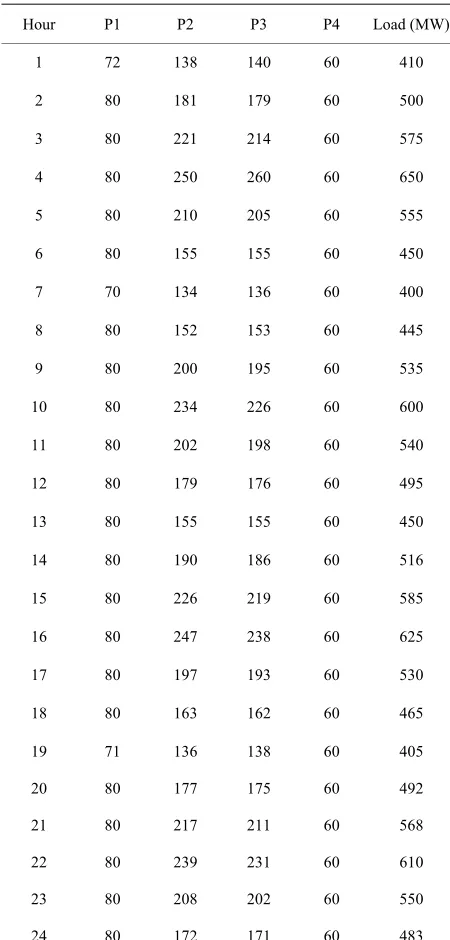
550 MW. For each combination CCF coefficients for committed units, lambda, power generation and total operating cost are obtained. Then the combination 1111 is chosen for first hour because its operating cost is low (Rs.862/-). Hence for the first hour the unit combination is 1111 and the economic schedule for the committed unit is P1 = 72 MW, P2 = 138 MW, P3 = 140 MW and P4 = 60 MW. In case if there is any violation of power limit, the power is fixed at its maximum limit or mini-mum limit. Then the CCF coefficients, lambda, power generation and total operating cost are obtained. The same procedure is continued for next hour.
5.1 IEEE 4-Unit Test System
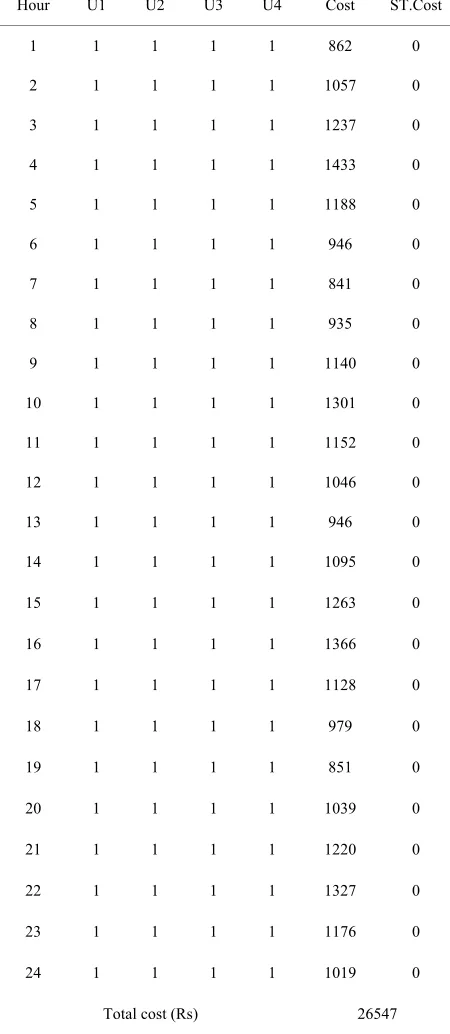
The proposed approach has been tested on a sample sys-tem consisting of four generating units. Table 1 summa-rizes the committed units, operating cost and start up cost. The committed unit shows that there was no need to add startup and shut down cost because all the units were ON
Start
Read system data
h = 1
Choose the possible combinations satisfy power demand and spinning reserve constraints
Generate 2n possible combinations
Compute CCF coefficients and λ for each combination
Evaluate the generations of units for each combination
Compute the total operating cost for each combination
Choose a combination with minimum total operating cost
Print the unit commitment schedule and dispatches
If h = T
Stop NO
[image:4.595.310.535.110.627.2]YES h = h+1
Figure 1. Flow chart of the proposed method
Table 1. Committed units and cost for 4-unit system
Hour U1 U2 U3 U4 Cost ST.Cost
1 1 1 1 1 862 0
2 1 1 1 1 1057 0
3 1 1 1 1 1237 0
4 1 1 1 1 1433 0
5 1 1 1 1 1188 0
6 1 1 1 1 946 0
7 1 1 1 1 841 0
8 1 1 1 1 935 0
9 1 1 1 1 1140 0
10 1 1 1 1 1301 0
11 1 1 1 1 1152 0
12 1 1 1 1 1046 0
13 1 1 1 1 946 0
14 1 1 1 1 1095 0
15 1 1 1 1 1263 0
16 1 1 1 1 1366 0
17 1 1 1 1 1128 0
18 1 1 1 1 979 0
19 1 1 1 1 851 0
20 1 1 1 1 1039 0
21 1 1 1 1 1220 0
22 1 1 1 1 1327 0
23 1 1 1 1 1176 0
24 1 1 1 1 1019 0
Total cost (Rs) 26547
[image:4.595.57.290.329.702.2]Table 2. Economic Schedule of committed units for 4-unit system
Hour P1 P2 P3 P4 Load (MW)
1 72 138 140 60 410
2 80 181 179 60 500
3 80 221 214 60 575
4 80 250 260 60 650
5 80 210 205 60 555
6 80 155 155 60 450
7 70 134 136 60 400
8 80 152 153 60 445
9 80 200 195 60 535
10 80 234 226 60 600
11 80 202 198 60 540
12 80 179 176 60 495
13 80 155 155 60 450
14 80 190 186 60 516
15 80 226 219 60 585
16 80 247 238 60 625
17 80 197 193 60 530
18 80 163 162 60 465
19 71 136 138 60 405
20 80 177 175 60 492
21 80 217 211 60 568
22 80 239 231 60 610
23 80 208 202 60 550
[image:5.595.60.287.627.719.2]24 80 172 171 60 483
Table 3. Comparison results of cost of generation for 4-unit system
Methods Production cost of generation (Rs)
Dynamic programming [11] 26986.40
Branch and bound [11] 26921.94
Ant colony system[11] 26921.94
CCF (PM) 26547.00
the comparison, that the proposed approach gives the better optimum solution for all load demands when compared to the other methods reported in Reference [11].
5.2 IEEE 7-Unit Test System
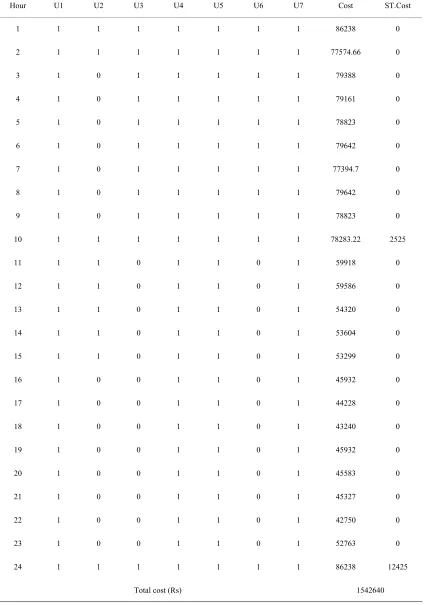
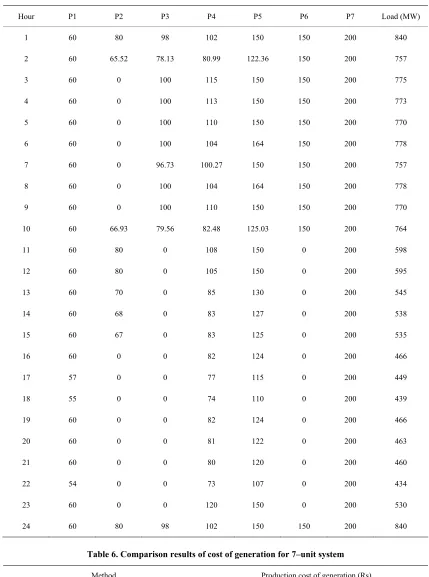
The proposed approach has been tested on a sample sys-tem the optimum generation schedule for various syssys-tem de consisting of seven generating units. Table 4 summa-rizes the committed units, operating cost and start up cost. The committed units show that it is necessary to add the start up cost at Hour 10 and Hour 24. Table 5
gives mands. The results do not show any violation of reserve and power demand constraints. In this article [14] there is no shutdown cost and ramp level for any generating units. The proposed method is compared with Tabu Search (TS) and the comparison is shown in
Table 6. It is clear from the comparison, that the pro-posed approach gives the better optimum solution for all load demands when compared to the other method re-ported in Reference [14].
5.3 IEEE 10-Unit Test System
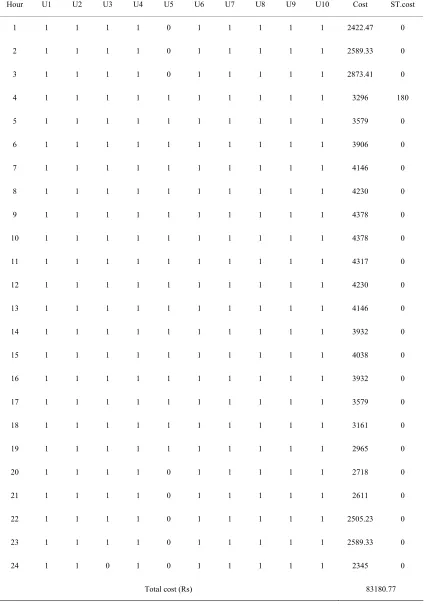
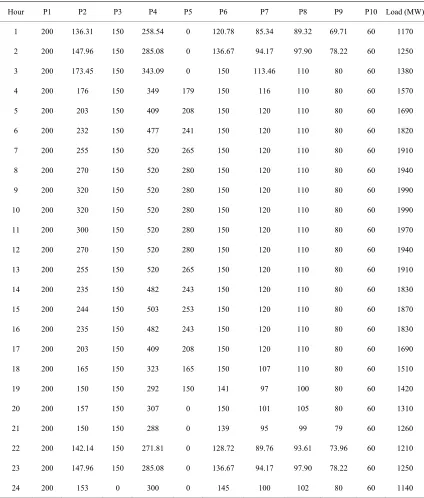
The proposed approach has been tested on a sample sys-tem consisting of ten generating units. Table 7 summa-rizes the committed units, operating cost and start up cost. The committed units shows that it is necessary to add startup cost Hour 4 and shutdown cost at Hour 1, Hour 20 and Hour 24. Table 8 gives the optimum generation schedule for various system demands. The ramp level should be maintained for entire 24 hour. The results do not show any violation of reserve and power demand constraints. The proposed method in comparison with Dynamic Programming (DP), Branch and bound and Ant colony system as shown in the Table 9. It is clear from the comparison, that the proposed approach gives the better optimum solution for all load demands when compared to the other methods reported in Reference [11].
The data are obtained for four generator [11], seven- generator [14] and ten-generator [11] as reported in ref-erences. From the results, it was clear that the proposed approach provides solution with close agreement with conventional method. The composite cost function-based solution method has the following distinctive features.
1) The conventional methods gives the committed units and total production cost only but the proposed method gives the committed units, cost and economic schedule for committed units.
2) The proposed approach directly express the opti-mum generation of each unit using CCF coefficients. Hence the computation time for unit commitment and economic schedule becomes an easy task.
Table 4. Committed units and cost for 7-unit system
Hour U1 U2 U3 U4 U5 U6 U7 Cost ST.Cost
1 1 1 1 1 1 1 1 86238 0
2 1 1 1 1 1 1 1 77574.66 0
3 1 0 1 1 1 1 1 79388 0
4 1 0 1 1 1 1 1 79161 0
5 1 0 1 1 1 1 1 78823 0
6 1 0 1 1 1 1 1 79642 0
7 1 0 1 1 1 1 1 77394.7 0
8 1 0 1 1 1 1 1 79642 0
9 1 0 1 1 1 1 1 78823 0
10 1 1 1 1 1 1 1 78283.22 2525
11 1 1 0 1 1 0 1 59918 0
12 1 1 0 1 1 0 1 59586 0
13 1 1 0 1 1 0 1 54320 0
14 1 1 0 1 1 0 1 53604 0
15 1 1 0 1 1 0 1 53299 0
16 1 0 0 1 1 0 1 45932 0
17 1 0 0 1 1 0 1 44228 0
18 1 0 0 1 1 0 1 43240 0
19 1 0 0 1 1 0 1 45932 0
20 1 0 0 1 1 0 1 45583 0
21 1 0 0 1 1 0 1 45327 0
22 1 0 0 1 1 0 1 42750 0
23 1 0 0 1 1 0 1 52763 0
24 1 1 1 1 1 1 1 86238 12425
Table 5. Economic Schedule of committed units for 7-unit system
Hour P1 P2 P3 P4 P5 P6 P7 Load (MW)
1 60 80 98 102 150 150 200 840
2 60 65.52 78.13 80.99 122.36 150 200 757
3 60 0 100 115 150 150 200 775
4 60 0 100 113 150 150 200 773
5 60 0 100 110 150 150 200 770
6 60 0 100 104 164 150 200 778
7 60 0 96.73 100.27 150 150 200 757
8 60 0 100 104 164 150 200 778
9 60 0 100 110 150 150 200 770
10 60 66.93 79.56 82.48 125.03 150 200 764
11 60 80 0 108 150 0 200 598
12 60 80 0 105 150 0 200 595
13 60 70 0 85 130 0 200 545
14 60 68 0 83 127 0 200 538
15 60 67 0 83 125 0 200 535
16 60 0 0 82 124 0 200 466
17 57 0 0 77 115 0 200 449
18 55 0 0 74 110 0 200 439
19 60 0 0 82 124 0 200 466
20 60 0 0 81 122 0 200 463
21 60 0 0 80 120 0 200 460
22 54 0 0 73 107 0 200 434
23 60 0 0 120 150 0 200 530
24 60 80 98 102 150 150 200 840
Table 6.Comparison results of cost of generation for 7–unit system
Method Production cost of generation (Rs)
Tabu Search [14] 1543179
Table 7. Committed units and cost for 10-unit system
Hour U1 U2 U3 U4 U5 U6 U7 U8 U9 U10 Cost ST.cost
1 1 1 1 1 0 1 1 1 1 1 2422.47 0
2 1 1 1 1 0 1 1 1 1 1 2589.33 0
3 1 1 1 1 0 1 1 1 1 1 2873.41 0
4 1 1 1 1 1 1 1 1 1 1 3296 180
5 1 1 1 1 1 1 1 1 1 1 3579 0
6 1 1 1 1 1 1 1 1 1 1 3906 0
7 1 1 1 1 1 1 1 1 1 1 4146 0
8 1 1 1 1 1 1 1 1 1 1 4230 0
9 1 1 1 1 1 1 1 1 1 1 4378 0
10 1 1 1 1 1 1 1 1 1 1 4378 0
11 1 1 1 1 1 1 1 1 1 1 4317 0
12 1 1 1 1 1 1 1 1 1 1 4230 0
13 1 1 1 1 1 1 1 1 1 1 4146 0
14 1 1 1 1 1 1 1 1 1 1 3932 0
15 1 1 1 1 1 1 1 1 1 1 4038 0
16 1 1 1 1 1 1 1 1 1 1 3932 0
17 1 1 1 1 1 1 1 1 1 1 3579 0
18 1 1 1 1 1 1 1 1 1 1 3161 0
19 1 1 1 1 1 1 1 1 1 1 2965 0
20 1 1 1 1 0 1 1 1 1 1 2718 0
21 1 1 1 1 0 1 1 1 1 1 2611 0
22 1 1 1 1 0 1 1 1 1 1 2505.23 0
23 1 1 1 1 0 1 1 1 1 1 2589.33 0
24 1 1 0 1 0 1 1 1 1 1 2345 0
Table 8. Economic Schedule of committed units for 10-unit system
Hour P1 P2 P3 P4 P5 P6 P7 P8 P9 P10 Load (MW)
1 200 136.31 150 258.54 0 120.78 85.34 89.32 69.71 60 1170
2 200 147.96 150 285.08 0 136.67 94.17 97.90 78.22 60 1250
3 200 173.45 150 343.09 0 150 113.46 110 80 60 1380
4 200 176 150 349 179 150 116 110 80 60 1570
5 200 203 150 409 208 150 120 110 80 60 1690
6 200 232 150 477 241 150 120 110 80 60 1820
7 200 255 150 520 265 150 120 110 80 60 1910
8 200 270 150 520 280 150 120 110 80 60 1940
9 200 320 150 520 280 150 120 110 80 60 1990
10 200 320 150 520 280 150 120 110 80 60 1990
11 200 300 150 520 280 150 120 110 80 60 1970
12 200 270 150 520 280 150 120 110 80 60 1940
13 200 255 150 520 265 150 120 110 80 60 1910
14 200 235 150 482 243 150 120 110 80 60 1830
15 200 244 150 503 253 150 120 110 80 60 1870
16 200 235 150 482 243 150 120 110 80 60 1830
17 200 203 150 409 208 150 120 110 80 60 1690
18 200 165 150 323 165 150 107 110 80 60 1510
19 200 150 150 292 150 141 97 100 80 60 1420
20 200 157 150 307 0 150 101 105 80 60 1310
21 200 150 150 288 0 139 95 99 79 60 1260
22 200 142.14 150 271.81 0 128.72 89.76 93.61 73.96 60 1210
23 200 147.96 150 285.08 0 136.67 94.17 97.90 78.22 60 1250
[image:9.595.86.510.100.598.2]24 200 153 0 300 0 145 100 102 80 60 1140
Table 9. Comparison results of cost of generation for 10-unit system
Methods Production cost of generation (Rs)
Dynamic Programming [11] 83652.40
Branch and bound [11] 83475.25
Ant colony system [11] 83491.42
CCF (PM) 83180.77
6. Conclusions
An effective, robust unit commitment solution is a nec-essary contribution to the operating on/off plans of the generating units. In this paper, a new composite cost function based solution algorithm for solving the unit commitment problem is presented. The proposed algo-rithm uses the composite cost coefficients to select the committed units and give the economic schedule for each specific hour. This new algorithm produces better results than the Branch and bound, Dynamic programming, Ant colony, and Tabu search methods in addition to satisfac-tion of the system constraints. The proposed algorithm is most suitable for system having smaller number of units. From the results, it is clear that the proposed method provides the quality solution with low cost and has a po-tential for on-line implementation.
7. Acknowledgements
The authors gratefully acknowledge the authorities of Annamalai University, Annamalainagar, Tamilnadu, In-dia, for their continued support, encouragement, and the extensive facilities provided to carry out this research work.
REFERENCES
[1] A. J. Wood and B. F. Wollenberg, “Power Generation, Operation and Control,” Wiley, New York, 1984. [2] M. Madrigal and V. H. Quintana, “An
Inte-rior–Point/Cutting-Plane Method to Solve Unit Commit-ment Problems,” IEEE Transactions on Power Systems, Vol. 15, No. 3, August 2000, pp. 1022-1027.
[3] J. M. Arroyo and A. J. Conejo, “A Parallel Repair Ge-netic Algorithm to Solve the Unit Commitment Problem,”
IEEE Transactions on Power Systems, Vol. 17, No. 4, November 2002, pp. 1216-1224.
[4] H. Y. Chen and X. F. Wang, “Cooperative Coevolution-ary Algorithm for Unit Commitment,” IEEE Transactions on Power Systems, Vol. 17, No. 1, February 2002, pp. 128-133.
[5] Q. Z. Zhai, X. H. Guan and J. Cui, “Unit Commitment with Identical Units: Successive Subproblem Solving Method Based on Lagrangian Relaxation,” IEEE Trans-actions on Power Systems, Vol. 17, No. 4, November 2002, pp. 1250-1257.
[6] A. L. Motto and F. D. Galiana, “Unit Commitment with Dual Variable Constraints,” IEEE Transactions on Power Systems, Vol. 19, No. 1, February 2004, pp. 330-338. [7] C. C. A. Rajan and M. R. Mohan, “An Evolutionary
Pro-gramming-Based Tabu Search Method for Solving the Unit Commitment Problem,” IEEE Transactions on Power Systems, Vol.19, No. 1, February 2004, pp. 577- 585.
[8] B. Lu and M. Shahidehpour, “Unit commitment with Flexible Generating Units,” IEEE Transactions on Power Systems, Vol.20, No. 2, May 2005, pp. 1022-1034. [9] T. Li and M. Shahidehpour, “Price-Based Unit
Commit-ment: A Case of Lagrangian Relaxation Versus Mixed Integer Programming,” IEEE Transactions on Power Sys-tems, Vol. 20, No. 4, November 2005, pp. 2015-2025. [10] A. Y. Saber, T. Senjyu, T. Miyagi, N. Urasaki and T.
Funabashi, “Fuzzy Unit Commitment Scheduling Using Absolutely Stochastic Simulated Annealing,” IEEE Transactions on Power Systems, Vol. 21, No. 2, May 2006, pp. 955-964.
[11] S. P. Simon, N. P. Padhy and R. S. Anand, “An Ant Col-ony System Approach for Unit Commitment Problem,”
Electrical Power and Energy Systems, Vol. 28, No. 5, 2006, pp. 315-323.
[12] M. Carrion and J. M. Arroyo, “A Computationally Effi-cient Mixed-Integer Linear Formulation for the Thermal Unit Commitment Problem,” IEEE Transactions on Power Systems, Vol. 21, No. 3, August 2006, pp. 1371- 1378.
[13] D. N. Simopoulos, S. D. Stavroula and C. D. Vournas, “Reliability Constraints Unit Commitment Using Simu-lated Annealing,” IEEE Transactions on Power Systems, Vol. 21, No. 4, November 2006, pp. 1699-1706.
[14] A. A. Victoire and A. E. Jeyakumar, “A Tabu Search Based Hybrid Optimization Approach for a Fuzzy Mod-elled Unit Commitment Problem,” Electric Power Sys-tems Research, Vol. 76, No. 6-7, 2006, pp. 413-425. [15] F. Aminifar, M. Fotuhi-Firuzabad and M. Shahidehpour,
“Unit Commitment with Probabilistic Spinning Reserve and Interruptible Load Considerations,” IEEE Transac-tions on Power Systems, Vol. 24, No. 1, February 2009, pp. 388-397.
[16] M. Eslamian, S. H. Hosseinian and B. Vahidi, “Bacterial Foraging Solution to the Unit-Commitment Problem,”