PAEAN: Portable and Scalable Runtime Support
for Parallel Haskell Dialects
JOST BERTHOLD∗
Commonwealth Bank of Australia, Sydney and
HANS-WOLFGANG LOIDL
School of Mathematical and Computer Sciences Heriot-Watt University
and
KEVIN HAMMOND School of Computer Science
University of St.Andrews
(e-mail:[email protected], [email protected], [email protected])
Abstract
Over time, several competing approaches to parallel Haskell programming have emerged. Differ-ent approaches support parallelism at various differDiffer-ent scales, ranging from small multicores to massively parallel high-performance computing systems. They also provide varying degrees of con-trol, ranging from completely implicit approaches to ones providing full programmer control. Most current designs assume a shared memory model at the programmer, implementation and hardware levels. This is, however, becoming increasingly divorced from the reality at the hardware level. It also imposes significant unwanted runtime overheads in the form of garbage collection synchronisation etc. What is needed is an easy way to abstract over the implementation and hardware levels, while presenting a simple parallelism model to the programmer.
The PAEAN (PArallEl shAred Nothing) runtime system design aims to provide a portable and high-levelshared-nothingimplementation platform for parallel Haskell dialects. It abstracts over ma-jor issues such as work distribution and data serialisation, consolidating existing, successful designs into a single framework. It also provides an optionalvirtualshared-memory programming abstraction for (possibly) shared-nothing parallel machines, such as modern multicore/manycore architectures or cluster/cloud computing systems. It builds on, unifies, and extends, existing well-developed support for shared-memory parallelism that is provided by the widely-used GHC Haskell compiler. This paper summarises the state-of-the-art in shared-nothing parallel Haskell implementations, introduces the PAEAN abstractions, shows how they can be used to implement three distinct parallel Haskell dialects, and demonstrates that good scalability can be obtained on recent parallel machines.
1 Introduction
This paper studies how to implement parallelism portably and abstractly for different dialects of parallel Haskell targeting modern multicore/manycore/cluster/cloud systems. In order to improve energy efficiency and performance, there is a strong trend towards reducing sharing in the underlying parallel hardware (Lameter, 2013). However, exposing sharing concerns to the programmer moves away from the traditional functional program-ming strengths of increasing programmability and maintaining very high levels of abstrac-tion. In this paper, we describe a runtime system approach that enables us to separate sharing at the language, implementation and hardware levels. In this way, we can provide a possiblyshared-nothing implementationfor a possiblylogically-shared language design, for example. We can thus obtain the benefits of reducing or eliminating sharing at the hardware level, without losing the benefits of high-level abstraction at the language level. By providing a coherent framework of sophisticated runtime system operations, it becomes possible to develop implementations of new language extensions quickly and robustly. The same approach also enables extensibility of the runtime system. This helps overcome two of the key obstacles to developing new parallel runtime systems, while maintaining functional programming properties of abstraction and ease of use at the language level. Our approach is evaluated against three existing and contrasting dialects of Parallel Haskell: GpH (Hammond & Peyton Jones, 1990; Trinderet al., 1995), Eden (Loogenet al., 2005) and EdI (Berthold & Loogen, 2007; Berthold, 2008).
1.1 Contributions
This paper makes the followingcontributions:
• We expose and evaluate the key design decisions underlying the GpH, Eden and EdI Parallel Haskell dialects, focusing particularly on sharing, parallelism control and load distribution;
• We describe a high-level, portable runtime system framework, PAEAN (PArallEl shAred-Nothing), that builds on the widely-used GHC1implementation and that can be used to implement a variety of parallel dialects of Haskell, forpossibly shared-nothingparallel systems;
• We demonstrate how PAEAN can be used to implement different dialects of Par-allel Haskell, in particular GpH and Eden, capturing all of the requirements of the previously-constructed specialised GUM and DREAM runtime systems;
• We evaluate the performance and scalability of the parallel Haskell implementations that follow PAEAN ideas and principles; and
• We discuss the state-of-the-art for distributed-memory parallel Haskell implemen-tations, relating different programming models to the respective runtime support and assessing the merits of runtime-system versus library support for coordinating parallel programs.
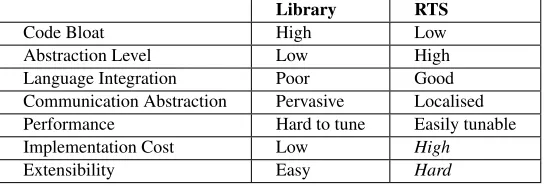
Table 1. Library based and runtime-system based parallel Haskell
Library RTS
Code Bloat High Low
Abstraction Level Low High
Language Integration Poor Good
Communication Abstraction Pervasive Localised Performance Hard to tune Easily tunable
Implementation Cost Low High
Extensibility Easy Hard
1.2 Library versus Runtime System
A number of recent designs have chosen to implement parallel Haskell constructs ex-clusively at the library level, e.g. (Maier & Trinder, 2012; Foltzer et al., 2012). In con-trast, we have deliberately taken a runtime system (RTS) approach. As summarised in Table 1, there are many advantages to our approach. Firstly, less coordination code is required to manage parallelism and load distribution because an underlying RTS will take care of all the details without programmer intervention. This significantly improves programmability and productivity. RTS-based approaches can abstract most of the coor-dination into language constructs, which simplifies programming, reduces code clutter and gives better integration with the programming language. This is especially true for communication abstractions, which are pervasive in any library-based approach for shared-nothing approaches. Secondly, performance-critical code is much easier to fine-tune and avoids the functionality limitations that are inherent to a library approach (for instance, custom memory management is simple and direct). The key disadvantages to an RTS approach are: firstly, that the cost of implementation can be significantly higher, since features must be considered throughout the language implementation; and secondly, that it can be difficult to incorporate new features. By taking a modular approach, PAEAN addresses both of these problems, making it easier to design and build new parallel runtime systems.
1.3 Why Sharing Matters
cache coherency, synchronisation etc. are exposed in the implementation, and not hidden through shared memory accesses.
If memory cannot be assumed to be shared, then a number of implementation issues need to be addressed. These include:
1. how to serialise data;
2. how to logically share values between physically disjoint heaps;
3. how to manage global garbage collection while minimising synchronisation costs; 4. how to migrate data, potential parallelism and threads.
Some recent approaches such as Cloud Haskell (Epsteinet al., 2011) and HdPH (Maier & Trinder, 2012) delegate much of this work to the applications programmer, making parallelism control fully explicit in the program. While this minimises the work of the systems implementor, such an approach is likely to suffer from replication, errors, and unexpected feature interaction, as well as to cause incompatibilities between applications. In our opinion, fully explicit parallelism control entangled with the application flies in the face of the usual functional programming philosophy of good abstraction, effectively “throwing out the baby with the bathwater”. This paper takes the opposite approach, by focusing on amostly implicitmodel of parallelism at the source level, where parallelism is specified in an abstract, declarative way and by supporting this with a sophisticated, well-engineered and flexible runtime system.
1.4 Paper Structure
The remainder of the paper is structured as follows. Section 2 describes the high-level programming models for Parallel Haskell that provide the requirements for the PAEAN implementation. Section 3 describes the PAEAN design and implementation. Section 4 evaluates the utility and scalability of the PAEAN approach. Section 5 covers related work, including extensions to PAEAN. Finally, Section 6 concludes.
2 Parallel Programming models for Haskell
A wide variety of parallel extensions to Haskell have been proposed. A key design question is how explicit to make the coordination of the parallel execution. One extreme is a purely implicit approach, as taken by pH (Adityaet al., 1995), where there are no extensions to the language and all parallelisation is performed by the compiler. Data parallel extensions to Haskell, such as DpH (Chakravartyet al., 2007), take a similar approach, but are limited to data-parallelism on specific data structures. While implicit parallelism is appealing to the programmer, it also limits the scope for performance tuning. The other extreme is to make most aspects of the coordination explicit in the program and thus give the programmer more control on how the parallelism is used. In the Haskell world, examples of this approach include the Par-Monad (Marlowet al., 2011) and Cloud Haskell (Epsteinet al., 2011). While they are easier to implement and tune than implicit approaches, such approaches have the disadvantage of introducing all the complexities and lack of abstraction from mainstream parallel programming models. In such an approach,applications programmers
sumEuler :: Int → Int
sumEuler n=sum[euler i|i← [n,n−1..1] ]
euler :: Int → Int −−Euler phi function : euler n=length( filter (relprime n) [1..n−1])
relprime :: Int → Int →Bool −−are x and y coprime relprime x y=hcf x y==1
hcf :: Int → Int → Int −−highest common factor of x and y hcf x0=x
hcf x y =hcf y(remx y)
Fig. 1. The basic Euler totient function,sumEuler
a middle one ofsemi-explicit parallelism, where the programmer only needs to identify (potential) parallelism, but where synchronisation and communication is managed by the runtime system. This greatly simplifies the parallel programming task, but still gives the programmer a concrete handle on how to improve parallel performance. Supporting such an approach requires an elaborate runtime system, however. The focus of this paper is on how to design such a runtime system in a generic, flexible and reusable way. A more detailed discussion of related systems, including ones taking both more explicit and more implicit approaches, is given in Section 5.
In this paper, we will consider three Haskell dialects: Glasgow parallel Haskell (GpH), Eden, and EdI (the implementation language for Eden). The approach taken by GpH uses programmer-specified annotations (par) to create “sparks” that may, or may not, be subsequently transformed into parallel threads. In contrast, in Eden and EdI, parallelism is introduced byprocessconstructs that always create new threads. While Eden provides a purely functional interface, EdI uses monadic constructs in a similar fashion to the Par Monad. We will use thesumEulerfunction to characterise these three dialects. For a given
n,sumEulercomputes the Eulerϕ-function2for values up ton, and sums the results. The sequential Haskell code for this is shown in Figure 1.
2.1 GpH
GpH (Hammond & Peyton Jones, 1990; Trinderet al., 1995) uses a semi-explicit paral-lelism model, where the programmer simply indicates potentially parallel closures and all synchronisation, coordinationetc.issues are delegated to the runtime system. It uses two basic primitives:parandpseq.
par, pseq :: a -> b -> b -- parallel/sequential composition
The parprimitive identifies potential parallelism usinglazy futures(Mohret al., 1991). Its first argument is a closure that is marked for possible parallel execution (sparked). It
2
typeStrategy a=... −−evaluation strategy abstraction
rseq:: Strategy a −−normal sequential evaluation
rpar:: Strategy a −−spark a closure
rdeepseq:: NFData a⇒Strategy a −−full evaluation
parList:: Strategy a → Strategy [a] −−parallel evaluation of a list
using:: a→ Strategy a→a −−strategy application
Fig. 2. Basic Evaluation Strategies
returns the value of its second argument. So,x ‘par‘ emarksxfor parallel execution, and then returnse. Thepseqprimitive sequences the evaluation of its arguments, returning the value of its second argument. So,x ‘pseq‘ efirst evaluatesx, and then returnse.
Experience has shown that unstructured use ofparandpseqcan quickly obscure pro-grams. A higher level of abstraction is provided byevaluation strategies(Trinder et al., 1998; Marlowet al., 2010), which cleanly separate coordination from computation. Eval-uation strategies are lazy, polymorphic, higher-order functions that control the evalEval-uation degree and parallelism of a Haskell expression. Some primitive strategies are shown in Figure 2. Therseqandrparstrategies are analogous topseqandpar. Therdeepseq
strategy is similar to rseq, except that it fully evaluates its argument3. The parList
strategy is an example of a higher-order strategy. This takes another, possibly parallel, strategy as its argument, and applies it in parallel to all elements of a list. So, for example,
parList rdeepseqis the strategy that evaluates a list in parallel, forcing all the results to be completely evaluated. Finally, theusingfunction applies a strategy to a Haskell expres-sion. So,e ‘using‘ parList rdeepseqwill evaluateeusing theparList rdeepseq
strategy.
sumEulerGpH0:: Int → Int
sumEulerGpH0 n=sum(mapeuler[n,n−1..1]
‘using‘parList rdeepseq)
sumEulerGpH:: Int → Int → Int
sumEulerGpH z n=sum(mapworkF(unshuffle z[n,n−1..1]) ‘using‘parList rdeepseq)
whereworkF=sum◦mapeuler
Fig. 3. GpH versions ofsumEuler
Our first GpH version ofsumEuler,sumEulerGpH0(Figure 3), simply usesparList rdeepseqto compute every application ofeulerin parallel. However, thegranularityof
splitAtN :: Int → [a] → [[a]] splitAtN n[]=[]
splitAtN n xs=ys:splitAtN n zs
where(ys,zs) =splitAt n xs
unshuffle:: Int → [a] → [[a]]
unshuffle n xs=map(takeEachN) [dropi xs|i← [0..n−1]]
wheretakeEachN [] =[]
takeEachN(x:xs)=x: takeEachN(drop(n−1)xs) Fig. 4. Chunking functions
the parallelism is too fine, since each spark only describes a single function application.
sumEulerGpH therefore useschunkingto overcome this. We therefore introduce an ad-ditional parameter z, the desired number of chunks (i.e. sparks). Thenlist elements are then distributed intozsub-lists. Each sub-list becomes a spark that may then potentially be evaluated in parallel. Alternative chunking functions can be easily defined as standard Haskell definitions4. For example, as shown in Figure 4,splitAtNsplits a list into sub-lists of sizen, andunshuffledistributes elements of a list into exactlynsub-lists, in a round-robin fashion. For sumEulerGpH, we have chosen to useunshufflerather than
splitAtNbecause the computation time for theϕ-function increases with its argument. If
splitAtNwas used instead, then the largest argument values would be gathered into the first sparks that were created, creating load-imbalance between the sparks.
−−Process abstraction and instantiation
process:: (Trans a, Trans b) ⇒ (a→b) →Process a b
( # ) :: (Trans a, Trans b) ⇒ (Process a b) → a → b spawn :: (Trans a, Trans b) ⇒[Process a b] →[a] → [b]
Fig. 5. Eden core constructs
2.2 Eden
In contrast to GpH, Eden provides explicit process abstraction and process instantiation operations (Figure 5). The expressionprocess(λx→e ) of typeProcess a bdenotes a
process abstractionover a functionλx→eof typea→b. The (#) operator allows a new
childprocess to beinstantiated, i.e. evaluated in parallel with the callingparentprocess.
process (\ x -> map factorial x) # [1..100] creates a process that maps the factorial function over the list[1..100]. This list is evaluated on the parent, and passed in a fully evaluated form to the child. Once computed, the result list is then returned to the parent. Eden’s spawn function lifts process to a list of processes and inputs. All processes are created eagerly in parallel. This avoids the sequential demand-driven
4 Chunking functions can also be provided abstractly for lists and other data types via aCluster
sumEulerEden :: Int → Int
sumEulerEden n=sum(spawn(repeatchildProc) (unshuffle noPe[1..n]))
wherechildProc=process(sum◦mapeuler) Fig. 6. Eden version ofsumEuler
evaluation that the lazy Haskell list would imply. Once instantiated, the new child process will be executed in parallel with the parent process. The parent and child processes have independent heaps. and will only communicate by exchanging (implicit) messages. Data that is exchanged between Eden processes is always in normal form (i.e. fully evaluated). Therefore, process instantiation is roughly equivalent to hyper-strict function application. Lists are communicated as streams, element by element. Tuple components are evaluated by concurrent threads. This allows for circular programs and infinite data streams.
Figure 6 shows how sumEulercan be implemented in Eden by spawning a number of independent processes that each applyeulerto part of the original input list. Having created these processes, the main process will block until the results become available, and then compute the final sum. Since, unlike GpH, Eden will create threads for everyprocess
construct that is specified by the programmer, we introduce a use of theunshuffle func-tion to balance the load between child processes. This will evenly divide the inputs among the number of available processors,noPe(provided as a constant by the Eden RTS).
spawnProcessAt:: Int→IO () →IO ()
dataChanName’a
createC::IO(ChanName’ a, a)
createCs:: Int → IO([ ChanName’ a], [a])
sendWith:: Strategy a →ChanName’ a→a→IO()
sendStreamWith:: Strategy a→ChanName’ [a]→[a]→ IO()
noPe,selfPe::IO Int
Fig. 7. The complete API for the Eden implementation language, EdI
2.3 EdI
The Eden implementation language EdI (Berthold & Loogen, 2007; Berthold, 2008) (Fig-ure 7) takes the approach of explicit process control even further, requiring the program-mer to take full control of, and responsibility for, all data transfers. As suggested by its name, EdI was designed to implement Eden, but can also be used in its own right as a monadic language for parallelism. As in Eden, a new parallel process can be spawned on a specific instance of a running system but, unlike Eden, an EdI process is simply anIO
sumEulerEdi:: Int → IOInt sumEulerEdi n=dopes←noPe
(cs, rs) ←createCs pes
zipWithM (spawnEulerW pes) [1..pes]cs
return (sumrs)
wherespawnEulerW:: Int→ Int →ChanName’ Int→IO() spawnEulerW stride k c=spawnProcessAt k
(sendWith rseq c
(sum(mapeuler[n−k+1,n−k+1−stride..1])) Fig. 8. EdI implementation forsumEuler
process, usingsendWith, or implicitly passed to a new process when it is created using
spawnProcessAt. The other process can use the channel to return data (of a suitable type) to the original process. Note that the sendWith operation takes an evaluation strategy argument. This controls where the evaluation happens and is applied to the data argument before it is transmitted. Finally, the sendStreamWith operation extends sendWith to streams. This enables the definition of circular process networks and pipelining.
Figure 8 shows howsumEulercan be implemented in EdI. A set of channels,cs, and placeholders,rs, are created usingcreateCs. One channel and one placeholder are cre-ated for each available processor (noPe). Each channel is used in one call tospawnEulerW, which creates a child process on processorkusingspawnProcessAt. The new process will generate its own part of the input list, apply theeulerfunction to this partial input, and sum the resulting list. This partial sum is returned to the parent by callingsendWith
on the given channel. EdI represents the lowest level of abstraction that we will consider in this paper, exposing the full control, and burden, of parallel evaluation and explicit communication to the programmer. It constitutes a minimal set of runtime-system support functionality for sending and receiving data and computations, exploiting the underlying GHC runtime system to achieve synchronisation.
3 Haskell on shared-nothing systems: The PAEAN runtime framework
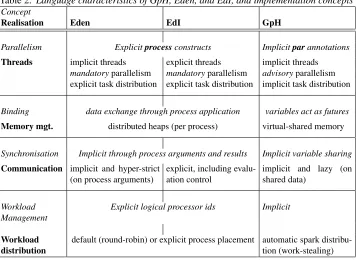
The language characteristics of Eden, GpH, and EdI can be classified into the four key concepts of parallelism,binding,synchronisationandworkload management (Table 2). Each of these will lead to a number of importantimplementation requirements.
Parallelism. As we have seen, in Eden and EdI, all threads that are specified by the programmermustbe created (parallelism ismandatory). In contrast, in GpH, the runtime system decides both when and whether to instantiate the potential parallelism that has been indicated by the programmer (parallelism isadvisory). The correspondingrequirementsfor
thread managementare:
Table 2. Language characteristics of GpH, Eden, and EdI, and implementation concepts Concept
Realisation Eden EdI GpH
Parallelism Explicitprocessconstructs Implicitparannotations
Threads implicit threads explicit threads implicit threads
mandatoryparallelism mandatoryparallelism advisoryparallelism explicit task distribution explicit task distribution implicit task distribution
Binding data exchange through process application variables act as futures
Memory mgt. distributed heaps (per process) virtual-shared memory
Synchronisation Implicit through process arguments and results Implicit variable sharing
Communication implicit and hyper-strict (on process arguments)
explicit, including evalu-ation control
implicit and lazy (on shared data)
Workload Management
Explicit logical processor ids Implicit
Workload distribution
default (round-robin) or explicit process placement automatic spark distribu-tion (work-stealing)
Binding. The concept of variable bindingis realised in Eden and EdI via data transfer, initiated by a process creation, and in GpH vialazy futuresand implicit synchronisation. This concept is implemented by the memory management component. For Eden, this links remote data access with the language concept of process abstraction, requiring explicit data transfer. For GpH, the main requirements are completely transparent access to bindings, which leads to automatic and distributed memory management over several physical heaps, and hence to avirtual-shared memoryabstraction. More specifically, the requirement on the runtime system is to ensure that all data is available at the location where the computa-tion is to be executed. This implicitly invokes communicacomputa-tion, so establishing a tighter link between these components in the GpH implementation. In contrast, the runtime system for Eden and EdI must implement a model of distributed heaps that are connected through communication channels. Therequirementsforparallel memory managementare:
• to identify points of data exchange;
• to implement a logically shared address space on top of distributed memory; • to interact with the communication component based on the need for remote data.
GpH, some data may be passed to a child thread when it is created, but the majority will be fetched on a demand-driven basis. This increases sharing and reduces startup costs, but may add some delay if a significant volume of data is fetched during execution. Having created one or more child processes, in Eden the parent process will typicallyblockuntil the results become available. In GpH, however, execution continues normally. If any GpH thread requires a value that is being evaluated by another thread, it will block until the result is produced. When the value of a virtually shared node becomes available, it will be returned to all blocked threads. This reduces synchronisation delays, but once again, shared data may be fetched incrementally. This uses an extension of the standard “black-holing” mechanism that is normally used to detect cycles in sequential code. Rather than raising an exception, as would normally happen, the parallel implementation treats an attempt to evaluate a node that is currently under evaluation as a synchronisation request5. The virtual shared graph model used in GpH will ensure that the results of computations will be shared as they become available, so avoiding repeated evaluation. In contrast, Eden and EdI make no attempt to avoid repeated evaluation other than through transmitting only normal forms. Therequirementsforcommunicationare therefore:
• to check whether necessary data is available; • to realise data exchange when necessary;
• to update values with results as they are produced; • to notify blocked threads of the availability of a result;
• to interact with the thread management component, based on data availability.
Workload Management. A key runtime decision is when and where to execute paral-lelism. At the language level, Eden and EdI both provide a notion of virtual processor, which can be used by the programmer to offload processes to specific processors. GpH abstracts this even further: threads are instantiated from sparks and then mapped to the available processors by the runtime system. In order to get a good load balance, it may be necessary to migrate sparks and/or threads between processors. Finally, where multiple threads exist on a single processor, it is necessary to schedule them appropriately both for efficiency and, in the case of Eden and EdI, to ensurefairness. Therequirementsfor
workload distributionare:
• to decide on the order of execution of available threads (scheduling); • to determine how to distribute the available parallelism (load balancing); • to decide whether and when to offload parallelism.
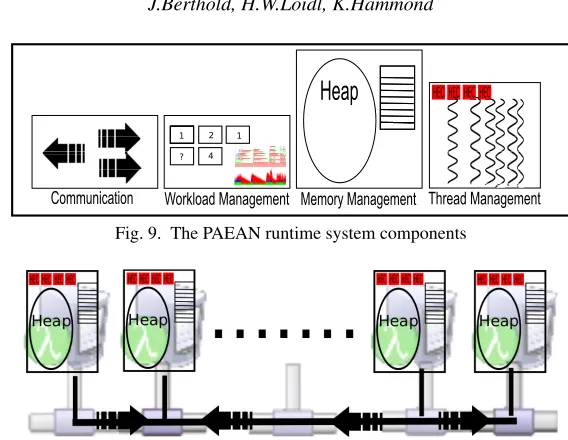
As shown in Figure 9, PAEAN realises each of these issues as its own modularcomponent. This makes PAEAN much more generally applicable. Although they have formed our starting point, the PAEAN system design is not restricted to the GpH and Eden parallelism models. Neither is it necessarily limited to Haskell: the concepts and realisations that we have shown in Table 2 are characteristic of a much wider class of languages, including some parallel dialects of Lisp, Prolog and C++. Any language that is more prescriptive in terms of thread management can easily be mapped to the underlying PAEAN realisations, though it may not make full use of the PAEAN mechanisms.
HEC HEC HEC HEC
Memory Management Thread Management
Heap
Communication Workload Management
1 2 1
[image:12.612.169.453.135.355.2]4 ?
Fig. 9. The PAEAN runtime system components
Fig. 10. Parallel system built as a collection of PAEAN instances
3.1 PAEAN Thread management
PAEAN coordinates multipleinstancesof the standard GHC runtime system. Each PAEAN instance is typically mapped onto a separate processor in its own operating system process. When run on a multicore, an instance may comprise multiple Haskell Execution Contexts (HECs) which share the same heap, i.e. the standard shared-memory parallel Haskell implementation of GpH, GHC-SMP (Marlowet al., 2009). These instances are connected to form a collaborating parallel system with a distributed heap, as shown in Figure 10. Each PAEAN instance manages its ownthread pooland, if required, aspark pool, pro-viding its own independent thread scheduler. In addition, PAEAN introduces the concept of aprocess, a thread group that shares a region of the Haskell heap and communication channels (explained in Section 3.4.3). As shown in Table 3, PAEAN routines are provided to: spark closures and add them to the local spark pool (createSpark); select a spark from the local spark pool (findSpark); turn a spark into a thread and move it from the spark pool to the thread pool (activateSpark); add an IO thread directly to the local thread pool (createIOThread); and start a new process (startNewProcess).
3.2 Virtual shared heap management
Following our shared-nothing design, each PAEAN instance maintains its own independent heap, with its own address space. Each instance undertakes its own local garbage collection (GC) on this heap, using, for example, the usual GHC garbage collection mechanism. By default, this is a stop-and-copygenerational garbage collector(Appel, 1989). On a shared-memory system, the GHC-SMP shared-shared-memory garbage collection implementation may be used, if desired, though this may degrade performance. It is possible to combine the heaps from multiple PAEAN instances to form a single virtually-shared heap that can be accessed by any PAEAN instance. Shared heap nodes are accessed through a sharedglobal
Table 3. PAEAN runtime system routines for sparks and threads Spark Management
PAEAN Routine and Parameters Description
void createSpark(StgClosure∗la) Generate a spark and put it into the local spark pool
StgClosure∗findSpark() Select and return a spark from the the local spark pool
void activateSpark(StgClosure∗spark) Turn a spark into a thread, allocating a thread, and put it into the thread pool
Thread Management
void startNewProcess(StgClosure∗la) Create a new thread in its own process, to evaluate given (IO) closure
[image:13.612.118.487.340.563.2]StgTSO∗createIOThread(StgClosure∗la) Create a new thread (sharing a process with other threads) to evaluate given closure
Table 4. PAEAN runtime system routines for global heap management
PAEAN Routine and Parameters Description
RtsGA∗makeGlobal() Create a new unique global address (GA) on the current node
StgClosure∗lookupGA(RtsGA∗ga) Look up global addressgain the GIT, return a local address (LA) if found
RtsGA∗lookupLocal(StgClosure∗la) Look up local addressla, return GA if found
void commonUp(RtsGA∗ga,StgClosure∗la) Check whether a ga already exists on this node; if so, keep only the further evaluated of the two (a data duplicate is eliminated)
void splitWeight(RtsGA∗ga1,RtsGA∗ga2) Split weight attached toga1, into 2 compo-nents adding up to the original, one attached toga1and one attached toga2(a reference is created)
RtsGA∗addWeight(RtsGA∗ga) Add the weight ingato the weight of the GA in the local GIT table (a reference is deleted)
void markGIT() Traverse in-pointers section of GIT during GC (local closures with GAs are roots)
void rebuildGIT Traverse GIT to fix references to local addresses (out-pointers), return weight for dead entries
3.2.1 Global addresses
The virtual shared heap forms a subset of the individual PAEAN instance heaps. Each (potentially) shared heap object is identified by a uniqueglobal address(GA), created by
Heap
Instance 1Heap
Instance 2 1 3 2 4 5 1 3 2 4 5 6 GIT GIT...
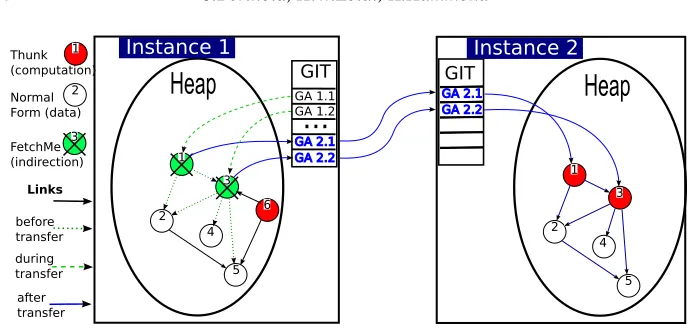
GA 1.1 GA 1.2 GA 2.1 GA 2.2 GA 2.1 GA 2.2 2 3 1 Thunk (computation) Normal Form (data) FetchMe (indirection) Links before transfer during transfer after transferFig. 11. Transferring graph structures between PAEAN instances. Here, the sub-graph rooted at address 1 (withGA2.1) has been transferred from instance 1 to instance 2. Thunks are moved, replacing them byFetchMeson instance 1, while normal forms are copied.GA1.1andGA1.2are only used during transfer. At completion of the transfer, they are replaced byGA2.1andGA2.2.
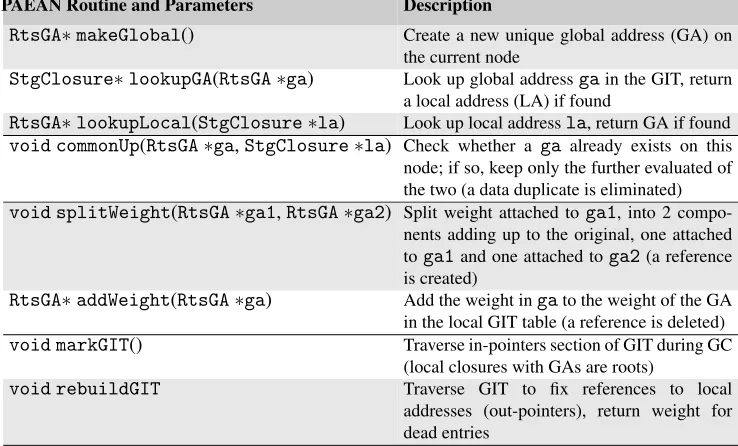
which provide external references to shared objects that are defined within the instance. By maintaining a separate table, we avoid the need to record a GA in every allocated closure, and also make the inter-heap dependencies explicit. This allows an instance to freely choose any appropriate local garbage collection mechanism — it is only necessary to treat the global in-pointers as additional GC roots. As discussed in Section 3.2.3,global garbage collectionis performed using weighted reference counting. The PAEAN virtually-shared heap implementation that is described here mostly follows that of (Trinderet al., 1995), but reduces the amount of heap management information that is needed. The most notable new extensions are user-tunable policies for globalising heap structures and for the size of a sub-graph to be transferred.
3.2.2 Transferring program graph between PAEAN instances
Every object which is moved from one PAEAN instance to another is given a new, unique GA in the target instance’s GIT. The original local heap node is replaced with a special
FetchMeclosure that refers to this GA. When the value of a FetchMenode is needed, the communication subsystem is invoked to obtain the value of the node from the remote PAEAN instance. In this way, local heap nodes are linked to remote heap nodes. The
commonUproutine is used to avoid replicating data where the same GA is communicated to an instance more than once. An example is shown in Figure 11. Here, twothunks(nodes 1 and 3) are moved between heaps, replacing the original nodes withFetchMe nodes. The packing routine checks whether the thunks are already global. If they are not, GAs are allocated locally for each thunk (GA1.1–GA1.2). These GAs are used to refer to the thunks while they are in transit. When the thunks are unpacked, new GAs (GA2.1–GA2.2) are generated to indicate the transfer of ownership toInstance 2. An acknowledgement message informsInstance 1thatGA1.1andGA1.2have been superseded byGA2.1and
3.2.3 Global Garbage Collection
Aweighted reference countingscheme (Bevan, 1987) is used to garbage collect the inde-pendent PAEAN heaps. As we have seen, the GIT indicates the possibly livein-pointersfor each instance. These are marked as roots during GC using themarkGITroutine. Weights are associated with each GA. Whenever a GA is shared between instances, e.g. because a
FetchMehas been replicated, then its weight is split between the two relevant GIT entries usingsplitWeight. Conversely, when an instance frees a remote closure during its local garbage collection, the weight is returned to the original GIT usingaddWeight. The same happens when old GAs are replaced by new ones. When all the weight is concentrated in the original GIT, then the closure is no longer referenced globally and the GIT entry can be removed. The local closure can then be freed if it is not referenced locally. One general weakness of this scheme is that it will not collect cycles across independent heaps. Various schemes can be used to deal with this issue, if needed, such as collating cross-heap cycles onto a single instance, where they can be collected (Bevan, 1987). Such a mechanism, however, is not currently implemented in PAEAN.
3.3 Haskell program graph serialisation
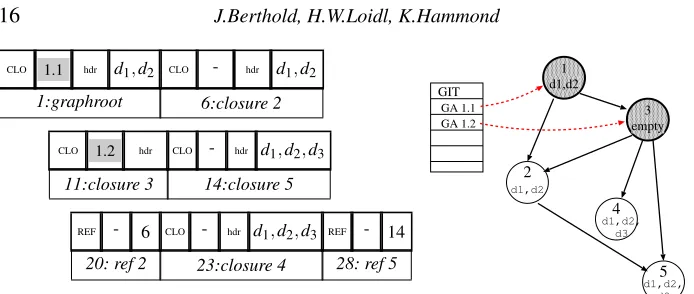
[image:15.612.122.478.558.608.2]Haskell program graphs are communicated between runtime system instances as seri-alised sub-graphs(see Figure 12). These are packed into one or more packets for efficient communication. PAEAN provides methods to traverse a graph in a local heap, packing it for efficient transmission (packGraph), and to unpack a serialised graph into the remote heap (unpackGraph), restoring its original structure and building any inter-instance links using new FetchMe closures. The serialisation concept used in PAEAN is a breadth-first traversal that is designed to limit the amount of communicated graph to a single efficiently-transmitted message. This was first used in (Trinder et al., 1995) as a modification of the original Graph for PVM mechanism (Loidl & Hammond, 1994; Hammond, 1993) that packed entire sub-graphs. (Loidl & Hammond, 1996) studies the best strategies for efficiently packing shared program graph. We have followed this work here.
Table 5. PAEAN runtime system routines for serialisation
PAEAN Routine and Parameters Description
rtsPackBuffer∗packGraph(StgClosure∗la) serialise a sub-graph rooted atla StgClosure∗unpackGraph(rtsPackBuffer∗buf) de-serialise a buffer, returning a
local address
3.3.1 Closure Layout and Serialisation
1:graphroot CLO 1.1 hdr d1,d2
6:closure 2 CLO - hdr d1,d2
11:closure 3 CLO 1.2 hdr
14:closure 5 CLO - hdr d1,d2,d3
20: ref 2 REF - 6
23:closure 4 CLO - hdr d1,d2,d3
28: ref 5 REF - 14
2 d1,d2
4
d1,d2, d3
5 d1,d2,
d3
GIT
GA 1.2 GA 1.1
1 d1,d2
[image:16.612.136.483.129.276.2]3 empty
Fig. 12. Example serialisation of the five-closure graph from Figure 11 with two shared closures. The packet on the left encodes the graph on the right, using REF tags to describe sharing. unique closure in the packet is identified using aCLOtag, followed by the global address of the packed closure. The header and all non-pointer data is packed directly into the packet immediately after the GA. Pointers into the local instance heap will, however, need to be re-established once the program graph has been successfully transmitted to the remote heap. They are therefore omitted from the packet. The order in which the graph is recon-structed allows them to be correctly re-established. Where a packed graph contains shared closures, explicitREFtags are used to preserve sharing. They also allow cyclic structures to be transmitted. Finally, top-level program constants (constant applicative forms) do not need to be transmitted between PAEAN instances, since each instance maintains its own identical collection of such constants, embedded in the binary program that is executed by all instances. These are identified using aCAFtag. Clearly, the graph referenced from the root might be larger than could fit into a single fixed-size packet. In this case, PAEAN will either useFetchMeclosures to reference the additional heap, or will raise an error.
A few special types of GHC closures cannot be packed using the mechanism described here. These include primitive GHC data structures for synchronisation: Haskell mutable variables,MVars, and transactional variables that used to implement software transactional memory,STM, as well as some system-level data structures. Packing these nodes would not be sensible since they encode state that is local to a specific PAEAN instance, such as operating system file handles.
3.3.2 Example: Packing/Unpacking Graph
Figure 12 shows how the graph from Figure 11 can be serialised into a single packet and transferred between PAEAN instances. Here, closures 2 and 5 are shared usingREFtags. ThepackGraphfunction traverses the graph in a breadth-first manner. This means that if the complete sub-graph cannot be packed, then a closure will generally be packed with all its children. In the example, closures 1 and 3 are thunks, and are therefore replaced by
Table 6. PAEAN runtime system communication routines.
PAEAN Routine Parameters Description
rtsBool MP_start Program arguments Start/synchronise all nodes
rtsBool MP_sync Program arguments Start/synchronise all nodes
rtsBool MP_quit error code disconnect from system
rtsBool MP_send receiver, tag, data (non-blocking) data sending
int MP_recv destination buffer (blocking) data reception
[image:17.612.122.479.274.533.2]rtsBool MP_probe void (non-blocking) probe for available messages
Table 7. PAEAN message tags and protocols
Message tag Meaning / Effect
System Sync: READY Sync. message from non-main to main instance
PETIDS Sync. message from main to non-main instances
FINISH Shutdown signal (from one non-main instance to main instance, or broadcast from main to all non-main instances)
FAIL Failure indicator (middleware to main instance) Data transfer: CONNECT receiver registers a sender for an inport
DATA receiving instance replaces heap placeholder by arriving data
STREAM receiving instance modifies heap placeholder, adding arriving data into a list
FETCH receiving instance sends back requested data (identified by a global address)
Global Addresses:ACK sender acknowledges reception of thunks by communicating new GAs, receiver creates FetchMe closures with GAs
NACK sender indicates failure to receive thunks, receiver will revert thunk
Process control: RFORK receiver instance creates a new Haskell process
TERMINATE receiving instance terminates a Haskell thread (identified by thread ID)
Work distribution:FISH sender requests work, receiver will forward fish or answer withSCHEDULE
SCHEDULE receiver will create new thread to evaluate data (answered by
ACKorNACK)
the receiving instance. In place of global addresses, global references are established by
communication channelsconnected to heap cells. These can be created from within Haskell source programs using thecreateCprimitive operation (Section 3.4.3).
3.4 The PAEAN communication subsystem
PAEAN provides a number of communication primitives that allow instances to commu-nicate using asynchronous messages. The RTS implementation provides event-handling routines that allow messages to be received at certain safe execution points, and that link to one of several low-level transport libraries.
3.4.1 Low-level Communication Primitives
Table 8. PAEAN primitive operations (callable from Haskell)
dataMode=Stream|Data data modes: Stream or Single data | Connect|InstantiateInt special modes: Connection, Instantiation
dataChanName’=ChanInt#Int#Int# a single channel
createC::IO ( ChanName’ a, a ) create a channel and placeholder
connectToPort:: ChanName’ a→IO()receiver registration
sendData:: Mode→a→IO () send data to registered receiver
fork:: IO () →IO () new thread in same process (Conc.Haskell)
noPe:: IO Int number of instances
selfPe:: IO Int ID of own instance (1..N)
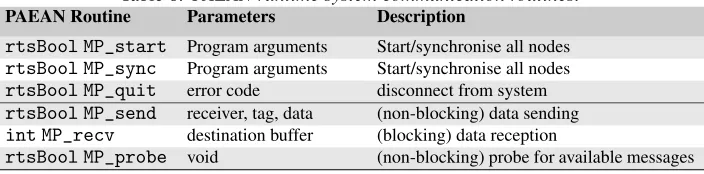
where one PAEAN instance acts as the main instance. As shown in Table 6, message passing is implemented byMP_send(non-blocking send) andMP_recv(blocking receive). These are complemented by the (non-blocking)MP_probe, which tests whether messages are available to receive.MP_startandMP_syncstart and synchronise PAEAN instances.
MP_quit performs a controlled shutdown of the system. Different middleware can be used to implement this communication sub-system. Existing implementations can use both PVM (Geist, 2011) and MPI (MPI Forum, 2012). The shared-nothing message-passing mechanism can also be implemented on top of physically-shared memory. The Eden im-plementation supports POSIX shared memory, Windows shared memory, and Windows Mailslots.
3.4.2 High-level messages
A high-level set of messages is built on this low-level implementation. Table 7 summarises all the PAEAN message types and their semantics. Many kinds of messages are sent internally by the runtime system itself:systemmessages are exchanged during startup and shutdown to synchronise and coordinate instances;data transfermessages (Section 3.2.2) request globalised data (FETCH); global address messages ACKnowledge a new GA or indicate failures (NACK); and work distribution messages (Section 3.5) search for work (FISH) and pass on new work (SCHEDULE).
3.4.3 Explicit communication via channels
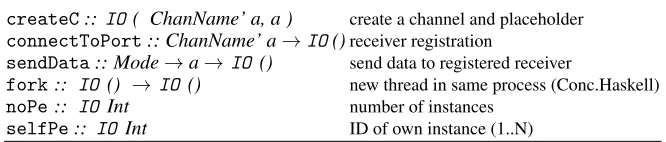
PAEAN also provides facilities to enable explicit communication and process control di-rectly from within Haskell, using a number of newprimitive operations(Table 8). These primitives may be preferred where a full shared heap is not required, and allow direct communication between two instances, forming a dual to theFetchMeclosures described above. EdI uses the primitives directly as a simple explicit language for parallel coordina-tion. Figure 13 shows a simple example of using the explicit communication primitives, which provide functionality forcreatingandusingtyped channels, as well asinstantiating
Heap
C C
C 1
2 Instantiate
createC 4
Data
3 connect
Instance 1
Heap
Instance 2
−−parent process
do−−create reply channel (1)
(ch,bkh)←createC −−spawn remote process (2) sendData(Instantiate2)
(thread2 ch)
−−next function call will −−block until response arrives print bkh
−−child process
−−thread2 ch=
doconnectToPort ch−−(3) let dat=fib42
[image:19.612.131.479.146.377.2]rnf dat‘pseq‘ −−(4) sendData Data dat −−terminated
Fig. 13. Communicating computations and values explicitly. A thread on Instance 1 creates a channel (1) and passes the createdChanName’to a new process on Instance 2 (2). A newly created thread
connects to the channel (3) and sends evaluatedData(4).
−−insert a closure into a local HEC’s spark pool: par#:: a→b→b
−−as above, but with locality control , specifying min and max distances : parDist#:: Int → Int →a→b→b
Fig. 14. Spark insertion primitives in GHC-SMP and PAEAN
3.5 Work distribution through Offloading and Work Stealing
run
spark activate
run spark activate
Spark Pool
Thread Pool
awake
block
Blocking Queue
Spark Pool
Thread Pool
awake
block
Blocking Queue SCHEDULE
HEC HEC
Instance 1 Instance 2
[image:20.612.182.444.144.306.2]FISH
Fig. 15. Work stealing using PAEAN’s spark-based mechanisms. An idle instance (Instance 2) sends a FISH message to Instance 1, aiming to steal some available work. If Instance 1 has any sparks, then the spark and any associated graph will be serialised and sent to Instance 2 in a SCHEDULE message.
a shared-nothing system by building on, and extending, the basic GHC-SMP spark/thread mechanisms (Figure 14). The serialisation mechanism described in Section 3.3 is used to offload asparkplus some or all of the data that is associated with it. The PAEAN work stealing mechanism supports stealing sparks, which are fairly cheap to transfer, rather than threads, which may carry significant local state.
3.5.1 Example of Work Stealing
Figure 15 illustrates this work-stealing load-balancing mechanism. WhenInstance 2 be-comes idle, it sends a work request message (or FISH) to another processor. In this case Instance 1is targeted. SinceInstance 1has some sparks in its spark pool, it responds by sending one of these sparks toInstance 2in a SCHEDULE message, serialising the graph that it refers to, as described in Section 3.3, and replacing the original sparked closure by a
FetchMe. The program graph will be de-serialised when it is received onInstance 2. The spark is added to its local spark pool, whence it can be turned into a thread using the usual thread scheduling mechanisms, or even passed on to another PAEAN instance ifInstance 2has gained sufficient work6. If a targeted instance has no sparks, it forwards the FISH message a fixed number of times. If no instance has any sparks, the FISH message is sent back to the originator. A back-off delay is introduced, and a new FISH message will be sent (Trinderet al., 1995).
Typically, execution of the thread that created the spark onInstance 1depends on the result of this spark that has been moved toInstance 2, and other threads might also depend on it. When execution requires the exported spark, the thread will be added to a local queue of blocked threads. TheFetchMewill then be followed, and a FETCH message will be sent
6 This helps avoid starvation. It would be possible, but highly unlikely, for a spark to be transferred
Load Balancing Mechanisms: Markers:
active with off-loading
passive without fishing
passive with fishing Low Watermark
High Watermark
[image:21.612.171.403.155.267.2]Spark Pool
Fig. 16. Low- and high-watermark mechanisms for spark distribution. (showing a single spark pool). By default work-stealing (passive) load distribution is used. If the size exceeds the higher-watermark, work is actively offloaded. The system aims to always fill the pool up to the low-watermark.
toInstance 2. If the spark has been evaluated byInstance 2, its (weak head) normal form will be serialised and returned toInstance 1in a DATA message. Otherwise,Instance 2 will record the attempt to fetch the closure in its blocking queue, so that its (weak head) normal form can be returned toInstance 1once it becomes available.
3.5.2 Work Distribution Mechanisms for Hierarchical Systems
We have made several enhancements to our work distribution mechanism in order to improve performance for large-scale systems, which typically involve clustersof multi-core processor nodes connected using high-latency networks. Such systems are usually hierarchical with widely varying inter-node latencies, i.e. they are genuinely non-uniform memory architectures. The largest system we have studied is Edinburgh Parallel Computer Centre’s HECToR, which has over 90,000 cores and a complex hardware interconnect. Section 4 shows scalability results from a smaller, but still realistic, hierarchical cluster.
Watermarks: One simple, but flexible, mechanism that gives better control of spark dis-tribution is to use low- and high-watermarks for each spark pool. Using this approach, work offloading decisions are based on the sizes of each spark pool, as shown in Figure 16. The
low-watermarkspecifies a minimum number of sparks that should be held in the local spark pool. If the number of sparks falls below this watermark, no sparks will be exported, and the instance will try to obtain additional sparks from other instances. Thehigh-watermark
to 28%. Further improvements are possible, by dynamically adapting the low-watermark over the runtime of the program. In more recent work (Aljabri, 2015) (Section 5.4), we have extended the scalability measurements to a combination of two remote clusters with 300 cores in total. Using oursumEulerexample, we have obtained speedups of up to 140 on this more heterogeneous, distributed architecture.
Locality control: Controlling locality is important for ensuring good performance on hierarchical shared-nothing systems, especially those with high latency connections (Loidl, 1998; Loidl, 2001). PAEAN provides several enhanced primitives to support locality con-trol. The most powerful of these primitives isparDist(Aswad, 2012) (Figure 14), which takes two additional integer arguments, specifying a lower and an upper limit on the distance of work distribution from the current instance. If these are both 0, then this forces local evaluation. Setting a minimum limit forces work to be distributed through the system. This is useful in low-load situations, such as system startup.
4 Evaluation of scalability and performance
We have carried out a series of experiments to assess the scalability and performance of our GpH, Eden and EdI implementations using the versions ofsumEulerfrom Section 2. Our experiments used a commodity cluster of 32 nodes, each with an 8-core x86 64 CPU7. The cluster therefore provides a total of 256 processor cores. Since the full machine was not available for our exclusive use, the measurements reported here are limited to a maximum of 64 cores on 16 nodes (i.e. using at most four cores per node). We delegate theplacement
of PAEAN instances to the communication middleware. Both MPI and PVM prefer using different nodes to using different cores on the same node. This balances the load at the cost of increased network communication. For our experiments, we have mainly used PVM, but, where indicated, some of the EdI results have also used MPI. The implementations used in our measurements are the Eden/EdI system version 7.8.3 (mid 2014), and a research version of GpH on clusters, GUM-SMP, based on GHC 6.12.3.
4.1 Measured Speedup
Figure 17 shows measured speedups for eachsumEulervariant, withn=90,000. We can clearly see that the sumEuler program gives near-linear speedup for all three implementa-tions, even when large numbers of cores are used. Overall, the EdI implementation shows the best speedups. The MPI implementation is slightly better than PVM. The Eden version comes close to EdI. However, since the GpH version requires more management (i.e. over-head), it delivers worse speedup. It does, however, scale robustly (we have confirmed this up to 180 cores). The difference between the EdI and the Eden versions can be explained by differences in communication behaviour: while the Eden version communicates the full list of arguments to each child process as a stream, the EdI version requires the child processes
7 The beowulf cluster at Heriot-Watt University Edinburgh. Each node is built from 2 quad-core
0 10 20 30 40 50 60
10 20 30 40 50 60
Speedup
Number of Cores
sumEuler, n=90000 (different versions) - Cluster of 16 x 4-core
[image:23.612.166.422.171.343.2]sumEulerEden, on PVM sumEulerEdi, on PVM sumEulerEdi, on MPI sumEulerGpH, on PVM linear speedup
Fig. 17. Speedup ofsumEulerVariants:n=90,000
to generate their arguments from parameters (size, offset, stride), and communicates only the results. This reduces communication costs. The GpH version suffers in this example due to the higher overheads associated with managing the virtual shared heap. Since the work is already well distributed through the structure of the problem, the automatic load balancing mechanism does not improve performance in this case. It would, however, deal better with situations where some nodes were executing external workloads, and were not dedicated to the Haskell program. Overall, thesumEulerexample clearly demonstrates the ease of parallelisation and simplicity that is claimed for parallel functional programming. It was straightforward to achieve the near-perfect speedup reported here, since the problem structure itself is intuitive and easy to parallelise. Note that the speedup we obtain is dependent on the problem size. For smaller problem sizes, where n<90,000, it would scale less well with increasing number of cores, since the constant overhead of instantiating the program and using the middleware would have an increasing effect.
4.2 Scalability
0 5 10 15 20 25 30 35 40
10 20 30 40 50 60
Speedup
Number of Cores
All-Pairs NBody, 20.000 bodies, 10 iterations - Cluster of 16 x 4-core
[image:24.612.184.437.157.343.2]NBody allToAll (Eden) on MPI NBody allToAll (Eden) on PVM linear speedup
Fig. 18. NBody (Eden): 20000 particles, 10 iterations
0 5 10 15 20
10 20 30 40 50 60
Speedup
Number of Cores
Parallelism Overhead (constant work) - Cluster of 16 x 4-core
4000 particles, 50 iterations 2828 particles, 100 iterations 2000 particles, 200 iterations
Fig. 19. NBody (Eden) on MPI: Overhead increasing with iteration count
et al., 2010) to implement the global data exchange. Figure 18 shows the speedups that we obtain with this implementation for a problem size of 20000 particles. For this problem size, the program scales reasonably well, achieving a maximum speedup of around 30 on 64 cores. Performance degrades when more than two cores per node are used. Once again, the MPI back-end performs similarly to, but slightly better than, its PVM counterpart.
The iterative structure of this algorithm means that each iteration is performed sequen-tially. Figure 19 shows theoverhead when the algorithm performs more iterations while the amount of computation is kept constant (N2·k computations forN particles and k
[image:24.612.184.437.392.571.2]0 5 10 15 20 25 30 35 40
5 10 15 20 25 30 35 40 45
Speedup
Number of Cores
sumEuler, n=90000 - 48-core AMD server
[image:25.612.166.424.164.342.2]sumEulerGpH, GUM on PVM sumEulerGpH, GHC-SMP (shared heap) sumEulerEden, on PVM sumEulerEden, on ShMem Linear
Fig. 20. Speedup ofsumEulerVariants on an 48-core machine:n=90000
4.3 Shared-nothing performance on shared-memory systems
As a baseline for our shared-memory results, we again use the sumEuler program on a 48-core machine8 to compare the performance of the GpH and Eden implementations. Figure 20 shows the results that we obtain. While the speedups are fairly modest for this simple parallel program, we observe a steady increase in speedup for all versions, up to 28 on 46 cores in the best case for Eden with an ShMem shared-memory back-end,. All implementation show a drop in speedup when using all 48 cores. This is consistent with previous experimental results on similar systems, where we have found that allocating all available processors to the parallel execution can interfere with system process execution. As with the cluster results, the GpH speedups are slightly worse than those for Eden, but notably better than those for the GHC-SMP shared-memory implementation. This matches with our previous study of the impact of NUMA architectures on parallel Haskell performance (Aljabriet al., 2014). We summarise our findings below. These findings are also consistent with parallel benchmarks, across languages, on this NUMA architecture. Due to the different memory latencies to different memory banks in NUMA architectures, even simple parallel programs struggle to efficiently exploit this kind of architectures.
For a more detailed evaluation of the performance of the PAEAN shared-nothing ap-proach on a physically shared-memory system, we have chosen to use theMatMult bench-mark program from the nofibsuite9. Matrix multiplication can be easily decomposed, with independent calculations, so should give good scalability, in principle, provided that the thread granularity is managed carefully. We compared the scalability of the original GHC-SMP implementation against that of an equivalent Eden version. The Eden version uses a variant of Cannon’s algorithm, communicating matrix blocks in a toroidal topology,
8 Four AMD Opteron-based processors, each with two NUMA regions, where each region has six
2.8GHz cores; total RAM is 512GB, with 64GB per region; there is a 2MB L2 cache, shared between every 2 cores in each region, and a globally shared 6MB L3 cache.
0 10 20 30 40 50
10 20 30 40 50 60
Speedup
Number of Cores
2000 x 2000 Matrix Multiplication - 64-core AMD Server Block-par. GHC-SMP
[image:26.612.183.438.155.344.2]EdI Toroid on MPI EdI Toroid on ShMem EdI Toroid on PVM linear speedup
Fig. 21. Matrix multiplication (2000×2000) comparing to GHC-SMP
using a recursive toroid skeleton (Berthold & Loogen, 2005). The GHC-SMP version uses a similar blockwise task distribution, but tasks communicate via the shared heap without using a specific communication topology. Hence, the GHC-SMP version can freely choose the block size to improve load balancing, but might encounter bus contention when doing so. Since we are evaluating scalability on shared-memory architectures, we have used a 64-core physically shared-memory system10. Our speedup results are shown in Figure 21. They clearly show that the Eden version can exploit the available cores, delivering a peak speedup of approximately 54 on 64 cores. The GHC-SMP shared-memory version delivers the best speedups on small numbers of cores, but flattens out at about 16−17×. The Eden versions scale better when using more than 25 cores; all PAEAN shared-nothing implementations have speedup that is equivalent to or better than GHC-SMP from that size onwards. This is probably an effect of shared-memory garbage collection. Note that the speedup for the Eden versions does not scale linearly with the number of cores. The toroidal algorithm delivers a “stepped” speedup profile, that is ideally matched to a square number of cores. The Eden program attempts to utilise all the cores by placing more than one process on some of them when approaching square numbers. This however, hardly yields any better speedup.
We note, in passing, two interesting phenomena: Firstly, the GHC-SMP version is faster than the equivalent sequential version without any spark creation when executed on only one core. However, it uses a considerably larger heap. Creating sparks reserves heap space early, and therefore accelerates execution. This effect is intensified when using column-wise instead of block-shaped sparks: column division exposes the worst access locality. On more cores, this effect quickly disappears, and the spark strategies only have a minor influence on the runtimes. Secondly, the Eden version has been measured with all three possible back-ends for data transfer: the shared-memory back-end, MPI, and PVM. As
10 Compute serverlovelace, University of St.Andrews: 4×16 core Opteron 6376 1.4GHz with 2MB
expected, PVM performs worse than MPI, and the shared-memory back-end yields the best performance. This exposes the overhead that is imposed by PAEAN communication sub-system middleware: the bespoke shared-memory back-end was tailor-made for its specific message-passing needs, without any additional features which would worsen performance. Finally, we have recently performed a systematic evaluation of shared-nothing ver-sus shared-memory parallel Haskell systems on a number of modern NUMA architec-tures (Aljabriet al., 2014). We have explored a range of configurations, including purely distributed memory, classic GUM; a mixture of shared-memory and distributed-memory, GUM-SMP (Aljabriet al., 2013; Aljabri, 2015); and purely shared-memory, GHC-SMP. Our measurements show that the shared-memory implementation consistently performs worst on these architectures, repeatedly hitting memory access and locking bottlenecks. A pure distributed-memory implementation improves runtimes by a factor of about 3 compared with the shared memory implementation. Further improvements can be achieved by configuring the system to use one shared heap for each NUMA region on the machine. These results support the findings reported above, underlining that even on the current generation of moderately parallel systems, a shared-nothing design delivers consistent and tangible performance benefits.
5 Related work
5.1 Built-in Parallelism Support in GHC: GHC-SMP
The standard GHC runtime system provides built-in support for parallelism (Marlowet al., 2009), but only on physically shared-memory systems. Drawing on experience with e.g. the GUM design for GpH (Trinderet al., 1995), GHC-SMP supports both the GpH and Par-Monad models of parallelism. It uses a physically-shared heap with a common address space. Synchronisation is achieved using a “black-holing” mechanism. Memory manage-ment uses a shared-memory implemanage-mentation of GHC’s standard generational garbage col-lector, with independent nursery areas, but shared old generations. Garbage collection is currentlystop-and-copy: all threads must be suspended during garbage collection. While there has been some work on independent garbage collection (Marlow & Peyton Jones, 2011), the complexity of supporting this efficiently and effectively on a physically shared-memory architecture, without adopting a shared-nothing implementation, means that this has not yet been integrated into the production version of GHC.
5.2 Implementations of GpH and Eden
message-passing communication library such as PVM or MPI. This gives significant flex-ibility. GUM has been extended using a variety of workload management systems (Loidl & Hammond, 1996; Loidl, 2001; Al Zainet al., 2008; Du Boiset al., 2002; Aljabriet al., 2012). Using these mechanisms, it has been deployed on a variety of systems ranging from small-scale multicores to hierarchical clusters of up to 90,000 cores (Maieret al., 2014a).
The DREAM runtime system (Breitingeret al., 1998; Klusiket al., 1999) was the first working implementation of Eden. It was originally implemented by adapting the GUM implementation to comply with the the DREAM abstract machine model (Breitingeret al., 1997). It has subsequently seen several complete rewrites and major revisions. Some parts of the implementation which were originally implemented directly in the runtime system have now been lifted to the Haskell level, relying on simpler and more modular runtime system support (Bertholdet al., 2003). This refinement ultimately led to factoring out the EdI language: all Eden language constructs are now implemented in Haskell, using the simpler primitive operations that implement EdI directly (Berthold & Loogen, 2007; Berthold, 2008).
5.3 Distributed Systems: Cloud Haskell and HdpH
A contrasting approach to that described here is taken by Cloud Haskell (Epsteinet al., 2011) and HdpH (Maieret al., 2014b). Rather than providing flexible and general runtime-system support, which can be used to build appropriate high-level parallel programming constructs for different language designs, Cloud Haskell and HdpH both use a fully explicit approach to parallelism on distributed memory platforms, relying on the programmer to build any necessary higher-level abstractions. Cloud Haskell provides a minimal abstrac-tion level, while HdpH also includes ideas of work stealing and virtual sharing that were previously developed for GpH. As with Eden or GpH, higher-level parallel abstractions can be built on these primitives, in the form of structured parallel approaches such as
algorithmic skeletons(Cole, 1989) orevaluation strategies(Trinderet al., 1998). In our opinion, this is likely to be the best way for functional applications programmers to use libraries such as Cloud Haskell or HdpH, since many problematic details can then be encapsulated into higher-level abstractions. This is also consistent with the functional programming philosophy of good abstraction and encapsulation.
5.4 Work distribution for Large-Scale Hierarchical PAEAN Systems
those in the standard GHC-SMP. This gives additional freedom in configuring PAEAN systems for large-scale clusters of multicore machines.
5.5 Scheduling Support in Haskell
Both the Par-monad (Marlowet al., 2011) and Meta-par (Foltzeret al., 2012) have adopted the idea of defining parallel scheduling policies in Haskell. However, these approaches do not consider more general runtime-system support and system architecture, as we have done in this paper. Moreover, unlike our approach, the Par-monad is restricted to shared memory parallelism. Two separate lightweight implementations of concurrent Haskell have also been produced that lift scheduling and other concurrency features to the Haskell level (Li et al., 2007; Sivaramakrishnanet al., 2013). This complements our work, that instead focuses on the introduction and control of parallelism. It would, however, be both straightforward and useful to incorporate similar concurrency features into PAEAN, and we intend to investigate this in future work. Similar support for scheduling operating system level threads and processes has been provided in the prototype House operating system (Hallgrenet al., 2005) , which was written entirely in Haskell.
5.6 TheARTCOPmicro-kernel
ARTCOP11is a highly modular micro-kernel design for parallel Haskell (Bertholdet al., 2008) that is closely related to PAEAN. Thekernel levelimplements simple and generic routines for asynchronous communication, basic execution management, and system in-formation.System Moduleswritten in Haskell restrict and combine these kernel routines to provide higher-level coordination constructs, narrowing the generic runtime support to a particular programming model. Coordination constructs can be used at both a Library
and anApplication leveleither to implement algorithms directly or to implement parallel algorithmic patterns and skeletons (Cole, 1989). System modularity is achieved similarly to PAEAN components: driven by a workload distribution logic, tasks are distributed to processors and controlled by aschedulingcomponent; scheduling relies on a communi-cationsubsystem; and amonitoringcomponent informs dynamic and adaptive scheduling decisions. In (Berthold, 2008; Bertholdet al., 2008), we presented a Haskell scheduling framework in the spirit of the ARTCOP design. Complex scheduling policies and heuristics can be defined in Haskell, based on a system of type classes for parallel jobs and scheduler states. The scheduling framework can express complex mechanisms such as the FISH mechanism discussed in Section 3 and Grid-GUM2.
5.7 Haskell-level serialisation for PAEAN
The PAEAN serialisation and de-serialisation routines allow data to be exchanged between different heaps in a running system. In doing so, however, they also provide type- and evaluation-agnostic data persistence for Haskell. This has several important uses (Berthold,
dataSerialized a=Serialized{packetData:: ByteArray#}
serialize :: a →IO( Serialized a) deserialize:: Serialized a→IOa
−− |Packing and unpacking exceptions : dataPackException
=P_BLACKHOLE|P_NOBUFFER|P_CANNOTPACK |... | P_GARBLED −−from RTS | P_ParseError|P_BinaryMismatch|P_TypeMismatch −−from Haskell
−−Serialized instances :
instance Typeable a⇒Binary(Serialized a) ...
instance Typeable a⇒Show(Serialized a) ...
instance Typeable a⇒Read(Serialized a) ...−−read◦show ==id
Fig. 22. Proposed Haskell types for serialised data
2011), including supporting persistence for memoised functions and checkpointing. Fig-ure 22 shows how Haskell-level serialisation can be realised, supported by PAEAN primi-tive operations. Serialisation isorthogonal to evaluation: any Haskell program graph can be serialised. It is alsoorthogonal to Haskell types: as shown, type-safety can be re-established by phantom types. WhenSerializeddata is externalised (written to files or sent over the network), phantom type information is lost and must be recovered dynamically, using
Typeable. This is achieved using the representations provided by theBinary,Showand
Readinstances. To make our work usable in other settings, e.g. networked systems, we have factored out this serialisation functionality, so that it can be installed as a Haskell library12 using cabal. This library is a good example of the targeted bespoke runtime-system support for parallelism that we advocate for PAEAN: well-tailored operations en-able a simple and straightforward API and avoid the pervasive complications of library-only solutions to Haskell data communication, as typified by e.g. Cloud Haskell or HdpH.
5.8 Kali Scheme
As with ARTCOP, Kali Scheme (Cejtinet al., 1995) aimed to provide user-level scheduling operations, including load balancing and thread migration. Like PAEAN, Kali Scheme is a shared-nothing implementation, but for Scheme rather than Haskell. Kali Scheme operates at a similar level to EdI, HdpH or Cloud Haskell, using explicit message-passing communi-cation. Unlike the PAEAN approach, but like Cloud Haskell and HdpH, it provides explicit primitives to create and manage independent heap spaces, including serialisation and de-serialisation for transmitting closures. Kali Scheme assignsunique identifiers(UIds) toall
heap objects, and uses a mechanism similar to ourFetchMeto fetch all data referenced by UId in a received message before taking any action on it. The PAEAN system, in contrast, assigns global addresses only to thunks that wereactually communicated before being evaluated, and lazily fetches other references only when the data is required. Kali Scheme