ISSN Online: 2333-9721 ISSN Print: 2333-9705
DOI: 10.4236/oalib.1105542 Jun. 25, 2019 1 Open Access Library Journal
Evaluate College Students’ Learning Situation
Based on Test Results
Yaming Ren
School of Mechanical and Control Engineering, Guilin University of Technology, Guilin, China
Abstract
The purpose of college education is to cultivate students’ self-learning ability to analyze and solve problems. In this paper, we use the method of mathe-matics to express the information of students’ examination results intuitively in the form of graphs. Using the visual characteristics of the graph, the stu-dents’ grasp of knowledge points is analyzed. The analysis results show that; students have a good grasp of basic concepts and definitions, and the flexible use of knowledge to solve practical problems is associated with a low scoring rate. Finally, we suggest strengthening the practical education part of the cur-riculum.
Subject Areas
Education
Keywords
Histogram, Probability Density Function, Practice
1. Introduction
In the 1990s, the American educational circles put forward the return to engi-neering; there is the classic concept of big engineering and the concept of CDIO (conceive, design, implement and operate) [1] [2]. The core of the concept of big engineering does not mean the scale or influence of the project, but should com-bine a series of non-technical factors such as economy, culture and morality with engineering practice. The CDIO concept emphasizes that engineers’ technical level, communication ability and overall view are always acquired in real engi-neering practice [3] [4], and the concept of CDIP has been widely used in the teaching process of various subjects [5] [6] [7] [8]. As a whole, different theories emphasize the importance of practice.
How to cite this paper: Ren, Y.M. (2019) Evaluate College Students’ Learning Situation Based on Test Results. Open Access Library Journal, 6: e5542.
https://doi.org/10.4236/oalib.1105542
Received: June 13, 2019 Accepted: June 22, 2019 Published: June 25, 2019
Copyright © 2019 by author(s) and Open Access Library Inc.
This work is licensed under the Creative Commons Attribution International License (CC BY 4.0).
DOI:10.4236/oalib.1105542 2 Open Access Library Journal Foundation of power system engineering is a basic major course of automa-tion, which is closely related to the production process and has a strong engi-neering application. In traditional theoretical teaching activities, university teachers first teach basic theories and concepts to students in the form of PPT, and apply the knowledge taught to solve problems. Finally, university teachers summarize the course and draw the key points. According to the author’s actual teaching process, it is found that the process of power system engineering foun-dation teaching is often troubled by the following problems: firstly, the teaching content of foundation of power system engineering includes a wide range of contents such as power system analysis, electric elements of power plants and power system relay protection. Secondly, the foundation of power system engi-neering is practical. Specifically, the contents involved in foundation of power system engineering come from the actual engineering objects, and the content of the course must be consistent with the actual engineering.
It is a fact that different teaching methods and teaching emphasis will affect students’ achievement. Some scholars design unique teaching processes based on goals in order to achieve their own teaching objectives. Cordero, Jose M and Gil-Izquierdo, María take advantage of TALIS-PISA-link to study the impact of different teaching methods on achievement [9]. At the same time, we can con-sider from the opposite process; if we analyze students’ performance and find out the shortcomings, then we can design the teaching process for the students’ shortcomings. John Jerrim, Mary Oliver and Sam Sims point out that students can obtain corresponding scientific knowledge from their own experiments and practices, which are often difficult to be taught by teachers in the class [10]. Therefore, in this paper, we propose to increase students’ practice part, so that students can get practical engineering experience that cannot be obtained in the classroom. In this paper, through the analysis of students’ final examination re-sults, we can judge students’ mastery of the knowledge structure of this course, so as to facilitate teachers to make corresponding improvements in teaching ac-tivities in the future.
2. The Test Design of the Foundation of Power System
Engineering
DOI: 10.4236/oalib.1105542 3 Open Access Library Journal
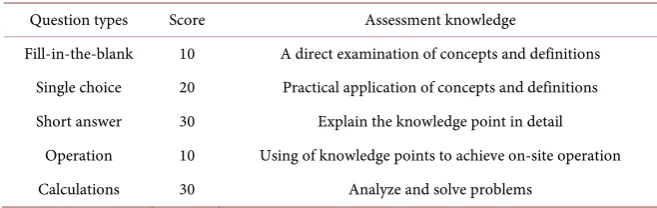
Table 1. The test design of the foundation of power system engineering.
Question types Score Assessment knowledge
Fill-in-the-blank 10 A direct examination of concepts and definitions
Single choice 20 Practical application of concepts and definitions
Short answer 30 Explain the knowledge point in detail
Operation 10 Using of knowledge points to achieve on-site operation
Calculations 30 Analyze and solve problems
According to the description in Table 1, it can be seen that the fill-in-the-blank, single choice and short answer questions only require students to master the ba-sic knowledge of power system, and the corresponding difficulty is relatively low. The total score was set to 60. In particular, for the fill-in-the-blank, there are ten questions, one blank for each question, and the total score is ten. For the Single choice, there are ten questions, one choice for each question, and the total score is twenty. For the Short answer, there are 5 questions, and the total score is thirty.
For the question types of operation and calculations, the purpose of assess-ment lies in the flexible use of knowledge points, requiring students to have the ability to analyze and solve problems. These types of question are worth 40 points. Take electric switching operation as an example. The basic principle is simple: when you disconnect the circuit, first disconnect the circuit breaker, and then disconnect the disconnecting switches on both sides of the circuit breaker. When closing the circuit, first close the disconnecting switches on both sides of the circuit breaker, and then close the circuit breaker. In the actual operation, there are many circuit breakers and disconnecting switches, how to carry out the operation according to the standard is what we want to exam.
The test design of the foundation of power system engineering, on the one hand, can ensure that students can make more questions and pass the examina-tion. On the other hand, students who want to get high marks must review carefully after class and understand essentially what is taught in the course. Teachers can judge students’ mastery of the course by analyzing students’ scores in operation and calculations.
3. Results and Discussion
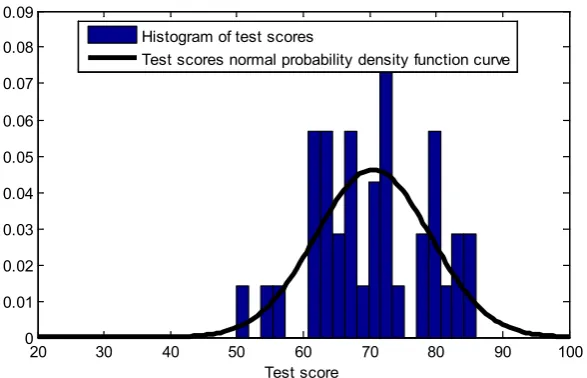
In this paper, we selected the test scores, in the course of foundation of power system engineering, of 39 students from class 16-1, automation major, school of mechanical and control engineering, Guilin University of Technology, as the sample.
DOI:10.4236/oalib.1105542 4 Open Access Library Journal
Figure 1. Test results histogram and the corresponding normal distribution probability
density function.
distribution. Further analysis shows that students’ scores are mainly in the range of 65 - 85, that means most students pass the exam.
However, in this paper, we want to find out the weak links of students, we need to further analysis of students’ performance. For this purpose, we divide the paper into two parts. In the first part, there are fill-in questions, choice ques-tions and short answer quesques-tions, the key points are students’ memory and ap-plication of basic concepts. The second part includes operational and computa-tional questions, the focuses on the flexible use of knowledge or the ability to analyze and solve questions.
By observing the changes of the curve in Figure 2, it can be obviously found that the histogram basically coincides with the normal probability density curve. The first part of the exam results are mainly between 45 and 60, considering that the total score for the first part is 60, it is clear that the scoring rate of the first part of students mainly focuses on 75% - 90%. For this reason, students scored well in the first part, indicating that students had a good grasp of the basic con-cepts and definitions of power system.
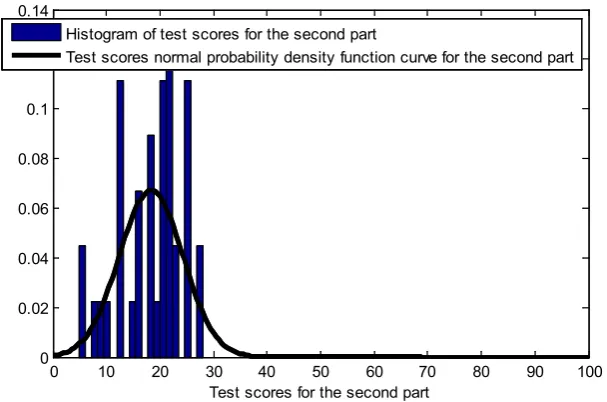
Specifically speaking, for the 39 students, the number of students who scored between 10 and 29 was 35, considering that the total score for the second part is 40, it is clear that the scoring rate of the second part of students mainly focuses on 25% - 70%. Compared with the scoring rate of the first part of the test paper, the scoring rate of the second part of the test paper is low. That is to say, most students in the second part of the exam, the score did not reach the pass line. In fact, the result is not surprising. Because the second part of the examination pa-per is a student’s ability to use knowledge flexibly and the ability to analyze problems. In China, college education tends to focus on the theoretical teaching in the classroom, which is insufficient to cultivate students’ practical engineering ability.
The information shown in Figure 3 is the histogram of students’ scores in the
20 30 40 50 60 70 80 90 100
0 0.01 0.02 0.03 0.04 0.05 0.06 0.07 0.08 0.09
Test score Histogram of test scores
DOI: 10.4236/oalib.1105542 5 Open Access Library Journal
Figure 2. Test results histogram and the corresponding normal distribution probability
density function for the first part (fill-in questions, choice questions and short answer questions).
Figure 3. Test results histogram and the corresponding normal distribution probability
density function for the second part (operational and computational questions).
second part of the paper (operational and computational questions) and the corresponding normal probability density function.
We have made this clear in the first section of this paper: different theories emphasize the importance of practice. For engineering majors, after graduation, students have to face specific project. No one can become a good engineer by rote, the right way to be a good engineer is to have the ability to analyze and solve problems through the flexible use of the theoretical knowledge learned and this is what we want students to learn in college.
According to the examination result, the engineering practice part should be
20 30 40 50 60 70 80 90 100
0 0.02 0.04 0.06 0.08 0.1 0.12
Test scores for the first part Histogram of test scores for the first part
Test scores normal probability density function curve for the first part
0 10 20 30 40 50 60 70 80 90 100
0 0.02 0.04 0.06 0.08 0.1 0.12 0.14
Test scores for the second part Histogram of test scores for the second part
[image:5.595.222.526.342.543.2]DOI:10.4236/oalib.1105542 6 Open Access Library Journal strengthened in the teaching activity of power system engineering foundation and specific measures are shown below.
1) Add practice section to ensure that each student has 6 class hours of prac-tical operation. The author hopes to strengthen students’ cognition and under-standing of practical engineering by adding practical class hours. The specific contents are: switching operation and power system short circuit test. This is just the author’s idea, and the specific effect needs to be verified by specific actual data. The author will collect and analyze the data in the next stage.
2) Make strict assessment standards, requiring students to demonstrate on the spot.
3) Submit a complete practice report, including the analysis and solution sec-tions of the problem.
4. Conclusion
The purpose of college education is to cultivate students’ self-learning ability to analyze and solve problems, not just rote learning. For engineering students, it is essential to combine theory with practice if they want to be an excellent engi-neer. In this paper, we analyze students’ mastery of knowledge from their ex-amination results; it is found that students are weak in the practical application of theoretical knowledge. Finally, aiming at this problem, we give the methods to enhance students’ practical ability in the future teaching activities. In this paper, we only analyze the results of students. In practice, student achievement is often related to many factors, such as academic attendance and time spent after class. The author will consider more factors in the next work.
Acknowledgements
The publication was prepared with the financial support of Teaching Reform Project of Guilin University of Technology: Application and practice of CDIO teaching method in the course of foundation of power system engineering (2019B16).
Conflicts of Interest
The author declares no conflicts of interest regarding the publication of this pa-per.
References
[1] Zhong, S.Y., Chen, Y.Z., Li, R.Y., et al. (2014) Application of CDIO Idea in Engi-neering Training. Advanced Materials Research, 3140, 1479-1482.
https://doi.org/10.4028/www.scientific.net/AMR.915-916.1479
[2] Gunnarsson, S. (2017) Automatic Control Education in a CDIO Perspective. IFAC-PapersOnLine, 50, 325-330. https://doi.org/10.1016/j.procir.2018.03.277 [3] Song, D. (2018) Comparison of CDIO and Chinese Engineering Education
DOI: 10.4236/oalib.1105542 7 Open Access Library Journal [4] Chuchalin, A., Malmqvist, J. and Tayurskaya, M. (2016) Professional Development of Russian HEIs’ Management and Faculty in CDIO Standards Application. Euro-pean Journal of Engineering Education, 41, 426-437.
https://doi.org/10.1080/03043797.2015.1085837
[5] Yan, H. and Hu, H.Y. (2014) Study on CDIO Talents Training System Based on the Internet of Things and Cloud Computing in Big Data Era. Advanced Materials Re-search, 989-994, 4949-4952.
https://doi.org/10.4028/www.scientific.net/AMR.989-994.4949
[6] Wang, Y., Zheng, S., Zhang, M., et al. (2014) Mode Reform of Sensor Courses Teaching in Civil Engineering Based on CDIO Education Concept. Sensors & Transducers, 173, 297-304.
[7] Hu, L., Li, Y., et al. (2013) The Progress of CDIO Engineering Education Reform in Several China Universities: A Review. Procedia—Social and Behavioral Sciences, 93, 381-385.https://doi.org/10.1016/j.sbspro.2013.09.207
[8] Lu, J., Yu, S., Jin, Z. and Wang, X. (2012) The Application of CDIO Standard and Computer Assist Instruction in the Design Course of Plain Fabric. International Journal of Education and Management Engineering, 2, 39-44.
https://doi.org/10.5815/ijeme.2012.04.07
[9] Cordero, J.M. and Gil-Izquierdo, M. (2018) The Effect of Teaching Strategies on Student Achievement: An Analysis Using TALIS-PISA-Link. Journal of Policy Modeling, 40, 1313-1331.https://doi.org/10.1016/j.jpolmod.2018.04.003
[10] Jerrim, J., Oliver, M. and Sims, S. (2019) The Relationship between Inquiry-Based Teaching and Students’ Achievement. New Evidence from a Longitudinal PISA Study in England. Learning and Instruction, 61, 35-44.