doi:10.4236/am.2011.26094 Published Online June 2011 (http://www.SciRP.org/journal/am)
Stepsize Selection in Explicit Runge-Kutta Methods for
Moderately Stiff Problems
Justin Steven Calder Prentice
Department of Applied Mathematics, University of Johannesburg, Johannesburg, South Africa
E-mail: [email protected]
Received March 27, 2011; revised April 9, 2011; accepted April 12, 2011
Abstract
We present an algorithm for determining the stepsize in an explicit Runge-Kutta method that is suitable when solving moderately stiff differential equations. The algorithm has a geometric character, and is based on a pair of semicircles that enclose the boundary of the stability region in the left half of the complex plane. The algorithm includes an error control device. We describe a vectorized form of the algorithm, and present a corresponding MATLAB code. Numerical examples for Runge-Kutta methods of third and fourth order demonstrate the properties and capabilities of the algorithm.
Keywords:Moderately Stiff Problems, Runge-Kutta, Stepsize, Jacobian, Stability Region
1. Introduction
Stiff initial-value problems (IVPs) are often solved nu-merically using implicit A-stable Runge-Kutta (RK) me-thods. In such methods, there is no need to adjust the stepsize for the sake of stability, since the stability region of the method is the entire left half of the complex plane. These methods are particularly useful when the problem is very stiff. However, implementing an implicit RK method requires the solution of a nonlinear system of stage equations at each step, whereas an explicit RK me-thod does not. It is, therefore, often feasible to use an explicit RK method to solve moderately stiff problems, wherein the stiffness constant λ is not too large. Often, the explicit RK pairs RK (3,4) [1] and RK (4,5) [2,3] are used to solve IVPs, so we will focus our attention on these methods.
The stability region of explicit RK methods is a bounded region S in the complex plane, and the stepsize h must be chosen such that, if the vector hλ is in the left half of the complex plane, then it lies within S. Moreover, λ can be complex, so that hλ does not necessarily lie along the real axis (even though h is always real). In this paper, we present a simple algorithm for determining h such that hλ lies within S, for any relevant λ and S per-taining to an explicit RK3 or RK4 method.
2. Relevant Concepts, Terminology and
Notation
An m-dimensional IVP of the form
0 0,
y f x y y x y
(1)
where
1 1
2 2
, ,
, ,
,
m m
y f x y
y f x y
y f x y
y f x y
(2)
can be solved using an explicit RK method
1 ,
i i i i
w w hF x w
, (3)where wi denotes the approximate numerical solution at xi (i.e. wi y x
i ), F is a function that defines the method, and h x i1xi. From here on, the notation RKr indicates an explicit Runge-Kutta method of order r. The stability function R z
of the RK method is ob-tained by applying the RK method to the Dahlquist equa-tion
0 0y y
y x y
to get, with w0y0,
1 0 0 ,
w w hF w (5) which can be written
1
w R z w0 (6) with z h . As a simple example, consider the sec-ond-order method of Heun [4], which has
,
,
,
.2
i i i i i i
i i
f x w f x h w hf x w
F x w , (7)
Applying this method to the Dahlquist equation
f x y, y
, we find
2 2
0 0 0
1 1 0
2 2 2
1 1 0 0
,
2 2
, ,
2 2
w w h w h
F x w w
h z
hF x w h w z w
(8)
so that
2 2
1 0 0 1 0,
2 2
z
w w z w z w
z (9)
from which we identify
1 22 z
R z z . (10) Generally speaking, the stability function for explicit RK methods is a power series in z that represents an ap-proximation to the exponential solution of the Dahlquist equation. Indeed, we see that in (10) is a low-order Taylor series for the exponential function
R z
z
e . For RK3 and RK4 we have [5]
2 3
2 3 4
1
2 6
1
2 6 24
z z z
R z
z z z z
RK3 RK4
(11)
and these are the stability functions that will interest us in the remainder of this paper.
The region of stability of the RK method is defined as [6]
:S z R z 1
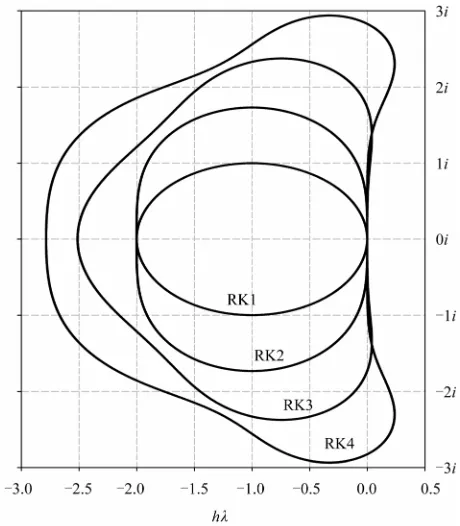
(12) and we denote the boundary of this region by ∂S. For an explicit RK method, ∂S is a closed contour in the com-plex plane (see Figure 1). [image:2.595.308.538.77.340.2]We must consider complex values for z, because it is possible that the stiffness constant λ could be complex; this is particularly true for systems of ODEs, as in (1), where the stiffness constants are determined from the eigenvalues of the Jacobian
Figure 1. Stability regions for the indicated explicit RK methods.
1 1
1
1
,
m
m m
m
f f
y y
J x y
f f
y y
(13)
There are m eigenvalues, and those with negative real part are taken as the stiffness constants of the system.
Now, assume 0 in (4). The exact solution is therefore expected to be an exponentially decreasing function of x. However, if h is such that R z
1, then the numerical solution (9) will increase with x, which is quite the opposite behaviour to what is expected. Fur-thermore, the numerical solution will increase without bound under iteration, whereas the exact solution tends to zero. This is referred to as an unstable solution, or instability with regard to stiff ODEs. It is therefore vital to choose h at each step of the RK method so that
1R z , i.e. z h lies within S. An algorithm for determining an appropriate stepsize h is the subject of the next and subsequent sections.
3. Theoretical Description of the Algorithm
We first consider the algorithm for a single stiffness con-stant (eigenvalue of J
1 i
). Consider two semicircles 1 and , of radius and , respectively, centered at
C half 2
C orig
r r2
circles are s
of the complex plane, C1 is contained entirely within S, and S is contained entirely within C2, as shown in Fig-ure 2. In this figure, S is the stabili egion of RK3 (for the sake of example), although the algorithm we describe here holds for the stability region of RK4, as well.
Say λ is an eigenvalue of
ty r
J
, and λ lies in the left half of the complex plane (i.e. λ a stiffness constant). De-fine the unit vector
is
ˆ ,
(14)
where
is the magnitude of λ. Then 1ˆ and 2ˆ
r r (15) are vectors of length and r1 r2, respectively, in the direction of λ, and
2 1
r2r12ˆ
r
ˆ
r
(16)
is the length of the segment of D r
that cuts ∂S (see
[image:3.595.314.535.78.369.2] [image:3.595.305.536.411.691.2]user-defined tolera ompute Figure 3).
Let ε be a nce, and c
* D N
D N
(17)
This gives
* e toler
. This is not ing more than a re-fin
rmine, for j = 0, ···, N, h
ement of th ance ε, consistent with an integer value of N.
Now dete
*
ˆ ˆ
zjr1 j (18) and compute
jR z (19) for each j.
largest
Find the zj (in magnitude) such that
zj 1—call th zc—and then determineR is
.
c
z h
(20)
Now, say is such that
*
h
*R h 1. (21) This gives
* *
* , *
h h
h h
(22)
so that the difference between th psize estimated in (20) and the exact value (in the sense of (21)) is de-
e ste *
h
Figure 2. Semicircles of radii r1 and r2, for the stability
re-gion of RK3.
[image:3.595.63.535.422.698.2]pendent on * , and . Hence, the smaller we choose ε, the closer the endpoint of hλ is to ∂S, particu-larly for large .
Note the following: (22) gives
* *
h h
1
h h h r
(23)
and if we demand that the relative difference *
h h h
must be less than some value δ, then choosing
1
r
1
r (24)
ensures that this will be case. In other words, (24) pro-vides a form of error control, since r1 and δ are known a priori.
The algorithm is depicted in Figure 3. In this figure, the curves labelled r1 and r2 are the semicircles, and
∂S indicates the boundary of the stability region. The arrow touching the r1 semicircle indicates r1ˆ, and the arrow touching the r2 semicircle indicates r2ˆ. The arrows between these two represent zj for
1, , 1
j N . The separation of two adjacent ws is
* arro
, as indicated. The arrow within S and closest to ∂S is It is clear that ∂S cuts r2ˆ
c
z , as shown. . The segment ween arrowheads that ∂S cuts is the segment of length D, referred to earlier.
For a system of ODEs, in which there is more than one stiffness constant, we
bet
would apply the above algorithm for each such constant. This would yield a stepsize for each stiffness constant, and we would choose the mini-mum of these stepsizes as h in (3).
4. Implementation of the Algorithm
algorithm, H
c
ere we present a vectorized version of the
atering for a system of ODEs which has more than one stiffness constant.
The parameters r r1, 2 and ε are input from which N and * are easily mined. Assume that the set of eigenvalues of
deter
i, i
J x w
yields M distinct stiffness con- stants (note that M m). Let denote a row vector containing these M stiffness constants, as in
1 2 M
,
λ (25)
and let ˆ denote the corresponding n
vector of unit vec-tors, as i
1 2 1 2 1 2 ˆ . M M M λ1 1 1
2 2 2
A
N N N
(27)
1 2 1 2 1 2 ˆ ˆ times
(28)
ˆ M M M L N
and hence, determine
*
1
1NM
Z r A L
where
(29)
1NM ent-by
is the N × M unit matrix, and ⊠ denotes the elem -element product of two matrices, sometimes product (the matrices must have f course). The structure of known as the Hadamard
the same dimensions, o Z is
*
*
1 ˆ1 1 ˆ2 1 M
r r
r *
ˆ
* * *
1 1 1 2 1
* * *
1 1 1 2 1
ˆ ˆ ˆ
2 2 2
.
ˆ ˆ
M
M
r r r
Z
r N r N r N
(26)
Define the N × M matrices
ˆ (30) We then evaluate
1 RK3
2 6
1
2 6
RK4 24
Z Z Z Z Z Z
Z Z Z Z Z R Z Z
Z Z
Z Z
where (31)
R Z is an N × M matrix, of which the jkth
en-try is
*
1 ˆ .k
jk
R Z R r j
(32)
We compute R Z
, the matrix containing the mag- f eacnitude o h element of R Z
, and we find the largestentry less than unity in each column of R Z
. The cor- responding elements in Z are the for each stiffness constant. There are M such values of c zc, one for eachz
stiffness constant k (denote hem zc k, ), and we de-termine t , c k z k k h
(34)
We provide a MATLAB code
nction for determining h for RK3.
5.
Some comments are in order:
1) It may occur that one of the for each k1, , M .
Finally, the stepsize h used in the RK iteration (3) is simply
1,..., min k k M h h in the Appendix, in the form of a fu
Comments
j
z lies on ∂S, in which case R z
j 1. If this is the case, we would stillhave that zj1 is within * of ∂S and, if we consider *
to be acceptably small, then zj1 can
ca be
n be taken as go refined to search when
c
z . Nevertheless, the al r those occasions
rithm
fo R z
j 1. It is our opinionssar n 4 in mind
any
ad d
of
y. that this refinement is not nece
2) Although the algorithm has bee developed with RK3 and RK , it should be clear that it can be applied to RK method for which semicircles with r ii r1 and r2 can be constructe (i.e. in the left half the complex plane, one of the semicircles contains S entirely, and the other is contained entirely within S). For methods of order greater than four, however, the stability function R(z) is method-specific so that the appropriate semicircles would also be method-specific. In our nu-merical examples in the next section, we will give semi-circles that are universally applicable to all RK3 and RK4 methods.
3) We have not considered applying the algorithm to RK1 and RK2 because it does not seem possible to de-fine a semicircle interior to S for these methods (see Fig-ure 1). Moreover, the low order of these methods proba-bly mitigates against their use in solving moderately stiff IVPs, anyway.
4) The vectorized algorithm described above is not the only way to determine h. We could use the algorithm with M 1 in a for-loop, providing a different λ for each pass through the loop, which would give a stepsize for each pass, and then taking the minimum of these stepsizes. The vectorized algorithm seems, to us, to be more elegant and may also be faster, generally speaking, al
onstan
though this might depend on computational platform. 5) In principle, the algorithm can be applied for stiff-ness c ts of any magnitude, although RK3 and RK4 would most likely be used only for moderately stiff problems, wherein |λ|≲1000.
6. Numerical Examples
In our first example, we consider the stiffness constants
1 2 3 1000 20 435 480 15 910 i i i (35)
which have magnitudes (rounded to nearest integer) of ly. The first of these lies ose to the real axis, the second is close to the diagonal,
Applying the algorithm to the RK3 stability region, with
(36) 1000, 647 and 910, respective
cl
and the third is close to the imaginary axis.
1 2 1.73 2.52 r r
and 103, gives 1 2 0.0025 0.0037 h h 3 0.0020 h (37)
Also, we find
1 1 2 2 3 3 0.9995 0.9993 0.9997 R h h R h R (38)
and * 1 1 * 2 2 * 3 3 0.040% 0.042% 0.055% h h h (39)
is the upper bound on * k k k h h h * k k h
where , as per
(22). Here, we have 3 1 10 0.058% 1.73 r
(40)
which is greater than the upper bounds in (39), as expected from (23). If we had desired a bound of 0.01%
73 10
, say, hav
we would e needed to use 4 1 1.
r
. e stability region of RK4, Applying the algorithm to th
with 1 2 2.5 3.0. r r
(41)
and
torized algorit d f i s for algor e see that the vectorized algorithm is slightly quicker than the for-loop v , in a orithm lso fast r RK4 for R t this e to t
er value of
hm, an ndicate -loop ithm. W
ersion ll cases. The alg is a er fo than K3, bu is du he
small-2 1 Also, we find
1 1
2 2
3 3
0.9990
0.9987
R h R h R h
0.9989 (43)
D r r, e u
which leads to a aller value of
N ( v
sm
we ha sed 103 in all ca f co the
n algor
icircles that “sandwich” relevant stability region in the left plane, is simple but robust and
effec-ses). O urse, values of r1 and r2, and hence D, are dependent on the geometry of the stability region.
7. Conclusions
We have designed a ithm for determining stepsizes appropriate for stable solutions of stiff IVPs, when such solutions are computed using explicit RK methods. The
gorithm, based on a pair of sem *
1 1 *
2 2 *
3 3
0.036% 0.037% 0.035%
h
h
h
(44)
upper bounds are consistent with
al
the boundary of the alf of the complex These
h 3
1
10
0.040% 2.5
r
.
Clearly, the relative “error” in the stepsizes is very small. Of course, since it is proportional to
tive, and possesses the facility to control the accuracy with which the stepsize is determined. The algorithm caters for complex stiffness constants, which can arise in IVP systems, and can be implemented in vectorized or for-loop form, with the former appearing to be slightly faster in terms of execution time. Features of the algo-rithm have been ably demonstrated with respect to the RK3 and RK4 methods. Indeed, we expect that the algo-rithm will be most useful when using RK3 and RK4 to solve moderately stiff problems, although it can easily be used with explicit RK methods of higher order.
8. References
[1] J. C. Butcher, “Numerical Methods for Ordinary Differ-ential Equations,” Wiley, Chichester, 2003.
doi:10.1002/0470868279
2] E. Fehlberg, “Low-Order Classical Runge-Kut
*
, it could maller, which can be made even smaller by choosing ε s
be done in a controlled way, using (24). rtheless, the calculations done here show that the ste deter-mined by the algorithm are very close to al, even for a fairly large tolerance
universally applicable to RK3 and RK4.
In our second example, we measure speed of compu-ta
d
seco
Neve psizes optim of . Note that the radii and r2 used in these calculations are
3
10
1
r
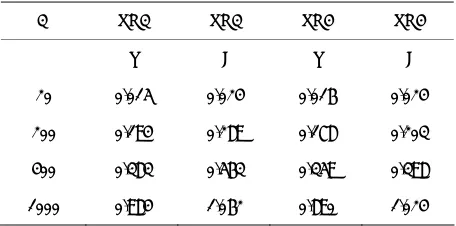
tion for different values of M, for both the vectorized algorithm and the for-loop algorithm mentione in #3 of our earlier comments. Our computational platform is MATLAB 6.5, Windows XP Pro, HP 30AA Mboard, Intel Celeron M 1.73 GHz, 1 MB L2 Cache, 2 GB RAM. Results are shown in Table 1.
[image:6.595.58.286.549.662.2]In this table, all times are in nds, v indicates vec-
Table 1. Algorithm computation times (in seconds) for the ind
[ ta
Formu-ize Control and Their Application to Some Problems,” Computing, Vol. 6, 1970, pp. 61-71.doi:10.1007/BF02241732
las with Step S Heat Transfer
icated cases.
M RK3 RK3 RK4 RK4
v f v f
20 0.015 0.024 0.016 0.024
200 0.194 0.289 0.178 0.203
400 0.383 0.563 0.359 0.398
1000 0.984 1.062 0.890 1.024
puting, Vol. [3] L. F. Shampine and M. W. Reichelt, “The MATLAB
ODE Suite,” SIAM Journal on Scientific Com
18, No. 1, 1970, pp. 1-22.
doi:10.1137/S1064827594276424
[4] D. Kincaid and W. Cheney, “Numerical Analysis: Mathe-matics of Scientific Computing,” 3rd Edition, Brooks/ Cole, Pacific Grove, 2002.
[5] E. Hairer and G. Wanner, “Solving Ordinary Differential Equations II: Stiff and Differential-Algebraic Problems,” Springer, Berlin, 2000.
The following is a MATLAB function file implementing
r RK4 by changing the stability function in the tenth line. Text in small font to the right is commentary.
function [f1] = STIFFSTEPSIZERK3(r1,r2,tol,lambda);
Appendix
the algorithm for RK3. It is easily modified folambda must be a row vector
M = length(lambda); number of stiffness constants
D = r2-r1;
N = ceil(D/tol);
newtol = D/N; this is *
unitlambda = lambda./abs(lambda); this is ˆ
A = repmat([1:N]',1,M); this is A
L = repmat(unitlambda,N,1); this is L
Z = (A*newtol+r1).*L; .* is the MATLAB notation for ⊠
R = 1 + Z + Z.^2/2 + Z.^3/6; this is R Z
for RK3I = find(abs(R)<1); this finds R Z
1B = zeros(N,M);
B(I) = Z(I); this places the corresponding entries of Z into a
matrix B whose other entries are all zero
h = max(abs(B))./abs(lambda);
max(abs(B)) finds the entry in each column of B of
largest magnitude; these are the
[f1] = min(h); output
,