ISSN Online: 2327-5227 ISSN Print: 2327-5219
DOI: 10.4236/jcc.2019.78002 Aug. 26, 2019 8 Journal of Computer and Communications
Performance Analysis of Multi-Hop Wireless
Link under Maximum Flow Algorithm
Sarwar Jahan
1, Md. Imdadul Islam
2, M. Ruhul Amin
31Department of Electronics and Communications Engineering, East West University, Dhaka, Bangladesh 2Department of Computer Science and Engineering, Jahangirnagar University, Savar, Bangladesh 3Deparment of Mathematical and Physical Sciences, East West University, Dhaka, Bangladesh
Abstract
To enhance link capacity of a wireless link one or more repeater is used be-tween the sender and the receiver. Recent literature deals with multiple paral-lel links to enhance throughput instead of conventional single path. In case of a multidirectional and multi-hop wireless network, the selection of link of maximum signal to noise ratio (SNR) does not guarantee the maximum throughput. In this paper, we use augmenting path of Ford-Fulkerson algo-rithm in detection of maximum flow from sender to receiver. To reduce the process time at the sending node, minimum-cut theorem is used to determine maximum flow like power flow of previous work. Using the maximum flow algorithm, we obtain the capacity of multi-hop wireless link higher than the conventional theorem. The concept of the paper is applicable in MANET (Mobile Ad-hoc Network), WSN (Wireless Sensor Network) and CRN (Cog-nitive Radio Network).
Keywords
Ford Fulkerson Algorithm, Flow-Conservation, Minimum Cut Theorem, SNR, Channel Capacity
1. Introduction
There are many applications of maximum flow algorithm which are found in our real-life situations. For example, in [1], the modified Edmonds-Karp algorithm is applied in water supply system of a campus. In [2], instead of Ford-Fulkerson al-gorithm, a parallel Genetic algorithm is applied in a weighted directed graph to find a maximum flow. In [3], the authors deal with maximum end-to-end spec-tral efficiency in multi-hop wireless link. Instead of a single path from source to
How to cite this paper: Jahan, S., Islam, Md.I. and Amin, M.R. (2019) Performance Analysis of Multi-Hop Wireless Link under Maximum Flow Algorithm. Journal of Computer and Communications, 7, 8-16. https://doi.org/10.4236/jcc.2019.78002
Received: July 30, 2019 Accepted: August 23, 2019 Published: August 26, 2019
Copyright © 2019 by author(s) and Scientific Research Publishing Inc. This work is licensed under the Creative Commons Attribution International License (CC BY 4.0).
DOI: 10.4236/jcc.2019.78002 9 Journal of Computer and Communications
destination, they have searched for multiple simultaneous source-destination routes using the optimal routing algorithm. Trade-off is made between complex-ity of network layer in determining route and MAC sub-layer in scheduling time slot. The normalized throughput (bps/Hz) or spectral efficiency is varied against the number of nodes for both fixed and variable time slot algorithms. In case of minimum spectral efficiency, the fixed time slot algorithm provides better results but in case of average spectral efficiency, the variable time slot gives better throughput. The throughput is also varied against SNR (signal to noise ratio) and the number of “source to destination” pairs. In [4], the gain of transmitting antenna array of single-hop link is evaluated to achieve equivalent throughput of dual-hop wireless link. The authors determine BER (Bit Error Rate) and proba-bility of symbol error against SNR of links in the Rayleigh and Nakagami-m
fading cases under 16-QAM and QPSK modulation techniques.
Closed-form solution of two-hop cooperative cognitive underlay relay net-work is found in [5] to estimate secrecy outage. Secrecy outage probability is plotted against secrecy data rate using MRC (maximal ratio combining), with power control as well as without power control under analytical and simulation techniques. Similar analysis is found in [6] for α-μ fading channel where SER (Symbol Error Rate) and outage probability is plotted against SNR in dB. Much the same results are also found in [7] under both analytical and simulation tech-niques in multi-hop amplify-and-forward (AF) relay systems with cooperative di-versity; where authors convert multi-hop relay system to its approximate equiva-lent dual-hop system. Application of maximum flow algorithm (Ford-Fulkerson Algorithm) along with Shortest Path (Dijkstra’s Algorithm) is found in conges-tion control of vehicle traffic [8]. Traffic volumes of roads are collected by manual traffic count and video recordings for the road network from Bandaraya Mosque to Kampung Air in Kota Kinabalu, Malaysia. Application of Ford-Fulkerson Al-gorithm is also found in [9] [10] [11] [12]; where the algorithm is applied for electrical load flow under minimum cut theorem and also in wireless sensor networks based on route minimum key set.
In our present paper, we use maximum flow algorithm to obtain the capacity of multi-hop wireless link higher than that of the conventional theorem.
The rest of the paper is organized as follows: section II deals with the system model along with the solution of multi-hop wireless link using maximum flow algorithm. Section III provides results based on the analysis of section II, while section IV concludes the entire analysis.
2. System Model
This section deals with the maximum flow algorithm and the way of its applica-tion in multi-hop wireless link.
2.1. Basic of the Maximum Flow Algorithm
equiva-DOI: 10.4236/jcc.2019.78002 10 Journal of Computer and Communications
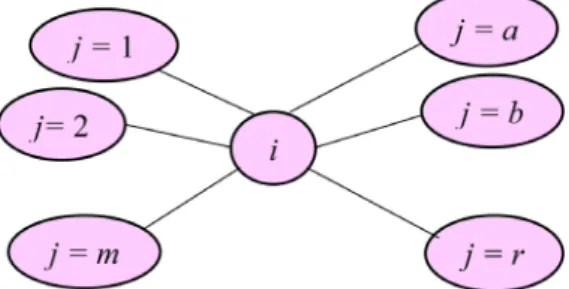
lent to source and sink. All the other nodes, i.e., repeaters of the network where data can be redirected without consuming or adding any amount of data resem-bles intermediate nodes like Figure 1. In a repeater, the total amount of data en-tering must be equal to the total amount of data leaving it; hence, it obeys the following flow-conservation requirement:
( ) ( )
: , ji : , ij
j j i E∈ C j i j E∈ C
=
∑
∑
for i = 2, 3, 4, …, n − 1, (1)where a network is often abstractly defined as a graph G, that has a set of vertices
V, connected by a set of edges E and here the network contains n nodes and the node 1 and node n correspond to the source and the sink respectively.
Because of the flow-conservation of intermediate nodes, the total amount of data leaving the source/transmitter must end up at the sink/receiver like Figure 2 and can be expressed as
( ) 1 ( )
: 1, j : , jn
j j E∈ C j j n E∈ C
=
∑
∑
(2)If the total outgoing flow from the source or total incoming flow to the sink is
c, then the requirements for the maximum flow are: Maximize
( ) 1
: 1, j
j j E
v C
∈
=
∑
Subjected to
( ) ( )
: , ji : , ij 0
j j i E j i j E
C C
∈ ∈
− =
∑
∑
for i = 2, 3, 4, …, n − 1 (3)0
ij
C ≥ for every edge
( )
i j, ∈E.The algorithm of maximum flow (Ford-Fulkerson Algorithm) is given below
[10] [11].
Figure 1. Flow-conservation of intermediate node i.
DOI: 10.4236/jcc.2019.78002 11 Journal of Computer and Communications
2.2. Ford-Fulkerson Algorithm (
G
,
s
,
t
)
Inputs: Given a graph G = (V, E) with flow capacity c, a source nodes, and a sink node t where s t V, ∈ .
Output: Compute a flow r from s to t of maximum value. 1) For all edges
( )
u v, ∈E ;2) r u v
( )
, =0 andr v u( )
, =0;3) Where there is a path p from s to t in Gr, such that c u vr
( )
, >0 for each( )
u v, ∈p;4) Do c pr
( )
=min{
c pr( )
=min{
c u vr( ) ( )
, : ,u v ∈p}
}
;5) For each edge
( )
u v, ∈p;6) r u v
( ) ( )
, =r u v c p, + r( )
;7) c u v
( ) ( )
, =c u v c p, − r( )
;8) r v u
( ) ( )
, =r v u c p, − r( )
;9) c v u
( ) ( )
, =c v u c p, + r( )
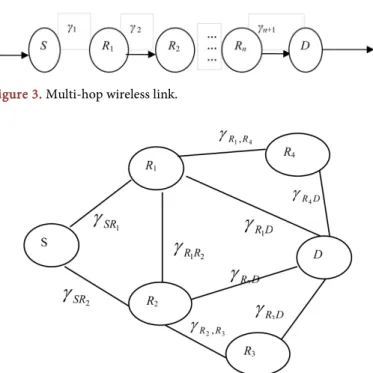
.Let us first consider a multi-hop wireless link, like Figure 3 where γ1 is the SNR between the sender S and the first rely R1, γi is the SNR between the (i − 1)th and the ith relay and γn+1 is that of between the nth relay and the destination D.
The overall SNR between S and D is like equivalent capacitor in series connec-tion or parallel resistor [12]:
1 1
1 2 1
11 .
n
eq n i
i
γ γ γ γ γ
− +
+ =
= =
∑
(4)
In this paper, we consider a wireless network with distributed repeaters like
Figure 4 where each node (transmitter or receiver) and the repeater can com-municate with one another to acquire channel knowledge, i.e. SNR between two
Figure 3. Multi-hop wireless link.
DOI: 10.4236/jcc.2019.78002 12 Journal of Computer and Communications
nodes. The main objective of a sender S is to transmit data to the destination node D with maximum rate under the provision of multiple paths. The network equivalent matrix will be
1 2
1 2 1 4 1
2 1 2 3 2
3 2 3
4 1 4
, ,
, , ,
, , ,
, ,
, ,
0 0 0 0
0 0 0
0 0 0
.
0 0 0 0
0 0 0 0
0 0 0 0 0 0
S R S R
R R R R R D
R R R R R D
R R R D
R R R D
U
γ γ
γ γ γ
γ γ γ
γ γ γ γ = (5)
Once the SNR of a link is known, its channel capacity is estimated as
(
)
2 log 1
i j i j
R R R R
C =B +γ in bps; where i j
R R
γ
is the SNR between the ith and thejth relay and B is the bandwidth of the baseband transmission. The capacity ma-trix will be
1 2
1 2 1 4 1
2 1 2 3 2
3 2 3
4 1 4
, ,
, , ,
, , ,
, ,
, ,
0 0 0 0
0 0 0
0 0 0
.
0 0 0 0
0 0 0 0
0 0 0 0 0 0
S R S R
R R R R R D
R R R R R D
R R R D
R R R D
C C
C C C
C C C
C C C C C = (6)
We apply the maximum flow algorithm with minimum cut theorem to eva-luate the amount of data flow from the source S to the destination D using the capacity matrix as the input to the algorithm. The repetition of the maximum flow algorithm with rapid change in SNR of any link is time-consuming; hence, minimum cut theorem, like power flow of [9] can be applied.
There are a lot of possible cut of network in Figure 4 as:
1) The set of vertices of with source, X = {S, R1, R2, R3, R4} and its comple-mentary set is, X = {D}. Now the cut, C(X, X) = {(R4, D), (R1, D), (R2, D), (R3, D)}.
2) The set of vertices of with source, X = {S, R1, R2} and X = {R4, R3, D},
C(X, X) = {(R1,R4), (R1, D), (R2, D), (R2, R3)}.
3) The set of vertices of with source, X = {S, R2, R3} and X = {R1, R4, D},
C(X, X) = {(S, R1), (R2, R1), (R2, D), (R3, D)}.
4) The set of vertices of with source, X = {S, R1} and X = {R4, R3, R2, D},
C(X, X) = {(R1, R2), (R1, R4), (R1, D), (S, R2)}.
5) The set of vertices of with source, X = {S, R2} and X = {R4, R3, R1, D},
C(X, X) = {(R2, R1), (R2, R3), (R2, D), (S, R1)}.
6) The set of vertices of with source, X = {S, R1, R2, R3} and X = {R4, D},
C(X, X) = {(R1, R4), (R1, D), (R2, D), (R3, D)}.
7) The set of vertices of with source, X = {S} and X = {R1, R2, R3, R4, D},
C(X, X) = {(S, R1), (S, R2)}, etc.
DOI: 10.4236/jcc.2019.78002 13 Journal of Computer and Communications
2.3. Algorithm
1) Sender first acquire channel knowledge, i.e. SNR of links, S-Ri, Ri-Rj, Rj-D; where i = 1, 2, 3, …, j = 1, 2, 3 … using shortest path algorithm.
2) The sender only selects m repeaters Rk; k = 1, 2, 3, …, m, where the link capacity of S-Ri, Ri-Rj, Rj-D, symbolically Ck ≥ Cth.
3) The sender creates a network with the selected nodes of Step 2; where the sending node S is considered as the source and destination node D as the sink.
4) Apply the maximum flow algorithm using minimum cut on the network of Step 3. The details of the algorithm will be shown in the next section.
5) The sender then sends data along the final augmenting paths.
6) In case of difficulty on the flow of data (message sent by D to S), repeat Steps 1 to 5.
2.4. Numerical Example
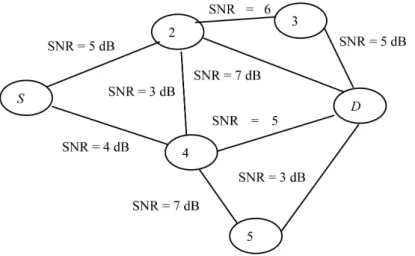
Let us consider the network of Figure 5. Let the source (S) be denoted as node 1 and the destination (D) as node 6, where 1 → 2, SNR = 5 dB; 1 → 4, SNR = 4 dB; 2 → 4, SNR = 3 dB; 4 → 5, SNR = 7 dB; 4 → 6, SNR = 5 dB; 2 → 6, SNR = 7 dB; 2 → 3, SNR = 6 dB; 3 → 6, SNR = 5 dB; 5 → 6, SNR = 3 dB. Here we use the nota-tion i → j, SNR = a; indicates the connection between node i and j with SNR of a
in absolute scale. Here Node 1 is source S and node 6 is destination D. Taking bandwidth of baseband transmission of B = 4 KHz, we get link capacity in bps as, 1 → 2, C = 10,340; 1 → 4, C = 9288; 2 → 4, C = 8000; 4 → 5, 12,000; 4 → 6, C = 10,340; 2 → 6, C = 12,000; 2 → 3, C = 11,229; 3 → 6, C = 10,340; 5 → 6, C = 8000.
Applying the Ford-Fulkerson algorithm, we obtain the maximum flow of 1.9628e+04 bps.
3. Results
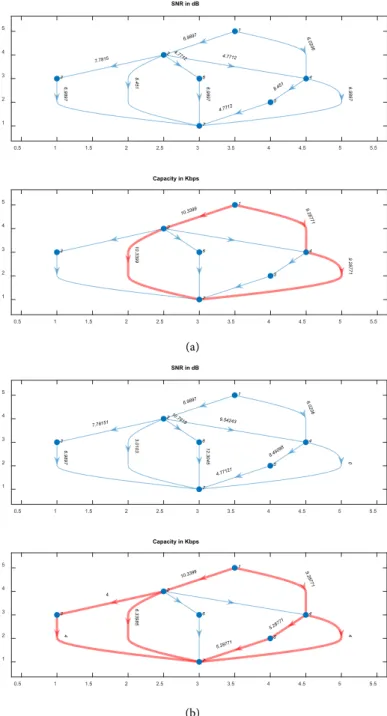
We use MATLAB 16 to evaluate the link capacity of the network of Figure 6(a)
and Figure 6(b), where both SNR in dB and capacity of each link in Kbps are shown. In Figure 6(a), Augmenting path coincides with the dual-hop parallel
DOI: 10.4236/jcc.2019.78002 14 Journal of Computer and Communications
(a)
(b)
Figure 6. Network with link SNR in dB and capacity in Kbps. (a) Augmenting path coin-cide with dual-hop parallel link; (b) Augmenting paths are different with dual-hop paral-lel link.
link (augmenting paths are heighted) but in Figure 6(b), Augmenting paths are different with dual-hop parallel link. Varying the SNR of link 1-2 and 1-4 we de-termine the capacity of the combined parallel link, i.e., 1-4-7 and 1-2-7 of Figure 6. The SNR of link 1-4-7 is found using the theory of parallel resistor:
1-4 4-7
1-4-7 1-4 4-7
1-4 4-7
SNR SNR
SNR SNR SNR
SNR SNR
= =
+ ,
and that of link 1-2-7 is
0.5 1 1.5 2 2.5 3 3.5 4 4.5 5 5.5
1 2 3 4 5
SNR in dB
1
2
3 4
5 6 7 6.9897 6.0206 7.7815 4.7712 4.7712 8.451 6.9897 8.451 6.9897 4.7712 6.9897
0.5 1 1.5 2 2.5 3 3.5 4 4.5 5 5.5
1 2 3 4 5
Capacity in Kbps
1
2
3 4
5 6 7 10.3399 9.28771 10.3399 9.28771
0.5 1 1.5 2 2.5 3 3.5 4 4.5 5 5.5
1 2 3 4 5
SNR in dB
1
2
3 4
5 6 7 6.9897 6.0206 7.78151 9.54243 10.7918 3.0103 6.9897 8.45098 0 4.77121 12.3045
0.5 1 1.5 2 2.5 3 3.5 4 4.5 5 5.5
1 2 3 4 5
Capacity in Kbps
1
2
3 4
5 6 7 10.3399 9.28771 4 6.33985
4 5.28771 4
DOI: 10.4236/jcc.2019.78002 15 Journal of Computer and Communications Figure 7. Comparison of capacity of combined parallel and maximum flow model.
1-2 2-7
1-2-7 1-2 2-7
1-2 2-7
SNR SNR
SNR SNR SNR .
SNR SNR
= =
+
Therefore, the total SNR will be SNR1-4-7+SNR1-2-7. The maximum flow
from the combined parallel link in Figure 6(a) is found as: 14.63 Kbps and that of Figure 6(b) provides 8.5124 Kbps, but the Ford-Fulkerson algorithm provides 19.6276 Kbps in both the cases.
A comparison of capacity of the combined parallel link and that of the Ford-Fulkerson algorithm is shown in Figure 7, where the capacity of the Ford-Fulkerson algorithm is found much higher than the case of the combined parallel link theory. When a link is outside of the augmenting path, the capacity remains fixed under the Ford-Fulkerson algorithm. Again, when a link of a net-work is not used under the theorem of multi-hop wireless link, then SNR of that link becomes independent of the capacity of the source to the destination. Such phenomenon is also visualized from Figure 7.
4. Conclusion
In this paper, the Ford-Fulkerson algorithm is applied in multi-hop wireless network which consists of several repeaters to determine the possible maximum data flow from the source to the destination. We have found better results under the Ford-Fulkerson algorithm compared to the generalized formula of multi-hop link. Under the Ford-Fulkerson algorithm the process time at the sender node decreases and also the capacity of the multi hop wireless link increases compare to the conventional theorem.
-4 -2 0 2 4 6 8
SNR in dB
8 10 12 14 16 18 20 22
Capacity Kbps
Variable link 1-4; Ford Fulkerson
Variable link 1-4; combined parallel
Variable link 1-2; Ford Fulkerson
Variable link 1-2; combined parallel
Variablbe link not in Augmenting path; Ford Fulkerson
DOI: 10.4236/jcc.2019.78002 16 Journal of Computer and Communications
Conflicts of Interest
The authors declare no conflicts of interest regarding the publication of this pa-per.
References
[1] Mallick, K.K., Khan, A.R., Ahmed, M.M., Arefin, M.S. and Uddin, M.S. (2016) Modified EDMONDS-KARP Algorithm to Solve Maximum Flow Problems. Open Journal of Applied Sciences, 6, 131-140. https://doi.org/10.4236/ojapps.2016.62014
[2] Surakhi, O.M., Qatawneh, M. and Al Ofeishat, H.A. (2017) A Parallel Genetic Algo-rithm for Maximum Flow Problem. International Journal of Advanced Computer Science and Applications, 8, 159-164. https://doi.org/10.14569/IJACSA.2017.080620
[3] Saad, M. (2018) Optimal Multicommodity Spectrum-Efficient Routing in Multihop Wireless Networks. Hindawi. Wireless Communications and Mobile Computing, 2018, Article ID: 7985756. https://doi.org/10.1155/2018/7985756
[4] Rahaman, A.S.M.M., Akhter, J., Jani, M.R. and Islam, M.I. (2018) Determination of Array Gain of Single Hop to Achieve the Performance of a 2-Hop Wireless Link.
Journal of Computer and Communications, 6, 84-98.
https://doi.org/10.4236/jcc.2018.67008
[5] Chakraborty, P. and Prakriya, S. (2017) Secrecy Outage Performance of a Coopera-tive CogniCoopera-tive Relay Network. IEEE Communications Letters, 21, 326-329.
https://doi.org/10.1109/LCOMM.2016.2564380
[6] Arzykulov, S., Nauryzbayev, G. and Tsiftsis, T.A. (2017) Underlay Cognitive Relay-ing System Over α-μ Fading Channels. IEEE Communications Letters, 21, 216-219.
https://doi.org/10.1109/LCOMM.2016.2617043
[7] Lim, S. and Ko, K. (2017) Approximation of Multi-Hop Relay to Dual-Hop Relay and Its Error Performance Analysis. IEEE Communications Letters, 21, 342-345.
https://doi.org/10.1109/LCOMM.2016.2627054
[8] Abdullah, N. and Hua, T.K. (2017) The Application of the Shortest Path and Max-imum Flow with Bottleneck in Traffic Flow of Kota Kinabalu. Journal of Computer Science & Computational Mathematics, 7, 37-43.
https://doi.org/10.20967/jcscm.2017.02.003
[9] Werho, T., Vittal, V., Kolluri, S. and Wong, S.M. (2016) Power System Connectivity Monitoring Using a Graph Theory Network Flow Algorithm. IEEE Transaction on Power Systems, 31, 4945-4952. https://doi.org/10.1109/TPWRS.2016.2515368
[10] Cormen, T.H., Leiserson, C.E., Rivest, R.L. and Stein, C. (2009) Introduction to Al-gorithms. Third Edition, The MIT Press Cambridge, London.
[11] Levitin, A. (2012) Introduction to Design and Analysis of Algorithms. Pearson Education, Boston.