Development and validation of HPTLC method for niacin and
simvastatin in binary combination
Pravish Kumar Tiwari, Padmakar Sathe
Department of Chemistry, Ramnarian Ruia College, Mumbai, India. Email: [email protected]
Received 21 February 2010; revised 11 March 2010; accepted 28 March 2010.
ABSTRACT
A simple, sensitive and validated HPTLC method has been developed to determine Niacin and simvastatin simultaneously in synthetic mixture form. Chroma- tographic separation was achieved on a RP18 plate using a mixture of Methanol: Water: Acetic acid (60: 40:0.1) at a wavelength of 237 nm. Linearity of the method was found to be in the concentration range of 5000.0-25000.0 µg/ml for niacin and 100.0-500.0 µg/ml for simvastatin with correlation coefficient greater than 0.999. The method can be used for simultaneous determination of Niacin and Simvastatin.
Keywords: HPTLC; Methanol; Niacin; Simvastatin
1. INTRODUCTION
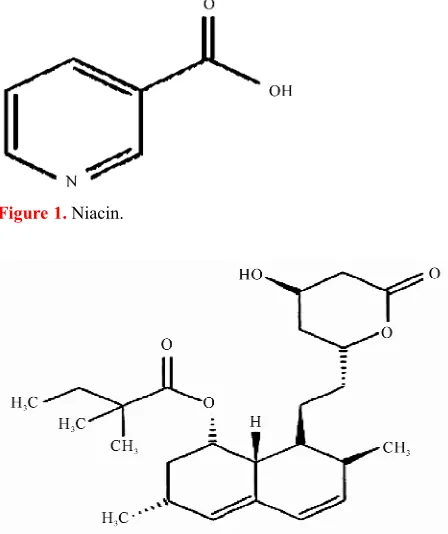
Niacin (Figure 1) chemically designated as Pyridine 3 carboxylic acid reduce triglyceride, levels, is also effec- tive for increasing serum HDL levels [1]. It has also been demonstrated that this drug lowers the incidence of coronary heart disease in humans [1]. A number of ana- lytical methods have been developed for its determina- tion in pharmaceutical formulations or in biofluids either alone or in combination with other drugs [2-8]. These include determination of niacin by liquid chromatogra- phy–mass spectrometry [9], HPLC [9-12], flow injection and spectrofluorimetric analysis.
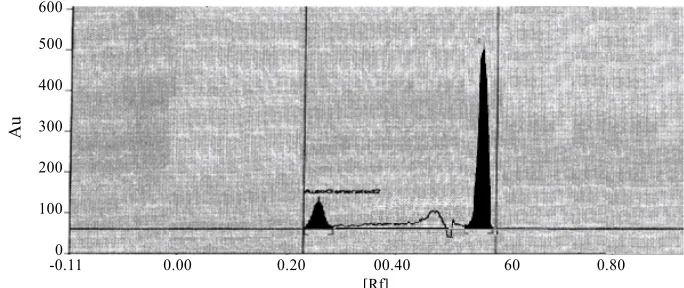
Simvastatin (Figure 2), a hypolipidemic drug belong ing to the class of pharmaceuticals called statins is che- mically designated as [(1S,3R,7R,8S,8aR)-8-[2-[(2R, 4R) -4-hydroxy-6-oxo-oxan-2-yl]ethyl]-3,7-dimethyl-1,2,3,7, 8,8ahexahydronaphthalen-1-yl]2,2-dimethy-lbutanoate. It is used for the treatment of hypercholes-terolemia [13]. An HMG-CoA reduces ase inhibitor, acts by decreasing cholesterol synthesis and by increasing low density lipo-protein (LDL) catabolism via increased LDL receptor activity [14]. Different analytical methods have been reported for the determination of simvastatin, which
[image:1.595.311.535.288.555.2]in-clude HPLC [15-17], HPLC-MS/MS [18], spectropho-tometer [19].
Figure 1. Niacin.
Figure 2. Simvastatin.
According to the information collected from literature there is no reported method for simultaneous determina-tion of Niacin and simvastatin. In the present work we have focused on deciding the optimum chromatographic conditions for the simultaneous determination of Niacin and simvastatin in a pharmaceutical preparation.
We describe in this paper a simple, sensitive and va- lidated HPTLC method for the simultaneous determina-tion of Niacin and Simvastatin. The developed method can be applied successfully for quality control and for other analytical purposes.
2. MATERIAL AND METHODS
2.1. Chemicals and Reagents
Niacin and simvastatin reference substances respecti- vely were taken from Precise Pharma (Turbhe, mumbai). Methanol (HPLC grade), Triethyl amine and acetic acid (analytical reagent grade) were purchased from Merck (Mumbai). All excepients used were of pharmaceutical grade.
2.2. Chromatographic Conditions
The chromatographic estimation were performed using RP18 coated on aluminum sheet (10 × 10 cm, pre-washed with methanol and dried in oven at 50℃ for 5 min) mobile phase, Methanol: Water: Acetic acid (60: 40:0.1), chamber and plate saturation time of 45 min, migration distance allowed was 75 mm, wavelength sc- anning was done at 237 nm, keeping the slit dimension at 5 × 0.45 mm.
2.3. Preparation of System Suitability Solution
A Stock solution of niacin and simvastatin was prepared at about 100000 µg/ml and 2000 µg/ml respectively in diluent. Then dilute 1 ml of stock solution to 10 ml with diluent to give 10000 µg/ml and 200 µg/ml niacin and si- mvastatin respectively. Spotted 2.5 µl of system suitabil-ity solution in five replicates. And found RSD of peak area and Rf is below 2%.
2.4. Determination of Simvastatin and Niacin in
Their Combined Dosage Forms
The content of twenty tablets where taken and weigh- ed .powder equivalent to Niacin 1000 mg and 20 mg si- mvastatin in 10.0 ml volumetric flask add 6 ml of diluent and flask was sonicated for 5 min .The flask was soni-cated and the volume was diluted to the mark with dilu-ent. The above solution was filtered using what man filter paper No. 1. Then diluted 1.0 ml of filtrate to 10.0 ml with diluent.
2.5. Linearity
Linearity of the proposed method was checked by ana-
lyzing solutions in the range of 5000-25000 µg/ml for niacin (5000, 7500, 10000, 12500, 15000, 20000, 25000 µg/ml) and 100-500 µg/ml for simvastatin (100,150,200, 250,300 ,400,500 µg/ ml). Each level was made in trip-licate and spot 2.5 µl of each solution.
2.6. Accuracy
Method accuracy was performed by adding known am- ounts of niacin and simvastatin to the pre analyzed sam-ple and then comparing the added concentration with the found concentration. Four levels of solutions were made which correspond to 0, 50, 100 and 150% of the nominal analytical concentration. Each level was made in tripli-cate and spot 2.5 µl of each solution.
2.7. Specificity
Commonly used exceipients (starch, microcrystalline ce- llulose and magnesium stearate, lactose,) were spiked in to a pre weighed quantity of drugs .The chromatogram was taken by appropriate dilution and the quantities of drug were determined.
2.8. Precision
For evaluating the within-day precision, results of six re- plicate analyses of samples were calculated on a single day. The between-day precision was calculated from the samples analyzed on different days.
3. RESULTS
In the present work conditions were optimized for the de- velopment and validation of a simple and accurate HP- TLC method for the simultaneous determination of nia-cin and simvastatin in synthetic mixture form.
Method development was started with water and me- thanol in the ratio of 50:50 (v/v). At this composition although both components were resolved but peak shape were not good. With the mobile phase composition of Methanol: Water: Acetic acid (60:40:0.1) good resolu-tion and better peak shape were obtained.
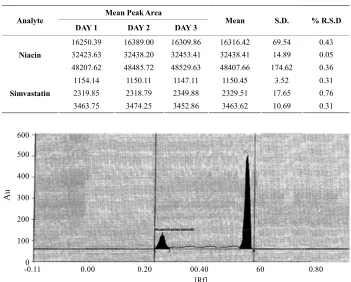
Under the described experimental conditions, sharp peaks that belong to niacin and simvastatin were obta- ined at retention factor of 0.23 and 0.57 minutes respec-tively as shown in Figure 3.
The linear regression equation for simvastatin was fo- und to be Y = 11.499 X + 4.8303 with value of correla-tion coefficient equal to 0.9999.
The recovery and the relative standard deviation for each of the analytes are given in Table 1, Table 2, Ta-ble 3 and Table 4 mean recovery for Niacin is found
100.48% & for simvastatin is found 99.80%.
The results of three successive day andprecision are presented in Table 5.
Chromatogram of niacin and simvastatin in sample in given in Figure 4 showing selectivity of the proposed method.
A
u
[Rf] 600
500
400
300
200
100
0
[image:3.595.125.467.171.315.2]-0.11 0.00 0.20 00.40 60 0.80
Figure 3. Chromatograms of Niacin and Simvastatin in standard solution.
Table 1. Accuracy of Niacin.
Amount of Niacin found in (mg) Level sample (mg) Wt. of added in (mg) Wt. of std
1 2 3
Mean
(mg) S.D %R.S.D
0 1352.66 0 1000.35 1000.19 1000.17 1000.24 0.10 0.01
50 1349.25 501.48 1501.48 1502.32 1504.80 1502.87 1.73 0.11
100 1351.41 1001.12 2000.35 2000.14 2000.18 2000.22 0.11 0.01
150 1351.23 1501.21 2512.36 2521.46 2521.48 2518.43 5.26 0.21
(
) (
)(
)
(
2) (
)
2Percent Recovery N XY X Y 100
N X X
−
= ×
−
∑
∑
∑
∑
∑
,Where, N = Number of observations; X = Amountof the standard added (mg); Y = Amount of the standard found (mg).
Table 2. Accuracy of Niacin.
Level X Y X2 X Y
0 3 × 0 3 × 1000.24 3 × (0.00)2 3 × 0 × 1000.24
1 3 × 501.48 3 ×1502.87 3 × (501.48)2 3 × 500.10 × 1502.87
2 3 × 1001.12 3 × 2000.22 3 × (1001.12)2 3 × 1000.02 × 2000.22
3 3 × 1501.21 3 × 2518.43 3 × (1501.21)2 3 × 1500.06 × 2518.43
∑ 9011.43 21065.28 9770627.04 19588924.19
(
)
2X
∑
81205870.64No. of Observations N = 12
12(19588924.19) (9011.43) (21065.28)
Therefore % Recovery 100
12(37552304.73) (10519061.37)
45238794.13
= 100
45022865.76
=100.48%
− ⋅
= ×
−
Table 3. Accuracy of Simvastatin.
Amount of Simvas-tatin found in (mg) Level Wt. of
sample (mg)
Wt. of std added in (mg)
1 2 3
Mean
(mg) S.D %R.S.D
0 1352.66 0 20.03 20.10 20.21 20.11 0.09 0.45
50 1349.25 10.21 30.25 30.16 30.29 30.23 0.07 0.22
100 1351.41 20.23 40.23 40.16 40.52 40.30 0.19 0.47
150 1351.23 30.15 50.12 50.23 50.16 50.17 0.06 0.11
Table 4. Accuracy of Simvastatin.
Level X Y X2 X Y
0 3 × 0 3 × 20.11 3 × (0.00)2 3 × 0 × 20.11
1 3 × 10.21 3 × 30.23 3 × (10.21)2 3 × 10.11 × 30.23
2 3 × 20.23 3 × 40.30 3 × (20.23)2 3 × 20.74 × 40.30
3 3 × 30.15 3 × 50.17 3 × (30.15)2 3 × 30.16 × 50.17
∑ 181.77 422.43 4367.56 7909.63
(
)
2X
∑
33040.33No. of Observations N = 12
12(7909.63) (181.77) (422.43)
Therefore % Recovery 100
12(33040.33) (4267.56)
18134.09
= 100
18170.37
=99.80%
− ⋅
= ×
−
[image:4.595.122.473.417.699.2]×
Table 5. Precision of the proposed HPTLC method.
Mean Peak Area Analyte
DAY 1 DAY 2 DAY 3 Mean S.D. % R.S.D
16250.39 16389.00 16309.86 16316.42 69.54 0.43
32423.63 32438.20 32453.41 32438.41 14.89 0.05
Niacin
48207.62 48485.72 48529.63 48407.66 174.62 0.36
1154.14 1150.11 1147.11 1150.45 3.52 0.31
2319.85 2318.79 2349.88 2329.51 17.65 0.76
Simvastatin
3463.75 3474.25 3452.86 3463.62 10.69 0.31
A
u
[Rf] 600
500
400
300
200
100
0
-0.11 0.00 0.20 00.40 60 0.80
4. CONCLUSIONS
A simple and accurate reverse phase HPTLC method has been developed for the simultaneous determination of niacin and simvastatin. The method was validated by testing its linearity, accuracy, precision and specificity.
5. ACKNOWLEDGEMENTS
The authors are great full to precise pharma for providing gift sample of simvastain and niacin.
REFERENCES
[1] Susman (1995) Niacin reduces triglycerides, increases good cholesterol in diabetics. Doctors Guide Publishing Limited.
[2] Kumar, V. and Shah, R.P., (2008) LC and LC–MS meth- ods for the investigation of polypills for the treatment of cardiovascular diseases: Part 1. Separation of active com- ponents and classification of their interaction/degradation products. Saranjit Singh Journal of Pharmaceutical and Biomedical Analysis, 47(3), 508-515.
[3] Chaudhari, B.G., Patel, N.M., Shah, P.B. and Modi, K.P. (2006) Development and validation of a HPTLC method for the simultaneous estimation of atorvastatin calcium and ezetimibe. Indian Journal of pharamaceutical Sci- ence, 68(6), 793-796.
[4] Jain, N. and Raghuwanshi, R. (2008) Development and validation of RP-HPTLC method for simultaneous esti-mation of atorvastatin calcium and fenofibrate in tablet dosage forms. Deepti Jain Indian Journal of pharmaceu-tical Science, 70(2), 263-265.
[5] Kova´, L.N. and Atı´nsky´, D.S., (2008) HPLC methods for the determination of simvastatin and atorvastatin.
PetrSolich Trac Trends in Analytical Chemistry, 27(4), 352-367.
[6] Jemal, M., Ouyang, Z. and Powell, M.L.(2000) A strat-egy for a post-method-validation use of incurred biolo- gical samples for establishing the acceptability of a liquid chromatography/tandem mass-spectrometric method for quantitation of drugs in biological samples. Journal Pharm Biomed Anal, 16(16), 1538-1547.
[7] Zhang, N., Yang, A., Rogers, J.D. and Zhao, J.J. (2004)
Journal Pharm Biomed Anal, 34, 175-187.
[8] Nirogi, R., Mudigonda, K. and Kandikere, V. (2004) Chromatography–mass spectrometry methods for the quantitation of statins in biological samples. Journal of pharmaceutical and Biomedical Analysis. 44, 379-387. [9] Research & Development report, may 2000, Australian
Government Analytical Laboratories.
[10] Khor, S.-C. and Tee, E.-S. (1996) Development of a
HPLC method for the simultaneous determination of several b-vitamins and ascorbic acid. Malaysian Journal of Nutrition, 2(1), 49-65.
[11] Euro Fir guidelines for assessment of Methods of Analy-sis KellieWindahi, V Craige Trenerry and Caroline Ward. [12] Pfuhl, P., Karcher, U., Haring, N., Baumeister, A., Tawab, M.A. and Schubert-Zsilaveez, M. (2005) Simultaneous Determination of Niacin, Niacinamide and Nicotinuric Acid in Human Plasma. Journal of Pharmaceutical and Biomedical Analysis, 36(5), 1045-1052.
[13] Todd, P. A. and Goa, K. L., (1990) Simvastatin: A review of its pharmacological properties and therapeutic poten-tial in hyperlipidaemia. Drugs, 40(4), 583-607.
[14] Pasternak, R.C., Smith, S.C.J., Merz, C.N.B., Grundy, S.M., Cleeman, J. I. and Lenfant, C. (2002) ACC/AHA/ NHLBI clinical advisory on the use and safety of statins.
Journal of The American Heart Association, 40, 567-572. [15] Dave, T. and Diab, E. Analysis of Simvastatin Tablets by High Speed LC. Application Notes 405, Thermo Fisher Scientific, San Jose, 1-6.
[16] Ashfaq, M., Khan, I.U., Quatab, S.S. and Razz, S.N. (2007) Hplc determination of ezetimibe and simvastatin in pharmaceutical formulations. Journal of the Chilean Chemical Society, 52(3), 1220-1224.
[17] Ashfaq, M., Khan, I.U. and Asghar, M.N. (2008) Devel-opment and Validation of Liquid Chromatographic Method for Gemfibrozil and Simvastatin in Binary Com-bination. Journal of the Chilean Chemical Society, 53(3), 1617-1619.
[18] Yang, H., Feng, Y. and Luana, Y. (2003) Determination of Simvastatin in human plasma by liquid chromatogra-phy–mass spectrometry. Journal of Chromatography B, 785(2) 369-375.
[19] Basavaiah, K. and Tharpa, K. (2008) The development and validation of visible spectrophotometric methods for simvastatin determination in pure and the tablet dosage forms. Chemical Industry and Chemical Engineering Quarterly, 14(3), 205-210.
[20] Brown, G.B., Zhao, X.-Q., Chait, A., Fisher, L.D., Ch- eung, M.C., Morese, J.S., Dowdy, A.A., Marino, E. K., Bolson, E. L., Alaupovic, P., Frohlich, J. and Albers, J. J. (2001) Simvastatin and niacin, antioxidant vitamins, or the combination for the prevention of coronary disease.
The New England Journal of Medicine, 345(22), 1583- 1592.
[21] Riordan, M. O. and Waknine, Y. (2008) FDA approves co- mbination niacin and simvastatin. Medical News, Med-scape.