ENVIRONMENTAL DETERMINANTS OF CHILD MORTALITY IN ETHIOPIA:
AN APPLICATION OF SURVIVAL ANALYSIS
1,*
Yohannes Tadesse Asnakew,
1Department of Statistics, College of Natural and Computational Science, University of Gondar, Gondar, Ethiopia 2Department of Statistics, College of Natural and Computational Science, Addis Abeba University, Addi
ARTICLE INFO ABSTRACT
This paper focuses on the environmental determinants of child mortality in Ethiopia. were obtained from the demographic and health survey conducted in 2014. child mortality is related to the household's
source of drinking water, type of toilet used, type of cooking fuels, antenatal visit and place of delivery. A survival analysis was used to analyze the determinants of child mortality.
estimation show that most of the deaths occurred at first birth day of life. As the result of this we employed Cox proportional hazard and weibull regression models to select factors affecting child mortality in Ethiopia. According to the
source of drinking water, type of toilet used, antenatal visit, place of delivery and type of cooking fuel were found to have
and above educational level were lower risk of mortality than mothers' who had no education level and children whose parents use non
who use impro
households using high polluting fuels (fire woods and charcoal) as their main source of cooking fuel have higher mortality rates as compared to those using low polluting
households with either flush toilets or pit latrines have lower mortality rate than those born in households without any toilet facility. Policies aimed at achieving the goal of reduced child mortality should be direct on improving the household’s environmental status if this goal is to be realized.
Copyright © 2019, Yohannes Tadesse Asnakew et al.
unrestricted use, distribution, and reproduction in any medium,
INTRODUCTION
Child mortality, commonly on the agenda of public health and international development agencies, has received renewed attention as a part of the United Nation’s. Approximately 6.3 million infants and children under five years of age die each year, with large variations in under-five mortality rates, across regions and countries (WHO, 2010, UNICEF, 2013).
the under-five mortality rates have declined from 85 per 1000 to 51 per 1000 (UNICEF, 2012). However, it is estimated that more than 7 million children will die before attaining the age of five. Of these, India, Pakistan, Ethiopia, Nigeria and Democratic Republic of Congo will suffer half of all under five children deaths (UNICEF, 2012). India alone shares the burden of 24% of world’s under-five mortality followed by Nigeria which shares 11% of this burden (UNICEF,
obvious that health policies in these five countries need to be reviewed and new imputes provided to bring down the high under-five mortality rate.
*Corresponding author: Yohannes Tadesse Asnakew
Department of Statistics, College of Natural and Computational Science, University of Gondar, Gondar, Ethiopia
ISSN: 0975-833X
Article History:
Received 20th October, 2018 Received in revised form 22nd November, 2018 Accepted 19th December, 2018 Published online 30th January, 2019
Citation: Yohannes Tadesse Asnakew, Shibru Temesgen and Kasim Mohammed Yesuf
An application of survival analysis”, International Journal
Key Words:
Child mortality, Kaplan-Meier estimator, Cox-PH model, Weibull model.
RESEARCH ARTICLE
ENVIRONMENTAL DETERMINANTS OF CHILD MORTALITY IN ETHIOPIA:
AN APPLICATION OF SURVIVAL ANALYSIS
Yohannes Tadesse Asnakew,
2Shibru Temesgen and
3Kasim Mohammed Yesuf
Department of Statistics, College of Natural and Computational Science, University of Gondar, Gondar, Ethiopia Department of Statistics, College of Natural and Computational Science, Addis Abeba University, Addi
ABSTRACT
This paper focuses on the environmental determinants of child mortality in Ethiopia. were obtained from the demographic and health survey conducted in 2014.
child mortality is related to the household's environmental characteristics, such as mother's education, source of drinking water, type of toilet used, type of cooking fuels, antenatal visit and place of delivery. A survival analysis was used to analyze the determinants of child mortality.
estimation show that most of the deaths occurred at first birth day of life. As the result of this we employed Cox proportional hazard and weibull regression models to select factors affecting child mortality in Ethiopia. According to the Cox proportional hazard and weibull regression models, mothers' education, source of drinking water, type of toilet used, antenatal visit, place of delivery and type of cooking fuel were found to have significant impact on child mortality in Ethiopia. Child's mother who had primary, secondary and above educational level were lower risk of mortality than mothers' who had no education level and children whose parents use non-improved source of drinking water have less survival chance than those who use improved source of drinking water. With regard to source of cooking fuel, children born in households using high polluting fuels (fire woods and charcoal) as their main source of cooking fuel have higher mortality rates as compared to those using low polluting
households with either flush toilets or pit latrines have lower mortality rate than those born in households without any toilet facility. Policies aimed at achieving the goal of reduced child mortality should be direct on improving the household’s environmental status if this goal is to be realized.
This is an open access article distributed under the Creative Commons medium, provided the original work is properly cited.
Child mortality, commonly on the agenda of public health and international development agencies, has received renewed attention as a part of the United Nation’s. Approximately 6.3 million infants and children under five years of age die each five mortality rates, across regions and countries (WHO, 2010, UNICEF, 2013). Globally, five mortality rates have declined from 85 per 1000 ). However, it is estimated that more than 7 million children will die before attaining the age of five. Of these, India, Pakistan, Ethiopia, Nigeria and Democratic Republic of Congo will suffer half of all
under-). India alone shares the five mortality followed by Nigeria which shares 11% of this burden (UNICEF, 2012). It is obvious that health policies in these five countries need to be reviewed and new imputes provided to bring down the high
College of Natural and Computational Science,
Environmental conditions are a major direct and indirect determinant of human health. In developing societies, modern forms of exposure to urban, industrial and agroche pollution add to the health burden caused by traditional household and community-based risks. The vicious cycle, intrinsically linking poverty, environmental degradation and ill health needs to be broken.
especially in Sub- Saharan Africa (SSA), the basic child mortality causes of more than 80% of the diseases are inadequate and unsafe water supply, and improper disposal of waste (WHO 2010). Child mortality varies among world regions but the highest prevalence is concentr
Saharan Africa where mortality of children under five decreased from 177 in 1990 to
in 2012 (UNICEF, 2013). Despite the overall decline in prevalence of child mortality, it remains still at unacceptably high levels. About half of all deaths of children under five has been concentrated in Sub-Saharan Africa in 2012
2013). Hence, the need to reduce child mortality is one of the major challenges in improving child health, in particular in Sub-Saharan Africa. Similarly empirical research used aggregated macro data to study the determinants of child
International Journal of Current Research
Vol. 11, Issue, 01, pp. 91-95, January, 2019
DOI: https://doi.org/10.24941/ijcr.33749.01.2019
Shibru Temesgen and Kasim Mohammed Yesuf. 2019. “Environmental determinants of child mortality in
Journal of Current Research, 11, (01), 91-95.
ENVIRONMENTAL DETERMINANTS OF CHILD MORTALITY IN ETHIOPIA:
Kasim Mohammed Yesuf
Department of Statistics, College of Natural and Computational Science, University of Gondar, Gondar, Ethiopia Department of Statistics, College of Natural and Computational Science, Addis Abeba University, Addis Abeba, Ethiopia
This paper focuses on the environmental determinants of child mortality in Ethiopia. The data for this study were obtained from the demographic and health survey conducted in 2014. It specifically examines how environmental characteristics, such as mother's education, source of drinking water, type of toilet used, type of cooking fuels, antenatal visit and place of delivery. A survival analysis was used to analyze the determinants of child mortality. As expected the Kaplan-Meier estimation show that most of the deaths occurred at first birth day of life. As the result of this we employed Cox proportional hazard and weibull regression models to select factors affecting child mortality in Cox proportional hazard and weibull regression models, mothers' education, source of drinking water, type of toilet used, antenatal visit, place of delivery and type of cooking fuel were ld's mother who had primary, secondary and above educational level were lower risk of mortality than mothers' who had no education level and improved source of drinking water have less survival chance than those With regard to source of cooking fuel, children born in households using high polluting fuels (fire woods and charcoal) as their main source of cooking fuel have higher mortality rates as compared to those using low polluting fuels (electricity). Children born in households with either flush toilets or pit latrines have lower mortality rate than those born in households without any toilet facility. Policies aimed at achieving the goal of reduced child mortality should be directed on improving the household’s environmental status if this goal is to be realized.
Commons Attribution License, which permits
Environmental conditions are a major direct and indirect determinant of human health. In developing societies, modern forms of exposure to urban, industrial and agrochemical pollution add to the health burden caused by traditional based risks. The vicious cycle, intrinsically linking poverty, environmental degradation and ill In most developing countries, Saharan Africa (SSA), the basic child mortality causes of more than 80% of the diseases are inadequate and unsafe water supply, and improper disposal of Child mortality varies among world regions but the highest prevalence is concentrated in Sub-Saharan Africa where mortality of children under five decreased from 177 in 1990 to 98 deaths per 1,000 live births in 2012 (UNICEF, 2013). Despite the overall decline in the prevalence of child mortality, it remains still at unacceptably of all deaths of children under five has Saharan Africa in 2012 (UNICEF, 2013). Hence, the need to reduce child mortality is one of the major challenges in improving child health, in particular in Similarly empirical research used aggregated macro data to study the determinants of child
INTERNATIONAL JOURNAL OF CURRENT RESEARCH
health outcomes. For example, Hmwe H. et al. (2013) show, based on a longitudinal study for 193 countries using annual data between 2000 and 2009 from the World Development Indicators, that GDP per capita, access to safe drinking water, improved sanitation, and public health expenditure per capita increases the probability of child survival. The health effects of such environmental determinants were highlighted in the World Health Organization’s 2010 World Health Report (WHO 2010), which showed that unsafe water, poor sanitation, and hygiene are the cause of 4%–8% of the overall burden of diseases in developing countries and nine-tenths of diarrheal diseases, which is a major contributor to infant mortality. According to World Bank (2013), environmental health risks fall into two broad categories. The first are the traditional hazards related to poverty and lack of development, such as lack of safe water, inadequate sanitation and waste disposal, indoor air pollution, and vector-borne diseases. The second category is the modern hazards such as rural air pollution and exposure to agro industrial chemicals and wastes that are caused by development that lacks environmental safeguards. Unsafe water and sanitation, indoor air pollution from household solid fuel use, and ambient urban particulate matter (PM) pollution are responsible for an estimated 3.4%, 2.7%, and 0.6% of the global burden of disease, respectively, with 90%, 71%, and 7% of the disease burden from these risk factors borne by infants and young children in low- and middle-income countries.
As the world enters into the 21st century, debate on childhood
mortality remains a big issue for developing countries. Their commitment is reflected in their desire to reduce the level of child mortality by two- thirds of their 1990 levels by the year 2015, as expressed in the Millennium Development Goals. To achieve this goal, it is imperative to attempt and determine what factors contribute to the high levels of child mortality in developing countries and in particular, Ethiopia. Worldwide, safe and adequate drinking water is still not accessible to 1.1 billion people, and 2.4 billion people lack adequate sanitation. The recent figures for Ethiopia (2010) indicate a water supply coverage of 38% (98% in urban areas and 26% in rural areas), and a sanitation coverage of 15% (58% in urban areas and 8% in rural areas). Unchecked urban growth has its price in terms of environmental health: disposal of municipal and hazardous waste, particularly health care waste, remains a problem in many regions. Up to 60% of the global burden of Acute Respiratory Infection (ARI) is associated with indoor air pollution and other environmental factors. Occupational diseases and injuries, grossly underreported are responsible for more than 1 million deaths annually all over the world; health care workers, miners and manufacturing workers are at highest risk.
Ethiopia has one of the lowest rates of coverage for improved water and sanitation in the world. Just over 54 per cent of households have access to an improved source of drinking water, with a higher proportion among urban households (75%) and among rural households (49%). According to Joint Monitoring Program (JMP) 2012 update, the proportion of the population having access to improve and unimproved sanitation facilities stands at 54 % (21% improved and 33 % unimproved).
Nearly 39 million Ethiopians – most of them in rural
areas don’t have access to safe water.
Nearly 48 million lack access to basic sanitation.
Environmental conditions, in particular, a safe source of drinking water, appear to be important determinants of infant mortality risks in both urban and rural locations. In the latter, the very few households with an electricity supply have a greatly reduced probability of infant death. In urban areas, the mortality risk is substantially higher among households living in premises with no finished floor. It seems likely that this characteristic identifies slum dwellings and the poor public health conditions found there. In rural areas, the majority of dwellings have no finished floor, and this is not significantly correlated with mortality risk. Surprisingly, having a toilet is not significantly correlated with mortality risk in either urban or rural areas. Children in households with fewer assets face a greater risk of death in urban but not in rural areas. This is consistent with a greater socio economic gradient in child health in urban areas that has been found in other studies (Kyei, 2012).
Data and Methodology: The source of the data used in this
study was the 2014 Ethiopia Demographic and Health survey (EDHS, 2014) conducted in Ethiopia as part of the worldwide demographic and health survey project.
Study Variables
Dependent Variable: The time is dependent variable and is
defined as the time that a child who has survived to the beginning of the respective interval (12 months-59 months) will fail (die) in that interval.
Independent Variables: The main focus of this study was on
the environmental variables only. The explanatory variables are sex of child, place of residence, women education level, antenatal visit, households’ access to water, household access to toilet, cooking fuel type and Place of delivery.
MATERIALS AND METHODS
Survival Analysis involves the modeling and analysis of data that have a principal end point, the time until an event occurs (time-to-event data). Generally, survival analysis is a collection of statistical procedures for data analysis for which the outcome variable of interest is time until an event occurs.
Methods of Statistical Data Analysis: In this study,
nonparametric, semi-parametric, and parametric survival analysis approaches were used to analyze the survival time of child.
RESULTS
As noted above the p-values of the log-rank test showed that the survival experience of children in the various categories antenatal visit, mothers educational status, toilet type used , type of cooking fuel, source of drinking water and place of residence were differ significantly (i.e. all of these covariates have P-value less than 0.05). Mother’s education is the most important determinant of child mortality among the mother’s characteristics that are considered in this study. Children whose mothers' have no education are 50.81% likely to die as infants compared with children whose mothers have secondary and above education (HR = .5081; 95% CI=(.2788-.9260)). The risk of death of children whose mothers' have primary education level was 44.58% compared to the reference group secondary and above education level (HR=.4457; 95% CI=(0.2714-0.7320)) keeping effects of other covariates constant. After adjusting other covariates, the estimated coefficients of improved and shared toilet types are -1.301 and 0.014 respectively.
The hazard ratio or relative risk of the covariate toilet type used improved is 1.014 and it is as little as 0.272. It means that the hazard rate of child reduce by 72.8 % in household with sanitary latrine as compared with the household without sanitary latrine (shared facility). In favor of this finding,
Klaauw and Wang (2004), suggest that good public sanitation
systems may constitute a more important preventive aspect of
child survival. In the latter study of Kabir & Amin (2013), in
Bangladesh also highlights that the households with sanitary latrines have low risks of child mortality.
[image:3.595.94.480.68.158.2]The risk of dying for a child born in a family without access to improved (pipe) source of drinking water is higher by 35% relative to those born in a family with access to improved drinking water. The 95% confidence interval (0.240, 0.511) implies that the risk of death of children whose source of water is not improved water is 0.240 as low and 0.511 as high as those in the reference group.
Table 1. Result of log-rank test of equality of survival distribution for the different categorical covariates
Covariates Chi-Square Df p-value
Sex of child 2.785 1 0.095
Place of Residence 52.99 1 0.000
Mothers Educational Status 34.748 2 0.001
Toilet Type Used 36.253 2 0.001
Type of Cooking Fuel 26.697 3 0.004
Antenatal visit during pregnancy 59.058 1 0.001
Place of Delivery 8.670 2 0.067
Source of drinking Water 41.378 1 0.000
Table 2. The Preliminary Final Model with parameter estimates and hazard ratios of the covariates
B SE Wald Df Sig. HR 95.0% CI for Exp(B)
Lower Upper Place of Residence Urban(1) Rural(2) (Ref) -.648 .272 5.674 1 .017 .523 .307 .891
Mothers' Education Status 12.293 2 .002
No Education(1) Primary(2) Secondary & above 3(Ref)
1.469 .748 3.857 1 .050 4.343 1.003 18.811
-.634 .270 5.504 1 .019 .531 .312 .901
Toilet Type Used 8.204 2 .017
Improved(1) Shared facility(2) Non-improved 3(Ref)
-1.301 .461 7.968 1 .005 .272 .110 .672
.014 .798 .000 1 .986 1.014 .212 4.842
Type of Cooking Fuel 8.471 3 .003
Fire wood (1) 1.252 .458 7.461 1 .006 3.497 1.424 8.588
Charcoal (2) .989 .514 3.703 1 .045 2.688 1.982 8.359
Kerosene (3) .844 .656 1.655 1 .198 2.326 .643 8.421
Electricity 4(Ref) Antenatal Visit No (0) Yes(1) (Ref)
1.085 .281 14.868 1 .000 2.959 1.705 5.135
source of drinking water improved (1) p-value (0.000) should be “0.001
[image:3.595.97.474.412.455.2]-1.050 .193 29.590 1 .000 .350 .240 .511
Table 3. The Likelihood Ratio, Score and Wald tests for overall measures of goodness of fit of the preliminary final model in Table 2
Test Chi-Square DF Pr > ChiSq
Likelihood Ratio 121.1679 6 <.0001
Score 108.1439 6 <.0001
Wald 102.8381 6 <.0001
Table 4. Result of test of proportionality assumption for each covariate in the final model
Linear Hypotheses Testing Results
Label Wald Chi-Square DF Pr > ChiSq
Test proportionality 8.1448 6 0.4195
Table 5. Statistical results for model comparison
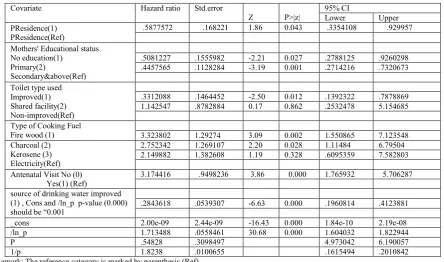
This result is in accordance with Unger (2013). But other researchers depicts that source of drinking water has no significant effect on child mortality. ( Abdul Hamid Chowdhury 1, Mohammad Emdad Hossian 2, Md. Musa Khan 3,Mohammad Nazmul Hoq 4, Asian Journal of Social science and humanities, Bangladish Vol.2 No.2 May 2013). The estimated hazard ratio for children whose mother's attended antenatal visits during pregnancy when compared to those mothers who did not attend antenatal visit was 2.959 (95% CI:1.705-5.135) keeping effects of other covariates constant. That is, children whose mothers attended antenatal visits during pregnancy had 95.9% lower risk of child mortality than those who did not attend antenatal visit. In other words the risk of death for children, mother's who did not attend antenatal visit was 2.959 times relative to whose mother's attended antenatal visits during pregnancy. With regard to households' source of cooking fuel, the risk of dying for children with fire hood, charcoal and kerosene were 3.497, 2.688, and 2.326, respectively. These figures shows that the risk of death children whose house hold cooking type of fuel, fire hood is 3.497 times relative to households type of cooking fuels is electricity. In other words, after adjusting other covariates, the hazard of death of children with households use fire hood cooking is 3.497 times higher than households use electricity (adjusted HR=3.479, 95% Cl:1.424-8.588). The hazard death of children for household use charcoal cooking is 2.688 times higher than households use electricity (adjusted HR=2.688, 95% Cl:1.982-7.36). The hazard death children for households use kerosene cooking fuel is 2.326 times higher than households use electricity (adjusted HR=2.326,95% Cl:1.643-8.421). All these findings are consistent with Hala (2002), Klaauw and Wang (2004) and Jacoby and Wang (2003). As we can see from Table 3: the p-values associated with the likelihood ratio, Score and Wald test statistics are all less than 1% indicating goodness of the fitted model at 5% level of significance. According to the results in Table 5 above, the Weibull regression model with the smallest value of AIC and BIC seems to be the best fit of the two models. Nevertheless, the results of cox-snell were consistent with the results based
on Akaikie's information criterion. Thus, the Weibull regression model was preferable to discuss the effect of covariates on the survival of Child mortality in Ethiopia.
DISCUSSION
[image:4.595.78.523.76.338.2]The main aim of this study was to identify factors of child mortality in Ethiopia using the nationally representative of 2014, EDHS data. Both univariate and multivariate statistical analyses were employed to examine factors affecting child mortality. The analyses revealed that environmental variables were statistically significant effect on child mortality in Ethiopia. The variables influencing child mortality are mothers' educational status, source of drinking water, place of residence, household type of toilet used, type of cooking fuel and antenatal visits. But covariates like sex of child and place of delivery were not statistically significant on child mortality in Ethiopia. The findings of this study showed that children whose mothers attended antenatal visits during pregnancy had lower risk of child mortality than those who did not attend antenatal visits. A study in the Gaza Strip, occupied Palestinian territory, by Antai D. and Moradi T. (2010) found that newborn babies born to mothers who attended fewer than four antenatal sessions during pregnancy had a risk of dying that was almost twice that of those born to mothers who attended antenatal session four or more times. A study in Indonesia also revealed that the risk of children death was higher among women who did not attend antenatal care visits during pregnancy (Kamal S.M.M. (2012). A study in Ethiopia by Desta, M. (2011) showed that child mortality was associated with antenatal care follow-up: there was better survival with at least one antenatal care follow-up. Thus, antenatal care follow-up is a prominent predictor of survival time of children. The result of this study also showed that children whose parents used unprotected drinking water have less survival chance than those who use piped drinking water or improved source of drinking water. A study in China showed that access to safe water or sanitation reduces child mortality risks by about 34% in rural areas, which means access to safe water/sanitation, and immunization
Table 6. Parameter estimates of the final multivariate weibull regression model
Covariate Hazard ratio Std.error
Z P>|z|
95% CI
Lower Upper PResidence(1)
PResidence(Ref)
.5877572 .168221 1.86 0.043 .3354108 .929957
Mothers' Educational status No education(1)
Primary(2)
Secondary&above(Ref)
.5081227 .1555982 -2.21 0.027 .2788125 .9260298 .4457565 .1128284 -3.19 0.001 .2714216 .7320673
Toilet type used Improved(1) Shared facility(2) Non-improved(Ref)
.3312088 .1464452 -2.50 0.012 .1392322 .7878869 1.142547 .8782884 0.17 0.862 .2532478 5.154685
Type of Cooking Fuel
Fire wood (1) 3.323802 1.29274 3.09 0.002 1.550865 7.123548
Charcoal (2) Kerosene (3) Electricity(Ref)
2.752342 1.269107 2.20 0.028 1.11484 6.79504 2.149882 1.382608 1.19 0.328 .6095359 7.582803
Antenatal Visit No (0) Yes(1) (Ref)
3.174416 .9498236 3.86 0.000 1.765932 5.706287
source of drinking water improved (1) , Cons and /ln_p p-value (0.000) should be “0.001
.2843618 .0539307 -6.63 0.000 .1960814 .4123881
_cons 2.00e-09 2.44e-09 -16.43 0.000 1.84e-10 2.19e-08 /ln_p 1.713488 .0558461 30.68 0.000 1.604032 1.822944
P .54828 .3098497 4.973042 6.190057
1/p 1.8238 .0100655 .1615494 .2010842
reduce diarrhea incidence in rural areas (Jacoby and Wang (2003)). In Kenya, Mutunga (2004) found that child survival was found better for those who had access to safe drinking water and sanitation facilities. A study in Egypt by Hala (2002) showed that access to municipal water decreases sanitary risks. Access to municipal water and improved sanitation facilities had significant positive impact on children mortality (Unger (2013)). Therefore, higher mortality rates are experienced in households that have access to unprotected source of drinking water drinking water. The probability of dying child for females compared to males found in this study was the same. It was not significant impact on environmental determinant of child mortality. But other study showed that there is a significant impact on child mortality. Likewise, more boys die before their first birth day than girls in Kenya (Hill et al., 2001).
Conclusion
The study employed survival statistical analysis to determine risk factors associated with child mortality in Ethiopia. Both Cox Proportional hazard model and Weibull regression model analysis techniques have been applied to identify the important predictors of child survival. The results from the Kaplan-Meier estimate showed that most of the deaths occurred during the first birth days of life. Results based on Proportional Hazards model and weibull model revealed that environmental factors had statistically significant effect on child mortality. Specifically, the study demonstrated that various factors such as mothers' education, household source of drinking water, antenatal visit, place of delivery, type of cooking fuel and type of toilet used had statistically significant impacts on the survival experience of children. But covariates like sex of child and place of residence were insignificant on survival of child. The two parametric regression models: Exponential and Weibull regression models, for survival probability of children were compared.
The Weibull regression model was found to better fit to the data. The findings further suggested the following: Mothers' educational and households source of drinking water had a significant effect on survival of child, that is, child mothers' who had primary, secondary and above educational level were lower risk of mortality than mothers' who had no education level. Children whose parents use non-improved has less survival chance than those who use improved source of drinking water. With regard to source of cooking fuel, children born in households using high polluting fuels (fire woods and charcoal) as their main source of cooking fuel have higher mortality rates as compared to those using low polluting fuels (electricity). Children born in household with either flush toilets or pit latrines have lower mortality rate than those born in households without any toilet facility.
Ethical consideration: This work has been approved by the
ethical review committee of University of Gondar, Collage of Natural, and Computational Sciences.
REFERENCES
Abdul et.al 2013. "Environmental determinants of Under-Five Mortality" Asian Journal of Social Science and Humanities, 2(2).
Antai D. and Moradi T. 2010. Urban Area Disadvantage and Under-5 Mortality in Nigeria: The Effect of Rapid
Urbanization. Environ Health Perspect, 118(6),877–883.
Collett, D. 2003. Modelling survival data in medical research,
Second edition. Chapman and Hall/CRC, London.
Cox, D. R., and Snell, E. J. 1968. A general definition of residuals
with discussion. Journal of the Royal Statistical Society. Series
B 30 (1968), 248-275.
Cox, D.R. 1972. “Regression models and life Tables (with
Discussion).” Journal of the Royal Statistical Society, 34:
187-220.
Desta, M., 2011. Infant & Child Mortality in Ethiopia: The role of Socioeconomic, Demographic and Biological factors in the previous five years period of 2000 and 2005.
Ethiopian Demographic and Health Survey 2011. Addis Ababa, Ethiopia.
Hala A. 2002. “The effect of water and sanitation on child mortality in Egypt”.
Hill, K., Bicego, J. and Mahy, M. 2011. Childhood mortality in Kenya: An examination of trends and determinants in the late 1990s to mid 2008s.
Hmwe H. et al. 2013. Association of Urban Slum Residency with Infant Mortality and Child Stunting in Low and Middle Income Countries.
Hosmer, D.W. and Lemeshow S. 1999. Applied Survival Analysis.
John Wiley and Sons, Inc., New York.
Hosmer, D.W., Lemeshow, S. and May, S. 2008. Applied survival analysis regression modeling of time to event data. John Wiley and Sons, Inc., New York.
Jacoby, H. and L. Wang (2003) “Environmental Determinants of Child Mortality in Rural China: A Competing Risks Approach” World Bank, Washington D.C.
Kabir M, Amin R. 2013. Factors influencing child mortality in Bangladesh and their implications for the National Health Programme. Asia-Pacific Population Journal: 8(3): 31-46. Kamal S.M.M. 2012. Maternal Education as a Determinant of
Neonatal Mortality in Bangladesh. Journal of Health
Management 14(3): 269–281.
Kaplan EL, Meier P. 1958. Nonparametric estimation from
incomplete observations. J Am Stat Assoc 1958; 53:457-81.
Klaauw, van der B. and L. Wang 2003. Child Mortality in Rural India‘, World Bank Working Paper, Washington DC: World Bank.
Kumar, PP., File G. 2010. Infant and Child Mortality in Ethiopia:
A Statistical Analysis Approach, Ethiopian Journal of
Education and Science, 5(2):51-7.
Kyei, Kwabena A., (2012), “Determinants of Childhood Mortality in South Africa: Using Categorical Data Modelling”, Journal of Human Ecology 37 (47– 56).
Mutunga CJ. 2004. Environmental determinants of child mortality in Urban Kenya. Abdus Salam ICTP; Trieste. Unger, A. 2013. Children‘s health in slum settings. Arch Dis
Child. Doi: 10.1136/archdischild- 2011 -301621.
UNICEF 2012. Situation Analysis of children and women in Kenya.
UNICEF 2012. Levels & Trends in Child mortality, estimate developed by the UN Inter_agency group for Child Mortality Estimation.
UNICEF 2013. “Levels & Trends in Child Mortality”, United Nations Children’s Fund
Weibull, W. 1939. A Statistical Theory of the Strength of Materials. Ingenioers vetenskaps akakemien Handlingar, 151, 29 3-297.
Weibull, W. 1951. A Statistical Distribution of Wide Applicability. Journal of Applied Mathematics, 18, 29 3-297. WHO. 2010. Countdown to 2015 decade report (2000-2010):
Taking stock of maternal, newborn and child survival. Geneva, Switzerland.
World Data Bank 2013. World Development Indicators. The World Bank Group.