doi:10.4236/ajcm.2011.12014 Published Online June 2011 (http://www.scirp.org/journal/ajcm)
Numerical Solution of Nonlinear Fredholm-Volterra
Integtral Equations via Piecewise Constant Function by
Collocation Method
Ahmad Shahsavaran
Faculty of Science, Islamic Azad University, Borujerd Branch, Borujerd, Iran E-mail: [email protected]
Received March 26, 2011; revised April 17, 2011; accepted May 10, 2011
Abstract
In this work, we present a computational method for solving nonlinear Fredholm-Volterra integral equations of the second kind which is based on replacement of the unknown function by truncated series of well known Block-Pulse functions (BPfs) expansion. Error analysis is worked out that shows efficiency of the method. Finally, we also give some numerical examples.
Keywords: Nonlinear Fredholm-Volterra Integral Equation, Block-Pulse Function, Error Analysis, Collocation Points
1. Introduction
The integral equation method is widely used for solving many problems in mathematical physics and engineering. This article proposes a computational method for solving nonlinear Fredholm-Volterra integral equations. Several numerical methods for approximating the solution of linear and nonlinear integral equations and specially Fredholm- Volterra integral equations are known [1-10]. Also, Block- Pulse functions are studied by many authors and applied for solving different problems. In presented paper, by using vector forms of BPfs, the main problem can be easily re-duced to a nonlinear system of algebraic equations which can be solved by Newton’s iterative method.
2. Review of Some Related Papers
Some computational methods for approximating the so-lution of linear and nonlinear integral equations are known. The classical method of successive approxima-tion for Fredholm-Hammerstein integral equaapproxima-tions was introduced in [3]. Brunner in [4] applied a collocation type method and Ordokhani in [8] applied rationalized Haar function to nonlinear Volterra-Fredholm-Hammer-stein integral equations. A variation of the Nystrom me- thod was presented in [5]. A collocation type method was developed in [6]. The asymptotic error expansion of a collocation type method for volterra-Hammerstein
in-tegral equations has been considered in [7]. Yousefi in [9] applied Legendre wavelets to a special type of nonlinear Volterra-Fredholm integral equations of the form.
1 0 1
1 2 0
( ) ( ) ( , ) ( ( ))d ( , ) ( ( ))d , 0 , 1,
t
u t f t K t x F u x x
K t x G u x x x t
2
(1)where f t( ), and K t x1( , ) and K t x2( , ) are assumed to be in L R2( ) on the interval 0x, t1. Yalcinbas in [10] used Taylor polynomials for solving Equation (1) with
( ) p
F u u and G u( )uq . Orthogonal functions and polynomials receive attention in dealing with various problems that one of those in integral equation. The main characteristic of using orthogonal basis is that it reduces these problems to solving a system of nonlinear algebraic equations. The aim of this work is to present a numerical method for approximating the solution of nonlinear Fred-holm-Volterra integral equation of the form:
1 0 1
1 2 0
( ) ( ) ( , )( ( )) d ( , )( ( )) d , 0 , 1,
t m
n
u t f t K t x u x x
K t x u x x x t
2
(2)where m and n are nonnegative integers and 1 and 2
are constants. For this purpose we define a k-set of BPfs as
1
1, , for all 1, 2, , ( )
0, elsewhere
i
i i
t i
B t k k
k
A. SHAHSAVARAN ET AL. 135
j
The functions are disjoint and orthogonal. That is, ( ) r B t 0, ( ) ( ) ( ), j i i i B t B t
B t i j
(4)
0,
( ) ( ) 1
, i j
i j
B t B t
i j k
(5)
A function defined over the interval [0, 1) may be expanded as:
( ) u t
1
( ) i i( ) i
u t u B t
. (6)In practice, only k-term of (6) are considered, where k is a power of 2, that is,
1
( ) ( ) ( )
k
k i
i
u t u t u B t
it
)
, (7)
with matrix from:
( ) k( ) t ( )
u t u t u B t
t
, (8) where, u[ , ,u1 u2 ,uk] and
1 2
( )t [B t( ), ( ),B t ,B tk( )]t B
m
.
In a similar manner, [ ( can be approximated in term of BPfs
)]
u t
[ ( )]u t m u Bt ( )t u
,
that we need to calculate vector whose elements are nonlinear combination of the elements of the vector u For this purpose, we can write
( ) ( )
u t u Bt t and [ (u t)]m u Bt ( )t . So,
( )t [ ( )]m
u Bt u Bt (9) now using (4) leads to
1
2
( ) 0
( ) ( ) ( )
0 k(
B t B t t t B t t B B
also from (3) we get 1
0 t k
implies that B t1( )1 and B ti( )0 for
. 2, ,
i k
1 t k k
2
implies that B t2( )1 and B ti( )0 for
and . 1, ,
i k i2 1 1 k t k
implies that B tk( )1 and B ti( )0 for
. Therefore, simply we obtain 1, , 1
i k
1 ( )t ( )dt t
k
1B B I0
t , (10)
where, is the identity matrix of order k. By incorporat-ing these results we have
I
1 1
0 ( ) ( )d 0[ ( )d
t t t t t t
k t t t k t
I
u u u B B u B(t) mB t. Hence, 1 0 1 1 1 1 1
( )] ( )d
( )] ( )d
( )] [ ( ) ( )]d
t t m
i k t m k i i k i k
t m t
k i
i k
k t t t
k t t t
k t t
t tu u B B
u B B
u B u B B t
[
[
[ t t
. (11)
So using (11) leads to
1 1 1 2 0 1 0 [ , , , ] 0 m t k k
k u u u
u . 1 2 1 2 1 2 1 1 0 0[ , , , ] 0 d
0 0
0 1 [ , , , ] 0
0 k m k k k
u u u t
k u u u
. 1 2 1 11 1 2
0 0
1
[ , , , ] 0 d
0 0 0 0 [ , , , ] 0 1 k m k k k
u u u t
k u u u
. 1 2 0 0 0[ , , , ] d
0
0 1
k
u u u t
2 1
1 1
1 1 1 2 2
0
1 1
1 1 2
[ 0, , 0]d [0, , , 0]d
[0, , 0, ]d [ , , , ]
m k m
k
k
m m m
k m m m
k
k u u t k u u t
k u u t u u u
m
t
Now for evaluating the integral at the
collocation points 0
( ) ( )d
t t
t t
B B1 2 j j t k
, j1, 2,,k, (12)
we may proceed as follows
1/ 2 1
0 0 0
2
1
1 1/ 2
2 1
1
2 0
1
( ) ( ) ( ) ( )d ( ) ( )d
( ) ( )d
( ) ( )d ( ) ( )d
0 0
1d 0
1d 0
0
0 0 0 0
j
j
t t t
k k t k k j j t t k k j j k k k k k
t t dt t t t t t t
t t t
t t t t t t
t t
B B B B B B
B B
B B B B
t 1 2 1/ 2 1 0 0 0 1d 0 0 0 0 0 0 0 1 1d 0 0 0 j k j k j j k j k t t k
D (13) where, 1[1, 1, , , 0, , 0] 2 j k k Diag D ,
in fact, the diagonal matrix Dj, is defined
as follows :
1, 2, ,
j
1, 1, 2, 1,
1
, ,
2
0, 1, , .
j mn
m n j
m n j
m n j k
D 2
Also, 2 may be approximated as: ( , ) [0, 1)
K x t L
k k
1 1
( , ) ij i( ) j( )
i j
K x t K B x B t
,or in matrix form
( , ) t( ) ( )
K x t B xKBt , (14) where K[Kij]1i j k, and
1 1 2
0 0 ( , ) ( )
ij i j
K k
K x t B xB .( )d dt x t
3. Solution of the Nonlinear Fredholm-
Volterra Integral Equations
In order to use BPfs for solving nonlinear Fredholm- Voterra integral equations given in Equation (2), we first approximate the u t( ), f t( ), ( ( ))u x m, ( ( ))u x n, K t1( ,
)
x and K t x2( , ) with respect to BPfs ( ) ( ) u t B t u
t t
(15)
( ) ( ) f t B t f ( ( ))m t (
u x u B x
(16)
1 )
( ( ))u x n u Bt ( )x
(17)
2
( , ) t( )
(18)
1 1 ( )
K t x B t KB x ( , ) t( ) ( )
(19)
2 2
K t x B t K B x (20) where k-vectors , , 1, 2, and matrices
and are BPfs coefficients of ,
u f u u k k
( ) u t 1
K K2 f t( ),
, , 1
( ( )u x)m ( ( )u x)n K t x( , ) and K t x2( , ) respectively. For solving Equation (2), we substitute (15-20) into (2), therefore
1 1
2 2 2
( ) ( ) ( ) ( ) ( )d
( ) ( ) ( )d
t t t t
t t
t t t x x
t x x x
tB u B f B K B B u
B K B B u
0 1 0 1 x k
, (21)
We now collocate Equation (21) at k points ti , 1, 2, ,
j defined by (12) as
1 1
2 2 2
( ) ( ) ( ) ( ) ( )d
( ) ( ) ( )d
t t t t
j j j
t t
j
t t t x x
t x x x
j tB u B f B K B B u
B K B B u
0 1 0 1 x (22)
by using (10) and (13) and the fact that ( )Btj ej
where, ej is the j-th column of the identity matrix of
order k, Equation (22) may then be restated as
1 2
1 1 2 2 j1, 2,,k
t j t
j i j j
u f
k k
e K D u e K u , . (23)
A. SHAHSAVARAN ET AL. 137 Table 1.
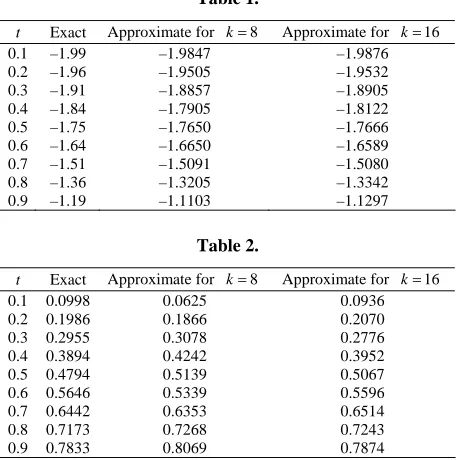
t Exact Approximate for k8 Approximate for k16
0.1 –1.99 –1.9847 –1.9876
0.2 –1.96 –1.9505 –1.9532
0.3 –1.91 –1.8857 –1.8905
0.4 –1.84 –1.7905 –1.8122
0.5 –1.75 –1.7650 –1.7666
0.6 –1.64 –1.6650 –1.6589
0.7 –1.51 –1.5091 –1.5080
0.8 –1.36 –1.3205 –1.3342
0.9 –1.19 –1.1103 –1.1297
Table 2.
t Exact Approximate for k8 Approximate for k16
0.1 0.0998 0.0625 0.0936
0.2 0.1986 0.1866 0.2070
0.3 0.2955 0.3078 0.2776
0.4 0.3894 0.4242 0.3952
0.5 0.4794 0.5139 0.5067
0.6 0.5646 0.5339 0.5596
0.7 0.6442 0.6353 0.6514
0.8 0.7173 0.7268 0.7243
0.9 0.7833 0.8069 0.7874
be solved for the elements using Newton’s iterative method.
1
u
4. Error in BPfs Approximation
Theorem. If a differentiable function with bounded first derivative on (0, 1) is represented in a
se-ries of BPfs over subinterval
( ) u t
1 [i , i)
k k
, we have
1 ( ) ( )
e t O
k
, where e t( )u tk( )u t( ).
Proof. See [1].
5. Illustrative Examples
Consider the following nonlinear volterra-Fredholm in-tegral equations.
Example 1.
6 4 2
1 2
0 0
1 1 5 5
( )
30 3 3 4
t( )[ ( )] ( )[ ( )] ,
u t t t t t
t x u x dx t x u x dx
0t, x1.
We applied the method presented in this paper for solving Equation (2) with k8 and k16.
The computational results together with the exact so-lution u t( ) t2 2 are given in Table 1.
Example 2.
2 0
1 1 1
( ) sin sin 2 [ ( )] d
8 4 2
t
u t t t t
u x x, 0t,x1.The computational results with k8 and k16 together with the exact solution are given in Table 2.
( ) u t sint
6. Conclusions
The aim of present work is to apply a method for solving the nonlinear Volterra-Fredholm integral equations. The properties of the Block Pulse functions together with the collocation method are used to reduce the problem to the solution of nonlinear algebraic equations. Example 1 is solved in [2] using Chebyshev expansion method (Cem), comparing the results shows Cem is more accurate than BPfs method But, it seems the number of calculations of BPfs method is lower. Also, the benefits of this method are low cost of setting up the equations due to properties of BPfs mentioned in Section 2. In addition, the nonlin-ear system of algebraic equations is sparse. Finally, this method can be easily extended and applied to nonlinear Volterra-Fredholm integral equations of the form Equa-tion (1). Illustrative examples are included to demon-strate the validity and applicability of the technique.
7. References
[1] A. Shahsavaran, E. Babolian, “Numerical Implementation of an Expansion Method for Linear Volterra Integral Equations of the Second Kind with Weakly Singular Kernels,” International Journal of Applied Mathematics, Vol. 3, No. 1, 2011, pp. 1-8.
[2] E. Babolian, F. Fattahzadeh and E. G. Raboky, “A Che-byshev Approximation for Solving Nonlinear Integral Equations of Hammerstein Type,” Applied Mathematics and Computation Vol. 189, No. 1, 2007, pp. 641-646.
doi:10.1016/j.amc.2006.11.181
[3] F. G. Tricomi, “Integral equations”, Dover, 1982.
[4] H. Brunner, “Implicity Linear Collocation Method for Nonlinear Volterra Equations,” Applied Numerical Ma- thematics, Vol. 9, No. 3-5, 1982, pp. 235-247.
doi:10.1016/0168-9274(92)90018-9
[5] L. J. Lardy, “A Variation of Nysrtom’s Method for Hammerstein Integral Equations,” Journal of Integral Equations, Vol. 3, No. 1, 1982, pp. 123-129.
[6] S. Kumar, I. H. Sloan, “A New Collocation—Type Method for Hammerstein Integral Equations,” Journal of Computational Mathematics, Vol. 48, No. 178, 1987, 585-593.
[7] H. Guoqiang, “Asymptotic Error Expansion Variation of A Collocation Method for Volterra—Hammerstein equa-tions,” Applied Numerical Mathematics, Vol. 13, No. 5, 1993, pp. 357-369. doi:10.1016/0168-9274(93)90094-8
[image:4.595.58.286.85.315.2]Volterra-Fred-holm-Hammerstein Integral Equations Via Rationalized Haar Functions,”Applied Mathematics and Computation, Vol. 180, No. 2, 2006, pp. 436-443.
doi:10.1016/j.amc.2005.12.034
[9] S. Yousefi and M. Razzaghi, “Legendre Wavelet Method for the Nonlinear Volterra-Fredholm Integral Equations,”
Mathematics and Computers in Simulation, Vol. 70, No.
1, 2005, pp. 1-8. doi:10.1016/j.matcom.2005.02.035
[10] S. Yashilbas, “Taylor Polynomial Solution of Non- linear Volterra-Fredholm Integral Equations,” Ap-plied Mathematics and Computation, Vol. 127 No. 2-3, 2002, pp. 195-200.