Open IE as an Intermediate Structure for Semantic Tasks
Gabriel Stanovsky† Ido Dagan‡ Mausam§
†,‡Department of Computer Science, Bar-Ilan University
§Department of Computer Science & Engg, Indian Institute of Technology, Delhi †[email protected]
‡[email protected] §[email protected]
Abstract
Semantic applications typically extract in-formation from intermediate structures de-rived from sentences, such as dependency parse or semantic role labeling. In this pa-per, we study Open Information Extrac-tion’s (Open IE) output as an additional in-termediate structure and find that for tasks such as text comprehension, word similar-ity and word analogy it can be very effec-tive. Specifically, for word analogy, Open IE-based embeddings surpass the state of the art. We suggest that semantic applica-tions will likely benefit from adding Open IE format to their set of potential sentence-level structures.
1 Introduction
Semantic applications, such as QA or summa-rization, typically extract sentence features from a derived intermediate structure. Common in-termediate structures include: (1) Lexical repre-sentations, in which features are extracted from the original word sequence or the bag of words, (2) Stanford dependency parse trees (De Marneffe and Manning, 2008), which draw syntactic rela-tions between words, and (3) Semantic role label-ing (SRL), which extracts frames linklabel-ing predi-cates with their semantic arguments (Carreras and M`arquez, 2005). For instance, a QA application can evaluate a question and a candidate answer by examining their lexical overlap (P´erez-Couti˜no et al., 2006), by using short dependency paths as features to compare their syntactic relationships (Liang et al., 2013), or by using SRL to compare their predicate-argument structures (Shen and La-pata, 2007).
In a seemingly independent research direction, Open Information Extraction (Open IE) extracts coherent propositions from a sentence, each com-prising a relation phrase and two or more argument
phrases (Etzioni et al., 2008; Fader et al., 2011; Mausam et al., 2012). We observe that while Open IE is primarily used as an end goal in itself (e.g., (Fader et al., 2014)), it also makes certain struc-tural design choices which differ from those made by dependency or SRL. For example, Open IE chooses different predicate and argument bound-aries and assigns different relations between them. Given the differences between Open IE and other intermediate structures (see Section 2), a re-search question arises: Can certain downstream applications gain additional benefits from utiliz-ing Open IE structures? To answer this question we quantitatively evaluate the use of Open IE out-put against other dominant structures (Sections 3 and 4). For each of text comprehension, word similarity and word analogy tasks, we choose a state-of-the-art algorithm in which we can easily swapthe intermediate structure while preserving the algorithmic computations over the features ex-tracted from it. We find that in several tasks Open IE substantially outperforms other structures, sug-gesting that it can provide an additional set of use-ful sentence-level features.
2 Intermediate Structures
In this section we review how intermediate struc-tures differ from each other, in terms of their im-posed structure, predicate and argument bound-aries, and the type of relations that they introduce. We include Open IE in this analysis, along with lexical, dependency and SRL representations, and highlight its unique properties. As we show in Section 4, these differences have an impact on the overall performance of certain downstream appli-cations.
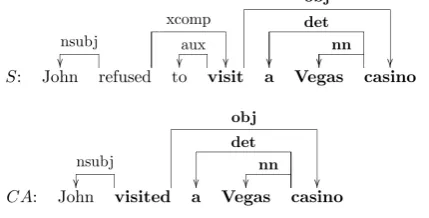
Lexical representations introduce little or no structure over the input text. Features for follow-ing computations are extracted directly from the original word sequence, e.g., word count statistics or lexical overlap (see Figure 1a).
Syntactic dependencies impose a tree structure (see Figure 1b), and use words as atomic elements. This structure implies that predicates are generally composed of a single word and that arguments are computed either as single words or as entire spans of subtrees subordinate to the predicate word.
In SRL (see Figure 1c), several non-connected frames are extracted from the sentence. The atomic elements of each frame consist of a single-word predicate (e.g., the different frames forvisit andrefused), and a list of its semantic arguments, without marking their internal structure. Each ar-gument is listed along with its semantic relation (e.g., agent, instrument, etc.) and usually spans several words.
Open IE (see Figure 1d) also extracts non-connected propositions, consisting of a predicate and its arguments. In contrast to SRL, argument relations are not analyzed, and predicates (as well as arguments) may consist of several consecu-tive words. Since Open IE focuses on human-readability, infinitive constructions (e.g., refused to visit), and multi-word predicates (e.g.,took ad-vantage) are grouped in a single predicate slot. Additionally, arguments are truncated in cases such as prepositional phrases and reduced rela-tive clauses. The resulting structure can be under-stood as an extension of shallow syntactic chunk-ing (Abney, 1992), where chunks are labeled as either predicates or arguments, and are then inter-linked to form a complete proposition.
It is not clear apriory whether the differences manifested in Open IE’s structure could be ben-eficial as intermediate structures for downstream applications. Although a few end tasks have made use of Open IE’s output (Christensen et al., 2013; Balasubramanian et al., 2013), there has been no systematic comparison against other structures. In the following sections, we quantitatively study and analyze the value of Open IE structures against the more common intermediate structures – lexi-cal, dependency and SRL, for three downstream NLP tasks.
3 Tasks and Algorithms
Comparing the effectiveness of intermediate struc-tures in semantic applications is hard for several reasons: (1) extracting the underlying structure de-pends on the accuracy of the specific system used, (2) the overall performance in the task depends heavily on the computations carried on top of these
S: John refused tovisit a Vegas casino
CA:Johnvisited a Vegas casino
(a) Lexical matching of a 5 words window (marked with a box). Current window yields a score of 4 - words contributing to the score are marked in bold.
(b) Dependency matching yields a score of 3. Contributing triplets are marked in bold.
S: refused0.1: A0: John A1: to visit a Vegas casino
visit0.1: A0: John A1: a Vegas casino
CA: visit0.1: A0: John A1: a Vegas casino
(c) SRL frames matching yields a score of 4, frame elements contributing to the score marked in bold.
S: (John, refused to visit,a Vegas casino) CA: (John, visited,a Vegas casino)
[image:2.595.310.525.139.248.2](d) Open IE matching yields a score of 2, contributing entries marked in bold.
Figure 1: Different intermediate structures used to compute the modified text comprehension match-ing score (Section 3), when answermatch-ing a question ”Where did John visit?”, given an input sentence S: ”John refused to visit a Vegas casino”, and a wrongcandidate answerCA: ”John visited a Ve-gas casino”.
structures, and (3) different structures may be suit-able for different tasks. To mitigate these com-plications, and comparatively evaluate the effec-tiveness of different types of structures, we choose three semantic tasks along with state-of-the-art al-gorithms that make a clear separation between fea-ture extraction and subsequent computation. We then compare performance by using features from four intermediate structures – lexical, dependency, SRL and Open IE. Each of these is extracted using state-of-the-art systems. Thus, while our compar-isons are valid only for the tested tasks and sys-tems, they do provide valuable evidence for the general question of effective intermediate struc-tures.
3.1 Text Comprehension Task
answer-Target Lexical Dependency SRL Open IE
refused
John nsubj John A0 John 0 John
to xcomp visit A1 to 1 to
visit A1 visit 1 visit
Vegas A1 Vegas 2 Vegas
Table 1: Some of the different contexts for the tar-get word “refused” in the sentence”John refused to visit Vegas”. SRL and Open IE contexts are pre-ceded by their element (predicate or argument) in-dex. See figure 1 for the different representations of this sentence.
ing. We use the MCTest corpus (Richardson et al., 2013), which is composed of short stories fol-lowed by multiple choice questions. The MCTest task does not require extensive world knowledge, which makes it ideal for testing underlying sen-tence representations, as performance will mostly depend on accuracy and informativeness of the ex-tracted structures.
We adapt the unsupervised lexical matching algorithm from the original MCTest paper. It counts lexical matches between an assertion ob-tained from a candidate answer (CA) and a sliding window over the story. The selected answer is the one for which the maximum number of matches are found. Our adaptation changes the algorithm to compute a modifiedmatching scoreby counting matches betweenstructure units. The correspond-ing units are either dependency edges, SRL frame elements or Open IE tuple elements. Figure 1 il-lustrates computations for a sentence - candidate answer pair.
3.2 Similarity and Analogy Tasks
Word similaritytasks deal with assessing the de-gree of ”similarity” between two input words. Tur-ney (2012) classifies two types of similarity: (1) domain similarity, e.g., carpenter is similar to wood, hammer, andnail, (2) functional similarity, in whichcarpenterwill be similar to other profes-sions, e.g.,shoemaker, brewer, mineretc. Several evaluation test sets exist for this task, each target-ing a slightly different aspect of similarity. While Bruni (2012), Luong (2013), Radinsky (2011), and ws353 (Finkelstein et al., 2001) can be largely categorized as targeting domain similarity, sim-lex999 (Hill et al., 2014) specifically targets func-tional aspects of similarity (e.g.,coastwill be sim-ilar to shore, while closet will not be similar to clothes). A related task isword analogy, in which
systems take three input words (A:A∗, B:?) and
output a wordB∗, such that the relation between
BandB∗ is closest to the relation betweenAand
A∗. For instance, queenis the desired answer for
the triple (man:king,woman:?).
Some recent state-of-the-art approaches to these two tasks derive a similarity score via arithmetic computations on word embeddings (Mikolov et al., 2013b). While original training of word em-beddings used lexical contexts (n-grams), recently Levy and Goldberg (2014) generalized this to ar-bitrary contexts, such as dependency paths. We use their software1 and recompute the word em-beddings using contexts from our four structures: lexical context, dependency paths, SRL’s seman-tic relations, and Open IE’s surrounding tuple ele-ments. Table 1 shows the different contexts for a sample word.
4 Evaluation
In our experiments we use MaltParser (Nivre et al., 2007) for dependency parsing, and ClearNLP (Choi and Palmer, 2011) for SRL.
To obtain Open-IE structures, we use the re-cent Open IE-4 system2which produces n-ary ex-tractions of both verb-based relation phrases using SRLIE (an improvement over (Christensen et al., 2011)) and nominal relations using regular expres-sions. SRLIE first processes sentences using SRL and then uses hand-coded rules to convert SRL frames and associated dependency parses to open extractions.
We choose these tools as they are on par with state-of-the-art in their respective fields, and there-fore represent the current available off-the-shelf intermediate structures for semantic applications. Furthermore, Open IE-4 is based on ClearNLP’s SRL, allowing for a direct comparison. For SRL systems, we take argument boundaries as their complete parse subtrees.3
Results on Text Comprehension Task We re-port results (in percentage of correct answers) on the whole of MC500 dataset (ignoring train-dev-test split) since all our methods are unsupervised. Figure 2 shows the accuracies obtained on the multiple-choice questions, categorized by single (the question can be answered based on a
sin-1https://bitbucket.org/yoavgo/word2vecf 2http://knowitall.github.io/openie/
3We tried an alternative approach which takes only the
Open IE Lexical Deps SRL bruni .757 .735 .618 .491 luong .288 .229 .197 .171 radinsky .681 .674 .592 .433 simlex .39 .365 .447 .306 ws353-rel .647 .64 .492 .551 ws353-sym .77 .763 .759 .439 ws353-full .711 .703 .629 .693
Table 2: Performance in word similarity tasks (Spearman’sρ)
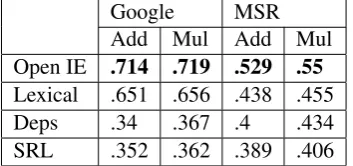
Google MSR
Add Mul Add Mul Open IE .714 .719 .529 .55
Lexical .651 .656 .438 .455 Deps .34 .367 .4 .434 SRL .352 .362 .389 .406
Table 3: Performance in word analogy tasks (per-centage of correct answers)
gle story sentence) ,multiple(multiple sentences needed) andall(single+multiple).4
In this task, we find that Open IE and depen-dency edges substantially outperform lexical and SRL. We conjecture that SRL’s weak performance is due to its treatment of infinitives and multi-word predicates as different propositions (see Section 2). This adds noise by wrongly counting partial matching between predications, as exemplified in Figure 1c. The gain over the lexical approach can be explained by the ability to capture longer range relations than the fixed size window.5 In our results Open IE slightly improves over depen-dency. This can be traced back to the different structural choices depicted in Section 2 – Open IE counts matches at the proposition level while the dependency variant may count path matches over unrelated sentence parts. The differences be-tween the performance of Open IE and all other systems were found to be statistically significant (p <0.01).
Results on Similarity and Analogy Tasks For these tasks, we train the various word embeddings
4As expected, all sentence-level intermediate structures
perform best on the singlepartition, yet results show that some of the questions from themultiplepartition may also be answered correctly using information from a single sentence.
5We experimented with various window sizes and found
that window size of the length of the current candidate-answer performed best.
on a Wikipedia dump (August 2013 dump), con-taining 77.5M sentences and 1.5B tokens. We used the default hyperparameters from Levy and Goldberg (2014): 300 dimensions, skip gram with negative sampling of size 5. Lexical embeddings were trained with 5-gram contexts. Performance is measured using Spearman’sρ, in order to assess the correlation of the predictions to the gold anno-tations, rather than comparing their values directly. Table 2 compares the results on theword similar-ity task using cosine similarity between embed-dings as the similarity predictor. For the ws353 test set we report results on the whole corpus (full) as well as on the partition suggested by (Agirre et al., 2009) into relatedness (mainly meronym-holonym) andsimilarity(synonyms, antonyms, or hyponym-hypernym).
We find that Open IE-based embeddings consis-tently do well; performing best across all test sets, except for simlex999. Analysis reveals that Open IE’s ability to represent multi-word predicates and arguments allows it to naturally incorporateboth notions of similarity. Context words originating from the same Open IE slot (either predicate or ar-gument) are lexically close and indicate domain-similarity, whereas context words from other ele-ments in the tuple express semantic relationships, and target functional similarity.
Thus, Open IE performs better on word-pairs which exhibit both topical and functional similar-ity, such as(latinist, classicist), or(provincialism, narrow-mindedness), which were taken from the Luong test set. Table 4 further illustrates this dual capturing of both types of similarity in Open IE space.
Our results also reiterate previous findings – lexical contexts do well on domain-similarity test sets (Mikolov et al., 2013b). The results on the simlex999 test set can be explained by its focus on functional similarity, previously identified as better captured by dependency contexts (Levy and Goldberg, 2014).
[image:4.595.94.271.221.304.2]simi-Figure 2: Performance in MCTest (percentage of correct answers).
lar to the word similarity tasks. To our knowl-edge, Open IE results on both analogy datasets surpass the state of the art. An example (from the Microsoft test set) which supports the observa-tion regarding Open IE embeddings space is ( gen-tlest:gentler, loudest:?), for which only Open IE answers correctly aslouder, while lexical respond with higher-pitched (domain similar to loudest), and dependency with thinnest (functionally sim-ilar to loudest). Our Open-IE embeddings are freely available6 and we note that these can serve as plug-in features for other NLP applications, as demonstrated in (Turian et al., 2010).
5 Conclusions
We studied Open IE’s output compared with other dominant structures, highlighting their main dif-ferences. We then conduct experiments and anal-ysis suggesting that these structural differences prove beneficial for certain downstream semantic applications. A key strength is Open IE’s ability to balance lexical proximity with long range depen-dencies in a single representation. Specifically, for the word analogy task, Open IE-based embeddings
6http://www.cs.bgu.ac.il/˜gabriels
Target Word Lexical Dependency Open IE
canine
dog feline dog
incisor bovine carnassial
dentition equine feline
parvovirus porcine fang-like
[image:5.595.74.298.62.204.2]dysplasia murine bovine
Table 4: Closest words tocaninein various word embeddings. Illustrating domain similarity (Lex-ical), functional similarity (Dependency), and a mixture of both (Open IE).
surpass all prior results. We conclude that an NLP practitioner will likely benefit from adding Open IE to their toolkit of potential sentence representa-tions.
Acknowledgments
This work was partially supported by the Israel Science Foundation grant 880/12, the German Research Foundation through the German-Israeli Project Cooperation (DIP, grant DA 1600/1-1), a Google Research Award to Ido Dagan, and Google’s Language Understanding and Knowl-edge Discovery Focused Research Award to Mausam.
References
Steven P Abney. 1992. Parsing by chunks.
Principle-based parsing, pages 257–278.
Eneko Agirre, Enrique Alfonseca, Keith Hall, Jana Kravalova, Marius Pas¸ca, and Aitor Soroa. 2009. A study on similarity and relatedness using
distribu-tional and wordnet-based approaches. In
Proceed-ings of Human Language Technologies: The 2009 Annual Conference of the North American Chap-ter of the Association for Computational Linguistics, pages 19–27. Association for Computational Lin-guistics.
Niranjan Balasubramanian, Stephen Soderland,
Mausam, and Oren Etzioni. 2013. Generating
coherent event schemas at scale. In Conference
on Empirical Methods in Natural Language Processing, pages 1721–1731.
Elia Bruni, Gemma Boleda, Marco Baroni, and Nam-Khanh Tran. 2012. Distributional semantics in
tech-nicolor. In Proceedings of the 50th Annual
Meet-ing of the Association for Computational LMeet-inguis- Linguis-tics: Long Papers-Volume 1, pages 136–145. Asso-ciation for Computational Linguistics.
Xavier Carreras and Llu´ıs M`arquez. 2005. Introduc-tion to the conll-2005 shared task: Semantic role
labeling. In Proceedings of The SIGNLL
Confer-ence on Computational Natural Language Learning (CoNLL), pages 152–164.
Jinho D Choi and Martha Palmer. 2011. Transition-based semantic role labeling using predicate
argu-ment clustering. In Proceedings of the ACL 2011
Workshop on Relational Models of Semantics, pages 37–45. Association for Computational Linguistics. Janara Christensen, Mausam, Stephen Soderland, and
Oren Etzioni. 2011. An analysis of open informa-tion extracinforma-tion based on semantic role labeling. In
[image:5.595.73.287.615.697.2]Janara Christensen, Mausam, Stephen Soderland, and Oren Etzioni. 2013. Towards coherent
multi-document summarization. In Conference of the
North American Chapter of the Association for Computational Linguistics Human Language Tech-nologies, pages 1163–1173.
Marie-Catherine De Marneffe and Christopher D Man-ning. 2008. The stanford typed dependencies
rep-resentation. In Coling 2008: Proceedings of the
workshop on Cross-Framework and Cross-Domain Parser Evaluation, pages 1–8.
Oren Etzioni, Michele Banko, Stephen Soderland, and Daniel S Weld. 2008. Open information
extrac-tion from the Web. Communications of the ACM,
51(12):68–74.
Anthony Fader, Stephen Soderland, and Oren Etzioni. 2011. Identifying relations for open information
ex-traction. In Proceedings of the Conference on
Em-pirical Methods in Natural Language Processing, pages 1535–1545. Association for Computational Linguistics.
Anthony Fader, Luke Zettlemoyer, and Oren Etzioni. 2014. Open question answering over curated and
extracted knowledge bases. In The 20th ACM
SIGKDD International Conference on Knowledge Discovery and Data Mining, KDD ’14, New York, NY, USA - August 24 - 27, 2014, pages 1156–1165. Lev Finkelstein, Evgeniy Gabrilovich, Yossi Matias,
Ehud Rivlin, Zach Solan, Gadi Wolfman, and Ey-tan Ruppin. 2001. Placing search in context: The concept revisited. InProceedings of the 10th inter-national conference on World Wide Web, pages 406– 414. ACM.
Felix Hill, Roi Reichart, and Anna Korhonen. 2014. Simlex-999: Evaluating semantic models with
(genuine) similarity estimation. arXiv preprint
arXiv:1408.3456.
Omer Levy and Yoav Goldberg. 2014.
Dependency-based word embeddings. InProceedings of the 52nd
Annual Meeting of the Association for Computa-tional Linguistics, volume 2.
Percy Liang, Michael I. Jordan, and Dan Klein. 2013. Learning dependency-based compositional seman-tics. Computational Linguistics, 39(2):389–446. Minh-Thang Luong, Richard Socher, and
Christo-pher D. Manning. 2013. Better word representa-tions with recursive neural networks for morphol-ogy. The SIGNLL Conference on Computational Natural Language Learning (CoNLL), 104.
Mausam, Michael Schmitz, Stephen Soderland, Robert Bart, and Oren Etzioni. 2012. Open language
learn-ing for information extraction. In Proceedings of
the 2012 Joint Conference on Empirical Methods in Natural Language Processing and Computational Natural Language Learning, pages 523–534, Jeju Island, Korea, July. Association for Computational Linguistics.
Tomas Mikolov, Kai Chen, Greg Corrado, and Jeffrey Dean. 2013a. Efficient estimation of word
rep-resentations in vector space. In Workshop at The
International Conference on Learning Representa-tions (ICLR).
Tomas Mikolov, Wen-tau Yih, and Geoffrey Zweig. 2013b. Linguistic regularities in continuous space
word representations. In Conference of the North
American Chapter of the Association for Computa-tional Linguistics Human Language Technologies, pages 746–751.
Joakim Nivre, Johan Hall, Jens Nilsson, Atanas Chanev, G¨ulsen Eryigit, Sandra K¨ubler, Svetoslav Marinov, and Erwin Marsi. 2007. Maltparser: A language-independent system for data-driven
de-pendency parsing. Natural Language Engineering,
13(02):95–135.
Manuel P´erez-Couti˜no, Manuel Montes-y G´omez, Au-relio L´opez-L´opez, and Luis Villase˜nor-Pineda.
2006. The role of lexical features in Question
An-swering for Spanish. Springer.
Kira Radinsky, Eugene Agichtein, Evgeniy
Gabrilovich, and Shaul Markovitch. 2011. A word at a time: computing word relatedness using
temporal semantic analysis. In Proceedings of the
20th international conference on World wide web, pages 337–346. ACM.
Matthew Richardson, Christopher JC Burges, and Erin Renshaw. 2013. Mctest: A challenge dataset for the open-domain machine comprehension of text. In
Conference on Empirical Methods in Natural Lan-guage Processing, pages 193–203.
Dan Shen and Mirella Lapata. 2007. Using semantic
roles to improve question answering. In
EMNLP-CoNLL 2007, Proceedings of the 2007 Joint Con-ference on Empirical Methods in Natural Language Processing and Computational Natural Language Learning, June 28-30, 2007, Prague, Czech Repub-lic, pages 12–21.
Joseph Turian, Lev Ratinov, and Yoshua Bengio. 2010. Word representations: a simple and general method for semi-supervised learning. InProceedings of the 48th annual meeting of the association for compu-tational linguistics, pages 384–394. Association for Computational Linguistics.
Peter D Turney. 2012. Domain and function: A dual-space model of semantic relations and compositions.