Dependency Recurrent Neural Language Models for Sentence Completion
Piotr Mirowski Google DeepMind
Andreas Vlachos University College London [email protected]
Abstract
Recent work on language modelling has shifted focus from count-based models to neural models. In these works, the words in each sentence are always considered in a left-to-right order. In this paper we show how we can improve the performance of the recurrent neural network (RNN) lan-guage model by incorporating the syntac-tic dependencies of a sentence, which have the effect of bringing relevant contexts closer to the word being predicted. We evaluate our approach on the Microsoft Research Sentence Completion Challenge and show that the dependency RNN pro-posed improves over the RNN by about 10 points in accuracy. Furthermore, we achieve results comparable with the state-of-the-art models on this task.
1 Introduction
Language Models (LM) are commonly used to score a sequence of tokens according to its prob-ability of occurring in natural language. They are an essential building block in a variety of applica-tions such as machine translation, speech recogni-tion and grammatical error correcrecogni-tion. The stan-dard way of evaluating a language model has been to calculate its perplexity on a large corpus. How-ever, this evaluation assumes the output of the lan-guage model to be probabilistic and it has been observed that perplexity does not always correlate with the downstream task performance.
For these reasons, Zweig and Burges (2012) proposed the Sentence Completion Challenge, in which the task is to pick the correct word to com-plete a sentence out of five candidates. Perfor-mance is evaluated by accuracy (how many sen-tences were completed correctly), thus both prob-abilistic and non-probprob-abilistic models (e.g. Roark
et al. (2007)) can be compared. Recent approaches for this task include both neural and count-based language models (Zweig et al., 2012; Gubbins and Vlachos, 2013; Mnih and Kavukcuoglu, 2013; Mikolov et al., 2013).
Most neural language models consider the to-kens in a sentence in the order they appear, and the hidden state representation of the network is typically reset at the beginning of each sen-tence. In this work we propose a novel ral language model that learns a recurrent neu-ral network (RNN) (Mikolov et al., 2010) on top of the syntactic dependency parse of a sen-tence. Syntactic dependencies bring relevant con-texts closer to the word being predicted, thus en-hancing performance as shown by Gubbins and Vlachos (2013) for count-based language models. Our Dependency RNN model is published simul-taneously with another model, introduced in Tai et al. (2015), who extend the Long-Short Term Mem-ory (LSTM) architecture to tree-structured net-work topologies and evaluate it at sentence-level sentiment classification and semantic relatedness tasks, but not as a language model.
Adapting the RNN to use the syntactic depen-dency structure required to reset and run the net-work on all the paths in the dependency parse tree of a given sentence, while maintaining a count of how often each token appears in those paths. Fur-thermore, we explain how we can incorporate the dependency labels as features.
Our results show that the dependency RNN lan-guage model proposed outperforms the RNN pro-posed by Mikolov et al. (2011) by about 10 points in accuracy. Furthermore, it improves upon the count-based dependency language model of Gub-bins and Vlachos (2013), while achieving slightly worse than the recent state-of-the-art results by Mnih and Kavukcuoglu (2013). Finally, we make the code and preprocessed data available to facili-tate comparisons with future work.
2 Dependency Recurrent Neural Network
Count-based language models operate by assign-ing probabilities to sentences by factorizassign-ing their likelihood into n-grams. Neural language mod-els further embed each word w(t) into a low-dimensional vector representation (denoted by
s(t))1. These word representations are learned as the language model is trained (Bengio et al., 2003) and enable to define a word in relation to other words in a metric space.
Recurrent Neural Network Mikolov et al. (2010) suggested the use of Recurrent Neural Net-works (RNN) to model long-range dependencies between words as they are not restricted to a fixed context length, like the feedforward neural net-work (Bengio et al., 2003). The hidden representa-tions(t)for the word in positiontof the sentence in the RNN follows a first order auto-regressive dynamic (Eq. 1), whereW is the matrix connect-ing the hidden representation of the previous word
s(t−1)to the current one,w(t)is the one-hot in-dex of the current word (in a vocabulary of sizeN words) andUis the matrix containing the embed-dings for all the words in the vocabulary:
s(t) =f(Ws(t−1) +Uw(t)) (1) The nonlinearityf is typically the logistic sigmoid functionf(x) = 1
1+exp(−x). At each time step, the
RNN generates the word probability vector y(t)
for the next wordw(t+ 1), using the output word embedding matrixVand the softmax nonlinearity g(xi) = Pexp(xi)
iexp(xi):
y(t) =g(Vs(t)) (2)
RNN with Maximum Entropy Model Mikolov et al. (2011) combined RNNs with a maximum en-tropy model, essentially adding a matrix that di-rectly connects the input words’ n-gram context
w(t −n + 1, . . . , t) to the output word proba-bilities. In practice, because of the large vocab-ulary sizeN, designing such a matrix is computa-tionally prohibitive. Instead, a hash-based imple-mentation is used, where the word context is fed through a hash function h that computes the in-dexh(w(t−n+ 1, . . . , t))of the context words
1In our notation, we make a distinction between the word
tokenw(t)at positiontin the sentence and its one-hot vector representationw(t). We notewithe i-th word token on a breadth-first traversal of a dependency parse tree.
in a one-dimensional arraydof sizeD(typically, D = 109). Arraydis trained in the same way as
the rest of the RNN model and contributes to the output word probabilities:
y(t) =gVs(t) +dh(w(t−n+1,...,t)) (3)
As we show in our experiments, this additional matrix is crucial to a good performance on word completion tasks.
Training RNNs RNNs are trained using maxi-mum likelihood through gradient-based optimiza-tion, such as Stochastic Gradient Descent (SGD) with an annealed learning rate λ. The Back-Propagation Through Time (BPTT) variant of SGD enables to sum-up gradients from consecu-tive time steps before updating the parameters of the RNN and to handle the long-range temporal dependencies in the hidden s and output y se-quences. The loss function is the cross-entropy between the generated word distributiony(t)and the targetone-hotword distributionw(t+ 1), and involves the log-likelihood termslogyw(t+1)(t).
For speed-up, the estimation of the output word probabilities is done using hierarchical softmax outputs, i.e., class-based factorization (Mikolov and Zweig, 2012). Each wordwi is assigned to
a classci and the corresponding log-likelihood is
effectively logywi(t) = logyci(t) + logywj(t), where j is the index of word wi among words
belonging to class ci. In our experiments, we
binned the words found in our training corpus into 250 classes according to frequency, roughly corre-sponding to the square root of the vocabulary size.
Dependency RNN RNNs are designed to pro-cess sequential data by iteratively presenting them with wordw(t)and generating next word’s proba-bility distributiony(t)at each time step. They can be reset at the beginning of a sentence by setting all the values of hidden vectors(t)to zero.
Dependency parsing (Nivre, 2005) generates, for each sentence (which we note {w(t)}T
t=0), a
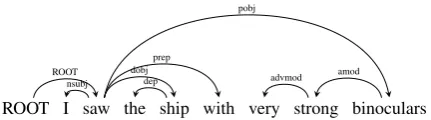
parse tree with a single root, many leaves and an unique path (also called unroll) from the root to each leaf, as illustrated on Figure 1. We now note {wi}ithe set of word tokens appearing in the parse
tree of a sentence. The order in the notation de-rives from the breadth-first traversal of that tree (i.e., the root word is notedw0). Each of the
ROOT I saw the ship with very strong binoculars nsubj
prep dobj
dep
pobj
[image:3.595.76.292.69.129.2]advmod amod ROOT
Figure 1: Example dependency tree
{wi}, starting from the single rootw0, that are
vis-ited when one takes a specific path on the parse tree. We propose a simple transformation to the RNN algorithm so that it can process dependency parse trees. The RNN is reset and independently run on each such unroll. As detailed in the next paragraph, when evaluating the log-probability of the sentence, a word tokenwi can appear in
mul-tiple unrolls but its log-likelihood is counted only once. During training, and to avoid over-training the network on word tokens that appear in more than one unroll (words near the root appear in more unrolls than those nearer the leaves), each word tokenwiis given a weight discountαi = n1i,
based on the number ni of unrolls the token
ap-pears in. Since the RNN is optimized using SGD and updated at every time-step, the contribution of word token wi can be discounted by multiplying
the learning rate by the discount factor:αiλ.
Sentence Probability in Dependency RNN
Given a word wi, let us define the ancestor
se-quence A(wi) to be the subsequence of words,
taken as a subset from {wk}ik−=01 and describing
the path from the root nodew0to the parent ofwi.
For example, in Figure 1, the ancestorsA(very)
of word tokenveryaresaw,binocularsand strong. Assuming that each word wi is
con-ditionally independent of the words outside of its ancestor sequence, given its ancestor sequence A(wi), Gubbins and Vlachos (2013) showed that
the probability of a sentence (i.e., the probability of a lexicalized treeST given an unlexicalized tree
T) could be written as:
P[ST|T] =
|S| Y
i=1
P[wi|A(wi)] (4)
This means that the conditional likelihood of a word given its ancestors needs to be counted only once in the calculation of the sentence likelihood, even though each word can appear in multiple un-rolls. When modeling a sentence using an RNN, the statesj that is used to generate the distribution
of wordswi(wherejis the parent ofiin the tree),
represents the vector embedding of the history of the ancestor words A(wi). Therefore, we count
the termP[wi|sj]only once when computing the
likelihood of the sentence.
3 Labelled Dependency RNN
The model presented so far does not use dependency labels. For this purpose we adapted the context-dependent RNN (Mikolov and Zweig, 2012) to handle them as additional M -dimensional label input featuresf(t). These fea-tures require a matrix F that connects label fea-tures to word vectors, thus yielding a new dynam-ical model (Eq. 5) in the RNN, and a matrix G
that connects label features to output word proba-bilities. The full model becomes as follows:
s(t) = f(Ws(t−1) +Uw(t) +Ff(t))(5)
y(t) = gVs(t) +Gf(t) +dh(wt t−n+1)
(6)
On our training dataset, the dependency parsing model foundM = 44distinct labels (e.g.,nsubj,
detorprep). At each time stept, the context word
w(t)is associated a single dependency labelf(t)
(a one-hot vector of dimensionM).
LetG(w)be the sequence of grammatical rela-tions (dependency tree labels) between successive elements of (A(w), w). The factorization of the sentence likelihood from Eq. 4 becomes:
P[ST|T] =Y|S| i=1
P[wi|A(wi), G(wi)] (7)
4 Implementation and Dataset
We modified the Feature-Augmented RNN toolkit2 and adapted it to handle tree-structured data. Specifically, and instead of being run se-quentially on the entire training corpus, the RNN is run on all the word tokens in all unrolls of all the sentences in all the books of the corpus. The RNN is reset at the beginning of each unroll of a sentence. When calculating the log-probability of a sentence, the contribution of each word token is counted only once (and stored in a hash-table specific for that sentence). Once all the unrolls of a sentence are processed, the log-probability of the sentence is the sum of the per-token log-probabilities in that hash-table. We also further
enhanced the RNN library by replacing some large matrix multiplication routines by calls to the CBLAS library, thus yielding a two- to three-fold speed-up in the test and training time.3
The training corpus consists of 522 19th cen-tury novels from Project Gutenberg (Zweig and Burges, 2012). All processing (sentence-splitting, PoS tagging, syntactic parsing) was performed us-ing the Stanford CoreNLP toolkit (Mannus-ing et al., 2014). The test set contains 1040 sentences to be completed. Each sentence consists of one ground truth and 4 impostor sentences where a specific word has been replaced with a syntactically cor-rect but semantically incorcor-rectimpostorword. De-pendency trees are generated for each sentence candidate. We split that set into two, using the first 520 sentences in the validation (development) set and the latter 520 sentences in the test set. Dur-ing trainDur-ing, we start annealDur-ing the learnDur-ing rateλ with decay factor 0.66 as soon as the classification error on the validation set starts to increase.
5 Results
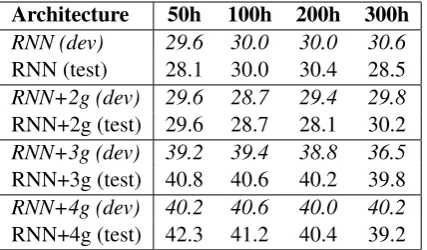
Table 1 shows the accuracy (validation and test sets) obtained using a simple RNN with 50, 100, 200 and 300-dimensional hidden word represen-tation and 250 frequency-based word classes (vo-cabulary sizeN = 72846words appearing at least 5 times in the training corpus). One notices that adding the direct word context to target word con-nections (using the additional matrix described in section 2), enables to jump from a poor perfor-mance of about 30% accuracy to about 40% test accuracy, essentially matching the 39% accuracy reported for Good-Turing n-gram language mod-els in Zweig et al. (2012). Modelling 4-grams yields even better results, closer to the 45% accu-racy reported for RNNs in (Zweig et al., 2012).4
As Table 2 shows, dependency RNNs (de-pRNN) enable about 10 point word accuracy im-provement over sequential RNNs.
The best accuracy achieved by the depRNN on the combined development and test sets used to re-port results in previous work was 53.5%. The best reported results in the MSR sentence completion challenge have been achieved by Log-BiLinear Models (LBLs) (Mnih and Hinton, 2007), a
vari-3Our code and our preprocessed datasets are
avail-able from:https://github.com/piotrmirowski/ DependencyTreeRnn
4The paper did not provide details on the maximum
en-tropy features or on class-based hierarchical softmax).
Architecture 50h 100h 200h 300h
RNN (dev) 29.6 30.0 30.0 30.6
RNN (test) 28.1 30.0 30.4 28.5
RNN+2g (dev) 29.6 28.7 29.4 29.8
RNN+2g (test) 29.6 28.7 28.1 30.2
RNN+3g (dev) 39.2 39.4 38.8 36.5
RNN+3g (test) 40.8 40.6 40.2 39.8
RNN+4g (dev) 40.2 40.6 40.0 40.2
[image:4.595.311.525.62.187.2]RNN+4g (test) 42.3 41.2 40.4 39.2
Table 1: Accuracy of sequential RNN on the MSR Sentence Completion Challenge.
Architecture 50h 100h 200h
depRNN+3g (dev) 53.3 54.2 54.2
depRNN+3g (test) 51.9 52.7 51.9
ldepRNN+3g (dev) 48.8 51.5 49.0
ldepRNN+3g (test) 44.8 45.4 47.7
depRNN+4g (dev) 52.7 54.0 52.7
depRNN+4g (test) 48.9 51.3 50.8
[image:4.595.318.519.241.368.2]ldepRNN+4g (dev) 49.4 50.0 (48.5) ldepRNN+4g (test) 47.7 51.4 (47.7)
Table 2: Accuracy of (un-)labeled dependency RNN (depRNN and ldepRNN respectively).
ant of neural language models with 54.7% to 55.5% accuracy (Mnih and Teh, 2012; Mnih and Kavukcuoglu, 2013). We conjecture that their su-perior performance might stem from the fact that LBLs, just like n-grams, take into account the or-der of the words in the context and can thus model higher-order Markovian dynamics than the simple first-order autoregressive dynamics in RNNs. The depRNN proposed ignores the left-to-right word order, thus it is likely that a combination of these approaches will result in even higher accuracies. Gubbins and Vlachos (2013) developed a count-based dependency language model achieving 50% accuracy. Finally, Mikolov et al. (2013) report that they achieved 55.4% accuracy with an ensemble of RNNs, without giving any other details.
6 Discussion
Bag-of-Words (CBOW) model of Mikolov et al. (2013) by incorporating morphology, PoS tags and en-tity categories into 600-dimensional word embed-dings trained on the Gutenberg dataset, increas-ing sentence completion accuracy from 41% to 44%. Other work on incorporating syntax into lan-guage modeling include Chelba et al. (1997) and Pauls and Klein (2012), however none of these ap-proaches considered neural language models, only count-based ones. Levy and Goldberg (2014) and Zhao et al. (2014) proposed to train neural word embeddings using skip-grams and CBOWs on de-pendency parse trees, but did not extend their ap-proach to actual language models such as LBL and RNN and did not evaluate the word embeddings on word completion tasks.
Note that we assume that the dependency tree is supplied prior to running the RNN which limits the scope of the Dependency RNN to the scoring of complete sentences, not to next word prediction (unless a dependency tree parse for the sentence to be generated is provided). Nevertheless, it is common in speech recognition and machine trans-lation to use a conventional decoder to produce an N-best list of the most likely candidate sentences and then re-score them with the language model. (Chelba et al., 1997; Pauls and Klein, 2011)
Tai et al. (2015) propose a similar approach to ours, learning Long Short-Term Memory (LSTM) (Hochreiter and Schmidhuber, 1997; Graves, 2012) RNNs on dependency parse tree network topologies. Their architectures is not designed to predict next-word probability distributions, as in a language model, but to classify the input words (sentiment analysis task) or to measure the sim-ilarity in hidden representations (semantic relat-edness task). Their relative improvement in per-formance (tree LSTMs vs standard LSTMs) on these two tasks is smaller than ours, probably be-cause the LSTMs are better than RNNs at storing long-term dependencies and thus do not benefit form the word ordering from dependency trees as much as RNNs. In a similar vein to ours, Miceli-Barone and Attardi (2015) simply propose to en-hance RNN-based machine translation by permut-ing the order of the words in the source sentence to match the order of the words in the target sentence, using a source-side dependency parsing.
Limitations of RNNs for word completion
[image:5.595.306.526.61.208.2]Zweig et al. (2012) reported that RNNs achieve lower perplexity than n-grams but do not always
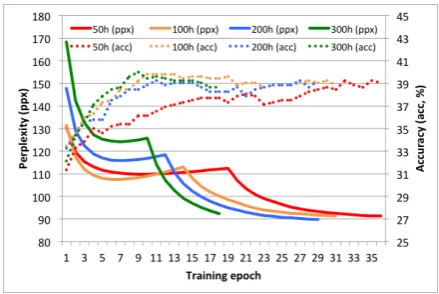
Figure 2: Perplexity vs. accuracy of RNNs
outperform them on word completion tasks. As illustrated in Fig. 2, the validation set perplex-ity (comprising all 5 choices for each sentence) of the RNN keeps decreasing monotonically (once we start annealing the learning rate), whereas the validation accuracy rapidly reaches a plateau and oscillates. Our observation confirms that, once an RNN went through a few training epochs, change in perplexity is no longer a good predictor of change in word accuracy. We presume that the log-likelihood of word distribution is not a train-ing objective crafted for precision@1, and that further perplexity reduction happens in the middle and tail of the word distribution.
7 Conclusions
In this paper we proposed a novel language model, dependency RNN, which incorporates syntactic dependencies into the RNN formulation. We eval-uated its performance on the MSR sentence com-pletion task and showed that it improves over RNN by 10 points in accuracy, while achieving re-sults comparable with the state-of-the-art. Further work will include extending the dependency tree language modeling to Long Short-Term Memory RNNs to handle longer syntactic dependencies.
Acknowledgements
References
Yoshua Bengio, R´ejean Ducharme, Pascal Vincent, and Christian Janvin. 2003. A neural probabilistic lan-guage model. The Journal of Machine Learning Re-search, 3:1137–1155.
Jiang Bian, Bin Gao, and Tie-Yan Liu. 2014. Knowledge-powered deep learning for word embed-ding. InMachine Learning and Knowledge Discov-ery in Databases, Lecture Notes in Computer Sci-ence, volume 8724, pages 132–148.
Ciprian Chelba, David Engle, Frederick Jelinek, Victor Jimenez, Sanjeev Khudanpur, Lidia Mangu, Harry Printz, Eric Ristad, Ronald Rosenfeld, Andreas Stol-cke, et al. 1997. Structure and performance of a dependency language model. InProceedings of Eu-rospeech, volume 5, pages 2775–2778.
Alex Graves. 2012. Supervised Sequence Labelling with Recurrent Neural Networks. Studies in Com-putational Intelligence. Springer.
Joseph Gubbins and Andreas Vlachos. 2013. Depen-dency language models for sentence completion. In
Proceedings of the 2013 Conference on Empirical Methods in Natural Language Processing.
Sepp Hochreiter and Jurgen Schmidhuber. 1997. Long short-term memory. Neural Computation, 9:17351780.
Omer Levy and Yoav Goldberg. 2014. Dependency-based word embeddings. InProceedings of the 52nd Annual Meeting of the Association for Computa-tional Linguistics (Volume 2: Short Papers), pages 302–308.
Christopher D. Manning, Mihai Surdeanu, John Bauer, Jenny Finkel, Steven J. Bethard, and David Mc-Closky. 2014. The Stanford CoreNLP natural lan-guage processing toolkit. In Proceedings of 52nd Annual Meeting of the Association for Computa-tional Linguistics: System Demonstrations, pages 55–60.
Antonio Valerio Miceli-Barone and Giuseppe At-tardi. 2015. Non-projective dependency-based pre-reordering with recurrent neural network for ma-chine translation. In The 53rd Annual Meeting of the Association for Computational Linguistics and The 7th International Joint Conference of the Asian Federation of Natural Language Processing. Tomas Mikolov and Geoff Zweig. 2012. Context
de-pendent recurrent neural network language model. InSpeech Language Technologies (SLT), 2012 IEEE Workshop on. IEEE.
Tomas Mikolov, Martin Karafi´at, Lukas Burget, Jan Cernock`y, and Sanjeev Khudanpur. 2010. Recur-rent neural network based language model. In IN-TERSPEECH 2010, 11th Annual Conference of the International Speech Communication Association, Makuhari, Chiba, Japan, September 26-30, 2010, pages 1045–1048.
Tomas Mikolov, Anoop Deoras, Daniel Povey, Lukas Burget, and Jan Cernocky. 2011. Strategies for training large scale neural network language mod-els. In Automatic Speech Recognition and Under-standing (ASRU), 2011 IEEE Workshop on, pages 196–201. IEEE.
Tomas Mikolov, Kai Chen, Greg Corrado, and Jef-frey Dean. 2013. Efficient estimation of word representations in vector space. arXiv preprint arXiv:1301.3781.
Piotr Mirowski, Sumit Chopra, Suhrid Balakrishnan, and Srinivas Bangalore. 2010. Feature-rich continu-ous language models for speech recognition. In Spo-ken Language Technology Workshop (SLT), 2010 IEEE, pages 241–246. IEEE.
Andriy Mnih and Geoffrey Hinton. 2007. Three new graphical models for statistical language modelling. InProceedings of the 24th International Conference on Machine Learning, page 641648.
Andriy Mnih and Koray Kavukcuoglu. 2013. Learning word embeddings efficiently with noise-contrastive estimation. In C.J.C. Burges, L. Bottou, M. Welling, Z. Ghahramani, and K.Q. Weinberger, editors, Ad-vances in Neural Information Processing Systems 26, pages 2265–2273. Curran Associates, Inc.
Andriy Mnih and Yee W Teh. 2012. A fast and simple algorithm for training neural probabilistic language models. In Proceedings of the 29th International Conference on Machine Learning (ICML-12), pages 1751–1758.
Joakim Nivre. 2005. Dependency grammar and de-pendency parsing.MSI report, 5133(1959):1–32.
Adam Pauls and Dan Klein. 2011. Faster and Smaller N-Gram Language Models. In Proceedings of the 49th Annual Meeting of the Association for Com-putational Linguistics: Human Language Technolo-gies, pages 258–267. Association for Computational Linguistics.
Adam Pauls and Dan Klein. 2012. Large-scale syntac-tic language modeling with treelets. InProceedings of the 50th Annual Meeting of the Association for Computational Linguistics: Long Papers-Volume 1, pages 959–968. Association for Computational Lin-guistics.
Brian Roark, Murat Saraclar, and Michael Collins. 2007. Discriminative n-gram language modeling.
Computer Speech & Language, 21(2):373 – 392.
Yinggong Zhao, Shujian Huang, Xinyu Dai, Jianbing Zhang, and Jiajun Chen. 2014. Learning word em-beddings from dependency relations. InIn Proceed-ings of Asian Language Processing (IALP).
Geoffrey Zweig and Christopher J. C. Burges. 2012. A challenge set for advancing language modeling. InProceedings of the NAACL-HLT 2012 Workshop: Will We Ever Really Replace the N-gram Model? On the Future of Language Modeling for HLT, pages 29–36. Association for Computational Linguistics. Geoffrey Zweig, John C Platt, Christopher Meek,