Munich Personal RePEc Archive
An analytically solvable model for soccer:
further implications of the classical
Poisson model
Fry, John and Hastings, Tom and Serbera, Jean-Philippe
School of Computing Mathematics and Digital Technology,
Manchester Metropolitan University, Sheffield Management School,
Sheffield University, Sheffield Business School, Sheffield Hallam
University
June 2017
Online at
https://mpra.ub.uni-muenchen.de/82458/
An analytically solvable model for soccer: further implications of
the classical Poisson model
July 2017
Abstract
In this paper we discuss an exactly soluble statistical model for soccer. By taking into
account key features of soccer matches (goals are rare, goal-scoring patterns are not well
understood) we arrive at a version of the classical Poisson model but with constraints on the
expected total number of goals in a game. Closed form expressions are derived for expected
scores and match outcomes. We are also able to reconstruct an empirically observed inverse
strike-back effect pertaining to teams scoring consecutive goals. We produce analytical results
for perfectly competitive soccer leagues where draws are tied to the average number of goals
in a game. An empirical application to the 2016 UEFA European Championships is also
discussed.
Keywords:Forecasting; Gaming; Sports; Stochastic Processes
1
Introduction
Kuyper and Szymanski, 2014). As such our contribution is important for a number of theoretical and practical considerations beyond considerable public interest.
The theoretical importance of our contribution is as follows. Our model reflects both a rich history of Poisson modelling in football (Maher, 1982; Keller, 1994) and the fact that soccer’s low scoring nature and high numbers of draws stands in sharp contrast to North American sports (Maher, 1982; Wright, 2009). Soccer’s rigid league structures and well-defined promotion, relegation, tournament qualification and winning targets also mean it is especially amenable to the kind of analysis considered here. Further, our model abstracts from key features of soccer matches such as the fact that goal-scoring patterns are not very well understood (Kuper and Szymanski, 2014) amid other stylised empirical facts (Dixon and Robinson, 1998).
between elite and non-elite leagues, is itself highly informative about the nature of individual competitions. For major competitions the typical number of goals per game is around 2.4-2.75 per game with average values of less than 2 goals per game and more than 3.5 goals per game thought to be exceptional and to usually be indicative of lower overall standards of play.
The layout of this paper is as follows. The second section outlines the model used and highlights the key analytical results obtained. The third section discusses perfectly competitive soccer leagues – an idealised setting that nonetheless has some interesting implications for the setting of performance benchmarks in elite soccer leagues. The fourth section discusses an em-pirical application to the 2016 UEFA European Championship finals. The final section concludes and discusses further work. A mathematical appendix is included at the end of the paper.
The model
Suppose that, as a simplification, the number of goals scored in a match is distributed as Poisson(λ) and that if a goal is scored then it is scored by team X with probability p and by team Y with probability 1−p. Thus, in this model goals are rare events and occur at random. This shares qualitative features of football matches discussed in Anderson and Sally (2013) and Kuper and Szymanski (2014) with the nature of real goal-scoring patterns not necessarily very well understood. Our model thus abstracts key details like overall team strengths and soccer’s low-scoring nature. Further modifications to take into account the effect of home advantage are discussed in the fourth section of this paper. More detailed effects such as short-term form, time of the season, managerial changes, fatigue, psychological judgements, bookmakers information and subjective judgements have been discussed in recent applied work (see e.g. Owen, 2011; Constantinou et al., 2012; Constantinou and Fenton, 2017) but have not been included in our theoretical model here.
Proposition 1 Let (X =x, Y =y) denote the event that Team X scores x goals and Team Y
scores y goals. We have that
P r(X=x, Y =y) =e
−λ
(λp)x(λ(1−p))y
x!y! . (1)
Proof.
P r(X =x, Y =y) = e
−λ
λx+y
(x+y)!.
(x+y)!px(1 −p)y
x!y! =
e−λ
λx+ypx(1 −p)y
x!y! .
As a simple corollary we have:
Proposition 2 (Expected score) We have the following results for the expected final score: (i) The expected final score is given by
E[X] =λp, E[Y] =λ(1−p).
(ii) If the score isX =x, Y =y after M minutes the expected final score is given by
E[X] =x+
1−M 90
λp, E[Y] =y+
1−M 90
λ(1−p).
In addition to individual match scores we can write down and solve the probabilities of individual match outcomes:
Proposition 3 (Probability of match outcomes.) We have the following results for overall match outcomes
(i) The probability of a drawn is given by e−λ
I0(2λ
p
p(1−p)), (ii) The probability that Team X wins is given by Q0(√2λp,
p
2λ(1−p)), (iii) The probability that Team Y wins is given by Q0(
p
2λ(1−p),√2λp),
where where Ik denotes the modified Bessel function of the first kind (Abramowitz and Stegun,
Proof.
See the Appendix.
The probabilities calculated in Proposition 3 can be evaluated numerically using simulation techniques (see e.g. Weinberg, 2006). However, using the recursion formula in Annamalai and Tellambura (2008) it can be shown that the Marcum Q-function can be written as
Q0(α, β) = 1−F2,α2(β2)−e
−α2+β
2
2 I0(αβ),
where F2,α2(·) denotes the Cumulative Distribution Function (CDF) of the non-central χ2
dis-tribution with 2 degrees of freedom and non-centrality parameter α2. Motivated by empirical implied probabilities obtained from bookmakers’ odds we have the following extension to Propo-sition 3 for one-off matches in knock-out competitions:
Proposition 4 (Outcomes in one-off knock-out matches.) Assume that in a penalty shoot-out each team is equally likely to win. Suppose a knock-shoot-out game goes to extra-time
(i) The conditional probability that team X wins after extra time (aet) is given by
P r(X aet) = 1 2Q0
r
2λp
3 ,
r
2λ(1−p) 3
!
+ 1
2 1−Q0
r
2λ(1−p) 3 , r 2λp 3 !! . (2)
(ii) The conditional probability that team Y wins after extra time (aet) is given by
P r(Y aet) = 1 2Q0
r
2λ(1−p) 3 , r 2λp 3 ! +1
2 1−Q0
r
2λp
3 ,
r
2λ(1−p) 3
!!
. (3)
(iii) The probability that team X wins the knockout match is given by
P r(X wins) =Q0
p
2λp,p2λ(1−p)+e−λ
I0(2λ
p
p(1−p))P r(X aet). (4)
(iv) The probability that team Y wins the knockout match is given by
P r(X wins) =Q0
p
2λ(1−p),p2λp+e−λ
I0(2λ
p
p(1−p))P r(Y aet). (5)
See the Appendix.
Dixon and Robinson (1998) find that the following stylised empirical facts are associated with soccer matches.
1. The scoring rate increases as soon as the first goal is scored.
2. The scoring rate depends on the score.
3. The scoring rate for both teams is non-decreasing over time.
4. The inverse strike-back effect. It is not the case that a team is never more vulnerable than after they have just scored a goal. The opposite effect is more likely.
5. If the home team is leading the home and away goalscoring rates generally decrease and increase respectively.
Whilst our simple model is unable to account for time-varying scoring rates our model is able to provide a theoretical description of the empirically observed inverse strike-back effect.
Proposition 5 (The inverse strike-back effect.) The team that has just scored is also more likely to score the next goal.
Proof
See the Appendix.
Perfectly competitive sports leagues
emerges as a consequence of very high levels of competition (see e.g. Campbell et al., 1997). It follows from Proposition 3 that in this case we have
P r(Win) = P r(Lose) = 1−e
−λ
I0(λ) 2 =w,
P r(Draw) = e−λ
I0(λ) = 1−2w. (6)
A similar formulation and related formulae can be found in Keller (1994). Here, we link this approach to a theoretical model for perfect competition in Cain and Haddock (2006) as the probability of a draw can be explicitly linked to the typical number of goals in a game. This suggests that around a quarter of all games will end in a draw (see the next subsection). This is in marked contrast for classical models of competitive balance in North American competitions which, excluding the possibility of draws, can be obtained forw= 1/2. Using the model we can both refine the discussion of relegation in Gandy (2016) and provide extensions covering various different performance objectives. Inter alia our approach may also enable us to compare and contrast the performance of teams from different eras (see e.g. Baker and McHale, 2015).
Consider a soccer league of n teams who play each other home and away once only. Each team thus plays 2(n−1) games over the course of a season. Three points are awarded for a win, one point for a draw and 0 points for a defeat. The objective for team X is to secure enough points over an entire league season so thatX defeats a randomly chosen opponent, teamY say, with probability q. For example, the English Premier league consists of n = 20 teams. The target to avoid relegation is to defeat at least 3 teams thus finishing 16+1=17th place or higher. This givesq = (3 defeated teams)/(19 rival teams). LetXi denote the number of points scored
by team X in gamei. We have thatP r(Xi = 3) =P r(Xi) = 0 =w,P r(Xi = 1) = 1−2w. It
follows thatE[Xi] = 3w+ 1−2w+ 0w= 1 +w. The expected season total for team X is then
given by
E[X] =X
i
The number of points scored by team X compared to team Y is given by
X−Y =
2n−4
X
i=1
Xi−Yi+Z2n−3+Z2n−2, (8)
where theZi represent direct head-to-head matches between the two teams and take the values ±3 with probability w and 0 with probability 1−2w, the distribution of the Xi and Yi is as
described above and all the random variables in equation (8) are mutually independent. The representation in equation (8) suggests that we can set points targets for Team X to achieve a given objective by setting
Target =E[Y] +F−1
X−Y(q), (9)
whereF−1
(·) denotes the inverse CDF of the random variableX−Y and q denotes the proba-bility q that Team X defeats a randomly chosen opponent (see above). We have the following approximation formulae for the end-of-season points targets in perfectly competitive leagues.
Proposition 6 We have the following approximation formulae for points targets in perfectly competitive leagues:
i) Mean-Variance (MV) approximation:
Target= (1 +w)2(n−1) +pw2[8−4n] +w[20n−4]Φ−1
(q). (10)
ii) Cornish-Fisher Mean-Variance-Kurtosis (MVK) approximation:
Target= (1 +w)2(n−1) +pw2[8−4n] +w[20n−4]
1− γ2
8
Φ−1
(q) +γ2[Φ
−1
(q)]3
8
,(11)
where Φ−1
(·) denotes the inverse CDF of the normal distribution and γ2 denotes the excess
kurtosis of the random variable X−Y where,
γ2 =
188 + 68n+w(1988n−5320) +w2(3600n−6000) +w3(1800n−3000) w((8−4n)w+ (20n−4))2 .
See the Appendix.
Equation (10) in Proposition 6 gives the familiar mean-variance approximation. This formula gives reasonable answers for low values ofqbut begins to get markedly less-accurate asqbecomes larger – in effect becoming less accurate higher up the league table. Equation (10) can be obtained as a special case of equation (11) withγ2 = 0. Further, as we see in the next subsection,
the Cornish-Fisher expansion in equation (11) can be seen to lead to empirically meaningful increases in accuracy.
Numerical example
As an illustration we apply equation (11) to the English Premier league with n = 20 teams. In the most recent fully completed season, 2015/16, the average Premier League match had on average 2.7 goals per game. Taking λ = 2.7 equation (6) thus gives P r(Draw) = 0.258,
w=P r(Win) =P r(Lose) = 0.371. Further calculations give
Mean = (1 +w)2(n−1) = 52.095
Variance = w2[8−4n] +w[20n−4] = 136.975
1. Winning the league. This involves defeating all 19 rivals. The method recommended by Hyndman and Fan (1996) suggests takingq = (19−1/3)/(19 + 1/3) = 0.966. In this case equation (10) gives
x= 52.095 +√136.975Φ−1
(0.966) = 73.379.
This suggests that in order to win the League title teams should aim to achieve a minimum total of 74 points. In contrast application of equation (11) suggests a winning target of 77 points. In view of the comparison of teams from different eras (see e.g. Baker and McHale, 2015) the suggestion is that once teams exceed 77 points in a Premier League season they can reasonably be viewed as potential Premier League Champions.
the Europa League (formerly the UEFA Cup) have also qualified for the Champions League Group stages though we do not account for this second qualification route here.) Since finishing in the top four involves defeating 16 randomly chosen rivals takingq = 16/19 in the above and using equation (10) gives
x= 52.019 +√136.294Φ−1
(16/19) = 63.835.
This suggests that in order to achieve Champions League qualification teams need to aim to achieve a minimum of 64 points. In this case equation (11) also gives the same answer.
3. Avoiding relegation. Avoiding relegation entails finishing in the top 17 places in the league or, equivalently, defeating 3 randomly chosen rivals. As such taking q = 3/19 and using equation (10) gives
x= 52.019 +√136.294Φ−1
(3/19) = 40.354.
This suggests that in order to avoid relegation teams need to aim to achieve a minimum total of 41 points. This appears in remarkably good agreement with the well-established rule of thumb that states that Premier League teams typically need to aim to achieve 40 points to avoid relegation. In this case equation (11) also gives the same answer.
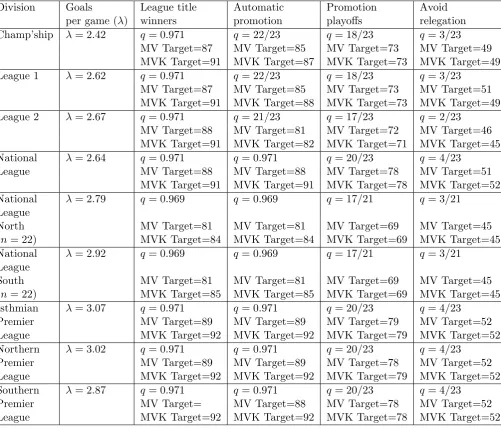
the standard of football decreases although the Championship has fewer goals per game than the Premier League. Similar patterns (where the second tier has a fewer number of goals per game than the top tier league) can also be seen in other European countries and may reflect a more defensive overall style of play. Since the structure of the English football league pyramid is so close to uniform – most divisions consisting of 24 teams – projected points totals are broadly the same throughout. However, there are slight differences lower down the pyramid due to different league structures and declining levels of quality – as reflected by generally higher numbers of goals per game.
Empirical application
As a numerical example we discuss the prediction of games in the recent 2016 UEFA European Championship. Thus we follow Dyte and Clark (2000) and Suzuki et al. (2010) in considering applications to recent international tournaments. Historical records show that prior to the 2016 championship there had been an average of 2.46 goals per game in European Championship finals matches. We use data from FIFA’s Coca Cola world rankings (data correct as of June 2nd 2016) as a proxy measure of team quality to estimate the value ofpin the above (see Table 2). This follows a similar approach using FIFA team ratings in Dyte and Clarke (2000) and also shares some similarities with classical models of competitive balance (Andreff and Szymanski, 2006).
Division Goals League title Automatic Promotion Avoid per game (λ) winners promotion playoffs relegation Champ’ship λ= 2.42 q= 0.971 q= 22/23 q= 18/23 q= 3/23
MV Target=87 MV Target=85 MV Target=73 MV Target=49 MVK Target=91 MVK Target=87 MVK Target=73 MVK Target=49 League 1 λ= 2.62 q= 0.971 q= 22/23 q= 18/23 q= 3/23
MV Target=87 MV Target=85 MV Target=73 MV Target=51 MVK Target=91 MVK Target=88 MVK Target=73 MVK Target=49 League 2 λ= 2.67 q= 0.971 q= 21/23 q= 17/23 q= 2/23
MV Target=88 MV Target=81 MV Target=72 MV Target=46 MVK Target=91 MVK Target=82 MVK Target=71 MVK Target=45 National λ= 2.64 q= 0.971 q= 0.971 q= 20/23 q= 4/23
League MV Target=88 MV Target=88 MV Target=78 MV Target=51 MVK Target=91 MVK Target=91 MVK Target=78 MVK Target=52 National λ= 2.79 q= 0.969 q= 0.969 q= 17/21 q= 3/21
League
North MV Target=81 MV Target=81 MV Target=69 MV Target=45 (n= 22) MVK Target=84 MVK Target=84 MVK Target=69 MVK Target=45 National λ= 2.92 q= 0.969 q= 0.969 q= 17/21 q= 3/21
League
South MV Target=81 MV Target=81 MV Target=69 MV Target=45 (n= 22) MVK Target=85 MVK Target=85 MVK Target=69 MVK Target=45 Isthmian λ= 3.07 q= 0.971 q= 0.971 q= 20/23 q= 4/23
Premier MV Target=89 MV Target=89 MV Target=79 MV Target=52 League MVK Target=92 MVK Target=92 MVK Target=79 MVK Target=52 Northern λ= 3.02 q= 0.971 q= 0.971 q= 20/23 q= 4/23
Premier MV Target=89 MV Target=89 MV Target=78 MV Target=52 League MVK Target=92 MVK Target=92 MVK Target=79 MVK Target=52 Southern λ= 2.87 q= 0.971 q= 0.971 q= 20/23 q= 4/23
[image:13.595.82.584.129.557.2]Premier MV Target= MV Target=88 MV Target=78 MV Target=52 League MVK Target=92 MVK Target=92 MVK Target=78 MVK Target=52
Table 1: English football league titles and suggested points targets for the mean-variance (MV) and mean-variance-kurtosis (MVK) approximations (n = 24 teams unless stated). Average number of goals, league structures and performance targets taken from the last fully completed league season (2015-2016).
Team World Ranking Points Total Belgium 2 1384
[image:14.595.193.407.129.265.2]Wales 26 846 Portugal 8 1181 Poland 27 842 Italy 12 982 Germany 4 1310 France 17 925 Iceland 34 751 England 11 1069
Table 2: FIFA World Rankings and points totals (proxy for team strengths) for the last nine teams to be eliminated from the 2016 UEFA European Championships.
Goals scored Iceland 0 Iceland 1 Iceland 2 Iceland 3 England 0 0.085 0.087 0.044 0.015 England 1 0.123 0.125 0.064 0.022 England 2 0.089 0.091 0.046 0.016 England 3 0.043 0.044 0.022 0.007
Table 3: Probability of various scores for England v. Iceland in EURO 2016
compared to playing away from home. This suggests that playing at home gives a net advantage of around 0.25 goals to the home team compared to a match at a neutral venue. Thus, we assume that playing at home increases the expected number of goals scored by the home team by 0.125 and simultaneously reduces the number of goals scored by the away team by 0.125. In order to retain appropriately normalised probabilities this suggests the adjustments
λphome = λp+ 0.125; phome=p+
0.125
λ ; λpaway = λp−0.125; paway =p−
0.125
λ (12)
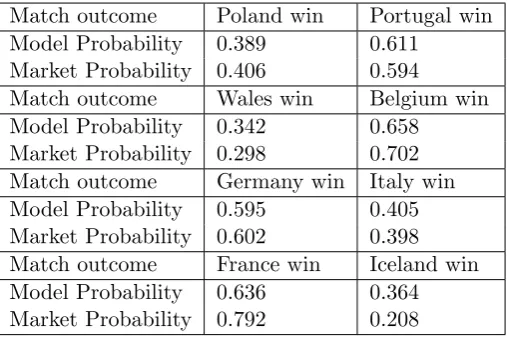
[image:14.595.150.451.322.396.2]runs counter to the so-called favourite-longshot bias (see e.g. Cain et al., 2000). Match outcome Poland win Portugal win Model Probability 0.389 0.611
Market Probability 0.406 0.594
Match outcome Wales win Belgium win Model Probability 0.342 0.658
[image:15.595.173.427.153.322.2]Market Probability 0.298 0.702 Match outcome Germany win Italy win Model Probability 0.595 0.405 Market Probability 0.602 0.398 Match outcome France win Iceland win Model Probability 0.636 0.364 Market Probability 0.792 0.208
Table 4: Model probabilities for EURO 2016 quarter finals compared to implied probabilities for bookmakers’ odds.
Conclusions and further work
Mean-Variance approximation when calculating performance targets.
In this paper we have explored the hidden implications of the classical Poisson model for soccer. Further work will extend will extend this model of perfect competition in Section 3 to other, more complicated, sports such as rugby and cricket. Amid much interest in sports modelling (see e.g. Wright, 2009) future work will develop analytical models with non-constant goal-scoring rates and adjusting for other important factors such as injuries, loss of form, psy-chology, fatigue etc. – see e.g. related applied work in Owen (2011) and Constantinou et al. (2012).
Appendix: The proofs
Proof of Proposition 3
Draws occur if both teams score ngoals. The probability of a draw can thus be calculated as
∞
X
n=0 e−λ
λ2n
2n! .
2n!pn(1−p)n
n!n! = e
−λ ∞
X
n=0
λpp(1−p)2n
n!n! = e−λ
I0(2λ
p
p(1−p))
The probability that team X wins by a margin of r goals can be calculated as
∞
X
k=0 e−λ
λ2k+r
(2k+r)!.
(2k+r)!pk+r(1−p)k
(k+r)!k! =e
−λ
p
1−p
r2
Ir
2λpp(1−p). (13)
The probability that Team X wins can then be obtained by summing equation (13) over r to obtain
P r(Team X wins) = e−λ ∞
X
r=1
p
1−p
r2
Ir(2λ
p
p(1−p))
= e−λ
eλQ0(
p
2λp,p2λ(1−p)),
using
Q0(α, β) =e
−α2+β
2 2 ∞ X k=1 α β k
(see e.g. Proakis, 1983).
Proof of Proposition 4
Parts (i-ii). From Proposition 3 the probability X wins outright in extra-time is given by
P r(X wins outright in extra-time) =Q0(
p
2/3λp,p2/3λ(1−p)). (14)
From equation (14) it follows that P r(X wins on penalties) is given by
1 2
h
1−Q0(
p
2/3λp,p2/3λ(1−p))−Q0(
p
2/3λ(1−p),p2/3λp)i. (15)
Equation (2) follows by summing equations (14-15). Parts (iii-iv) follow since
P r(X wins) =P r(X wins outright after 90 minutes) +P r(X wins after extra-time)P r(Draw).
Proof of Proposition 5
Suppose that a goal is scored at timeM. The probability that the same team scores again next is given by
p2+ (1−p)2h
1−e−λ[90−M]
90
i
. (16)
The probability that the other team scores again next is given by
[2p(1−p)]h1−e−λ[90−M]
90
i
. (17)
The probability in equation (16) is higher than in equation (17) since
4p−4p2≤1; 4p−2p2≤1 + 2p2; 2p−2p2≤1 + 2p2−2p.
Proof of Proposition 6
Equation (10) is a mean-variance approximation. The mean follows from equation (7). The variance can be calculated using
Var(X−Y) =
2n−4
X
i=1
Var(Xi−Yi) + 2Var(Zi) = (2n−4)2(5w−w2) + 2(18w)
= [20n−4]w+w2[8−4n].
In the sequel we consider a higher-order Cornish-Fisher approximation (Fisher and Cornish, 1960). The form of equation (11) simplifies since from (8) the random variable X −Y is symmetric and so has skewness zero. The excess kurtosis of the random variable X−Y can be calculated as follows. Let Wi =Xi−Yi and let Zi be defined as above with Var(Wi) = σ12,
Var(Zi) = σ22. Since E[Wi] = E[Zi] = 0 the Excess Kurtosis (Ex Kurt) of X −Y can be
calculated as
Ex Kurt(X−Y) = E[(W1+. . .+W2n−4+Z2n−3+Z2n−2)4]
Var(W1+. . .+W2n−4+Z2n−3+Z2n−2)
−3
=
(2n−4)E[Wi4] + 2E[Zi4] + 6(2n−2)(2n−3)
2 σ41+ 2(2n−4)σ21σ22+σ42
((2n−4)σ21+ 2σ22)2 −3
= (2n−4)E[W
4
i] + 2E[Zi4] +σ14[18n−30]−6σ42
((2n−4)σ21+ 2σ22)2 . (18)
We have that σ12 = 10w(1 +w), σ22 = 18w, E[Zi4] = 162w. Further, E[Wi4] =E[(Xi−Yi)4] =
94w2+ 34w. Inputting these values into (18) the stated result follows.
References
[1] Abramowitz M and Stegun I (eds) (1968). Handbook of mathematical functions. Dover: New York.
[3] Anderson C and Sally D (2013). The numbers game: Why everything you know about football is wrong. Penguin: London.
[4] Annamalai, A. and Tellambura, C. (2008) A simple exponential integral representation of the Generalized Marcum Q-Function QM(a, b) for real-order M with applications. In
Milcom 2008 - 2008 IEEE Military Communications Conference pp. 1-7.
[5] Baker R D and McHale I G (2015). Time varying ratings in association football: the all time greatest team is ... Journal of the Royal Statistical Society A178: 481-492.
[6] Boshnakov G, Kharrat T and McHale I G (2015). Are goals Poisson distributed? STN Journal of Sports Modelling and Trading (forthcoming)
[7] Cain L P and Haddock D D (2006). Measuring parity: Tying into the idealized standard deviation. Journal of Sports Economics 7: 330-338.
[8] Cain M, Law D and Peel D (2000). The favourite-longshot bias and market efficiency in UK football betting. Scottish Journal of Political Economy 47: 25-36.
[9] Campbell J Y Lo A and MacKinlay A C (1997) The econometrics of financial markets, Princeton University Press: Princeton.
[10] Clarke S T and Norman J M (1995)Home ground advantage of individual clubs in English soccer. Journal of the Royal Statistical Society D 44: 509-526.
[11] Constantinou A C and Fenton N E (2017) Towards smart-data: Improving predictive ac-curacy in long-term football team performance. Knowledge-Based Systems 124: 93-104.
[12] Constantinou, A C., Fenton N E and Neil, M. (2012) pi-football. A Bayesian network model for forecasting Association football match outcomes. Knowledge-Based Systems 36: 322-329.
[13] Dixon, M J and Robinson M E (1998). A birth process model for association football matches. Journal of the Royal Statistical society D 47: 523-538.
[15] Espitia-Escuer M and Garc´ıa-Cebri´an L I (2010). Measurement of the efficiency of football teams in the Champions League. Managerial and Decision Economics 31: 373-386.
[16] Fisher R A and Cornish E A (1960). The percentile points of distrbutions having known cumulants. Technometrics 2: 209-225.
[17] Fitt A D, Howls C J and Kabelka M (2006). Valuation of soocer spread bets. Journal of the Operational Research Society 57: 975-985.
[18] Gandy R (2016). Second season syndrome. Significance 13: 26-29.
[19] Hyndman R J and Fan Y (1996) Sample quantiles in statistical packages. The American Statistician 50: 361-365.
[20] Jessop A (2006). A measure of compeitiveness in leagues: a network approach. Journal of the Operational Research Society 57: 1425-1434.
[21] Keller J B (1994). A characterisation of the Poisson distribution and the probability of winning a game. The American Statistician 48: 294-298
[22] Kuper S and Szymanski S (2014). Soccernomics. HarperSport: London.
[23] Lee R and Fort Y H (2012). Competitive balance: Time series lessons from the English Premier League. Scottish Journal of Political Economy: 59 266-282
[24] Maher M J (1982). Modelling association football scores. Statistica Neerlandica 36: 109-118.
[25] McNulty P (2016). Euro 2106: FA and England will sift through wreckage of embarrassment. BBC website.http://www.bbc.co.uk/sport/football/36647964
[26] Nuttall A H (1975). Some integrals involving the QM function. IEEE Transactions on
Information Theory 21: 95-96.
[27] Owen A (2011). Dynamic Bayesian forecasting models of football match outcomes with estimation of the evolution parameter. IMA Journal of Management Mathematics 22: 99-113.
[29] Percy, D F (2015). Strategy selection and outcome prediction in sport using dynamic learn-ing for stochastic processes. Journal of the Operational Research Society 66, 1840-1849.
[30] Rottenberg S (1956). The baseball players’ labour market. Journal of Political Economy 64: 242-258.
[31] Suzuki A K, Salasat, L E B, Leite J G and Louzado-Neto, F (2010). A Bayesian approach for predicting match outcomes: The 2006 (Association) Football World Cup. Journal of the Operational Research Society 61: 1530-1539.
[32] Weingberg G V (2006). Poisson representation and Monte Carlo estimatin of Generalized Marcum Q-Function. IEEE Transactions on Aerospace and Electronic Systems 42: 1520-1531.