Munich Personal RePEc Archive
Self- Supplied Microgrid Economic
Scheduling Based on Modified Multiverse
Evolutionary Algorithm
Bayat, Alireza and Mahdavi, Sadegh and Mirzaei, Farzad
Electrical and Computer Engineering Department, Azad University
of Shiraz, Shiraz, Iran, Electrical and Computer Engineering
Department, Azad University of Shiraz, Shiraz, Iran, Electrical and
Computer Engineering Department, Azad University of Shiraz,
Shiraz, Iran
2019
Online at
https://mpra.ub.uni-muenchen.de/95892/
Self- Supplied Microgrid Economic
Scheduling Based on Modified Multiverse
Evolutionary Algorithm
Alireza Bayat, Sadegh Mahdavi, Farzad Mirzaei
Electrical and Computer Engineering Department, Azad University of Shiraz, Shiraz, Iran
Abstract: In this paper, a new evolutionary algorithm, known as the multiverse
evolutionary algorithm (MEA) is developed for self-supplied microgrid operation. To show
the effectiveness of the proposed method, it has been tested on the modified IEEE 33
bus test system. Results demonstrates the economic merit of the proposed technique.
I. INTRODUCTION
Recently, microgrids (MG) is very attractive due to some importance benefits such as
closeness to the consumers, that can lead to higher reliability of the network [1-5]. MG can
be connected to the main grid and also has potential to be disconnected from the main
grid. In the case that the MG is disconnected, the distributed generators (DGs) should
satisfy the load [6-10]. This case is known as the islanded mode where the MG is in the
self-supplied mode. MG can be disconnected due to the technical problem in the main
grid, or due to the economic benefits [11]. However, the energy management,
cybersecurity, and protection of the MG would be more challenging [12-14]. MG is a
mixed-integer non-linear problem (MINLP), which is hard to solve. Hence, this paper proposed a
II. PROBLEM FORMULATIONS
The proposed problem has an objective function, as
𝑚𝑖𝑛 ∑ [𝐶∀𝑖 𝑖𝑃𝑖𝑡𝐼𝑖𝑡+ 𝑆𝑈𝑖𝑡 + 𝑆𝐷𝑖𝑡] (1)
Here, I is a binary variable that can be zero or one and determine the status of unit i at time t. SU and SD are the startup and shutdown costs of the ith unit at time t.
Also, there exist some constraints associated with the problem. For instance, the capacity
of the DGs should be within limits as
𝑃𝑖𝑡,𝑚𝑖𝑛 ≤ 𝑃𝑖𝑡 ≤ 𝑃𝑖𝑡,𝑚𝑎𝑥 (2)
Here, P is the output power of DGs.
In addition, the limitation on the ramp up and down of generators are as:
𝑃𝑖𝑡 − 𝑃𝑖(𝑡−1) ≤ 𝑅𝑈𝑖 (3)
𝑃𝑖(𝑡−1)− 𝑃𝑖𝑡 ≤ 𝑅𝐷𝑖 (4)
Where:
𝑅𝑈𝑖 and 𝑅𝑈𝑖 are the ramp up and ramp down rates of the ith generation units, respectively.
Finally, the minimum up and down time limits are considered as:
𝑇(𝑜𝑛)𝑖𝑡 ≥ 𝑈𝑇𝑖(𝐼𝑖𝑡− 𝐼𝑖(𝑡−1) (5)
𝑇(𝑜𝑓𝑓)𝑖𝑡 ≥ 𝐷𝑇𝑖(𝐼𝑖(𝑡−1)− 𝐼𝑖𝑡 (6)
Where:
𝑈𝑇𝑖 and 𝐷𝑇𝑖 are minimum up and down rates of the ith unit.
𝑇(𝑜𝑛) and 𝑇(𝑜𝑓𝑓) represents the number of successive on and off hours.
This paper utilized a new evolutionary algorithm known as the multiverse evolutionary
particle swarm optimization (PSO) and genetic algorithm (GA), the proposed technique
has higher accuracy and speed.
III. RESULTS
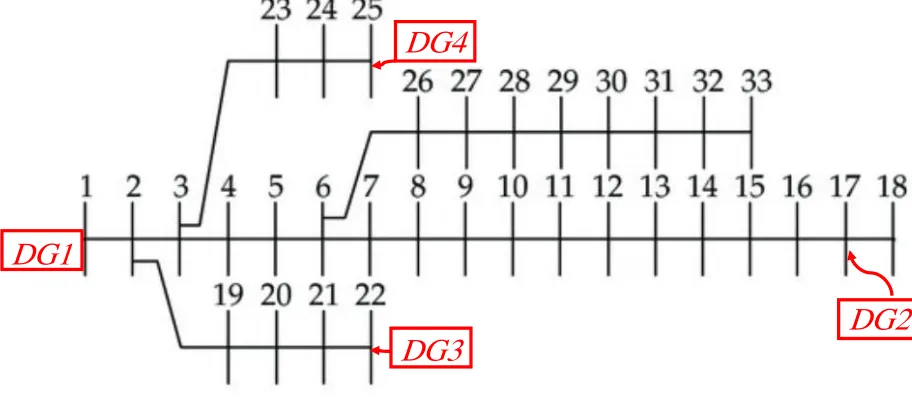
Figure 1 depicts the diagram of the modified IEEE 33 bus test system. The network
[image:4.612.77.535.246.671.2]consist of 4 DGs. DGs characteristics are shown in Table I.
Fig. 1. Modified Islanded MG
Table I
DGs minimum and maximum capacity
DG No. Minimum output power
Maximum output power
DG 1 20 100
DG 2 40 150
DG 3 50 150
DG 4 20 200
DG1
DG2
DG3
[image:4.612.76.532.248.447.2]Fig. 2. Day-ahead forecasted values of load demand
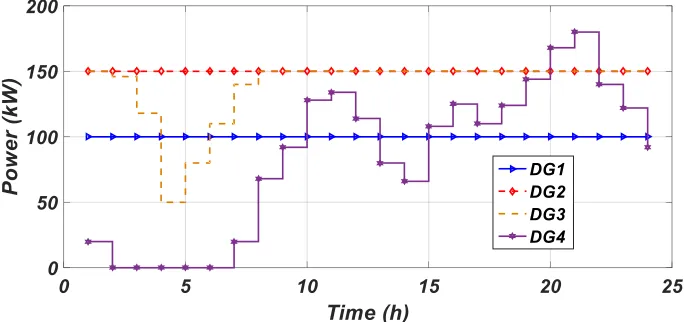
The day-ahead forecasted values of the load demand is shown in Fig. 2. Fig 3 shows the
output power of DGs. The cheapest unit is ON in the entire day. It should be noted that
the price of the DG1 is less than other DGs. That means the power is based on the
economic situation.
Fig. 3. DGs power in the self-supplied MG
The total operation cost of the MG grid in the self-supplied mode is presented in Table II.
[image:5.612.129.472.423.584.2]the proposed technique. Also, the convergence speed is very higher than well-known
[image:6.612.83.532.130.215.2]techniques.
Table II Operation cost
Operation cost ($) Computational Time (second)
PSO 8436.3.7 11.6
GA 9635.25 12.4
Proposed method 7956.2 10.2
IV. CONCLUSION
In this paper a new evolutionary algorithm known as the multiverse evolutionary
algorithm is proposed and adapted for the self-supplied MG. The results demonstrate the
economic merit of the proposed method, compare to the well-known techniques such as
PSO and GA algorithms. Also, the convergence speed of the proposed method is very
higher than these techniques.
Reference
[1] Zhang, Yan, Fanlin Meng, Rui Wang, Behzad Kazemtabrizi, and Jianmai Shi. "Uncertainty-resistant Stochastic MPC Approach for Optimal Operation of CHP Microgrid." Energy(2019).
[2] Chen, Yahong, Changhong Deng, Weiwei Yao, Ning Liang, Pei Xia, Peng Cao, Yiwang Dong et al. "Impacts of stochastic forecast errors of renewable energy generation and load demands on microgrid operation." Renewable Energy 133 (2019): 442-461.
[3] Kavousi-Fard, Abdollah, Morteza Dabbaghjamanesh, Jie Zhang, and Omid Avatefipour. "Superconducting Fault Current Limiter Allocation in Reconfigurable Smart Grids." arXiv preprint arXiv:1905.02324 (2019).
[4] Tsikalakis, Antonis G., and Nikos D. Hatziargyriou. "Centralized control for optimizing microgrids operation." In 2011 IEEE power and energy society general meeting, pp. 1-8. IEEE, 2011.
[6] Dabbaghjamanesh, Morteza, Boyu Wang, Shahab Mehraeen, Jie Zhang, and Abdollah Kavousi-Fard. "Networked Microgrid Security and Privacy Enhancement By the Blockchain-enabled Internet of Things Approach." In 2019 IEEE Green Technologies Conference (GreenTech), pp. 1-5. IEEE, 2019.
[7] Basak, Prasenjit, A. K. Saha, S. Chowdhury, and S. P. Chowdhury. "Microgrid: Control techniques and modeling." In 2009 44th International Universities Power Engineering Conference (UPEC), pp. 1-5. IEEE, 2009.
[8] Ghaffari, Saeed, and Maryam Ashkaboosi. "Applying Hidden Markov Model Baby Cry Signal Recognition Based on Cybernetic Theory." IJEIR 5: 243-247.
[9] Ashkaboosi, Maryam, Farnoosh Ashkaboosi, and Seyed Mehdi Nourani. "The Interaction of Cybernetics and Contemporary Economic Graphic Art as" Interactive Graphics"." (2016).
[10] Ghaffari, Saeed, and M. Ashkaboosi. "Applying Hidden Markov M Recognition Based on C." (2016).
[11] Carvalho, Rodrigo de, Rodney Rezende Saldanha, B. N. Gomes, Adriano Chaves Lisboa, and A. X. Martins. "A multi-objective evolutionary algorithm based on decomposition for optimal design of Yagi-Uda antennas." IEEE Transactions on Magnetics 48, no. 2 (2012): 803-806.
[12] Dabbaghjamanesh, Morteza, Boyu Wang, Abdollah Kavousi-Fard, Shahab Mehraeen, Nikos D. Hatziargyriou, Dimitris Trakas, and Farzad Ferdowsi. "A Novel Two-Stage Multi-Layer Constrained Spectral Clustering Strategy for Intentional Islanding of Power Grids." IEEE Transactions on Power Delivery (2019).
[13] Wang, Boyu, Morteza Dabbaghjamanesh, Abdollah Kavousi Fard, and Shahab Mehraeen. "Cybersecurity Enhancement of Power Trading Within the Networked Microgrids Based on Blockchain and Directed Acylic Graph Approach." IEEE Transactions on Industry Applications (2019).
[14] Saberi, Hossein, Shahab Mehraeen, and Boyu Wang. "Stability improvement of microgrids using a novel reduced UPFC structure via nonlinear optimal control." In 2018 IEEE Applied Power Electronics Conference and Exposition (APEC), pp. 3294-3300. IEEE, 2018.
[15] Benmessahel, Ilyas, Kun Xie, and Mouna Chellal. "A new evolutionary neural
networks based on intrusion detection systems using multiverse