Proceedings of the 57th Annual Meeting of the Association for Computational Linguistics, pages 3924–3930 3924
Uncovering Probabilistic Implications in Typological Knowledge Bases
Johannes Bjerva@ Yova Kementchedjhieva@ Ryan CotterellP,H Isabelle Augenstein@ @Department of Computer Science, University of Copenhagen
PDepartment of Computer Science, Johns Hopkins University
HDepartment of Computer Science and Technology, University of Cambridge
bjerva,yova,[email protected], [email protected]
Abstract
The study of linguistic typology is rooted in the implications we find between linguistic features, such as the fact that languages with object-verb word ordering tend to have post-positions. Uncovering such implications typi-cally amounts to time-consuming manual pro-cessing by trained and experienced linguists, which potentially leaves key linguistic univer-sals unexplored. In this paper, we present a computational model which successfully iden-tifies known universals, including Greenberg universals, but also uncovers new ones, wor-thy of further linguistic investigation. Our ap-proach outperforms baselines previously used for this problem, as well as a strong baseline from knowledge base population.
1 Introduction
Linguistic typology is concerned with mapping out the relationships between languages with reference to structural and functional properties (Croft,2002). A typologist may ask, for instance, how a language encodes syntactic features and relationships. Does it place its verbs before objects or after, and does it have prepositions or postpositions? It is well estab-lished that many features of languages are highly correlated, sometimes to the extent that they imply each other. Based on this observation,Greenberg
(1963) establishes the notion of implicational uni-versals, i.e., cases where the presence of one feature strictlyimplies the presence of another.
Universals are important to investigate as they of-fer insight into the inner workings of language and define the space of plausible languages. Universals can aid cognitive scientists examining the underly-ing processes of language, as there arguably is a cognitive reason for why, e.g., languages with OV ordering are postpositional (Greenberg,1963). In the context of natural language processing (NLP), when creating synthetic data for multilingual NLP,
SV
OV
SVO
[image:1.595.340.493.221.315.2]Noun-Adjective
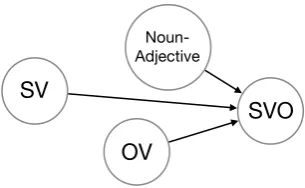
Figure 1: Visualisation of a section of our induced graphical model. Observing the features in the left-most nodes (SV, OV, and Noun-Adjective), can we cor-rectly infer the value of the right-most node (SVO)?
one should consider universals to maintain the plau-sibility of the data (Wang and Eisner,2016). Com-putational typology can furthermore be used to in-duce language representations, useful in, e.g., lan-guage modelling (Ostling and Tiedemann¨ ,2017) and syntactic parsing (de Lhoneux et al.,2018).
In this paper, we argue that the deterministic Greenbergian view of implications (Greenberg,
com-paring to strong baselines.
2 From A Generative Model to Probabilistic Implications
Notation. We now seek a probabilistic formali-sation of typological implications. First, we will introduce the relevant notation. Let`be a language. We will seek to explain the observed, language-specific binary vector of typological features, or parameters,π`whereπ`i = 1indicates that theith typological feature is “on” in language`. When it is unambiguous, we will drop the superscript`. Note that we call the vectorπdue to a spiritual sim-ilarity to the principle-and-parameters framework ofChomsky(1981).
A Generative Model of Typology. We construct a simple generative probability model over the the vector of typological featuresπ, which factorises according to some tree structureT. We will dis-cuss the provenance ofT below. Concretely, this distribution is defined as
p(π) = |π|
Y
i=1
p(πi|paT[πi]) (1)
where paT[·] is a function that returns the par-ents of πi, if any, in the tree T. Each
condi-tionalp(πi |paT[πi])is treated tabularly with one
parameter per table entry: each table entry is a unique configuration of the featureπiand its
par-entspaT[πi]. We place a symmetric Dirichlet prior
with concentration parameterα = 5, over each of p(πi |paT[πi])’s table entries. This corresponds to
add-5 smoothing.
Probabilistic Implications. Although the orig-inal Greenbergian view of implications is deter-ministic, we argue that a probabilistic approach is more suitable. Indeed, logical implications are a special case of conditional probabilities that only take the values0and1, rather than values in[0,1]. Specifically, we argue that probabilistic implica-tions should take the form of the following condi-tional probability distribution:
p(πi |πj) = X
π0
p(πi,π0 |πj) (2)
where π0 is a subvector that omits the indices i and j. In text, our goal is to sum out all possi-ble languages, holding two typological features, πi andπj, fixed. We note that since our modelp
factorises according to the treeT, this sum may be performed in polynomial time using dynamic programming, specifically the belief propagation algorithm (Pearl,1982). Note that we contend this improves upon the ideas ofDaum´e III and Camp-bell(2007), who only considered pair-wise inter-actions of features: Our definition of probabilistic implicationsmarginalises outall other features.
Discovering Probabilistic Implications. How can we use a generative model to discover typo-logical implications? What we would like to know is how oftenp(πi | πj) is significantly different
thanp(πi). We note thatp(πi) can also be
com-puted with BP. We now reduce the search for ty-pological implications as asking when the quantity |p(πi | πj)−p(πi)| is statistically significantly
greater than 0. Given a sufficiently expressive gen-erative modelp, this allows for a richer notion of implication than Greenberg original proposed, as it admits the softer notion of typological influence.
Learning the Structure of p. There are many ways to learn the tree structureT, and we choose the PC algorithm ofNeapolitan(2004). This algo-rithm works in two steps—first, it learns a skeleton graph from the data (in our case, a typological data base), withundirectededges. Next, it orients these edges so as to form a directed acyclic graph. Once we have fit this graph so as to representp(π), we are left with a tractable model we can use to predict held-out typological features and discover typolog-ical implications.
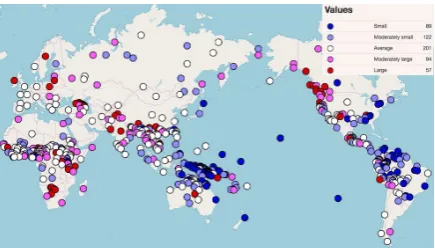
perform-Figure 2: Consonant inventory sizes across languages in the world (WALS,Dryer and Haspelmath(2013)).
ing count-and-divide. This is a standard technique in the literature.
Decoding. In section 4, we are interested in pre-dicting typological features given others. If we wish to predict πi given observed features for a
languageπobs, we compute
π?i =argmaxp(πi|πobs) (3)
=argmax X
πunobs
p(πi,πunobs|πobs) (4)
where we marginalize out all those featuresπunobs
unobserved or held out in a given language. The conditional may be computed with belief propa-gation and the argmax is over the set{0,1}. This makes the computation tractable.
3 WALS: A Typological Database
Before explaining our experimental setup, we first explain the data set we use in evaluation. We eval-uate on the World Atlas of Language Structure (WALS,Dryer and Haspelmath(2013), which is the largest openly available typological database. It comprises approximately 200 linguistic features with annotations for more than 2,500 languages. These annotations have been made by expert typol-ogists through meticulous study of grammars and field work. WALS is quite sparse, however, as only 100 of these languages have annotations for all fea-tures. For instance, Figure2shows the distribution of consonant inventory sizes across the languages for which this feature is annotated. Although this is not our main contribution, the fact that we can predict held-out features offers a way to fill in the feature value gaps which exist for the vast majority of languages.
Pre-processing We pre-process our data simi-larly toDaum´e III and Campbell(2007). We
fil-N implicants 2 3 4 5 6
Phonology 0.75 0.82 0.84 0.86 0.89
Morphology 0.77 0.85 0.87 0.70 0.82
Nominal Categories 0.72 0.83 0.80 0.84 0.81 Nominal Syntax 0.77 0.89 0.85 0.89 0.81 Verbal Categories 0.80 0.84 0.80 0.86 0.90
Word Order 0.74 0.86 0.86 0.86 0.93
Clause 0.75 0.81 0.84 0.85 0.84
Complex 0.82 0.83 0.87 0.93 0.84
Lexical 0.83 0.76 0.75 0.85 0.79
Mean 0.77 0.83 0.83 0.85 0.85
Most freq. 0.30
Pairwise 0.77
PRA 0.81
[image:3.595.73.291.61.185.2]Language embeddings 0.85
Table 1: Accuracies for feature prediction in a typo-logically diverse test set, across number of implicants used. Note that the numbers are not comparable across columns nor to the baseline, since each makes a differ-ent number of predictions.
ter out features which are not encoded for at least 100 languages, and feature values which occur for fewer than 10% of the languages. The reason for this is that any implications found for exceedingly rare features is likely to be inconclusive. We fur-ther followDaum´e III and Campbell(2007) in that we binarise features with more than 7 feature val-ues such that they simply encode whether or not a language has a feature. For instance, features are not likely to have implicants determining the num-berof tones, but rather the presence or absence of tones. Finally, they take into account that languages are not independent, as phylogenetic similarity can help infer features in closely related languages. We do not use this information, as we are interested in finding implications which ought to be independent of language relatedness.
4 Two Typological Experiments
In order to evaluate our probabilistic approach to typological implications, we define two tasks. Our
empirical evaluationis based on predicting fea-tures so as to get an objective measure of our model, which is comparable both to previous work and other strong baselines. Second, we include a quali-tative evaluation, as we are interested in uncover-ing both known and novel typological implications.
4.1 Predicting Typological Features
[image:3.595.308.525.62.244.2]the typological features of languages (Daum´e III and Campbell,2007;Malaviya et al.,2017; Cot-terell and Eisner,2018;Ponti et al.,2018;Bjerva et al.,2019a). This is an important task which can highlight the extent to which a model has learned interdependencies between languages and features. We include this evaluation to first show that our model has predictive power which surpasses strong baselines, before investigating the main research question of this work, i.e., the extent to which we can uncover probabilistic implications. We evalu-ate the models on feature prediction by fitting our model on 80% of the languages in WALS, and leav-ing out 10% of the languages for development and testing, respectively.
We split our evaluation of our model up across the feature categories present in WALS. These cover areas such as phonology, morphology etc., listed in Table 1. During the typological feature prediction experiments, we consider a single such WALS category at a time.We vary the number of implicants by allowing the model to observe 2 to 6 features from within this category as well as the values of features in other categories. This is done as having access to, e.g., all word-order features when predicting a final word order feature would be much easier than our setting. Hence, our experiment will show the extent to which increasing the number of features from the current feature category affects predictive power. We vary the number of implicantskfrom 2 to 6 features in each category with a total ofnfeatures, this gives us nktotal sets per number of implicantsk. For each such set, we attempt to predict all held-out features in that category in a leave-one-out-style evaluation. This results in nk(n−k)predictions to make per category per number of implicants k. Performance is measured by averaging the accuracy of predictions of all held-out features over the entire test set, across categories.
Baseline #1: Most frequent Since many typo-logical features have low-entropy distributions, a most frequent class baseline is a relatively strong lower bound for prediction of typological features. For instance, this yields an accuracy of 45% when predicting the canonical subject–object–verb order-ing in a language.
Baseline #2: Pairwise prediction We imple-ment a simple baseline based on pairwise predic-tion of typological features. This is inspired by the
approach inDaum´e III and Campbell(2007). As this code was not publicly available we provide our own non-Bayesian implementation.
Baseline #3: PRA Since WALS can be seen as a knowledge base, we apply a strong baseline from the field of knowledge base population. Path Rank-ing Algorithm (PRA) is an algorithm which finds relation paths by traversing the knowledge graph, which can then be used to predict implicatures and feature values (Lao and Cohen, 2010; Lao et al.,2011).1 We train PRA using the standard hyperparameters of the existing implementation, which includes regularising with`1 = 0.001and
`2= 0.001, as well as using negative sampling.
Baseline #4: Language embeddings Although we aim to predict implications, and not only fea-ture values, we compare with previous work on predicting typological features in WALS (Bjerva and Augenstein,2018a). As their setup is different, we use their highest reported score as a baseline.
Feature Prediction Results. Table 1 contains the results from feature prediction across the chap-ters outlined in WALS. Our implementation is able to predict features across categories above baseline levels. At increasing numbers of implicants, pre-diction power tends to increase. This is not the case for all feature categories, however. One such case is Nominal Syntax, in which performance peaks at 3 implicants. This is expected, as correlations only exist between some features, thus at a certain point access to more typological features no longer helps performance. Note that although the baseline numbers are based on predicting the same features as our model, the baseline models do not observe the same features during prediction - for instance Baseline #4 does not make predictions based on other feature values, but is trained on one feature at a time.
4.2 Discovering Typological Implications
Having established that our method bests several competitive baselines for prediction of typologi-cal features, we next look at what implications our probabilisation of typology allows us to find. We search for those conditional probabilities where the quantity|p(πi|πj)−p(πi)|is statistically
signifi-cantly greater than 0, as found with an independent
# Implicant⊃Implicand
1* Postpositions⊃Genitive-Noun (Greenberg #2a)
2* Postpositions⊃OV (Greenberg #4)
3 OV⊃SV
4* Postpositions⊃SV
5* Prepositions⊃VO (Greenberg #4)
6* Prepositions⊃Initial subord. word (Lehmann)
7* Adjective-Noun, Postpositions⊃Demonstrative-Noun
8* Genitive-Noun, Adjective-Noun⊃OV
9 SV OV Noun-Adjective⊃SOV
10 Degree word-Adjective
VO and Noun–Relative Clause
SVO⊃Numeral-Noun
11 SOV OV and Relative Clause–Noun
[image:5.595.74.290.62.234.2]Adjective-Degree word⊃Noun-Numeral
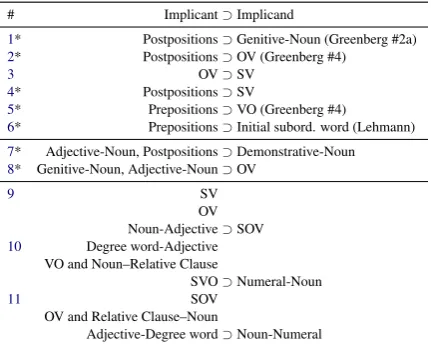
Table 2: Hand-picked implications. In cases where the same is covered byDaum´e III and Campbell (2007), we borrow their analysis (marked with *).
two-tailed t-test.2 After adjusting for multiple tests with the Bonferroni correction, we report those im-plications wherep <0.05. We report the full list of implications found by our model in the Supple-ments and show a subset of these in Table2.3 We
note that we are able to find the same implications listed byDaum´e III and Campbell(2007), some of which are listed in the table. These implications include Greenberg universals (Greenberg,1963), showing that our approach to probabilisation of lin-guistic universals is suitable to replicate previous work.
Transitivity across implications At first glance, it is not clear why postpositions should imply SV word order, as stated in #4. Yet, #2 is a well-established universal (Greenberg, 1963) and #3
comes with strong statistical evidence: SV order is much more frequent than VS word order in OV languages (98.44% of these are predominantly SV). Our model has thus used transitive reasoning of the formifA⊃B∧B⊃CthenA⊃Cto find #2.
The power of multiple implicants Implications #10and #11concern the order between nouns and their numeral modifiers. The two main alterna-tives here, Noun-Numeral and Numeral-Noun are of comparable frequency in WALS; they occur in 607 and 479 languages, respectively, i.e. Noun-Numeral holds the majority with only 55%. If we consider each of the three implicants listed in im-plication #11on their own, the strongest statistical
2
Future work will make use of a non-parametric test, whose details we are still working out.
3Also onbjerva.github.io/imp_acl19.pdf.
power goes to theDegree word–Adjectivefeature: conditioned on this feature, the Numeral-Noun or-der holds in 79% of the relevant languages. The combination of all three implicants, on the other hand, results in a subset of languages with 91% Numeral-Noun order. The Numeral-Noun order can thus be implied with considerably more confi-dence from a combination of multiple implicants.
5 Related Work
Typological implications outline the space of possible languages, based on evidence from ob-served languages, as recorded and classified by lin-guists (Greenberg,1963;Lehmann,1978;Hawkins,
1983). While work in this direction has been man-ual, typological knowledge bases do exist now (Dryer and Haspelmath,2013;Partick Littel and Levin,2016), which allows for automated discov-ery of implications. Although previous computa-tional work exists (Daum´e III and Campbell,2007), we are the first to introduce a probabilisation of typological implications.
In addition to work on finding implications based on known features, there is an increasing amount of work on computational methods to discovering typological features (Ponti et al.,2018). Work in this area includes unsupervised discovery of word order (Ostling¨ ,2015) or other linguistic features (Asgari and Sch¨utze,2017), typological probing of language representations (Bjerva et al.,2019b;
Beinborn and Choenni,2019), and several papers attempt to predict typological features in WALS (Georgi et al.,2010;Malaviya et al.,2017;Bjerva and Augenstein, 2018a,b; Cotterell and Eisner,
2017,2018;Bjerva et al.,2019a).
6 Conclusions
We defined the notion of probabilistic implications, and presented a computational model which suc-cessfully identifies known universals, including Greenberg universals, but also uncovers new ones, worthy of further investigation by typologists. Ad-ditionally, our approach outperforms strong base-lines for prediction of typological features.
Acknowledgments
References
Ehsaneddin Asgari and Hinrich Sch¨utze. 2017. Past, Present, Future: A Computational Investigation of the Typology of Tense in 1000 Languages. In Pro-ceedings of the 2017 Conference on Empirical
Meth-ods in Natural Language Processing, pages 113–
124, Copenhagen, Denmark. Association for Com-putational Linguistics.
Lisa Beinborn and Rochelle Choenni. 2019. Seman-tic Drift in Multilingual Representations. arXiv
preprint arXiv:1904.10820.
Johannes Bjerva and Isabelle Augenstein. 2018a.From Phonology to Syntax: Unsupervised Linguistic Ty-pology at Different Levels with Language Embed-dings. InProceedings of the 2018 Conference of the North American Chapter of the Association for Com-putational Linguistics: Human Language
Technolo-gies, Volume 1 (Long Papers), pages 907–916, New
Orleans, Louisiana. Association for Computational Linguistics.
Johannes Bjerva and Isabelle Augenstein. 2018b.
Tracking Typological Traits of Uralic Languages in Distributed Language Representations. In Proceed-ings of the Fourth International Workshop on
Com-putatinal Linguistics of Uralic Languages, pages
76–86, Helsinki, Finland. Association for Computa-tional Linguistics.
Johannes Bjerva, Yova Kementchedjhieva, Ryan Cot-terell, and Isabelle Augenstein. 2019a. A Probabilis-tic Generative Model of LinguisProbabilis-tic Typology. In
Proceedings of the 2019 Conference of the North American Chapter of the Association for Compu-tational Linguistics: Human Language
Technolo-gies, Volume 1 (Long and Short Papers), pages
1529–1540, Minneapolis, Minnesota. Association for Computational Linguistics.
Johannes Bjerva, Robert ¨Ostling, Maria Han Veiga, J¨org Tiedemann, and Isabelle Augenstein. 2019b. What do Language Representations Really Repre-sent? Computational Linguistics, 45(2):381–389.
Noam Chomsky. 1981. Lectures on government and
binding: The Pisa lectures. 9. Walter de Gruyter.
Ryan Cotterell and Jason Eisner. 2017. Probabilistic Typology: Deep Generative Models of Vowel Inven-tories. InProceedings of the 55th Annual Meeting of the Association for Computational Linguistics
(Vol-ume 1: Long Papers), pages 1182–1192, Vancouver,
Canada. Association for Computational Linguistics.
Ryan Cotterell and Jason Eisner. 2018. A Deep Gen-erative Model of Vowel Formant Typology. In Pro-ceedings of the 2018 Conference of the North Amer-ican Chapter of the Association for Computational Linguistics: Human Language Technologies,
Vol-ume 1 (Long Papers), pages 37–46, New Orleans,
Louisiana. Association for Computational Linguis-tics.
William Croft. 2002. Typology and Universals. Cam-bridge University Press.
Hal Daum´e III and Lyle Campbell. 2007. A Bayesian Model for Discovering Typological Implications. In
Proceedings of the 45th Annual Meeting of the
Asso-ciation of Computational Linguistics, pages 65–72,
Prague, Czech Republic. Association for Computa-tional Linguistics.
Arthur P. Dempster, Nan M. Laird, and Donald B. Rubin. 1977. Maximum Likelihood from Incom-plete Data via the EM Algorithm. Journal of the
Royal Statistical Society: Series B (Methodological),
39(1):1–22.
Matthew S. Dryer and Martin Haspelmath, editors. 2013. WALS Online. Max Planck Institute for Evo-lutionary Anthropology, Leipzig.
Ryan Georgi, Fei Xia, and William Lewis. 2010.
Comparing Language Similarity across Genetic and Typologically-Based Groupings. In Proceedings of the 23rd International Conference on
Computa-tional Linguistics (Coling 2010), pages 385–393,
Beijing, China. Coling 2010 Organizing Committee.
Joseph Harold Greenberg. 1963. Universals of
Lan-guage. MIT Press.
John A. Hawkins. 1983. Word Order Universals:
Quantitative analyses of linguistic structure.
Aca-demic Press.
Ni Lao and William W. Cohen. 2010. Relational Retrieval Using a Combination of Path-constrained Random Walks.Machine Learning, 81(1):53–67.
Ni Lao, Tom Mitchell, and William W. Cohen. 2011.
Random Walk Inference and Learning in A Large Scale Knowledge Base. InProceedings of the 2011 Conference on Empirical Methods in Natural
Lan-guage Processing, pages 529–539, Edinburgh,
Scot-land, UK. Association for Computational Linguis-tics.
Winfred P. Lehmann. 1978. Syntactic Typology.
Stud-ies in the Phenomenology of Language, pages 3–55.
Miryam de Lhoneux, Johannes Bjerva, Isabelle Au-genstein, and Anders Søgaard. 2018. Parameter sharing between dependency parsers for related lan-guages. InProceedings of the 2018 Conference on
Empirical Methods in Natural Language Processing,
pages 4992–4997, Brussels, Belgium. Association for Computational Linguistics.
Chaitanya Malaviya, Graham Neubig, and Patrick Lit-tell. 2017. Learning Language Representations for Typology Prediction. In Proceedings of the 2017 Conference on Empirical Methods in Natural
Lan-guage Processing, pages 2529–2535, Copenhagen,
Richard E. Neapolitan. 2004. Learning Bayesian
Net-works, volume 38. Pearson Prentice Hall Upper
Sad-dle River, NJ.
Robert ¨Ostling. 2015. Word Order Typology through Multilingual Word Alignment. In Proceedings of the 53rd Annual Meeting of the Association for Computational Linguistics and the 7th International Joint Conference on Natural Language Processing
(Volume 2: Short Papers), pages 205–211, Beijing,
China. Association for Computational Linguistics.
Robert ¨Ostling and J¨org Tiedemann. 2017. Continu-ous multilinguality with language vectors. In ACL, pages 644–649.
David Mortensen Partick Littel and Lori Levin, editors. 2016. URIEL Typological Database. Carnegie Mel-lon University, Pittsburgh.
Judea Pearl. 1982. Reverend Bayes on Inference
En-gines: A Distributed Hierarchical Approach.
Cogni-tive Systems Laboratory, School of Engineering and Applied Science.
Edoardo Maria Ponti, Helen O’Horan, Yevgeni Berzak, Ivan Vuli´c, Roi Reichart, Thierry Poibeau, Ekaterina Shutova, and Anna Korhonen. 2018. Modeling Lan-guage Variation and Universals: A Survey on Typo-logical Linguistics for Natural Language Processing.
arXiv preprint arXiv:1807.00914.
Dingquan Wang and Jason Eisner. 2016. The Galac-tic Dependencies Treebanks: Getting More Data by Synthesizing New Languages. Transactions of the
Association for Computational Linguistics, 4:491–