Proceedings of the 56th Annual Meeting of the Association for Computational Linguistics (Long Papers), pages 241–251 241
Retrieval of the Best Counterargument without Prior Topic Knowledge
Henning Wachsmuth Paderborn University
Computational Social Science Group [email protected]
Shahbaz Syed and Benno Stein Bauhaus-Universität Weimar Faculty of Media, Webis Group <first>.<last>@uni-weimar.de
Abstract
Given any argument on any controversial topic, how to counter it? This question im-plies the challenging retrieval task of find-ing the best counterargument. Since prior knowledge of a topic cannot be expected in general, we hypothesize the best counterar-gument to invoke the same aspects as the argument while having the opposite stance. To operationalize our hypothesis, we simul-taneously model the similarity and dissim-ilarity of pairs of arguments, based on the words and embeddings of the arguments’ premises and conclusions. A salient prop-erty of our model is its independence from the topic at hand, i.e., it applies to arbitrary arguments. We evaluate different model variations on millions of argument pairs de-rived from the web portalidebate.org. Sys-tematic ranking experiments suggest that our hypothesis is true for many arguments: For 7.6 candidates with opposing stance on average, we rank the best counterargument highest with 60% accuracy. Even among all 2801 test set pairs as candidates, we still find the best one about every third time.
1 Introduction
Many controversial topics in real life divide us into opposing camps, such as whether to ban guns, who should become president, or what phone to buy. When being confronted with arguments against our stance, but also when forming own arguments, we need to think about how they could best be coun-tered. Argumentation theory tells us that — aside from ad-hominem attacks — a counterargument denies either an argument’s premises, its conclu-sion, or the reasoning between them (Walton,2009). Take the following argument in favor of the right to bear arms from the web portal idebate.org:
Argument “Gun ownership is an integral aspect of the right to self defence.(conclusion)
Law-abiding citizens deserve the right to protect their families in their own homes, especially if the police are judged incapable of dealing with the threat of attack. [...]”(premise)
While the conclusion seems well-reasoned, the web portal directly provides a counter to the argument:
Counterargument “Burglary should not be pun-ished by vigilante killings of the offender. No amount of property is worth a human life. Per-versely, the danger of attack by homeowners may make it more likely that criminals will carry their own weapons. If a right to self-defence is granted in this way, many accidental deaths are bound to result. [...]”
As in this example, we observe that a counterargu-ment often takes on the aspects of the topic invoked by the argument, while adding a new perspective to its conclusion and/or premises, conveying the opposite stance. Research has tackled the stance of argument units (Bar-Haim et al.,2017) as well as the attack relations between arguments (Cabrio and Villata,2012). However, existing approaches learn the interplay of aspects and topics on training data or infer it from external knowledge bases (details in Section2). This does not work for topics unseen before. Moreover, to our knowledge, no work so far aims at actualcounterarguments.
~
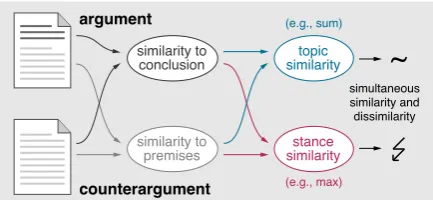
argumentcounterargument
simultaneous similarity and dissimilarity
similarity to conclusion
similarity to premises
topic similarity
stance similarity
(e.g., max)
[image:2.595.72.289.62.162.2](e.g., sum)
Figure 1: Modeling the simultaneous similarity and dissimilarity of a counterargument to an argument.
to the argument. Both are inferred — in different ways — from the similarities to the argument’s con-clusion and premises, since it is unclear in advance, whether either of these units or the reasoning be-tween them is countered. Thereby, we find the most dissimilar among the most similar arguments.
To study counteraguments, we provide a new corpus with 6753 argument-counterargument pairs, taken from 1069 debates on idebate.org, as well as millions of false pairs derived from them. Given the corpus, we define eight retrieval tasks that differ in the types of candidate counterarguments. Based on the words and embeddings of the arguments, we de-velop similarity functions that realize the outlined model as a ranking approach. In systematic experi-ments, we evaluate the different building blocks of our model on all defined tasks.
The results suggest that our hypothesis is true for many arguments. The best model configuration improves common word and embedding similarity measures by eight to ten points accuracy in all tasks. Inter alia, we rank 60.3% of the best counterargu-ments highest when given all argucounterargu-ments with op-posite stance (7.6 on average). Even with all 2801 test arguments as candidates, we still achieve 32.4% (and a mean rank of 15), fitting the intuition that off-topic arguments are easier to discard. Our analysis reveals notable gaps across topical themes though.
Contributions We believe that our findings will be important for applications such as automatic debating technologies (Rinott et al.,2015) and ar-gument search (Wachsmuth et al.,2017b). To sum-marize, our main contributions are:
• A large corpus for studying multiple counter-argument retrieval tasks (Sections3and4).
• A topic-independent approach to find the best counterargument to any argument (Section5).
• Evidence that many counterarguments can be found without topic knowledge (Section6).
The corpus as well as the Java source code for reproducing the experiments are available athttp:
//www.arguana.com.
2 Related Work
Counterarguments rebut arguments. In the theoreti-cal model ofToulmin(1958), a rebuttal in fact does not attack the argument, but it merely shows excep-tions to the argument’s reasoning. Govier(2010) suggests to rather speak of counterconsiderations in such cases. UnlikeDamer(2009), who investi-gateshow to attackseveral kinds of fallacies, we are interested inhow to identify attacks. We focus on those that target arguments, excluding personal (ad-hominem) attacks (Habernal et al.,2018).
FollowingWalton(2006), an argument can be attacked in two ways: one is to question its validity — not meaning that its conclusion must be wrong.
The other is to rebut it with acounterargumentthat entails the opposite conclusion, often by revisiting aspects or introducing new ones. This is the type of attack we study. AsWalton(2009) details, rebuttals may target an argument’s premises or conclusion, or they may undercut the reasoning between them.
Recently, the computational analysis of natural language argumentation is receiving much atten-tion. Most research focuses on argument mining, ranging from segmenting a text into argument units (Ajjour et al., 2017), over identifying unit types (Rinott et al.,2015) and roles (Niculae et al.,2017), to classifying argument schemes (Feng and Hirst,
2011) and relations (Lawrence and Reed, 2017). Some works detect counterconsiderations in a text (Peldszus and Stede,2015) or their absence (Stab and Gurevych,2016). Such considerations make arguments more balanced (see above). In contrast, we seek for arguments that defeat others.
Many approaches mine attack relations between arguments. Some use deep learning to find attacks in discussions (Cocarascu and Toni,2017). Closer to this paper, others determine them in a given set of arguments, using textual entailment (Cabrio and Villata,2012) or a combination of markov logic and stance classification (Hou and Jochim,2017). In principle, any attacking argument denotes a coun-terargument. Unlike previous work, however, we aim for thebestcounterargument to an argument.
supervised learning, while we do not expect to have prior topic knowledge.Bar-Haim et al.(2017) ap-proach the stance of claims towards open-domain topics. Their approach combines aspect-based sen-timent with external relations between aspects and topics from Wikipedia. As such, it is in fact limited to the topics covered there. Our model applies to arbitrary arguments and counterarguments.
We need to identify only whether arguments op-pose each other, not their actual stance. Similarly,
Menini et al.(2017) classify only thedisagreement
of political texts. Part of their approach is to de-tect topical key aspects in an unsupervised manner, which seems useful for our purposes. Analogously,
Beigman Klebanov et al.(2010) study differences in vocabulary choice for the related task of per-spective classification, andTan et al.(2016) find that the best way to persuade opinion holders in the Change my view forum on reddit.com is to use dissimilar words. As we report later, however, our experiments did not show such results for the argument-counterargument pairs we deal with.
The goal of persuasion reveals the association of counterarguments to argumentation quality. Many quality criteria have been assessed for arguments, surveyed in (Wachsmuth et al.,2017a). In the study ofHabernal and Gurevych(2016), one reason an-notators gave for why an argument was more con-vincing than another was that it tackled flaws in the opposing view. Zhang et al.(2016) even found that debate winners tend to counter opposing arguments rather than focusing on their own arguments.
Argument quality assessment is particularly im-portant in retrieval scenarios. Existing approaches aim to retrieve documents that contain many claims (Roitman et al., 2016) or that provide most sup-port for their claims (Braunstain et al.,2016). In
Wachsmuth et al.(2017c), we adapt PageRank to ar-gumentative relations, in order to assess argument relevance objectively. While our search engineargs
for arguments on the web still uses content-based relevance measures in its first version (Wachsmuth et al.,2017b), its long-term idea is to rank the best arguments highest.1 The model present in this work finds the bestcounterarguments, but it is meant to be integrated intoargsat some point.
Like here,argsuses idebate.org arguments. Oth-ers take data from that portal for studying support (Boltuži´c and Šnajder,2014) or for the distant su-pervision of argument mining (Al-Khatib et al.,
1Argument search engineargs:http://args.me
2016). Our corpus is not only larger, though, but it is the first to utilize a unique feature of idebate.org: the explicit specification of counterarguments.
3 The ArguAna Counterargs Corpus
This section introduces ourArguAna Counterargs corpuswith argument-counterargument pairs, cre-ated automatically from the structure of idebate.org. The corpus is freely available at http://www.
arguana.com/data. We also provide the code
to replicate the construction process.
3.1 The Web Portal idebate.org
On theportalidebate.org, diverse controversial top-ics of usually rather general interest are discussed in debates, subsumed under 15 themes, such as “economy” and “health”. Each debate has a title capturing a thesis on a topic, such as “This House would limit the right to bear arms”, followed by an introductory text, a set of mostly elaborated and well-writtenpointsthat have a pro or a con stance towards the thesis, and a bibliography.
A specific feature of idebate.org is that virtually every point comes along with acounterthat imme-diately attacks the point and its stance. Both points and counters can be seen asarguments. While a point consists of a one-sentence claim (the argu-ment’sconclusion) and a few sentences justifying the claim (thepremise(s)), the counter’s (opposite) conclusion remains implicit.
All arguments on the portal are established by a community with the goal of showing both sides of a topic in a balanced manner. We therefore as-sume each counter to be the best counterargument available for the respective point, and we use all resultingtrue argument pairsas the basis of our corpus. Figure2illustrates the italicized concepts, showing the structure of idebate.org. An example argument pair has been discussed in Section1.
3.2 Corpus Construction
point
true counter
other argument pairs in same debate
other points with same stance
counters to same stance
points with opposite stance
counters to opposite stance
points from other debates
counters from other debates
other debates from same theme
points from other themes
counters from other themes
debates from other themes
argument conclusion argument premise(s)
argument premise(s) (conclusion
implicit) (a) (b) (c)
(e) (d)
(f) (h)
(g) (i)
true argument pair
[image:4.595.98.498.63.222.2]... ... ... ...
Figure 2: Structure of idebate.org for one true argument pair in our corpus. Colors denote matching stance; we assume arguments from other debates to have no stance towards a point. Points have a conclusion and premises, counters only premises. (a)–(i) are used in Section4to specify the candidates in different tasks.
Theme Debates Points Counters
Culture 46 278 278
Digital freedoms 48 341 341
Economy 95 590 588
Education 58 382 381
Environment 36 215 215
Free speech debate 43 274 273
Health 57 334 333
International 196 1315 1307
Law 116 732 730
Philosophy 50 320 320
Politics 155 982 978
Religion 30 179 179
Science 41 271 269
Society 75 436 431
Sport 23 130 130
Training set 644 4083 4065
Validation set 211 1290 1287
Test set 214 1406 1401
[image:4.595.70.292.288.519.2]counterargs-18 1069 6779 6753
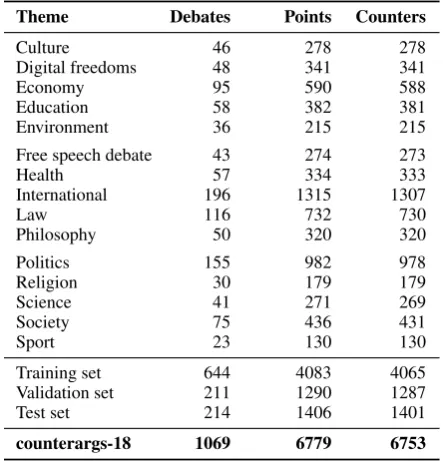
Table 1: Distribution of debates, points, and coun-ters over the themes in thecounterargs-18corpus. The bottom rows show the size of the datasets.
3.3 Corpus Statistics
Table1lists the number of debates crawled for each theme, along with the numbers of points and coun-ters in the debates. The 26 found points without a counter are included in the corpus, but we do not use them in our experiments.
In total, the ArguAna Counterargs corpus con-sists of 1069 debates with 6753 points that have a counter. The mean length of points is 196.3 words, whereas counters span only 129.6 words, largely due to the missing explicit conclusion. To avoid exploiting this corpus bias, no approach in our ex-periments captures length differences.
3.4 Datasets
We split the corpus into a training set, consisting of the first 60% of all debates of each theme (ordered by alphabet), as well as a validation set and a test set, each covering 20%. The dataset sizes are found at the bottom of Table1. By putting all arguments from a debate into a single dataset, no specific topic knowledge can be gained from the training or validation set. We include all themes in all datasets, because we expect the set of themes to be stable.
We checked for duplicates. Among the 13 532 point and counters, 3407 appear twice, 723 three times, 36 four times, and 1 five times. We ensure that no true pair is used as a false pair in our tasks.
4 Counterargument Retrieval Tasks
Based on the new corpus, we define the following eight counterargument retrieval tasks of different complexity. All tasks consider all true argument-counterargument pairs, while differing in terms of what arguments (points and/or counters) from which context (same debate, same theme, or entire portal) are candidates for a given argument.
Same Debate: Opposing Counters All coun-ters in the same debate with stance opposite to the given argument are candidates (Figure2: a, b). The task is to find the best counterargument among all counters to the argument’s stance.
Training Set Validation Set Test Set
Context Candidate Counterarg’s True False Ratio True False Ratio True False Ratio
Same debate Opposing counters 4 065 11 672 1:2.9 1 287 3 590 1:2.8 1 401 4 052 1:2.9
Counters 4 065 27 024 1:6.6 1 287 8 348 1:6.5 1 401 9 312 1:6.6
Opposing arguments 4 065 27 026 1:6.6 1 287 8 350 1:6.5 1 401 9 312 1:6.6
Arguments 4 065 54 070 1:13.3 1 287 16 700 1:13.0 1 401 18 630 1:13.3
Same theme Counters 4 065 1 616 000 1:398 1 287 176 266 1:137 1 401 189 870 1:136
Arguments 4 065 3 232 038 1:795 1 287 352 536 1:274 1 401 379 746 1:271
Entire portal Counters 4 065 16 517 994 1:4063 1 287 1 654 878 1:1286 1 401 1 961 182 1:1400
Arguments 4 065 33 038 154 1:8127 1 287 3 309 760 1:2572 1 401 3 922 582 1:2800
Table 2: Number of true and false argument-counterargument pairs as well as their ratio for each evaluated context and type of candidate counterarguments in the three datasets. Each line defines one retrieval task.
Same Debate: Opposing Arguments All argu-ments in the same debate with opposite stance are candidates (Figure2: a, b, d). The task is to find the best among all on-topic counterarguments.
Same Debate: Arguments All arguments in the same debate irrespective of their stance are candi-dates (Figure2: a–e). The task is to find the best counterargument among all on-topic arguments.
Same Theme: Counters All counters from the same theme are candidates (Figure2: a–c, f). The task is to find the best counterargument among all on-theme arguments phrased as counters.
Same Theme: Arguments All arguments from the same theme are candidates (Figure2: a–g). The task is to find the best counterargument among all on-theme arguments.
Entire Portal: Counters All counters are candi-dates (Figure2: a–c, f, h). The task is to find the best counterargument among all arguments phrased as counters.
Entire Portal: Arguments All arguments are candidates (Figure2: a–i). The task is to find the best counterargument among all arguments.
Table2lists the numbers of true and false pairs for each task. Experiment files containing the file paths of all candidate pairs are provided in our corpus.
5 Retrieval of the Best Counterargument without Prior Topic Knowledge
The eight defined tasks indicate the subproblems of retrieving the best counterargument to a given argument: Finding all arguments that address the
same topic, filtering those arguments with an oppo-site stancetowards the topic, and identifying the
best counteramong these arguments. This section
presents our approach to solving these problems computationally without prior knowledge of the argument’s topic, based on the simultaneous simi-larity and dissimisimi-larity of arguments.2
5.1 Topic as Word and Embedding Similarity
We do not reinvent the wheel to assess topical rel-evance, but rather follow common practice. Con-cretely, we hypothesize a candidate counterargu-ment to be on-topic if it is similar to the argucounterargu-ment in terms of its words and its embedding. We capture these two types of similarity as follows.
Word Argument Similarity To best represent the words in arguments, we did initial counterargu-ment retrieval tests with token, stem, and lemma
n-grams,n∈ {1,2,3}. While the differences were not large, stems worked best and stem 1-grams suf-ficed. Both might be a consequence of the limited data size. In our experiments in Section6, we de-termine thestem 1-gramsto be considered on the training set of each task.
For word similarity computation, we tested four inverse vector-based distance measures: Cosine, Euclidean, Manhattan, and, Jaccard similarity (Cha,
2007). On the validation sets, the Manhattan sim-ilarity performed best, closely followed by the Jaccard similarity. Both clearly outperformed Eu-clidean and especially Cosine similarity. This sug-gests that the presence and absence of words are equally important and that outliers should not be punished more. For brevity, we report only results for theManhattan similaritybelow.
2
Embedding Argument Similarity We evalu-ated five pretrained word embedding models for representing arguments in first tests: GoogleNews-vectors (Mikolov et al.,2013), ConceptNet Num-berbatch (Speer et al.,2017), wiki-news-300d-1M, wiki-news-300d-1M-subword, and crawl-300d-2M (Mikolov et al.,2017). The former two were com-petitive, the others performed notably worse. Since
ConceptNet Numberbatchis smaller and supposed to have less bias, we used it in all experiments.
To capture argument-level embedding similar-ity, we compared the four inverse vector-based dis-tance measures above on average word embeddings against the inverse Word Mover’s distance, which quantifies the optimum alignment of two word em-bedding sequences (Kusner et al.,2015). ThisWord Mover’s similarityconsistently beat the others, so we decided to restrict our view to it.
5.2 Stance as Topic Dissimilarity
Stance classification without prior topic knowledge is challenging: While we can compare the topics of any two arguments, it is impossible in general to infer the stance of the specific aspects invoked by one argument to those of the other. As sketched in Section2, related work employs external knowl-edge to infer stance relations of aspects and topics (Bar-Haim et al.,2017) or trains classifying attack relations (Cabrio and Villata,2012). Unfortunately, both does not apply to topics unseen before.
For argument pairs invoking similar aspects, a way to go is in principle to assess sentiment polar-ity; intuitively, two arguments with the same topic but opposite sentiment have opposing stance. How-ever, we tested topic-agnostic sentiment lexicons (Baccianella et al.,2010) and state-of-the-art sen-timent classifiers, trained on large-scale multiple-domain review data (Prettenhofer and Stein,2010;
Joulin et al.,2017). The correlation between senti-ment and stance differences of training argusenti-ments was close to zero. A possible explanation is the lim-ited explicitness of sentiment on idebate.org, mak-ing the lexicons and classifiers fail there.
Other related work suggests that the vocabulary of opposing sides differs (Beigman Klebanov et al.,
2010). We thus checked on the training set whether counterarguments are similar in their embeddings but dissimilar in their words. The measures above did not support this hypothesis, i.e., both embed-ding and word similarity increased the likelihood of a candidate counterargument being the best. Still,
there must be a difference between an argument and its counterargument by concept. As a solution, we capture dissimilarity with the same similarity functions as above, but we change the granularity level on which we measure similarity.
5.3 Simultaneous Similarity and Dissimilarity
The arising question is how to assess similarity and dissimilarity at the same time. We hypothesize the best counterargument to be very similar in overall terms, but very dissimilar in certain respects. To capture this intuition, we rely on expert knowledge from argumentation theory (see Section2).
Word and Embedding Unit Similarities In par-ticular, we follow the notion that a counterargument attacks either the conclusion of an argument, the ar-gument’s premises, or both. As a consequence, we compute two word and two embedding similarities as specified above for each candidate counterargu-ment; once to the argument’s conclusion (calledwc
andecfor words and embeddings respectively) and
once to the argument’s premises (wpandep).
Now, to capture similarity and dissimilarity si-multaneously, we need multiple ways to aggregate conclusion and premise similarities. As we do not generally know which argument unit is attacked, we resort to four standard aggregation functions that generalize over the unit similarities. For words, these are the followingword unit similarities:
w↓ := min{wc, wp} w×:= wc·wp
w↑ := max{wc, wp} w+:= wc+wp
Accordingly, we define four respectiveembedding unit similarities,e↓,e↑,e×, ande+.
As mentioned above, both word similarity and embedding similarity positively affect the likeli-hood that a candidate is the best counterargument. Therefore, we combine each pair of similarities as
w↓+e↓,w↑+e↑,w×+e×, andw++e+, but we
also evaluate their impact in isolation below.3
Counterargument Scoring Model Based on the unit similarities, we finally define a scoring model for a given pair of argument and candidate counterargument. The model includes two unit similarity values,simanddissim, butdissimis subtracted fromsim, such that it actually favors dissimilarity. Thereby, we realize the topic and
3In principle, other unit similarities could be used for
stance similarity sketched in Figure1. We weight the two values with a damping factorα:
α·sim − (1−α)·dissim
wheresim, dissim∈ {w↓+e↓, w↑+e↑, w×+e×, w++e+}andsim6=dissim.
The general idea of the scoring model is that
simrewards one type of similarity, whereas sub-tractingdissimpunishes another type. We seek to thereby find the most dissimilar candidate among the similar candidates. The model is meant to give a higher score to a pair the more likely the candi-date is the best counterargument to the argument, so the scores can be used for ranking.
What combination ofsimanddissimturns out best, is hard to foresee and may depend on the retrieval task at hand. We hence evaluate different combinations empirically below. The same holds for the damping factorα∈[0,1]. If our hypothesis on similarity and dissimilarity is true, then the best
αshould be close to but lower than 1. Conversely, ifα= 1.0achieves the best performance, then only similarity would be captured by our model.
6 Evaluation
We now report on systematic ranking experiments with our counterargument scoring model. The goal is to evaluate on all eight retrieval tasks from Sec-tion4to what extent our hypothesis holds that the best counterargument to an argument invokes the same aspects while having opposing stance. The Java source code of the experiments is available at:
http://www.arguana.com/software
6.1 Experimental Set-up
We evaluated the following set-up of tasks, data, measures, baselines, and approaches.
Tasks We tackled each of the eight retrieval tasks as a ranking problem, i.e., we aimed to rank the best counterargument to each argument highest, given all candidates. Accordingly, only one candidate counterargument per argument is correct.4
4
One alternative would be to see each argument pair as one instance of a classification problem. However, our pre-liminary tests confirmed the intuition that identifying the best counterargument is hard without knowing the other candidates, i.e., there is no general (dis)similarity threshold that makes an argument the best counterargument. Rather, how similar or dissimilar a counterargument needs to be depends on the topic and on the other candidates. Another alternative would be to treat all candidates for an argument as one instance, but this makes the experimental set-up very intricated.
Data Table2has shown the true and false argu-ment pairs in all datasets. We undersampled each training set, resulting in 4065 true and 4065 false training pairs in all tasks.5 Our model does not do any learning-to-rank on these pairs, but we derived lexicons for the word similarities from them (all stems included in at least 1% of all pairs). As de-tailed below, we then determined the best model configurations on the validation sets and evaluated these configurations on the test sets.
Measures As only one candidate is true per argu-ment, we report theaccuracy@1of each approach, i.e., the percentage of arguments for which the true counterargument was ranked highest. Besides, we compute the roundedmean rankof the best coun-terargument in all rankings, reflecting the average performance of an approach. Exemplarily, we also mention themean reciprocal rank (MRR), which is more sensitive to outliers.
Baselines A trivial way to address the given tasks is to pick any candidate by chance for each argu-ment. Thisrandom baselineallows quantifying the impact of other approaches. As counterargument retrieval has not been tackled yet, we do not use any existing baseline.6 Instead, we evaluate the ef-fects of the different building blocks of our scoring model. On one hand, we check the need for distin-guishing conclusions and premises by comparing to the word argument similarity (w) and the embed-ding argument similarity (e). On the other hand, we consider all eight word and embedding unit sim-ilarities (w↓,w↑, . . . ,e+) as baselines, in order to
see whether and how to best aggregate them.
Approaches After initial tests, we reduced the set of tested values of the damping factorαin our scoring model to{0.8,0.9,1.0}. On the validation sets of the first six tasks,7 we then analyzed all possible combinations ofw↓+e↓,w↑+e↑,w×+e×,
w++e+, as well asw+eforsimand dissim.
Three configurations of the model turned out best:
we := 1.0·(w×+e×)
we↓ := 0.9·(w×+e×)−0.1·(w↓+e↓)
we↑ := 0.9·(w++e+)−0.1·(w↑+e↑)
5Undersampling was done stratified, such that the same
number of false counterarguments was taken from each type, b–i, in Figure2that is relevant in the respective task.
6Notice, though, that we tested a number of approaches to
identify opposing stance, as discussed in Section5.
7We did not expect “game-changing” validation set results
Same Debate Same Theme Entire Portal
Opp. Ctr.’s Counters Opposing Arguments Counters Arguments Counters Arguments
# Baseline / Approach @1 R @1 R @1 R @1 R @1 R @1 R @1 R @1 R
w Word argument similarity 65.9 2 48.5 2 42.5 3 30.0 4 44.1 5 28.3 10 39.7 22 21.8 49
e Embedding argument similarity 62.9 2 44.6 2 51.6 2 36.8 4 38.8 7 32.9 10 34.2 39 23.9 55
w↓ Word unit similarity minimum 53.8 2 38.4 3 45.9 3 33.7 5 28.5 22 24.8 42 21.4 206 18.5 403
w↑ Word unit similarity maximum 66.1 2 48.0 2 44.0 3 30.2 4 44.0 5 28.3 9 38.0 21 21.2 44
w× Word unit similarity product 64.9 2 49.5 3 56.1 2 40.7 4 44.3 18 36.8 35 37.8 177 26.8 354
w+ Word unit similarity sum 71.5 1 53.7 2 54.1 2 39.1 4 49.0 4 36.8 7 44.7 17 28.6 33
e↓ Embedding unit sim. minimum 61.6 2 44.9 3 43.4 3 32.1 4 37.8 7 27.4 13 32.5 42 20.7 74
e↑ Embedding unit sim. maximum 63.4 2 44.5 2 47.5 2 33.2 4 39.8 5 29.8 8 32.1 20 20.1 33
e× Embedding unit sim. product 69.7 1 52.0 2 55.4 2 41.0 3 44.3 4 37.1 6 43.2 14 27.8 21
e+ Embedding unit sim. sum 69.7 1 51.8 2 55.4 2 40.5 3 47.5 4 36.8 6 43.0 13 27.6 21
we 1.0·(w×+e×) 72.1 1 55.2 2 ‡60.3 2 †44.9 3 50.4 4 40.9 7 46.0 19 32.2 34
we↓0.9·(w×+e×)−0.1·(w↓+e↓) 72.0 1 55.5 2 59.5 2 44.1 3 51.3 4 †41.0 7 46.3 19 31.7 35
we↑0.9·(w++e+)−0.1·(w↑+e↑)†74.5 1 †57.7 2 59.6 2 44.1 3 ‡54.2 3 40.8 5 ‡50.0 9 ‡32.4 15
[image:8.595.71.529.64.271.2]r Random baseline 25.7 2 13.1 4 13.1 4 7.0 7 0.7 69 0.4 137 0.1 701 0.0 1401
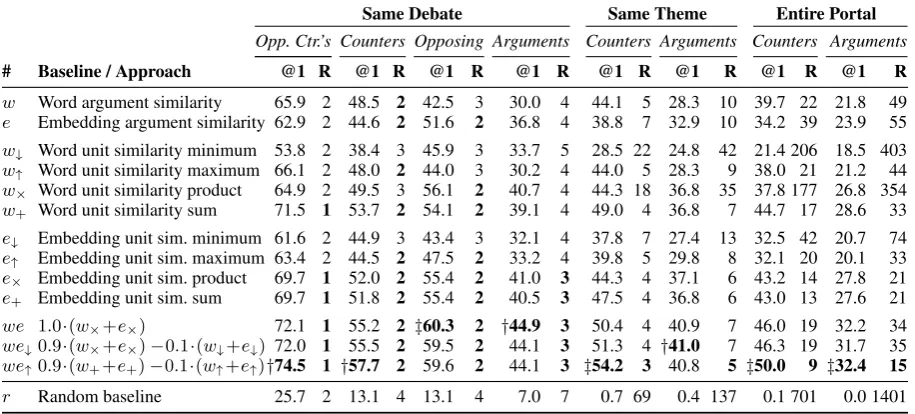
Table 3: Test set accuracy of ranking the best counterargument highest (@1) and mean rank (R) for 14 baselines and approaches (w,e,w↓, . . . ,r) in all eight tasks (given byContextandCandidates). Each best accuracy value (bold) significantly outperforms the best baseline with 99% (†) or 99.9% (‡) confidence.
wewas best on the validation set ofSame Debate: Opposing Arguments(accuracy@1: 62.1) andwe↓
on the one ofSame Debate: Arguments(49.0). All other tasks were dominated by we↑. Especially,
we↑was better than1.0·(w++e+)in all of them
with clear leads of up to 2.2 points. This underlines the importance of modeling dissimilarity for coun-terargument retrieval. We tookwe,we↓, andwe↑
as our approaches for the test set.8
6.2 Results
Table3shows the accuracy@1 and the mean rank of all baselines and approaches on each of the eight given retrieval tasks.
Overall, the counter-only tasks seem slightly harder within thesame debate(comparing Coun-terstoOpposing), i.e., stance is harder to assess than topical relevance. Conversely, the other Coun-ters tasks seem easier, suggesting that topically close but false candidate counterarguments with the same stance as the argument (which are not in-cluded in anyCounterstask) are classified wrongly most often. Besides, these results support that po-tential differences in the phrasing of counters are not exploited, as desired.
The accuracy of the standard similarity measures,
wande, goes from 65.9 and 62.9 respectively in the smallest task down to 21.8 and 23.9 in the largest.
8All validation set results are found in the
supplemen-tary material, which we provide athttp://www.arguana.
com/publications
wis stronger when only counters are candidates,e
otherwise. This implies that words capture differ-ences between the best and other counters, whereas embeddings rather help discard false candidates with the same stance as the argument.
From the eight unit similarity baselines,w+
per-forms best on five tasks (e×twice,w×once).w+
finds 71.5% true counterarguments among all op-posing counters in a debate, and 28.6% among all test arguments from the entire portal. In that task, however, the mean ranks ofw+(33) and
particu-larly ofw×(354) are much worse than fore×(21), meaning that words are insufficient to robustly find counterarguments.
we,we↓, andwe↑outperform all baselines in all
tasks, improving the accuracy by 8.1 (Same Theme: Arguments) to 10.3 points (Entire Portal: Counters) overwande, and at least 3.0 over the best baseline in each task. Among all opposing arguments from the same debate (true-to-false ratio 1:6.6),wefinds 60.3% of the best counterarguments, 44.9% when all arguments are given (1:13.3).
The winner in our evaluation is we↑, though, being best in five of the eight tasks. It found the true among all opposing counters in 74.5% of all cases, and about every third time (32.4) among all 2801 test set arguments; a setting where the random baseline has virtually no chance. Given all arguments from the same theme,we↑ puts the
Entire Portal: Arguments Accuracy@1 Mean Rank
Theme Arguments w+ we↑ w+ we↑
Culture 69 31.9 36.2 12 9
Digital freedoms 61 37.7 44.3 58 20
Economy 125 27.2 25.6 21 10
Education 81 38.3 39.5 36 17
Environment 46 17.4 21.7 22 7
Free speech debate 58 10.3 12.1 130 55
Health 77 28.6 36.4 26 14
International 271 25.8 31.4 31 19
Law 134 38.8 38.1 16 8
Philosophy 85 34.1 38.8 29 14
Politics 202 28.7 33.2 28 11
Religion 45 24.4 33.3 58 8
Science 57 19.3 28.1 6 5
Society 60 16.7 20.0 45 22
Sport 30 43.3 46.7 35 9
[image:9.595.73.289.68.274.2]All themes 1401 28.6 32.4 33 15
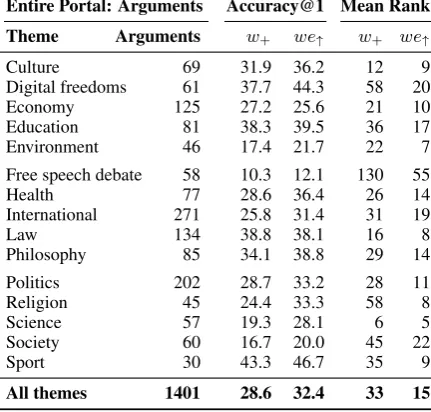
Table 4: Accuracy@1 and mean rank of the best baseline (w+) and approach (we↑) on each theme
when all 2801 test set arguments are candidates.
Although our scoring model thus does notsolvethe retrieval tasks, we conclude that it serves as a robust approach to rank the best counterargument high.
To test significance, we separately computed the accuracy@1 for the arguments from each theme. The differences between the 15 values of the best approach on each task and those of the best baseline (w+,w×, ore×) were normally distributed. Since
the baselines and approaches are dependent, we used a one-tailed dependentt-test with paired sam-ples. As Table3specifies, our approaches are con-sistently better, partly with at least 99% confidence, partly even with 99.9% confidence.
In Table 4, we exemplarily detail the compari-son of the best approach (we↑) to the best baseline
(w+) onEntire Portal: Arguments. The mean ranks
across themes underline the robustness ofwe↑, be-ing in the top 10 for 7 and in the top 20 even for 13 themes. Still, the accuracy@1 of bothw+andwe↑
varies notably, in case ofwe↑ from 12.1 forfree speech debateto 46.7 forsport. For free speech debates (e.g., “This House would criminalise blas-phemy”), we observed that their arguments tend to be overproportionally long, which might lead to deviating similarities. In case of sports, the topical specificity (e.g., “This House would ban boxing”) reduces the probability of mistakenly choosing can-didates from other themes.
Free speech debate turned out the hardest theme in seven tasks,healthin the remaining one. Besides sports, in some tasks the best results were obtained
forreligionandscience, both of which share the characteristic of dealing with very specific topics.9
7 Conclusion
This paper has asked how to find the best counterar-gument to any arcounterar-gument without prior knowledge of the argument’s topic. We didnotaim to engineer the best approach to this retrieval task, but to study whether we can model the simultaneous similarity and dissimilarity of a counterargument to an argu-ment computationally. For the restricted domain of debate portal arguments, our main result is quite intriguing: The best model (we↑) rewards a high overall similarity to the argument’s conclusion and premises while punishing a too high similarity to either of them. Despite its simplicity,we↑found the best counterargument among 2801 candidates in almost a third of all cases, and ranked it into the top 15 on average. This speaks for our hypothesis that the best counterargument often just addresses the same topical aspects with opposite stance.
Of course, our hypothesis is simplifying, i.e., there are counterarguments that will not be found based on aspect and stance similarity only. Apart from some hyperparameters, however, our model is unsupervised and it does not make any assump-tion about an argument’s topic. Hence, it applies to any argument, given a pool of candidate coun-terarguments. While the model can be considered
open-topic, a next step will be to study counterar-gument retrievalopen-source.
We are confident that the modeled intuition gen-eralizes beyond idebate.org. To obtain further in-sights into the nature of counterarguments, deeper linguistic analysis along with supervised learning may be needed, though. We provide a corpus to train respective approaches, but leave the according research to future work.
The intended practical application of our model is to retrieve counterarguments in automatic debat-ing technologies (Rinott et al.,2015) and argument search (Wachsmuth et al.,2017b). While debate portal arguments are often suitable in this regard, in general not always a real counterargument exists to an argument. Still, returning one that addresses similar aspects with opposite stance makes sense then. An alternative would be togenerate counter-arguments, but we believe that humans are better than machines in writing them — currently.
9The individual results of the best approach and baseline
References
Yamen Ajjour, Wei-Fan Chen, Johannes Kiesel,
Hen-ning Wachsmuth, and Benno Stein. 2017. Unit
seg-mentation of argumentative texts. InProceedings of the 4th Workshop on Argument Mining, pages 118– 128. Association for Computational Linguistics.
Khalid Al-Khatib, Henning Wachsmuth, Matthias
Ha-gen, Jonas Köhler, and Benno Stein. 2016.
Cross-domain mining of argumentative text through dis-tant supervision. InProceedings of the 2016 Con-ference of the North American Chapter of the Asso-ciation for Computational Linguistics: Human Lan-guage Technologies, pages 1395–1404. Association for Computational Linguistics.
Stefano Baccianella, Andrea Esuli, and Fabrizio
Sebas-tiani. 2010. SentiWordNet 3.0: An enhanced
lexi-cal resource for sentiment analysis and opinion min-ing. In Proceedings of the Seventh conference on International Language Resources and Evaluation (LREC’10). European Languages Resources Associ-ation (ELRA).
Roy Bar-Haim, Indrajit Bhattacharya, Francesco
Din-uzzo, Amrita Saha, and Noam Slonim. 2017. Stance
classification of context-dependent claims. In Pro-ceedings of the 15th Conference of the European Chapter of the Association for Computational Lin-guistics: Volume 1, Long Papers, pages 251–261. Association for Computational Linguistics.
Beata Beigman Klebanov, Eyal Beigman, and Daniel
Diermeier. 2010. Vocabulary choice as an
indica-tor of perspective. InProceedings of the ACL 2010 Conference Short Papers, pages 253–257. Associa-tion for ComputaAssocia-tional Linguistics.
Filip Boltuži´c and Jan Šnajder. 2014. Back up your
stance: Recognizing arguments in online discus-sions. InProceedings of the First Workshop on Ar-gumentation Mining, pages 49–58. Association for Computational Linguistics.
Liora Braunstain, Oren Kurland, David Carmel, Idan Szpektor, and Anna Shtok. 2016. Supporting human answers for advice-seeking questions in CQA sites. InProceedings of the 38th European Conference on IR Research, pages 129–141.
Elena Cabrio and Serena Villata. 2012.Combining
tex-tual entailment and argumentation theory for sup-porting online debates interactions. In Proceed-ings of the 50th Annual Meeting of the Associa-tion for ComputaAssocia-tional Linguistics (Volume 2: Short Papers), pages 208–212. Association for Computa-tional Linguistics.
Sung-Hyuk Cha. 2007. Comprehensive Survey on
Distance/Similarity Measures between Probability
Density Functions. International Journal of
Math-ematical Models and Methods in Applied Sciences, 1(4):300–307.
Oana Cocarascu and Francesca Toni. 2017.
Identify-ing attack and support argumentative relations us-ing deep learnus-ing. InProceedings of the 2017 Con-ference on Empirical Methods in Natural Language Processing, pages 1374–1379. Association for Com-putational Linguistics.
T. Edward Damer. 2009. Attacking Faulty Reasoning:
A Practical Guide to Fallacy-Free Arguments, 6th edition. Wadsworth, Cengage Learning, Belmont, CA.
Vanessa Wei Feng and Graeme Hirst. 2011.
Classify-ing arguments by scheme. In Proceedings of the 49th Annual Meeting of the Association for Com-putational Linguistics: Human Language
Technolo-gies, pages 987–996. Association for Computational
Linguistics.
Trudy Govier. 2010. A Practical Study of Argument,
7th edition. Wadsworth, Cengage Learning,
Bel-mont, CA.
Ivan Habernal and Iryna Gurevych. 2016.What makes
a convincing argument? Empirical analysis and de-tecting attributes of convincingness in web argumen-tation. In Proceedings of the 2016 Conference on Empirical Methods in Natural Language Processing, pages 1214–1223. Association for Computational Linguistics.
Ivan Habernal, Henning Wachsmuth, Iryna Gurevych, and Benno Stein. 2018. Before name-calling: Dy-namics and triggers of ad hominem fallacies in web
argumentation. In 16th Annual Conference of the
North American Chapter of the Association for Com-putational Linguistics: Human Language
Technolo-gies. Association for Computational Linguistics, to
appear.
Yufang Hou and Charles Jochim. 2017. Argument
rela-tion classificarela-tion using a joint inference model. In Proceedings of the 4th Workshop on Argument
Min-ing, pages 60–66. Association for Computational
Linguistics.
Armand Joulin, Edouard Grave, Piotr Bojanowski, and
Tomas Mikolov. 2017. Bag of tricks for efficient
text classification. InProceedings of the 15th Con-ference of the European Chapter of the Association for Computational Linguistics: Volume 2, Short
Pa-pers, pages 427–431. Association for Computational
Linguistics.
Matt J. Kusner, Yu Sun, Nicholas I. Kolkin, and
Kil-ian Q. Weinberger. 2015.From word embeddings to
document distances. InProceedings of the 32Nd In-ternational Conference on InIn-ternational Conference on Machine Learning - Volume 37, pages 957–966.
John Lawrence and Chris Reed. 2017. Mining
Stefano Menini, Federico Nanni, Simone Paolo
Ponzetto, and Sara Tonelli. 2017. Topic-based
agree-ment and disagreeagree-ment in us electoral manifestos. In Proceedings of the 2017 Conference on Empiri-cal Methods in Natural Language Processing, pages 2938–2944. Association for Computational Linguis-tics.
Tomas Mikolov, Edouard Grave, Piotr Bojanowski,
Christian Puhrsch, and Armand Joulin. 2017.
Ad-vances in pre-training distributed word representa-tions. CoRR.
Tomas Mikolov, Ilya Sutskever, Kai Chen, Greg
Cor-rado, and Jeffrey Dean. 2013. Distributed
represen-tations of words and phrases and their composition-ality. InProceedings of the 26th International Conference on Neural Information Processing Systems -Volume 2, pages 3111–3119.
Vlad Niculae, Joonsuk Park, and Claire Cardie. 2017.
Argument mining with structured SVMs and RNNs. InProceedings of the 55th Annual Meeting of the As-sociation for Computational Linguistics (Volume 1: Long Papers), pages 985–995. Association for Com-putational Linguistics.
Andreas Peldszus and Manfred Stede. 2015. Towards
detecting counter-considerations in text. In Proceed-ings of the 2nd Workshop on Argumentation Mining, pages 104–109. Association for Computational Lin-guistics.
Peter Prettenhofer and Benno Stein. 2010.
Cross-language text classification using structural corre-spondence learning. InProceedings of the 48th An-nual Meeting of the Association for Computational Linguistics, pages 1118–1127. Association for Com-putational Linguistics.
Ruty Rinott, Lena Dankin, Carlos Alzate Perez, M. Mitesh Khapra, Ehud Aharoni, and Noam
Slonim. 2015. Show me your evidence — An
au-tomatic method for context dependent evidence de-tection. InProceedings of the 2015 Conference on Empirical Methods in Natural Language Processing, pages 440–450. Association for Computational Lin-guistics.
Haggai Roitman, Shay Hummel, Ella Rabinovich, Ben-jamin Sznajder, Noam Slonim, and Ehud Aharoni. 2016. On the retrieval of wikipedia articles
contain-ing claims on controversial topics. InProceedings
of the 25th International Conference on World Wide Web, Companion Volume, pages 991–996.
Parinaz Sobhani, Diana Inkpen, and Stan Matwin.
2015.From argumentation mining to stance
classifi-cation. InProceedings of the 2nd Workshop on Ar-gumentation Mining, pages 67–77. Association for Computational Linguistics.
Robert Speer, Joshua Chin, and Catherine Havasi. 2017.
Conceptnet 5.5: An open multilingual graph of gen-eral knowledge. InProceedings of the Thirty-First
AAAI Conference on Artificial Intelligence, pages 4444–4451.
Christian Stab and Iryna Gurevych. 2016.
Recogniz-ing the absence of opposRecogniz-ing arguments in persuasive essays. In Proceedings of the Third Workshop on Argument Mining (ArgMining2016), pages 113–118. Association for Computational Linguistics.
Chenhao Tan, Vlad Niculae, Cristian
Danescu-Niculescu-Mizil, and Lillian Lee. 2016. Winning arguments: Interaction dynamics and persuasion
strategies in good-faith online discussions. In
Pro-ceedings of the 25th International World Wide Web Conference, pages 613–624.
Stephen E. Toulmin. 1958. The Uses of Argument.
Cambridge University Press.
Henning Wachsmuth, Nona Naderi, Yufang Hou, Yonatan Bilu, Vinodkumar Prabhakaran, Tim Al-berdingk Thijm, Graeme Hirst, and Benno Stein.
2017a. Computational argumentation quality
assess-ment in natural language. InProceedings of the 15th Conference of the European Chapter of the Associa-tion for ComputaAssocia-tional Linguistics: Volume 1, Long Papers, pages 176–187. Association for Computa-tional Linguistics.
Henning Wachsmuth, Martin Potthast, Khalid
Al Khatib, Yamen Ajjour, Jana Puschmann, Jiani Qu, Jonas Dorsch, Viorel Morari, Janek Bevendorff,
and Benno Stein. 2017b. Building an argument
search engine for the web. In Proceedings of the 4th Workshop on Argument Mining, pages 49–59. Association for Computational Linguistics.
Henning Wachsmuth, Benno Stein, and Yamen Ajjour.
2017c. “PageRank” for Argument Relevance. In
Proceedings of the 15th Conference of the European Chapter of the Association for Computational Lin-guistics: Volume 1, Long Papers, pages 1117–1127. Association for Computational Linguistics.
Douglas Walton. 2006.Fundamentals of Critical
Argu-mentation. Cambridge University Press.
Douglas Walton. 2009. Objections, rebuttals and refu-tations. pages 1–10.
Justine Zhang, Ravi Kumar, Sujith Ravi, and Cristian
Danescu-Niculescu-Mizil. 2016. Conversational