Proceedings of the Fourth Conference on Machine Translation (WMT), Volume 2: Shared Task Papers (Day 1) pages 455–463 455
A Test Suite and Manual Evaluation of Document-Level NMT at WMT19
Kateˇrina Rysov´a, Magdal´ena Rysov´a, Tom´aˇs Musil, Lucie Pol´akov´a and Ondˇrej Bojar
Charles University, Faculty of Mathematics and Physics Institute of Formal and Applied Linguistics
Malostransk´e n´amˇest´ı 25, 118 00 Prague, Czech Republic
{rysova, magdalena.rysova, musil, polakova, bojar}@ufal.mff.cuni.cz
Abstract
As the quality of machine translation rises and neural machine translation (NMT) is moving from sentence to document level translations, it is becoming increasingly difficult to evaluate the output of translation systems.
We provide a test suite for WMT19 aimed at assessing discourse phenomena of MT sys-tems participating in the News Translation Task. We have manually checked the outputs and identified types of translation errors that are relevant to document-level translation.
1 Introduction
Currently, the level of machine translation sys-tems can be very good or excellent. For some languages, the systems are on par with humans when evaluated at the level of individual sen-tences, see Hassan et al. (2018) for Chinese-to-English and Bojar et al. (2018) for English-to-Czech translation at WMT18. The main criterion for distinguishing MT systems’ quality thus has to shift from evaluating individual sentences to larger units. Ideally, the translated text should be now evaluated as a whole.
We believe that the fundamental criterion of the quality of manual or automatic translation is the extent to which the translation is functional in hu-man communication. These days, the critical ba-sic level in this criterion has been already reached by multiple machine translation systems covering a wide range of language pairs. While the reader of an automatically translated text may be grop-ing at some points in the text, the overall quality of the translation is already so high that the main content of the text and the author’s communicative intention is mostly conveyed.
Still, the reader of an MT output takes a higher effort to understand the translated text. For ex-ample, morphological errors, shortcomings in the
word order, incorrect syntactic relations, failure in translating terminology, or the choice of inappro-priate synonyms can hinder the speed and accu-racy of text understanding.
In this paper, we first provide a test suite for WMT19 aimed at assessing translation qual-ity of English to Czech NMT systems regarding document-level language phenomena. As qualita-tive analyses of document-level errors in MT out-puts are up-to-date quite rare, this paper further aims at identification, manual annotation and lin-guistic description of these types of errors relevant to English-Czech NMT and a comparison of per-formance of the submitted systems in the given ar-eas. We compare NMT systems that translate one sentence at a time with systems that have more than one sentence on input and therefore have po-tential to translate document-level phenomena bet-ter.
After an overview of detected translation er-rors from various levels of language description, the paper zooms in on three document-level, or coherence-related, phenomena: topic-focus artic-ulation (information structure), discourse tives and alternative lexicalizations of connec-tives.1 We assume that translation systems might have difficulties with these phenomena, as they are related to the previous context and go beyond (or are affected by the phenomena across) the sen-tence boundary. In this way, they contribute to the overall coherence of the text that should (as a whole) function as an independent unit of human communication.
1This work does not address in detail errors in
corefer-ence, pronoun and gender translation, as these phenomena have been already widely accounted for, e.g. Guillou et al.
2 Data
The evaluations in this paper are conducted on a selection of 101 documents from the paral-lel Prague Czech-English Dependency Treebank (PCEDT, Hajiˇc et al. (2012)), and we also used discourse annotations of the same texts in the Penn Discourse Treebank 3.0 (PDTB, for details see Webber et al.(2019)).
2.1 Prague Czech-English Dependency Treebank
The Prague Czech-English Dependency Treebank is a parallel corpus consisting of English original texts and their Czech translations. The PCEDT contains 1.2 million running words in almost 50,000 sentences in each part.
The English texts come from the Penn Tree-bank (Wall Street Journal Section; Marcus et al., 1993). They were manually translated into Czech by trained linguists without any support of MT and proofread. The PCEDT is manually an-notated on the tectogrammatical (deep-syntactic) layer in both languages. The sentences are repre-sented by dependency structures of content words. The nodes in the tree structures are provided with syntactico-semantic labels as, e.g., predi-cate, actor, patiens, addressee or locative. Also, the valency frames of verbs (argument structure) are captured, as well as elliptical structures and anaphoric relations.
In addition, the Czech part is automatically tagged and parsed as surface-syntactic depen-dency trees on the analytical layer. The English part also preserves the original phrase-structure annotation of the Penn Treebank. Also, the anno-tation of discourse relations, connectives and Al-tlexes from the Penn Discourse Treebank was ex-tracted and added to our PCEDT dataset.
3 NMT Systems
We evaluated 5 NMT systems from those partic-ipating in WMT19 in English-to-Czech transla-tion. In particular, we selected those of the highest quality as estimated by automatic scoring at ma-trix.statmt.org.2
CUNI-Transf-2018is last year submission by Popel (2018). It is a neural machine transla-tion model based on the Transformer architecture
2http://matrix.statmt.org/matrix/
systems_list/1896
and trained on parallel and back-translated mono-lingual data. It translates one sentence at a time.
CUNI-DocTransf-T2T is a Transformer model following Popel (2018), but trained on WMT19 document-level parallel and monolin-gual data. During decoding, each document was split into overlapping multi-sentence seg-ments, where only the “middle” sentences in each segment are used for the final transla-tion.CUNI-Transf-T2Tis the same system as CUNI-DocTransf-T2T, just applied on sepa-rate sentences during decoding.
CUNI-DocTransf-Marian is document-level trained Transformer in Marian frame-work following Popel (2018), but finetuned on document-level parallel and monolingual data by translating triples of adjacent sentences at once. If possible, only the middle sentence is consid-ered for the final translation hypothesis, otherwise a double or single sentence context is used.
Online-B is an anonymized online system which we know also from several previous years of WMT.
Reference is the Czech side of the PCEDT corpus.
4 Annotation Design
The 101 PCEDT documents selected for transla-tion and manual evaluatransla-tion belong to the “essay” and “letter” genre labels according to the classifi-cation of PDTB given in Webber (2009). At the same time, the selected texts have a length of 20– 50 sentences. These documents were submitted as an additional test suite for Machine Transla-tion of News shared task at the WMT 2019. Be-cause we are interested in document-level transla-tion and the effect of context on the translatransla-tion, we only selected documents with cross-sentence dis-course relations.
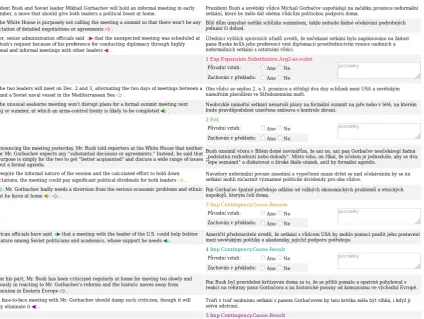
We have created a simple annotation interface (see Figure1), which allows the annotator to mark the items that were translated correctly.
Specifically, several types of cross-sentence dis-course relations are considered on the source side (reusing the annotations available in the Penn Dis-course Treebank 3.0).
The target side was validated by trained lin-guists. For each of the observed connectives / Al-tLex, the annotators indicated whether:
Figure 1: Screenshot of the annotation interface.
annotator, or the function of AltLex – according to the original English annotation displayed. If yes, then whether its Czech translation is (2):
• adequate and correctly placed,3
• adequate but incorrectly placed, • omitted and it does not harm the output • omitted and it harms the output
• not adequate.
The questionnaire for word order annotation is analogous, compare the description of tables with results below in Section7. The original translation into Czech from PCEDT could serve as a reference translation but similarly toBojar et al.(2018), we opted for a bilingual evaluation, showing the anno-tators always the source and the candidate transla-tion. The benefit is that the human translation can be evaluated using the same criteria as the MT sys-tem outputs.
There were 6 annotators, all of them students of linguistics. Each annotator evaluated 8 docu-ments in the first round. For each document, they
3for Altlexes: and preserves the original discourse
mean-ing
evaluated the output of one MT system (without knowing which MT system produced the output). To measure the inter-annotator agreement, we or-ganized a second round of evaluation, where each annotator was given documents and systems com-bination that was in the first round evaluated by another annotator. Details on the IAA are given in Section7.
5 Linguistic Analysis of Translations Errors across Language Levels
sentence, it does not mean that word order errors are also present in the rest of the translated text. It turned out, on the contrary, that the errors / prob-lematic issues appear individually, as singularities. In the following part, we discuss the problem-atic places in a sample of translated texts. We tried to select the best or (at least) good MT systems to demonstrate that even in such an advanced transla-tion, there are still issues requiring improvement.
5.1 Morphology
We were able to detect errors from various lev-els of language description. Some problematic issues concerned even such basic phenomena as e.g. the use of a verbal mood or other morpholog-ical issues (It’s as if France decided to give only French history questions to students in a Euro-pean history class, and when everybody aces the test, they say their kids are good in European his-tory – Je to, jako by se Francie rozhodla d´avat student˚um evropsk´ych hodin dˇejepisu jen ot´azky z francouzˇstiny, a kdyˇz vˇsichni v testu exceluj´ı, ˇr´ıkaj´ı, ˇze jejich dˇeti jsou v evropsk´ych dˇejin´ach dobr´e; the Czech translation is not consistent in maintaining potentiality: the intended content should be translated into Czech as: jakokdybyse Francie..., aaˇz byvˇsichni v textu excelovali, ˇrekli
by...) with the obligatory conditional morpheme by, also as a part of the conjunctionkdyby, used in past (unreal) conditions.
5.2 Lexicon
Other issues concerned the choice of vocabulary. The individual translations included e.g. inap-propriate repetition of the same word (ie. the MT systems produced a non-natural output by not attempting to use a synonym, cf. in test-coaching workbooks and worksheets — v pra-covn´ıch seˇsitech a prapra-covn´ıch seˇsitech “in test-coaching workbooks and in test-test-coaching work-books”). In some of them, there also appeared in-correct literal translations of terms (cf.a joint ven-ture of McGraw-Hill Inc. and Macmillan’s par-entt, Britain’s Maxwell Communication Corp – spoleˇcn´ym podnikem McGraw-Hill Inc. a Macmil-lanov´ym rodiˇcem, britskou spoleˇcnost´ı Maxwell Communication Corp).
Another lexical issue was the use of an inac-curate synonym in a given context (cf. but he doesn’t deny that some items are similar – ale nepop´ır´a, ˇze nˇekter´e pˇredmˇety jsou podobn´e; the wordpˇredmˇetymay be a synonym to the original
itemsbut not in this context, the Czech word here means rather tangibleobjects).
Generally, the MT systems succeed in translat-ing basic words or phrases but sometimes they fail in translating terms or technical words and in lex-ical variety (often resulting in word repetition and failure to use an appropriate synonym).
5.3 Syntax
The translations also exhibit signs of incorrect syntactic relations, e.g. excessive genitive ac-cumulation, which is untypical for Czech (cf. About 20,000 sets of Learning Materials teachers’ binders have also been sold in the past four years. – Asi 20 000 soubor˚u (Noun in Gen) uˇcebn´ıch materi´al˚u (NP in Gen) uˇcitelsk´ych poˇradaˇc˚u (NP in Gen) bylo tak´e prod´ano v posledn´ıch ˇctyˇrech letech.). Another typical syntactic error appears in translation of syntactically potentially homony-mous phrases, as in the example above in5.1the phraseEuropean history class, translated wrongly asevropsk´ych hodin dˇejepisu(European classes of history).
Also, a large problematic area was revealed in word order configurations. Some translations contained the word order adopted from English, where it is untypical or even incorrect in Czech. This issue is related to sentence information struc-ture or topic-focus articulation, as the word or-der is connected with contextual boundness (cf. . . . says ”well over 10 million” of its Scoring High test-preparation books have been sold since their introduction 10 years ago – uv´ad´ı, ˇze “v´ıce neˇz 10 milion˚u” jeho testovac´ıch knih Scoring High se prodalo od jejich zaveden´ı pˇred 10 lety; the expression“v´ıce neˇz 10 milion˚u”is the focus of the sentence and therefore it should be placed in the final position in Czech). Similar issue (con-cerning topic-focus articulation) may be observed in the sentence Scoring High and Learning Ma-terials are the best-selling preparation tests. – Scoring High and Learning Materials jsou ne-jprod´avanˇejˇs´ı pˇr´ıpravn´e testy. Again, the expres-sionScoring High and Learning Materialsshould be (as focus proper of the sentence) placed in the final sentence position in Czech.
5.4 Semantics
French history questions was incorrectly trans-lated as ot´azky z francouzˇstiny “questions from French”.
In some cases, even a whole part of the orig-inal text was completely omitted in the transla-tion – the meaning of the sentence was thus nega-tively affected (. . . and Harcourt Brace Jovanovich Inc.’s Metropolitan Achievement Test and Stan-ford Achievement Test – . . . a Harcourt Brace Jo-vanovich).
5.5 Discourse
Further issues in translations also appeared on higher levels of language description, crossing the sentence boundary and mostly affecting text understanding as a whole. These discourse-related phenomena include especially corefer-ence and discourse (semantico-pragmatic) rela-tions, largely expressed by discourse connectives or their paraphrases (AltLexes). A detailed analy-sis of discourse-related translation errors is given below in Section6.1.
6 Linguistic Analysis of Selected Document-Level Errors
6.1 Selected coherence phenomena
A comprehensive linguistic analysis of a sample of translated texts showed that even the best trans-lations are not completely error-free (the best ones contained about 15–20 errors per text). These er-rors were further analyzed – they appear across individual levels of language description. Unfor-tunately, the main common feature of the errors seems to be the fact that they are not systematic. The key to a good distinction of translation qual-ity is thus their complex linguistic analysis. For the annotation, we have chosen three document-level types of the errors discovered in the output analysis, namely those concerningtopic-focus ar-ticulation, discourse connectivesand the mean-ings they convey andalternative lexicalizations of connectives (AltLexes). The annotators then assessed them on a larger sample of translated data from all the systems and the reference translation. The finding are analyzed linguistically in the rest of this Section and quantitatively below in Sec-tion7.
6.1.1 Topic-focus articulation and word order
First, we observed the phenomenon of topic-focus articulation (we follow this phenomenon as pre-sented within the Functional Generative Descrip-tion, seeSgall(1967) orSgall et al.(1986)). In our experiment, we took advantage of the fact that En-glish and Czech have a different word order sys-tem in combination with topic-focus articulation and contextual boundness.4 While English has a fixed word order, strongly influenced by grammar, Czech has a free word order mainly influenced by the contextual boundness of individual sentence constituents. It is thus necessary to harmonize the word order in a Czech sentence always with re-spect to the previous (con)text.
In the annotation of the translated texts, we fo-cused on the word order of the subject. While the subject is typically at the beginning of the sen-tence in English, it can occupy various positions in Czech, depending on whether it is contextually bound or not. We were wondering how individual MT-systems reflect this word order issue.
We automatically selected English original sen-tences from the PCEDT that contained a noun used with an indefinite article in the subject posi-tion and its Czech counterparts in evaluated trans-lated texts. It is assumed that this subject is con-textually non-bound (not deductible from the pre-vious context, it is “new” information) and is thus expected elsewhere than at the beginning of the sentence, most likely to follow the predicate in Czech. Moreover, this subject (or the constituent corresponding to it in Czech) could be also so-calledfocus properstanding at the very end of the Czech sentence in written texts.
For Czech translations, it was necessary to check whether the Czech equivalent of the English subject was retained as a contextually non-bound sentence constituent and whether it was appropriately located in the Czech sentence, see the following example.
English text: What is the best-selling prepa-ration test? A NEW LANGUAGE TEST is the best-selling preparation test.
Expected Czech translation: Co je ne-jprod´avanˇejˇs´ım pˇr´ıpravn´ym testem?
Ne-4For definitions of terms related to topic-focus articulation
jprod´avanˇejˇs´ım pˇr´ıpravn´ym testem je NEW LANGUAGE TEST.
6.1.2 Discourse connectives and their sentence positions
The second phenomenon assessed in the anno-tation were discourse connectives. Discourse connectives are rather short function words (e.g. but, therefore, nevertheless, because, or and) that connect two text units while expressing a discourse (semantico-pragmatic) relation between them, thus ensuring text to a large extent text co-herence and cohesion. Here, the problematic is-sues included the use of a wrong Czech equiv-alent – both from the semantic and grammati-cal point of view (e.g. the positions of connec-tives in a sentence etc.). An example of a wrong connective translation is as follows. Since chalk first touched slate, schoolchildren have wanted to know: What’s on the test? – *Protoˇze se kˇr´ıda poprv´e dotkla bˇridlice, ˇz´aci chtˇeli vˇedˇet: Co je na testu?
The English connective since is homonymous and its meaning may be causal or temporal. In the example, it was translated as causal (by the Czech connectiveprotoˇze – because) in a temporal context (the correct Czech translation here would be od okamˇziku, kdy (from the moment when...). Such an incorrect translation of a discourse con-nective demonstrates nicely the potential huge im-pact on overall comprehensibility.
From the word order perspective, even these cohesive devices have their typical positions in a clause – according to their part-of-speech classifi-cation. Coordinating conjunctions typically stand between two discourse units (I play the fluteand
I dance. /Hraju na fl´etnuatanˇc´ım.) both in En-glish and Czech. Subordinating conjunctions typi-cally occur at the beginning of the discourse unit to which they belong syntactically (Because it rains, I’m not going out. I won’t go out because it rains. /Protoˇzeprˇs´ı, nep˚ujdu ven. Nep˚ujdu ven,protoˇze
prˇs´ı.). Connectives of adverbial origin have looser positions in some cases;5 they can occur e.g. in the first and second position in the sentence (For me it is easier to not lose a game than to win it,
thus I produce better results in stronger tourna-ments. Both umpires claimed that they were un-sighted, and were thus forced to give Somny the benefit of the doubt. /Pro mˇe je snazˇs´ı neztratit
5For more information seeRysov´a and Rysov´a(2018).
hru, neˇz ji vyhr´at,protodosahuji lepˇs´ıch v´ysledk˚u v silnˇejˇs´ıch turnaj´ıch. Oba rozhodˇc´ı tvrdili, ˇze nevidˇeli, byli proto nuceni d´at Somnymu v´yhodu pochybovat.).
In some word-order positions of discourse con-nectives, English and Czech differ. In other words, a Czech translation should not copy the connec-tive ordering from an English original. In English, some discourse connectives can occur e.g. at the very end of the sentence (cf. too, as well, instead, neverthelessetc.), which is not typical for Czech.
To better compare the quality of the individual translations, we observed especially the transla-tion equivalents of multi-word connectives likeas long as oras much as that could be problematic due to their idiomatic character.
6.1.3 Alternative lexicalizations of discourse connectives (AltLexes)
In addition to discourse connectives, discourse re-lations can also be expressed by their alternatives called AltLexes, seePrasad et al.(2010). Alterna-tive lexicalizations of connecAlterna-tives are often multi-word phrases such asfor this reason. Since these cohesive structures often have an idiomatic char-acter and they generally do not achieve such de-gree of grammaticalization as connectives, their forms in languages may vary to a large extent.
For example, the AltLex for this reasonis not translated into Czech literary as pro tento d˚uvod ‘lit. for this reason’, but as z tohoto d˚uvodu‘lit. from this reason’. Other examples of English Al-tLexes are that’s all, that’s largely due to, at-tributed that to, it will cause etc. A list of Al-tLexes in English is given inPrasad et al.(2007), multi-word connective expressions in Czech are described and presented in Rysov´a (2018). Due to their high lexical variety and lower degree of grammaticalization, AltLexes were selected for the annotation as potentially interesting expres-sions for translation.
7 Results
In this section, we present the results of the evalu-ation.
7.1 Inter-annotator agreement
7.2 AltLexes
The annotation interface for alternative lexicaliza-tions contained identical queslexicaliza-tions to those for connective assessment (described above in Sec-tion 4), with the exception of their (in)correct placement, as this question is irrelevant for such non-grammaticalized phrases. There were 23 queries in average for each of the evaluated lations. The results for adequacy of AltLex trans-lations in each system output AND the reference are summed up in Table1.
A source AltLex was assessed as an appropri-ate connecting device in accordance with the orig-inal discourse annotation in 130 cases (Yes), and inappropriate in 42 cases (No). The proportion of negative answers is surprisingly high, but a closer look on the data reveals that the annotators, quite in unity (but in contrast to the PDTB no-tion of AltLex), resist treatingverbsas a specific form of connecting devices. This mostly concerns causative verbs liketo explain, to strengthenorto blame. They might be in fact right, these verbs are mostly translated well and their role in discourse coherence is a rather supplementary one. Apart from this issue, Table1demonstrates that once an AltLex is approved as a connecting device, it is in vast majority of cases translated correctly (rarely incorrectly), the original discourse meaning is pre-served and it is not omitted in the translation. This applies quite equally across all systems, with a small decrease for CUNI-DocTransf-Marian sys-tem and the reference (!). A potential explanation is the typically looser human translation (and pos-sibly the context-aware Marian system).
7.3 Connectives
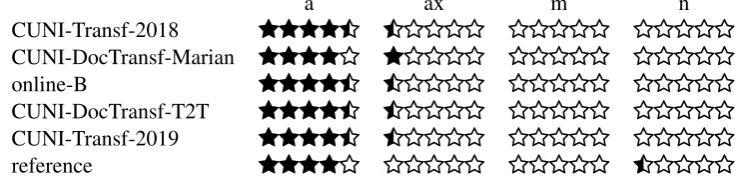
As for connectives, there were 52 queries in av-erage for each of the evaluated translations. The results for adequacy of connective translations in each system output and the reference are summed up in Table 2. A source connective candidate was assessed as an factual connecting device in 303 cases (Yes), and not a connective in 30 cases (No). This proportion seems to be correct, the non-connective readings of some expressions are relevant, e.g. several times foras much asin the function (and position) of a quantifier. Once a con-nective candidate is approved as an actual connec-tive, it translated always correctly (compare col-umn “n” in Table2), but it is possibly incorrectly placed in the translation (column “ax”). The result
figures indicate that there are no significant differ-ences across the systems in translating the traced connectives.
7.4 Word order
The word order evaluation focused the translation of contextually non-bound subjects (representing a new information in the sentence). The annota-tors first determined, which of the automatically preselected sentences from the English source in-deed contain a contextually non-bound subject (85 Yes, 10 No). If yes, they traced whether the sub-ject in the Czech translation also contextually non-bound. The results of manual annotation demon-strate that MT systems in general preserve the con-textual non-boundness of the subjects. The figures are comparable across the systems, only the Mar-ian system and the reference achieved a slightly worse scores:
yes no
CUNI-Transf-2018 11 1
CUNI-DocTransf-Marian 17 3
online-B 6 1
CUNI-DocTransf-T2T 17 1
CUNI-Transf-2019 6 1
reference 19 4
In a second task, we observed whether the sub-ject in the English original the focus proper of the given sentence. Again, the annotators first fil-tered out relevant sentences (10 Yes, 36 No). Then they looked at whether the subject in the Czech translation is also the focus proper of the sentence. Similarly as in the previous task, the Marian sys-tem’s performance is worse, and the performance of CUNI-DocTransf-T2T drops. However, the re-sults here are less significant, as there were only few occurrences of the annotated tokens:
yes no
CUNI-Transf-2018 2 0
CUNI-DocTransf-Marian 5 3
online-B 0 1
CUNI-DocTransf-T2T 1 2
CUNI-Transf-2019 0 1
reference 1 6
adequate missing wrong
CUNI-Transf-2018
CUNI-DocTransf-Marian
online-B
CUNI-DocTransf-T2T
CUNI-Transf-2019
[image:8.595.147.452.66.157.2]reference
Table 1: Results for AltLex annotations. EachFrepresents 20 % and the results are rounded to the nearest half-star.
a ax m n
CUNI-Transf-2018
CUNI-DocTransf-Marian
online-B
CUNI-DocTransf-T2T
CUNI-Transf-2019
reference
Table 2: Results for connectives annotations. The columns are: (a) adequate and correctly placed, (ax) adequate but incorrectly placed, (m) omitted and it does not harm the output, and (n) not adequate. EachFrepresents 20 % and the results are rounded to the nearest half-star.
worse than others:
yes no
CUNI-Transf-2018 14 0
CUNI-DocTransf-Marian 14 5
online-B 3 1
CUNI-DocTransf-T2T 13 3
CUNI-Transf-2019 6 0
reference 19 3
8 Conclusion
In this paper, we have described a test suite of parallel English-Czech texts provided for WMT19 with the aim to assess discourse phenomena in output of MT systems participating in the News Translation Task. We have carried out an exten-sive manual annotation of the MT outputs and identified types of translation errors relevant to document-level translation. We also compared the systems’ performance with respect to the observed phenomena.
In general, the recent NMT systems have achieved such a high level of translation quality that it has become difficult to evaluate their output in a systematic fashion. Most of the errors in the translation cannot be found by a simple compari-son with the reference translation, a bilingual eval-uation is needed. Moreover, for the observed phe-nomena, the systems performed with only a mi-nor differences among each other and they reached
the quality of the reference. In fact, the refer-ence translation was in some aspects evaluated as worse, which is likely caused by the greater literal adherence of the automatic translations to the original and it does not mean that the refer-ence is incorrect. Contrary to our assumptions, the two context-aware systems did not outperform the others in translating the followed document-level phenomena. This can be attributed to the fact that the systems perform good enough on this task already, and also partly because the evalua-tion can change a lot using just a slightly differ-ent annotation setting, e.g. if we traced also other (ambiguous) connective expressions or anaphoric items. The actual errors are difficult to predict from scratch and they occur randomly. More specifically, while the translations of AltLexes and discourse connectives showed quite satisfactory (at least of those observed here), the most errors (equally across systems) were detected in the area of word order and contextual (non-)boundness of the subjects. The systems prefer to keep the orig-inal word also in the translations, not really ac-counting for the impact of information structure.
Acknowledgement
[image:8.595.112.484.208.298.2]Descrip-tion and Bilingual Corpus Analysis) and the EU project H2020-ICT-2018-2-825460 (ELITR). This study has utilized language resources distributed by the LINDAT/CLARIN project of the Ministry of Education, Youth and Sports of the Czech Re-public (project LM2015071). This research was partially supported by SVV project number 260 453.
References
Ondˇrej Bojar, Christian Federmann, Mark Fishel, Yvette Graham, Barry Haddow, Matthias Huck, Philipp Koehn, and Christof Monz. 2018. Find-ings of the 2018 Conference on Machine Translation (WMT18). InProceedings of the Third Conference on Machine Translation, Volume 2: Shared Task Pa-pers, Brussels, Belgium. Association for Computa-tional Linguistics.
Liane Guillou, Christian Hardmeier, Preslav Nakov, Sara Stymne, J¨org Tiedemann, Yannick Vers-ley, Mauro Cettolo, Bonnie Webber, and Andrei Popescu-Belis. 2016. Findings of the 2016 WMT shared task on cross-lingual pronoun prediction. In
Proceedings of the First Conference on Machine Translation: Volume 2, Shared Task Papers, vol-ume 2, pages 525–542.
Jan Hajiˇc, Eva Hajiˇcov´a, Jarmila Panevov´a, Petr Sgall, Ondˇrej Bojar, Silvie Cinkov´a, Eva Fuˇc´ıkov´a, Marie Mikulov´a, Petr Pajas, Jan Popelka, Jiˇr´ı Semeck´y, Jana ˇSindlerov´a, Jan ˇStˇep´anek, Josef Toman, Zdeˇnka Ureˇsov´a, and Zdenˇek ˇZabokrtsk´y. 2012. Announcing Prague Czech-English Depen-dency Treebank 2.0. InProceedings of the Eighth International Language Resources and Evaluation Conference (LREC’12), pages 3153–3160, Istanbul, Turkey. ELRA, European Language Resources As-sociation.
Eva Hajiˇcov´a, Barbara H Partee, and Petr Sgall. 1998.
Topic-focus articulation, tripartite structures and se-mantic content. Kluwer, Dordrecht.
Hany Hassan, Anthony Aue, Chang Chen, Vishal Chowdhary, Jonathan Clark, Christian Federmann, Xuedong Huang, Marcin Junczys-Dowmunt, William Lewis, Mu Li, Shujie Liu, Tie-Yan Liu, Renqian Luo, Arul Menezes, Tao Qin, Frank Seide, Xu Tan, Fei Tian, Lijun Wu, Shuangzhi Wu, Yingce Xia, Dongdong Zhang, Zhirui Zhang, and Ming Zhou. 2018. Achieving Human Parity on Automatic Chinese to English News
Trans-lation. https://www.microsoft.com/
en-us/research/uploads/prod/2018/ 03/final-achieving-human.pdf.
M. P. Marcus, B. Santorini, and M. A. Marcinkiewicz. 1993. Building a large annotated corpus of En-glish: the Penn treebank. Computational Linguis-tics, 19:313–330.
Michal Nov´ak. 2016. Pronoun prediction with linguis-tic features and example weighing. InProceedings of the First Conference on Machine Translation: Volume 2, Shared Task Papers, volume 2, pages 602–608.
Martin Popel. 2018. Cuni transformer neural mt sys-tem for wmt18. InProceedings of the Third Confer-ence on Machine Translation: Shared Task Papers, pages 482–487.
Rashmi Prasad, Aravind Joshi, and Bonnie Webber. 2010. Realization of discourse relations by other means: Alternative lexicalizations. InProceedings of the 23rd International Conference on Computa-tional Linguistics: Posters, pages 1023–1031. Asso-ciation for Computational Linguistics.
Rashmi Prasad, Eleni Miltsakaki, Nikhil Dinesh, Alan Lee, Aravind Joshi, Livio Robaldo, and Bonnie L Webber. 2007. The penn discourse treebank 2.0 an-notation manual.
Magdal´ena Rysov´a and Kateˇrina Rysov´a. 2018. Pri-mary and secondary discourse connectives: Con-straints and preferences. Journal of Pragmatics, 130:16–32.
Magdal´ena Rysov´a. 2018. Diskurzn´ı konektory v ˇceˇstinˇe: Od centra k periferii. Institute of Formal and Applied Linguistics, Praha, Czechia.
Petr Sgall. 1967. Functional sentence perspective in a generative description. Prague studies in mathemat-ical linguistics, 2(203-225).
Petr Sgall, Eva Hajiˇcov´a, and Jarmila Panevov´a. 1986.
The meaning of the sentence in its semantic and pragmatic aspects. Springer Science & Business Media.
Bonnie Webber. 2009. Genre distinctions for discourse in the Penn TreeBank. InProceedings of the Joint Conference of the 47th Annual Meeting of the ACL and the 4th International Joint Conference on Natu-ral Language Processing of the AFNLP: Volume 2-Volume 2, pages 674–682. Association for Compu-tational Linguistics.