Munich Personal RePEc Archive
Persistence in Incarcerations: Global
Comparative Evidence
Asongu, Simplice
May 2017
Online at
https://mpra.ub.uni-muenchen.de/85483/
1
A G D I Working Paper
WP/17/056
Persistence in Incarcerations: Global Comparative Evidence
Forthcoming: Journal of Criminological Research, Policy and Practice
Simplice A. Asongu
African Governance and Development Institute, P.O. Box 8413, Yaoundé, Cameroon E-mails: [email protected]
2
2017 African Governance and Development Institute WP/17/056
Research Department
Persistence in Incarcerations: Global Comparative Evidence
Simplice A. Asongu
May 2017
Abstract
Purpose - The purpose of this study is to assess how incarcerations persist across the world. The focus is on 163 countries for the period 2010 to 2015.
Design/methodology/approach - The empirical evidence is based on Generalised Method of Moments. In order to increase room for policy implications, the dataset is decomposed into sub-samples based on income levels, religious domination, openness to the sea, regional proximity and legal origins.
Findings - The following main findings are established. Incarcerations are more persistent in low income, Christian-protestant and Latin American countries while comparative evidence is not feasible on the basis of landlockedness and legal origins owing to unfavorable post-estimation diagnostic tests. Justifications for the comparative advantages and relevance of findings to theory-building in public economics are discussed.
Practical implications - First, income levels matter in the persistence of incarcerations because low income nations vis-à-vis their high income counterparts, have less financial resources with which to prevent and deal with events like terrorism, political instability and violence that lead to incarcerations. Second, the intuition for religious domination builds on the fact that liberal societies can be more associated with incarcerations compared to conservative societies. The main theoretical contribution of this study to the literature is that we have built on empirical validity to provide theoretical justification as to why categorizing countries on the basis of selected fundamental characteristics determine cross-country variations in incarcerations. Such evidence is important for theory-building in public economics.
Originality/value- It is important for policy makers to understand the persistence of incarcerations across nations because resources could be allocated to regions and countries, contingent on the relative importance of future incarceration tendencies.
JEL Classification: K42; P50
3 1. Introduction
The purpose of this study is to assess how incarcerations persist across the world. The
positioning of the inquiry builds on two main trends in academic and policy circles, notably:
the relevance of understanding drivers of incarcerations and gaps in the literature. The points
are engaged in chronological order.
First, there are growing levels of incarcerations across the world on the one hand and
on the other hand, increasing levels of government expenditure allocated to the funding of the
underlying incarcerations. According to the Global Peace Index (GPI) (2016), over the past
decades, whereas societal security and safety have been increasing, there has also been a
substantial increase in government expenditure used to control and prevent violence, notably:
incarcerations and policing. To put this point into perspective, the GPI report of 2015
maintains that more than thirteen per cent of the global Gross Domestic Product (GDP) is
allocated to the prevention and fighting of violence (Anderson, 2015). Accordingly, about
14.3 trillion USD (representing approximately 13.4 per cent of global GDP) was devoted to
this cause. The underlying cost is equivalent to the total annual output of Brazil, Canada,
France, Germany, Spain and the United Kingdom (UK) (Asongu & Kodila-Tedika, 2017).
Second, the extant literature has failed to engage the persistence of incarcerations. The
contemporary literature has fundamentally focused on inter alia: risk assessment in
sentencing decisions as a remedy to mass incarceration (Kopkin et al., 2017); intersectional
analysis on parallels between mass deportation and mass incarceration (Tanya, 2017); factors
affecting the use of drug during incarceration (Rao et al., 2016); the role of legal origins in
cross-country incarcerations (D’Amico & Williamson, 2015); whether restorative justice
reduces incarceration (Wood, 2015); the incarceration of substantially traumatized
adolescents (Mallet, 2015); factors of delinquency among incarcerated male juveniles
(Olashore et al., 2017); nexus between public health, mass incarceration and inequality
(Wilderman & Wang, 2017) and supporting strategies for children and families that are
affected by parental incarceration (Kjellstrand, 2017).
We now discuss the theoretical underpinnings for persistence in incarcerations. These
theoretical foundations are consistent with recent literature on persistence within the banking
sector (Stephan & Tsapin, 2008; Goddard et al., 2011); inclusive development (Asongu &
Nwachukwu, 2017a) and knowledge economy (Asongu, 2017). Moreover, the underlying
theoretical underpinnings are broadly in line with the literature on income convergence which
has been considerably documented with the context of neoclassical growth estimations
4 theoretical framework has also been recently extended to other development fields, notably:
inclusive human development (Mayer-Foulkes, 2010; Asongu, 2014a) and financial market
development (Narayan et al., 2011; Bruno et al., 2012; Asongu, 2013, 2014b, 2014c).
After the Keynesian era, new economic growth theories saw the light of day with
momentum from the neoclassical revolution which enabled income convergence among
nations. Conceptions of market equilibrium were articulated with absolute decrease in
cross-country income disparities. Such income catch-up or convergence in the wealth of nations
was established to be the result of free-market competition policies (see Mayer-Foulkes,
2010). Initial studies that concluded on the absence of convergence attributed the divergence
to, among others: the possibility of multiple equilibria and differences in initial conditions of
development (see Barro, 1991; Pritchett, 1997). On the contrary, there is another strand of the
literature which argues that regardless of initial conditions of development, decreasing
cross-country variations in income levels is feasible from the standpoint of countries’ common
steady-states or long run equilibria (Asongu & Nwachukwu, 2017a).
What is important to note from both schools for our study is the fact that both schools
of thought agree on the criteria for establishing convergence or a cross-country decreasing
tendency of differences in income levels. We build on these common criteria for establishing
convergence because the purpose of this inquiry is not to take sides with either school, but to
assess convergence in incarcerations across the world.
In the light of the underlying theoretical insights, this study investigates the
persistence of incarcerations using global data. The notion of persistence in the study is
understood in relation to how past observations in incarcerations affect future observations in
incarcerations. From an empirical perspective, the hypothesis of persistence can be
investigated with a dynamic estimation approach. Such a dynamic technique is the
Generalized Method of Moments that has been employed in recent literature to investigate
persistence in economic phenomena (Asongu & Nwachukwu, 2018; Asongu et al., 2018).
It is important for policy makers to understand the persistence of incarcerations across
nations because resources could be devoted to regions and countries contingent on the relative
importance of future incarceration tendencies. To this end, in order to increase room for
policy implications, the dataset is decomposed into some sub-samples based on income levels,
religious domination, openness to the sea, regional proximity and legal origins. The rest of the
study is structured in the following manner. Section 2 discusses the data and methodology
while the empirical results are presented in Section 3. Section 4 concludes with implications
5 2. Data and Methodology
2.1 Data
A sample of 163 nations in the world is examined with data for the period 2010 to 2015 from
a plethora of sources, namely, the: Institute for Economics and Peace (IEP); Uppsala Conflict
Data Program (UCDP) Battle-Related Deaths Dataset; Qualitative assessment by the
Economic Intelligence Unit (EIU) analysts’ estimates; United Nations Office on Drugs and
Crime (UNODC) Surveys on Crime Trends and United Nations Committee on Contributions
and the Operations of Criminal Justice Systems (CTS).
The dependent variable is the incarceration rate: the number of jailed persons per 100,
000 people. It is important to note that the independent variable of interest with which
persistence is established is the lagged dependent variable. Variables in the conditioning
information set include: perceptions of criminality; security officers & polices; political
instability; weapons imports; displaced persons and military expenditure. While these
indicators are potential determinants of incarcerations (Mallet, 2015; Wood, 2015; D’Amico
& Williamson, 2015; Rao et al., 2016 ; Kopkin et al., 2017 ; Olashore et al., 2017; Wilderman
& Wang, 2017; Kjellstrand, 2017), the expected signs and effects are contingent on specific
fundamental characteristics.
As highlighted in the introduction, in order to improve room for policy implications,
some fundamental characteristics are adopted, namely: (i) income levels (High income, Upper
middle income, Lower middle income and Low income); (ii) religious domination (Christian
with Catholic domination; Christian with Protestant inclination; Christian countries in which
another Christian religion apart from Catholicism and Protestantism is dominant;
Islam-dominated countries and Buddhist-oriented countries); (iii) openness to sea (Landlocked and
Coastal countries); (iv) legal origins (English Common law, French Civil law, German Civil
law, Scandinavian Civil law and Socialists countries) and (v) regions (South Asia; Europe &
Central Asia; East Asia & the Pacific; Middle East & North Africa; sub-Saharan Africa;
Latin America and North America). These fundamental features have been employed in
recent comparative development literature (Narayan et al., 2011; Mlachila et al., 2016; Beegle
et al., 2016; Asongu & Le Roux, 2017; Asongu & Nwachukwu, 2017b).
The categorization of the sample by legal origins builds on La Porta et al. (2008, p.
289) while classification by income groups is in accordance with the World Bank’s
stratification1.
1
6 While Landlocked versus Coastal nations can easily be viewed from a World map,
information on dominant religions is from the Central Intelligence Agency (CIA) World Fact
Book (CIA, 2011). More details about the definitions of variables and corresponding sources
are provided in Appendix 1 whereas the summary statistics and sampled countries are
disclosed in Appendix 2. Appendix 3 provides the correlation matrix.
2.2 Methodology
2.2.1 Specification
The estimation strategy adopted in this study is the Generalised Method of Moments
(GMM). The empirical approach is consistent with recent literature on the persistence of
macroeconomic phenomena (Asongu & Nwachukwu, 2017a; Doyle, 2017). Moreover, five
additional reasons motivate the choice of this empirical strategy. First, it is apparent that the
numbers of countries are higher compared to the units of periodicity in each country. Hence,
the N(163)>T(6) condition for the employment of the GMM is met. Second, incarceration is
by definition persistent because the correlation between incarceration and its first lag is 0.972,
which is substantially higher than the rule of thumb threshold of 0.800 that is needed to
establish persistence. Third, cross-country differences are not eliminated with the estimation
approach because it is employed on a panel data structure. Fourth, endogeneity is addressed
with the estimation procedure from two main perspectives. On the one hand, the
instrumentation process is designed to account for simultaneity in the explanatory variables.
On the other hand, the control for time-invariant omitted variables accounts for the
unobserved heterogeneity. Fifth, biases that are inherent in the difference estimator are
addressed with the system estimator.
The Roodman (2009a, 2009b) extension of Arellano and Bover (1995) is employed in
this study because when compared with traditional GMM methods (systems and difference
GMM approaches), it control for cross-sectional dependence and limits the proliferation of
instruments (see Love & Zicchino, 2006; Baltagi, 2008; Asongu & Nwachukwu, 2016a;
Boateng et al., 2018).
The following equations in level (1) and first difference (2) summarise the standard
system GMM estimation procedure.
t i t i t i h h
h t
i t
i I W
I ,, ,
6
1 , 1 0
,
(1)7
hit hit t t ith h t i t i t i t
i I I I W W
I ,, ,, 2 ,
6 1 2 , , 1 , , ( ) ( ) ( )
, (2)
where, Ii,t represents incarcerations in country i at period t, 0 is a constant, W is the vector of control variables (criminality; security officers & polices; political instability;
weapons imports; displaced persons and military expenditure), represents the coefficient of auto-regression which is one for the specification due to limited degrees of freedom, t is the
time-specific constant,i is the country-specific effect and i,t the error term.
2.2.2 Identification and exclusion restrictions
It is important to devote space to clarifying identification and exclusion restrictions
that are critical for a sound GMM specification approach. All explanatory indicators are
considered to be endogenous explaining (i.e. predetermined or suspected endogenous)
variables while the time-invariant variables are considered to be strictly exogenous. Recent
empirical literature has employed a similar identification strategy (see Asongu &
Nwachukwu, 2016b; Boateng et al., 2018). The process of identification is consistent with
Roodman (2009b) because the author has argued that is not feasible for time invariant
indicators to become endogenous after first difference2.
As concerns exclusion restrictions, given the identification process, the selected
strictly exogenous variables affect the outcome variable (or incarcerations) exclusively
through the predetermined or suspected endogenous variables. In addition, the underlying
exclusion restriction assumption is valid if the alternative hypothesis corresponding to the
Difference in Hansen Test (DHT) for instrument exogeneity is rejected. Put in other words,
incarcerations are elucidated by the strictly exogenous variables exclusively via
predetermined mechanisms or variables.
In the light of the above insights, in the findings that are reported in Section 3, the
exclusion restriction assumption is valid if the alternative hypothesis related to the DHT
which is connected to instrumental variables (IV) (year, eq.(diff)) is rejected. It is particularly
worthwhile to note that this process of confirming exclusion restrictions is consistent with the
standard IV approach. Accordingly in the standard framework, a rejection of the null
hypothesis related to the Sargan Overidentifying Restrictions (OIR) test is an implication that
the strictly exogenous variables do not affect the outcome variables exclusively through the
8 predetermined mechanisms or suspected endogenous variables (see Beck et al., 2003; Asongu
& Nwachukwu, 2016c).
3. Empirical results
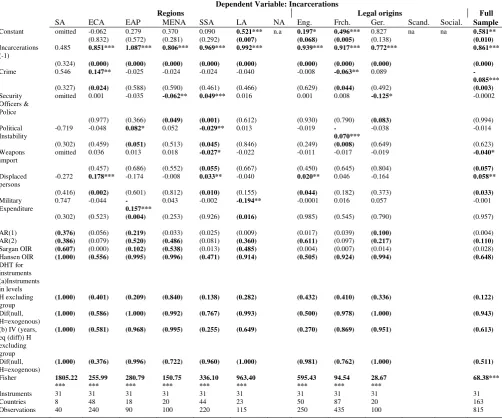
The empirical results are presented in Table 1 and Table 2. While the findings of Table
1 correspond to income levels, religious domination and openness to sea, those of Table 2 are
focused on legal origins and regions. In the two tables, the last column corresponds to the full
sample whereas prior columns disclose findings corresponding to the fundamental
characteristics. Four principal information criteria are employed to assess the validity of
GMM models3. In light of these criteria, some specifications are not valid because they fail to
pass the post-estimation diagnostic tests, namely: Europe & Central Asia; sub-Saharan Africa
and French civil law countries. Specifications pertaining to these fundamental features are
consistently invalid because the null hypotheses of the Arellano and Bond autocorrelation test
in differences are rejected. Note should be taken of the fact that the validity of models is a
necessary but not a sufficient condition for establishing persistence. In what follows, we
discuss the information criteria.
The following requirements should be met before persistence is established: the
estimated lagged incarceration variable should be significant on the one hand and meet the
convergence criterion on the other hand. The criterion for convergence is that the absolute
value of the estimated lagged dependent variable should be within the interval of zero and
one. More insights into this criterion are apparent in recent literature on convergence (Fung,
2009, p. 58; Asongu, 2013). It is important to note that in the standard GMM procedure, the
estimated lagged dependent variable is reported and then one is subtracted from the
coefficient to obtain beta (β= a-1). Within this framework, the information criterion for
convergence is <0. Furthermore, the estimated lagged dependent variable can be disclosed
directly and an alternative criterion (“0< lagged value <1”) is employed to establish
convergence (see Prochniak & Witkowski, 2012a, p. 20; Prochniak & Witkowski, 2012b, p.
23; Asongu & Nwachukwu, 2016d, p. 459).
3 “First, the null hypothesis of the second-order Arellano and Bond autocorrelation test (AR(2)) in difference for the absence of
9
Table 1: Persistence in incarcerations with income levels, religious domination and landlockedness Dependent Variable: Incarcerations
Income Levels Religious Domination Openness to sea Full
HI UMI LMI LI CC CP CO Islam Bhu LL NLL Sample
Constant 0.427*** 0.265 0.534*** 0.034 0.096 0.137 0.157 0.890*** 0.937
-0.172**
0.463** 0.581** (0.004) (0.295) (0.000) (0.526) (0.530) (0.228) (0.888) (0.000) (0.294) (0.018) (0.010) (0.010)
Incarcerations (-1) 0.879*** 0.876*** 0.741*** 0.996*** 1.000*** 0.978*** 0.824*** 0.463*** 0.855*** 1.034**
*
0.890** *
0.861*** (0.000) (0.000) (0.000) (0.000) (0.000) (0.000) (0.001) (0.000) (0.000) (0.000) (0.000) (0.000)
Crime -0.067** -0.026 -0.037 0.007 0.084** -0.003 -2.121 0.004 -0.003 0.074**
* -0.059**
-0.085*** (0.016) (0.431) (0.349) (0.589) (0.013) (0.785) (0.124) (0.879) (0.980) (0.004) (0.024) (0.003)
Security Officers & Police
-0.109*** 0.009 -0.146***
0.006 -0.055 0.023** 0.452** -0.049 -0.087 0.037* 0.007 -0.0002
(0.000) (0.742) (0.000) (0.359) (0.112) (0.016) (0.031) (0.142) (0.327) (0.090) (0.748) (0.994)
Political Instability 0.114*** -0.040 -0.038 -0.014*
-0.110***
0.003 0.885* 0.031 -0.120
-0.076** *
-0.035 -0.014
(0.000) (0.145) (0.322) (0.094) (0.002) (0.805) (0.083) (0.313) (0.440) (0.000) (0.226) (0.623)
Weapons import -0.020* 0.023 0.493***
-0.046***
0.080*** -0.033 0.242 0.017 -0.097 -0.009 -0.041**
-0.040* (0.061) (0.184) (0.000) (0.005) (0.001) (0.200) (0.397) (0.636) (0.388) (0.752) (0.022) (0.057)
Displaced persons 0.036 0.039*** 0.009 0.017** 0.044 0.007 0.493 -0.068** -0.004 -0.006 0.069** 0.058**
(0.513) (0.005) (0.740) (0.019) (0.120) (0.354) (0.290) (0.038) (0.957) (0.689) (0.047) (0.033)
Military Expenditure 0.039 0.043 0.006 0.008 -0.029
-0.063***
0.407 0.065** 0.061 0.028* -0.009 -0.001
(0.184) (0.151) (0.867) (0.302) (0.261) (0.002) (0.443) (0.037) (0.720) (0.054) (0.689) (0.957)
AR(1) (0.036) (0.100) (0.095) (0.227) (0.000) (0.084) (0.176) (0.048) (0.030) (0.034) (0.023) (0.004)
AR(2) (0.834) (0.358) (0.336) (0.223) (0.490) (0.306) (0.707) (0.404) (0.185) (0.107) (0.215) (0.110)
Sargan OIR (0.002) (0.022) (0.082) (0.142) (0.029) (0.817) (0.007) (0.155) (0.120) (0.332) (0.008) (0.028)
Hansen OIR (0.226) (0.647) (0.421) (0.462) (0.739) (0.981) (1.000) (0.783) (1.000) (0.736) (0.356) (0.648)
DHT for instruments (a)Instruments in levels
H excluding group (0.350) (0.465) (0.202) (0.387) (0.384) (0.980) (0.936) (0.368) (1.000) (0.216) (0.071) (0.122)
Dif(null, H=exogenous)
(0.220) (0.651) (0.608) (0.480) (0.818) (0.885) (1.000) (0.874) (1.000) (0.928) (0.769) (0.943)
(b) IV (years, eq (diff)) H excluding group
(0.392) (0.783) (0.662) (0.754) (0.671) (0.594) (0.994) (0.661) (1.000) (0.564) (0.536) (0.613)
Dif(null, H=exogenous)
(0.116) (0.232) (0.118) (0.094) (0.621) (1.000) (1.000) (0.776) (0.921) (0.863) (0.147) (0.511)
Fisher 247.40*** 224.92
*** 101.93 *** 2115.49 *** 328.65 *** 4963.03 *** 75.25 ***
16.55*** 443.78 *** 2161.06 *** 158.57 *** 68.38***
Instruments 31 31 31 31 31 31 31 31 31 31 31 31
Countries 43 36 46 38 54 26 14 49 13 34 129 163
Observations 215 180 230 190 270 130 70 245 65 170 645 815
10
Table 2: Persistence in incarcerations with regions and legal origin dynamics Dependent Variable: Incarcerations
Regions Legal origins Full
SA ECA EAP MENA SSA LA NA Eng. Frch. Ger. Scand. Social. Sample
Constant omitted -0.062 0.279 0.370 0.090 0.521*** n.a 0.197* 0.496*** 0.827 na na 0.581**
(0.832) (0.572) (0.281) (0.292) (0.007) (0.068) (0.005) (0.138) (0.010)
Incarcerations (-1)
0.485 0.851*** 1.087*** 0.806*** 0.969*** 0.992*** 0.939*** 0.917*** 0.772*** 0.861***
(0.324) (0.000) (0.000) (0.000) (0.000) (0.000) (0.000) (0.000) (0.000) (0.000)
Crime 0.546 0.147** -0.025 -0.024 -0.024 -0.040 -0.008 -0.063** 0.089
-0.085***
(0.327) (0.024) (0.588) (0.590) (0.461) (0.466) (0.629) (0.044) (0.492) (0.003)
Security Officers & Police
omitted 0.001 -0.035 -0.062** 0.049*** 0.016 0.001 0.008 -0.125* -0.0002
(0.977) (0.366) (0.049) (0.001) (0.612) (0.930) (0.790) (0.083) (0.994)
Political Instability
-0.719 -0.048 0.082* 0.052 -0.029** 0.013 -0.019
-0.070***
-0.038 -0.014
(0.302) (0.459) (0.051) (0.513) (0.045) (0.846) (0.249) (0.008) (0.649) (0.623)
Weapons import
omitted 0.036 0.013 0.018 -0.027* -0.022 -0.011 -0.017 -0.019 -0.040*
(0.457) (0.686) (0.552) (0.055) (0.667) (0.450) (0.645) (0.804) (0.057)
Displaced persons
-0.272 0.178*** -0.174 -0.008 0.033** -0.040 0.020** 0.046 -0.164 0.058**
(0.416) (0.002) (0.601) (0.812) (0.010) (0.155) (0.044) (0.182) (0.373) (0.033)
Military Expenditure
0.747 -0.044
-0.157***
0.043 -0.002 -0.194** -0.0001 0.016 0.057 -0.001
(0.302) (0.523) (0.004) (0.253) (0.926) (0.016) (0.985) (0.545) (0.790) (0.957)
AR(1) (0.376) (0.056) (0.219) (0.033) (0.025) (0.009) (0.017) (0.039) (0.100) (0.004)
AR(2) (0.386) (0.079) (0.520) (0.486) (0.081) (0.360) (0.611) (0.097) (0.217) (0.110)
Sargan OIR (0.607) (0.000) (0.102) (0.538) (0.013) (0.485) (0.004) (0.007) (0.014) (0.028)
Hansen OIR (1.000) (0.556) (0.995) (0.996) (0.471) (0.914) (0.505) (0.924) (0.994) (0.648)
DHT for instruments (a)Instruments in levels H excluding group
(1.000) (0.401) (0.209) (0.840) (0.138) (0.282) (0.432) (0.410) (0.336) (0.122)
Dif(null, H=exogenous)
(1.000) (0.586) (1.000) (0.992) (0.767) (0.993) (0.500) (0.978) (1.000) (0.943)
(b) IV (years, eq (diff)) H excluding group
(1.000) (0.581) (0.968) (0.995) (0.255) (0.649) (0.270) (0.869) (0.951) (0.613)
Dif(null, H=exogenous)
(1.000) (0.376) (0.996) (0.722) (0.960) (1.000) (0.981) (0.762) (1.000) (0.511)
Fisher 1805.22
*** 255.99 *** 280.79 *** 150.75 *** 336.10 *** 963.40 *** 595.43 *** 94.54 *** 28.67 *** 68.38***
Instruments 31 31 31 31 31 31 31 31 31 31
Countries 8 48 18 20 44 23 50 87 20 163
Observations 40 240 90 100 220 115 250 435 100 815
***,**,*: significance levels at 1%, 5% and 10% respectively. DHT: Difference in Hansen Test for Exogeneity of Instruments Subsets. Dif: Difference. OIR: Over-identifying Restrictions Test. The significance of bold values is twofold. 1) The significance of estimated coefficients and the Wald statistics. 2) The failure to reject the null hypotheses of: a) no autocorrelation in the AR(1) & AR(2) tests and; b) the validity of the instruments in the Sargan and Hansen OIR tests. Eng: English Common Law countries. Frch: French Civil Law countries. Ger: German Civil law countries. Scand: Scandinavian Civil law countries. Social: Socialists countries. ECA: Europe & Central Asia. EAP: East Asia & the Pacific. MENA: Middle East & North Africa. SSA: sub-Saharan Africa. LA: Latin America. NA: North America. Eng: English Common Law countries. Frch: French Civil Law countries. Ger: German Civil law countries. Scand: Scandinavian Civil law countries. Social: Socialists countries. na: not applicable because of issues in degrees of freedom.
Given these insights, for two sub-samples that meet the information criteria for
persistence, the sub-sample with a higher estimated value is acknowledged to reflect a higher
degree of persistence in incarcerations. The magnitude of estimated lagged value is relevant
because it reflects how past values of incarcerations affect future values of incarcerations.
This is essentially because from a comparative perspective, higher estimated lagged values
imply that future values of incarcerations are more proportionately affected by past values of
incarcerations. The following findings can be established. First, incarcerations are more
persistent in low income countries compared to their higher income counterparts. Second, in
11 their counterparts with other dominants religions. Third, it is difficult to assess comparative
evidence from the criterion related to landlockedness because the estimated lagged value for
the Landlocked sub-sample does not meet the information criteria required for the
establishment of convergence. Fourth, incarcerations are most predominant in Latin American
countries. Fifth, a comparative assessment is not feasible on the basis of legal origins because
the French civil sample does not pass post-estimation diagnostic tests: autocorrelation is
present in the residuals after estimation.
4. Concluding implications and future research direction
The purpose of this study is to assess how incarcerations persist across the world. The focus is
on 163 countries for the period 2010 to 2015. The empirical evidence is based on Generalised
Method of Moments. In order to increase room for policy implications, the dataset is
decomposed into some sub-samples based on income levels, religious domination, openness
to the sea, regional proximity and legal origins. The following main findings are established.
Incarcerations are more persistent in low income, Christian-protestant and Latin American
countries while comparative evidence is not feasible on the basis of landlockedness and legal
origins owing to negative post-estimation diagnostic tests. In what follows, we provide
justifications for the comparative advantages and discuss attendant policy implications.
We first discuss the relevance of fundamental characteristics from which feasible
comparison could not be established. First, legal origins are important in incarcerations
because compared to French civil law countries, Common law nations are less associated with
incarcerations. This difference is for a plethora of reasons, notably: in Common law tradition,
the accused is not jailed until proven guilty, which is contrary to French civil law where a
simple accusation leads to the incarceration of the accused. This narrative is broadly
consistent with the relevance of legal origins in comparative economic development (La Porta
et al., 1998, 1999; Beck et al., 2003; Agbor, 2015). Second, as concerns landlockedness, there
is an institutional cost of being closed from the sea (Arvis et al., 2007; Asongu & Le Roux,
2017). Such an institutional cost is the additional time it takes to transport by land (i.e.
through a neighboring coastal country), equipments needed for national security and broader
economic development. Accordingly, transport by air is more expensive than transport by sea.
It is also reasonable to postulate that institutional malfunctioning could be associated with
12 We now justify the relevance of significant comparisons. First, income levels matter in
the persistence of incarcerations because low income nations vis-à-vis their high income
counterparts have less financial resources with which to deal with events like terrorism
(Gaibulloev & Sandler, 2009), political instability and violence that lead to incarcerations.
Moreover, beyond the reactionary approach, higher income countries also have more financial
resources with which to engage in proactive efforts in view of preventing activities associated
with violence, political instability and incarcerations.
Second, the intuition for religious domination builds on the fact that liberal societies
can be more associated with incarcerations compared to conservative societies. Recent
literature has documented the importance of religious-orientation in comparative development
(see Asongu & Nwachukwu, 2017b). As shown in the findings, countries dominated by
Protestant Christianity may be experiencing more incarcerations because of the Protestant
ethic which may be associated with a higher propensity to strikes and civil unrests. According
to Weber (2002) (first published in 1930), the Protestant ethic influences people to adopt
modes of conduct that are contrary to mainstream thinking and by extension, violate the some
established rules in society.
Beyond understanding how policy makers can leverage on the established connections
between fundamental characteristics and incarcerations, it is important to note that since the
established evidence of persistence is contingent on the conditioning information set (or
control variables), policy makers can decrease or increase the established drivers (in the
conditioning information set) in order to ultimately limit persistence in incarcerations. Such
policy relevance of factors in the conditioning information set is not blanket (or one size fits
all) but contingent on fundamental characteristics. Overall, the analysis and corresponding
implications for policy are contingent on the variables used in the conditioning information
set.
The main theoretical contribution of this study to the literature is that we have built on
empirical validity to provide theoretical justification as to why categorizing countries on the
basis of selected fundamental characteristics determine cross-country variations in
incarcerations. Such evidence is important for theory-building in public economics because
applied econometrics should not be exclusively limited to the acceptance or rejection of
existing theories (Naryan et al., 2011; Constatini & Lupi, 2005).
Future studies can build on these insights to extend knowledge on how growing rates
13 with high rates of incarcerations can learn from their counterparts with lower rates of
incarcerations.
Appendices
Appendix 1: Definition of variables
Variables Definition and sources of variables
Displaced people Number of refugees and internally displaced people as a percentage of the population
Office of the High Commissioner for Refugees (UNHCR) Mid-Year Trends; Internal Displacement Monitoring Centre (IDMC)
Political instability Political instability
Qualitative assessment by EIU analysts Violent crime Level of violent crime
Qualitative assessment by EIU analysts
Incarceration Number of jailed population per 100,000 people
World Prison Brief, International Centre for Prison Studies, University of Essex Security Officers & Police Number of internal security officers and police
per 100,000 people UNODC; EIU estimates Military expenditure Military expenditure as a percentage of GDP
The Military Balance, IISS
Weapon imports Volume of transfers of major conventional weapons as recipient (imports) per 100,000 people
Stockholm International Peace Research Institute (SIPRI) Arms Transfers Database
14 Appendix 2: Summary statistics and countries
Panel A: Summary statistics
Variables Mean Standard dev. Minimum Maximum Obsers
Incarcerations 2.194 0.889 1.150 5.000 978 Political instability 2.545 1.030 1.000 5.000 978 Displaced people 1.348 0.872 1.000 5.000 978 Violent crime 2.768 1.136 1.000 5.000 978 Security Officers & Police 2.728 0.911 1.081 5.000 978 Military expenditure 1.966 0.824 1.000 5.000 978 Weapon imports 1.489 0.868 1.000 5.000 978
Panel B: Sampled countries (163)
Afghanistan; Albania; Algeria; Angola; Argentina; Armenia; Australia; Austria; Azerbaijan; Bahrain; Bangladesh; Belarus; Belgium; Benin; Bhutan; Bolivia; Bosnia and Herzegovina; Botswana; Brazil; Bulgaria; Burkina Faso; Burundi; Cambodia; Cameroon; Canada; Central African Republic; Chad; Chile; China; Colombia; Costa Rica; Cote d' Ivoire; Croatia; Cuba; Cyprus; Czech Republic; Democratic Republic of the Congo; Denmark; Djibouti; Dominican Republic; Ecuador; Egypt; El Salvador; Equatorial Guinea; Eritrea; Estonia; Ethiopia; Finland; France; Gabon; Georgia; Germany; Ghana; Greece; Guatemala; Guinea; Guinea-Bissau; Guyana; Haiti; Honduras; Hungary; Iceland; India; Indonesia; Iran; Iraq; Ireland; Israel; Italy; Jamaica; Japan; Jordan; Kazakhstan; Kenya; Kosovo; Kuwait; Kyrgyz Republic; Laos; Latvia; Lebanon; Lesotho; Liberia; Libya; Lithuania; Macedonia (FYR); Madagascar; Malawi; Malaysia; Mali; Mauritania; Mauritius; Mexico; Moldova; Mongolia; Montenegro; Morocco; Mozambique; Myanmar; Namibia; Nepal; Netherlands; New Zealand; Nicaragua; Niger; Nigeria; North Korea; Norway; Oman; Pakistan; Palestine; Panama; Papua New Guinea; Paraguay; Peru; Philippines; Poland; Portugal; Qatar; Republic of the Congo; Romania; Russia; Rwanda; Saudi Arabia; Senegal; Serbia; Sierra Leone; Singapore; Slovakia; Slovenia; Somalia; South Africa; South Korea; South Sudan; Spain; Sri Lanka; Sudan; Swaziland; Sweden;Switzerland; Syria; Taiwan; Tajikistan; Tanzania; Thailand; The Gambia; Timor-Leste; Togo; Trinidad and Tobago; Tunisia; Turkey; Turkmenistan; Uganda; Ukraine; United Arab Emirates; United Kingdom; United States of America; Uruguay; Uzbekistan; Venezuela; Vietnam; Yemen; Zambia and Zimbabwe.
Standard dev: Standard deviation. Obsers: Observations.
Appendix 3: Correlation matrix (uniform sample size: 978)
Pol. Insta. Displ. P. Crime S O & P Military W. Imports Incarcerations
1.000 0.336 0.479 0.042 0.336 -0.238 -0.140 Pol. Insta.
1.000 0.235 0.036 0.291 -0.058 -0.105 Displ. P
1.000 -0.122 -0.027 -0.386 -0.116 Crime
1.000 0.215 0.140 0.279 S O & P
1.000 0.236 0.093 Military
1.000 0.044 W. Imports
1.000 Incarcerations Pol. Insta: Political Instability. Displ. P: Displaced Persons. Crime: Violent crime. S O & P: Security Officers & Police. Military: Military Expenditure. W. Imports: Weapons Imports.
References
Agbor, J. A. (2015). “How does colonial origin matter for economic performance in sub-
Saharan Africa?”, In Augustin K. Fosu (Ed.), Growth and Institutions in African
15
Anderson, M., (2015), “Global cost of conflict reaches $14.3 tn, says report” , The guardian,
http://www.theguardian.com/global-development/2015/jun/16/global-cost-conflict-reaches- 14tn-says-report (Accessed: 27/06/2015).
Arvis, J-F., Marteau, J-F., & Raballand, G. (2007). The cost of being landlocked: logistics
costs and supply chain reliability”, Word Bank Working Paper Series No. 4258, Washington.
Asongu, S. A. (2013). “African Stock Market Performance Dynamics: A Multidimensional
Convergence Assessment”, Journal of African Business, 40(3), pp. 186-201.
Asongu, S. A., (2014a). “African Development: Beyond Income Convergence”, South African
Journal of Economics, 82(3), pp. 334-353.
Asongu, S. A., (2014b). “Are proposed African monetary unions optimal currency areas?
Real, monetary and fiscal policy convergence analysis”, African Journal of Economic and Management Studies, 5(1), pp. 9-29.
Asongu, S. A., (2014c). “African financial development dynamics: big time convergence”,
African Journal of Economic and Management Studies, 5(2), pp. 160-194.
Asongu, S. A., (2017). “Knowledge Economy Gaps, Policy Syndromes, and Catch-Up
Strategies: Fresh South Korean Lessons to Africa”, Journal of the Knowledge Economy, 8(1), pp. 211-253.
Asongu, S. A., & Kodila-Tedika, O., (2017). “Trade, aid and terror”, International Journal of Development Issues, 16 (1), pp.2-24,
Asongu, S. A, & De Moor, L., (2017). “Financial Globalisation Dynamic Thresholds for
Financial Development: Evidence from Africa”, European Journal of Development
Research, 29(1), pp. 192-212.
Asongu, S. A., & Le Roux S., (2017). “Enhancing ICT for inclusive human development in
Sub-Saharan Africa”, Technological Forecasting and Social Change, 118(May), pp. 44–54.
Asongu, S. A, & Nwachukwu, J. C., (2016a). “The Mobile Phone in the Diffusion of
Knowledge for Institutional Quality in Sub Saharan Africa”, World Development,
86(October), pp. 133-147.
Asongu, S. A., & Nwachukwu, J. C., (2016b). “The Role of Governance in Mobile Phones
for Inclusive Human Development in Sub-Saharan Africa”, Technovation, 55-56
(September- October), pp. 1-13.
Asongu, S. A, & Nwachukwu, J. C., (2016c). “Foreign aid and governance in Africa”,
International Review of Applied Economics, 30(1), pp. 69-88.
Asongu, S. A., & Nwachukwu, J. C., (2016d). “Revolution empirics: predicting the Arab
Spring”, Empirical Economics, 51(2), pp. 439-482.
Asongu, S. A., & Nwachukwu, J. C., (2017a). “Mobile phones in the diffusion of knowledge
and persistence in inclusive human development in Sub-Saharan Africa”, Information
16
Asongu, S. A., & Nwachukwu, J. C., (2017b). “The Comparative Inclusive Human
Development of Globalisation in Africa”, Social Indicators Research. 134(3), pp. 1027-1050.
Asongu, S. A., & Nwachukwu, J. C., (2018). “Fighting Terrorism: Empirics on Policy
Harmonisation”, German Economic Review, DOI: 10.1111/geer.12126.
Asongu, S. A., Tchamyou, V. S., Minkoua, N, J. R., Asongu, N., & Tchamyou, N. P., (2018).
“Fighting terrorism in Africa: Benchmarking policy harmonization”, Physica A: Statistical Mechanics and its Applications, 492(February), pp. 1931-1957.
Baltagi, B. H., (2008). “Forecasting with panel data”, Journal of Forecasting, 27(2), pp.
153-173.
Barro, R., (1991). “Economic Growth in a Cross Section of Countries”. Quarterly Journal of
Economics, 196 (2/May), pp. 407-443.
Barro, R. J., & Sala-i-Martin, X., (1992). “Convergence”, Journal of Political Economy, 100(2), pp. 223-251.
Barro, R. J., & Sala-i-Martin, X., (1995). Economic Growth. The MIT Press, Cambridge, MA.
Baumol, W. J., (1986). “Productivity, growth, convergence and welfare: what the long run
data show”, American Economic Review, 76(5), pp. 1072-1085.
Beck, T., Demirgüç-Kunt, A., & Levine, R., (2003), “Law and finance: why does legal origin
matter?”, Journal of Comparative Economics, 31(4), pp. 653-675.
Beegle, K., Christiaensen, L., Dabalen, A., & Gaddis, I., (2016). “Poverty in a Rising Africa”, Africa Poverty Report, the World Bank, Washington.
http://www.worldbank.org/en/region/afr/publication/poverty-rising-africa-poverty-report (Accessed: 23/07/2016).
Blundell, R., & Bond, S., (1998). “Initial conditions and moment restrictions in dynamic
panel data models” Journal of Econometrics, 87(1), pp. 115-143.
Boateng, A., Asongu, S. A., Akamavi, R., & Tchamyou, V. S., (2016). “Information
Asymmetry and Market Power in the African Banking Industry”, African Governance and
Development Institute Working Paper No. 16/032, Yaoundé.
Bond, S., Hoeffler, A., & Tample, J. (2001) “GMM Estimation of Empirical Growth Models”,
University of Oxford.
Bruno, G., De Bonis, R., & Silvestrini, A., (2012). “Do financial systems converge? New
evidence from financial assets in OECD countries”. Journal of Comparative Economics;
40(1), pp. 141-155.
17
D’Amico, D. J., & Williamson, C., (2015). “Do legal origins affect cross-country
incarceration rates?”, Journal of Comparative Economics, 43(3), pp. 595–612.
Doyle, J. M., (2017). “Persistence in the long-run expected rate of return for corporate
pension plans”, The Quarterly Review of Economics and Finance, 63(February), pp. 271–277.
Fung, M. K., (2009). “Financial development and economic growth: Convergence or
divergence?”, Journal of International Money and Finance, 28(1), pp. 56–67.
Gaibulloev, K., & Sandler, T., (2009). “The impact of terrorism and conflicts on growth in
Asia”, Economics and Politics, 21(3), pp. 359-383.
GPI (2016). Global Peace Index 2016. Institute for Economics & Peace.
Goddard, J., Liu, H., Molyneux, P., & Wilson, J. O. S. (2011). “The persistence of bank Profit”. Journal of Banking & Finance, 35(11), pp. 2881-2890.
Kjellstrand, K., (2017). “Building a Tailored, Multilevel Prevention Strategy to Support
Children and Families Affected by Parental Incarceration”, Journal Smith College Studies in Social Work, 87(1), pp. 112-129.
Kopkin, M. R., Brodsky, S. L., & DeMatteo, D., (2017). “Risk assessment in sentencing
decisions: a remedy to mass incarceration?”, Journal of Aggression, Conflict and Peace Research, 9(2), pp.155-164.
La Porta, R., Lopez-de-Silanes, F., Shleifer, A., & Vishny, R. W. (1998). “Law and finance”,
Journal of Political Economy, 106(6), 1113-1155.
La Porta, R., Lopez-de-Silanes, F., Shleifer, A., & Vishny, R. W. (1999). “The quality of
government”, Journal of Law, Economics and Organization, 15(1), pp. 222-279.
La Porta, R., Lopez-de-Silanes, F., & Shleifer, A., (2008), “The Economic Consequences of
Legal Origin,” Journal of Economic Literature, 46(2), pp. 285-332.
Love, I., & Zicchino, L., (2006). “Financial Development and Dynamic Investment
Behaviour: Evidence from Panel VAR” .The Quarterly Review of Economics and Finance,
46(2), pp. 190-210.
Mallet, C. A., (2015). “The incarceration of seriously traumatised adolescents in the USA:
Limited progress and significant harm”, Criminal Behavior and Mental Health, 25(1), pp. 1-9.
Mankiw, N. G., Romer, D., & Weil, D. N., (1992). “A contribution to the empirics of
economic growth”, Quarterly Journal of Economics, 107 (May, 1992), pp. 407–437.
Mayer-Foulkes, D., (2010). “Divergences and Convergences in Human Development”.
UNDP Human Development Research Paper 2010/20, Paris.
Mlachila, M., Tapsoba, R., & Tapsoba, S. J. A., (2016). “A Quality of Growth Index for
Developing Countries: A Proposal”, Social Indicators Research, DOI:
18
Narayan, P.K., Mishra, S., & Narayan, S., (2011). “Do market capitalization and stocks traded
converge? New global evidence”. Journal of Banking and Finance, 35(10), pp. 2771-2781.
Olashore, A. A., Okanni, O. O., & Olashore, O. O., (2017). “Associate Factors of Delinquency Among Incarcerated Male Juveniles in a Borstal Institution in Nigeria”, Journal International Journal of Forensic Mental Health, DOI: 10.1080/14999013.2017.1288668.
Pritchett, L., (1997). “Divergence, Big Time”. Journal of Economic Perspectives, 11(3), pp.
3-17.
Prochniak, M., & Witkowski, B., (2012a). “Beta convergence stability among “Old” and “New” EU countries: The Bayesian Model Averaging Perspective”, Warsaw School of
Economics.
Prochniak, M., & Witkowski, B., (2012b). “Real economic convergence and the impact of
monetary policy on economic growth of the EU countries: The analysis of time stability and
the identification of major turning points based on the Bayesian methods”, Warsaw School of
Economics.
Rao, R., Mandal, P., Gupta, R., Ramshankar, P., Mishra, A., Ambekar, A., Jhanjee, S., & Dhawan, J., (2016). “Factors Affecting Drug Use During Incarceration: A Cross-Sectional Study of Opioid-Dependent Persons from India”, Journal of Substance Abuse Treatment, 61(February), pp. 13-17.
Roodman, D., (2009a). “A Note on the Theme of Too Many Instruments”, Oxford Bulletin of
Economics and Statistics, 71(1), pp. 135-158.
Roodman, D., (2009b). “How to do xtabond2: An introduction to difference and system
GMM in Stata”, Stata Journal, 9(1), pp. 86-136.
Stephan, A., & Tsapin, A. (2008). “Persistence and determinants of firm profit in emerging Markets”. Applied Economics Quarterly, 54(4), pp. 231-253.
Tanya, G-B, (2017). “The Parallels between Mass Incarceration and Mass Deportation: An Intersectional Analysis of State Repression 1”, Journal of World - Systems Research, 22(2), pp. 484-509.
Tchamyou, V. S., & Asongu, S. A., (2017). “Information Sharing and Financial Sector
Development in Africa”, Journal of African Business, 18(1), pp. 24-49.
Wilderman, C., & Wang, A. W., (2017). “Mass incarceration, public health, and widening
inequality in the USA”, THE LANCET, 389(10077), pp. 1464-1474.
Woods, W. R., (2015). “Why Restorative Justice Will Not Reduce Incarceration”, Br J