Proceedings of the 57th Annual Meeting of the Association for Computational Linguistics, pages 241–251 241
Attention Guided Graph Convolutional Networks for Relation Extraction
Zhijiang Guo∗, Yan Zhang∗ and Wei Lu
StatNLP Research Group
Singapore University of Technology and Design
{zhijiang guo,yan zhang}@mymail.sutd.edu.sg, [email protected]
Abstract
Dependency trees convey rich structural in-formation that is proven useful for extract-ing relations among entities in text. However, how to effectively make use of relevant infor-mation while ignoring irrelevant inforinfor-mation from the dependency trees remains a challeng-ing research question. Existing approaches employing rule based hard-pruning strategies for selecting relevant partial dependency struc-tures may not always yield optimal results. In this work, we propose Attention Guided Graph Convolutional Networks (AGGCNs), a novel model which directly takes full dependency trees as inputs. Our model can be understood as a soft-pruning approach that automatically learns how to selectively attend to the relevant sub-structures useful for the relation extrac-tion task. Extensive results on various tasks including cross-sentencen-ary relation extrac-tion and large-scale sentence-level relaextrac-tion ex-traction show that our model is able to bet-ter leverage the structural information of the full dependency trees, giving significantly bet-ter results than previous approaches.
1 Introduction
Relation extraction aims to detect relations among entities in the text. It plays a significant role in a variety of natural language processing applica-tions including biomedical knowledge discovery
(Quirk and Poon,2017), knowledge base
popula-tion (Zhang et al.,2017) and question answering
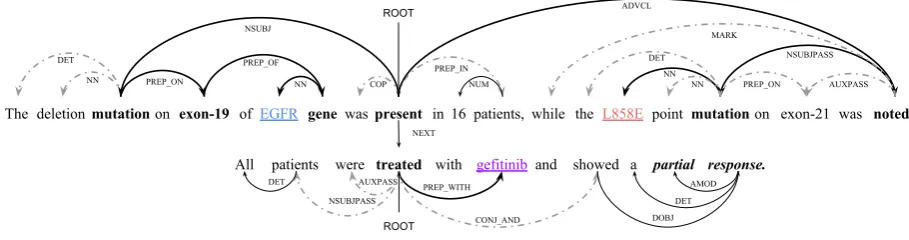
(Yu et al.,2017). Figure1shows an example about
expressing a relation sensitivity among three enti-tiesL858E,EGFRandgefitinibin two sentences.
Most existing relation extraction models can be categorized into two classes: sequence-based and dependency-based. Sequence-based models op-erate only on the word sequences (Zeng et al.,
∗ ∗
Equally Contributed.
2014; Wang et al., 2016), whereas
dependency-based models incorporate dependency trees into the models (Bunescu and Mooney, 2005; Peng
et al.,2017). Compared to sequence-based
mod-els, dependency-based models are able to capture non-local syntactic relations that are obscure from the surface form alone (Zhang et al.,2018). Var-ious pruning strategies are also proposed to distill the dependency information in order to further im-prove the performance. Xu et al.(2015b,c) apply neural networks only on the shortest dependency path between the entities in the full tree.Miwa and
Bansal (2016) reduce the full tree to the subtree
below the lowest common ancestor (LCA) of the entities. Zhang et al.(2018) apply graph convolu-tional networks (GCNs) (Kipf and Welling,2017) model over a pruned tree. This tree includes to-kens that are up to distanceK away from the de-pendency path in the LCA subtree.
However, rule-based pruning strategies might eliminate some important information in the full tree. Figure1shows an example in cross-sentence
n-ary relation extraction that the key tokens par-tial responsewould be excluded if the model only takes the pruned tree into consideration. Ideally, the model should be able to learn how to main-tain a balance between including and excluding information in the full tree. In this paper, we pro-pose the novel Attention Guided Graph Convo-lutional Networks (AGGCNs), which operate di-rectly on the full tree. Intuitively, we develop a “soft pruning” strategy that transforms the origi-nal dependency tree into a fully connected edge-weighted graph. These weights can be viewed as the strength of relatedness between nodes, which can be learned in an end-to-end fashion by using self-attention mechanism (Vaswani et al.,2017).
In order to encode a large fully connected graph, we next introduce dense connections (Huang et al.,
AUXPASS
The deletionmutationon exon-19 of EGFR genewaspresent in 16 patients, while the L858E point mutationon exon-21 was noted.
All patients were treated with gefitinib and showed a partial response. ROOT
DET
NN PREP_ON
PREP_OF
NN NSUBJ
COP NUM
PREP_IN
NN NN DET
MARK
PREP_ON AUXPASS NSUBJPASS ADVCL
DET
NSUBJPASS
PREP_WITH
CONJ_AND DOBJ
DET AMOD NEXT
[image:2.595.71.526.68.188.2]ROOT
Figure 1: An example dependency tree for two sentences expressing a relation (sensitivity) among three entities. The shortest dependency path between these entities is highlighted in bold (edges and tokens). The root node of the LCA subtree of entities ispresent. The dotted edges indicate tokensK=1 away from the subtree. Note that tokenspartial responseoff these paths (shortest dependency path, LCA subtree, pruned tree whenK=1).
2019). For GCNs,Llayers will be needed in or-der to capture neighborhood information that is
L hops away. A shallow GCN model may not be able to capture non-local interactions of large graphs. Interestingly, while deeper GCNs can cap-ture richer neighborhood information of a graph, empirically it has been observed that the best per-formance is achieved with a 2-layer model (Xu
et al.,2018). With the help of dense connections,
we are able to train the AGGCN model with a large depth, allowing rich local and non-local de-pendency information to be captured.
Experiments show that our model is able to achieve better performance for various tasks. For the cross-sentence relation extraction task, our model surpasses the current state-of-the-art models on multi-class ternary and binary relation extraction by 8% and 6% in terms of accuracy respectively. For the large-scale sentence-level extraction task (TACRED dataset), our model is also consistently bet-ter than others, showing the effectiveness of the model on a large training set. Our code is available at http://www.statnlp.org/
research/information-extraction1
Our contributions are summarized as follows: • We propose the novel AGGCNs that learn a
“soft pruning” strategy in an end-to-end fash-ion, which learns how to select and discard information. Combining with dense connec-tions, our AGGCN model is able to learn a better graph representation.
• Our model achieves new state-of-the-art re-sults without additional computational
over-1Implementation is based on Pytorch (Paszke et al.,2017).
head when compared with previous GCNs.2
Unlike tree-structured models (e.g., Tree-LSTM (Tai et al.,2015)), it can be efficiently applied over dependency trees in parallel.
2 Attention Guided GCNs
In this section, we will present the basic compo-nents used for constructing our AGGCN model.
2.1 GCNs
GCNs are neural networks that operate directly on graph structures (Kipf and Welling, 2017). Here we mathematically illustrate how multi-layer GCNs work on a graph. Given a graph with n
nodes, we can represent the graph with ann×n
adjacency matrix A. Marcheggiani and Titov
(2017) extend GCNs for encoding dependency trees by incorporating directionality of edges into the model. They add a self-loop for each node in the tree. Opposite direction of a dependency arc is also included, which meansAij = 1andAji = 1 if there is an edge going from node ito node j, otherwiseAij = 0and Aji = 0. The convolu-tion computaconvolu-tion for nodeiat thel-th layer, which takes the input feature representationh(l−1)as in-put and outin-puts the induced representation h(il), can be defined as:
h(il)=ρ Xn
j=1
AijW(l)hj(l−1)+b(l)
(1)
where W(l) is the weight matrix, b(l) is the bias vector, and ρ is an activation function (e.g., RELU).h(0)i is the initial inputxi, wherexi ∈Rd
anddis the input feature dimension.
2The size of the adjacency matrix representing the fully
0.3 0.1 0.1 0.2 0.6 0.2 0.1 0.1 0.7 0.1 0.2 0.6 0.2 0.2 0.1 0.3 0.3 V3
The winery includes gardens
V1 V3
V2
V1
V4
0.1 0.2 0.1 0.6 1 1 0 0
1 0 0 1 1 0 1 1 1 0 1 1 Multi-Head Attention N V1 V2 V3 V4
V1 V2 V4
Attention Guided Layer
V3
V2
Ã(1)
Ã(N)
G(1)
G(N)
Attention Guided Layer Densely Connected
Layer
Linear Combination Layer
N Densely Connected Layer 0.1 0.3 0.3 0.1 0.3 0.1 0.2 0.3 0.3 0.1 0.2 0.4 0.1 0.3 0.3 0.7 0.3 0.1 0.1 0.1 0.2 0.1 0.2 0.7 0.1 0.1 0.1
0.4 0.2 0.3 0.6 0.3 0.1 0.1 0.3
Densely Connected Layer (number of sub-layers is 3) M
V2 V3 V4
V1
[image:3.595.100.493.62.240.2]V4
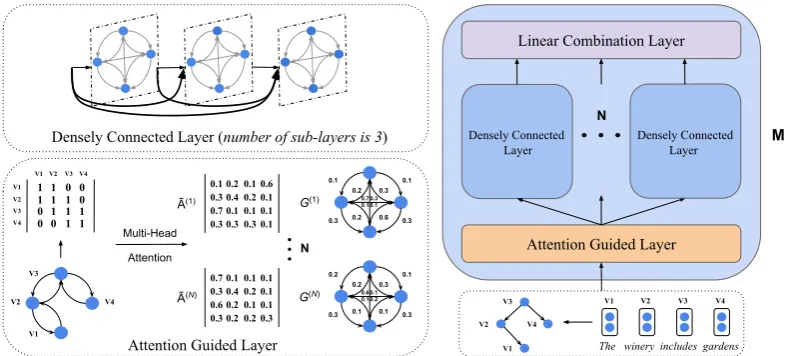
Figure 2: The AGGCN model is shown with an example sentence and its dependency tree. It is composed of
M identical blocks and each block has three types of layers as shown on the right. Every block takes node embeddings and adjacency matrix that represents the graph as inputs. ThenNattention guided adjacency matrices are constructed by using multi-head attention as shown at bottom left. The original dependency tree is transformed intoN different fully connected edge-weighted graphs (self-loops are omitted for simplification). Numbers near the edges represent the weights in the matrix. Resulting matrices are fed intoNseparate densely connected layers, generating new representations. Top left shows an example of the densely connected layer, where the number (L) of sub-layers is 3 (Lis a hyper-parameter). Each sub-layer concatenates all preceding outputs as the input. Eventually, a linear combination is applied to combine outputs ofNdensely connected layers into hidden representations.
2.2 Attention Guided Layer
The AGGCN model is composed of M identical blocks as shown in Figure2. Each block consists of three types of layers: attention guided layer, densely connected layer and linear combination layer. We first introduce the attention guided layer of the AGGCN model.
As we discuss in Section1, most existing prun-ing strategies are predefined. They prune the full tree into a subtree, based on which the adjacency matrix is constructed. In fact, such strategies can also be viewed as a form of hard attention (Xu
et al.,2015a), where edges that connect nodes not
on the resulting subtree will be directly assigned zero weights (not attended). Such strategies might eliminate relevant information from the original dependency tree. Instead of using rule-based prun-ing, we develop a “soft pruning” strategy in the at-tention guided layer, which assigns weights to all edges. These weights can be learned by the model in an end-to-end fashion.
In the attention guided layer, we transform the original dependency tree into a fully connected edge-weighted graph by constructing an attention guided adjacency matrixA˜. EachA˜ corresponds to a certain fully connected graph and each entry
˜
Aij is the weight of the edge going from nodeito nodej. As shown in Figure2,A˜(1) represents a
fully connected graphG(1). A˜ can be constructed by using self-attention mechanism (Cheng et al.,
2016), which is an attention mechanism (
Bah-danau et al., 2015) that captures the interactions
between two arbitrary positions of a single se-quence. Once we getA˜, we can use it as the in-put for the comin-putation of the later graph convolu-tional layer. Note that the size ofA˜ is the same as the original adjacency matrix A(n×n). There-fore, no additional computational overhead is in-volved. The key idea behind the attention guided layer is to use attention for inducing relations be-tween nodes, especially for those connected by in-direct, multi-hop paths. These soft relations can be captured by differentiable functions in the model.
Here we compute A˜ by using multi-head at-tention (Vaswani et al., 2017), which allows the model to jointly attend to information from differ-ent represdiffer-entation subspaces. The calculation in-volves a query and a set of key-value pairs. The output is computed as a weighted sum of the val-ues, where the weight is computed by a function of the query with the corresponding key.
˜
A(t)=sof tmax(QW
Q
i ×√(KWKi )T
d )V (2)
AG-GCN model. The projections are parameter ma-trices WQi ∈ Rd×d andWKi ∈ Rd×d. A˜(t) is the t-th attention guided adjacency matrix corre-sponding to thet-th head. Up toN matrices are constructed, whereN is a hyper-parameter.
Figure2shows an example that the original ad-jacency matrix is transformed into multiple atten-tion guided adjacency matrices. Accordingly, the input dependency tree is converted into multiple fully connected edge-weighted graphs. In prac-tice, we treat the original adjacency matrix as an initialization so that the dependency information can be captured in the node representations for later attention calculation. The attention guided layer is included starting from the second block.
2.3 Densely Connected Layer
Unlike previous pruning strategies, which lead to a resulting structure that is smaller than the original structure, our attention guided layer out-puts a larger fully connected graph. Following
(Guo et al.,2019), we introduce dense connections
(Huang et al.,2017) into the AGGCN model in
or-der to capture more structural information on large graphs. With the help of dense connections, we are able to train a deeper model, allowing rich lo-cal and non-lolo-cal information to be captured for learning a better graph representation.
Dense connectivity is shown in Figure2. Direct connections are introduced from any layer to all its preceding layers. Mathematically, we first define
gj(l)as the concatenation of the initial node repre-sentation and the node reprerepre-sentations produced in layers1,· · ·,l−1:
g(jl)= [xj;h(1)j ;...;h
(l−1)
j ]. (3)
In practice, each densely connected layer has
Lsub-layers. The dimensions of these sub-layers
dhiddenare decided byLand the input feature di-mensiond. In AGGCNs, we usedhidden =d/L. For example, if the densely connected layer has 3 sub-layers and the input dimension is 300, the hid-den dimension of each sub-layer will bedhidden =
d/L = 300/3 = 100. Then we concatenate the output of each sub-layer to form the new repre-sentation. Therefore, the output dimension is 300 (3×100). Different from the GCN model whose hidden dimension is larger than or equal to the in-put dimension, the AGGCN model shrinks the hid-den dimension as the number of layers increases in order to improves the parameter efficiency similar to DenseNets (Huang et al.,2017).
Since we haveN different attention guided ad-jacency matrices, N separate densely connected layers are required. Accordingly, we modify the computation of each layer as follows (for thet-th matrixA˜(t)):
h(tl)
i =ρ
Xn
j=1
˜
Aij(t)W(tl)gj(l)+b(tl) (4)
where t = 1, ..., N andt selects the weight ma-trix and bias term associated with the attention guided adjacency matrix A˜(t). The column di-mension of the weight matrix increases bydhidden per sub-layer, i.e., W(tl) ∈ Rdhidden×d(l), where
d(l) =d+dhidden×(l−1).
2.4 Linear Combination Layer
The AGGCN model includes a linear combination layer to integrate representations fromNdifferent densely connected layers. Formally, the output of the linear combination layer is defined as:
hcomb=Wcombhout+bcomb (5)
where hout is the output by concatenating out-puts from N separate densely connected layers, i.e., hout = [h(1);...;h(N)] ∈ Rd×N. Wcomb ∈
R(d×N)×d is a weight matrix andbcomb is a bias vector for the linear transformation.
2.5 AGGCNs for Relation Extraction
After applying the AGGCN model over the depen-dency tree, we obtain hidden representations of all tokens. Given these representations, the goal of re-lation extraction is to predict a rere-lation among en-tities. Following (Zhang et al.,2018), we concate-nate the sentence representation and entity repre-sentations to get the final representation for classi-fication. First we need to obtain the sentence rep-resentationhsent. It can be computed as:
hsent=f(hmask) =f(AGGCN(x)) (6)
where hmask represents the masked collective
hidden representations. Masked here means we only select representations of tokens that are not entity tokens in the sentence. f : Rd×n → Rd×1
is a max pooling function that maps fromnoutput vectors to 1 sentence vector. Similarly, we can ob-tain the entity representations. For thei-th entity, its representationheican be computed as:
whereheiindicates the hidden representation
cor-responding to the i-th entity.3 Entity representa-tions will be concatenated with sentence represen-tation to form a new represenrepresen-tation. Following
(Zhang et al.,2018), we apply a feed-forward
neu-ral network (FFNN) over the concatenated repre-sentations inspired by relational reasoning works
(Santoro et al.,2017;Lee et al.,2017):
hf inal =FFNN([hsent;he1;...hei]) (8)
wherehf inal will be taken as inputs to a logistic regression classifier to make a prediction.
3 Experiments
3.1 Data
We evaluate the performance of our model on two tasks, namely, cross-sentence n-ary relation ex-traction and sentence-level relation exex-traction.
For the cross-sentencen-ary relation extraction task, we use the dataset introduced in (Peng et al.,
2017), which contains 6,987 ternary relation in-stances and 6,087 binary relation inin-stances ex-tracted from PubMed.4 Most instances contain multiple sentences and each instance is assigned with one of the five labels, including “resistance or nonresponse”, “sensitivity”, “response”, “resis-tance” and “none”. We consider two specific tasks for evaluation, i,e., binary-classn-ary relation ex-traction and multi-classn-ary relation extraction. For binary-classn-ary relation extraction, we fol-low (Peng et al.,2017) to binarize multi-class la-bels by grouping the four relation classes as “yes” and treating “none” as “no”.
For the sentence-level relation extraction task, we follow the experimental settings in (Zhang
et al.,2018) to evaluate our model on the TACRED
dataset (Zhang et al.,2017) and Semeval-10 Task
8 (Hendrickx et al., 2010). With over 106K
in-stances, the TACRED dataset introduces 41 rela-tion types and a special “no relarela-tion” type to de-scribe the relations between the mention pairs in instances. Subject mentions are categorized into “person” and “organization”, while object men-tions are categorized into 16 fine-grained types, in-cluding “date”, “location”, etc. Semeval-10 Task 8 is a public dataset, which contains 10,717 in-stances with 9 relations and a special “other” class.
3
The number of entities is fixed inn-ary relation extrac-tion task. It is 3 for the first dataset and 2 for the second.
4The dataset is available athttps://github.com/
freesunshine0316/nary-grn
3.2 Setup
We tune the hyper-parameters according to results on the development sets. For the cross-sentencen -ary relation extraction task, we use the same data split used in (Song et al., 2018b)4, while for the sentence-level relation extraction task, we use the same development set from (Zhang et al.,2018)5.
We choose the number of heads N for at-tention guided layer from {1,2,3,4}, the block number M from {1,2,3}, the number of sub-layers L in each densely connected layer from {2,3,4,5,6}. Through preliminary experiments on the development sets, we find that the com-binations (N=2, M=2, L=5, dhidden=340) and (N=3, M=2, L=5, dhidden=300) give the best results on cross-sentence n-ary relation extrac-tion and sentence-level relaextrac-tion extracextrac-tion, respec-tively. GloVe (Pennington et al., 2014)6 vectors are used as the initialization for word embeddings. Models are evaluated using the same metrics as previous work (Song et al., 2018b; Zhang et al.,
2018). We report the test accuracy averaged over five cross validation folds (Song et al.,2018b) for the cross-sentence n-ary relation extraction task. For the sentence-level relation extraction task, we report the micro-averaged F1 scores for the TA-CRED dataset and the macro-averaged F1 scores for the SemEval dataset (Zhang et al.,2018).
3.3 Results on Cross-Sentencen-ary Relation Extraction
For cross-sentence n-ary relation extraction task, we consider three kinds of models as baselines: 1) a feature-based classifier (Quirk and Poon,2017) based on shortest dependency paths between all entity pairs, 2) Graph-structured LSTM meth-ods, including Graph LSTM (Peng et al., 2017), bidirectional DAG LSTM (Bidir DAG LSTM)
(Song et al., 2018b) and Graph State LSTM (GS
GLSTM) (Song et al., 2018b). These meth-ods extend LSTM to encode graphs constructed from input sentences with dependency edges, 3) Graph convolutional networks (GCN) with pruned trees, which have shown efficacy on the relation extraction task (Zhang et al., 2018)7.
Addition-5
https://nlp.stanford.edu/projects/ tacred/
6We use the 300-dimensional Glove word vectors
trained on the Common Crawl corpus https://nlp. stanford.edu/projects/glove/
7The results are produced by the open implementation
Model
Binary-class Multi-class
T B T B
Single Cross Single Cross Cross Cross
Feature-Based (Quirk and Poon,2017) 74.7 77.7 73.9 75.2 - -SPTree (Miwa and Bansal,2016) - - 75.9 75.9 - -Graph LSTM-EMBED (Peng et al.,2017) 76.5 80.6 74.3 76.5 - -Graph LSTM-FULL (Peng et al.,2017) 77.9 80.7 75.6 76.7 -
-00000000000000000+ multi-task - 82.0 - 78.5 - -Bidir DAG LSTM (Song et al.,2018b) 75.6 77.3 76.9 76.4 51.7 50.7 GS GLSTM (Song et al.,2018b) 80.3 83.2 83.5 83.6 71.7 71.7
GCN (Full Tree) (Zhang et al.,2018) 84.3 84.8 84.2 83.6 77.5 74.3 GCN (K=0) (Zhang et al.,2018) 85.8 85.8 82.8 82.7 75.6 72.3 GCN (K=1) (Zhang et al.,2018) 85.4 85.7 83.5 83.4 78.1 73.6 GCN (K=2) (Zhang et al.,2018) 84.7 85.0 83.8 83.7 77.9 73.1
[image:6.595.108.496.64.273.2]AGGCN (ours) 87.1 87.0 85.2 85.6 79.7 77.4
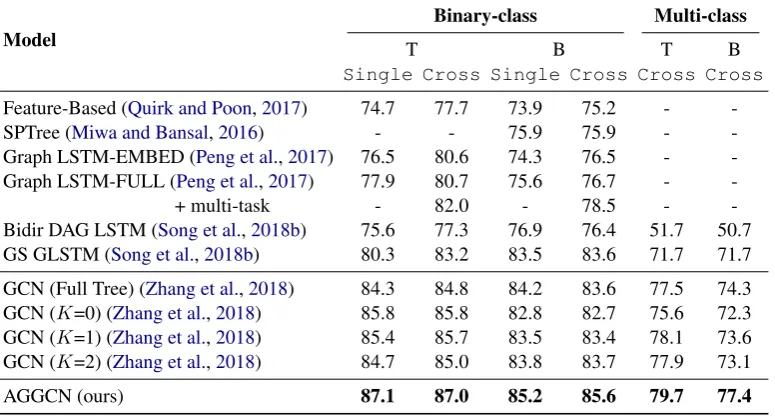
Table 1: Average test accuracies in five-fold validation for binary-classn-ary relation extraction and multi-class
n-ary relation extraction. “T” and “B” denote ternary drug-gene-mutation interactions and binary drug-mutation interactions, respectively.Singlemeans that we report the accuracy on instances within single sentences, while
Crossmeans the accuracy on all instances. K in the GCN models means that the preprocessed pruned trees include tokens up to distanceKaway from the dependency path in the LCA subtree.
ally, we follow (Song et al., 2018b) to consider the tree-structured LSTM method (SPTree) (Miwa
and Bansal, 2016) on drug-mutation binary
rela-tion extracrela-tion. Main results are shown in Table1.
We first focus on the binary-class n-ary rela-tion extracrela-tion task. For ternary relarela-tion extrac-tion (first two columns in Table1), our AGGCN model achieves accuracies of 87.1 and 87.0 on in-stances within single sentence (Single) and on all instances (Cross), respectively, which outper-form all the baselines. More specifically, our AG-GCN model surpasses the state-of-the-art Graph-structured LSTM model (GS GLSTM) by 6.8 and 3.8 points for the Single andCross settings, respectively. Compared to GCN models , our model obtains 1.3 and 1.2 points higher than the best performing model with pruned tree (K=1). For binary relation extraction (third and fourth columns in Table1), AGGCN consistently outper-forms GS GLSTM and GCN as well.
These results suggest that, compared to previ-ous full tree based methods, e.g., GS GLSTM, AGGCN is able to extract more information from the underlying graph structure to learn a more expressive representation through graph con-volutions. AGGCN also performs better than GCNs, although its performance can be boosted via pruned trees. We believe this is because of the combination of densely connected layer and
attention guided layer. The dense connections could facilitate information propagation in large graphs, enabling AGGCN to efficiently learn from long-distance dependencies without pruning tech-niques. Meanwhile, the attention guided layer can further distill relevant information and filter out noises from the representation learned by the densely connected layer.
We next show the results on the multi-class clas-sification task (last two columns in Table1). We follow (Song et al.,2018b) to evaluate our model on all instances for both ternary and binary rela-tions. This fine-grained classification task is much harder than coarse-grained classification task. As a result, the performance of all models degrades a lot. However, our AGGCN model still obtains 8.0 and 5.7 points higher than the GS GLSTM model for ternary and binary relations, respec-tively. We also notice that our AGGCN achieves a better test accuracy than all GCN models, which further demonstrates its ability to learn better rep-resentations from full trees.
3.4 Results on Sentence-level Relation Extraction
Model P R F1
LR (Zhang et al.,2017) 73.5 49.9 59.4
SDP-LSTM (Xu et al.,2015c)* 66.3 52.7 58.7 Tree-LSTM (Tai et al.,2015)** 66.0 59.2 62.4 PA-LSTM (Zhang et al.,2017) 65.7 64.5 65.1
GCN (Zhang et al.,2018) 69.8 59.0 64.0 C-GCN (Zhang et al.,2018) 69.9 63.3 66.4
AGGCN (ours) 69.9 60.9 65.1
[image:7.595.319.514.63.156.2]C-AGGCN (ours) 71.8 66.4 69.0
Table 2: Results on the TACRED dataset. Model with * indicates that the results are reported inZhang et al.
(2017), while model with ** indicates the results are reported inZhang et al.(2018).
Model F1
SVM (Rink and Harabagiu,2010) 82.2 SDP-LSTM (Xu et al.,2015c) 83.7 SPTree (Miwa and Bansal,2016) 84.4 PA-LSTM (Zhang et al.,2017) 82.7 C-GCN (Zhang et al.,2018) 84.8
C-AGGCN (ours) 85.7
Table 3: Results on the SemEval dataset.
sequence-based models. Dependency-based mod-els include the logistic regression classifier (LR)
(Zhang et al., 2017), Shortest Path LSTM
(SDP-LSTM) (Xu et al., 2015c), Tree-structured neu-ral model (Tree-LSTM) (Tai et al., 2015), GCN and Contextualized GCN (C-GCN) (Zhang et al.,
2018). Both GCN and C-GCN models use the pruned trees. For sequence-based model, we con-sider the state-of-the-art Position Aware LSTM (PA-LSTM) (Zhang et al.,2017).
As shown in Table 2, the logistic regression classifier (LR) obtains the highest precision score. We hypothesize that the reason behind this is due to the data imbalance issue. This feature-based method tends to predict a highly frequent label as the relation (e.g., “per:title”). Therefore, it has a high precision while having a relatively low recall. On the other hand, the neural models are able to better balance the precision and recall scores.
Since GCN and C-GCN already show their superiority over other dependency-based models and PA-LSTM, we mainly compare our AGGCN model with them. We can observe that AGGCN outperforms GCN by 1.1 F1 points. We speculate
Model F1
C-AGGCN 69.0
0– Attention-guided layer (AG) 67.1 0– Dense connected layer (DC) 67.3
0– AG, DC 66.7
0– Feed-Forward layer (FF) 67.8
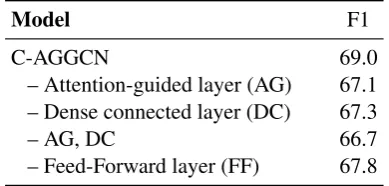
Table 4: An ablation study for C-AGGCN model.
Model F1
C-AGGCN (Full tree) 69.0
C-AGGCN (K=2) 67.5
C-AGGCN (K=1) 67.9
[image:7.595.75.292.64.205.2]C-AGGCN (K=0) 67.0
Table 5: Results of C-AGGCN with pruned trees.
that the limited improvement is due to the lack of contextual information about word order or dis-ambiguation. Similar to C-GCN (Zhang et al.,
2018), we extend our AGGCN model with a bi-directional LSTM network to capture the contex-tual representations which are subsequently fed into AGGCN layers. We term the modified model as C-AGGCN. Our C-AGGCN model achieves an F1 score of 69.0, which outperforms the state-of-art C-GCN model by 2.6 points. We also notice that AGGCN and C-AGGCN achieve better preci-sion and recall scores than GCN and C-GCN, re-spectively. The performance gap between GCNs with pruned trees and AGGCNs with full trees em-pirically show that the AGGCN model is better at distinguishing relevant from irrelevant informa-tion for learning a better graph representainforma-tion.
We also evaluate our model on the SemEval dataset under the same settings as (Zhang et al.,
2018). Results are shown in Table3. This dataset is much smaller than TACRED (only 1/10 of TA-CRED in terms of the number of instances). Our C-AGGCN model (85.7) consistently outperforms the C-GCN model (84.8), showing the good gen-eralizability.
3.5 Analysis and Discussion
[image:7.595.84.282.281.393.2]20 40 60 80 100
percentage of training dataset (%)
58 60 62 64 66 68 70
F1
58.5 58.9
61.5 62.7
64 65.6
64.2
66.5 66.4 69 C-GCN
[image:8.595.115.483.75.230.2]C-AGGCN
Figure 3: Comparison of C-AGGCN and C-GCN against different training data sizes. The results of C-GCN are reproduced from (Zhang et al.,2018).
<20 20-30 30-40 40-50 >=50 Sentence length
64 65 66 67 68 69 70
F1
[image:8.595.92.273.287.425.2]C-AGGCN (Full Tree) C-AGGCN (K=1) C-GCN (K=1)
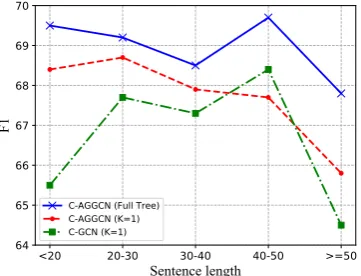
Figure 4: Comparison of C-AGGCN and C-GCN against different sentence lengths. The results of C-GCN are reproduced from (Zhang et al.,2018).
or densely connected layers improves the perfor-mance of the model. This suggests that both lay-ers can assist GCNs to learn better information aggregations, producing better representations for graphs, where the attention-guided layer seems to be playing a more significant role. We also no-tice that the feed-forward layer is effective in our model. Without the feed-forward layer, the result drops to an F1 score of 67.8.
Performance with Pruned Trees. Table 5
shows the performance of the C-AGGCN model with pruned trees, whereKmeans that the pruned trees include tokens that are up to distanceKaway from the dependency path in the LCA subtree. We can observe that all the C-AGGCN models with varied values ofKare able to outperform the state-of-the-art C-GCN model (Zhang et al.,2018) (reported in Table2). Specifically, with the same setting asK=1, C-AGGCN surpasses C-GCN by
1.5 points of F1 score. This demonstrates that, with the combination of densely connected layer and attention guided layer, C-AGGCN can learn better representations of graphs than C-GCN for downstream tasks. In addition, we notice that the performance of C-AGGCN with full trees outper-forms all C-AGGCNs with pruned trees. These re-sults further show the superiority of “soft pruning” strategy over hard pruning strategy in utilizing full tree information.
Performance against Sentence Length. Fig-ure4 shows the F1 scores of three models under different sentence lengths. We partition the sen-tence length into five classes (<20,[20, 30),[30, 40),[40, 50),≥50). In general, C-AGGCN with full trees outperforms C-AGGCN with pruned trees and C-GCN against various sentence lengths. We also notice that C-AGGCN with pruned trees performs better than C-GCN in most cases. More-over, the improvement achieved by C-AGGCN with pruned trees decays when the sentence length increases. Such a performance degradation can be avoided by using full trees, which provide more in-formation of the underlying graph structures. Intu-itively, with the increase of the sentence length, the dependency graph becomes larger as more nodes are included. This suggests that C-AGGCN can benefit more from larger graphs (full tree).
outper-forms C-GCN under the same amount of training data. When the size of training data increases, we can observe that the performance gap becomes more obvious. Specifically, using 80% of the training data, the C-AGGCN model is able to achieve a F1 score of 66.5, higher than C-GCN trained on the complete training set. These results demonstrate that our model is more effective in terms of using training resources.
4 Related Work
Our work builds on a rich line of recent efforts on relation extraction models and graph convolu-tional networks.
Relation Extraction. Early research efforts are based on statistical methods. Tree-based kernels
(Zelenko et al.,2002) and dependency path-based
kernels (Bunescu and Mooney,2005) are explored to extract the relation. McDonald et al. (2005) construct maximal cliques of entities to predict re-lations. Mintz et al.(2009) include syntactic fea-tures to a statistical classifier. Recently, sequence-based models leverages different neural networks to extract relations, including convolutional neural networks (Zeng et al., 2014;Nguyen and
Grish-man, 2015; Wang et al., 2016), recurrent neural
networks (Zhou et al., 2016;Zhang et al., 2017) the combination of both (Vu et al., 2016) and transformer (Verga et al.,2018).
Dependency-based approaches also try to incor-porate structural information into the neural
mod-els. Peng et al. (2017) first split the dependency
graph into two DAGs, then extend the tree LSTM model (Tai et al.,2015) over these two graphs for
n-ary relation extraction. Closest to our work,
Song et al.(2018b) use graph recurrent networks
(Song et al., 2018a) to directly encode the whole
dependency graph without breaking it. The con-trast between our model and theirs is reminiscent of the contrast between CNN and RNN. Various pruning strategies have also been proposed to dis-till the dependency information in order to fur-ther improve the performance.Xu et al.(2015b,c) adapt neural models to encode the shortest depen-dency path.Miwa and Bansal(2016) apply LSTM model over the LCA subtree of two entities. Liu
et al.(2015) combine the shortest dependency path
and the dependency subtree. Zhang et al. (2018) adopt a path-centric pruning strategy. Unlike these strategies that remove edges in preprocessing, our model learns to assign each edge a different weight
in an end-to-end fashion.
Graph Convolutional Networks. Early efforts that attempt to extend neural networks to deal with arbitrary structured graphs are introduced by
Gori et al.(2005);Bruna(2014). Subsequent
ef-forts improve its computational efficiency with lo-cal spectral convolution techniques (Henaff et al.,
2015; Defferrard et al., 2016). Our approach is
closely related to the GCNs (Kipf and Welling,
2017), which restrict the filters to operate on a first-order neighborhood around each node.
More recently, Velickovic et al. (2018) pro-posed graph attention networks (GATs) to sum-marize neighborhood states by using masked self-attentional layers (Vaswani et al., 2017). Com-pared to our work, their motivations and network structures are different. In particular, each node only attends to its neighbors in GATs whereas AG-GCNs measure the relatedness among all nodes. The network topology in GATs remains the same, while fully connected graphs will be built in AG-GCNs to capture long-range semantic interactions.
5 Conclusion
We introduce the novel Attention Guided Graph Convolutional Networks (AGGCNs). Experimen-tal results show that AGGCNs achieve state-of-the-art results on various relation extraction tasks. Unlike previous approaches, AGGCNs operate di-rectly on the full tree and learn to distill the use-ful information from it in an end-to-end fashion. There are multiple venues for future work. One natural question we would like to ask is how to make use of the proposed framework to perform improved graph representation learning for graph related tasks (Bastings et al.,2017).
Acknowledgements
References
Dzmitry Bahdanau, Kyunghyun Cho, and Yoshua Ben-gio. 2015. Neural machine translation by jointly learning to align and translate. InProc. of ICLR.
Joost Bastings, Ivan Titov, Wilker Aziz, Diego Marcheggiani, and Khalil Sima’an. 2017. Graph convolutional encoders for syntax-aware neural ma-chine translation. InProc. of EMNLP.
Joan Bruna. 2014. Spectral networks and deep locally connected networks on graphs. InProc. of ICLR.
Razvan C. Bunescu and Raymond J. Mooney. 2005. A shortest path dependency kernel for relation extrac-tion. InProc. of EMNLP.
Jianpeng Cheng, Li Dong, and Mirella Lapata. 2016. Long short-term memory-networks for machine reading. InProc. of EMNLP.
Micha¨el Defferrard, Xavier Bresson, and Pierre Van-dergheynst. 2016. Convolutional neural networks on graphs with fast localized spectral filtering. InProc. of NeurIPS.
Michele Gori, Gabriele Monfardini, and Franco Scarselli. 2005. A new model for learning in graph domains. InProc. of IJCNN.
Zhijiang Guo, Yan Zhang, Zhiyang Teng, and Wei Lu. 2019. Densely connected graph convolutional net-works for graph-to-sequence learning. Transactions of the Association of Computational Linguistics.
Mikael Henaff, Joan Bruna, and Yann LeCun. 2015. Deep convolutional networks on graph-structured data.arXiv preprint.
Iris Hendrickx, Su Nam Kim, Zornitsa Kozareva, Preslav Nakov, Diarmuid ´O S´eaghdha, Sebastian Pad´o, Marco Pennacchiotti, Lorenza Romano, and Stan Szpakowicz. 2010. Semeval-2010 task 8: Multi-way classification of semantic relations be-tween pairs of nominals. InSemEval@ACL.
Gao Huang, Zhuang Liu, Laurens van der Maaten, and Kilian Q. Weinberger. 2017. Densely connected convolutional networks. InProc. of CVPR.
Thomas N. Kipf and Max Welling. 2017. Semi-supervised classification with graph convolutional networks. InProc. of ICLR.
Kenton Lee, Luheng He, Mike Lewis, and Luke S. Zettlemoyer. 2017. End-to-end neural coreference resolution. InProc. of EMNLP.
Yang Liu, Furu Wei, Sujian Li, Heng Ji, Ming Zhou, and Houfeng Wang. 2015. A dependency-based neural network for relation classification. InProc. of ACL.
Diego Marcheggiani and Ivan Titov. 2017. Encoding sentences with graph convolutional networks for se-mantic role labeling. InProc. of EMNLP.
Ryan T. McDonald, Fernando Pereira, Seth Kulick, R. Scott Winters, Yang Jin, and Peter S. White. 2005. Simple algorithms for complex relation ex-traction with applications to biomedical ie. InProc. of ACL.
Mike Mintz, Steven Bills, Rion Snow, and Daniel Ju-rafsky. 2009. Distant supervision for relation extrac-tion without labeled data. InProc. of ACL.
Makoto Miwa and Mohit Bansal. 2016. End-to-end re-lation extraction using lstms on sequences and tree structures. InProc. of ACL.
Thien Huu Nguyen and Ralph Grishman. 2015. Rela-tion extracRela-tion: Perspective from convoluRela-tional neu-ral networks. InProc. of VS@NAACL-HLT.
Adam Paszke, Sam Gross, and Adam Lerer. 2017. Au-tomatic differentiation in pytorch. InProc. of work-shop on NeurIPS.
Nanyun Peng, Hoifung Poon, Chris Quirk, Kristina Toutanova, and Wen tau Yih. 2017. Cross-sentence n-ary relation extraction with graph lstms. Transac-tions of the Association for Computational Linguis-tics, 5:101–115.
Jeffrey Pennington, Richard Socher, and Christo-pher D. Manning. 2014. Glove: Global vectors for word representation. InProc. of EMNLP.
Chris Quirk and Hoifung Poon. 2017. Distant super-vision for relation extraction beyond the sentence boundary. InProc. of EACL.
Bryan Rink and Sanda M. Harabagiu. 2010. Utd: Clas-sifying semantic relations by combining lexical and semantic resources. InSemEval@ACL.
Adam Santoro, David Raposo, David G. T. Barrett, Mateusz Malinowski, Razvan Pascanu, Peter W. Battaglia, and Timothy P. Lillicrap. 2017. A sim-ple neural network module for relational reasoning. InProc. of NeurIPS.
Linfeng Song, Yue Zhang, Zhiguo Wang, and Daniel Gildea. 2018a. A graph-to-sequence model for amr-to-text generation. InProc. of ACL.
Linfeng Song, Yue Zhang, Zhiguo Wang, and Daniel Gildea. 2018b. N-ary relation extraction using graph state lstm. InProc. of EMNLP.
Kai Sheng Tai, Richard Socher, and Christopher D. Manning. 2015. Improved semantic representations from tree-structured long short-term memory net-works. InProc. of ACL.
Ashish Vaswani, Noam Shazeer, Niki Parmar, Jakob Uszkoreit, Llion Jones, Aidan N. Gomez, Lukasz Kaiser, and Illia Polosukhin. 2017. Attention is all you need. InProc. of NeurIPS.
Patrick Verga, Emma Strubell, and Andrew McCallum. 2018. Simultaneously self-attending to all mentions for full-abstract biological relation extraction. In Proc. of NAACL-HLT.
Ngoc Thang Vu, Heike Adel, Pankaj Gupta, and Hin-rich Sch¨utze. 2016. Combining recurrent and convo-lutional neural networks for relation classification. InProc. of NAACL-HLT.
Linlin Wang, Zhu Cao, Gerard de Melo, and Zhiyuan Liu. 2016. Relation classification via multi-level at-tention cnns. InProc. of ACL.
Kelvin Xu, Jimmy Ba, Ryan Kiros, Kyunghyun Cho, Aaron C. Courville, Ruslan Salakhutdinov, Richard S. Zemel, and Yoshua Bengio. 2015a. Show, attend and tell: Neural image caption genera-tion with visual attengenera-tion. InProc. of ICML.
Keyulu Xu, Chengtao Li, Yonglong Tian, Tomo-hiro Sonobe, Ken ichi Kawarabayashi, and Stefanie Jegelka. 2018. Representation learning on graphs with jumping knowledge networks. In Proc. of ICML.
Kun Xu, Yansong Feng, Songfang Huang, and Dongyan Zhao. 2015b. Semantic relation classifica-tion via convoluclassifica-tional neural networks with simple negative sampling. InProc. of EMNLP.
Yan Xu, Lili Mou, Ge Li, Yunchuan Chen, Hao Peng, and Zhi Jin. 2015c. Classifying relations via long short term memory networks along shortest depen-dency paths. InProc. of EMNLP.
Mo Yu, Wenpeng Yin, Kazi Saidul Hasan, C´ıcero Nogueira dos Santos, Bing Xiang, and Bowen Zhou. 2017. Improved neural relation detection for knowledge base question answering. InProc. of ACL.
Dmitry Zelenko, Chinatsu Aone, and Anthony Richardella. 2002. Kernel methods for relation ex-traction. InProc. of EMNLP.
Daojian Zeng, Kang Liu, Siwei Lai, Guangyou Zhou, and Jian Zhao. 2014. Relation classification via con-volutional deep neural network. In Proc. of COL-ING.
Yuhao Zhang, Peng Qi, and Christopher D. Man-ning. 2018. Graph convolution over pruned depen-dency trees improves relation extraction. InProc. of EMNLP.
Yuhao Zhang, Victor Zhong, Danqi Chen, Gabor An-geli, and Christopher D. Manning. 2017. Position-aware attention and supervised data improve slot fill-ing. InProc. of EMNLP.