Proceedings of the 57th Annual Meeting of the Association for Computational Linguistics, pages 867–876 867
Knowledge-aware Pronoun Coreference Resolution
Hongming Zhang♣∗, Yan Song♠, Yangqiu Song♣, and Dong Yu♠ ♣Department of CSE, The Hong Kong University of Science and Technology
♠Tencent AI Lab
[email protected], [email protected], [email protected], [email protected]
Abstract
Resolving pronoun coreference requires knowledge support, especially for particular domains (e.g., medicine). In this paper, we explore how to leverage different types of knowledge to better resolve pronoun coreference with a neural model. To ensure the generalization ability of our model, we directly incorporate knowledge in the format of triplets, which is the most common format of modern knowledge graphs, instead of encoding it with features or rules as that in conventional approaches. Moreover, since not all knowledge is helpful in certain contexts, to selectively use them, we propose a knowledge attention module, which learns to select and use informative knowledge based on contexts, to enhance our model. Experimental results on two datasets from different domains prove the validity and effectiveness of our model, where it outperforms state-of-the-art baselines by a large margin. Moreover, since our model learns to use external knowledge rather than only fitting the training data, it also demonstrates superior performance to baselines in the cross-domain setting.
1 Introduction
Being an important human language phenomenon, coreference brings simplicity for human languages while introducing a huge challenge for machines to process, especially for pronouns, which are hard to be interpreted owing to their weak semantic meanings (Ehrlich,1981). As one challenging yet vital subtask of the general coreference resolution, pronoun coreference resolution (Hobbs, 1978) is to find the correct reference for a given pronominal anaphor in the context and has showed its impor-tance in many natural language processing (NLP)
∗
This work was partially done during the internship of the first author in Tencent AI Lab.
Example A Example B
[image:1.595.306.526.222.352.2]Sentence The appleon the table looks great and I want to eat
it.
Yesterday, the patient tookthe CT scanin the hospital anditshowed that she had recovered.
Pronoun it it
Answer The apple the CT scan
Knowledge We can eat ap-ples but we can-not eat a table.
A ‘test’ shows results to patients; ‘the CT scan’ is a medical test.
Table 1: Demonstration of two pronoun corefer-ence examples, which require complex knowledge (ex-plained in the table) to resolve. Pronouns and their cor-responding mentions are marked in bold red and under-line blue fonts, respectively.
tasks, such as machine translation (Mitkov et al., 1995), dialog systems (Strube and M¨uller,2003), information extraction (Edens et al., 2003), and summarization (Steinberger et al.,2007), etc.
algo-rithms can effectively incorporate contextual in-formation from large-scale external unlabeled data into the model, they are insufficient to incorpo-rate existing complex knowledge into the repre-sentation for covering all the knowledge one needs to build a successful pronoun coreference sys-tem. In addition, overfitting is always observed on deep models, whose performance is thus lim-ited in cross-domain scenarios and restricts their usage in real applications (Liu et al.,2018,2019). Recently, a joint model (Zhang et al.,2019b) was proposed to connect the contextual information and human-designed features together for pronoun coreference resolution task (with gold mention support) and achieved the state-of-the-art perfor-mance. However, their model still requires the complex features designed by experts, which is ex-pensive and difficult to acquire, and requires the support of the gold mentions.
To address the limitations of the aforementioned models, in this paper, we propose a novel end-to-end model that learns to resolve pronoun corefer-ences with general knowledge graphs (KGs). Dif-ferent from conventional approaches, our model does not require to use featurized knowledge. Instead, we directly encode knowledge triplets, the most common format of modern knowledge graphs, into our model. In doing so, the learned model can be easily applied across different knowledge types as well as domains with adopted KG. Moreover, to address the knowledge match-ing issue, we propose a knowledge attention mod-ule in our model, which learns to select the most related and helpful knowledge triplets according to different contexts. Experiments conducted on gen-eral (news) and in-domain (medical) cases shows that the proposed model outperforms all baseline models by a great margin. Additional experiments with the cross-domain setting further illustrate the validity and effectiveness of our model in lever-aging knowledge smartly rather than fitting with limited training data1. To summarize, this paper makes the following contributions:
1. We explore how to resolve pronoun corefer-ences with KGs, which outperforms all existing models by a large margin on datasets from two different domains.
2. We propose a knowledge attention module, which helps to select the most related and
help-1All code and data are available at:https://github.
[image:2.595.308.524.62.223.2]com/HKUST-KnowComp/Pronoun-Coref-KG.
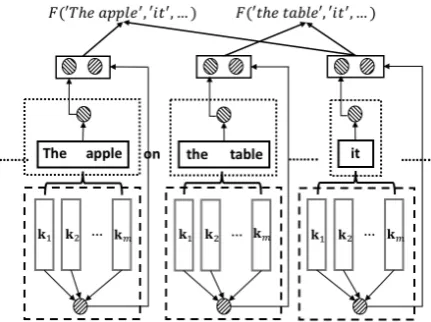
Figure 1: The overall framework of our approach to pronoun corference resolution with KGs. k1,...,km
represent the retrieved knowledge for each span in the black boxes. Dotted box represents the span repre-sentation module, which generates a contextual rep-resentation for each span. Dashed box represents the knowledge selection module, which selects appropri-ate knowledge based on the context and generappropri-ates an overall knowledge representation for each span. F(·)
is the overall coreference scoring function.
ful knowledge from different KGs.
3. We evaluate the performance of different pro-noun coreference models in a cross-domain set-ting and show that our model has better gener-alization ability than state-of-the-art baselines.
2 The Task
Given a textD, which contains a pronounp, the goal is to identify all the mentions thatprefers to. We denote the correct mentionsprefers to asc∈ C, where C is the correct mention set. Similarly, each candidate span is denoted as s ∈ S, where
S is the set of all candidate spans. Note that in the case where no golden mentions are annotated, all possible spans in D are used to form S. To exploit knowledge, we denote the knowledge set asG, instantiated by multiple knowledge triplets2. The task is thus to identify C out of S with the support ofG. Formally, it optimizes
J =
P
c∈CeF(c,p,G,D) P
s∈SeF(s,p,G,D)
, (1)
where F(·) is the overall scoring function3 of p
referring to sinD with G. The details of F are illustrated in the following section.
2
Each triplet contains a head, a tail, and a relation from the head to the tail.
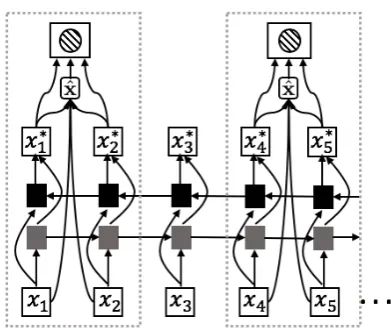
Figure 2: The structure of the span representation mod-ule. BiLSTM and attention are employed to encode the contextual information.
3 Model
The overall framework of our model is shown in Figure 1. There are several layers in it. At the bottom, we encode all mention spans (s) and pro-nouns (p) into embeddings so as to incorporate contextual information. In the middle layer, for each pair of (s, p), we use their embeddings to select the most helpful knowledge triplets from
Gand generate the knowledge representation ofs
andp. At the top layer, we concatenate the textual and knowledge representation as the final repre-sentation of eachsandp, and then use this repre-sentation to predict whether there exists the coref-erence relation between them.
3.1 Span Representation
Contextual information is crucial to distinguish the semantics of a word or phrase, especially for text representation learning (Song et al., 2018; Song and Shi, 2018). In this work, a stan-dard bidirectional LSTM (BiLSTM) (Hochreiter and Schmidhuber, 1997) model is used to en-code each span with attentions (Bahdanau et al., 2014), which is similar to the one used in Lee et al.(2017). The structure is shown in Figure2. Let initial word embeddings in a span si be de-noted asx1, ...,xT and their encoded representa-tion be x∗1, ...,x∗T. The weighted embeddings of each spanxˆiis obtained by
ˆ xi =
T
X
t=1
at·xt, (2)
Figure 3: The structure of the knowledge attention module. The joint representation of the candidate span and pronoun is used to select knowledge forsandp.
whereatis the inner-span attention computed by
at=
eαt
PT
k=1eαk
, (3)
where αt is a standard feed-forward neural net-work4αt=N Nα(x∗t).
Finally, the starting (x∗start) and ending (x∗end) embedding of each span is concatenated with the weighted embedding (xˆi) and the length feature (φ(i)) to form its final representatione:
ei= [x∗start,x
∗
end,xˆi, φ(i)]. (4)
Thus the span representation ofsandpare marked asesandep, respectively.
3.2 Knowledge Representation
For each candidate spansand the target pronoun
p, different knowledge from a KG can be extracted with various methods. For simplicity and gener-alization consideration, we use the string match in our model for knowledge extraction. Specifi-cally, for each triplet t ∈ G where the head and tail of tare both lists of words, if its head is the same as the string ofs, we consider it to be a re-lated triplet. Therefore, we encode the informa-tion oftby the averaging embeddings of all words in its tail. For example, ifsis ‘the apple’ and the knowledge triplet (‘the apple’,IsA, ‘healthy food’) is found by searching the KG, we represent this re-lation from the averaged embeddings of ‘healthy’ and ‘food’. Consequently, forsandp, we denote their retrieved knowledge set asKsandKp respec-tively, where Ks containsms related knowledge embeddingsk1,s, k2,s, ...,kms,s andKp contains mp of themk1,p,k2,p, ...,kmp,p.
[image:3.595.309.525.62.189.2]To incorporate the aforementioned knowledge embeddings into our model, we face a challenge that there are a huge number of such embeddings while most of them are useless in certain contexts. To solve it, a knowledge attention module is pro-posed to select the appropriate knowledge.
For each pair of (s, p), as shown in Figure 3, we first concatenate es andep to get the overall (span, pronoun) representationes,p, which is used to select knowledge for bothsandp. Taking that forsas example, we compute the weight of each
ki ∈ Ksby
wi=
eβki
P kj∈Kse
βkj, (5)
where βk = N Nβ([es,p,k]). As a result, the knowledge ofsis summed by
os =
X
ki∈Ks
wi·ki. (6)
to represent the overall knowledge fors. A similar process is also conducted forpwith its knowledge representationop.
3.3 Scoring
The final score of each pair (s,p) is computed by
F(s, p) =fm(s) +fc(s, p), (7)
where fm(s) = N Nm([es,os]) is the scoring function forsto be a valid mention andfc(s, p) =
N Nc([en,on,ep,op,en ep,on op]) is the scoring function to identify whether there exists a coreference relation fromptos, withdenoting element-wise multiplication.
After getting the coreference score for all men-tion spans, we adopt a softmax selecmen-tion on the most confident candidates for the final prediction, which is formulated as
ˆ
F(s, p) = e
F(s,p)
P
si∈Se
F(si,p). (8)
where candidates with score Fˆ higher than a thresholdtare selected.
4 Experiments
Experiments are illustrated in this section.
Dataset TP Poss Dem All
CoNLL
train 21,828 7,749 2,229 31,806
dev 2,518 1,007 222 3,747
test 2720 1,037 321 4,078
i2b2 train 2,024 685 270 2,979
test 1,244 367 166 1,777
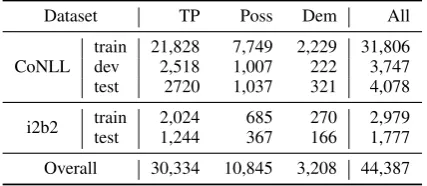
[image:4.595.310.524.63.156.2]Overall 30,334 10,845 3,208 44,387
Table 2: Statistics of the two datasets. ‘TP’, ‘Poss’, and ‘Dem’ refer to third personal, possessive, and demon-strative pronouns, respectively.
4.1 Datasets
Two datasets are used in our experiments, where they are from two different domains:
• CoNLL:The CoNLL-2012 shared task ( Prad-han et al.,2012) corpus, which is a widely used dataset selected from the Ontonotes 5.05.
• i2b2: The i2b2 shared task dataset (Uzuner et al., 2012), consisting of electronic medi-cal records from two different organizations, namely, Partners HealthCare (Part) and Beth Israel Deaconess medical center (Beth). All records have been fully de-identified and manu-ally annotated with coreferences.
We split the datasets into different proportions based on their original settings. Three types of pronouns are considered in this paper following Ng(2005), i.e., third personal pronoun (e.g.,she,
her, he, him, them, they, it), possessive pronoun (e.g., his, hers, its, their, theirs), and demonstra-tive pronoun (e.g.,this,that,these,those). Table2 reports the number of the three types of pronouns and the overall statistics of the experiment datasets with proportion splittings. Following conventional approaches (Ng, 2005; Li et al., 2011), for each pronoun, we consider its candidate mentions from the previous two sentences and the current sen-tence it belongs to. According to our selection range of the candidate mentions, each pronoun in the CoNLL data and i2b2 data has averagely 1.3 and 1.4 correct references, respectively.
4.2 Knowledge Resources
As mentioned in previous sections, our model is designed to leverage general KGs, where it takes triplets as the input of knowledge representations. For all knowledge resources, we format them as triplets and merge them together to obtain the final
knowledge set. Different knowledge resources are introduced as follows.
Commonsense knowledge graph (OMCS). We use the largest commonsense knowledge base, the open mind common sense (OMCS) (Singh, 2002) in this paper. OMCS contains 600K crowd-sourced commonsense triplets such as (food, UsedFor, eat) and (wind, CapableOf, blow to east). All relations in OMCS are human-defined and we select those highly-confident ones (confi-dence score larger than2) to form the OMCS KG, with 62,730 triplets.
Medical concepts (Medical-KG). Being part of the i2b2 contest, the related knowledge about med-ical concepts such as(the CT scan, is, test)and (in-travenous fluids, is, treatment)are provided. The annotated triplets are used as the medical concept KG, which contains 22,234 triplets.
Linguist features (Ling). In addition to manu-ally annotated KGs, we also consider linguist fea-tures, i.e., plurality and animacy & gender (AG), as one important knowledge resources. Stanford parser6is employed to generate plurality, animacy, and gender markups for all the noun phrases, so as to automatically generate linguistic knowledge (in the form of triplets) for our data. Specifically, the plurality feature denotes eachsandpto be singu-lar or plural. The animacy & gender (AG) feature denotes whether thenorpis a living object, and being male, female, or neutral if it is alive. For example, a mention ‘the girls’ is labeled as plu-ralandfemale; we use triplets(‘the girls’, plural-ity, Plural)and(‘the girls’, AG, female) to repre-sent them. As a result, we have 40,149 and 40,462 triplets for plurality and AG, respectively.
Selectional Preference (SP). Selectional prefer-ence (Hobbs,1978) knowledge is employed as the last knowledge resource, which is the semantic constraint for word usage. SP generally refers to that, given a predicate (e.g., verb), people have the preference for the argument (e.g., its object or subject) connected. To collect SP knowledge, we first parse the English Wikipedia7 with the Stan-ford parser and extract all dependency edges in the format of(predicate, argument, relation, number), where predicate is the governor and argument the dependent in each dependency edge8. Following
6
https://stanfordnlp.github.io/CoreNLP/ 7
https://dumps.wikimedia.org/enwiki/
8In the Stanford parser, an ‘nsubj’ edge is created between
its predictive and subject when a verb is a linking verb (e.g.,
(Resnik,1997), each potential SP pair is measured by a posterior probability
Pr(a|p) = Countr(p, a)
Countr(p)
, (9)
whereCountr(p)andCountr(p, a)refer to how many timespand the predicate-argument pair (p,
a) appear in the relationr, respectively. In our ex-periment, if Pr(a|p) > 0.1 andCountr(p, a) >
10, we consider the triplet (p, r, a) (e.g., (‘dog’, nsubj, ‘barks’)) a valid SP relation. Finally, we se-lect two SP relations,nsubjanddobj, to form the SP knowledge graph, including 17,074 and 4,536 frequent predicate-argument pairs for nsubj and
dobj, respectively.
4.3 Baselines
Several baselines are compared in this paper, in-cluding three widely used pre-trained models:
• Deterministic model (Raghunathan et al., 2010), which is an unsupervised model and leverages manual rules to detect coreferences.
• Statistical model (Clark and Manning, 2015), which is a supervised model and trained on manually crafted entity-level features between clusters and mentions.
• Deep-RL model (Clark and Manning, 2016), which uses reinforcement learning to directly optimize the coreference matrix instead of the loss function of supervised learning.
The above models are included in the Stanford CoreNLP toolkit9. We also include a state-of-the-art end-to-end neural model as one of our base-lines:
• End2end(Lee et al.,2018), which is the current state-of-the-art model performing in an end-to-end manner and leverages both contextual infor-mation and a pre-trained language model ( Pe-ters et al.,2018).
We use their released code10. In addition, to show the importance of incorporating knowledge, we also experiment with two variations of our model:
• Without KGremoves the KG component and keeps all other components in the same setting as that in our complete model.
am, is); the predicative is thus treated as the predicate for the subject (argument) in this paper.
9
Model Third Personal Possessive Demonstrative All
P R F1 P R F1 P R F1 P R F1
Deterministic 25.5 58.9 35.6 22.9 64.3 33.8 3.4 5.7 4.2 23.4 57.0 33.4
Statistical 25.8 62.1 36.5 28.9 64.9 40.0 9.8 6.3 7.6 25.4 59.3 36.5
Deep-RL 78.6 63.9 70.5 73.3 68.9 71.0 3.7 2.9 5.5 76.4 61.2 68.0
End2end 70.6 75.7 73.1 73.0 76.2 74.6 58.4 17.6 27.0 71.1 72.1 71.6
Without KG 78.2 72.4 75.2 80.0 66.4 72.6 46.7 62.5 53.4 75.7 70.1 72.8
Without Attention 76.6 77.9 77.2 79.0 73.5 76.2 42.4 72.6 53.5 73.6 76.4 74.9 Our Complete Model 78.8 77.8 78.1 80.7 72.5 76.4 45.3 66.7 53.9 75.9 75.6 75.7
(a) CoNLL
Model Third Personal Possessive Demonstrative All
P R F1 P R F1 P R F1 P R F1
Deterministic 25.7 57.4 35.5 25.2 61.6 35.7 6.6 4.0 5.0 25.1 54.0 34.3
Statistical 19.3 35.9 25.1 25.7 50.5 34.0 6.7 4.5 5.4 20.5 36.6 26.3
Deep-RL 78.2 48.0 59.5 78.6 57.7 66.5 9.1 5.1 9.6 77.8 46.3 58.1
End2end 95.0 93.4 94.2 95.3 96.0 95.7 74.8 52.5 61.7 93.9 90.7 92.3
Without KG 96.8 95.9 96.3 97.1 97.5 97.3 66.5 68.2 67.3 94.3 94.0 94.2
Without Attention 96.1 97.2 96.6 96.3 98.2 97.2 66.7 77.8 71.8 93.4 95.9 94.6 Our Complete Model 97.5 96.3 96.9 98.5 97.8 98.2 71.9 72.2 72.0 95.6 94.7 95.2
[image:6.595.88.510.63.310.2](b) i2b2
Table 3: The performance of pronoun coreference resolution with different models on two evaluation datasets. Precision (P), recall (R), and the F1 score are reported, with the best one in each F1 column marked as bold.
• Without Attentionremoves the knowledge at-tention module and concatenates all the knowl-edge embeddings. All other components are identical as our complete model.
4.4 Implementation
Following the previous work (Lee et al.,2018), we use the concatenation of the 300d GloVe embed-dings (Pennington et al.,2014) and the ELMo ( Pe-ters et al., 2018) embeddings as the initial word representations for computing span representa-tions. For knowledge triplets, we use the GloVe embeddings to encode tail words in them. Out-of-vocabulary words are initialized with zero vec-tors. The hidden state of the LSTM module is set to 200, and all the feed-forward networks have two 150-dimension hidden layers. The selection thresholds are set to10−2and10−8for the CoNLL and i2b2 dataset, respectively.
For model training, we use cross-entropy as the loss function and Adam (Kingma and Ba, 2014) as the optimizer. All the aforementioned hyper-parameters are initialized randomly, and we apply dropout rate 0.2 to all hidden layers in the model. For the CoNLL dataset, the model training is per-formed with up to 100 epochs, and the best one is selected based on its performance on the develop-ment set. For the i2b2 dataset, because no dev set is provided, we train the model up to 100 epochs
and use the final converged one.
4.5 Results
Table 3 reports the performance of all models, with the results for CoNLL and i2b2 in (a) and (b), respectively. Overall, our model outperforms all baselines on two datasets with respect to all pronoun types. There are several interesting ob-servations. In general, the i2b2 dataset seems sim-pler than the CoNLL dataset, which might because that i2b2 only involves clinical narratives and its training data is highly similar to the test data. As a result, all neural models perform dramatically good, especially on the third personal and posses-sive pronouns. In addition, we also notice that it is more challenging for all models to resolve demonstrative pronouns (e.g., this, that) on both datasets, because such pronouns may refer to com-plex things and occur with low frequency.
Sec-CoNLL i2b2
F1 ∆F1 F1 ∆F1
The Complete Model 75.7 - 95.2
-–OMCS 74.8 -0.9 95.1 -0.1
–Medical-KG 74.5 -1.2 94.6 -0.6
–Ling 73.8 -1.9 94.9 -0.3
[image:7.595.310.521.51.214.2]–SP 74.0 -1.7 94.7 -0.5
Table 4: The performance of our model with removing different knowledge resources. The F1 of each case and the difference of F1 between each case and the com-plete model are reported.
ond, adding knowledge in an appropriate man-ner within neural models is helpful, which is sup-ported by that our model outperforms the End2end model and the Without KG one on both datasets, especially CoNLL, where the external knowledge plays a more important role. Third, the knowl-edge attention module ensures our model to pre-dict more precisely, which also results in the over-all improvement on F1. To summarize, the results suggest that external knowledge is important for effectively resolving pronoun coreference, where rich contextual information determines the appro-priate knowledge with a well-designed module.
5 Analysis
Further analysis is conducted in this section garding the effect of different knowledge re-sources, model components, and settings. Details are illustrated as follows.
5.1 Ablation Study
We ablate different knowledge for their contribu-tions in our model, with the results reported in Ta-ble4. It is observed that all knowledge resources contribute to the final success of our model, where different knowledge types play their unique roles in different datasets. For example, the Ling knowl-edge contributes the most to the CoNLL dataset while the medical knowledge is the most impor-tant one for the medical data.
5.2 Effect of the Selection Threshold
[image:7.595.76.286.63.149.2]We experiment with different thresholdstfor the softmax selection. The effects oftagainst overall performance are shown in Figure 4. In general, with the increase of t, fewer candidates are se-lected. Therefore, the overall precision increases and the recall drops. Consider that both the preci-sion and recall are important for resolving pronoun
Figure 4: Effect of different softmax selection thresh-olds with respect to our model performance on two datasets. In general, with the threshold becoming larger, less candidates are selected, the precision thus increases while the recall drops.
Model Setting CoNLL i2b2
End2end Original 71.6 92.3
+ Gold mention 77.8 94.4
Our Model Original 75.7 95.2
+ Gold mention 80.7 96.0
(Zhang et al.,2019b) + Gold mention 79.9
-Table 5: Influence of gold mentions. F1 scores on dif-ferent test sets are reported. Adding human-annotated gold mentions help both the End2end and our model. Best performed model are indicated with the bold font.
coreference, we select different thresholds for dif-ferent datasets to ensure the balance between pre-cision and recall. In detail, for the CoNLL dataset, we setr = 10−2 to select the most confident pre-dictions; and for the i2b2 dataset, we setr = 10−8 so as to keep more predictions.
5.3 Effect of Gold Mentions
Ta-Model Training data Test data CoNLL i2b2
End2end CoNLL 71.6 75.2
i2b2 20.0 92.3
Our Model CoNLL 75.7 80.9
[image:8.595.306.525.63.177.2]i2b2 42.7 95.2
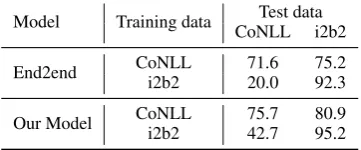
Table 6: Cross-domain performance of different mod-els. F1 on the target domain test sets are reported.
ble 5. As we also included one new challeng-ing pronoun type, the demonstrative pronoun, the overall performance of their model is lower than the one reported in the original paper. The reason of our model being better is that more knowledge resources (e.g., OMCS) can be incorporated into our model due to its generalizable design. More-over, it is more difficult for their method (Zhang et al.,2019b) to incorporate mention detection into the model, because in this case we need to enumer-ate all mention spans and generenumer-ate corresponding features for all spans. which is expensive and dif-ficult to acquire.
5.4 Cross-domain Evaluation
Considering that neural models are intensive data-driven and normally restricted by data nature, they are not easily applied in a cross-domain setting. However, if a model is required to perform in real applications, it has to show promising per-formance on those cases out of the training data. Herein we investigate the performance of different models with training and testing in different do-mains, with the results reported in Table6. Over-all, all models perform significantly worse if they are used cross domains. Specifically, if we train the End2end model on the CoNLL dataset and test it on the i2b2 dataset, it only achieves 75.2 F1. As a comparison, our model can achieve 80.9 F1 in the same case. This observation confirms the ca-pability of knowledge where our model is able to handle. A similar observation is also drawn for the reversed case. However, even though our model outperforms the End2end model by 22.7 F1 from i2b2 to CoNLL, its overall performance is still poor, which might be explained by that the i2b2 is an in-domain dataset and the knowledge con-tained in its training data is rarely useful for the general (news) domain dataset. Nevertheless, this experiment clearly shows that the generalization ability of deep models is still crucial for building a successful coreference model, and learns to use knowledge is a promising solution to it.
Example A Example B
Sentence He walks into the room with one magazine and drops it on the couch.
... A small area of erythemaaround his arm ... Thiswill be treated empirically.
Prediction magazine erythema
Knowledge (‘magazine’, dobj, ‘drop’)
[image:8.595.91.272.65.140.2](‘erythema’, IsA, ‘disease’)
Table 7: The case study on two examples from the test data, i.e., A: from the CoNLL and B: from the i2b2. Pronouns and correct mentions are marked by red bold and blue underline font respectively. Knowledge triplets used for them are listed in the bottom row.
6 Case Study
To better illustrate the effectiveness of incorporat-ing different knowledge in this task, two exam-ples are provided for the case study in Table 7. In example A, our model correctly predicts that ‘it’ refers to the ‘magazine’ rather than the ‘room’, because we successfully retrieve the knowledge that compared with the ‘room’, the ‘magazine’ is more likely to be the object ofdrop. In example B, even though the distance between ‘erythema’ and ‘This’ is relatively far11, our model is able to determine the coreference relation between them because it successfully finds out that ‘erythema’ is a kind of disease, while a lot of diseases appear as the context of ‘be treated’ in the training data.
7 Related Work
Detecting mention spans in linguistic expressions and identifying coreference relations among them is a core task, namely, coreference resolution, for natural language understanding. Mention detec-tion and coreference predicdetec-tion are the two major focuses of the task as listed inLee et al. (2017). Compared to general coreference problem, pro-noun coreference resolution has its unique chal-lenge since pronouns themselves have weak se-mantics meanings, which make it the most chal-lenging sub-task in general coreference resolution. To address the unique difficulty brought by pro-nouns, we thus focus on resolving pronoun coref-erences in this paper.
Resolving pronoun coreference relations often requires the support of manually crafted knowl-edge (Rahman and Ng,2011;Emami et al.,2018),
11We omit the intermediate part of the long sentence in the
especially for particular domains such as medicine (Uzuner et al., 2012) and biology (Cohen et al., 2017). Previous studies on pronoun coreference resolution incorporated external knowledge in-cluding human defined rules (Hobbs, 1978; Ng, 2005), e.g., number/gender requirement of dif-ferent pronouns, domain-specific knowledge such as medical (Jindal and Roth, 2013) or biologi-cal (Trieu et al., 2018) ones, and world knowl-edge (Rahman and Ng,2011), such as selectional preference (Wilks, 1975). Later, end-to-end so-lutions (Lee et al., 2017, 2018) were proposed to learn contextual information and solve coref-erences synchronously with neural networks, e.g., LSTM. Their results proved that such knowledge is helpful when appropriately used for coreference resolution. However, external knowledge is of-ten omitted in their models. Consider that con-text and external knowledge have their own advan-tages: the contextual information covering diverse text expressions that are difficult to be predefined while the external knowledge being usually more precisely constructed and able to provide extra in-formation beyond the training data, one could ben-efit from both sides for this task. Different from previous studies, we provide a generic solution to resolving pronoun coreference with the support of knowledge graphs based on contextual mod-eling, where deep learning models are adopted in our work to incorporate knowledge into pro-noun coreference resolution and achieve remark-ably good results.
8 Conclusion
In this paper, we explore how to build a knowledge-aware pronoun coreference resolution model, which is able to leverage different external knowledge for this task. The proposed model is an attempt of the general solution of incorporating knowledge (in the form of KG) into the deep learn-ing based pronoun coreference model, rather than using knowledge as features or rules in a dedicated manner. As a result, any knowledge resource pre-sented in the format of triplets, the most widely used entry format for KG, can be consumed in our model with a proposed attention module. Experi-mental results on two different corpora from two domains demonstrate the superiority of the pro-posed model to all baselines. Moreover, as our model learns to use knowledge rather than just fit-ting the training data, our model achieves much
better and more robust performance than state-of-the-art models in the cross-domain scenario.
Acknowledgements
This paper was partially supported by the Early Career Scheme (ECS, No.26206717) from Re-search Grants Council in Hong Kong and Tencent AI Lab Rhino-Bird Focused Research Program. In addition, Hongming Zhang has been supported by the Hong Kong Ph.D. Fellowship. We also thank the anonymous reviewers for their valuable comments and suggestions that help improving the quality of this paper.
References
Dzmitry Bahdanau, Kyunghyun Cho, and Yoshua Ben-gio. 2014. Neural machine translation by jointly learning to align and translate. arXiv preprint arXiv:1409.0473.
Eugene Charniak and Micha Elsner. 2009. Em works for pronoun anaphora resolution. In EACL, 2009, pages 148–156.
Kevin Clark and Christopher D Manning. 2015. Entity-centric coreference resolution with model stacking. InACL-IJCNLP, 2015, volume 1, pages 1405–1415.
Kevin Clark and Christopher D. Manning. 2016. Deep reinforcement learning for mention-ranking corefer-ence models. InEMNLP 2016, Austin, Texas, USA, November 1-4, 2016, pages 2256–2262.
K Bretonnel Cohen, Arrick Lanfranchi, Miji Joo-young Choi, Michael Bada, William A Baumgartner, Na-talya Panteleyeva, Karin Verspoor, Martha Palmer, and Lawrence E Hunter. 2017. Coreference annota-tion and resoluannota-tion in the colorado richly annotated full text (craft) corpus of biomedical journal articles.
BMC bioinformatics, 18(1):372.
Richard J Edens, Helen L Gaylard, Gareth JF Jones, and Adenike M Lam-Adesina. 2003. An investiga-tion of broad coverage automatic pronoun resoluinvestiga-tion for information retrieval. InSIGIR, pages 381–382. ACM.
Kate Ehrlich. 1981. Search and inference strategies in pronoun resolution: An experimental study. InACL, 1981, pages 89–93.
Ali Emami, Paul Trichelair, Adam Trischler, Ka-heer Suleman, Hannes Schulz, and Jackie Chi Kit Cheung. 2018. The hard-core coreference cor-pus: Removing gender and number cues for diffi-cult pronominal anaphora resolution. arXiv preprint arXiv:1811.01747.
Jerry R Hobbs. 1978. Resolving pronoun references.
Sepp Hochreiter and J¨urgen Schmidhuber. 1997. Long short-term memory. Neural computation, 9(8):1735–1780.
Prateek Jindal and Dan Roth. 2013. End-to-end coref-erence resolution for clinical narratives. In Twenty-Third International Joint Conference on Artificial Intelligence.
Diederik P Kingma and Jimmy Ba. 2014. Adam: A method for stochastic optimization. arXiv preprint arXiv:1412.6980.
Kenton Lee, Luheng He, Mike Lewis, and Luke Zettle-moyer. 2017. End-to-end neural coreference resolu-tion. InEMNLP, 9-11, 2017, pages 188–197.
Kenton Lee, Luheng He, and Luke Zettlemoyer. 2018. Higher-order coreference resolution with coarse-to-fine inference. InNAACL-HLT, pages 687–692.
Dingcheng Li, Tim Miller, and William Schuler. 2011. A pronoun anaphora resolution system based on fac-torial hidden markov models. In Proceedings of ACL 2011, pages 1169–1178.
Miaofeng Liu, Jialong Han, Haisong Zhang, and Yan Song. 2018. Domain Adaptation for Disease Phrase Matching with Adversarial Networks. In Proceed-ings of the BioNLP 2018 workshop 2018, pages 137–141.
Miaofeng Liu, Yan Song, Hongbin Zou, and Tong Zhang. 2019. Reinforced Training Data Selection for Domain Adaptation. In Proceedings of ACL 2019.
Ruslan Mitkov. 1998. Robust pronoun resolution with limited knowledge. InACL, 1998, pages 869–875.
Ruslan Mitkov et al. 1995. Anaphora resolution in ma-chine translation. In Proceedings of the Sixth In-ternational conference on Theoretical and Method-ological issues in Machine Translation. Citeseer.
Testuya Nasukawa. 1994. Robust method of pro-noun resolution using full-text information. InCCL, 1994, pages 1157–1163.
Vincent Ng. 2005. Supervised ranking for pronoun res-olution: Some recent improvements. In EMNLP, 2005, volume 20, page 1081.
Jeffrey Pennington, Richard Socher, and Christopher Manning. 2014. Glove: Global vectors for word representation. InEMNLP, 2014, pages 1532–1543.
Matthew E Peters, Mark Neumann, Mohit Iyyer, Matt Gardner, Christopher Clark, Kenton Lee, and Luke Zettlemoyer. 2018. Deep contextualized word rep-resentations. arXiv preprint arXiv:1802.05365.
Sameer Pradhan, Alessandro Moschitti, Nianwen Xue, Olga Uryupina, and Yuchen Zhang. 2012. Conll-2012 shared task: Modeling multilingual unre-stricted coreference in ontonotes. InEMNLP, 2012, pages 1–40.
Karthik Raghunathan, Heeyoung Lee, Sudarshan Ran-garajan, Nathanael Chambers, Mihai Surdeanu, Dan Jurafsky, and Christopher Manning. 2010. A multi-pass sieve for coreference resolution. In EMNLP, 2010, pages 492–501.
Altaf Rahman and Vincent Ng. 2011. Coreference res-olution with world knowledge. InACL, 2011, pages 814–824.
Philip Resnik. 1997. Selectional preference and sense disambiguation. Tagging Text with Lexical Seman-tics: Why, What, and How?
Push Singh. 2002. The open mind common sense project. KurzweilAI. net.
Yan Song and Shuming Shi. 2018. Complementary Learning of Word Embeddings. In Proceedings of IJCAI 2018, pages 4368–4374.
Yan Song, Shuming Shi, Jing Li, and Haisong Zhang. 2018. Directional Skip-Gram: Explicitly Distin-guishing Left and Right Context for Word Embed-dings. InProceedings of NAACL-HLT 2018, pages 175–180.
Josef Steinberger, Massimo Poesio, Mijail A Kabadjov, and Karel Jevzek. 2007. Two uses of anaphora reso-lution in summarization. Information Processing & Management, 43(6):1663–1680.
Michael Strube and Christoph M¨uller. 2003. A ma-chine learning approach to pronoun resolution in spoken dialogue. InACL, 2003, pages 168–175.
Long Trieu, Nhung Nguyen, Makoto Miwa, and Sophia Ananiadou. 2018. Investigating domain-specific information for neural coreference resolution on biomedical texts. In Proceedings of the BioNLP 2018 workshop, pages 183–188.
Ozlem Uzuner, Andreea Bodnari, Shuying Shen, Tyler Forbush, John Pestian, and Brett R South. 2012. Evaluating the state of the art in coreference res-olution for electronic medical records. Journal of the American Medical Informatics Association, 19(5):786–791.
Yorick Wilks. 1975. A preferential, pattern-seeking, semantics for natural language inference. Artificial intelligence, 6(1):53–74.
Hongming Zhang, Xin Liu, Haojie Pan, Yangqiu Song, and Cane Wing-Ki Leung. 2019a. Aser: A large-scale eventuality knowledge graph. arXiv preprint arXiv:1905.00270.