155
Automatic Gender Identification and Reinflection in Arabic
Nizar Habash, Houda Bouamor,†Christine Chung
Computational Approaches to Modeling Language Lab New York University Abu Dhabi, UAE
†Carnegie Mellon University in Qatar, Qatar
{nizar.habash,cic266}@nyu.edu, [email protected]
Abstract
The impressive progress in many Natural Lan-guage Processing (NLP) applications has in-creased the awareness of some of the biases these NLP systems have with regards to gen-der identities. In this paper, we propose an ap-proach to extend biased single-output gender-blind NLP systems with gender-specific al-ternative reinflections. We focus on Ara-bic, a gender-marking morphologically rich language, in the context of machine transla-tion (MT) from English, and for first-person-singular constructions only. Our contributions are the development of a system-independent gender-awareness wrapper, and the building of a corpus for training and evaluating first-person-singular gender identification and re-inflection in Arabic. Our results successfully demonstrate the viability of this approach with 8% relative increase in BLEU score for first-person-singular feminine, and 5.3% compara-ble increase for first-person-singular mascu-line on top of a state-of-the-art gender-blind MT system on a held-out test set.
1 Introduction
The impressive progress in the last decade in many Natural Language Processing (NLP) applications, from machine translation (MT) to dialogue sys-tem, has increased awareness of some of the bi-ases these systems have with regards to gender identities. A case in point is the I-am-a-doctor/
I-am-a-nurse MT problem in many
morphologi-cally rich languages. While English uses gender-neutral terms that hide the ambiguity of the first-person gender reference, many morphologically rich languages need to use different grammatically gender-specific terms for these two expressions. In Arabic, as in other languages with grammatical gender, gender-blind single-output MT from
En-glish often results in
I
. J.£ A
K
@
ÂnA Tbyb1 ‘I am a [male] doctor’/é
QÜØ A K
@
ÂnA mmrD~ ‘I am a [fe-male] nurse’, which is inappropriate for female doctors and male nurses, respectively.Part of this problem comes from human-generated data that mirrors the social biases and inequalities of the world we live in, and that re-sults in biased models and representations. Many research efforts responded to this problem by de-biasing and balancing the models created from the data through model modification or data augmen-tation (Font and Costa-jussà,2019;Zmigrod et al.,
2019). However, ultimately, even the most bal-anced and unbiased of models can be useless in gender-blind systems that are designed to gener-ate a single text output. Such systems are doomed to unsurprisingly pass on the biases of the models they use, as demonstrated in the doctor/nurse ex-ample above. In contrast, gender-aware systems should be designed to produce outputs that are as gender-specific as the input information they have access to. The input gender information may be contextual (e.g., the input ‘she is a doctor’), or ex-tra linguistics (e.g., the gender feature provided in the user profile in social media). But, there may be contexts where the gender information is unavail-able to the system (e.g., ‘the student is a nurse’). In such cases, generating both gender-specific forms or a gender-neutral (gender-ambiguous) form is more appropriate.
In this paper, we propose an approach that ex-tends the possibly biased output of gender-blind NLP systems with gender-specific reinflections. This is a monolingual postprocessing rephrasing task that wraps around a gender-blind system to make it gender-aware, through identifying if there are gender-specific phrases in its output and
fering alternative reinflections instead. The se-lection of the gender-specific form is then left to the user or another automatic component has ac-cess to extra-linguistic information, such as pro-file gender. For example, the Arabic gender-blind MT output translating English ‘I am a nurse’ as
é
QÜØ A K
@
ÂnA mmrD~ ‘I am a [female] nurse’ is turned into two gender-marked output options: (a)é
QÜØ A K
@
ÂnA mmrD~‘[First Person Singular Fem-inine]’, and (b)QÜØ A K
@
ÂnA mmrD ‘[First Per-son Singular Masculine]’. Since the output of the gender-blind NLP system is not necessarily always masculine or feminine, our approach re-quires two components: gender identificationand gender reinflection, which can be modeled jointly or in cascade. The approach is system-independent and can be used with MT, dialogue systems, etc., as well as, to balance corpora through augmentation by adding reinflected copies of gender-specific constructions.
We focus on Arabic, a gender-marking mor-phologically rich language, in the context of MT from English, and for first-person-singular structions only. We only work on first-person con-structions because they tend to be gender-neutral in English. Furthermore, as sentences may involve multiple gendered references, we wanted to con-trol for the number of combinations. We plan to extend to multiple references in future work.
Our contributions are the development of a system-independent gender-awareness wrapper, and the building of a corpus for training and eval-uating first-person-singular gender identification and reinflection in Arabic. For gender identifica-tion, we compare rule-based and machine learning methods using our annotated corpus. For gender reinflection, we use a character-level neural MT (NMT) model in a single step (identify and rein-flect, jointly), and as the second part of a two-step (identify then reinflect) system. Our results successfully demonstrate the viability of this ap-proach with 8% relative increase in BLEU score for first-person-singular feminine, and 5.3% com-parable increase for first-person-singular mascu-line on top of a state-of-the-art gender-blind MT system on a held-out test set.
Next, we discuss some related work (Section2) and Arabic linguistic facts (Section3). We present our Arabic parallel gender corpus in Section 4, gender identification in Section5, and gender re-inflection and MT results in Section6.
2 Related Work
Gender bias has been detected, studied, and par-tially addressed for standard and contextualized word embeddings in a number of studies ( Boluk-basi et al., 2016; Caliskan et al., 2017; Sutton et al.,2018;Basta et al.,2019;Garg et al.,2018;
Zhao et al., 2018, 2019). These studies showed that training word embeddings on large human produced corpora such as news text leads to en-coding societal biases including gender and race. Some of these studies focused on quantifying the bias, and proposed approaches for mitigating it within word embeddings.
In the context of data augmentation solutions,
Lu et al. (2018) introduced counterfactual data
augmentation (CDA), a generic methodology to
mitigate bias in neural NLP tasks, where for each training instance, a copy with an intervention on its targeted words is added, replacing each with its partner, while maintaining the same ground truth. The goal here is to encourage learning algorithms to not pick up on biased distinctions. Building on CDA, (Zmigrod et al., 2019) presented a genera-tive model that allows conversion between mas-culine inflected and feminine inflected sentences in four morphologically rich languages (Hebrew, Spanish, French and Italian) with a focus on ani-mate nouns.
Specifically for MT, Rabinovich et al. (2016) presented work on the preservation of author gender. Some researchers suggested improve-ment through co-reference resolution (Gonzales and Tuggener, 2017; Luong and Popescu-Belis,
2016). Vanmassenhove et al. (2018) conducted a series of experiments to improve morpholog-ical agreement and improve translation quality in NMT systems for 20 language pairs (none of
which were Arabic). They compiled large datasets
sentences from a variety of gender-neutral lan-guages into English. They showed that occupa-tions related to science, engineering and math-ematics present a strong stereotype towards the male gender. More recently,Font and Costa-jussà
(2019) studied the impact of gender debiasing on NMT between English and Spanish using debi-ased and gender-neutral word embeddings.
Google Translate publicly announced an ef-fort to address gender bias for a few languages in different degrees and contexts (Help, 2019). As of the time of writing this paper, the system shows both feminine and masculine translations for some single words in certain languages; and provides gender-specific pronominal translations for some gender ambiguous cases (i.e., Turkish-English MT). In our work, we also evaluate on the output of Google Translate.
This paper sits in the intersection of efforts like data augmentation for morphologically rich lan-guages (Zmigrod et al., 2019) and gender-aware MT (Vanmassenhove et al., 2018;Elaraby et al.,
2018). Similarly to Zmigrod et al. (2019), we are interested in reinflection, but we implement it as character-based NMT. While Vanmassenhove et al. (2018) and Elaraby et al. (2018) expect gender meta-information as input, we propose a gender-aware post-processing approach, that ap-plies gender identification and reinflection.
3 Arabic Linguistic Facts
We present three specific challenges for Modern Standard Arabic (MSA) NLP with attention to gender expression and MT.
Morphological Richness Arabic is a morpho-logically rich language that inflects for gender, number, person, case, state, aspect, mood and voice, in addition to allowing a number of at-tachable clitics (prepositions, particles, pronouns) (Habash, 2010). Wright (1955) classifies nouns according to their gender into three classes: mas-culine (M), feminine (F), and those that can be ei-ther masculine or feminine (B). Examples include
I
. J.£
Tabiyb ‘male doctor’ [M],éJ.J.£
Tabiyba~ ‘female doctor’ [F], and words likeKQ£
Tariyq ‘road’ [B]. Arabic adjectives have gender-specific forms (M or F). But some pronouns and some verb conjugations can be used for either masculine or feminine (B). For example, the pronounA K
@
ÂanA ‘I’, and the first-person-singular perfect and im-perfect verbal conjugations (e.g.,I.
J»
katabtu ‘Iwrote’ and
I
.
J»
@
Âaktub ‘I write’) are all gender-ambiguous (B).The Arabic agreement system between verbs and their subjects, and between nouns and their adjectives does not just involve gender, number, case and state, but also a lexical feature called
ra-tionality– a quality typically associated with
hu-man actors (Alkuhlani and Habash,2011). For in-stance, while adjectives modifying rational nouns agree with them in gender and number; adjectives modifying irrational plural nouns are always fem-inine and singular.
Orthographic Ambiguity Arabic is also ortho-graphically ambiguous due to the optionality of diacritic specification in the written form. This optionality can lead to gender ambiguous ortho-graphic forms as some gender-specific forms only differ in diacritics (short vowel specification).2 For example, the word
I.
J»
can be diacritized askatabta ‘you [masc.sing] wrote’ or katabti ‘you
[fem.sing] wrote’, and it is ambiguous with yet two other forms:katabtu‘I [fem/masc] wrote’ and
katabat ‘she wrote’. In this regard, orthographic
ambiguity reduces gender bias. But it is still an issue for speech synthesis systems (Halabi,2016). In general, for first person expressions, we ex-pect the verbal sentences to be gender-ambiguous (B), and the copular/equational sentences involv-ing adjectives and rational nouns to be gender-specific ([M] or [F]). We will present an analysis of our data in the next section that confirms this.
Orthographic Noise MSA unedited text tends to have a large percentage (∼23%) of spelling er-rors (Zaghouani et al., 2014). Most common er-rors involve Alif-Hamza (Glottal Stop) spelling (
@ ,
@ , @ ,
@
A, ¯A, ˇA, Â), Ya spelling (ø , ø
y, ý), and the feminine suffix Ta-Marbuta spelling (è ,
è
h, ~). These errors are so common, that in Arabic NLP, Alif/Ya normalization is standard preprocessing (Habash,2010), and Alif/Ya speci-fication is done as postprocessing (El Kholy and Habash,2010). Since the Arabic text we use from the OpenSubtitles Corpus (Lison and Tiedemann,2016), a collection of translated movie subtitles, has many spelling errors of the above mentioned kinds, we evaluate MT within an orthographically normalized space (more details in Section6).
Original Corpus Balanced Corpus
(a) (b) (c) (d) (e)
Sentences Words WordsM F Input Reinflected Input TargetM TargetF Sentences Words WordsM F
10,242 74,702 0 B B B B 10,242 74,702 0
362 2,720 422 F Mr F Mr F 362 2,720 422
636 4,710 743 M Fr M M Fr 636 4,710 743
Mr Mr F 362 2720 422
Fr M Fr 636 4,710 743
[image:4.595.75.527.63.161.2]11,240 82,132 1,165 12,238 89,562 2,330
Table 1: Statistics of the original corpus we annotated and the balanced version we report on in the paper experi-ments. WordsM F refers to the count of gender-marking words, specifically. Mrand Frare the reinflected versions
of the F and M labelled sentences, respectively, in the same rows they appear in.
English Original Arabic Gender Reinflection I have no interest in that. @Yë ú
¯
éjÊÓ øYË Ë B
He shot at me! !ú
Ϋ PA JË@ Ê£ @ Y®Ë B
I’m leaving. éÊg@P A K@ F Ég@P A K@
I’m rich! I’m rich! éJ J « A K@éJ J « A K@ F ú æ « A K
@ ú
æ « A K @
I am a Muslim and a Hindu and a Christian and a Jew. øXñîE ð úG@Qå ð ú
æ ðY Jë ð ÕÎÓ A K
@ M éKXñîE ð éJ K@Qå ð éJðY Jë ð éÒÊÓ A K@
I’m the new attending. . YKYm.Ì'@ ùKA kB@ A K @ M . èYKYm.Ì'@ éJKA kB@ A K @
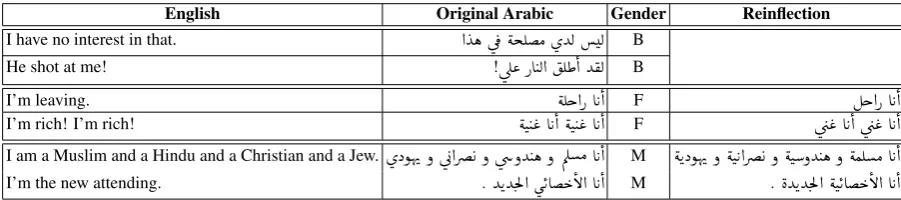
Table 2: Examples from the Arabic Parallel Gender Corpus including original sentence, its gender and its reinflec-tion to the opposite gender where appropriate.
4 The Arabic Parallel Gender Corpus
For the kind of experiments we conduct in this paper, we need a corpus of first-person-singular Arabic sentences that are gender-annotated and gender-translated. That is, for every sentence in such corpus, we would like the gender of the sentence’s speaker to be identified as B (gender-ambiguous), F (feminine) orM (masculine); and for the F and M cases, we would like the equiv-alent opposite gender form. Such a corpus needs to also be paired with English translations to sup-port possible MT experiments. To the best of our knowledge, no such corpus exists for Arabic, nor for any other language. We plan to make this re-source publicly available.3 We describe next the approach we followed to build this corpus.
Corpus Selection We decided to use a subset of the sentences from the OpenSubtitles 2018 cor-pus (Lison and Tiedemann, 2016). We selected this corpus because it has parallel English and Arabic sentences, and because it contains a lot of first-person-singular sentences. We first extracted all the English-Arabic sentence pairs that include first-person-singular pronouns in the English side:
I, me, my, myself, mine. We used English because
it is not a pro-drop language like Arabic. There
3http://resources.camel-lab.com
were 8.5 million sentences of this kind, 5.7 million of which do not include a second person pronoun
(you, your, yourself, yours). In this work, we
de-cided to focus on the first-person-singular exclu-sively and excluded all second person cases. Out of this rich set, we selected 12,000 sentences to be annotated. All the Arabic sentences were white-space-and-punctuation tokenized, as well as mor-phologically analyzed and lemmatized using the MADAMIRA toolkit for Arabic NLP (Pasha et al.,
2014).
[image:4.595.73.524.221.321.2]appropriately to a related lemma expressing the opposite gender. For example, the word
Ð
@
Âm ‘mother’ is mapped toH.
@
Âb ‘father’.4 Proper names are all treated as gender-neutral (B), even when they have strong gender-specific associa-tions, and as such are not reinflected. The annota-tors were made aware of hetreo-centrist interpreta-tions and were instructed to suspend any precon-ceived assumptions, e.g., the sentenceú
æk.ð P ½ÊK
‘That’s my wife’ is given the label B, not M. Fi-nally, the annotators were also instructed to flag bad translations or malformed sentences. Exam-ples from our corpus are illustrated in Table 2. The average pairwise inter-annotator agreement on a 60-sentence set that was annotated by all annotators is quite high (97.2%), suggesting the task is reasonable. The points of disagreement were plausible different interpretations. For exam-ple, the word@Q k
AJÓ
mtÂxrA ‘late’ in the sentence@Q k
AJÓ
¡
®J
@
Âstyq ˇD mtÂxrA‘I wake up late’ was interpreted as an adverb (which would not gender-inflect) or as an adjective (which would).The Original Corpus After the annotation was completed, we excluded all sentences with mal-formed input, sentences with Latin characters, and sentences with Arabic-Arabic gender misalign-ment due to annotation errors. This resulted in a set of 11,240 sentences (82,132 words), which constitute our Original Corpus Input (Table1, col-umn (a)). In this corpus, about 91% of all the sen-tences are gender-ambiguous (B). Interestingly, the M sentences are almost twice as many as the F sentences. All of the gender-specific sentences were reinflected (M→Frand F→Mr), resulting in an additional 989 sentences (7,430 words) (Ta-ble1, column (b)). Among the words of the first-person-singular gender-specific sentences, 1,165 are gender-specific (15.7%). The percentage of these words in the whole corpus is 1.4%.
The Balanced Corpus Given the stark gender imbalance as well as the small ratio of gender-specific sentences, we opted to balance the corpus by introducing the reinflected sentences (Mr and Fr) as if they were original input and pair them with their original input as their reinflection. In Table1the added sentence statistics appear in the
4We are aware that sentences with gender-specific English words, e.g.,widow and widower, will be mismatched with the reinflected Arabic. We do not consider this to be a problem from the point of view of the spirit of the task as a whole.
two additional rows under Balanced Corpus. In Table1 columns (c), (d) and (e), we define three versions of the balanced corpus, which we will re-fer to and use in the rest of the paper. The first is the balanced Arabic input corpus (henceforth,
Balanced Input), which matches the original
in-put plus the added reinflected sentences. The sec-ond is a masculine target corpus (TargetM) con-taining only B, M and Mr sentences. And the last is a feminine target corpus (TargetF) con-taining only B, F, and Fr sentences. All three corpora naturally have the same number of sen-tences, words, and gender-specific words. Given the addition of the reinflected sentences, the per-centage of all gender-specific sentences in the bal-anced corpus is 16.3% and the number of mascu-line and feminine sentences is the same. The bal-anced corpora were all divided randomly and in parallel into training (TRAIN: 70% or 8,566 sen-tences), development (DEV: 10% or 1,224 sen-tences) and blind test (TEST: 20% or 2,448 sen-tences). The balanced corpus DEV and TEST English side sentences were also machine trans-lated through Google Translate’s API to create the DEVGT and TESTGT sets5(See Section6).
The Synthetic Corpus Given the very small number of gender-specific words in the corpus, we created a synthetic corpus consisting of short gender-inflected sentences using an Arabic mor-phological analyzer and generator (Taji et al.,
2018). We covered 6,447 adjectives and 2,172 rational nouns (8,619 total) producing 25 differ-ent expressions for each in parallel, in masculine and feminine form. The 25 expressions consisted of simple nominal sentences, including construc-tions with
AîE@ñ k
@ð àA¿
‘Kan and her sisters’, andAîE@ñ k
@ð à@
‘Inna and her sisters’. For example, for the masculine adjectiveYJª
sςyd ‘happy’ we in-clude the sentencesYJª A
K
@
ÂnA sςyd‘I am happy’,@YJª I
J»
knt sςydA ‘I was happy’,@YJª IË
lst sςydA ‘I was not happy’, etc., and their femi-nine versions, respectively,èYJª A
K
@
ÂnA sςyd~‘I am happy’,èYJª I
J»
knt sςyd~ ‘I was happy’,èYJª IË
lst sςyd~ ‘I was not happy’, etc. The choice of expressions was influenced by a sample manual analysis, which we discuss in Section5.1. In total, the synthetic corpus has 226,175 sentence pairs covering 5 million words on each side. We use this corpus for training purposes only.Arabic ÐñJË@ é JKYÖÏAK. ú GB èPðQåÓ A K@ English I’m just glad I was in town tonight
Tokens AnA msrwr~ lÂny bAlmdyn~ Alywm
Gloss I happy for that I in the city today
Featurespron+1s adj+fs li_prep conj_sub+ 1s_pron bi_prep noun+fsi noun+msi
first feminine preposition subordinating first preposition feminine masculine person singular clitic conjunction person clitic singular singular singular adjective singular irrational irrational
[image:6.595.76.524.61.182.2]pronoun pronoun noun noun
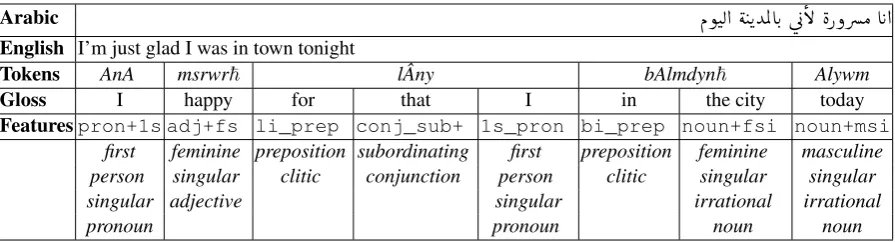
Table 3: Example of the morphological features used in automatic gender identification. In the third row, the Arabic words are presented in transliteration from left to right. The features are paired with the words they are generated from. The Gloss is the literal translation of the word. The English translation is from the OpenSubtitles corpus.
5 Automatic First-Person-Singular Gender Identification
We define the task of automatic first-person-singular gender identification as taking a sentence from our Balanced Input corpus (DEVand TEST) and predicting a label from the set {B, F, M} that indicates the gender-specificity of the first person speaker. We present four models for accomplish-ing this task. The first is a rule-based baseline, and the other three are machine-learning models trained on the TRAIN set of the Balanced Input corpus. Two of the machine learning models and the rule-based one make extensive use of automat-ically determined morphological features. All sys-tem development and parameter tuning was done using the DEV set. We report only the TEST re-sults here. The DEV and TEST results were very similar. We discuss the morphological features next, followed by the four models, then we present our results and discussion.
5.1 The Morphological Features
We started this effort with an analysis of 100 sam-ples from the training data: 50 from B cases, and 50 from M/F cases. For each case, we manually identified how the first person singular aspect of the task, and how the gender aspect of the task are realized linguistically. We identified three cate-gories for the first person singular: as pro-dropped subject of a verb, as the pronoun
A K
@
ÂnA ‘I’, and as the pronominal cliticsú
G+
+ny andø+
+y ‘me, my’. As for gender-specific forms, they were as-sociated with adjectives and rational nouns. It was interesting to see that not a single case of the B sentences had an adjective or rational noun refer-ring to the first person. Among the gender-specificcases, 96% of them (all but 2 cases out of 50) appeared as simple copular sentences with some variations involving
AîE@ñ k
@ð àA¿
‘the so-called Kan and her sisters’, orAîE@ñ k
@ð à@
‘the pseudo verbs so-called Inna and her sisters’.For all the collected and created corpora (man-ually translated, synthetic and machine trans-lated), we generated a parallel morphologically analyzed feature corpus using the MADAMIRA Arabic analysis toolkit (Pasha et al.,2014). Since MADAMIRA uses the SAMA analyzer (Graff et al.,2009) which does not provide functional fea-tures for gender and number, and rationality, we extended MADAMIRA’s analyses using the work of Taji et al. (2018). We further extracted a set of specific morphological features that we deter-mined to be relevant from the analysis we did. An example of the features associated with a sentence from our corpus is shown in Table3.
5.2 The Rule-based Model
Given the insights developed from our initial anal-ysis, we created a simple regular expression that operates on the morphological features discussed above. This was intended as a baseline system. The regular expression captured any context in which a first-person-singular indicator (e.g., the pronoun
A K
@
ÂnA‘I’, a copular verb or pseudo verb with first person subject, or a subordinating con-junction with a first person pronominal clitic)fol-lowed bya singular rational noun or singular
Rule-based Lexicalized Delexicalized Joint
P R F1 P R F1 P R F1 P R F1
B 92% 99% 95% 93% 98% 96% 93% 98% 95% 94% 98% 96%
F 96% 56% 71% 84% 65% 73% 91% 65% 75% 90% 72% 80%
M 81% 53% 64% 81% 57% 67% 80% 54% 64% 84% 62% 71%
[image:7.595.113.491.62.146.2]Average 89% 69% 77% 86% 73% 79% 88% 72% 78% 89% 78% 83%
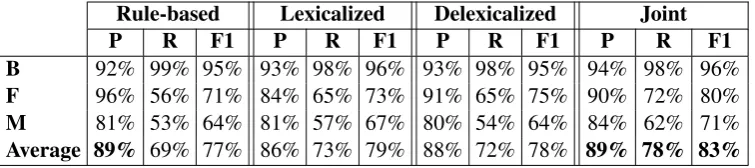
Table 4: First person singular gender identification results on TEST. P, R, and F1 refer to Precision, Recall and F1-score, respectively. Average is theMacro Averageof values in its column.
5.3 The Machine Learning Models
As part of the development of the machine-learning models, we experimented with a very large number of learning algorithms, vectorization features, and hyper parameters. This included the use of sentence2vec embeddings trained on large collections of text, and neural models, which were not competitive due to the limited training data size. We only report below on the settings and models that were determined to be optimal during development.
We trained three models, all using logistic re-gression with a liblinear solver, and using features derived from the input sentences or their morpho-logical features. For the input sentence, we nor-malized the Alif/Ya forms. We used character n-gram features from length 1 to length 7, word n-gram features (from length 1 to length 7), and morphological n-gram features (from length 1 to length 7). We imposed a limit of 20,000 features on each of the character, word, and morphological n-grams. All these models were implemented us-ing the scikit-learn toolkit (Pedregosa et al.,2011). The three machine learning models are as fol-lows. TheLexicalized Modelonly used the input sentence character and word n-gram features as presented above. TheDelexicalized Modelonly used the morphological n-gram features as pre-sented above. And theJoint Modelused both sets of features concatenated for each sentence.
5.4 Results and Discussion
Table4presents the results of the four models de-scribed above, on the blind TEST set. For each model, we report the precision (P), recall (R) and F1-score (F1) for the three labels (B, F, and M), and their macro averages. While F and M are bal-anced, B is about 84% of all cases.
With regards to the overall performance, the Joint model outperforms all models in terms of macro-average F1. Across all models, the
preci-sion, recall and F1 scores for B are the highest, which makes sense given the higher proportion of training data. We tried several techniques for bal-ancing the corpus, but none improved the over-all scores. Interestingly, the scores for F are al-ways higher than M. This may be attributed to the fact that feminine is themarkedfeature in Arabic, where specific endings are easy to detect, e.g., the feminine singular suffix is
è
+ +~.The Rule-based model is the least performing, although it is very competitive given that it was ‘human learned’ from 100 examples only (50 B, and 50 M/F). If we use a comparable training set (50 B with 50 M and F pairs), the Lexicalized, Delixicalized and Joint macro average F1 scores decrease to 56%,54%, and 60%, respectively, all below the Rule-based model. The Rule-based model also has very high precision, comparable to that of the Joint model; but it trades off with the lowest recall. This is expected and typical of rule-based models.
The Delexicalized and Lexicalized models have comparable scores and generally lower precision and higher recall than the Rule-based model. The Joint model seems to successfully increase both recall and precision (with a slight reduction of pre-cision for F in the Delexicalized model). This sug-gests that the Joint model brings together comple-mentary strengths from the Lexicalized and Delex-icalized models.
6 Automatic First Person Singular Gender Reinflection
6.1 Gender Reinflection as Character-based NMT
We recast the gender reinflection task as a MT task that maps the text from one source gender to a tar-get gender. We use character-based NMT, which views the input and output sentences as sequences of characters rather than words and learn to en-code and deen-code at the character-level. The main reason for this setup is that character-level repre-sentations are reported to be good in capturing and learning morphological aspects (Ling et al.,2015;
Kim et al., 2016), which is important for a mor-phologically rich language like Arabic. Further-more, character-level NMT modeling requires less vocabulary and helps reduce out-of-vocabulary by translating unseen words.
Our character-based NMT system is an encoder-decoder model that uses the general global attention architecture introduced byLuong and Manning (2015). All the NMT models we use have been trained with the OpenNMT toolkit (Klein et al., 2017) with no restriction on the input vocabulary size. Specifically, we use long short-term memory units (LSTM), with hidden units of size 500 and 2 layers in both the encoder and decoder. The model is trained for 13 epochs, using Adam with a learning rate of 0.002 and mini-batches of 40 with no pre-trained embeddings. Our char-level embeddings are learned within the training of the model.
Using different combinations of the data sets presented in Section4, we build four reinflection models.
• in-to-Mis a model trained to map from the Balanced Input corpus (and Synthetic F) to the TargetM corpus (and Synthetic M).
• in-to-F is a model trained to map from the Balanced Input corpus (and Synthetic M) to the TargetF corpus (and Synthetic F).
• M-to-F is a model trained to map from the TargetM corpus (and Synthetic M) to the TargetF corpus (and Synthetic F).
• F-to-M is a model trained to map from the TargetF corpus (and Synthetic F) to the TargetM corpus (and Synthetic M).
Single Direct Reinflection System The first two models (in-to-M and in-to-F) are used for the sgle system reinflection approach, where no in-put gender identification is needed. The in-to-M
model is used to generate the M target; and the in-to-F model is used to generate the F target.
Two-step Identify-then-Reinflect System The last two models (M-to-F and F-to-M) are used in the two-step reinflection approach. We use the output of the best sentence-level Arabic gen-der identification model (Joint model) described in Section5to identify the gender of the sentence. Then, we proceed as follows. For the M target, if the identified input sentence gender is B or M, we pass the input through as is; otherwise, we rein-flect the F sentence to M using the F-to-M model. And vice versa for the F target: if the identified input sentence gender is B or F, we pass the input through as is; otherwise, we reinflect the M sen-tence to F using the M-to-F model.
6.2 Experimental Results and Analysis
The character-based NMT reinflection models are trained using the 8,566 TRAINsentence pairs and the 226,175 synthetic corpus sentence pairs (as discussed above). The DEV and TEST sets com-prise 1,224 and 2,448 sentences, respectively. We compare two input settings: (a) the Balanced In-put DEVand TEST, and (b) the English-to-Arabic Google Translate output of the English sentences corresponding the Balanced Input DEVand TEST, DEVGT and TESTGT (Section 4). We evaluate sentence gender reinflection against the DEV and TEST portions of the TargetF and TargetM cor-pora as references (also, Section4). In addition to the single and two-step system, we include a “do-nothing” baseline that simply passes the input to the output as is.
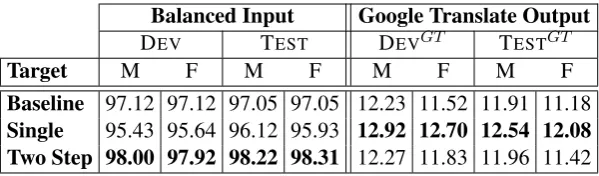
Reinflection Evaluation Reinflection results for each setup are reported in Table5in terms of the MT metric BLEU (Papineni et al.,2002). It is im-portant to note that all the reported scores are on AYT-normalized texts.6 This normalization helps reduce the number of cases in which Alif, Ya, and Ta Marbuta are inconsistently represented in the references. The table specifies columns for Target M, and Target F, which indicate which reference is used for evaluation.
For the Balanced Input, the best performance was achieved using the two-step system. The BLEU scores are very high because most of the
Balanced Input Google Translate Output
DEV TEST DEVGT TESTGT
Target M F M F M F M F
Baseline 97.12 97.12 97.05 97.05 12.23 11.52 11.91 11.18
[image:9.595.149.449.61.149.2]Single 95.43 95.64 96.12 95.93 12.92 12.70 12.54 12.08 Two Step 98.00 97.92 98.22 98.31 12.27 11.83 11.96 11.42
Table 5: BLEU results (all AYT normalized) for the Baseline, Single and Select systems on the DEVand TEST sets of the Balanced Corpus Input (Inputar) and English-Arabic Google Translate output (InputGT ) for both F and M targets.
words are not changed between input and refer-ence. The single system in fact introduced errors that made it worse than the do-nothing baseline. While in the baseline, 91.75% of DEV sentences are fully accurate; the two-step system sentence accuracy is 95.42% (M) and 94.68% (F), a∼40% error reduction on average.
For the Google Translate results, the single sys-tem outperforms the two-step syssys-tem and the base-line. On the TESTGT set, the single system has an 8% relative increase in BLEU score for Target F, and 5.3% relative increase for Target M. The BLEU scores are much lower than the Balanced Input case since the actual input to the Google MT was English and many gender and non-gender re-lated translation errors occur. Also, we only have a single MT reference to compare against. We sus-pect that the reason the two-step system did not do as well is that the gender identification component was not trained with the kind of input (and noise) generated by MT systems. One possible solution in the future is to train the gender identification component with MT/NLP output specifically.
Finally, an interesting side observation from this experiment is that automatic gender identification for the Google Translate Arabic output showed a 10-to-1 bias of M versus F, compared to the 50-50 distribution in the Balanced Corpus and the 2-to-1 bias in the Original Corpus. This further confirms the bias towards masculine forms in single-output MT systems.
Error Examples in MT output We conducted a limited analysis to understand the behavior of the NMT reinflection systems. While there were many cases that were handled properly, and cases of under-correction where the input is passed to the output as is; there were also cases of over-correction where words that should maintain their form are treated as gender-specific and modified.
One example is the input word
é
«Y
«YÊË
lldγdγh‘for tickling’, which is erroneously turned into the non-sense wordY
«YÊË
lldγd. There were also a few cases of very long repetitions in the output; as well as reduced output – simply leading to sen-tence length mismatch. All of these phenomena are unsurprising side effects of using character-based NMT models. In our experiments, they hap-pened infrequently, but we plan to address them in future work.7 Conclusions and Future Work
We presented an approach to gender identifica-tion and reinflecidentifica-tion that can be used together with any NLP application that generates text interfac-ing with users. We also presented the first paral-lel gender corpus for Arabic. We plan on making this data set publicly available for research pur-poses. We demonstrated the use of the corpus in benchmarking the quality of different systems for automatic gender identification and reinflection in the context of producing gender-specific machine translation. Our results are very promising, but there is still a lot to improve.
In the future, we plan to extend our work be-yond first-person sentences, annotate additional data sets, and explore other techniques for gen-der identification and reinflection. Among the techniques to plan to explore is word-level gen-der identification as a sequence labeling task. For gender reinflection, we plan to consider the ap-proaches introduced byCotterell et al.(2017) and
Acknowledgments
We thank the New York University Abu Dhabi stu-dents who helped with the annotation and trans-lation of the Arabic parallel gender corpus: Fa-tima Alaydaroos, Aya Bouhelal, Fatema AlNu-aimi, Muhannad AlRamlawi, and Ella Noll. We also thank Ryan Cotterell, for helpful discussions. Finally, we thank the reviewers for their extremely helpful remarks and feedback.
References
Sarah Alkuhlani and Nizar Habash. 2011. A corpus for modeling morpho-syntactic agreement in Ara-bic: Gender, number and rationality. InProceedings of the 49th Annual Meeting of the Association for Computational Linguistics (ACL’11), Portland, Ore-gon, USA.
Christine Basta, Marta Ruiz Costa-jussà, and Noe Casas. 2019. Evaluating the underlying gender bias in contextualized word embeddings. CoRR, abs/1904.08783.
Tolga Bolukbasi, Kai-Wei Chang, James Y Zou, Venkatesh Saligrama, and Adam T Kalai. 2016. Man is to computer programmer as woman is to homemaker? debiasing word embeddings. In Ad-vances in Neural Information Processing Systems, pages 4349–4357.
Aylin Caliskan, Joanna J. Bryson, and Arvind Narayanan. 2017. Semantics derived automatically from language corpora contain human-like biases.
Science, 356.6334.
Ryan Cotterell, Christo Kirov, John Sylak-Glassman, Géraldine Walther, Ekaterina Vylomova, Patrick Xia, Manaal Faruqui, Sandra Kübler, David Yarowsky, Jason Eisner, and Mans Hulden. 2017. CoNLL-SIGMORPHON 2017 shared task: Uni-versal morphological reinflection in 52 languages.
CoRR, abs/1706.09031.
Ahmed El Kholy and Nizar Habash. 2010. Ortho-graphic and morphological processing for English-Arabic statistical machine translation. In Pro-ceedings of Traitement Automatique des Langues Naturelles (TALN), Montréal, Canada. Montréal, Canada.
Mostafa Elaraby, Ahmed Y Tawfik, Mahmoud Khaled, Hany Hassan, and Aly Osama. 2018. Gender aware spoken language translation applied to English-Arabic. In Natural Language and Speech Process-ing (ICNLSP), 2018 2nd International Conference on, pages 1–6. IEEE.
Joel Escudé Font and Marta R Costa-jussà. 2019. Equalizing gender biases in neural machine trans-lation with word embeddings techniques. arXiv preprint arXiv:1901.03116.
Nikhil Garg, Londa Schiebinger, Dan Jurafsky, and James Zou. 2018. Word embeddings quantify
100 years of gender and ethnic stereotypes. Pro-ceedings of the National Academy of Sciences, 115(16):E3635–E3644.
Annette Rios Gonzales and Don Tuggener. 2017. Co-reference resolution of elided subjects and posses-sive pronouns in Spanish-English statistical machine translation. InProceedings of the 15th Conference of the European Chapter of the Association for Com-putational Linguistics: Volume 2, Short Papers, vol-ume 2, pages 657–662.
David Graff, Mohamed Maamouri, Basma Bouziri, Sondos Krouna, Seth Kulick, and Tim Buckwal-ter. 2009. Standard Arabic Morphological Analyzer (SAMA) Version 3.1. Linguistic Data Consortium LDC2009E73.
Nizar Habash, Abdelhadi Soudi, and Tim Buckwalter. 2007. On Arabic Transliteration. In A. van den Bosch and A. Soudi, editors, Arabic Computa-tional Morphology: Knowledge-based and Empiri-cal Methods, pages 15–22. Springer, Netherlands. Nizar Y Habash. 2010. Introduction to Arabic natural
language processing, volume 3. Morgan & Clay-pool Publishers.
Nawar Halabi. 2016. Modern standard Arabic phonet-ics for speech synthesis. Ph.D. thesis, University of Southampton.
Google Translate Help. 2019. Get gender specific translations. https://support.google.
com/translate/answer/9179237.
Yoon Kim, Yacine Jernite, David Sontag, and Alexan-der M Rush. 2016. Character-aware neural language models. InThirtieth AAAI Conference on Artificial Intelligence.
Guillaume Klein, Yoon Kim, Yuntian Deng, Jean Senellart, and Alexander M Rush. 2017. Opennmt: Open-source toolkit for neural machine translation.
arXiv preprint arXiv:1701.02810.
P. Koehn. 2005. Europarl: A parallel corpus for statis-tical machine translation. InMT summit, volume 5. Citeseer.
Wang Ling, Isabel Trancoso, Chris Dyer, and Alan W. Black. 2015. Character-based neural machine trans-lation.CoRR, abs/1511.04586.
Pierre Lison and Jörg Tiedemann. 2016. OpenSubti-tles2016: Extracting Large Parallel Corpora from Movie and TV Subtitles. In Proceedings of the Language Resources and Evaluation Conference (LREC), Portorož, Slovenia.
Kaiji Lu, Piotr Mardziel, Fangjing Wu, Preetam Aman-charla, and Anupam Datta. 2018. Gender bias in neural natural language processing. CoRR, abs/1807.11714.
Ngoc Quang Luong and Andrei Popescu-Belis. 2016. Improving pronoun translation by modeling corefer-ence uncertainty. InProceedings of the First Confer-ence on Machine Translation: Volume 1, Research Papers, volume 1, pages 12–20.
Kishore Papineni, Salim Roukos, Todd Ward, and Wei-Jing Zhu. 2002. Bleu: a method for automatic eval-uation of machine translation. In Proceedings of ACL, Philadelphia, USA.
Arfath Pasha, Mohamed Al-Badrashiny, Mona Diab, Ahmed El Kholy, Ramy Eskander, Nizar Habash, Manoj Pooleery, Owen Rambow, and Ryan Roth. 2014. Madamira: A fast, comprehensive tool for morphological analysis and disambiguation of Ara-bic. InProceedings of the Language Resources and Evaluation Conference (LREC), pages 1094–1101, Reykjavik, Iceland.
F. Pedregosa, G. Varoquaux, A. Gramfort, V. Michel, B. Thirion, O. Grisel, M. Blondel, P. Pretten-hofer, R. Weiss, V. Dubourg, J. Vanderplas, A. Pas-sos, D. Cournapeau, M. Brucher, M. Perrot, and E. Duchesnay. 2011. Scikit-learn: Machine Learn-ing in Python . Journal of Machine Learning Re-search, 12:2825–2830.
Marcelo O. R. Prates, Pedro H. C. Avelar, and Luís C. Lamb. 2018. Assessing gender bias in machine translation - A case study with google translate.
CoRR, abs/1809.02208.
Ella Rabinovich, Shachar Mirkin, Raj Nath Patel, Lu-cia SpeLu-cia, and Shuly Wintner. 2016. Personal-ized machine translation: Preserving original author traits.arXiv preprint arXiv:1610.05461.
Adam Sutton, Thomas Lansdall-Welfare, and Nello Cristianini. 2018. Biased embeddings from wild data: Measuring, understanding and removing.
CoRR, abs/1806.06301.
Dima Taji, Jamila El Gizuli, and Nizar Habash. 2018. An Arabic dependency treebank in the travel do-main. In Proceedings of the Workshop on Open-Source Arabic Corpora and Processing Tools (OS-ACT), Miyazaki, Japan.
Eva Vanmassenhove, Christian Hardmeier, and Andy Way. 2018. Getting gender right in neural machine translation. InProceedings of the 2018 Conference on Empirical Methods in Natural Language Pro-cessing, pages 3003–3008. Association for Compu-tational Linguistics.
William Wright. 1955. A grammar of the Arabic lan-guage, volume I. Cambridge University Press. Wajdi Zaghouani, Behrang Mohit, Nizar Habash,
Ossama Obeid, Nadi Tomeh, Alla Rozovskaya, Noura Farra, Sarah Alkuhlani, and Kemal Oflazer. 2014. Large Scale Arabic Error Annotation: Guide-lines and Framework. In Proceedings of the Language Resources and Evaluation Conference (LREC), Reykjavik, Iceland.
Jieyu Zhao, Tianlu Wang, Mark Yatskar, Ryan Cot-terell, Vicente Ordonez, and Kai-Wei Chang. 2019. Gender bias in contextualized word embeddings.
CoRR, abs/1904.03310.
Jieyu Zhao, Yichao Zhou, Zeyu Li, Wei Wang, and Kai-Wei Chang. 2018. Learning gender-neutral word embeddings. arXiv preprint arXiv:1809.01496. Ran Zmigrod, Sebastian J. Mielke, Hanna Wallach, and