Proceedings of the 55th Annual Meeting of the Association for Computational Linguistics, pages 873–883 Vancouver, Canada, July 30 - August 4, 2017. c2017 Association for Computational Linguistics Proceedings of the 55th Annual Meeting of the Association for Computational Linguistics, pages 873–883
Vancouver, Canada, July 30 - August 4, 2017. c2017 Association for Computational Linguistics
Context-Dependent Sentiment Analysis in User-Generated Videos
Soujanya Poria Temasek Laboratories
NTU, Singapore
Erik Cambria
School of Computer Science and Engineering, NTU, Singapore
Devamanyu Hazarika Computer Science and Engineering, NITW, India
Navonil Mazumder Centro de Investigacin en Computacin, IPN, Mexico
Amir Zadeh Language Technologies
Institute, CMU, USA
Louis-Philippe Morency Language Technologies
Institute, CMU, USA
Abstract
Multimodal sentiment analysis is a de-veloping area of research, which involves the identification of sentiments in videos. Current research considers utterances as independent entities, i.e., ignores the inter-dependencies and relations among the ut-terances of a video. In this paper, we pro-pose a LSTM-based model that enables utterances to capture contextual informa-tion from their surroundings in the same video, thus aiding the classification pro-cess. Our method shows 5-10% perfor-mance improvement over the state of the art and high robustness to generalizability.
1 Introduction
Sentiment analysis is a ‘suitcase’ research prob-lem that requires tackling many NLP sub-tasks, e.g., aspect extraction (Poria et al.,2016a), named entity recognition (Ma et al., 2016), concept ex-traction (Rajagopal et al., 2013), sarcasm detec-tion (Poria et al., 2016b), personality recognition (Majumder et al.,2017), and more.
Sentiment analysis can be performed at differ-ent granularity levels, e.g., subjectivity detection simply classifies data as either subjective (opin-ionated) or objective (neutral), while polarity de-tection focuses on determining whether subjec-tive data indicate posisubjec-tive or negasubjec-tive sentiment. Emotion recognition further breaks down the in-ferred polarity into a set of emotions conveyed by the subjective data, e.g., positive sentiment can be caused by joy or anticipation, while negative sen-timent can be caused by fear or disgust.
Even though the primary focus of this paper is to classify sentiment in videos, we also show the performance of the proposed method for the finer-grained task of emotion recognition.
Emotion recognition and sentiment analysis have become a new trend in social media, help-ing users and companies to automatically extract the opinions expressed in user-generated content, especially videos. Thanks to the high availability of computers and smartphones, and the rapid rise of social media, consumers tend to record their re-views and opinions about products or films and upload them on social media platforms, such as YouTube and Facebook. Such videos often con-tain comparisons, which can aid prospective buy-ers make an informed decision.
The primary advantage of analyzing videos over text is the surplus of behavioral cues present in vo-cal and visual modalities. The vovo-cal modulations and facial expressions in the visual data, along with textual data, provide important cues to bet-ter identify affective states of the opinion holder. Thus, a combination of text and video data helps to create a more robust emotion and sentiment anal-ysis model (Poria et al.,2017a).
An utterance (Olson, 1977) is a unit of speech bound by breathes or pauses. Utterance-level sen-timent analysis focuses on tagging every utterance of a video with a sentiment label (instead of as-signing a unique label to the whole video). In par-ticular, utterance-level sentiment analysis is use-ful to understand the sentiment dynamics of dif-ferent aspects of the topics covered by the speaker throughout his/her speech.
Recently, a number of approaches to multi-modal sentiment analysis, producing interesting results, have been proposed (P´erez-Rosas et al.,
2013; Wollmer et al., 2013; Poria et al., 2015). However, there are major issues that remain un-addressed. Not considering the relation and de-pendencies among the utterances is one of such is-sues. State-of-the-art approaches in this area treat utterances independently and ignore the order of utterances in a video (Cambria et al.,2017b).
Every utterance in a video is spoken at a distinct time and in a particular order. Thus, a video can be treated as a sequence of utterances. Like any other sequence classification problem (Collobert et al.,2011), sequential utterances of a video may largely be contextually correlated and, hence, in-fluence each other’s sentiment distribution. In our paper, we give importance to the order in which utterances appear in a video.
We treat surrounding utterances as the con-text of the utterance that is aimed to be classi-fied. For example, the MOSI dataset (Zadeh et al.,
2016) contains a video, in which a girl reviews the movie ‘Green Hornet’. At one point, she says “The Green Hornet did something similar”. Nor-mally, doing something similar, i.e., monotonous or repetitive might be perceived as negative. How-ever, the nearby utterances “It engages the audi-ence more”, “they took a new spin on it”, “and I just loved it” indicate a positive context.
The hypothesis of the independence of tokens is quite popular in information retrieval and data mining, e.g., bag-of-words model, but it has a lot limitations (Cambria and White,2014). In this pa-per, we discard such an oversimplifying hypothe-sis and develop a framework based on long short-term memory (LSTM) that takes a sequence of ut-terances as input and extracts contextual utterance-level features.
The other uncovered major issues in the lit-erature are the role of speaker-dependent versus speaker-independent models, the impact of each modality across the dataset, and generalization ability of a multimodal sentiment classifier. Leav-ing these issues unaddressed has presented diffi-culties in effective comparison of different multi-modal sentiment analysis methods. In this work, we address all of these issues.
Our model preserves the sequential order of utterances and enables consecutive utterances to share information, thus providing contextual infor-mation to the utterance-level sentiment classifica-tion process. Experimental results show that the proposed framework has outperformed the state of the art on three benchmark datasets by 5-10%.
The paper is organized as follows: Section 2
provides a brief literature review on multimodal sentiment analysis; Section 3 describes the pro-posed method in detail; experimental results and discussion are shown in Section 4; finally, Sec-tion5concludes the paper.
2 Related Work
The opportunity to capture people’s opinions has raised growing interest both within the scientific community, for the new research challenges, and in the business world, due to the remarkable bene-fits to be had from financial market prediction.
Text-based sentiment analysis systems can be broadly categorized into knowledge-based and statistics-based approaches (Cambria et al.,
2017a). While the use of knowledge bases was initially more popular for the identification of polarity in text (Cambria et al., 2016; Poria et al.,2016c), sentiment analysis researchers have recently been using statistics-based approaches, with a special focus on supervised statistical meth-ods (Socher et al.,2013;Oneto et al.,2016).
In 1974, Ekman (Ekman, 1974) carried out extensive studies on facial expressions which showed that universal facial expressions are able to provide sufficient clues to detect emotions. Re-cent studies on speech-based emotion analysis (Datcu and Rothkrantz, 2008) have focused on identifying relevant acoustic features, such as fun-damental frequency (pitch), intensity of utterance, bandwidth, and duration.
As for fusing audio and visual modalities for emotion recognition, two of the early works were (De Silva et al., 1997) and (Chen et al.,
1998). Both works showed that a bimodal system yielded a higher accuracy than any unimodal sys-tem. More recent research on audio-visual fusion for emotion recognition has been conducted at ei-ther feature level (Kessous et al.,2010) or decision level (Schuller,2011). While there are many re-search papers on audio-visual fusion for emotion recognition, only a few have been devoted to mul-timodal emotion or sentiment analysis using tex-tual clues along with visual and audio modalities. (Wollmer et al., 2013) and (Rozgic et al., 2012) fused information from audio, visual, and textual modalities to extract emotion and sentiment.
3 Method
In this work, we propose a LSTM network that takes as input the sequence of utterances in a video and extracts contextual unimodal and multimodal features by modeling the dependencies among the input utterances.Mnumber of videos, comprising of its constituent utterances, serve as the input. We represent the dataset asU =u1, u2, u3..., uM and
eachui=ui,1, ui,2, ..., ui, LiwhereLiis the
num-ber of utterances in videoui. Below, we present
an overview of the proposed method in two major steps.
A. Context-Independent Unimodal Utterance-Level Feature Extraction
Firstly, the unimodal features are extracted without considering the contextual informa-tion of the utterances (Secinforma-tion3.1).
B. Contextual Unimodal and Multimodal Classification
Secondly, the context-independent unimodal features (from Step A) are fed into a LSTM network (termed contextual LSTM) that al-lows consecutive utterances in a video to share information in the feature extraction process (Section3.2).
We experimentally show that this pro-posed framework improves the performance of utterance-level sentiment classification over traditional frameworks.
3.1 Extracting Context-Independent Unimodal Features
Initially, the unimodal features are extracted from each utterance separately, i.e., we do not consider the contextual relation and dependency among the utterances. Below, we explain the textual, audio, and visual feature extraction methods.
3.1.1 text-CNN: Textual Features Extraction The source of textual modality is the transcrip-tion of the spoken words. For extracting features from the textual modality, we use a CNN ( Karpa-thy et al., 2014). In particular, we first repre-sent each utterance as the concatenation of vec-tors of the constituent words. These vecvec-tors are the publicly available300-dimensional word2vec vectors trained on 100 billion words from Google News (Mikolov et al.,2013).
The convolution kernels are thus applied to these concatenated word vectors instead of indi-vidual words. Each utterance is wrapped to a win-dow of 50 words which serves as the input to the CNN. The CNN has two convolutional layers; the first layer has two kernels of size3and4, with50 feature maps each and the second layer has a ker-nel of size2with100feature maps.
The convolution layers are interleaved with max-pooling layers of window 2 ×2. This is followed by a fully connected layer of size 500 and softmax output. We use a rectified linear unit (ReLU) (Teh and Hinton, 2001) as the acti-vation function. The actiacti-vation values of the fully-connected layer are taken as the features of utter-ances for text modality. The convolution of the CNN over the utterance learns abstract representa-tions of the phrases equipped with implicit seman-tic information, which with each successive layer spans over increasing number of words and ulti-mately the entire utterance.
3.1.2 openSMILE: Audio Feature Extraction Audio features are extracted at 30 Hz frame-rate and a sliding window of 100 ms. To compute the features, we use openSMILE (Eyben et al.,
2010b), an open-source software that automati-cally extracts audio features such as pitch and voice intensity. Voice normalization is performed and voice intensity is thresholded to identify sam-ples with and without voice. Z-standardization is used to perform voice normalization.
The features extracted by openSMILE con-sist of several low-level descriptors (LLD), e.g., MFCC, voice intensity, pitch, and their statistics, e.g., mean, root quadratic mean, etc. Specifically, we use IS13-ComParE configuration file in openS-MILE. Taking into account all functionals of each LLD, we obtained 6373 features.
3.1.3 3D-CNN: Visual Feature Extraction We use 3D-CNN (Ji et al., 2013) to obtain vi-sual features from the video. We hypothesize that 3D-CNN will not only be able to learn rele-vant features from each frame, but will also learn the changes among given number of consecutive frames.
Letvid∈Rc×f×h×wbe a video, wherec= num-ber of channels in an image (in our case c = 3,
since we consider only RGB images), f =
num-ber of frames, h = height of the frames, andw= width of the frames. Again, we consider the 3D convolutional filterf ilt∈Rfm×c×fd×fh×fw, where fm= number of feature maps,c= number of
chan-nels,fd= number of frames (in other words depth
of the filter), fh = height of the filter, and fw =
width of the filter. Similar to 2D-CNN,f iltslides
across video vidand generates outputconvout∈ Rfm×c×(f−fd+1)×(h−fh+1)×(w−fw+1). Next, we
ap-ply max pooling toconvoutto select only relevant
features. The pooling will be applied only to the last three dimensions of the arrayconvout.
In our experiments, we obtained best results with 32 feature maps (fm) with the filter-size of
5×5×5 (or fd×fh×fw). In other words, the
dimension of the filter is 32×3×5×5×5 (or
fm×c×fd×fh ×fw). Subsequently, we apply
max pooling on the output of convolution opera-tion, with window-size being 3×3×3. This is followed by a dense layer of size300and softmax. The activation values of this dense layer are finally used as the video features for each utterance.
3.2 Context-Dependent Feature Extraction In sequence classification, the classification of each member is dependent on the other members. Utterances in a video maintain a sequence. We hy-pothesize that, within a video, there is a high prob-ability of inter-utterance dependency with respect to their sentimental clues.
In particular, we claim that, when classifying one utterance, other utterances can provide impor-tant contextual information. This calls for a model which takes into account such inter-dependencies and the effect these might have on the target ut-terance. To capture this flow of informational triggers across utterances, we use a LSTM-based recurrent neural network (RNN) scheme (Gers,
2001).
3.2.1 Long Short-Term Memory
LSTM (Hochreiter and Schmidhuber, 1997) is a kind of RNN, an extension of conventional feed-forward neural network. Specifically, LSTM cells are capable of modeling long-range dependencies, which other traditional RNNs fail to do given the vanishing gradient issue. Each LSTM cell consists of an input gatei, an output gateo, and a forget
gatef, to control the flow of information.
Current research (Zhou et al., 2016) indicates the benefit of using such networks to incorporate contextual information in the classification pro-cess. In our case, the LSTM network serves the purpose of context-dependent feature extraction by modeling relations among utterances. We term our architecture ‘contextual LSTM’. We propose several architectural variants of it later in the pa-per.
3.2.2 Contextual LSTM Architecture
Let unimodal features have dimension k, each
utterance is thus represented by a feature vec-tor xi,t ∈ Rk, where t represents the tth
utter-ance of the video i. For a video, we collect the
vectors for all the utterances in it, to get Xi =
[xi,1,xi,2, ...,xi,Li] ∈R
Li×k, whereL
irepresents
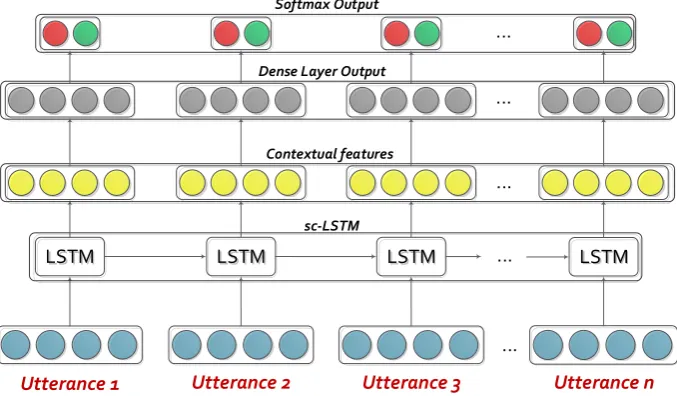
the number of utterances in the video. This ma-trixXi serves as the input to the LSTM. Figure1
demonstrates the functioning of this LSTM mod-ule.
In the procedure, getLstmFeatures(Xi) of
Al-gorithm 1, each of these utterance xi,t is passed
through a LSTM cell using the equations men-tioned in line32to37. The output of the LSTM cellhi,t is then fed into a dense layer and finally
into a softmax layer (line38 to 39). The activa-tions of the dense layerzi,tare used as the
context-dependent features of contextual LSTM. 3.2.3 Training
The training of the LSTM network is performed using categorical cross-entropy on each utter-ance’s softmax output per video, i.e.,
loss= − 1
(∑M
i=1Li)
M
∑
i=1
Li
∑
j=1 C
∑
c=1
yi,cj log2(yˆi,cj ),
whereM =total number of videos,Li =number
of utterances for ith video, yi,cj =original output
of classc, andyˆji,c=predicted output forjth
utter-ance ofithvideo.
Softmax Output
Dense Layer Output
Contextual features
sc-LSTM
Utterance 1 Utterance 2 Utterance n
LSTM
LSTM LSTM
Utterance 3
LSTM
...
...
...
...
[image:5.595.129.468.64.262.2]...
Figure 1: Contextual LSTM network: input features are passed through an unidirectional LSTM layer, followed by a dense and then a softmax layer. The dense layer activations serve as the output features.
RMSprop has been used as the optimizer which is known to resolve Adagrad’s radically dimin-ishing learning rates (Duchi et al., 2011). After feeding the training set to the network, the test set is passed through it to generate their context-dependent features. These features are finally passed through an SVM for the final classification. Different Network Architectures We consider the following variants of the contextual LSTM ar-chitecture in our experiments.
sc-LSTM This variant of the contextual LSTM architecture consists of unidirectional LSTM cells. As this is the simple variant of the contextual LSTM, we termed it as simple contex-tual LSTM (sc-LSTM1).
h-LSTM We also investigate an architecture where the dense layer after the LSTM cell is omit-ted. Thus, the output of the LSTM cell hi,t
pro-vides our context-dependent features and the soft-max layer provides the classification. We call this architecture hidden-LSTM (h-LSTM).
bc-LSTM Bi-directional LSTMs are two uni-directional LSTMs stacked together having oppo-site directions. Thus, an utterance can get infor-mation from utterances occurring before and after itself in the video. We replaced the regular LSTM with a bi-directional LSTM and named the result-ing architecture as bi-directional contextual LSTM (bc-LSTM). The training process of this architec-ture is similar to sc-LSTM.
1http://github.com/senticnet/sc-lstm
uni-SVM In this setting, we first obtain the unimodal features as explained in Section 3.1, concatenate them and then send to an SVM for the final classification. It should be noted that using a gated recurrent unit (GRU) instead of LSTM did not improve the performance.
3.3 Fusion of Modalities
We accomplish multimodal fusion through two different frameworks, described below.
3.3.1 Non-hierarchical Framework
In this framework, we concatenate context-independent unimodal features (from Section3.1) and feed that into the contextual LSTM networks, i.e., sc-LSTM, bc-LSTM, and h-LSTM.
3.3.2 Hierarchical Framework
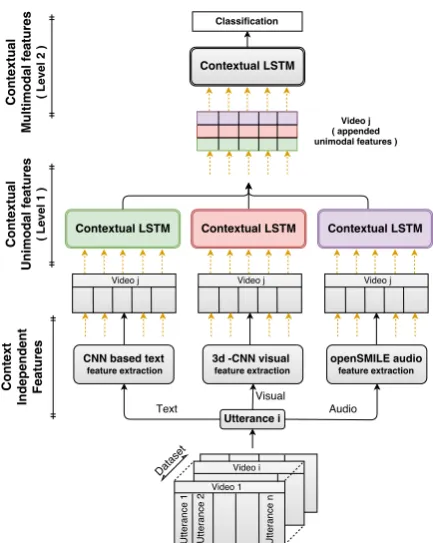
Contextual unimodal features can further improve performance of the multimodal fusion framework explained in Section3.3.1. To accomplish this, we propose a hierarchical deep network which con-sists of two levels.
Level-1 Context-independent unimodal fea-tures (from Section 3.1) are fed to the proposed LSTM network to getcontext-sensitiveunimodal feature representations for each utterance. Individ-ual LSTM networks are used for each modality.
Figure 2: Hierarchical architecture for extracting context-dependent multimodal utterance features (see Figure1for the LSTM module).
The performance of the second level banks on the quality of the features from the previous level, with better features aiding the fusion process. Al-gorithm1describes the overall computation for ut-terance classification. For the hierarchical frame-work, we train Level-1 and Level-2 successively but separately, i.e., the training is not performed “end-to-end”.
Weight Bias
Wi, Wf, Wc, Wo ∈Rd×k bi, bf, bc, bo ∈Rd
Pi, Pf, Pc, PoVo ∈Rd×d bz ∈Rm
Wz ∈Rm×d bsf t ∈Rc
[image:6.595.304.525.66.564.2]Wsf t ∈Rc×m
Table 1: Summary of notations used in Algorithm1. Leg-enda:d= dimension of hidden unit;k= dimension of input vectors to LSTM layer;c= number of classes.
4 Experiments 4.1 Dataset details
Most of the research in multimodal sentiment analysis is performed on datasets with speaker overlap in train and test splits. Because each in-dividual has a unique way of expressing emotions and sentiments, however, finding generic, person-independent features for sentiment analysis is very important.
Algorithm 1Proposed Architecture
1: procedureTRAINARCHITECTURE( U, V)
2: Train context-independent models withU
3: fori:[1,M]do ▷extract baseline features 4: forj:[1,Li]do
5: xi,j←T extF eatures(ui,j) 6: x′i,j←V ideoF eatures(ui,j) 7: x”i,j←AudioF eatures(ui,j)
8: Unimodal:
9: Train LSTM at Level-1withX, X′andX”.
10: fori:[1,M]do ▷unimodal features 11: Zi←getLST M F eatures(Xi)
12: Zi′←getLST M F eatures(X ′ i)
13: Z”
i ←getLST M F eatures(Xi”)
14: Multimodal:
15: fori:[1,M]do
16: forj:[1,Li]do
17: ifNon-hierarchical fusionthen
18: x∗i,j← (xi,j∣∣x ′
i,j∣∣x”i,j) ▷ concatenation
19: else
20: ifHierarchical fusionthen
21: x∗i,j← (zi,j∣∣z ′
i,j∣∣zi,j” ) ▷ concatenation
22: Train LSTM at Level-2withX∗.
23: fori:[1,M]do ▷multimodal features 24: Zi∗←getLST M F eatures(Xi∗)
25: testArchitecture( V)
26: returnZ∗
27: procedureTESTARCHITECTURE( V)
28: Similar to training phase. V is passed through the learnt models to get the features and classification out-puts. Table1shows the trainable parameters.
29: procedureGETLSTMFEATURES(Xi) ▷forithvideo
30: Zi←φ
31: fort:[1,Li]do ▷Table1provides notation 32: it←σ(Wixi,t+Pi.ht−1+bi)
33: ̃Ct←tanh(Wcxi,t+Pcht−1+bc) 34: ft←σ(Wfxt+Pfht−1+bf) 35: Ct←it∗ ̃Ct+ft∗Ct−1
36: ot←σ(Woxt+Poht−1+VoCt+bo)
37: ht←ot∗tanh(Ct) ▷output of lstm cell 38: zt←ReLU(Wzht+bz) ▷dense layer 39: prediction←sof tmax(Wsf tzt+bsf t) 40: Zi←Zi∪zt
41: returnZi
In real-world applications, the model should be robust to person idiosyncrasy but it is very diffi-cult to come up with a generalized model from the behavior of a limited number of individuals. To this end, we perform person-independent experi-ments to study generalization of our model, i.e., our train/test splits of the datasets are completely disjoint with respect to speakers.
are segmented with each segments sentiment label scored between +3 (strong positive) to -3 (strong negative) by 5 annotators. We took the average of these five annotations as the sentiment polarity and, hence, considered only two classes (positive and negative). The train/validation set consists of the first 62 individuals in the dataset. The test set contains opinionated videos by rest 31 speakers. In particular, 1447 and 752 utterances are used in training and test, respectively.
MOUD This dataset (P´erez-Rosas et al.,
2013) contains product review videos provided by 55 persons. The reviews are in Spanish (we used Google Translate API2 to get the English tran-scripts). The utterances are labeled to be either
positive, negative or neutral. However, we drop theneutrallabel to maintain consistency with pre-vious work. Out of 79 videos in the dataset, 59 videos are considered in the train/val set.
Multimodal Emotion Recognition Datasets
IEMOCAP The IEMOCAP (Busso et al.,
2008) contains the acts of 10 speakers in a two-way conversation segmented into utterances. The medium of the conversations in all the videos is English. The database contains the following cat-egorical labels: anger, happiness, sadness, neutral, excitement, frustration, fear, surprise, and other, but we take only the first four so as to compare with the state of the art (Rozgic et al., 2012). Videos by the first 8 speakers are considered in the training set. The train/test split details are pro-vided in Table2, which provides information re-garding train/test split of all the datasets. Table2
also provides cross-dataset split details where the datasets MOSI and MOUD are used for training and testing, respectively. The proposed model be-ing used on reviews from different languages al-lows us to analyze its robustness and generalizabil-ity.
4.1.1 Characteristic of the Datasets
In order to evaluate the robustness of our proposed method, we employ it on multiple datasets of different kinds. Both MOSI and MOUD are used for the sentiment classification task but they consist of review videos spoken in different languages, i.e., English and Spanish, respectively.
2http://translate.google.com
IEMOCAP dataset is different from MOSI and MOUD since it is annotated with emotion la-bels. Apart from this, IEMOCAP dataset was created using a different method than MOSI and MOUD. These two datasets were developed by crawling consumers’ spontaneous online product review videos from popular social websites and later labeled with sentiment labels. To curate the IEMOCAP dataset, instead, subjects were pro-vided affect-related scripts and asked to act.
As pointed out by Poria et al. (Poria et al.,
2017a), acted dataset like IEMOCAP can suffer from biased labeling and incorrect acting which can further cause the poor generalizability of the models trained on the acted datasets.
Dataset uttrnceTrainvideo uttrnceTestvideo
IEMOCAP 4290 120 1208 31
MOSI 1447 62 752 31
MOUD 322 59 115 20
MOSI→MOUD 2199 93 437 79
Table 2: uttrnce: Utterance; Person-Independent Train/Test split details of each dataset (≈70/30 % split). Legenda: X→Y represents train: X and test: Y; Validation sets are extracted from the shuffled training sets using 80/20 % train/val ratio.
It should be noted that the datasets’ individ-ual configuration and splits are same throughout all the experiments (i.e., context-independent uni-modal feature extraction, LSTM-based context-dependent unimodal and multimodal feature ex-traction and classification).
4.2 Performance of Different Models
In this section, we present unimodal and multi-modal sentiment analysis performance of differ-ent LSTM network variants as explained in Sec-tion3.2.3and comparison with the state of the art.
Hierarchical vs Non-hierarchical Fusion Framework As expected, trained contextual unimodal features help the hierarchical fusion framework to outperform the non-hierarchical framework. Table 3 demonstrates this by com-paring the hierarchical and the non-hierarchical frameworks using the bc-LSTM network.
Comparison of Different Network Variants It is to be noted that both sc-LSTM and bc-LSTM perform quite well on the multimodal emotion recognition and sentiment analysis datasets. Since bc-LSTM has access to both the preceding and following information of the utterance sequence, it performs consistently better on all the datasets over sc-LSTM. The usefulness of the dense layer in increasing the performance is evident from the experimental results shown in Table 3. The per-formance improvement is in the range of 0.3% to 1.5% on MOSI and MOUD datasets. On the IEMOCAP dataset, the performance improvement of bc-LSTM and sc-LSTM over h-LSTM is in the range of 1% to 5%.
Comparison with the Baselines Every LSTM network variant has outperformed the baseline uni-SVM on all the datasets by the margin of 2% to 5% (see Table 3). These results prove our initial hypothesis that modeling the contex-tual dependencies among utterances (which uni-SVM cannot do) improves the classification. The higher performance improvement on the IEMO-CAP dataset indicates the necessity of modeling long-range dependencies among the utterances as continuous emotion recognition is a multiclass se-quential problem where a person does not fre-quently change emotions (W¨ollmer et al., 2008). We have implemented and compared with the cur-rent state-of-the-art approach proposed by ( Po-ria et al., 2015). In their method, they extracted features from each modality and fed these to a MKL classifier. However, they did not conduct the experiment in a speaker-independent manner and also did not consider the contextual relation among the utterances. In Table 3, the results in bold are statistically significant (p<0.05) in
com-pare to uni-SVM. Experimental results in Table4
show that the proposed method outperformes ( Po-ria et al., 2015) by a significant margin. For the emotion recognition task, we have compared our method with the current state of the art (Rozgic et al., 2012), who extracted features in a similar fashion to (Poria et al.,2015) (although they used SVM trees (Yuan et al.,2006) for the fusion).
4.3 Importance of the Modalities
As expected, in all kinds of experiments, bimodal and trimodal models have outperformed unimodal models. Overall, audio modality has performed better than visual on all the datasets.
On MOSI and IEMOCAP datasets, the tex-tual classifier achieves the best performance over other unimodal classifiers. On IEMOCAP dataset, the unimodal and multimodal classifiers obtained poor performance to classify neutral utterances. The textual modality, combined with non-textual modes, boosts the performance in IEMOCAP by a large margin. However, the margin is less in the other datasets.
On the MOUD dataset, the textual modality per-forms worse than audio modality due to the noise introduced in translating Spanish utterances to En-glish. Using Spanish word vectors3 in text-CNN results in an improvement of10%. Nonetheless, we report results using these translated utterances as opposed to utterances trained on Spanish word vectors, in order to make fair comparison with (Poria et al.,2015).
4.4 Generalization of the Models
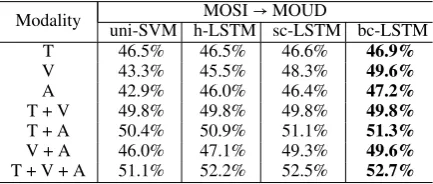
To test the generalizability of the models, we have trained our framework on complete MOSI dataset and tested on MOUD dataset (Table5). The per-formance was poor for audio and textual modal-ity as the MOUD dataset is in Spanish while the model is trained on MOSI dataset, which is in English language. However, notably the vi-sual modality performs better than the other two modalities in this experiment, which means that in cross-lingual scenarios facial expressions carry more generalized, robust information than audio and textual modalities. We could not carry out a similar experiment for emotion recognition as no other utterance-level dataset apart from the IEMO-CAP was available at the time of our experiments.
4.5 Qualitative Analysis
The need for considering context dependency (see Section 1) is of prime importance for utterance-level sentiment classification. For example, in the utterance “What would have been a better name for the movie”, the speaker is attempting to com-ment the quality of the movie by giving an appro-priate name. However, the sentiment is expressed implicitly and requires the contextual knowledge about the mood of the speaker and his/her general opinion about the film. The baseline unimodal-SVM and state of the art fail to classify this utter-ance correctly4.
3http://crscardellino.me/SBWCE
Modality hierarchical (%)MOSI MOUD IEMOCAP
non-hier
(%) hierarchical (%)
non-hier
(%) hierarchical (%)
non-hier
(%)
[image:9.595.76.524.61.221.2]uni-SVM h-LSTM sc-LSTM bc-LSTM uni-SVM h-LSTM sc-LSTM bc-LSTM uni-SVM h-LSTM sc-LSTM bc-LSTM T 75.5 77.4 77.6 78.1 49.5 50.1 51.3 52.1 65.5 68.9 71.4 73.6 V 53.1 55.2 55.6 55.8 46.3 48.0 48.2 48.5 47.0 52.0 52.6 53.2 A 58.5 59.6 59.9 60.3 51.5 56.3 57.5 59.9 52.9 54.4 55.2 57.1 T + V 76.7 78.9 79.9 80.2 78.5 50.2 50.6 51.3 52.2 50.9 68.5 70.3 72.3 75.4 73.2 T + A 75.8 78.3 78.8 79.3 78.2 53.1 56.9 57.4 60.4 55.5 70.1 74.1 75.2 75.6 74.5 V + A 58.6 61.5 61.8 62.1 60.3 62.8 62.9 64.4 65.3 64.2 67.6 67.8 68.2 68.9 67.3 T + V + A 77.9 78.1 78.6 80.3 78.1 66.1 66.4 67.3 68.1 67.0 72.5 73.3 74.2 76.1 73.5
Table 3: Comparison of models mentioned in Section3.2.3. The table reports the accuracy of classification. Legenda: non-hier
←Non-hierarchical bc-lstm. For remaining fusion, hierarchical fusion framework is used (Section3.3.2).
Modality Sentiment (%)MOSI MOUD Emotion on IEMOCAP (%)angry happy sad neutral T 78.12 52.17 76.07 78.97 76.23 67.44 V 55.80 48.58 53.15 58.15 55.49 51.26 A 60.31 59.99 58.37 60.45 61.35 52.31 T + V 80.22 52.23 77.24 78.99 78.35 68.15 T + A 79.33 60.39 77.15 79.10 78.10 69.14 V + A 62.17 65.36 68.21 71.97 70.35 62.37 A + V + T 80.30 68.11 77.98 79.31 78.30 69.92 State-of 73.551 63.251 73.102 72.402 61.902 58.102
-the-art
[image:9.595.75.293.276.393.2]1by (Poria et al.,2015),2by (Rozgic et al.,2012)
Table 4: Accuracy % on textual (T), visual (V), audio (A) modality and comparison with the state of the art. For the fusion, the hierarchical fusion framework was used.
Modality uni-SVM h-LSTM sc-LSTM bc-LSTMMOSI→MOUD
T 46.5% 46.5% 46.6% 46.9%
V 43.3% 45.5% 48.3% 49.6%
A 42.9% 46.0% 46.4% 47.2%
T + V 49.8% 49.8% 49.8% 49.8%
T + A 50.4% 50.9% 51.1% 51.3%
V + A 46.0% 47.1% 49.3% 49.6%
T + V + A 51.1% 52.2% 52.5% 52.7%
Table 5: Cross-dataset comparison in terms of classification accuracy.
However, information from neighboring ut-terances, e.g., “And I really enjoyed it” and
“The countryside which they showed while go-ing through Ireland was astoundgo-ingly beautiful”
indicate its positive context and help our contex-tual model to classify the target utterance cor-rectly. Such contextual relationships are prevalent throughout the dataset.
In order to have a better understanding of the roles of each modality for the overall classifica-tion, we have also done some qualitative analy-sis. For example, the utterance“who doesn’t have
any presence or greatness at all” was classified as positive by the audio classifier (as “presence and greatness at all” was spoken with enthusiasm). However, the textual modality caught the negation induced by “doesn’t” and classified it correctly. The same happened to the utterance “amazing spe-cial effects”, which presented no jest of enthusi-asm in the speaker’s voice nor face, but was cor-rectly classified by the textual classifier.
On other hand, the textual classifier classified the utterance “that like to see comic book charac-ters treated responsibly” as positive (for the pres-ence of “like to see” and “responsibly”) but the high pitch of anger in the person’s voice and the frowning face helps to identify this as a negative utterance. In some cases, the predictions of the proposed method are wrong because of face oc-clusion or noisy audio. Also, in cases where sen-timent is very weak and non contextual, the pro-posed approach shows some bias towards its sur-rounding utterances, which further leads to wrong predictions.
5 Conclusion
The contextual relationship among utterances in a video is mostly ignored in the literature. In this pa-per, we developed a LSTM-based network to ex-tract contextual features from the utterances of a video for multimodal sentiment analysis. The pro-posed method has outperformed the state of the art and showed significant performance improvement over the baseline.
[image:9.595.73.290.456.548.2]References
Carlos Busso, Murtaza Bulut, Chi-Chun Lee, Abe Kazemzadeh, Emily Mower, Samuel Kim, Jean-nette N Chang, Sungbok Lee, and Shrikanth S Narayanan. 2008. Iemocap: Interactive emotional dyadic motion capture database. Language re-sources and evaluation42(4):335–359.
Erik Cambria, Dipankar Das, Sivaji Bandyopadhyay, and Antonio Feraco. 2017a. A Practical Guide to Sentiment Analysis. Springer, Cham, Switzerland.
Erik Cambria, Devamanyu Hazarika, Soujanya Po-ria, Amir Hussain, and RBV Subramanyam. 2017b. Benchmarking multimodal sentiment aanlysis. In CICLing.
Erik Cambria, Soujanya Poria, Rajiv Bajpai, and Bj¨orn Schuller. 2016. SenticNet 4: A semantic resource for sentiment analysis based on conceptual primi-tives. InCOLING. pages 2666–2677.
Erik Cambria and Bebo White. 2014. Jumping NLP curves: A review of natural language processing re-search. IEEE Computational Intelligence Magazine 9(2):48–57.
Lawrence S Chen, Thomas S Huang, Tsutomu Miyasato, and Ryohei Nakatsu. 1998. Multimodal human emotion/expression recognition. In Proceed-ings of the Third IEEE International Conference on Automatic Face and Gesture Recognition. IEEE, pages 366–371.
Ronan Collobert, Jason Weston, L´eon Bottou, Michael Karlen, Koray Kavukcuoglu, and Pavel Kuksa. 2011. Natural language processing (almost) from scratch. Journal of Machine Learning Research 12(Aug):2493–2537.
Dragos Datcu and L Rothkrantz. 2008. Seman-tic audio-visual data fusion for automaSeman-tic emotion recognition. Euromedia’2008.
Liyanage C De Silva, Tsutomu Miyasato, and Ryohei Nakatsu. 1997. Facial emotion recognition using multi-modal information. InProceedings of ICICS. IEEE, volume 1, pages 397–401.
John Duchi, Elad Hazan, and Yoram Singer. 2011. Adaptive subgradient methods for online learning and stochastic optimization. Journal of Machine Learning Research12(Jul):2121–2159.
Paul Ekman. 1974. Universal facial expressions of emotion. Culture and Personality: Contemporary Readings/Chicago.
Florian Eyben, Martin W¨ollmer, Alex Graves, Bj¨orn Schuller, Ellen Douglas-Cowie, and Roddy Cowie. 2010a. On-line emotion recognition in a 3-d activation-valence-time continuum using acoustic and linguistic cues. Journal on Multimodal User In-terfaces3(1-2):7–19.
Florian Eyben, Martin W¨ollmer, and Bj¨orn Schuller. 2010b. Opensmile: the munich versatile and fast open-source audio feature extractor. InProceedings of the 18th ACM international conference on Multi-media. ACM, pages 1459–1462.
Felix Gers. 2001. Long Short-Term Memory in Re-current Neural Networks. Ph.D. thesis, Universit¨at Hannover.
Sepp Hochreiter and J¨urgen Schmidhuber. 1997. Long short-term memory. Neural computation 9(8):1735–1780.
Shuiwang Ji, Wei Xu, Ming Yang, and Kai Yu. 2013. 3d convolutional neural networks for human action recognition. IEEE transactions on pattern analysis and machine intelligence35(1):221–231.
Andrej Karpathy, George Toderici, Sanketh Shetty, Thomas Leung, Rahul Sukthankar, and Li Fei-Fei. 2014. Large-scale video classification with convolu-tional neural networks. InProceedings of the IEEE conference on Computer Vision and Pattern Recog-nition. pages 1725–1732.
Loic Kessous, Ginevra Castellano, and George Cari-dakis. 2010. Multimodal emotion recognition in speech-based interaction using facial expression, body gesture and acoustic analysis. Journal on Mul-timodal User Interfaces3(1-2):33–48.
Yukun Ma, Erik Cambria, and Sa Gao. 2016. Label embedding for zero-shot fine-grained named entity typing. InCOLING. Osaka, pages 171–180.
Navonil Majumder, Soujanya Poria, Alexander Gel-bukh, and Erik Cambria. 2017. Deep learning based document modeling for personality detection from text. IEEE Intelligent Systems32(2):74–79.
Angeliki Metallinou, Sungbok Lee, and Shrikanth Narayanan. 2008. Audio-visual emotion recogni-tion using gaussian mixture models for face and voice. In Tenth IEEE International Symposium on ISM 2008. IEEE, pages 250–257.
Tomas Mikolov, Kai Chen, Greg Corrado, and Jef-frey Dean. 2013. Efficient estimation of word representations in vector space. arXiv preprint arXiv:1301.3781.
David Olson. 1977. From utterance to text: The bias of language in speech and writing. Harvard educa-tional review47(3):257–281.
Luca Oneto, Federica Bisio, Erik Cambria, and Davide Anguita. 2016. Statistical learning theory and ELM for big social data analysis. IEEE Computational Intelligence Magazine11(3):45–55.
Soujanya Poria, Erik Cambria, Rajiv Bajpai, and Amir Hussain. 2017a. A review of affective computing: From unimodal analysis to multimodal fusion. In-formation Fusion.
Soujanya Poria, Erik Cambria, and Alexander Gel-bukh. 2015. Deep convolutional neural network textual features and multiple kernel learning for utterance-level multimodal sentiment analysis. In Proceedings of EMNLP. pages 2539–2544.
Soujanya Poria, Erik Cambria, and Alexander Gel-bukh. 2016a. Aspect extraction for opinion min-ing with a deep convolutional neural network. Knowledge-Based Systems108:42–49.
Soujanya Poria, Erik Cambria, D Hazarika, and Prateek Vij. 2016b. A deeper look into sarcastic tweets using deep convolutional neural networks. In COLING. pages 1601–1612.
Soujanya Poria, Iti Chaturvedi, Erik Cambria, and Fed-erica Bisio. 2016c. Sentic LDA: Improving on LDA with semantic similarity for aspect-based sentiment analysis. InIJCNN. pages 4465–4473.
Soujanya Poria, Iti Chaturvedi, Erik Cambria, and Amir Hussain. 2016d. Convolutional mkl based multimodal emotion recognition and sentiment anal-ysis. InData Mining (ICDM), 2016 IEEE 16th In-ternational Conference on. IEEE, pages 439–448.
Soujanya Poria, Haiyun Peng, Amir Hussain, Newton Howard, and Erik Cambria. 2017b. Ensemble appli-cation of convolutional neural networks and multiple kernel learning for multimodal sentiment analysis. Neurocomputing.
Dheeraj Rajagopal, Erik Cambria, Daniel Olsher, and Kenneth Kwok. 2013. A graph-based approach to commonsense concept extraction and semantic sim-ilarity detection. In WWW. Rio De Janeiro, pages 565–570.
Viktor Rozgic, Sankaranarayanan Ananthakrishnan, Shirin Saleem, Rohit Kumar, and Rohit Prasad. 2012. Ensemble of svm trees for multimodal emo-tion recogniemo-tion. In Signal & Information Pro-cessing Association Annual Summit and Conference (APSIPA ASC), 2012 Asia-Pacific. IEEE, pages 1–4.
Bj¨orn Schuller. 2011. Recognizing affect from linguis-tic information in 3d continuous space. IEEE Trans-actions on Affective Computing2(4):192–205. Richard Socher, Alex Perelygin, Jean Y Wu, Jason
Chuang, Christopher D Manning, Andrew Y Ng, and Christopher Potts. 2013. Recursive deep models for semantic compositionality over a sentiment tree-bank. InProceedings of EMNLP. pages 1631–1642.
Vee Teh and Geoffrey E Hinton. 2001. Rate-coded re-stricted boltzmann machines for face recognition. In T Leen, T Dietterich, and V Tresp, editors,Advances in neural information processing system. volume 13, pages 908–914.
Martin W¨ollmer, Florian Eyben, Stephan Reiter, Bj¨orn W Schuller, Cate Cox, Ellen Douglas-Cowie, Roddy Cowie, et al. 2008. Abandoning emo-tion classes-towards continuous emoemo-tion recogniemo-tion with modelling of long-range dependencies. In In-terspeech. volume 2008, pages 597–600.
Martin Wollmer, Felix Weninger, Timo Knaup, Bjorn Schuller, Congkai Sun, Kenji Sagae, and Louis-Philippe Morency. 2013. Youtube movie reviews: Sentiment analysis in an audio-visual context. IEEE Intelligent Systems28(3):46–53.
Chung-Hsien Wu and Wei-Bin Liang. 2011. Emo-tion recogniEmo-tion of affective speech based on mul-tiple classifiers using acoustic-prosodic information and semantic labels.IEEE Transactions on Affective Computing2(1):10–21.
Xun Yuan, Wei Lai, Tao Mei, Xian-Sheng Hua, Xiu-Qing Wu, and Shipeng Li. 2006. Automatic video genre categorization using hierarchical svm. In Im-age Processing, 2006 IEEE International Confer-ence on. IEEE, pages 2905–2908.
Amir Zadeh, Rowan Zellers, Eli Pincus, and Louis-Philippe Morency. 2016. Multimodal sentiment in-tensity analysis in videos: Facial gestures and verbal messages. IEEE Intelligent Systems31(6):82–88.