77
Chinese Grammatical Error Diagnosis Based on Policy Gradient LSTM
Model
Changliang Li Kingsoft
Ji Qi
Communication University of China [email protected]
Abstract
Chinese Grammatical Error Diagnosis (CGED) is a natural language process-ing task for the NLPTEA2018 workshop held during ACL2018. The goal of this task is to diagnose Chinese sentences con-taining four kinds of grammatical errors through the model and find out the sen-tence errors. Chinese grammatical er-ror diagnosis system is a very important tool, which can help Chinese learners au-tomatically diagnose grammatical errors in many scenarios. However, due to the limitations of the Chinese language’s own characteristics and datasets, the traditional model faces the problem of extreme im-balances in the positive and negative sam-ples and the disappearance of gradients. In this paper, we propose a sequence la-beling method based on the Policy Gradi-ent LSTM model and apply it to this task to solve the above problems. The results show that our model can achieve higher precision scores in the case of lower False positive rate (FPR) and it is convenient to optimize the model on-line.
1 Introduction
In English and many other languages , the space is a good approximation of a word divider (word de-limiter), a sentence separated by spaces into mul-tiple words. Unlike the English, Chinese does not have a separator on the written scripts, a sen-tence consists of Chinese characters that are next to each other, where sentences but not words are delimited. This is very difficult for the machine or learner without a Chinese foundation to ana-lyze Chinese grammar, because it first has to face the problem of Chinese word segmentation (Xue,
2003). Compared to English, Chinese has neither singular/plural change, nor the tense changes of the verb, and it uses more short sentences but less clauses. In addition, the same word may express different meanings in different contexts, namely ambiguity. All these problems make learning Chi-nese very difficult. Most non-native ChiChi-nese lan-guage learners usually need professional Chinese teachers to guide them and correct grammatical errors. However, online teaching has recently become the main channel for language learning, which requires the system to automatically diag-nose and give advice to a large number of learners’ grammatical errors. Therefore, the study of Chi-nese grammatical error automatic diagnosis sys-tem is very important. The goal of Chinese Gram-matical Error Diagnosis (CGED) is to build a sys-tem that can automatically diagnose errors in Chi-nese sentences. Such errors are defined as re-dundant words (denoted as a capital ”R”), miss-ing words (”M”), word selection errors (”S”), and word ordering errors (”W”). Evaluation includes three levels, which are detection level, identifica-tion level and posiidentifica-tion level.
where N denotes a negative label, ie there is no wrong label, P denotes a positive label, ie there is a wrong label. We can see that the proportion of positive and negative sample labels in a not very long sentence is seriously unbalanced, in the above example, the ratio is 2:27, which is a serious problem faced by the Chinese grammatical error diagnosis model. In order to solve the above problems, we propose a Policy Gradient-based model to tag Chinese sentences. Similar to the recent work, we also use the LSTM model to handle this task as a sequence labeling problem (Zheng et al.,2016). Moreover, we use the Policy Gradient method to deal with the imbalance of positive and negative samples. The results show that our method can achieve better results.
This paper is organized as follows. Section 2 introduces some related work . Section 3 briefly describes the CGED Shared Task. Section 4 il-lustrates our methodology, including data prepa-ration, model description and the details of policy gradient method. Section 5 shows the experiment settings and results. And finally, section 6 con-cludes the paper and presents future work.
2 Related works
The English Grammatical Error Correction task has been held for two consecutive years as one of the natural language processing tasks of the Conference on Computational Natural Language Learning (CoNLL). The researchers used many different methods to study the task and achieved good results (Tou et al., 2017). where (Junczys-Dowmunt and Grundkiewicz,2014) usesd phrase-based translation optimized for F-score using a combination of kb-MIRA and MERT with aug-mented language models and task-specific fea-tures, and got a good result. As a universal language model, the Long Short-Term Memory network (LSTM) (Hochreiter and Schmidhuber, 1997) has achieved good results in many tasks in natural language processing in recent years, in-cluding text classification tasks, machine transla-tion tasks, and sequence annotatransla-tion tasks. (Yuan and Briscoe, 2016) used the Encoder-Decoder model similar to neural machine translation to process the English Grammatical error correction Task and achieved good results. Compared with English, the research time of Chinese grammati-cal error diagnosis system is short, the data sets and effective methods are lacking. (Yu and Chen,
2012) uses the CRF-based model to construct a Chinese word ordering error detection model and obtains a higher accuracy on the experimental data set. In recent years, Chinese grammatical er-ror diagnosis has been cited as a shared task of NLPTEA CGED. Many researchers in the field of natural language processing have researched and proposed several effective methods (Yu et al., 2014; Lee et al., 2015, 2016). HIT propose a CRF+BiLSTM model based on character embed-ding on bigram embedembed-ding, on the CGED-HSK dataset of NLP-TEA-3 shared task, their system presents the best F1-scores in all the three levels (Zheng et al.,2016).
3 CGED Task Description
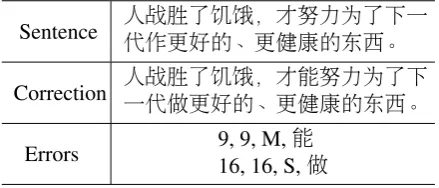
The goal of The NLPTEA CGED task is to use a model to perform a grammar diagnosis on a data set containing Chinese sentences, these datasets are written by Chinese Foreign Language (CFL) leaner. These datasets contain the following four errors, such errors are defined as redundant words (denoted as a capital ”R”), missing words (”M”), word selection errors (”S”), and word ordering er-rors (”W”). The input sentence may contain one or more such errors, and there may also be no errors. The developed system should indicate which error types are embedded in the given sentence and the position at which they occur. Some typical exam-ples are shown in Table 1:
Sentence 人代战作更胜了好饥饿的、更健康的,才努力为了下一东西。
Correction 人一代战做更胜了饥饿好的、更健康的,才能努力为了下东西。
Errors 9, 9, M,能
[image:2.595.307.527.486.580.2]16, 16, S,做
Table 1: Typical Error Examples
Table1 shows the CGED shared task input data and output data samples. Each sentence contains a single id, each output error contains the sentence id, and the number in Errors indicates the index of the error location. The criteria for judging cor-rectness are determined at three levels as detection level, identification level and position level.
4 Methodology
preprocess-ing, model construction, and the construction of objective functions based on the Policy Gradient. Same as previous work, we treat the CGED task as a sequence labeling problem. Such as given a sentence x, our model generates a corresponding label sequence y. Each label in y is a token from a specific tag set. We use ”O” to indicate the correct character’s tag, ‘B-X’ indicating the beginning po-sitions for errors of type ‘X’ and ‘I-X’ as middle and ending positions for errors of type ‘X’.
First, we will introduce our CGED task data preprocessing process, including Bigram feature construction, POS data annotation, and data label settings. Second, we will introduce the construc-tion of the ensemble model that combines Big-gram feature, POS feature, and character embed-ding. Finally, we will introduce the idea and math-ematical formula of the objective function based on the Policy Gradient.
4.1 Data Preparation
First, we use the Word2vec tool to train the Bi-grams of all Chinese sentences in the data set into word vectors. These word vectors will be used to generate input sentence features during model building. we first convert the original character sequence to a bigram sequence. Then we can train bigram embeddings readily using word2vec (Mikolov et al.,2013) on the resulting bigram se-quences.
We use the Part-of-speech (POS) feature to im-prove the performance of the system. Therefore, we use the part-of-speech (POS) feature to gen-erate a corresponding POS tag sequence for each Chinese sentence sequence of the data set, B-pos indicating the beginning character’s POS tag while I-pos indicating the middle and end characters’.
We define each character in the sentence as a separate tag that contains the character’s position in the word. We use ”O” to indicate the correct character’s tag, ‘B-X’ indicating the beginning po-sitions for errors of type ‘X’ and ‘I-X’ as middle and ending positions for errors of type ‘X’. In the CGED task, we will get 8 labels: W, I-R, B-R, B-M, I-S, I-W, B-S, O. After the data is pre-processed, each sample can be represented as the structure shown by Table 2. The input of each sample during training is composed of three parts as shown in the inputs features of Table 2, and the label sequence of each sample is composed of 8 pre-defined labels.
4.2 Model Description
We regard the Chinese grammatical error diag-nosis task as a sequence labeling task, and first use LSTM to construct a sequence labeling model. LSTM network is a variant of recurrent neural net-work (RNN) and have better ability to capture long term dependencies. Given a sequence of input vectors X = x1, x2, . . . , xT = {xt}T1, a
recur-rent unitH computes a sequence of hidden vec-tors h=h1, h2, . . . , hT ={ht}T1 and a sequence of
output symbolsYˆ = ˆy1,yˆ2, . . . ,yˆT = {ˆyt}T1 by
iterating the following equations,
ht=H(xt, ht−1) (1)
ˆ
yt=argmax(sof tmax(Whyht)) (2)
where sof tmax(zm) = ezm/Piezi, The
[image:3.595.309.536.481.629.2]LSTM recurrent unitHrepresents the calculation process of the LSTM network. A typical LSTM network consists of input gates, oblivion gates, output gates, and memory cells. Which input gate controls the current time step which information will be input into the memory cell, the forgot-ten gate controls the current time step which his-tory information will be forgotten by the memory cell, and the output gate controls which informa-tion will be output asht according to the current memory cell state. Each gate consists of a sig-moid neural net layer and a point-wise multiplica-tion operamultiplica-tion.
Figure 1: An illustration of LSTM model
In this work, we denote the input of the time stepias:
xt=σ(Wx(ct, bt, pt)) (3)
Sentence 我根本不能了解这妇女辞职回家的现象。
Char 我根本不能了解这妇 女辞职回家的现象。
Bigram <s>我 我根 根本 本不 不能 能了 了解 解这 这妇 妇女 女辞 辞职 职回 回家 家的
的现 现象 象。 。</s>
POS B-r B-d I-d B-d B-v B-v I-v B-r B-n I-n B-v I-v B-v I-v B-u B-n I-n B-wp
[image:4.595.77.523.62.166.2]Label O O O O O B-S I-S B-R O O O O O O O O O O
Table 2: A snapshot of our training data after the pre-processing
vector of the current time step, andpt represents the POS discrete feature. These three simple fea-tures are combined as the input vector for the time stept. The ensemble model is shown in Figure 1.
4.3 Policy Gradient
Deep Reinforcement Learning (DRL) is divided into Value-Based Deep RL (Mnih et al.,2015) and Policy-Based Deep RL (Lillicrap et al., 2015) in terms of implementation[16]. Value-Based Deep RL is a Neural Network usually used as a Q func-tion to estimate the return of an acfunc-tion which can be obtained in the current environment, namely Deep Q-network (DQN). Such as (Mnih et al., 2013) present the first deep learning model to successfully learn control policies directly from high-dimensional sensory input using reinforce-ment learning, model is a convolutional neural net-work, trained with a variant of Q-learning. The Policy-Based Deep RL is Represent policy by deep network with weights u, as shown below:
a =π(a|s,u) or a =π(s,u) (4)
Where π is the policy expressed by the neural network and u is the network learning parameter. Define objective function as total discounted re-ward:
L(u) =E[r1+γr2+γ2r3+...|π(·,u)] (5)
L(u) denotes the objective function, r1,r2, ...
denotes the returns obtained in each step. In this paper, the value of the return of the tagged result of each token is indicated. γ ∈ [0,1]is the discount factor, which indicates the importance of future re-turns. In this article we set γ = 0.9. To make high-value actions more likely, the gradient of a stochastic policyπ(a|s,u)is given by:
∂L(u) ∂u =E[
∂logπ(a|s,u) ∂u Q
π(s,a)] (6)
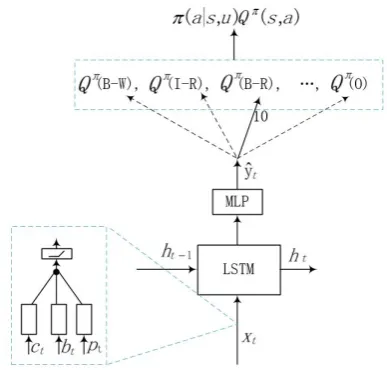
WhereQπ is a function value that measures the return of each action. In this article, we define that the return value of the tag ”O” is successfully marked as 1, and the return value of the failed tag is -1. Defining all other error labels ”W, I-W, B-M, I-W ...” is marked with a score of 10 for a suc-cessful return, and a return of -10 for a failed tag. Finally, update parametersuby stochastic gradient ascent. Our ensemble model is shown in Figure 2.
Figure 2: An illustration of Policy Gradient-based LSTM model
WhereQπ(X)represents the reward after label
”X” was tagged, for example, the ”X” is ”B-R”,
ˆ
yt represents the policy obtained by the network.
Finally, the final output π(a|s,u)Qπ(s,a) of the
network is obtained with the policyπ and reward
Qknown. This output is used to calculate the pol-icy gradient ∂L(u)∂u , and then the gradient is used to update the network parameters.
5 Experiments
[image:4.595.318.512.337.522.2]method. Finally, we introduce the results on the validation dataset and the results from the evalua-tion dataset based on our proposed model.
5.1 Dataset and criteria
During the training of the model, we use the col-lection of training set of CGED2017 and train-ing set of CGED2018 as the traintrain-ing dataset. In CGED2017 training set, provide 10,449 training units with a total of 26,448 grammatical errors, categorized as redundant (5,852 instances), miss-ing (7,010), word selection (11,591) and word or-dering(1,995). In the CGED2018 training set, con-tain total of 1,067 grammatical errors, categorized as redundant (208 instances), missing (298), word selection (87) and word ordering(474). In addi-tion, use CGED2017’s test set as the validation set during training, it’s contain total of 4,871 gram-matical errors, categorized as redundant (1,060 in-stances), missing (1,269), word selection (2,156) and word ordering(386). Table 3 shows the data distribution in the training data.
R error M error S error W error
Train 6060 7308 11678 2469
Validation 1060 1269 2156 386
Table 3: Data statistics
The criteria for judging correctness are deter-mined at three levels, (1)Detection-level: Binary classification of a given sentence, that is, correct or incorrect, should be completely identical with the gold standard. All error types will be regarded as incorrect. (2)Identification-level: This level could be considered as a multi-class categoriza-tion problem. All error types should be clearly identified. A correct case should be completely identical with the gold standard of the given error type. (3)Position-level: In addition to identifying the error types, this level also judges the occur-rence range of the grammatical error. That is to say, the system results should be perfectly identi-cal with the quadruples of the gold standard. The False Positive Rate(FPR), Accuracy (Acc), Preci-sion (Pre), Recall (Rec) and F1 score(F1) are mea-sured at all levels with the help of the confusion matrix.
5.2 Experiment results
We use the above data partitioning to train and converge the training set based on our proposed
Policy Gradient-based model, the trained model was tested on the validation set and evaluation set.
5.2.1 Results on Validation Dataset
We refer to the model’s results on the valida-tion dataset and select the best hyper-parameters model. Table 4 shows the results.
5.2.2 Results on evaluation Dataset
We testing on the final evaluation dataset for CGED2018 test set, the result showing with table 5. As we can see, our model can obtain better iden-tification score and position score while obtaining a better detection level score.
Our model obtains good results at three levels, and the Policy Gradient-based model can be eas-ily applied to online tasks to optimize the network structure through continuous interaction and at-tempting to obtain maximum rewards.
5.3 Conclusion and Future Work
This paper proposes a method based on policy gradient applied to NLPTEA 2018 CGED shared task. We use the value function method of deep re-inforcement learning to map the labeling results to rewards to solve the problem of imbalanced posi-tive and negaposi-tive samples in Chinese grammatical error diagnosis. Moreover, our system can be ap-plied to online optimization as easily as a depth-enhanced model. In this paper, we verify the ef-fectiveness of the Policy Gradient through experi-ments on the validation dataset and the evaluation dataset.
In the future, we hope to betterly solve the prob-lem of serial labeling with imbalanced positive and negative samples in Chinese grammatical er-ror diagnosis through deep reinforcement learn-ing strategies. In terms of Policy Gradients, we hope to be able to define reward functions that are more in line with the mission requirements and op-timize the entire network. In addition, we hope to optimize the network through multiple rounds of online annotation results and further conduct rele-vant online experiments. Ultimately, the network can achieve good labeling results while also being able to cope with the challenges posed by online data changes.
References
Model runs Detection Level Identification Level Position Level
Pre Rec F1 Pre Rec F1 Pre Rec F1
1 0.64 0.26 0.37 0.45 0.28 0.35 0.17 0.02 0.03
2 0.71 0.47 0.52 0.48 0.17 0.25 0.21 0.01 0.02
Table 4: Results on Validation Dataset
Model runs Detection Level Identification Level Position Level
Pre Rec F1 Pre Rec F1 Pre Rec F1
1 0.6349 0.4232 0.5079 0.4792 0.1995 0.2817 0.1185 0.0442 0.0644
2 0.6698 0.2494 0.3634 0.5139 0.1323 0.2105 0.1585 0.0331 0.0547
3 0.6346 0.5426 0.5850 0.4735 0.2646 0.3395 0.1129 0.0609 0.0792
Table 5: Results on Evaluation Dataset
Marcin Junczys-Dowmunt and Roman Grundkiewicz. 2014. The amu system in the conll-2014 shared task: Grammatical error correction by data-intensive and feature-rich statistical machine translation. In Proceedings of the Eighteenth Conference on Com-putational Natural Language Learning: Shared Task, pages 25–33.
John Lafferty, Andrew McCallum, and Fernando CN Pereira. 2001. Conditional random fields: Prob-abilistic models for segmenting and labeling se-quence data.
Lung-Hao Lee, RAO Gaoqi, Liang-Chih Yu, XUN Endong, Baolin Zhang, and Li-Ping Chang. 2016. Overview of nlp-tea 2016 shared task for chi-nese grammatical error diagnosis. In Proceed-ings of the 3rd Workshop on Natural Language Processing Techniques for Educational Applications (NLPTEA2016), pages 40–48.
Lung-Hao Lee, Liang-Chih Yu, and Li-Ping Chang. 2015. Guest editoral: Special issue on chinese as a foreign language. International Journal of Compu-tational Linguistics & Chinese Language Pro-cessing, Volume 20, Number 1, June 2015-Special Issue on Chinese as a Foreign Language, 20(1).
Timothy P Lillicrap, Jonathan J Hunt, Alexander Pritzel, Nicolas Heess, Tom Erez, Yuval Tassa, David Silver, and Daan Wierstra. 2015. Continu-ous control with deep reinforcement learning. arXiv preprint arXiv:1509.02971.
Tomas Mikolov, Kai Chen, Greg Corrado, and Jef-frey Dean. 2013. Efficient estimation of word representations in vector space. arXiv preprint arXiv:1301.3781.
Volodymyr Mnih, Koray Kavukcuoglu, David Sil-ver, Alex Graves, Ioannis Antonoglou, Daan Wier-stra, and Martin Riedmiller. 2013. Playing atari with deep reinforcement learning. arXiv preprint arXiv:1312.5602.
Volodymyr Mnih, Koray Kavukcuoglu, David Silver, Andrei A Rusu, Joel Veness, Marc G Bellemare,
Alex Graves, Martin Riedmiller, Andreas K Fidje-land, Georg Ostrovski, et al. 2015. Human-level control through deep reinforcement learning. Na-ture, 518(7540):529.
Burr Settles and Mark Craven. 2008. An analysis of ac-tive learning strategies for sequence labeling tasks. InProceedings of the conference on empirical meth-ods in natural language processing, pages 1070– 1079. Association for Computational Linguistics.
Ng Hwee Tou, Wu Siew Mei, Ted Briscoe, Christian Hadiwinoto, Raymond Hendy Susanto, and Christo-pher Bryant. 2017. Conll-2014 shared task: Gram-matical error correction.
Nianwen Xue. 2003. Chinese word segmentation as character tagging. International Journal of Compu-tational Linguistics & Chinese Language Pro-cessing, Volume 8, Number 1, February 2003: Spe-cial Issue on Word Formation and Chinese Lan-guage Processing, 8(1):29–48.
Chi-Hsin Yu and Hsin-Hsi Chen. 2012. Detecting word ordering errors in chinese sentences for learning chi-nese as a foreign language. Proceedings of COLING 2012, pages 3003–3018.
Liang-Chih Yu, Lung-Hao Lee, and Li-Ping Chang. 2014. Overview of grammatical error diagnosis for learning chinese as a foreign language. In Proceed-ings of the 1st Workshop on Natural Language Pro-cessing Techniques for Educational Applications, pages 42–47.
Zheng Yuan and Ted Briscoe. 2016. Grammatical error correction using neural machine translation. In Pro-ceedings of the 2016 Conference of the North Amer-ican Chapter of the Association for Computational Linguistics: Human Language Technologies, pages 380–386.