A Knowledge-Intensive Model for Prepositional Phrase Attachment
Ndapandula Nakashole Carnegie Mellon University
5000 Forbes Avenue Pittsburgh, PA, 15213 [email protected]
Tom M. Mitchell Carnegie Mellon University
5000 Forbes Avenue Pittsburgh, PA, 15213 [email protected]
Abstract
Prepositional phrases (PPs) express cru-cial information that knowledge base con-struction methods need to extract. How-ever, PPs are a major source of syntactic ambiguity and still pose problems in pars-ing. We present a method for resolving ambiguities arising from PPs, making ex-tensive use of semantic knowledge from various resources. As training data, we use both labeled and unlabeled data, utilizing an expectation maximization algorithm for parameter estimation. Experiments show that our method yields improvements over existing methods including a state of the art dependency parser.
1 Introduction
Machine reading and information extraction (IE) projects have produced large resources with many millions of facts (Suchanek et al., 2007; Mitchell et al., 2015). This wealth of knowledge creates a positive feedback loop for automatic knowledge base construction efforts: the accumulated knowl-edge can be leveraged to improve machine read-ing; in turn, improved reading methods can be used to better extract knowledge expressed using complex and potentially ambiguous language. For example, prepositional phrases (PPs) express cru-cial information that IE methods need to extract. However, PPs are a major source of syntactic am-biguity. In this paper, we propose to use semantic knowledge to improve PP attachment disambigua-tion. PPs such as “in”, “at”, and “for” express de-tails about thewhere, when, andwhyof relations and events. PPs also state attributes of nouns.
As an example, consider the following sen-tences: S1.) Alice caught the butterfly with the spots. S2.) Alice caught the butterfly with the net.
S
NP VP
VP NP
Alice
caught butterfly
PP
with spots S1.) Noun attachment
S
NP VP
VP NP PP
Alice
caught butterfly with net S2.) Verb attachment
Figure 1: Parse trees where the prepositional phrase (PP) attaches to the noun, and to the verb.
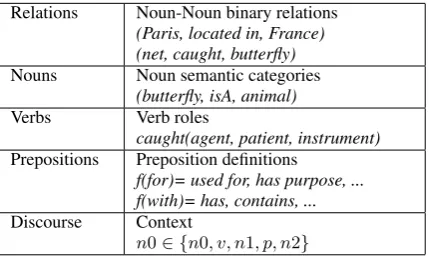
Relations Noun-Noun binary relations (Paris, located in, France) (net, caught, butterfly) Nouns Noun semantic categories
(butterfly, isA, animal) Verbs Verb roles
caught(agent, patient, instrument) Prepositions Preposition definitions
f(for)= used for, has purpose, ... f(with)= has, contains, ... Discourse Context
[image:1.595.310.511.205.317.2]n0∈ {n0, v, n1, p, n2}
Table 1: Types of background knowledge used in this paper to determine PP attachment.
S1 and S2 are syntactically different, this is evi-dent from their corresponding parse trees in Fig-ure 1. Specifically, S1 and S2 differ in where their PPs attach. In S1, the butterfly has spots and there-fore the PP, “with the spots”, attaches to thenoun. For relation extraction, we obtain abinaryrelation of the form: hAliceicaughthbutterfly with spotsi. However, in S2, the net is the instrument used for catching and therefore the PP, “with the net”, at-taches to theverb. For relation extraction, we get a ternary extraction of the form: hAlicei caught
hbutterflyiwithhneti.
The PP attachment problem is often defined as follows: given a PP occurring within a sentence where there are multiple possible attachment sites
[image:1.595.308.523.365.494.2]0.4 0.5 0.6 0.7 0.8 0.9
[image:2.595.327.494.62.194.2]WITH AT FROM FOR AS IN ON
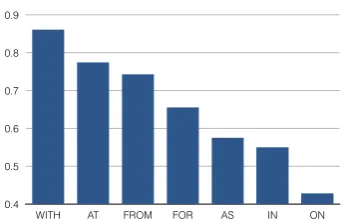
Figure 2: Dependency parser PP attachment accu-racy for various frequent prepositions.
for the PP, choose the most plausible attachment site. In the literature, prior work going as far back as (Brill and Resnik, 1994; Ratnaparkhi et al., 1994; Collins and Brooks, 1995) has focused on the language pattern that causes most PP ambigui-ties, which is the 4-word sequence:{v, n1, p, n2}
(e.g.,{caught, butterfly, with, spots}). The task is to determine if the prepositional phrase(p, n2) at-taches to the verbvor to the first nounn1. Follow-ing common practice, we focus on PPs occurrFollow-ing as{v, n1, p, n2} quadruples — we shall refer to these asPP quads.
The approach we present here differs from prior work in two main ways. First, we make ex-tensive use of semantic knowledge about nouns, verbs, prepositions, pairs of nouns, and the dis-course context in which a PP quad occurs. Table 1 summarizes the types of knowledge we considered in our work. Second, in training our model, we rely on both labeled and unlabeled data, employ-ing an expectation maximization (EM) algorithm (Dempster et al., 1977).
Contributions. In summary, our main
contribu-tions are:
1) Semantic Knowledge: Previous methods largely rely on corpus statistics. Our approach draws upon diverse sources of background knowl-edge, leading to performance improvements.
2) Unlabeled Data:In addition to training on la-beled data, we also make use of a large amount of unlabeled data. This enhances our method’s abil-ity to generalize to diverse data sets.
3) Datasets: In addition to the standard Wall Street Journal corpus (WSJ) (Ratnaparkhi et al., 1994), we labeled two new datasets for testing purposes, one from Wikipedia (WKP), and an-other from the New York Times Corpus (NYTC). We make these datasets freely available for
fu-0 0.25 0.5 0.75 1
IN FROM WITH FOR OF As AT ON Verb attachments Noun attachments
Figure 3: Noun vs. verb attachment proportions for frequent prepositions in the labeled NYTC dataset.
ture research. In addition, we have applied our model to over 4 million 5-tuples of the form
{n0, v, n1, p, n2}, and we also make this dataset available1for research into ternary relation
extrac-tion beyond spatial and temporal scoping.
2 State of the Art
To quantitatively assess existing tools, we ana-lyzed performance of the widely used Stanford parser2 as of 2014, and the established baseline
algorithm (Collins and Brooks, 1995), which has stood the test of time. We first manually labeled PP quads from the NYTC dataset, then prepended the noun phrase appearing before the quad, ef-fectively creating sentences made up of 5 lexi-cal items (n0 v n1 p n2). We then applied the Stanford parser, obtaining the results summarized in Figure 2. The parser performs well on some prepositions, for example, “of”, which tends to oc-cur with noun attaching PPs as can be seen in Fig-ure 3. However, for prepositions with an even dis-tribution over verb and noun attachments, such as “on”, precision is as low as 50%. The Collins baseline achieves 84% accuracy on the bench-mark Wall Street Journal PP dataset. However, drawing a distinction in the precision of different prepositions provides useful insights on its per-formance. We re-implemented this baseline and found that when we remove the trivial preposi-tion, “of”, whose PPs are by default attached to the noun by this baseline, precision drops to 78%. This analysis suggests there is substantial room for improvement.
[image:2.595.92.264.64.175.2]3 Related Work
Statistics-based Methods.Prominent prior
meth-ods learn to perform PP attachment based on corpus co-occurrence statistics, gathered either from manually annotated training data (Collins and Brooks, 1995; Brill and Resnik, 1994) or from automatically acquired training data that may be noisy (Ratnaparkhi, 1998; Pantel and Lin, 2000). These models collect statistics on how of-ten a given quadruple,{v, n1, p, n2}, occurs in the training data as a verb attachment as opposed to a noun attachment. The issue with this approach is sparsity, that is, many quadruples occuring in the test data might not have been seen in the training data. Smoothing techniques are often employed to overcome sparsity. For example, (Collins and Brooks, 1995) proposed a back-off model that uses subsets of the words in the quadruple, by also keeping frequency counts of triples, pairs and sin-gle words. Another approach to overcoming spar-sity has been to use WordNet (Fellbaum, 1998) classes, by replacing nouns with their WordNet classes (Stetina and Nagao, 1997; Toutanova et al., 2004) to obtain less sparse corpus statistics. Corpus-derived clusters of similar nouns and verbs have also been used (Pantel and Lin, 2000).
Hindle and Rooth proposed a lexical associa-tion approach based on how words are associated with each other (Hindle and Rooth, 1993). Lexi-cal preference is used by computing co-occurrence frequencies (lexical associations) of verbs and nouns, with prepositions. In this manner, they would discover that, for example, the verb “send” is highly associated with the prepositionfrom, in-dicating that in this case, the PP is likely to be a verb attachment.
Structure-based Methods. These methods are
based on high-level observations that are then gen-eralized into heuristics for PP attachment deci-sions. (Kimball, 1988) proposed a right associa-tion method, whose premise is that a word tends to attach to another word immediately to its right. (Frazier, 1978) introduced a minimal attachment method, which posits that words attach to an ex-isting non-terminal word using the fewest addi-tional syntactic nodes. While simple, in practice these methods have been found to perform poorly (Whittemore et al., 1990).
Rule-based Methods. (Brill and Resnik, 1994)
proposed methods that learn a set of transforma-tion rules from a corpus. The rules can be too spe-cific to have broad applicability, resulting in low recall. To address low recall, knowledge about nouns, as found in WordNet, is used to replace cer-tain words in rules with their WordNet classes.
Parser Correction Methods.The quadruples
for-mulation of the PP problem can be seen as a simplified setting. This is because, with quadru-ples, there is no need to deal with complex sen-tences but only well-defined quadruples of the form {v, n1, p, n2}. Thus in the quadruples set-ting, there are only two possible attachment sites for the PP, thevandn1. An alternative setting is to work in the context of full sentences. In this setting the problem is cast as a dependency parser correction problem (Atterer and Sch¨utze, 2007; Agirre et al., 2008; Anguiano and Candito, 2011). That is, given a dependency parse of a sentence, with potentially incorrect PP attachments, rectify it such that the prepositional phrases attach to the correct sites. Unlike our approach, these methods do not take semantic knowledge into account.
Sense Disambiguation.In addition to prior work
on prepositional phrase attachment, a highly re-lated problem is preposition sense disambiguation (Hovy et al., 2011; Srikumar and Roth, 2013). Even a syntactically correctly attached PP can still be semantically ambiguous with respect to ques-tions of machine reading such aswhere, when,and why. Therefore, when extracting information from prepositions, the problem of preposition sense dis-ambiguation (semantics) has to be addressed in ad-dition to prepositional phrase attachment disam-biguation (syntax). In this paper, our focus is on the latter.
4 Methodology
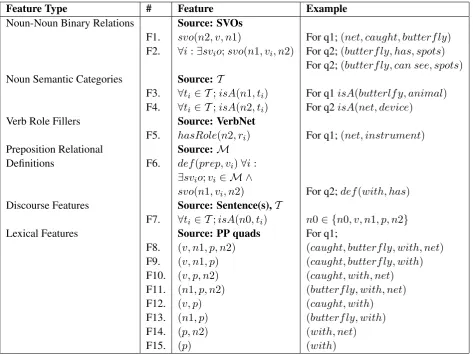
Our approach consists of first generating features from background knowledge and then training a model to learn with these features. The types of features considered in our experiments are sum-marized in Table 2. The choice of features was motivated by our empirically driven characteriza-tion of the problem as follows:
Feature Type # Feature Example
Noun-Noun Binary Relations Source: SVOs
F1. svo(n2, v, n1) For q1;(net, caught, butterfly)
F2. ∀i:∃svio;svo(n1, vi, n2) For q2;(butterfly, has, spots) For q2;(butterfly, can see, spots)
Noun Semantic Categories Source: T
F3. ∀ti ∈ T;isA(n1, ti) For q1isA(butterlfy, animal) F4. ∀ti ∈ T;isA(n2, ti) For q2isA(net, device)
Verb Role Fillers Source: VerbNet
F5. hasRole(n2, ri) For q1;(net, instrument)
Preposition Relational Source: M
Definitions F6. def(prep, vi)∀i:
∃svio;vi ∈ M ∧
svo(n1, vi, n2) For q2;def(with, has)
Discourse Features Source: Sentence(s),T
F7. ∀ti ∈ T;isA(n0, ti) n0∈ {n0, v, n1, p, n2}
Lexical Features Source: PP quads For q1;
F8. (v, n1, p, n2) (caught, butterfly, with, net)
F9. (v, n1, p) (caught, butterfly, with)
F10. (v, p, n2) (caught, with, net)
F11. (n1, p, n2) (butterfly, with, net)
F12. (v, p) (caught, with)
F13. (n1, p) (butterfly, with)
F14. (p, n2) (with, net)
F15. (p) (with)
Table 2: Types of features considered in our experiments. All features have values of 1 or 0. The PP quads used as running examples are: q1 = {caught, butterfly, with, net} : V, q2 =
{caught, butterfly, with, spots}:N.
That is, we found that for verb-attaching PPs,
n2is usually a role filler for the verb, e.g., the net fills the role of an instrument for the verbcatch. On the other hand, for noun-attaching PPs, one noun describes or elaborates on the other. In par-ticular, we found two kinds of noun attachments. For the first kind of noun attachment, the second noun n2 describes the first noun n1, for exam-ple n2 might be an attribute or property of n1, as in the spots(n2) are an attribute of the butter-fly (n1). And for the second kind of noun attach-ment, the first nounn1describes the second noun
n2, as in the PP quad{expect, decline, in, rates}, where the PP “in rates”, attaches to thenoun. The decline:n1that is expected:vis in the rates:n2. We sampled 50 PP quads from the WSJ dataset and found that every labeling could be explained using our characterization. We make this labeling avail-able with the rest of the datasets.
We next describe in more detail how each type
of feature is derived from the background knowl-edge in Table 1.
4.1 Feature Generation
We generate boolean-valued features for all the feature types we describe in this section.
4.1.1 Noun-Noun Binary Relations
The noun-noun binary relation features, F1-2 in Table 2, are boolean features svo(n1, vi, n2) (wherevi is any verb) and svo(n2, v, n1)(where
v is the verb in the PP quad, and the roles of
[image:4.595.72.546.61.415.2]each SVO triple in the corpus. The value of any given featuresvo(n1, vi, n2)is defined to be 1 if that SVO triple was found at least 3 times in these SVO triples, and 0 otherwise. To see why these relations are relevant, let us suppose that we have the knowledge that butterfly-has-spots, svo(n1, vi, n2). From this, we can infer that the PP in {caught, butterfly, with, spots}
is likely to attach to the noun. Similarly, suppose we know thatnet-caught-butterfly,svo(n2, v, n1). The fact that a net can be used to catch a but-terfly can be used to predict that the PP in
{caught, butterfly, with, net}is likely to attach to the verb.
4.1.2 Noun Semantic Categories
Noun semantic type features, F3-4, are boolean featuresisA(n1, ti)andisA(n2, ti)wheretiis a noun category in a noun categorization schemeT
such as WordNet classes. Knowledge about se-mantic types of nouns, for example that a butter-fly is an animal, enables extrapolating predictions to other PP quads that contain nouns of the same type. We ran experiments with several noun cat-egorizations including WordNet classes, knowl-edge base ontological types, and an unsupervised noun categorization produced by clustering nouns based on the verbs and adjectives with which they co-occur (distributional similarity).
4.1.3 Verb Role Fillers
The verb role feature, F5, is a boolean fea-ture hasRole(n2, ri) where ri is a role that
n2 can fulfill for the verb v in the PP quad, according to background knowledge. Notice that if n2 fills a role for the verb, then the PP is a verb attachment. Consider the quad
{caught, butterfly, with, net}, if we know that a net can play the role of an instrument for the verbcatch, this suggests a likely verb attachment. We obtained background knowledge of verbs and their possible roles from the VerbNet lexical re-source (Kipper et al., 2008). From VerbNet we obtained 2,573 labeled sentences containing PP quads (verbs in the same VerbNet group are con-sidered synonymous), and the labeled semantic roles filled by the second nounn2in the PP quad. We use these example sentences to label similar PP quads, where similarity of PP quads is defined by verbs from the same VerbNet group.
4.1.4 Preposition Definitions
The preposition definition feature, F6, is a boolean feature def(prep, vi) = 1 if ∃vi ∈
M ∧ svo(n1, vi, n2) = 1, where M is a def-inition mapping of prepositions to verb phrases. This mapping defines prepositions, using verbs in our ClueWeb09 derived SVO corpus, in or-der to capture their senses using verbs; it con-tains definitions such as def(with, *) = contains, accompanied by, ... . If “with” is used in the sense of “contains” , then the PP is a likely noun attachment, as in n1 contains n2 in the quadate, cookies, with, cranberries. However, if “with” is used in the sense of “accompanied by”, then the PP is a likely verb attachment, as in the quadvisted, P aris, with, Sue. To obtain the mapping, we took the labeled PP quads (WSJ, (Ratnaparkhi et al., 1994)) and computed a ranked list of verbs from SVOs, that appear frequently between pairs of nouns for a given preposition. Other sample mappings are: def(for,*)= used for, def(in,*)= located in. Notice that this featureF6
is a selective, more targeted version ofF2.
4.1.5 Discourse and Lexical Features
The discourse feature, F7, is a boolean feature
isA(n0, ti), for each noun category ti found in a noun category ontology T such as WordNet se-mantic types. The context of the PP quad can contain relevant information for attachment deci-sions. We take into account the noun preceding a PP quad, in particular, its semantic type. This in effect makes the PP quad into a PP 5-tuple:
{n0, v, n1, p, n2}, where the n0 provides addi-tional context.
Finally, we use lexical features in the form of PP quads, features F8-15. To overcome sparsity of occurrences of PP quads, we also use counts of shorter sub-sequences, including triples, pairs and singles. We only use sub-sequences that con-tain the preposition, as the preposition has been found to be highly crucial in PP attachment deci-sions (Collins and Brooks, 1995).
4.2 Disambiguation Algorithm
We use the described features to train a model for making PP attachment decisions. Our goal is to computeP(y|x), the probability that the PP
a feature vectorxdescribing that tuple. As input to training the model, we are given a collection of PP quads,Dwheredi ∈ D : di = {v, n1, p, n2}. A small subset,Dl ⊂ Dis labeled data, thus for each
di ∈ Dlwe know the corresponding yi. The rest of the quads,Du, are unlabeled, hence their corre-spondingyis are unknown. From each PP quaddi, we extract a feature vectorxiaccording to the fea-ture generation process discussed in Section 4.1.
4.2.1 Model
To model P(y|x), there a various possibilities. One could use a generative model (e.g., Naive Bayes) or a discriminative model ( e.g., logistic re-gression). In our experiments we used both kinds of models, but found the discriminative model per-formed better. Therefore, we present details only for our discriminative model. We use the logistic function: P(y|x, ~θ) = 1+e~θxe~θx, where ~θ is a
vec-tor of model parameters. To estimate these pa-rameters, we could use the labeled data as training data and use standard gradient descent to minimize the logistic regression cost function. However, we also leverage the unlabeled data.
4.2.2 Parameter Estimation
To estimate model parameters based on both la-beled and unlala-beled data, we use an Expecta-tion MaximizaExpecta-tion (EM) algorithm. EM estimates model parameters that maximize the expected log likelihood of the full (observed and unobserved) data. Since we are using a discriminative model, our likelihood function is a conditional likelihood function:
L(θ) =XN
i=1
lnP(yi|xi)
=XN
i=1
yiθTxi−ln(1 +exp(θTxi)) (1)
whereiindexes over theN training examples. The EM algorithm produces parameter esti-mates that correspond to a local maximum in the expected log likelihood of the data under the posterior distribution of the labels, given by:
arg max
θ Ep(y|x,θ)[lnP(y|x, θ)]. In the E-step, we use the current parameters θt−1 to compute the posterior distribution over the y labels, give by P(y|x, θt−1). We then use this posterior distri-bution to find the expectation of the log of the
complete-data conditional likelihood, this expec-tation is given byQ(θ, θt−1), defined as:
Q(θ, θt−1) =XN
i=1
Eθt−1[lnP(y|x, θ)] (2)
In the M-step, a new estimate θt is then pro-duced, by maximizing thisQfunction with respect toθ:
θt= arg max
θ Q(θ, θ
t−1) (3)
EM iteratively computes parameters
θ0, θ1, ...θt, using the above update rule at each iteration t, halting when there is no further improvement in the value of theQfunction. Our algorithm is summarized in Algorithm 1. The M-step solution for θt is obtained using gradient ascent to maximize theQfunction.
Algorithm 1The EM algorithm for PP attachment
Input:X,D=Dl∪Du
Output: θT
fort = 1 . . . Tdo E-Step:
Computep(y|xi, θt−1)
xi :di ∈Du;p(y|xi, ~θ) = e
~ θx
1+e~θx
xi :di ∈Dl;p(y|xi) = 1ify=yi,else0
M-Step:
Compute new parameters,θt
θt= arg max θ Q(θ, θ
t−1)
Q(θ, θt−1) =
N
X
i=1
X
y∈{0,1}
p(y|xi, θt−1)×
(yθTxi−ln(1 +exp(θTxi)))
ifconvergence(L(θ),L(θt−1))then
break end if end for return θT
5 Experimental Evaluation
We evaluated our method on several datasets con-taining PP quads of the form{v, n1, p, n2}. The task is to predict if the PP (p, n2) attaches to the verbvor to the first nounn1.
5.1 Experimental Setup
Datasets. Table 3 shows the datasets used in our
DataSet # Training quads # Test quads
Labeled data
WSJ 20,801 3,097
NYTC 0 293
WKP 0 381
Unlabeled data
[image:7.595.75.288.64.163.2]WKP 100,000 4,473,072
Table 3: Training and test datasets used in our ex-periments.
PPAD PPAD- Coll-
Stan-NB ins ford
WKP 0.793 0.740 0.727 0.701
WKP 0.759 0.698 0.683 0.652
\of
NYTC 0.843 0.792 0.809 0.679
NYTC 0.815 0.754 0.774 0.621
\of
WSJ 0.843 0.816 0.841 N\A
WSJ 0.779 0.741 0.778 N\A
\of
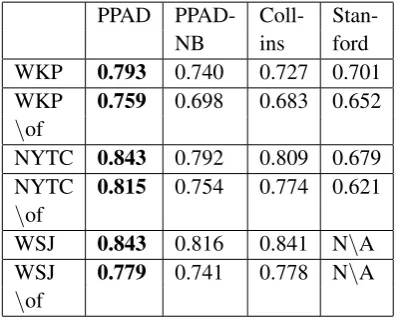
Table 4: PPAD vs. baselines.
Wall Street Journal (WSJ) dataset. For the unla-beled training data, we extracted PP quads from Wikipedia (WKP) and randomly selected100,000
which we found to be a sufficient amount of un-labeled data. The largest un-labeled test dataset is WSJ but it is also made up of a large fraction, of “of” PP quads, 30% , which trivially attach to the noun, as already seen in Figure 3. The New York Times (NYTC) and Wikipedia (WKP) datasets are smaller but contain fewer proportions of “of” PP quads, 15%, and 14%, respectively. Addition-ally, we applied our model to over 4 million un-labeled 5-tuples from Wikipedia. We make this data available for download, along with our man-ually labeled NYTC and WKP datasets. For the WKP & NYTC corpora, each quad has a preced-ing noun,n0, as context, resulting in PP 5-tuples of the form: {n0, v, n1, p, n2}. The WSJ dataset was only available to us in the form of PP quads with no other sentence information.
Methods Under Comparison. 1) PPAD
(Prepo-sitional Phrase Attachment Disambiguator) is our proposed method. It uses diverse types of seman-tic knowledge, a mixture of labeled and unlabeled data for training data, a logistic regression
classi-0.5 0.58 0.66 0.74 0.82 0.9
[image:7.595.309.518.67.229.2]WKP WKP\of NYTC NYTC\of WSJ WSJ\of PPAD - WordNet Types PPAD - KB Types PPAD - Unsupervised Types PPAD - WordNet Verbs PPAD - Naive Bayes Collins Baseline Stanford Parser
Figure 4: PPAD variations vs. baselines.
fier, and expectation maximization (EM) for pa-rameter estimation 2) Collins is the established baseline among PP attachment algorithms (Collins and Brooks, 1995). 3) Stanford Parseris a state-of-the-art dependency parser, the 2014 online ver-sion. 4) PPAD Naive Bayes(NB) is the same as PPAD but uses a generative model, as opposed to the discriminative model used in PPAD.
5.2 PPAD vs. Baselines
[image:7.595.82.282.213.376.2]Feature Type Precision Recall F1
Noun-Noun Binary Relations (F1-2) low high low
Noun Semantic Categories (F3-4) high high high
Verb Role Fillers (F5) high low low
Preposition Definitions (F6) low low low
Discourse Features (F7) high low high
[image:8.595.154.449.62.163.2]Lexical Features (F8-15) high high high
Table 5: An approximate characterization of feature knowledge sources in terms of precision/recall/F1
5.3 Feature Analysis
We found that features F2 and F6 did not im-prove performance, therefore we excluded them from the final model, PPAD. This means that bi-nary noun-noun relations were not useful when used permissively, featureF2, but when used se-lectively, featureF1, we found them to be useful. Our attempt at mapping prepositions to verb def-initions produced some noisy mappings, resulting in feature F6 producing mixed results. To ana-lyze the impact of the unlabeled data, we inspected the features and their weights as produced by the PPAD model. From the unlabeled data, new lex-ical features were discovered that were not in the original labeled data. Some sample new features with high weights for verb attachments are: (per-form,song,for,*), (lose,*,by,*), (buy,property,in,*). And for noun attachments: (*,conference,on,*), (obtain,degree,in,*), (abolish,taxes,on,*).
We evaluated several variations of PPAD, the results are shown in Figure 4. For “PPAD-WordNet Verbs”, we expanded the data by replac-ing verbs in PP quads with synonymous WordNet verbs, ignoring verb senses. This resulted in more instances of features F1, F8-10, & F12.
We also used different types of noun categoriza-tions: WordNet classes, semantic types from the NELL knowledge base (Mitchell et al., 2015) and unsupervised types. The KB types and the unsu-pervised types did not perform well, possibly due to the noise found in these categorizations. Word-Net classes showed the best results, hence they were used in the final PPAD model for features F3-4 & F7. In Section 5.1, PPAD corresponds to the best model.
5.4 Discussion: The F1 Score of Knowledge
Why did we not reach 100% accuracy? Should re-lational knowledge not be providing a much big-ger performance boost than we have seen in the
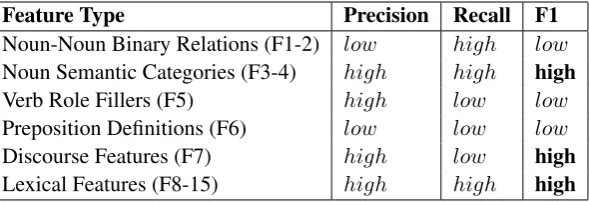
re-sults? To answer these questions, we characterize our features in terms precision and recall, and F1 measure of their knowledge sources in Table 5. A low recall feature means that the feature does not fire on many examples, the feature’s knowledge source suffers from low coverage. A low preci-sion feature means that when it fires, the feature could be incorrect, the feature’s knowledge source contains a lot of errors.
From Table 5, the noun-noun binary relation features (F1− 2) have low precision, but high recall. This is because the SVO data, extracted from the ClueWeb09 corpus, that we used as our relational knowledge source is very noisy but it is high coverage. The low precision of the SVO data causes these features to be detrimental to perfor-mance. Notice that when we used a filtered ver-sion of the data, in feature F2, the data was no longer detrimental to performance. However, the
F2feature is low recall, and therefore it’s impact on performance is also limited. The noun seman-tic category features(F3−4)have high recall and precision, hence it to be expected that their im-pact on performance is significant. The verb role filler features (F5), obtained from VerbNet have high precision but low recall, hence their marginal impact on performance is also to be expected. The preposition definition features(F6)poor precision made them unusable. The discourse features(F7)
are based noun semantic types and lexical features (F8−15), both of which have high recall and pre-cision, hence they useful impact on performance.
Relation Prep. Attachment accuracy Example(s)
acquired from 99.97 BNY MellonacquiredInsightfromLloyds.
hasSpouse in 91.54 DavidmarriedVictoriainIreland.
worksFor as 99.98 ShubertjoinedCNNasreporter.
[image:9.595.70.534.63.135.2]playsInstrument with 98.40 Kushnerplayedguitarwithrock band Weezer.
Table 6: Binary relations extended to ternary relations by mapping to verb-preposition pairs in PP 5-tuples. PPAD predicted verb attachments with accuracy>90% in all relations.
5.5 Application to Ternary Relations
Through the application of ternary relation extrac-tion, we further tested PPAD’s PP disambiguation accuracy and illustrated its usefulness for knowl-edge base population. Recall that a PP 5-tuple of the form{n0, v, n1, p, n2}, whose enclosed PP at-taches to the verbv, denotes a ternary relation with argumentsn0, n1, & n2. Therefore, we can extract a ternary relation from every 5-tuple for which our method predicts a verb attachment. If we have a mapping between verbs and binary relations from a knowledge base (KB), we can extend KB rela-tions to ternary relarela-tions by augmenting the KB relations with a third argumentn2.
We considered four KB binary
re-lations and their instances such as
worksF or(T imCook, Apple), from the NELL KB. We then took the collection of 4 million 5-tuples that we extracted from Wikipedia. We mapped verbs in 5-tuples to KB relations, based on significant overlaps in the instances of the KB relations, noun pairs such as(T imCook, Apple)
with then0, n1pairs in the Wikipedia PP 5-tuple collection. We found that, for example, instances of the noun-noun KB relation “worksFor” match
n0, n1 pairs in tuples where v = joined and
p = as, with n2 referring to the job title. Other binary relations extended are: “hasSpouse” ex-tended by “in” with wedding location, “acquired” extended by “from” with the seller of the company being acquired. Examples are shown in Table 6. In all these mappings, the proportion of verb attachments in the corresponding PP quads is significantly high (>90%). PPAD is overwhelm-ing makoverwhelm-ing the right attachment decisions in this setting.
Efforts in temporal and spatial relation tion have shown that higher N-ary relation extrac-tion is challenging. Since preposiextrac-tions specify de-tails that transform binary relations to higher
N-ary relations, our method can be used to read infor-mation that can augment binary relations already in KBs. As future work, we would like to incor-porate our method into a pipeline for reading be-yond binary relations. One possible direction is to read details about thewhere,why, whoof events and relations, effectively moving from extracting only binary relations to reading at a more general level.
6 Conclusion
We have presented a knowledge-intensive ap-proach to prepositional phrase (PP) attachment disambiguation, which is a type of syntactic ambi-guity. Our method incorporates knowledge about verbs, nouns, discourse, and noun-noun binary re-lations. We trained a model using labeled data and unlabeled data, making use of expectation max-imization for parameter estimation. Our method can be seen as an example of tapping into a pos-itive feedback loop for machine reading, which has only become possible in recent years due to the progress made by information extraction and knowledge base construction techniques. That is, using background knowledge from existing re-sources to read better in order to further populate knowledge bases with otherwise difficult to extract knowledge. As future work, we would like to use our method to extract more than just binary rela-tions.
Acknowledgments
References
Eneko Agirre, Timothy Baldwin, and David Martinez. 2008. Improving parsing and PP attachment perfor-mance with sense information. In Proceedings of ACL-08: HLT, pages 317–325.
Gerry Altmann and Mark Steedman. 1988. Interac-tion with context during human sentence processing. Cognition, 30:191–238.
Enrique Henestroza Anguiano and Marie Candito. 2011. Parse correction with specialized models for difficult attachment types. In Proceedings of the 2011 Conference on Empirical Methods in Natural Language Processing, EMNLP, pages 1222–1233. Michaela Atterer and Hinrich Sch¨utze. 2007.
Preposi-tional phrase attachment without oracles. Computa-tional Linguistics, 33(4):469–476.
S¨oren Auer, Christian Bizer, Georgi Kobilarov, Jens Lehmann, Richard Cyganiak, and Zachary G. Ives. 2007. Dbpedia: A nucleus for a web of open data. In The Semantic Web, 6th International Semantic Web Conference, 2nd Asian Semantic Web Confer-ence, ISWC 2007 + ASWC 2007, Busan, Korea, November 11-15, 2007., pages 722–735.
Michele Banko, Michael J Cafarella, Stephen Soder-land, Matthew Broadhead, and Oren Etzioni. 2007. Open information extraction for the web. InIJCAI, volume 7, pages 2670–2676.
Kurt Bollacker, Colin Evans, Praveen Paritosh, Tim Sturge, and Jamie Taylor. 2008. Freebase: A col-laboratively created graph database for structuring human knowledge. InProceedings of the 2008 ACM SIGMOD International Conference on Management of Data, SIGMOD ’08, pages 1247–1250.
Eric Brill and Philip Resnik. 1994. A rule-based approach to prepositional phrase attachment disam-biguation. In 15th International Conference on Computational Linguistics, COLING, pages 1198– 1204.
Andrew Carlson, Justin Betteridge, Richard C. Wang, Estevam R. Hruschka, Jr., and Tom M. Mitchell. 2010. Coupled semi-supervised learning for infor-mation extraction. InProceedings of the Third ACM International Conference on Web Search and Data Mining, WSDM ’10, pages 101–110.
Michael Collins and James Brooks. 1995. Prepo-sitional phrase attachment through a backed-off model. InProceedings of the Conference on Empiri-cal Methods in Natural Language Processing, pages 27–38.
Marie-Catherine de Marneffe, Bill MacCartney, and Christopher D. Manning. 2006. Generating typed dependency parses from phrase structure parses. In Proceedings of the International Conference on Language Recources and Evaluation (LREC, pages 449–454.
Luciano Del Corro and Rainer Gemulla. 2013. Clausie: Clause-based open information extraction. In Proceedings of the 22Nd International Confer-ence on World Wide Web, WWW ’13, pages 355– 366.
A. P. Dempster, N. M. Laird, and D. B. Rubin. 1977. Maximum likelihood from incomplete data via the em algorithm. Journal of the Royal Statistical Soci-ety, Series B, 39(1):1–38.
Anthony Fader, Stephen Soderland, and Oren Etzioni. 2011a. Identifying relations for open information extraction. InProceedings of the Conference on Em-pirical Methods in Natural Language Processing, EMNLP ’11, pages 1535–1545.
Anthony Fader, Stephen Soderland, and Oren Etzioni. 2011b. Identifying relations for open information extraction. In Proceedings of the Conference on Empirical Methods in Natural Language Process-ing, pages 1535–1545. Association for Computa-tional Linguistics.
Christiane Fellbaum, editor. 1998. WordNet: an elec-tronic lexical database. MIT Press.
Lyn Frazier. 1978.On comprehending sentences: Syn-tactic parsing strategies. Ph.D. thesis, University of Connecticut.
Sanda M. Harabagiu and Marius Pasca. 1999. Inte-grating symbolic and statistical methods for prepo-sitional phrase attachment. In Proceedings of the Twelfth International Florida Artificial Intelligence Research Society ConferenceFLAIRS, pages 303– 307.
Donald Hindle and Mats Rooth. 1993. Structural am-biguity and lexical relations. Computational Lin-guistics, 19(1):103–120.
Dirk Hovy, Ashish Vaswani, Stephen Tratz, David Chi-ang, and Eduard Hovy. 2011. Models and training for unsupervised preposition sense disambiguation. In Proceedings of the 49th Annual Meeting of the Association for Computational Linguistics: Human Language Technologies: Short Papers - Volume 2, pages 323–328.
John Kimball. 1988. Seven principles of surface struc-ture parsing in natural language. Cognition, 2:15– 47.
Karin Kipper, Anna Korhonen, Neville Ryant, and Martha Palmer. 2008. A large-scale classification of english verbs. Language Resources and Evalua-tion, 42(1):21–40.
Ni Lao, Tom Mitchell, and William W Cohen. 2011. Random walk inference and learning in a large scale knowledge base. InProceedings of the Conference on Empirical Methods in Natural Language Pro-cessing, pages 529–539. Association for Computa-tional Linguistics.
Jeff Mitchell and Mirella Lapata. 2008. Vector-based models of semantic composition. InProceedings of the 46th Annual Meeting of the Association for Com-putational Linguistics, ACL, pages 236–244.
Tom M. Mitchell, William W. Cohen, Estevam R. Hr-uschka Jr., Partha Pratim Talukdar, Justin Bet-teridge, Andrew Carlson, Bhavana Dalvi Mishra, Matthew Gardner, Bryan Kisiel, Jayant Krishna-murthy, Ni Lao, Kathryn Mazaitis, Thahir Mo-hamed, Ndapandula Nakashole, Emmanouil Anto-nios PlataAnto-nios, Alan Ritter, Mehdi Samadi, Burr Set-tles, Richard C. Wang, Derry Tanti Wijaya, Abhi-nav Gupta, Xinlei Chen, Abulhair Saparov, Malcolm Greaves, and Joel Welling. 2015. Never-ending learning. InProceedings of the Twenty-Ninth AAAI Conference on Artificial Intelligence, January 25-30, 2015, Austin, Texas, USA., pages 2302–2310.
Ndapandula Nakashole and Tom M. Mitchell. 2014. Language-aware truth assessment of fact candidates. In Proceedings of the 52nd Annual Meeting of the Association for Computational Linguistics, ACL 2014, June 22-27, 2014, Baltimore, MD, USA, Vol-ume 1: Long Papers, pages 1009–1019.
Ndapandula Nakashole and Gerhard Weikum. 2012. Real-time population of knowledge bases: opportu-nities and challenges. In Proceedings of the Joint Workshop on Automatic Knowledge Base Construc-tion and Web-scale Knowledge ExtracConstruc-tion, pages 41–45. Association for Computational Linguistics.
Ndapandula Nakashole, Martin Theobald, and Gerhard Weikum. 2011. Scalable knowledge harvesting with high precision and high recall. InProceedings of the Fourth ACM International Conference on Web Search and Data Mining, WSDM ’11, pages 227– 236.
Ndapandula Nakashole, Tomasz Tylenda, and Gerhard Weikum. 2013. Fine-grained semantic typing of emerging entities. In Proceedings of the 51st An-nual Meeting of the Association for Computational Linguistics, ACL, pages 1488–1497.
Kamal Nigam, Andrew McCallum, Sebastian Thrun, and Tom M. Mitchell. 2000. Text classification from labeled and unlabeled documents using EM. Machine Learning, 39(2/3):103–134.
Patrick Pantel and Dekang Lin. 2000. An unsuper-vised approach to prepositional phrase attachment using contextually similar words. In 38th Annual Meeting of the Association for Computational Lin-guistics, ACL.
Adwait Ratnaparkhi, Jeff Reynar, and Salim Roukos. 1994. A maximum entropy model for prepositional phrase attachment. InProceedings of the Workshop on Human Language Technology, HLT ’94, pages 250–255.
Adwait Ratnaparkhi. 1998. Statistical models for unsupervised prepositional phrase attachement. In 36th Annual Meeting of the Association for Compu-tational Linguistics and 17th International Confer-ence on Computational Linguistics, COLING-ACL, pages 1079–1085.
Vivek Srikumar and Dan Roth. 2013. Modeling se-mantic relations expressed by prepositions. TACL, 1:231–242.
Jiri Stetina and Makoto Nagao. 1997. Prepositional phrase attachment through a backed-off model. In Proceedings of the Conference on Empirical Meth-ods in Natural Language Processing, pages 66–80. Fabian M Suchanek, Gjergji Kasneci, and Gerhard
Weikum. 2007. Yago: a core of semantic knowl-edge. InProceedings of the 16th international con-ference on World Wide Web, pages 697–706. ACM. Kristina Toutanova, Christopher D. Manning, and
An-drew Y. Ng. 2004. Learning random walk models for inducing word dependency distributions. In Ma-chine Learning, Proceedings of the Twenty-first In-ternational Conference, ICML.
Olga van Herwijnen, Antal van den Bosch, Jacques M. B. Terken, and Erwin Marsi. 2003. Learning PP attachment for filtering prosodic phrasing. In 10th Conference of the European Chapter of the Asso-ciation for Computational Linguistics,EACL, pages 139–146.
Greg Whittemore, Kathleen Ferrara, and Hans Brun-ner. 1990. Empirical study of predictive powers od simple attachment schemes for post-modifier prepo-sitional phrases. In28th Annual Meeting of the As-sociation for Computational Linguistics,ACL, pages 23–30.
Derry Wijaya, Ndapandula Nakashole, and Tom Mitchell. 2014. Ctps: Contextual temporal profiles for time scoping facts via entity state change detec-tion. InProceedings of the Conference on Empirical Methods in Natural Language Processing. Associa-tion for ComputaAssocia-tional Linguistics.