Proceedings of the 57th Annual Meeting of the Association for Computational Linguistics, pages 1483–1493 1483
Improving Neural Language Models by
Segmenting, Attending, and Predicting the Future
Hongyin Luo1 Lan Jiang2 Yonatan Belinkov1 James Glass1
1MIT Computer Science and Artificial Intelligence Laboratory, Cambridge, MA 02139, USA
{hyluo, belinkov, glass}@mit.edu
2School of Information Sciences, University of Illinois at Urbana–Champaign
Champaign, IL 61820, USA [email protected]
Abstract
Common language models typically predict the next word given the context. In this work, we propose a method that improves language modeling by learning to align the given con-text and the following phrase. The model does not require any linguistic annotation of phrase segmentation. Instead, we define syn-tactic heights and phrase segmentation rules, enabling the model to automatically induce phrases, recognize their task-specific heads, and generate phrase embeddings in an unsu-pervised learning manner. Our method can easily be applied to language models with dif-ferent network architectures since an indepen-dent module is used for phrase induction and context-phrase alignment, and no change is re-quired in the underlying language modeling network. Experiments have shown that our model outperformed several strong baseline models on different data sets. We achieved a new state-of-the-art performance of 17.4 per-plexity on the Wikitext-103 dataset. Addi-tionally, visualizing the outputs of the phrase induction module showed that our model is able to learn approximate phrase-level struc-tural knowledge without any annotation.
1 Introduction
Neural language models are typically trained by predicting the next word given a past context ( Ben-gio et al., 2003). However, natural sentences are not constructed as simple linear word sequences, as they usually contain complex syntactic infor-mation. For example, a subsequence of words can constitute a phrase, and two non-neighboring words can depend on each other. These properties make natural sentences more complex than simple linear sequences.
Most recent work on neural language modeling learns a model by encoding contexts and match-ing the context embeddmatch-ings to the embeddmatch-ing of
the next word (Bengio et al., 2003;Merity et al., 2017;Melis et al.,2017). In this line of work, a given context is encoded with a neural network, for example a long short-term memory (LSTM; Hochreiter and Schmidhuber,1997) network, and is represented with a distributed vector. The log-likelihood of predicting a word is computed by calculating the inner product between the word embedding and the context embedding. Although most models do not explicitly consider syntax, they still achieve state-of-the-art performance on different corpora. Efforts have also been made to utilize structural information to learn better language models. For instance, parsing-reading-predict networks (PRPN; Shen et al., 2017) ex-plicitly learn a constituent parsing structure of a sentence and predict the next word considering the internal structure of the given context with an at-tention mechanism. Experiments have shown that the model is able to capture some syntactic infor-mation.
phrases following given contexts. We make the following contributions in this paper:
• We propose a phrase prediction model that improves the performance of state-of-the-art word-level language models.
• Our model learns to predict approximate phrases and headwords without any annota-tion.
2 Related Work
Neural networks have been widely applied in natural language modeling and generation ( Ben-gio et al., 2003; Bahdanau et al., 2014) for both encoding and decoding. Among differ-ent neural architectures, the most popular mod-els are recurrent neural networks (RNNs;Mikolov et al., 2010), long short-term memory networks (LSTMs;Hochreiter and Schmidhuber,1997), and convolutional neural networks (CNNs;Bai et al., 2018;Dauphin et al.,2017).
Many modifications of network structures have been made based on these architectures. LSTMs with self-attention can improve the performance of language modeling (Tran et al.,2016;Cheng et al., 2016). As an extension of simple self-attention, transformers (Vaswani et al., 2017) apply multi-head self-attention and have achieved competitive performance compared with recurrent neural lan-guage models. A current state-of-the-art model, Transformer-XL (Dai et al., 2018), applied both a recurrent architecture and a multi-head atten-tion mechanism. To improve the quality of input word embeddings, character-level information is also considered (Kim et al.,2016). It has also been shown that context encoders can learn syntactic in-formation (Shen et al.,2017).
However, instead of introducing architectural changes, for example a self-attention mechanism or character-level information, previous studies have shown that careful hyper-parameter tuning and regularization techniques on standard LSTM language models can obtain significant improve-ments (Melis et al., 2017; Merity et al., 2017). Similarly, applying more careful dropout strate-gies can also improve the language models (Gal and Ghahramani,2016;Melis et al.,2018). LSTM language models can be improved with these approaches because LSTMs suffer from serious over-fitting problems.
Recently, researchers have also attempted to improve language models at the decoding phase.
Inan et al. (2016) showed that reusing the in-put word embeddings in the decoder can reduce the perplexity of language models. Yang et al. (2017) showed the low-rank issue in factoriz-ing the context-to-word mutual information ma-trix and proposed a multi-head softmax decoder to solve the problem. Instead of predicting the next word by using only similarities between contexts and words, the neural cache model (Grave et al., 2016) can significantly improve language model-ing by considermodel-ing the global word distributions conditioned on the same contexts in other parts of the corpus.
To learn the grammar and syntax in natural lan-guages,Dyer et al.(2016) proposed the recurrent neural network grammar (RNNG) that models lan-guage incorporating a transition parsing model. Syntax annotations are required in this model. To utilize the constituent structures in language modeling without syntax annotation, parse-read-predict networks (PRPNs; Shen et al.,2017) cal-culate syntactic distances among words and com-putes self-attentions. Syntactic distances have been proved effective in constituent parsing tasks (Shen et al.,2018a). In this work, we learn phrase segmentation with a model based on this method and our model does not require syntax annotation.
3 Syntactic Height and Phrase Induction
In this work, we propose a language model that not only predicts the next word of a given context, but also attempts to match the embedding of the next phrase. The first step of this approach is conduct-ing phrase induction based on syntactic heights. In this section, we explain the definition of syntac-tic height in our approach and describe the basics ideas about whether a word can be included in an induced phrase.
net-work (TCN) (Bai et al.,2018).
di =Wd·[xi−n, xi−n+1,· · ·, xi]T +bd (1)
hi =Wh·ReLU(di) +bh (2)
wherehistands for the syntactic height of wordxi. The syntactic heighthi for each word is a scalar, and Wh is a 1×D matrix, where D is the di-mensionality ofdi. These heights are learned and not imposed by external syntactic supervision. In Shen et al.(2017), the syntactic heights are used to generate context embeddings. In our work, we use the syntactic heights to predict induced phrases and calculate their embeddings.
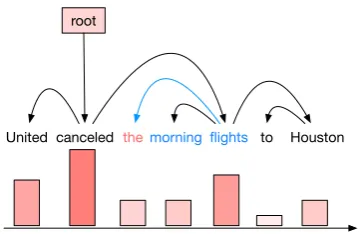
We define the phrase induced by a word based on the syntactic heights. Consider two words xi andxk. xkbelongs to the phrase induced byxiif and only if for anyj ∈(i, k),hj < max(hi, hk). For example, in Figure 1, the phrase induced by the red marked wordtheis “the morning flights”, since the syntactic height of the word morning,
hmorning < hf lights. However, the word “to” does not belong to the phrase becausehf lightsis higher than both hthe and hto. The induced phrase and the inducing dependency connection are labeled in blue in the figure.
Note that this definition of an induced phrase does not necessarily correspond to a phrase in the syntactic constituency sense. For instance, the words “to Houston” would be included in the phrase “the morning flights to Houston” in a tra-ditional syntactic tree. Given the definition of induced phrases, we propose phrase segmenting conditions (PSCs) to find the last word of an in-duced phrase. Considering the inin-duced phrase of thei-th word,si = [xi, xi+1,· · ·, xj]. Ifxj is not the last word of a given sentence, there are two conditions thatxj should satisfy:
1. (PSC-1) The syntactic height of xj must be higher than the height ofxi, that is
hj−hi >0 (3)
2. (PSC-2) The syntactic height ofxj+1 should
be lower thatxj.
hj −hj+1 >0 (4)
Given the PSCs, we can decide the induced phrases for the sentence shown in Figure1. The last word of the phrase induced by “United” is
[image:3.595.323.504.64.181.2]United canceled themorning flights to Houston root
Figure 1: Groundtruth dependency tree and syntactic heights of each word.
“canceled”, and the last word of the phrase in-duced by “flights” is “Houston”. For the word assigned the highest syntactic height, its induced phrase is all remaining words in the sentence.
4 Model
In this work, we formulate multi-layer neural lan-guage models as a two-part framework. For exam-ple, in a two-layer LSTM language model (Merity et al.,2017), we use the first layer as phrase gen-erator and the last layer as a word gengen-erator:
[c1, c2,· · ·, cT] =RN N1([x1, x2,· · ·, xT]) (5)
[y1, y2,· · ·, yT] =RN N2([c1, c2,· · ·, cT]) (6)
For a L-layer network, we can regard the first
L1 layers as the phrase generator and the next
L2 = L−L1 layers as the word generator. Note
that we use yi to represent the hidden state out-put by the second layer instead of hi, since hi in our work is defined as the syntactic height of
xi. In the traditional setting, the first layer does not explicitly learn the semantics of the following phrase because there is no extra objective function for phrase learning.
United canceled
the
morning
flights
to
Houston
Phrase Generator
Step 1. Syntactic height and phrase induction
morning flights
Step2. Phrase embedding with headword attention
Word Generator
Context-phrase alignment
next-word embedding:
morning
Context-word alignment
Objective Function
Step 3. Phrase and word prediction
[image:4.595.89.508.66.211.2]Phrase Embedding: morning flights
Figure 2: The 3-step diagram of our approach. The current target word is “the”, the induced phrase is “morning flights”, and the next word is “morning”. The context-phrase and context-word alignments are jointly trained.
4.1 Phrase Segmentation
We calculate the syntactic height and predict the induced phrase for each word:
hi =T CN([xi−n, xi−n+1,· · ·, xi]) (7)
where T CN(·) stands for the TCN model de-scribed in Equations (1) and (2), andnis the width of the convolution window.
Based on the proposed phrase segmenting con-ditions (PSCs) described in the previous section, we predict the probability of a word being the first word outside a induced phrase. Firstly, we decide if each word,xj−1, j ∈(i+ 1, n], satisfies the two phrase segmenting conditions, PSC-1 and PSC-2. The probability thatxj satisfies PSC-1 is
p1psc(xj) = 1 2·(f
HT(h
j−hi) + 1) (8)
Similarly, the probability thatxj satisfies PSC-2 is
p2psc(xj) = 1 2 ·(f
HT(h
j −hj+1) + 1) (9)
wherefHT stands for the HardTanh function with a temperaturea:
fHT(x) =
−1 x≤ −1a
a·x −1a < x≤ a1
1 x > 1a
This approach is inspired by the context attention method proposed in the PRPN model (Shen et al., 2017).
Then we can infer the probability of whether a word belongs to the induced phrase ofxiwith
pind(xj) = j
Y
k=1
ˆ
p(xk) (10)
where pind(xi) stands for the probability that xi belongs to the induced phrase, and
ˆ p(xk)=
1 k≤i+ 1
1−p1psc(xk−1)·p2psc(xk−1) k > i+ 1
Note that the factorization in Equation10assumes that words are independently likely to be included in the induced phrase ofxi.
4.2 Phrase Embedding with Attention
Given induced phrases, we can calculate their em-beddings based on syntactic heights. To calculate the embedding of phrases= [x1, x2,· · ·, xn], we calculate an attention distribution over the phrase:
αi=
hi·pind(xi) +c
P
jhj·pind(xj) +c
(11)
wherehi stands for the syntactic height for word
xi andc is a constant real number for smoothing the attention distribution. Then we generate the phrase embedding with a linear transformation:
s=W ·X
i
αi·ei (12)
whereei is the word embedding ofxi. In training, we apply a dropout layer ons.
4.3 Phrase and Word Prediction
A traditional language model learns the probabil-ity of a sequence of words:
p(x1, x2,· · ·, xn) =p(x1)·Y
i
p(xi+1|xi1) (13)
where xi
1 stands for x1, x2,· · ·, xi, which is the
context used for predicting the next word, xi+1.
is calculated with the output of the top layer of a neural networkyi and the word representations
ei+1learned by the decoding layer:
p(xi+1) =Sof tmax(eTi+1·yi) (14)
The state-of-the-art neural language models contain multiple layers. The outputs of different hidden layers capture different level of semantics of the context. In this work, we force one of the hidden layers to align its output with the embed-dings of induced phrases si. We apply an em-bedding model similar to Mikolov et al. (2013) to train the hidden output and phrase embedding alignment. We define the context-phrase align-ment model as follows.
We first define the probability that a phrasephi can be induced by context[x1, . . . , xi].
p(phi|xi1) =σ(cTi ·si) (15)
whereσ(x) = 1+1e−x, andci stands for the con-text embedding ofx1, x2,· · ·, xi output by a hid-den layer, defined in Equation5. si is the gener-ated embedding of an induced phrase. The proba-bility that a phrasephi cannot be induced by con-text[x1, . . . , xi]is1−p(phi|xi1). This approach
follows the method for learning word embeddings proposed inMikolov et al.(2013).
We use an extra objective function and the neg-ative sampling strategy to align context represen-tations and the embeddings of induced phrases. Given the context embedding ci, the induced phrase embedding si, and random sampled neg-ative phrase embeddings snegi , we train the neu-ral network to maximize the likelihood of true in-duced phrases and minimize the likelihood of neg-ative samples. we define the following objective function for contexti:
lCP Ai = 1−σ(cTi ·si) + 1
n
n
X
j=1
σ(cTi ·snegj ) (16)
where n stands for the number of negative sam-ples. With this loss function, the model learns to maximize the similarity between the context and true induced phrase embeddings, and mini-mize the similarity between the context and neg-ative samples randomly selected from the induced phrases of other words. In practice, this loss func-tion is used as a regularizafunc-tion term with a coeffi-cientγ:
l=lLM +γ·lCP A (17)
It worth noting that our approach is model-agnostic and and can be applied to various ar-chitectures. The TCN network for calculating the syntactic heights and phrase inducing is an independent module. In context-phrase align-ment training with negative sampling, the objec-tive function provides phrase-aware gradients and does not change the word-by-word generation pro-cess of the language model.
5 Experiments
We evaluate our model with word-level language modeling tasks on Penn Treebank (PTB;Mikolov et al., 2010), Wikitext-2 (WT2; Bradbury et al., 2016), and Wikitext-103 (WT103; Merity et al., 2016) corpora.
The PTB dataset has a vocabulary size of 10,000 unique words. The entire corpus includes roughly 40,000 sentences in the training set, and more than 3,000 sentences in both valid and test set.
The WT2 data is about two times larger the the PTB dataset. The dataset consists of Wikipedia articles. The corpus includes 30,000 unique words in its vocabulary and is not cleaned as heavily as the PTB corpus.
The WT103 corpus contains a larger vocabulary and more articles than WT2. It consists of 28k articles and more than 100M words in the training set. WT2 and WT103 corpora can evaluate the ability of capturing long-term dependencies (Dai et al.,2018).
In each corpus, we apply our approach to publicly-available, state-of-the-art models. This demonstrates that our approach can improve dif-ferent existing architectures. Our trained models will be published for downloading. The imple-mentation of our models is publicly available.1
5.1 Penn Treebank
We train a 3-layer AWD-LSTM language model (Merity et al., 2017) on PTB data set. We use 1,150 as the number of hidden neurons and 400 as the size of word embeddings. We also apply the word embedding tying strategy (Inan et al.,2016). We apply variational dropout for hidden states (Gal and Ghahramani,2016) and the dropout rate is 0.25. We also apply weight dropout (Merity et al.,2017) and set weight dropout rate as 0.5. We apply stochastic gradient descent (SGD) and av-eraged SGD (ASGD;Polyak and Juditsky,1992)
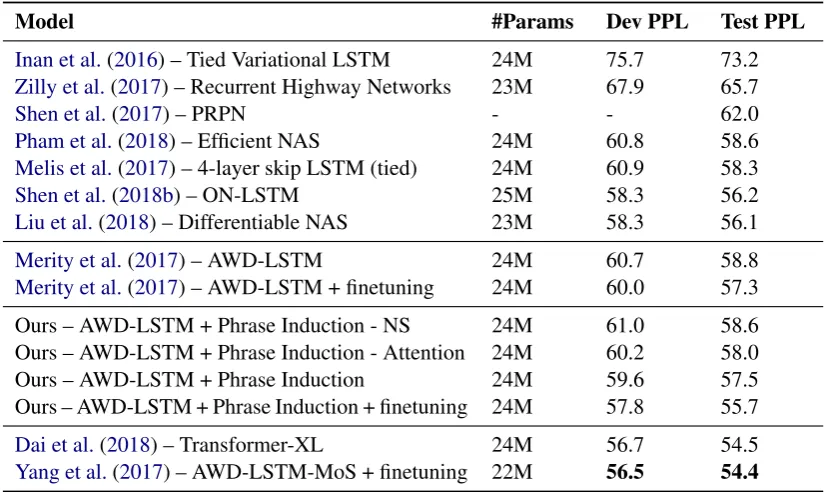
Model #Params Dev PPL Test PPL
Inan et al.(2016) – Tied Variational LSTM 24M 75.7 73.2 Zilly et al.(2017) – Recurrent Highway Networks 23M 67.9 65.7
Shen et al.(2017) – PRPN - - 62.0
Pham et al.(2018) – Efficient NAS 24M 60.8 58.6 Melis et al.(2017) – 4-layer skip LSTM (tied) 24M 60.9 58.3 Shen et al.(2018b) – ON-LSTM 25M 58.3 56.2 Liu et al.(2018) – Differentiable NAS 23M 58.3 56.1
Merity et al.(2017) – AWD-LSTM 24M 60.7 58.8 Merity et al.(2017) – AWD-LSTM + finetuning 24M 60.0 57.3
Ours – AWD-LSTM + Phrase Induction - NS 24M 61.0 58.6
Ours – AWD-LSTM + Phrase Induction - Attention 24M 60.2 58.0
Ours – AWD-LSTM + Phrase Induction 24M 59.6 57.5
Ours – AWD-LSTM + Phrase Induction + finetuning 24M 57.8 55.7
[image:6.595.92.505.62.308.2]Dai et al.(2018) – Transformer-XL 24M 56.7 54.5 Yang et al.(2017) – AWD-LSTM-MoS + finetuning 22M 56.5 54.4
Table 1: Experimental results on Penn Treebank dataset. Compared with the AWD-LSTM baseline models, our method reduced the perplexity on test set by 1.6.
Model #Params Dev PPL Test PPL
Inan et al.(2016) – Variational LSTM (tied) 28M 92.3 87.7 Inan et al.(2016) – VLSTM + augmented loss 28M 91.5 87.0
Grave et al.(2016) – LSTM - - 99.3
Grave et al.(2016) – LSTM + Neural cache - - 68.9 Melis et al.(2017) – 1-Layer LSTM 24M 69.3 69.9 Melis et al.(2017) – 2-Layer Skip Conn. LSTM 24M 69.1 65.9
Merity et al.(2017) – AWD-LSTM + finetuning 33M 68.6 65.8
Ours – AWD-LSTM + Phrase Induction 33M 68.4 65.2
Ours – AWD-LSTM + Phrase Induction + finetuning 33M 66.9 64.1
Table 2: Experimental results on Wikitext-2 dataset.
for training. The learning rate is 30 and we clip the gradients with a norm of 0.25. For the phrase induction model, we randomly sample 1 negative sample for each context, and the context-phrase alignment loss is given a coefficient of 0.5. The output of the second layer of the neural network is used for learning context-phrase alignment, and the final layer is used for word generation.
We compare the word-level perplexity of our model with other state-of-the-art models and our baseline is AWD-LSTM (Merity et al.,2017). The experimental results are shown in Table 1. Al-though not as good as the Transformer-XL model (Dai et al., 2018) and the mixture of softmax model (Yang et al.,2017), our model significantly
improved the AWD-LSTM, reducing 2.2 points of perplexity on the validation set and 1.6 points of perplexity on the test set. Note that the “finetun-ing” process stands for further training the lan-guage models with ASGD algorithm (Merity et al., 2017).
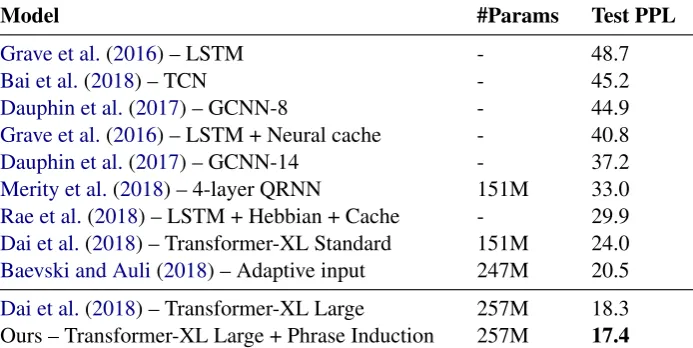
[image:6.595.89.505.354.513.2]Model #Params Test PPL
Grave et al.(2016) – LSTM - 48.7
Bai et al.(2018) – TCN - 45.2
Dauphin et al.(2017) – GCNN-8 - 44.9 Grave et al.(2016) – LSTM + Neural cache - 40.8 Dauphin et al.(2017) – GCNN-14 - 37.2 Merity et al.(2018) – 4-layer QRNN 151M 33.0 Rae et al.(2018) – LSTM + Hebbian + Cache - 29.9 Dai et al.(2018) – Transformer-XL Standard 151M 24.0 Baevski and Auli(2018) – Adaptive input 247M 20.5
[image:7.595.128.475.65.239.2]Dai et al.(2018) – Transformer-XL Large 257M 18.3 Ours – Transformer-XL Large + Phrase Induction 257M 17.4
Table 3: Experimental results on Wikitext-103 dataset.
phrases to align with the context embedding. It is also indicated that the negative sampling strat-egy can improve the performance by 1.1 perplex-ity. Hence we just test the full model in the fol-lowing experiments.
5.2 Wikitext-2
We also trained a 3-layer AWD-LSTM language model on the WT2 dataset. The network has the same input size, output size, and hidden size as the model we applied on PTB dataset, following the experiments done byMerity et al. (2017). Some hyper-parameters are different from the PTB lan-guage model. We use a batch size of 60. The embedding dropout rate is 0.65 and the dropout rate of hidden outputs is set to 0.2. Other hyper-parameters are the same as we set in training on the PTB dataset.
The experimental results are shown in Table2. Our model improves the AWD-LSTM model by reducing 1.7 points of perplexity on both the val-idation and test sets, while we did not make any change to the architecture of the AWD-LSTM lan-guage model.
5.3 Wikitext-103
The current state-of-the-art language model trained on Wikitext-103 dataset is the Transformer-XL (Dai et al.,2018). We apply our method on the state-of-the-art Transformer-XL Large model, which has 18 layers and 257M parameters. The input size and hidden size are 1024. 16 attention heads are used. We regard the first 14 layers as the phrase generator and the last 4 layers as the word generator. In other words,
the context-phrase alignment is trained with the outputs of the 14th layer.
The model is trained on 4 Titan X Pascal GPUs, each of which has 12G memory. Because of the limitation of computational resources, we use our approach to fine-tune the officially released pre-trained Transformer-XL Large model for 1 epoch. The experimental results are shown in Table 3. Our approach got 17.4 perplexity with the offi-cially released evaluation scripts, significantly out-performing all baselines and achieving new state-of-the-art performance2.
6 Discussion
In this section, we show what is learned by training language models with the context-phrase align-ment objective function by visualizing the syn-tactic heights output by the TCN model and the phrases induced by each target word in a sentence. We also visualize the headword attentions over the induced phrase.
The first example is the sentence showed in Fig-ure1. The sentence came fromJurafsky and Mar-tin (2014) and did not appear in our training set. Figure 1 shows the syntactic heights and the in-duced phrase of “the” according to the ground-truth dependency information. Our model is not given such high-quality inputs in either training or evaluation.
Figure3visualizes the structure learned by our phrase induction model. The inferred syntactic heights are shown in Figure3a. Heights assigned
2We did not show Dev PPLs in Table 3since only the
United canceled
the mor
ning flights to Houston Predictions Groundtruth
(a) Syntactic heights of each word.
unitedcanceled themorning flights to
houston
united canceled the morning flights to
0.0 1.0 0.0 0.0 0.0 0.0 0.0 0.0 0.0 0.12 0.32 0.34 0.03 0.19 0.0 0.0 0.0 0.48 0.52 0.0 0.0 0.0 0.0 0.0 0.0 1.0 0.0 0.0 0.0 0.0 0.0 0.0 0.0 0.12 0.88 0.0 0.0 0.0 0.0 0.0 0.0 1.0
[image:8.595.121.489.63.210.2](b) Induced phrases and headword attentions.
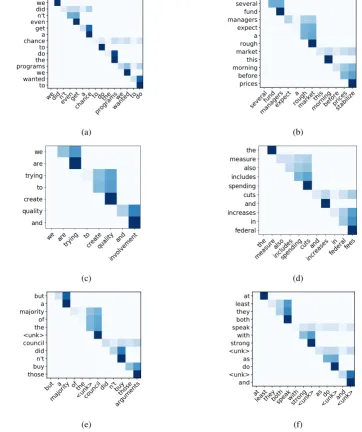
Figure 3: Examples of induced phrases and corresponding headword attention for generating the phrase embed-ding. The word of each row stands for the target word as the current input of the language model, and the values in each row in the matrices stands for the words consisting the induced phrase and their weights.
wedidn'tevenget achancetodothe programs
we wantedtodo
we did n't even get a chance to do the programs we wanted to
(a)
severalmanagersfundexpectroughamarketmorningthisbeforepricesstabilize
several fund managers expect a rough market this morning before prices
(b)
(c) (d)
but a
majority ofthe<unk>councildid n'tbuythosearguments
but a majority of the <unk> council did n't buy those
(e)
at
leasttheybothspeakwithstrong<unk>as do<unk>and<unk>
at least they both speak with strong <unk> as do <unk> and
(f)
[image:8.595.106.469.288.721.2]to words “the” and “to” are significantly lower than others, while the verb “canceled” is assigned the highest in the sentence. Induced phrases are shown in Figure3b. The words at the beginning of each row stand for the target word of each step. Values in the matrix stand for attention weights for calculating phrase embedding. The weights are calculated with the phrase segmenting condi-tions (PSC) and the syntactic heights described in Equations 8 to11. For the target word “united”,
hunited < hcanceled andhcanceled > hthe, hence the induced phrase of “united” is a single word “canceled”, and the headword attention of “can-celed” is 1, which is indicated in the first row of Figure 3b. The phrase induced by “canceled” is the entire following sequence, “the morning flights to houston”, since no following word has a higher syntactic height than the target word. It is also shown that the headword of the induced phrase of “canceled” is “flights”, which agrees with the de-pendency structure indicated in Figure1.
More examples are shown in Figure4. Figures 4a to4dshow random examples without any un-known word, while the examples shown in Figures 4e and 4f are randomly selected from sentences with unknown words, which are marked with the UNK symbol. The examples show that the phrase induction model does not always predict the exact structure represented by the dependency tree. For example, in Figure 4b, the TCN model assigned the highest syntactic height to the word “market” and induced the phrase “expect a rough market” for the context “the fund managers”. However, in a ground-truth dependency tree, the verb “expect” is the word directly connected to the root node and therefore has the highest syntactic height.
Although not exactly matching linguistic de-pendency structures, the phrase-level structure predictions are reasonable. The segmentation is interpretable and the predicted headwords are ap-propriate. In Figure 4c, the headwords are “try-ing”, “quality”, and “involvement”. The model is also robust with unknown words. In Figure 4e, “the<unk>council” is segmented as the induced phrase of “but a majority of”. In this case, the model recognized that the unknown word is de-pendent on “council”.
The sentence in Figure 4f includes even more unknown words. However, the model still cor-rectly predicted the root word, the verb “speak”. For the target word “with”, the induced phrase is
“strong <unk>”. Two unknown words are lo-cated in the last few words of the sentence. The model failed to induce the phrase “<unk> and
<unk>” for the word “do”, but still successfully split “<unk>” and “and”. Meanwhile, the atten-tions over the phrases induced by “speak”, “do”, and the first “<unk>” are not quite informative, suggesting that unknown words made some diffi-culties for headword prediction in this example. However, the unknown words are assigned sig-nificantly higher syntactic heights than the word “and”.
7 Conclusion
In this work, we improved state-of-the-art lan-guage models by aligning context and induced phrases. We defined syntactic heights and phrase segmentation rules. The model generates phrase embeddings with headword attentions. We im-proved the AWD-LSTM and Transformer-XL lan-guage models on different data sets and achieved state-of-the-art performance on the Wikitext-103 corpus. Experiments showed that our model suc-cessfully learned approximate phrase-level knowl-edge, including segmentation and headwords, without any annotation. In future work, we aim to capture better structural information and possible connections to unsupervised grammar induction.
References
Alexei Baevski and Michael Auli. 2018. Adaptive in-put representations for neural language modeling.
arXiv preprint arXiv:1809.10853.
Dzmitry Bahdanau, Kyunghyun Cho, and Yoshua Ben-gio. 2014. Neural machine translation by jointly learning to align and translate. arXiv preprint arXiv:1409.0473.
Shaojie Bai, J Zico Kolter, and Vladlen Koltun. 2018. An empirical evaluation of generic convolu-tional and recurrent networks for sequence model-ing.arXiv preprint arXiv:1803.01271.
Yoshua Bengio, R´ejean Ducharme, Pascal Vincent, and Christian Jauvin. 2003. A neural probabilistic lan-guage model. Journal of machine learning research, 3(Feb):1137–1155.
James Bradbury, Stephen Merity, Caiming Xiong, and Richard Socher. 2016. Quasi-recurrent neural net-works. arXiv preprint arXiv:1611.01576.
Zihang Dai, Zhilin Yang, Yiming Yang, William W Cohen, Jaime Carbonell, Quoc V Le, and Ruslan Salakhutdinov. 2018. Transformer-xl: Language modeling with longer-term dependency.
Yann N Dauphin, Angela Fan, Michael Auli, and David Grangier. 2017. Language modeling with gated con-volutional networks. In Proceedings of the 34th International Conference on Machine Learning-Volume 70, pages 933–941. JMLR. org.
Chris Dyer, Adhiguna Kuncoro, Miguel Ballesteros, and Noah A Smith. 2016. Recurrent neural network grammars. arXiv preprint arXiv:1602.07776.
Yarin Gal and Zoubin Ghahramani. 2016. A theoret-ically grounded application of dropout in recurrent neural networks. InAdvances in neural information processing systems, pages 1019–1027.
Edouard Grave, Armand Joulin, and Nicolas Usunier. 2016. Improving neural language models with a continuous cache. arXiv preprint arXiv:1612.04426.
Sepp Hochreiter and J¨urgen Schmidhuber. 1997. Long short-term memory. Neural computation, 9(8):1735–1780.
Hakan Inan, Khashayar Khosravi, and Richard Socher. 2016. Tying word vectors and word classifiers: A loss framework for language modeling. arXiv preprint arXiv:1611.01462.
Dan Jurafsky and James H Martin. 2014. Speech and language processing, volume 3. Pearson London.
Yoon Kim, Yacine Jernite, David Sontag, and Alexan-der M Rush. 2016. Character-aware neural language models. InThirtieth AAAI Conference on Artificial Intelligence.
Hanxiao Liu, Karen Simonyan, and Yiming Yang. 2018. Darts: Differentiable architecture search.
arXiv preprint arXiv:1806.09055.
G´abor Melis, Charles Blundell, Tom´aˇs Koˇcisk`y, Karl Moritz Hermann, Chris Dyer, and Phil Blun-som. 2018. Pushing the bounds of dropout. arXiv preprint arXiv:1805.09208.
G´abor Melis, Chris Dyer, and Phil Blunsom. 2017. On the state of the art of evaluation in neural language models. arXiv preprint arXiv:1707.05589.
Stephen Merity, Nitish Shirish Keskar, and Richard Socher. 2017. Regularizing and optimizing lstm lan-guage models. arXiv preprint arXiv:1708.02182.
Stephen Merity, Nitish Shirish Keskar, and Richard Socher. 2018. An analysis of neural language modeling at multiple scales. arXiv preprint arXiv:1803.08240.
Stephen Merity, Caiming Xiong, James Bradbury, and Richard Socher. 2016. Pointer sentinel mixture models. arXiv preprint arXiv:1609.07843.
Tom´aˇs Mikolov, Martin Karafi´at, Luk´aˇs Burget, Jan ˇ
Cernock`y, and Sanjeev Khudanpur. 2010. Recurrent neural network based language model. InEleventh annual conference of the international speech com-munication association.
Tomas Mikolov, Ilya Sutskever, Kai Chen, Greg S Cor-rado, and Jeff Dean. 2013. Distributed representa-tions of words and phrases and their compositional-ity. InAdvances in neural information processing systems, pages 3111–3119.
Jeffrey Pennington, Richard Socher, and Christopher Manning. 2014. Glove: Global vectors for word representation. InProceedings of the 2014 confer-ence on empirical methods in natural language pro-cessing (EMNLP), pages 1532–1543.
Hieu Pham, Melody Y Guan, Barret Zoph, Quoc V Le, and Jeff Dean. 2018. Efficient neural architec-ture search via parameter sharing. arXiv preprint arXiv:1802.03268.
Boris T Polyak and Anatoli B Juditsky. 1992. Ac-celeration of stochastic approximation by averag-ing. SIAM Journal on Control and Optimization, 30(4):838–855.
Jack W Rae, Chris Dyer, Peter Dayan, and Tim-othy P Lillicrap. 2018. Fast parametric learn-ing with activation memorization. arXiv preprint arXiv:1803.10049.
Yikang Shen, Zhouhan Lin, Chin-Wei Huang, and Aaron Courville. 2017. Neural language model-ing by jointly learnmodel-ing syntax and lexicon. arXiv preprint arXiv:1711.02013.
Yikang Shen, Zhouhan Lin, Athul Paul Jacob, Alessan-dro Sordoni, Aaron Courville, and Yoshua Bengio. 2018a. Straight to the tree: Constituency pars-ing with neural syntactic distance. arXiv preprint arXiv:1806.04168.
Yikang Shen, Shawn Tan, Alessandro Sordoni, and Aaron Courville. 2018b. Ordered neurons: Integrat-ing tree structures into recurrent neural networks.
arXiv preprint arXiv:1810.09536.
Ke Tran, Arianna Bisazza, and Christof Monz. 2016. Recurrent memory networks for language modeling.
arXiv preprint arXiv:1601.01272.
Ashish Vaswani, Noam Shazeer, Niki Parmar, Jakob Uszkoreit, Llion Jones, Aidan N Gomez, Łukasz Kaiser, and Illia Polosukhin. 2017. Attention is all you need. InAdvances in Neural Information Pro-cessing Systems, pages 5998–6008.