2726
Avoiding Reasoning Shortcuts: Adversarial Evaluation, Training, and
Model Development for Multi-Hop QA
Yichen Jiang and Mohit Bansal
UNC Chapel Hill
{yichenj, mbansal}@cs.unc.edu
Abstract
Multi-hop question answering requires a model to connect multiple pieces of evidence scattered in a long context to answer the ques-tion. In this paper, we show that in the multi-hop HotpotQA (Yang et al., 2018) dataset, the examples often contain reasoning shortcuts through which models can directly locate the answer by word-matching the question with a sentence in the context. We demonstrate this issue by constructing adversarial documents that create contradicting answers to the short-cut but do not affect the validity of the origi-nal answer. The performance of strong base-line models drops significantly on our adver-sarial evaluation, indicating that they are in-deed exploiting the shortcuts rather than per-forming multi-hop reasoning. After adversar-ial training, the baseline’s performance im-proves but is still limited on the adversarial evaluation. Hence, we use a control unit that dynamically attends to the question at differ-ent reasoning hops to guide the model’s multi-hop reasoning. We show that this 2-multi-hop model trained on the regular data is more robust to the adversaries than the baseline model. Af-ter adversarial training, this 2-hop model not only achieves improvements over its counter-part trained on regular data, but also outper-forms the adversarially-trained 1-hop baseline. We hope that these insights and initial im-provements will motivate the development of new models that combine explicit composi-tional reasoning with adversarial training.1
1 Introduction
The task of question answering (QA) requires the model to answer a natural language question by finding relevant information in a given natural lan-guage context. Most QA datasets require single-hop reasoning only, which means that the evidence
1Our code and data are publicly available at:
https://github.com/jiangycTarheel/ Adversarial-MultiHopQA
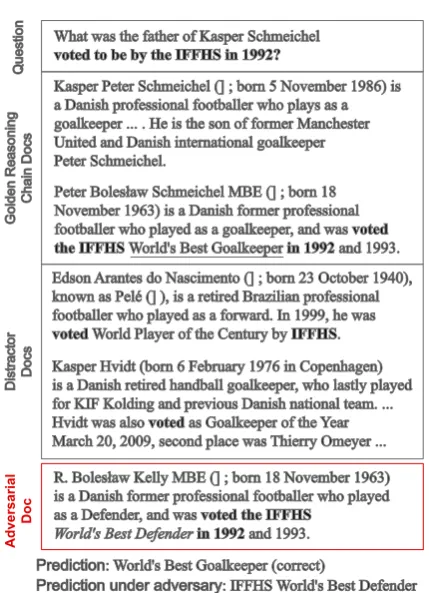
What was the father of Kasper Schmeichel voted to be by the IFFHS in 1992?
R. Bolesław Kelly MBE (] ; born 18 November 1963) is a Danish former professional footballer who played as a Defender, and was voted the IFFHS
World's Best Defender in 1992 and 1993.
Kasper Peter Schmeichel (] ; born 5 November 1986) is a Danish professional footballer who plays as a goalkeeper ... . He is the son of former Manchester United and Danish international goalkeeper Peter Schmeichel.
Edson Arantes do Nascimento (] ; born 23 October 1940), known as Pelé (] ), is a retired Brazilian professional footballer who played as a forward. In 1999, he was voted World Player of the Century by IFFHS.
Peter Bolesław Schmeichel MBE (] ; born 18 November 1963) is a Danish former professional footballer who played as a goalkeeper, and was voted the IFFHS World's Best Goalkeeper in 1992 and 1993.
Kasper Hvidt (born 6 February 1976 in Copenhagen) is a Danish retired handball goalkeeper, who lastly played for KIF Kolding and previous Danish national team. ... Hvidt was also voted as Goalkeeper of the Year March 20, 2009, second place was Thierry Omeyer ...
Prediction: World's Best Goalkeeper (correct)
Q
ue
st
io
n
G
ol
de
n R
ea
so
ni
ng
C
ha
in
D
oc
s
D
is
tr
ac
to
r
D
oc
s
Ad
versari
al
Do
c
[image:1.595.308.523.214.511.2]Prediction under adversary: IFFHS World's Best Defender
Figure 1: HotpotQA example with a reasoning short-cut, and our adversarial document that eliminates this shortcut to necessitate multi-hop reasoning.
necessary to answer the question is concentrated in a single sentence or located closely in a single paragraph (Q: “What’s the color of the sky?”, Con-text: “The sky is blue.”, Answer: “Blue”). Such datasets emphasize the role of matching and align-ing information between the question and the con-text (“sky→sky, color→blue”). Previous works have shown that models with strong question-aware context representation (Seo et al., 2017;
Xiong et al.,2017) can achieve suhuman per-formance on single-hop QA tasks like SQuAD (Rajpurkar et al.,2016,2018).
as QAngaroo (Welbl et al., 2017) and Hot-potQA (Yang et al., 2018), have been proposed to further assess QA systems’ ability to perform composite reasoning. In this setting, the informa-tion required to answer the quesinforma-tion is scattered in the long context and the model has to connect mul-tiple evidence pieces to pinpoint to the final an-swer. Fig.1shows an example from the HotpotQA dev set, where it is necessary to consider infor-mation in two documents to infer the hidden rea-soning chain “Kasper Schemeichel −−−−→son of Peter Schemeichel −−−−−→voted as World’s Best Goalkeeper” that leads to the final answer. However, in this example, one may also arrive at the correct an-swer by matching a few keywords in the question (“voted, IFFHS, in 1992”) with the corresponding fact in the context without reasoning through the first hop to find “father of Kasper Schmeichel”, as neither of the two distractor documents con-tains sufficient distracting information about an-other person “voted as something by IFFHS in 1992”. Therefore, a model performing well on the existing evaluation does not necessarily suggest its strong compositional reasoning ability. To truly promote and evaluate a model’s ability to perform multi-hop reasoning, there should be no such “rea-soning shortcut” where the model can locate the answer with single-hop reasoning only. This is a common pitfall when collecting multi-hop exam-ples and is difficult to address properly.
In this work, we improve the original HotpotQA distractor setting2by adversarially generating bet-ter distractor documents that make it necessary to perform multi-hop reasoning in order to find the correct answer. As shown in Fig. 1, we apply phrase-level perturbations to the answer span and the titles in the supporting documents to create the adversary with a new title and a fake answer to confuse the model. With the adversary added to the context, it is no longer possible to locate the correct answer with the single-hop shortcut, which now leads to two possible answers (“World’s Best Goalkeeper” and “World’s Best Defender”). We evaluate the strong “Bi-attention + Self-attention” model (Seo et al.,2017;Wang et al.,2017) from
Yang et al. (2018) on our constructed adversar-ial dev set (adv-dev), and find that its EM score drops significantly. In the example in Fig.1, the
2HotpotQA has a fullwiki setting as an open-domain QA
task. In this work, we focus on the distractor setting as it pro-vides a less noisy environment to study machine reasoning.
model is confused by our adversary and predicts the wrong answer (“World’s Best Defender”). Our experiments further reveal that when strong su-pervision of the supporting facts that contain the evidence is applied, the baseline achieves a sig-nificantly higher score on the adversarial dev set. This is because the strong supervision encourages the model to not only locate the answer but also find the evidence that completes the first reason-ing hop and hence promotes robust multi-hop rea-soning behavior from the model. We then train the baseline with supporting fact supervision on our generated adversarial training set (adv-train) and observe significant improvement on adv-dev. However, the result is still poor compared to the model’s performance on the regular dev set be-cause this single-hop model is not well-designed to perform multi-hop reasoning.
To motivate and analyze some new multi-hop reasoning models, we propose an initial architec-ture by incorporating the recurrent control unit fromHudson and Manning(2018), which dynam-ically computes a distribution over question words at each reasoning hop to guide the multi-hop bi-attention. In this way, the model can learn to put the focus on “father of Kasper Schmeichel” at the first step and then attend to “voted by IFFHS in 1992” in the second step to complete this 2-hop reasoning chain. When trained on the regu-lar data, this 2-hop model outperforms the single-hop baseline in the adversarial evaluation, indi-cating improved robustness against adversaries. Furthermore, this 2-hop model, with or without supporting-fact supervision, can benefit from ad-versarial training and achieve better performance on adv-dev compared to the counterpart trained with the regular training set, while also outper-forming the adversarially-trained baseline. Over-all, we hope that these insights and initial improve-ments will motivate the development of new mod-els that combine explicit compositional reasoning with adversarial training.
2 Adversarial Evaluation
2.1 The HotpotQA Task
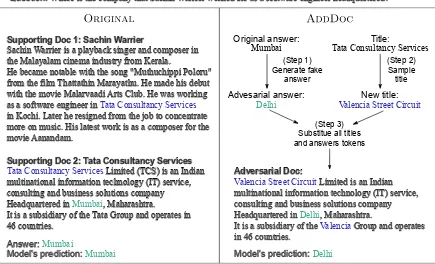
Supporting Doc 1: Sachin Warrier
Sachin Warrier is a playback singer and composer in the Malayalam cinema industry from Kerala.
He became notable with the song "Muthuchippi Poloru" from the film Thattathin Marayathu. He made his debut with the movie Malarvaadi Arts Club. He was working as a software engineer in Tata Consultancy Services in Kochi. Later he resigned from the job to concentrate more on music. His latest work is as a composer for the movie Aanandam.
Supporting Doc 2: Tata Consultancy Services
Tata Consultancy Services Limited (TCS) is an Indian multinational information technology (IT) service, consulting and business solutions company
Headquartered in Mumbai, Maharashtra.
It is a subsidiary of the Tata Group and operates in 46 countries.
Question: Where is the company that Sachin Warrier worked for as a software engineer headquartered?
Answer: Mumbai
Model's prediction: Mumbai
Adversarial Doc:
Valencia Street Circuit Limited is an Indian multinational information technology (IT) service, consulting and business solutions company
Headquartered in Delhi, Maharashtra.
It is a subsidiary of the Valencia Group and operates in 46 countries.
Model's prediction: Delhi
(Step 3) Substitue all titles and answers tokens
Original answer:
Mumbai
Advesarial answer: Delhi
(Step 1) Generate fake
answer
Title:
Tata Consultancy Services
New title:
[image:3.595.78.513.70.334.2]Valencia Street Circuit (Step 2) Sample title
Figure 2: An illustration of our ADDDOCprocedure. In this example, the keyword “headquarter” appears in no distractor documents. Thus the reader can easily infer the answer by looking for this keyword in the context.
given documents. Yang et al. (2018) then se-lect the top-8 documents from Wikipedia with the shortest bigram TF-IDF (Chen et al., 2017) dis-tance to the question as the distractors to form the context with a total of 10 documents. Since the crowd workers are not provided with distrac-tor documents when generating the question, there is no guarantee that both supporting documents are necessary to infer the answer given the entire context. The multi-hop assumption can be bro-ken by incompetent distractor documents in two ways. First, one of the selected distractors may contain all required evidence to infer the answer (e.g., “The father of Kasper Schmeichel was voted the IFFHS World’s Best Goalkeeper in 1992.”). Empirically, we find no such cases in HotpotQA, as Wiki article about one subject rarely discusses details of another subject. Second, the entire pool of distractor documents may not contain the in-formation to truly distract the reader/model. As shown in Fig. 1, one can directly locate the an-swer by looking for a few keywords in the question (“voted, IFFHS, in 1992”) without actually dis-covering the intended 2-hop reasoning path. We call this pattern of bypassing the first reasoning hop the “reasoning shortcut”, and we find such shortcuts exist frequently in the
non-comparison-type examples in HotpotQA.3 We randomly sam-ple 50 “bridge-type” questions in the dev set, and found that 26 of them contain this kind of reason-ing shortcut.
2.2 Adversary Construction
To investigate whether neural models exploit rea-soning shortcuts instead of exploring the desired reasoning path, we adapt the original examples in HotpotQA to eliminate these shortcuts. Given a context-question-answer tuple (C, q, a) that may contain a reasoning shortcut, the objective is to produce(C0, q, a)such that (1)ais still the valid answer to the new tuple, (2)C0is close to the origi-nal example, and (3) there is no reasoning shortcut that leads to a single answer. In HotpotQA, there is a subset of 2 supporting documentsP ⊂Cthat contains all evidence needed to infer the answer. To achieve this, we propose an adversary AD
-DDOC(illustrated in Fig.2) that constructs docu-mentsP0to get(ξ(C, P0), q, a)whereξis a func-tion that mixes the context and adversaries.
3
Suppose p2 ∈ P is a document containing the answeraandp1∈Pis the other supporting docu-ment.4 ADDDOCapplies a word/phrase-level per-turbation to p2 so that the generated p02 contains a fake answer that satisfies the reasoning short-cut but does not contradict the answer to the entire question (e.g., the adversarial document in Fig.2). First, for every non-stopword in the answer, we find the substitute within the top-10 closest words in GloVe (Pennington et al., 2014) 100-d vector space that doesn’t have an overlapping substring longer than 3 with the original answer (“Mumbai
→Delhi, Goalkeeper→Defender”). If this proce-dure fails, we randomly sample a candidate from the entire pool of answers in the HotpotQA dev set (e.g., “Rome” for Fig.2or “defence of the Cathe-dral” for Fig.1). We then replace the original an-swer in p2 with our generated answer to get p02. If the original answer spans multiple words, we substitute one non-stopword in the answer with the corresponding sampled answer word to cre-ate the fake answer (“World’s Best Goalkeeper→
World’s Best Defender”) and replace all mentions of the original answer inp02.
The resulting paragraphp02 provides an answer that satisfies the reasoning shortcut, but also con-tradicts the real answer to the entire question as it forms another valid reasoning chain connecting the question to the fake answer (“Sachin Warrier
workAt
−−−−→ TCS −at→ Delhi”). To break this contra-dicting reasoning chain, we need to replace the bridge entity that connects the two pieces of evi-dence (“Tata Consultancy Services” in this case) with another entity so that the generated answer no longer serves as a valid answer to the ques-tion. We replace the title of p02 with a candidate randomly sampled from all document titles in the HotpotQA dev set. If the title ofp1 appears inp02, we also replace it with another sampled title to en-tirely eliminate the connection betweenp02andp1. Empirically, we find that the title of eitherp1orp2 serves as the bridge entity in most examples. Note that it is possible that models trained on our adver-sarial data could simply learn new reasoning short-cuts in these adversaries by ignoring adversarial documents with randomly-sampled titles, because these titles never appear in any other document in the context. Hence, to eliminate this bias in
ti-4|P|= 2in HotpotQA. If both documents inP contain the answer, we apply ADDDOCtwice while alternating the choice ofp1andp2
tle occurrence, for each adversarial document, we additionally find another document from the entire dev set that contains the exact title of our adversar-ial document and add it to the context.5Every new document added to the context replaces an original non-supporting document so that the total number of documents in context remains unchanged. Note that ADDDOCadversaries are model-independent, which means that they require no access to the model or any training data, similar to the AD -DONESENTinJia and Liang(2017).
3 Models
3.1 Encoding
We first describe the pre-processing and encod-ing steps. We use a Highway Network ( Srivas-tava et al., 2015) of dimension v, which merges the character embedding and GloVe word embed-ding (Pennington et al., 2014), to get the word representations for the context and the question as x ∈ RJ×v and q ∈ RS×v where J and S
are the lengths of the context and question. We then apply a bi-directional LSTM-RNN ( Hochre-iter and Schmidhuber,1997) ofdhidden units to get the contextualized word representations for the context and question: h = BiLSTM(x); u = BiLSTM(q)so thath∈RJ×2dandu∈RS×2d. 3.2 Single-Hop Baseline
We use the bi-attention + self-attention model (Yang et al., 2018; Clark and Gard-ner,2018), which is a strong near-state-of-the-art6 model on HotpotQA. Given the contextualized encoding h,u for the context and question,
BiAttn(h,u) (Seo et al., 2017; Xiong et al.,
2017) first computes a similarity matrix MS×J
between every question and context word and use it to derive context-to-query attention:
Ms,j=W1us+W2hj+W3(ushj)
ps,j= PSexp(Ms,j) s=1exp(Ms,j)
cqj =
S
X
s=1 ps,jus
(1)
5Empirically, we find that our models trained on the
ad-versarial data without this final title-balancing step do not seem to be exploiting this new shortcut, because they still perform equally well on the title-balanced adversarial evalu-ation. However, we keep this final title-balancing step in our adversary-generation procedure so as to prevent future model families from exploiting this title shortcut.
RNN RNN
question bi-attention
RNN
RNN
self-attention
bi-attention
Word Emb Char Emb
context
Word Emb Char Emb
Query2Context Attention
S
of
tmax
W,b Previous
Control
W,b W,b
Control Unit
Contextualized word emb question
vector
Context2Query and Query2Context Attention
S
of
tmax
Context2Query Attention
Bridge-entity Supervision
RNN Start index
[image:5.595.77.525.62.230.2]RNN End index
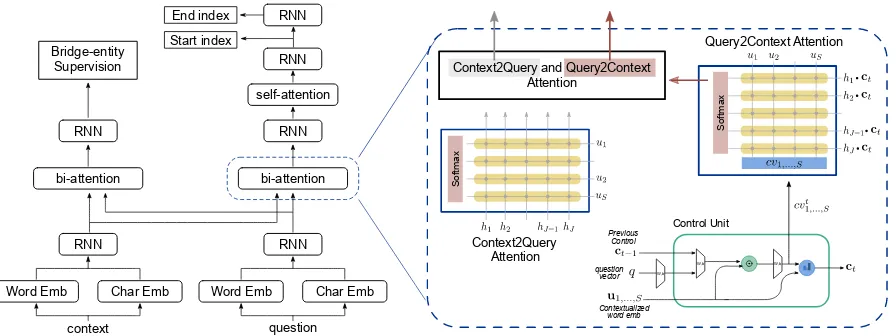
Figure 3: A 2-hop bi-attention model with a control unit. The Context2Query attention is modeled as inSeo et al. (2017). The output distributioncvof the control unit is used to bias the Query2Context attention.
where W1, W2 and W3 are trainable parameters, and is element-wise multiplication. Then the query-to-context attention vector is derived as:
mj = max1≤s≤SMs,j
pj =
exp(mj)
PJ
j=1exp(mj)
qc=
J
X
j=1 pjhj
(2)
We then obtain the question-aware context rep-resentation and pass it through another layer of
BiLSTM:
h0j = [hj;cqj;hjcqj;cqjqc]
h1 = BiLSTM(h0) (3)
where ; is concatenation. Self-attention is modeled uponh1asBiAttn(h1,h1)to produceh2. Then, we apply linear projection toh2to get the start in-dex logits for span prediction and the end inin-dex logits is modeled ash3 = BiLSTM(h2)followed by linear projection. Furthermore, the model uses a 3-way classifier onh3 to predict the answer as “yes”, “no”, or a text span. The model is addition-ally supervised to predict the sentence-level sup-porting fact by applying a binary classifier to every sentence onh2 after self-attention.
3.3 Compositional Attention over Question
To present some initial model insights for fu-ture community research, we try to improve the model’s ability to perform composite reasoning using a recurrent control unit (Hudson and Man-ning, 2018) that computes a distribution-over-word on the question at each hop. Intuitively, the
control unit imitates human’s behavior when an-swering a question that requires multiple reason-ing steps. For the example in Fig. 1, a human reader would first look for the name of “Kasper Schmeichel’s father”. Then s/he can locate the correct answer by finding what “Peter Schme-ichel” (the answer to the first reasoning hop) was “voted to be by the IFFHS in 1992”. Recall thatS, J are the lengths of the question and con-text. At each hop i, given the recurrent control stateci−1, contextualized question representation
u, and question’s vector representationq, the con-trol unit outputs a distributioncvover all words in the question and updates the stateci:
cqi= Proj[ci−1;q]; cai,s= Proj(cqius)
cvis= softmax(cais); ci = S
X
s=1
cvi,s·us
(4)
whereProjis the linear projection layer. The dis-tributioncv tells which part of the question is re-lated to the current reasoning hop.
Then we usecv andci to bias the BiAttn de-scribed in the single-hop baseline. Specifically, we use h ci to replace h in Eqn. 1, Eqn. 2,
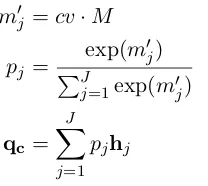
and Eqn.3. Moreover, after we compute the sim-ilarity matrix M between question and context words as in Eqn.1, instead of max-poolingM on the question dimension (as done in the single-hop bi-attention), we calculate the distribution overJ
m0j =cv·M
pj = exp(m
0
j)
PJ
j=1exp(m 0
j)
qc=
J
X
j=1 pjhj
(5)
The query-to-context attention vectorqc is
ap-plied to the following computation in Eqn. 3 to get the query-aware context representation. Here, with the output distribution from the control unit,
qcrepresents the context information that is most
relevant to the sub-question of the current rea-soning hop, as opposed to encoding the context most related to any question word in the origi-nal bi-attention. Overall, this model (illustrated in Fig. 3) combines the control unit from the state-of-the-art multi-hop VQA model and the widely-adopted bi-attention mechanism from text-based QA to perform composite reasoning on the con-text and question.
Bridge Entity Supervision However, even with the multi-hop architecture to capture a hop-specific distribution over the question, there is no supervision on the control unit’s output distribu-tioncvabout which part of the question is impor-tant to the current reasoning step, thus preventing the control unit from learning the composite rea-soning skill. To address this problem, we look for the bridge entity (defined in Sec.2.2) that connects the two supporting documents. We supervise the main model to predict the bridge entity span (“Tata Consultancy Services” in Fig.2) after the first bi-attention layer, which indirectly encourages the control unit to look for question information re-lated to this entity (“company that Sachin Warrier worked for as a software engineer”) at the first hop. For examples with the answer appearing in both supporting documents,7 the intermediate su-pervision is given as the answer appearing in the first supporting document, while the answer in the second supporting document serves as the answer-prediction supervision.
4 Experimental Setup
Adversarial Evaluation and Training For all the adversarial analysis in this paper, we construct four adversarial dev sets with different numbers of adversarial documents per supporting document
7This mostly happens for questions requiring checking
multiple facts of an entity.
Train Reg Reg Adv Adv
Eval Reg Adv Reg Adv
1-hop Base 42.32 26.67 41.55 37.65 1-hop Base + sp 43.12 34.00 45.12 44.65
2-hop 47.68 34.71 45.71 40.72
[image:6.595.133.237.58.151.2]2-hop + sp 46.41 32.30 47.08 46.87
Table 1: EM scores after training on the regular data or on the adversarial training set ADD4DOCS-RAND, and evaluation on the regular dev set or the ADD4DOCS -RANDadv-dev set. “1-hop Base” and ”2-hop” do not have sentence-level supporting-facts supervision.
containing answer (4 or 8) and mixing strategy (randomly insert or prepend). We name these 4 dev sets “Add4Docs-Rand”, “Add4Docs-Prep”, “Add8Docs-Rand”, and “Add8Docs-Prep”. For adversarial training, we choose the “Add4Docs-Rand” training set since it is shown inWang and Bansal(2018) that training with randomly inserted adversaries yields the model that is the most ro-bust to the various adversarial evaluation settings. In the adversarial training examples, the fake titles and answers are sampled from the original training set. We randomly select 40% of the adversarial ex-amples and add them to the regular training set to build our adversarial training set.
Dataset and Metrics We use the Hot-potQA (Yang et al., 2018) dataset’s distractor setting. We show EM scores rather than F1 scores because our generated fake answer usually has word-overlap with the original answer, but the overall result trends and take-away’s are the same even for F1 scores.
Training Details We use 300-d pre-trained GloVe word embedding (Pennington et al.,2014) and 80-d encoding LSTM-RNNs. The control unit of the 2-hop model has an 128-d internal state. We train the models using Adam (Kingma and Ba,
2014) optimizer, with an initial learning rate of 0.001. We keep exponential moving averages of all trainable variables in our models and use them during the evaluation.
5 Results
[image:6.595.317.520.63.135.2]A4D-R A4D-P A8D-R A8D-P
1-hop Base 37.65 37.72 34.14 34.84
1-hop Base + sp 44.65 44.51 43.42 43.59
2-hop 40.72 41.03 37.26 37.70
2-hop + sp 46.87 47.14 44.28 44.44
Table 2: EM scores on 4 adversarial evaluation set-tings after training on ADD4DOCS-RAND. ‘-R’ and ‘-P’ represent random insertion and prepending. A4D and A8D stands for ADD4DOCSand ADD8DOCS adv-dev sets.
in the first row, the single-hop baseline trained on regular data performs poorly on the adversar-ial evaluation, suggesting that it is indeed exploit-ing the reasonexploit-ing shortcuts instead of actually per-forming the multi-hop reasoning in locating the answer. After we add the supporting fact super-vision (2nd row in Table1), we observe a signif-icant improvement8(p< 0.001) on the adversar-ial evaluation, compared to the baseline without this strong supervision. However, this score is still more than 9 points lower than the model’s perfor-mance on the regular evaluation. Next, the 2-hop bi-attention model with the control unit obtains a higher EM score than the baseline in the adver-sarial evaluation, demonstrating better robustness against the adversaries. After this 2-hop model is additionally supervised to predict the sentence-level supporting facts, the performance in both regular and adversarial evaluation decreases a bit, but still outperforms both baselines in the regular evaluation (with stat. significance). One possible explanation for this performance drop is that the 2-hop model without the extra task of predicting supporting facts overfits to the task of the final an-swer prediction, thus achieving higher scores.
Adversarially-Trained Models We further train all four models with the adversarial training set, and the results are shown in the last two columns in Table 1. Comparing the numbers horizontally, we observe that after adversarial training, both the baselines and the 2-hop models with control unit gained statistically significant9 improvement on the adversarial evaluations. Comparing the numbers in Table 1 vertically, we show that the 2-hop model (row 3) achieves significantly (p-value< 0.001) better results than the baseline (row 1) on both regular and
adver-8
All stat. signif. is based on bootstrapped randomization test with 100K samples (Efron and Tibshirani,1994).
9Statistical significance of p<0.01.
Train Regular Regular Adv Adv
Eval Regular Adv Regular Adv
2-hop 47.68 34.71 45.71 40.72
2-hop - Ctrl 46.12 32.46 45.20 40.32 2-hop - Bridge 43.31 31.80 41.90 37.37
1-hop Base 42.32 26.67 41.55 37.65
Table 3: Ablation for the Control unit and Bridge-entity supervision, reported as EM scores after training on the regular or adversarial ADD4DOCS-RANDdata, and evaluation on regular dev set and ADD4DOCS-RAND
adv-dev set. Note that 1-hop Base is same as 2-hop without both control unit and bridge-entity supervision.
sarial evaluation. After we add the sentence-level supporting-fact supervision, the 2-hop model (row 4) obtains further improvements in both regular and adversarial evaluation. Overall, we hope that these initial improvements will motivate the development of new models that combine explicit compositional reasoning with adversarial training.
Adversary Ablation In order to test the robust-ness of the adversarially-trained models against new adversaries, we additionally evaluate them on dev sets with varying numbers of adversarial doc-uments and a different adversary placement strat-egy elaborated in Sec. 4. As shown in the first two columns in Table2, neither the baselines nor the 2-hop models are affected when the adversarial documents are pre-pended to the context. When the number of adversarial documents per support-ing document with answer is increased to eight, all four models’ performance drops by more than 1 points, but again the 2-hop model, with or with-out supporting-fact supervision, continues to with- out-perform its single-hop counterpart.
Control Unit Ablation We also conduct an ab-lation study on the 2-hop model by removing the control unit. As shown in the first two rows of Ta-ble3, the model with the control unit outperforms the alternative in all 4 settings with different train-ing and evaluation data combinations. The results validate our intuition that the control unit can im-prove the model’s multi-hop reasoning ability and robustness against adversarial documents.
super-vision, using 2 unshared layers of bi-attention (2-hop - Bridge), as opposed to our previous model with 2 parallel, shared layers of bi-attention. As shown in Table3, both the 2-hop and 1-hop mod-els without the bridge-entity supervision suffer large drops in the EM scores, suggesting that in-termediate supervision is important for the model to learn the compositional reasoning behavior.
6 Analysis
In this section, we seek to understand the behavior of the model under the influence of the adversar-ial examples. FollowingJia and Liang(2017), we focus on examples where the model predicted the correct answer on the regular dev set. This portion of the examples is divided into “model-successes” — where the model continues to predict the cor-rect answer given the adversarial documents, and “model-failures” — where the model makes the wrong prediction on the adversarial example.
Manual Verification of Adversaries We first verify that the adversarial documents do not con-tradict the original answer. As elaborated in Sec. 2.2, we assume that the bridge entity is the title of a supporting document and substitute it with another title sampled from the training/dev set. Thus, the contradiction could arise when the adversarial documentp02is linked withp1with an-other entity an-other than the titles. We randomly sample 50 examples in ADD4DOCS-RAND, and find 0 example where the fake answers in the ad-versarial docs contradict the original answer. This shows that our adversary construction is effective in breaking the logical connection between the supporting documents and adversaries.
Model Error Analysis Next, we try to under-stand the model’s false prediction in the “model-failures” subset on ADD4DOCS-RAND. For the
1-hop Baseline trained on regular data (2nd row, 2nd column in Table 1), in 96.3% of the failures, the model’s prediction spans at least one of the ad-versarial documents. For the same baseline trained with adversarial data, the model’s prediction spans at least one adversarial document in 95.4% of the failures. We further found that in some examples, the span predicted on the adversarial data is much longer than the span predicted on the original dev set, sometimes starting from a word in one doc-ument and ending several docdoc-uments later. This is because our models predict the start and end
in-dexes separately, and thus could be affected by dif-ferent adversarial documents in the context.
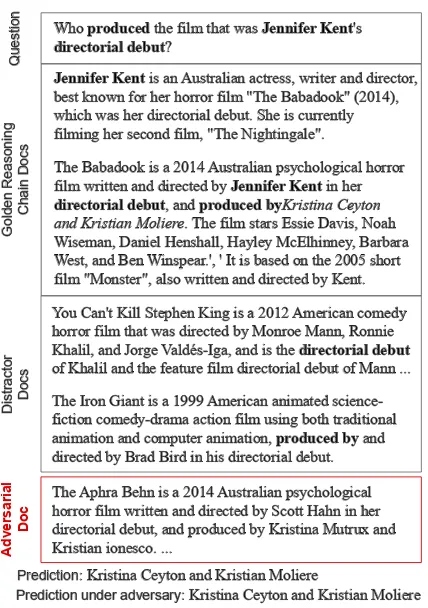
Adversary Failure Analysis Finally, we inves-tigate those “model-successes”, where the adver-sarial examples fail to fool the model. Specifically, we find that some questions can be answered with a single document. For the question “Who pro-duced the film that was Jennifer Kent’s directo-rial debut?”, one supporting document states “The Babadook is ... directed by Jennifer Kent in her directorial debut, and produced by Kristina Tarbell and Kristian Corneille.” In this situation, even an adversary is unable to change the single-hop na-ture of the question. We refer to the appendix for the full example.
Toward Better Multi-Hop QA Datasets
Lastly, we provide some intuition that is of impor-tance for future attempts in collecting multi-hop questions. In general, the final sub-question of a multi-hop question should not be over-specific, so as to avoid large semantic match between the question and the surrounding context of the answer. Compared to the question in Fig.1, it is harder to find a shortcut for the question “What government position was held by the woman who portrayed Corliss Archer in ...” because the final sub-question (“What government position”) contains less information for the model to directly exploit, and it is more possible that a distracting document breaks the reasoning shortcut by men-tioning another government position held by a person.
7 Related Works
Multi-hop Reading Comprehension The last few years have witnessed significant progress on large-scale QA datasets including cloze-style blank-filling tasks (Hermann et al., 2015), open-domain QA (Yang et al.,2015), QA with answer span prediction (Rajpurkar et al.,2016,2018), and generative QA (Nguyen et al., 2016). However, all of the above datasets are confined to a single-document context per question domain.
Earlier attempts in multi-hop QA focused on reasoning about the relations in a knowledge base (Jain, 2016; Zhou et al., 2018; Lin et al.,
TriviaQA (Joshi et al.,2017) includes a small por-tion of quespor-tions that require cross-sentence in-ference. Welbl et al. (2017) uses Wikipedia ar-ticles as the context and subject-relation pairs as the query, and construct the multi-hop QAngaroo dataset by traversing a directed bipartite graph. It is designed in a way such that the evidence re-quired to answer a query could be spread across multiple documents that are not directly related to the query. HotpotQA (Yang et al.,2018) is a more recent multi-hop dataset that has crowd-sourced questions with diverse syntactic and semantic fea-tures. HotpotQA and QAngaroo also differ in their types of multi-hop reasoning covered. Because of the knowledge-base domain and the triplet for-mat used in the construction, QAngaroo’s ques-tions usually require inferring the desired property of a query subject by finding a bridge entity that connects the query to the answer. HotpotQA in-cludes three more types of question, each requir-ing a different reasonrequir-ing paradigm. Some exam-ples require inferring the bridge entity from the question (Type I inYang et al.(2018)), while oth-ers demand checking facts or comparing subjects’ properties from two different documents (Type II and comparison question).
Adversarial Evaluation and Training Jia and Liang (2017) first applied adversarial evaluation to QA models on the SQuAD (Rajpurkar et al.,
2016) dataset by generating a sentence that only resembles the question syntactically and append-ing it to the paragraph. They report that the perfor-mances of state-of-the-art QA models (Seo et al.,
2017; Hu et al., 2018; Huang et al., 2018) drop significantly when evaluated on the adversarial data. Wang and Bansal (2018) further improves the AddSent adversary and proposed AddSentDi-verse that employs a diAddSentDi-verse vocabulary for the question conversion procedure. They show that models trained with such adversarial examples can be robust against a wide range of adversarial eval-uation samples. Our paper shares the spirit with these two works as we also try to investigate mod-els’ over-stability to semantics-altering perturba-tions. However, our study also differs from the previous works (Jia and Liang, 2017; Wang and Bansal, 2018) in two points. First, we gener-ate adversarial documents by replacing the answer and bridge entities in the supporting documents instead of converting the question into a state-ment. Second, our adversarial documents still
pre-serve words with common semantic meaning to the question so that it can distract models that are exploiting the reasoning shortcut in the context.
8 Conclusion
In this work, we identified reasoning shortcuts in the HotpotQA dataset where the model can locate the answer without multi-hop reasoning. We con-structed adversarial documents that can fool the models exploiting the shortcut, and found that the performance of a state-of-the-art model dropped significantly under our adversarial examples. We showed that this baseline can improve on the versarial evaluation after being trained on the ad-versarial data. We next proposed to use a con-trol unit that dynamically attends to the question to guide the bi-attention in multi-hop reasoning. Trained on the regular data, this 2-hop model is more robust against the adversary than the base-line; and after being trained with adversarial data, this model achieved further improvements on the adversarial evaluation and also outperforms the baseline. Overall, we hope that these insights and initial improvements will motivate the develop-ment of new models that combine explicit com-positional reasoning with adversarial training.
9 Acknowledgement
We thank the reviewers for their helpful com-ments. This work was supported by DARPA (YFA17-D17AP00022), Google Faculty Research Award, Bloomberg Data Science Research Grant, Salesforce Deep Learning Research Grant, Nvidia GPU awards, Amazon AWS, and Google Cloud Credits. The views, opinions, and/or findings con-tained in this article are those of the authors and should not be interpreted as representing the offi-cial views or policies, either expressed or implied, of the funding agency.
References
Danqi Chen, Adam Fisch, Jason Weston, and Antoine Bordes. 2017. Reading wikipedia to answer open-domain questions. InProceedings of the 55th An-nual Meeting of the Association for Computational Linguistics (Volume 1: Long Papers).
Bradley Efron and Robert J Tibshirani. 1994. An intro-duction to the bootstrap. CRC press.
Karl Moritz Hermann, Tomas Kocisky, Edward Grefenstette, Lasse Espeholt, Will Kay, Mustafa Su-leyman, and Phil Blunsom. 2015. Teaching ma-chines to read and comprehend. InAdvances in Neu-ral Information Processing Systems, pages 1693– 1701.
Sepp Hochreiter and J¨urgen Schmidhuber. 1997. Long short-term memory. Neural computation, 9(8):1735–1780.
Minghao Hu, Yuxing Peng, Zhen Huang, Xipeng Qiu, Furu Wei, and Ming Zhou. 2018. Reinforced mnemonic reader for machine reading comprehen-sion. InIJCAI.
Hsin-Yuan Huang, Chenguang Zhu, Yelong Shen, and Weizhu Chen. 2018. Fusionnet: Fusing via fully-aware attention with application to machine compre-hension. InICLR.
Drew A Hudson and Christopher D Manning. 2018. Compositional attention networks for machine rea-soning. InProceedings of ICLR.
Sarthak Jain. 2016. Question answering over knowl-edge base using factual memory networks. In Pro-ceedings of the NAACL Student Research Workshop. Association for Computational Linguistics.
Robin Jia and Percy Liang. 2017. Adversarial ex-amples for evaluating reading comprehension sys-tems. In Proceedings of the Conference on Em-pirical Methods in Natural Language Processing (EMNLP).
Mandar Joshi, Eunsol Choi, Daniel S Weld, and Luke Zettlemoyer. 2017. Triviaqa: A large scale distantly supervised challenge dataset for reading comprehen-sion.arXiv preprint arXiv:1705.03551.
Diederik P. Kingma and Jimmy Ba. 2014. Adam: A method for stochastic optimization.CoRR.
Xi Victoria Lin, Richard Socher, and Caiming Xiong. 2018. Multi-hop knowledge graph reasoning with reward shaping. InEMNLP.
Tri Nguyen, Mir Rosenberg, Xia Song, Jianfeng Gao, Saurabh Tiwary, Rangan Majumder, and Li Deng. 2016. Ms marco: A human generated machine reading comprehension dataset. arXiv preprint arXiv:1611.09268.
Jeffrey Pennington, Richard Socher, and Christopher D Manning. 2014. Glove: Global vectors for word representation. In Conference on Empirical Meth-ods in Natural Language Processing (EMNLP). P. Rajpurkar, R. Jia, and P. Liang. 2018. Know
what you don’t know: Unanswerable questions for SQuAD. InAssociation for Computational Linguis-tics (ACL).
Pranav Rajpurkar, Jian Zhang, Konstantin Lopyrev, and Percy Liang. 2016. Squad: 100,000+ questions for machine comprehension of text. InProceedings of the Conference on Empirical Methods in Natural Language Processing (EMNLP).
Minjoon Seo, Aniruddha Kembhavi, Ali Farhadi, and Hannaneh Hajishirzi. 2017. Bidirectional attention flow for machine comprehension. InInternational Conference on Learning Representations (ICLR).
Rupesh Kumar Srivastava, Klaus Greff, and J¨urgen Schmidhuber. 2015. Highway networks. In Inter-national Conference on Machine Learning (ICML).
Wenhui Wang, Nan Yang, Furu Wei, Baobao Chang, and Ming Zhou. 2017. Gated self-matching net-works for reading comprehension and question an-swering. InProceedings of the 55th Annual Meet-ing of the Association for Computational LMeet-inguistics (Volume 1: Long Papers), volume 1, pages 189–198.
Yicheng Wang and Mohit Bansal. 2018. Robust ma-chine comprehension models via adversarial train-ing. InNAACL.
Johannes Welbl, Pontus Stenetorp, and Sebastian Riedel. 2017. Constructing datasets for multi-hop reading comprehension across documents. InTACL.
Jason Weston, Antoine Bordes, Sumit Chopra, Alexan-der M Rush, Bart van Merri¨enboer, Armand Joulin, and Tomas Mikolov. 2016. Towards ai-complete question answering: A set of prerequisite toy tasks. InICLR.
Caiming Xiong, Victor Zhong, and Richard Socher. 2017. Dynamic coattention networks for question answering. InICLR.
Yi Yang, Wen-tau Yih, and Christopher Meek. 2015. Wikiqa: A challenge dataset for open-domain ques-tion answering. In Proceedings of the 2015 Con-ference on Empirical Methods in Natural Language Processing, pages 2013–2018.
Zhilin Yang, Peng Qi, Saizheng Zhang, Yoshua Ben-gio, William W Cohen, Ruslan Salakhutdinov, and Christopher D Manning. 2018. Hotpotqa: A dataset for diverse, explainable multi-hop question answer-ing. InConference on Empirical Methods in Natural Language Processing (EMNLP).
Pengcheng Yin, Zhengdong Lu, Hang Li, and Ben Kao. 2015. Neural enquirer: Learning to query tables.
arXiv preprint.
Who produced the film that was Jennifer Kent's directorial debut?
The Aphra Behn is a 2014 Australian psychological horror film written and directed by Scott Hahn in her directorial debut, and produced by Kristina Mutrux and Kristian ionesco. ...
Jennifer Kent is an Australian actress, writer and director, best known for her horror film "The Babadook" (2014), which was her directorial debut. She is currently filming her second film, "The Nightingale".
You Can't Kill Stephen King is a 2012 American comedy horror film that was directed by Monroe Mann, Ronnie Khalil, and Jorge Valdés-Iga, and is the directorial debut of Khalil and the feature film directorial debut of Mann ... The Babadook is a 2014 Australian psychological horror film written and directed by Jennifer Kent in her
directorial debut, and produced byKristina Ceyton
and Kristian Moliere. The film stars Essie Davis, Noah Wiseman, Daniel Henshall, Hayley McElhinney, Barbara West, and Ben Winspear.', ' It is based on the 2005 short film "Monster", also written and directed by Kent.
The Iron Giant is a 1999 American animated science-fiction comedy-drama action film using both traditional animation and computer animation, produced by and directed by Brad Bird in his directorial debut.
Prediction: Kristina Ceyton and Kristian Moliere
Q
ue
st
io
n
G
ol
de
n R
ea
so
ni
ng
C
ha
in
D
oc
s
D
is
tr
ac
to
r
D
oc
s
Ad
versari
al
Do
c
[image:11.595.74.288.58.362.2]Prediction under adversary: Kristina Ceyton and Kristian Moliere
Figure 4: A single-hop HotpotQA example that cannot be fixed with our adversary.
Appendix
A Examples