3002
Reference Network for Neural Machine Translation
Han Fu†‡ Chenghao Liu§ Jianling Sun†‡∗
†Zhejiang University, Hangzhou, China
‡Alibaba-Zhejiang University Joint Institute of Frontier Technologies, China
§Singapore Management University, Singapore
{11821003, sunjl}@zju.edu.cn [email protected]
Abstract
Neural Machine Translation (NMT) has achieved notable success in recent years. Such a framework usually generates translations in isolation. In contrast, human translators often refer to reference data, either rephrasing the in-tricate sentence fragments with common terms in source language, or just accessing to the golden translation directly. In this paper, we propose a Reference Network to incorporate referring process into translation decoding of NMT. To construct areference book, an intu-itive way is to store the detailed translation his-tory with extra memory, which is computation-ally expensive. Instead, we employ Local Co-ordinates Coding (LCC) to obtain global con-text vectors containing monolingual and bilin-gual contextual information for NMT decod-ing. Experimental results on Chinese-English and English-German tasks demonstrate that our proposed model is effective in improving the translation quality with lightweight com-putation cost.
1 Introduction
Neural Machine Translation (NMT) has enjoyed impressive success in most large-scale
transla-tion tasks (Kalchbrenner and Blunsom, 2013;
Sutskever et al.,2014;Cho et al.,2014). Typical NMT model to date is a single end-to-end trained deep neural network that encodes the source sen-tence into a fixed-length vector and generates the
words in the target sentence sequentially. The
alignment relationship between source and target sentence is learned by the attention mechanism (Bahdanau et al.,2015;Luong et al.,2015).
Though the framework has achieved significant success, one critical concern is that NMT gener-ates translations in isolation, which leads to trans-lation inconsistency and ambiguity arising from
∗
Corresponding author: Jianling Sun.
a single source sentence (Tu et al., 2018).
Re-cently, there have been few attempts to model the semantic information across sentences. The basic ideas are to store a handful of previous source or
target sentences with context vectors (Jean et al.,
2017; Wang et al., 2017a) or memory
compo-nents (Maruf and Haffari, 2018;Tu et al.,2018).
However, these methods have several limitations. First, the very short view of the previous sentences (usually one or two sentence(s)) is not sufficient enough to catch long term dependencies across paragraphs and storing detailed translation history is computationally expensive. Second, in the real-world scenarios, input data of MT application is
often isolated sentences, such as Google
Trans-late, where no cross-sentence contexts are
pro-vided. Moreover, translations generated by such document-level NMT models are not stable, ef-fected by the sentences surrounding the current one to translate.
To address these limitations, we model the se-mantic information across sentences by mimick-ing the human translation process. In real scenar-ios, there will always be sentences or fragments that the translator can understand the meaning but cannot write down the translations directly. The obstacle could be unfamiliar collocation, descrip-tions in specific language habits and slang. The usual solutions for human are: (1) paraphrasing the sentence in another way, with simpler and more colloquial terms in the source language, and (2) directly referring to the standard translations of the intricate sentence fragments. For example
in Table1, the Chinese word ”zaiyu” is not a
com-mon expression. A reference can either provide simple Chinese terms such as ”daizhe rongyu” or directly offer the corresponding English transla-tion ”with honor”. Therefore, if a good quality
source canjia dongaohui de faguo
yun-dongyuanzaiyufanhui bali.
translation French athletes participating in winter olympics returned to
pariswith honors.
Table 1: An example of sentence fragment that is hard to translate.
performance of human translators.
To be specific, the motivation of this work can be summarized as two aspects corresponding to the two kinds of human reference processes. First, we aim to provide the machine translator with a reference during decoding, which contains all pos-sible source sentence fragments that are semanti-cally similar to the current one. If the system finds it hard to translate the source fragment, it can turn to translate the fragments in the reference. Sec-ond, we intend to offer the oracle translations of the current sentence fragments to translate.
In this paper, we propose a novel model namely Reference Network that incorporates the referring process into translation decoding of NMT. Instead of storing the detailed sentences or translation his-tory, we propose to generate representations con-taining global monolingual and bilingual contex-tual information with Local Coordinate Coding
(LCC) (Yu et al.,2009). Specifically, for solution
(1), the hidden states of NMT encoder are coded by a linear combination of a set of anchor points in an unsupervised manner. The anchors are ca-pable to cover the entire latent space of the source language seamlessly. For solution (2), we employ local codings to approximate the mapping from source and target contexts to the current target word with a supervised regression function. The local coding is then fed to the decoder to modify the update of the decoder hidden state. In this way, the translation decoding can be improved by of-fering the representation of a common paraphrase
(Figure1) or golden target translation (Figure2).
We conduct experiments on NIST Chinese-English (Zh-En) and WMT German-Chinese (En-De) translation tasks. The experimental results in-dicate that the proposed method can effectively ex-ploit the global information and improve the trans-lation quality. The two proposed models signif-icantly outperform the strong NMT baselines by adding only 9.3% and 19.6% parameters respec-tively.
2 Background
2.1 Neural Machine Translation
Our model is built on the RNN-based NMT (
Bah-danau et al., 2015). However, since recurrent ar-chitecture is not necessary for our approach, the
idea can also be applied to ConvS2S (Gehring
et al., 2017) and Transformer (Vaswani et al.,
2017). We leave it for future work. Formally, let
x = (x1, ..., xm) be a given source sentence and
y = (y1, ..., yT)be the corresponding target sen-tence. NMT generates the target words sequen-tially by maximizing the probability of translation conditioned on the source sentence:
ˆ
y= arg max
y
T
X
t=1
logp(yt|x,y<t). (1)
At each timestep, the generation probability is computed as
p(yt|x,y<t) = softmax(g(e(yt−1),st,ct)), (2)
wheregis a transformation function that outputs a
vocabulary-sized vector,e(yt−1)is the embedding
of previous target wordyt−1,ctis the source
con-text vector obtained by attention mechanism, and
st is thet-th hidden state of NMT decoder,
com-puted as:
st=fd(e(yt−1),st−1,ct), (3)
wherefdis a nonlinear activation. The source
con-textctis typically a weighted sum of encoder
hid-den states as:
ct= m
X
i=1
αti·hi, (4)
where attention scoreαti is the alignment vector
of thei-th source wordxi and thet-th target word
yt:
αti= softmax(v>αtanh(Wαst−1+Uαhi)). (5)
whereWα,Uα andvα are trainable matrices or
vectors. hi is the annotation of xi computed by
the NMT encoder. The encoder, generally imple-mented as a bi-directional RNN, encodes the input sentence into a sequence of source hidden states
h= (h1, ...,hm)wherehiis obtained by
concate-nating the forward hidden state−→hi and backward
𝐡𝐡1𝑁𝑁 𝐡𝐡2𝑁𝑁 … 𝐡𝐡|𝑁𝑁𝐱𝐱𝑁𝑁| 𝑥𝑥2𝑁𝑁 𝑥𝑥|𝐱𝐱𝑁𝑁𝑁𝑁|
𝑥𝑥1𝑁𝑁 𝐱𝐱𝑁𝑁:
average pooling 𝐡𝐡12 𝐡𝐡22 … 𝐡𝐡|2𝐱𝐱2|
𝑥𝑥22 𝑥𝑥|𝐱𝐱22|
𝑥𝑥12 𝐱𝐱2:
average pooling
…
𝐡𝐡1𝑀𝑀 𝐡𝐡𝑀𝑀2 𝐡𝐡𝑀𝑀𝑁𝑁
local coordinate coding 𝐡𝐡11 𝐡𝐡12 … 𝐡𝐡|1𝐱𝐱1|
𝑥𝑥21 𝑥𝑥|𝐱𝐱11|
𝑥𝑥11 𝐱𝐱1:
average pooling
𝐯𝐯2
𝐯𝐯1 … 𝐯𝐯|𝒞𝒞| LCC anchors
𝐡𝐡1 𝐡𝐡2 … 𝐡𝐡𝑚𝑚
𝑥𝑥1 𝑥𝑥2 𝑥𝑥𝑚𝑚
attention
𝐬𝐬1 … 𝐬𝐬𝑡𝑡−1 𝐬𝐬𝑡𝑡
𝑦𝑦1 𝑦𝑦𝑡𝑡−1 𝑦𝑦𝑡𝑡 𝐜𝐜1 … 𝐜𝐜𝑡𝑡−1 𝐜𝐜𝑡𝑡
[image:3.595.111.499.64.206.2]attention 𝐜𝐜𝑡𝑡𝐺𝐺
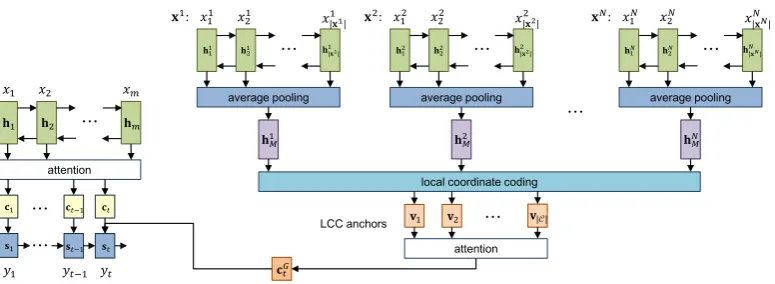
Figure 1: Framework of NMT with M-RefNet. xi represents thei-th source sentence in the training corpus and |xi|is the length of the sentence. The global context vectorcG
t can be regarded as a paraphrase of the current
source contextct.
According to the above formulations, conven-tional NMT models translate sentences indepen-dently. However, human translators usually tend to seek for reference materials when in trouble. Motivated by such common human behaviors, we propose Reference Network to provide global
in-formation as areference bookin two ways. First,
the model utilizes all source hidden states to para-phrase current source sentence. Second, the model
directly provides the target wordy˜t according to
the rest translation samples in the training corpus. Since it is impossible to store all information di-rectly, we leverage local coordinate coding (LCC) to compress the semantics into a latent manifold.
2.2 Local Coordinate Coding
With the assumption that data usually lies on the lower dimensional manifold of the input space, the manifold approximation of high dimensional input
x can be defined as a linear combination of
sur-rounding anchor points as:
x≈γ(x) =X
v
γv(x)v, (6)
where vis an anchor point and γv is the weight
corresponding tovsuch that
X
v
γv(x) = 1. (7)
According to the definitions, it is proved in (Yu
et al., 2009) that if the anchor points are
local-ized enough, any (lα, lβ)-Lipschitz smooth
func-tion f(x) defined on a lower dimensional
mani-foldMcan be globally approximated by a linear
combination of the function values of a set of the
anchorsCas:
f(x)≈X
v∈C
γv(x)f(v), (8)
with the upper bound of the approximation error:
lαkx−
X
v∈C
γv(x)vk
+X
v∈C
lβ|γv(x)|kv−
X
v∈C
γv(x)vk2.
(9)
3 Reference Network
In this section, we present our proposed Reference Network (RefNet).
3.1 Overview
We propose two models which explore the global information from the training data in different
manners as illustrated by Figure1and Figure2.
The monolingual reference network
(M-RefNet) provides a global source context vector
to paraphrase the current contextct based on all
other source sentences. To be specific, we train several unsupervised anchors as the bases of the semantic space of source contexts and each source sentence in the training corpus can be represented by a weighted sum of the anchors.
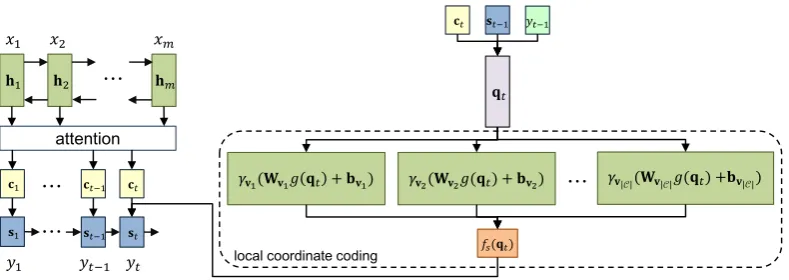
The bilingual reference network (B-RefNet) generates a referable target embedding according to all sentence pairs in the training corpus to guide output sequence generation. Concretely, we for-mulate the translation process as a mapping from
source and target contexts (ct and st−1) to the
𝐡𝐡1 𝐡𝐡2
…
𝐡𝐡𝑚𝑚𝑥𝑥1 𝑥𝑥2 𝑥𝑥𝑚𝑚
attention
𝐬𝐬1
…
𝐬𝐬𝑡𝑡−1 𝐬𝐬𝑡𝑡𝑦𝑦1 𝑦𝑦𝑡𝑡−1 𝑦𝑦𝑡𝑡
𝐜𝐜1
…
𝐜𝐜𝑡𝑡−1 𝐜𝐜𝑡𝑡𝐜𝐜𝑡𝑡 𝐬𝐬𝑡𝑡−1 𝑦𝑦𝑡𝑡−1
𝐪𝐪𝑡𝑡
𝛾𝛾𝐯𝐯1(𝐖𝐖𝐯𝐯1𝑔𝑔 𝐪𝐪𝑡𝑡 +𝐛𝐛𝐯𝐯1) 𝛾𝛾𝐯𝐯2(𝐖𝐖𝐯𝐯2𝑔𝑔(𝐪𝐪𝑡𝑡) +𝐛𝐛𝐯𝐯2)
…
𝛾𝛾𝐯𝐯𝒞𝒞(𝐖𝐖𝐯𝐯𝒞𝒞𝑔𝑔(𝐪𝐪𝑡𝑡)+𝐛𝐛𝐯𝐯|𝒞𝒞|)𝑓𝑓𝑠𝑠(𝐪𝐪𝑡𝑡)
[image:4.595.103.498.70.210.2]local coordinate coding
Figure 2: Framework of NMT with B-RefNet. The outputfs(qt)of RefNet can be regarded as an approximation
of current target word embeddinge(yt).
learns this mapping with a supervised regression function derived from LCC.
It should be noted that the corpus from which
the reference vectors (cGt or fs(qt)) are learned
can be any monolingual or bilingual data, and the translations generated are relatively effected by the quality of the corpus. In this work, we con-strain it as the training corpus for convenience and a fair comparison with the related work.
3.2 Monolingual Referent Network
In this section, we seek to improve NMT by rephrasing the source sentence. Instead of stor-ing all source contexts, we regenerate the source contexts from a learned manifold with a combina-tion of a fixed number of anchor points. Formally,
given any source sequencexwith lengthmin the
training samples, leth= (h1, ...,hm)denotes the
hidden states generated by the NMT encoder. We firstly obtain the representation of the source
sen-tencehM via amean-poolingoperation.
Accord-ing to the definition of LCC, it can be assumed
thathM ≈γ(hM)whereγ(hM)is the local
coor-dinate coding ofhM, computed as:
γ(hM) =
|C|
X
j=1
γj(hM)vj. (10)
Here, vj is the j-th anchor point. The
coeffi-cientγj(hM)is used to measure the weight of
an-chor pointvjcorresponding toγ(hM). In
conven-tional manifold learning methods,γj(hM)is
gen-erally computed with distance measure. And to achieve localization, the coefficients
correspond-ing to anchor points out of the neighbors of hM
are set to zero. However, it is hard to train in deep
neural network using stochastic gradient methods.
Inspired by the attention mechanism (Bahdanau
et al., 2015), we propose to employ an attention layer to obtain the weights:
γj(hM) =
exp(s(hM,vj))
P|C|
j=1exp(s(hM,vj))
, (11)
wheres(·)is a score function. Here, we propose a
tri-nonlinear score function which has been proven especially effective in the experiments:
s(hM,vj) =vs>tanh(Wsvj+UshM
+Vs(vj◦hM)),
(12)
whereWs,Us, Vsandvs are trainable
parame-ters. ◦is the element-wise multiplication, and
di-mension of any anchor point should be the same
tohM.
To find the optimal anchor point, localization
measure(Yu et al.,2009) is employed as the opti-mization object:
min
γ,C lαkhM −γ(hM)k+
lβ
|C|
X
j=1
|γj(hM)| kvj −γ(hM)k2.
(13)
Since any source sentence presentationhM can
be represented by the linear combination of the an-chors, the trained anchor points can be regarded as the bases of the latent space of all source an-notations, containing the global contextual infor-mation. Therefore, during translation decoding of
NMT, we can drop the coefficientγ and rephrase
Specifically, we apply an attention mechanism be-tween current local contextual information and
each anchor pointvj to get the global context as:
cGt =
|C|
X
j=1
αGtjvj, (14)
where αtjG is the attention score between current
local contexts and the global context, computed as:
αGtj= softmax(v>αtanh(Wαst−1
+Uαct+Vαvj)).
(15)
Once the global contextcGt is obtained, we feed it
to decoder states:
st=fd(e(yt−1),st−1,ct,cGt ), (16)
wherectencodes the local contextual information
andcGt contains the global monolingual
informa-tion from all source sentences in the training cor-pus. When the model has trouble to translate some
words or sentence fragments, it can refer tocGt to
gain the richer source contextual information.
3.3 Bilingual Reference Network
The bilingual model is proposed to improve NMT by providing a golden translations according to rest samples in the training corpora. To be specific,
once source contextctand target contextst−1are
obtained, we hope to provide a referable
predic-tion e( ˜yt) of the current target word embedding
e(yt)according to other sentence pairs in the
train-ing data for the decoder.
The functionality of the NMT decoder during
translation (Eq.2 and Eq.3) is totally a function
that maps the source contextct, target contextst−1
and last target wordyt−1to current targetyt. NMT
takes it as a classification problem, usingtanhor
other gated RNN unit to implement this function. In this work, we propose a much stronger model in information expression, that regrades the problem as regression:
qt= [e(yt−1)>,s>t−1,c>t ]>, (17)
e(yt)≈fs(qt) =W(qt)g(qt) +b(qt), (18)
where g is a transformation function that
trans-forms qt to a anchor-size vector, W and b are
the weight matrix and bias vector of the regres-sion function. The weight and bias are allowed to
vary according to the inputqt, which makes the
function capable of mapping eachqtto the
corre-spondinge(yt)precisely. However, it is
impossi-ble to store the weight and bias for everyqt
com-puted within the training data. Therefore, we
ap-proximate the weight and bias function in Eq.18
using local coordinate coding as:
fs(qt) =
|C|
X
j=1
γj(qt) Wvjg(qt) +bvj
, (19)
wherevj ∈ C is an anchor point, Wvj and bvj
are trainable parameters corresponding tovj, and
γj(qt)is the weight function, computed as:
γj(qt) =
exp(s(qt,vj))
P|C|
j=1exp(s(qt,vj))
. (20)
Similar to M-RefNet, the score is computed by the tri-nonlinear function as:
s(qt,vj) =v>b tanh(Wbvj+Ubqt+Vb(vj◦qt)). (21)
Here,fs(qt)can be regarded as an approximation
ofe(yt)based on all the sentence pairs in the
train-ing data. Therefore, we feed the function value to the decoder state to guide sentence generation:
st=fd(e(yt−1),st−1,ct, fs(qt)). (22)
The optimal weight matrices and anchor points are obtained by minimizing the hinge loss for each
sentence pair(x,y)as:
LM =
|y|
X
t=1
ke(yt)−fs(qt)k2+λM
|C|
X
j=1
kW(vj)k2.
(23)
3.4 Training and Inference
Stage-wise training strategies have been proven to be efficient when system is relative
compli-cated by plenty of recent work (Maruf and
Haf-fari, 2018;Tu et al.,2018). In this work, we first pre-train a standard NMT on a set of training
ex-amples{[xn,yn]}N
n=1as initialization for training
the added parameters in our proposed models.
Letθ={θE, θD}denote the parameters of the
standard NMT, whereθEandθDare parameters of
the standard encoder and decoder (including atten-tion model) respectively. For M-RefNet, the stage following NMT training is to obtain the weight
System MT05 MT06 MT08 Avg
Dl4mt 32.88 32.30 25.97 30.38
NMT 35.76 34.82 27.86 32.81
CS-NMT 36.63 36.41 29.47 34.17
LS-NMT 36.46 36.99 29.73 34.39
CC-NMT 36.65 37.08 29.71 34.48
DC-NMT 36.82 36.73 29.83 34.46
This work
M-RefNet 37.31 37.72 30.41 35.15
[image:6.595.75.287.61.201.2]B-RefNet 37.71 37.99 30.80 35.50
Table 2: BLEU scores of different models on Zh-En.
sentence representationshMby minimizing
local-ization measure(Eq.13). Then we fix the trained anchor points and encoder, and only fine-tune the
decoderθD and the added parametersθM related
to the monolingual reference network (Eq.15 and
Eq.16):
max
θD,θM
N
X
n=1
[logP(yn|xn;θ, θM, γ)]. (24)
To train B-RefNet efficiently, we fix the trained parameters of the standard NMT and only update
the added parametersθBincluding all weight
ma-trices and biases related to local coordinate coding
(Eq.19and Eq.21). The training object is:
max
θB
N
X
n=1
[logP(yn|xn;θ, θB)−λLM], (25)
where λ is a hyper-parameter that balances the
preference between likelihood and hinge loss. During inference, all parameters related to LCC are fixed. Therefore, the work can be regarded as astaticapproach, compared with the conventional document-level NMT. That means, the final trans-lation is only effected by the reference corpus but not by the sentences surrounding the current one to translate. Naturally, there leaves a question that how it influences the quality of translations when various reference corpus is chosen. We leave it in future work and only use the training corpus in this paper.
4 Experiments
We evaluate the reference network models on two translation tasks, NIST Chinese-English tion (Zh-En) and WMT English-German transla-tion (En-De).
4.1 Settings
Datasets For Zh-En, we choose 1.25M sentence
pairs from LDC dataset1with 34.5 English words
and 27.9M Chinese words. NIST MT02 is cho-sen as the development set, and NIST MT05/06/08 as test sets. Sentences with more than 50 words
are filtered and vocabulary size is limited as 30k.
We use case-insensitive BLEU score to evaluate Zh-En translation performance. For En-De, the
training set is from (Luong et al., 2015) which
contains 4.5M bilingual pairs with 116M English
words and 100M German words. BPE (Sennrich
et al.,2016) is employed to split the sentence pairs
into subwords and we limit the vocabulary as 40k
sub-words units. Newstest2012/2013 are chosen for developing and Newsetest2014 for test.
case-sensitive BLEU2 is employed as the evaluation
metric.
Models We evaluate our RefNet with different structures on Zh-En and En-De. For Zh-En we choose the typical attention-based recurrent NMT
model (Bahdanau et al., 2015) as initialization,
which consists of a bi-directional RNN-based en-coder and a one layer RNN deen-coder. The dimen-sions of embedding and hidden state are 620 and 1000 respectively. For En-De, deep linear
associa-tive unit model (DeepLAU) (Wang et al.,2017b)
is chosen as the base model. Both the encoder and decoder consist of 4-layer LAUs. All embed-ding and hidden states are 512-dimensional
vec-tors. Moreover, we use layer normalization (Ba
et al.,2016) on all layers. For both architectures, the number of anchor points is 100 for M-RefNet and 30 for B-RefNet. The anchor dimension of
B-RefNet is set to 100. The hyper-parameterλin
Eq.25is set to 1. The norm of gradient is clipped
to be within[−1,1]and dropout is applied to
em-bedding and output layer with rate 0.2 and 0.3 re-spectively. When generating translations, we uti-lize beam search with beam size 10 on Zh-En and 8 on En-De.
4.2 Results on Chinese-English Translation
The standard attention-based NMT model is cho-sen as the baseline and initialization of our mod-els. Moreover, we also list the results of the
open-1The corpus contains LDC2002E18, LDC2003E07,
LDC2003E14, Hansards portion of LDC2004T07,
LDC2004T08 and LDC2005T06
2https://github.com/moses-smt/mosesdecoder
source Dl4mt and re-implementations of the fol-lowing related work for comparison:
• Cross-sentence context-aware NMT
(CS-NMT) (Wang et al.,2017a): A cross-sentence
NMT model that incorporates the histori-cal representation of three previous sentences into decoder.
• LC-NMT (Jean et al.,2017): A NMT model
that concurrently encodes the previous and current source sentences as context, added to decoder states.
• NMT augmented with a continuous cache
(CC-NMT) (Tu et al.,2018): A NMT model
armed with a cache3 which stores the recent
translation history.
• Document Context NMT with Memory
Net-works (DC-NMT) (Maruf and Haffari,2018):
A document-level NMT model that stores all source and target sentence representations of
a document to guide translation generating4.
All the re-implemented systems share the same settings with ours for fair comparisons.
4.2.1 Main Results
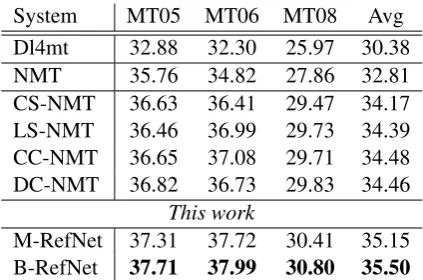
Results on Zh-En are shown in Table 2. The
baseline NMT significantly outperforms the open-source Dl4mt by 2.43 BLEU points, indicating the baseline is strong. Our proposed M-RefNet and B-RefNet improve the baseline NMT by 2.34 and 2.69 BLEU respectively and up to 2.90 and 3.17 BLEU on NIST MT06, which confirms the ef-fectiveness of our proposed reference networks. Overall, B-RefNet achieves the best performance over all test sets
Compared with the related work which incor-porate document-level information NMT, our pro-posed models still have a significant advantage. Compared to the best performance achieved by the related work (CC-NMT), M-RefNet and B-RefNet outperform it over all test sets and gain improvements of 0.77 BLEU and 1.02 BLEU in average. The possible reason is that all the related work only leverage a small range of the document-level information, limited by model complexity
3Cache size is set to 25.
4LDC training corpora contains nature boundaries.
How-ever document range is not clear for NIST test data. We use clustering and regard each class as a document. Dimension of document context is set to 1024.
# System #Para Speed
Train Test
0 NMT 71.1M 3590.4 114.21
1 CS-NMT 95.7M 747.5 97.10
2 LC-NMT 96.8M 1983.5 70.11
3 CC-NMT 75.1M 2844.7 113.09
4 DC-NMT 86.2M 2093.6 54.07
5 M-RefNet 77.7M 2563.98 113.26
[image:7.595.315.522.60.185.2]6 B-RefNet 85.1M 2191.4 104.07
Table 3: Statistics of parameters, training speed (sen-tences/minute) and testing speed (words/second).
10 20 30 40 50 60 70 80
[0,10) [10,20) [20,30) [30,40) [40,50) >50
T
ra
nsl
at
io
n
Le
ngt
h
Length of Source Sentence
NMT M-RefNet B-RefNet Reference
10 15 20 25 30 35 40
[0,10) [10,20) [20,30) [30,40) [40,50) >50
BL
EU
Length of Source Sentence
NMT M-RefNet B-RefNet
(a) Translation quality (b) Averaged length
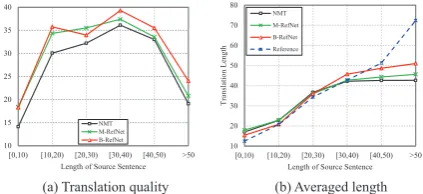
Figure 3: Translation quality and averaged length of the translations as source sentences become longer.
and time consuming. In contrast, our models are capable to express all information with more ab-stract representations. According to the results, though the information is deeply compressed in our models, it is still effective.
4.2.2 Analysis
Parameters and Speed The number of
parame-ters and speed of each model are listed in Table3.
It can be seen that M-RefNet only introduces 6.6M additional parameters while B-RefNet introduces relative larger number of parameters (14M). Con-sidering training process, both M-RefNet and B-RefNet are quite efficient and the training speeds are little slower than CC-NMT, for the added amount of parameters is quite small compared
to the baseline NMT and related systems. In
terms of decoding, both proposed models do not slow down the translation speed obviously and M-RefNet achieves the fastest speed over all sys-tems except the baseline NMT. The reason is that our models do not incorporate additional previ-ous sentences or interact with extra memory as the
relevant document-level systems. Furthermore,
[image:7.595.313.525.235.332.2]Source agenting zantong yige zhongguo delichang.
Reference argentina supports the ” one china ”policy.
NMT argentina agrees with china ’ sstand onthe one china .
M-RefNet the argentine government supports the one chinaposition.
B-RefNet argentina supports the one chinapolicy.
Source yindu bianfang minbing 2 yue 17 ri ,jiaqiang le dui niboer bianjie de xunluo.
Reference on february 17 , the indian border security forcestepped up patrols along the border
with nepal.
NMT on 17 february , indian border defense militia [UNK UNK UNK UNK UNK] .
M-RefNet the indian border defense militia , on 17 february ,strengthened the patrol of nepal ’ s
border.
B-RefNet the indian border defense militiahas stepped up patrols on the nepalese borderon 17
[image:8.595.71.528.61.246.2]february .
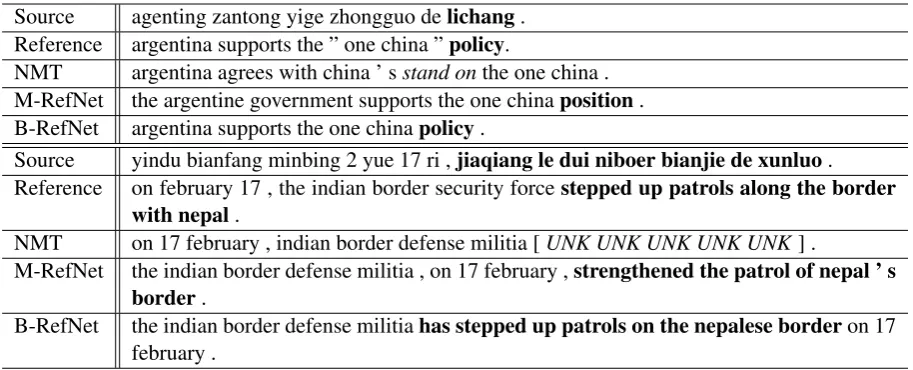
Table 4: Comparison on translation examples. The translation errors are highlighted with italic and the correct ones are highlighted with bold type.
process to fill the memory cells.
Length Analysis We follow (Luong et al.,2015) to group sentences with similar lengths and com-pute the BLEU score of each group, as shown in
Figure3. The reason for the falling of BLEU in the
last group (>50) is that sentences longer than 50
are removed during training. From this figure, we can see that our proposed models outperform the baseline NMT in all ranges of length. Moreover, translations generated by M-RefNet and B-RefNet have more similar lengths to the references com-pared with the baseline NMT.
Case Study Table4shows the translation exam-ples on Zh-En. In the first case, the Chinese word ”lichang” (standpoint, position, or policy) is incor-rectly interpreted as ”stand on” by NMT. Both M-RefNet and B-M-RefNet generate legible translations while translation from B-RefNet is more precise. This is because the word pair (”lichang”, ”policy”) appear somewhere in the training data and is lever-aged by the systems according to the contexts. This phenomenon is similar in the second case. Translation given by NMT is not readable. In con-trast, M-RefNet generates the core verb ”strength-ened” and B-RefNet provides a more accurate col-location ”stepped up patrols”.
4.3 Results on English-German Translation
On this task, DeepLAU (Wang et al., 2017b) is
chosen as the baseline and also used as the pre-trained model. We list the translation performance of our models and some existing NMT systems
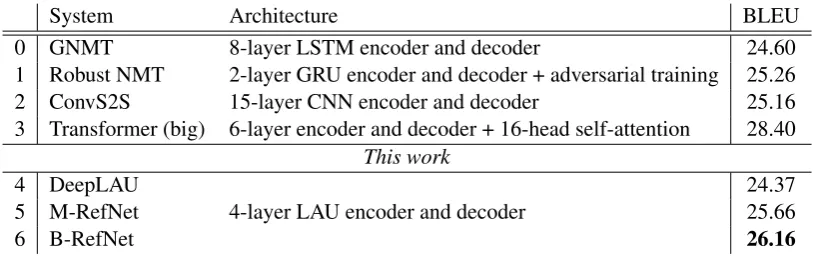
in Table 5. All the systems except for Robust
NMT (Cheng et al., 2018) have a deep
architec-ture with no less than 4 layers while Robust NMT introduces a additional discriminator for adversar-ial training. From the table, we can observe that our strong baseline DeepLAU is comparable to
Google’s neural machine translation (GNMT) (Wu
et al., 2016). M-RefNet outperforms the base-line by 1.29 BLEU points and B-RefNet achieves slightly better performance with a 1.79 BLEU im-provement, which is consistent to the results on Zh-En. Compared with the SOTA deep NMT sys-tems, both M-RefNet and B-RefNet outperform GNMT and even obtain comparable performance
with ConvS2S (Gehring et al., 2017) and
Trans-former (Vaswani et al., 2017) which have much
deeper architectures with relative much more pa-rameters. Since the reference networks do not rely on the recurrent structure, one interesting future direction is to apply our methods to such compli-cated models to bring further improvements.
5 Related Work
Document-level Neural Machine Translation
There are few works that consider the document-level contextual information to improve typical NMT. Jean et al. (2017) propose to use a addi-tional encoder to generate the latent representa-tion of previous sentence as extra context for de-coder and attention mechanism is also applied be-tween the decoder state and previous context to get access to word-level information of the
pre-vious sentence. Contemporaneously, Wang et al.
System Architecture BLEU
0 GNMT 8-layer LSTM encoder and decoder 24.60
1 Robust NMT 2-layer GRU encoder and decoder + adversarial training 25.26
2 ConvS2S 15-layer CNN encoder and decoder 25.16
3 Transformer (big) 6-layer encoder and decoder + 16-head self-attention 28.40
This work
4 DeepLAU 24.37
5 M-RefNet 4-layer LAU encoder and decoder 25.66
[image:9.595.95.502.61.192.2]6 B-RefNet 26.16
Table 5: Translation quality on En-De.
sentence-level respectively. The last hidden state of encoders are considered as the summarization
of a previous sentence and the group. Bawden
et al. (2018) employ multiple encoder s to sum-marize the antecedent and propose to combine the contexts with a gated function. However, these in-corporated extra encoders bring large amount of parameters and slow down the translation speed.
Tu et al.(2018) propose to modify the NMT with light-weight key-value memory to store the trans-lation history. However, due to the limitation of the memory size, the very short view on the pre-vious (25 timesteps) is not sufficient to model the document-level contextual information.
Addition-ally,Maruf and Haffari(2018) propose to capture
the global source and target context of a entire
document with memory network (Graves et al.,
2014;Wang et al.,2016). Nevertheless, since the number of sentence pairs in a document could be enormous, storing all sentence with memory com-ponents could be very time and space
consum-ing. More recently, Miculicich et al. (2018) and
Zhang et al. (2018) propose to improve Trans-former by encoding previous sentences with extra
encoders. Thereference bookin this work can be
regarded as a special kind of document context. However, there are two major differences between our approach and the above work. First, we en-code the entire corpus into a handful of anchor points which is much more light-weight but con-centrated to capture the global contextual informa-tion . Second, the global contexts in this work is
static. That means, given a sentence to translate, the final translation result only depends on the ref-erence corpus, but not the sentences surrounding the current one.
Local Coding There are a number of works
on manifold learning (Roweis and Saul, 2000;
Van Gemert et al.,2008;Yu et al.,2009;Ladicky
and Torr,2011). The manifold learning methods approximate any point on the latent manifold with a linear combination of a set of localized anchor points relying on the assumption that high dimen-sional input usually lies on the lower dimendimen-sional
manifold. Agustsson et al. (2017) utilize local
coding into deep neural networks on age
predic-tion from images and Cao et al. (2018) exploit
LCC for GAN (Goodfellow et al.,2014) to
cap-ture the local information of data. All these works focus on application of Computer Vision while we apply LCC in a Nature Language Processing task. To our knowledge, this is the first attempt to incor-porate local coding into NMT modeling.
6 Conclusion and Future Work
In this work, we propose two models to improve the translation quality of NMT inspired by the common human behaviors, paraphrasing and
con-sulting. The monolingual model simulates the
paraphrasing process by utilizing the global source information while the bilingual model provides a referable target word based on other sentence pairs in the training corpus. We conduct experiments on Chinese-English and English-German tasks, and the experimental results manifest the effectiveness and efficiency of our methods.
In the future, we would like to investigate the feasibility of our methods on non-recurrent
NMT models such as Transformer (Vaswani et al.,
2017). Moreover, we are also interested in
incor-porating discourse-level relations into our models.
Acknowledgments
References
Eirikur Agustsson, Radu Timofte, and Luc Van Gool. 2017. Anchored regression networks applied to age estimation and super resolution. InProceedings of ICCV.
Jimmy Lei Ba, Jamie Ryan Kiros, and Geoffrey E Hin-ton. 2016. Layer normalization. arXiv preprint arXiv:1607.06450.
Dzmitry Bahdanau, Kyunghyun Cho, and Yoshua Ben-gio. 2015. Neural machine translation by jointly learning to align and translate. In Proceedings of ICLR.
Rachel Bawden, Rico Sennrich, Alexandra Birch, and Barry Haddow. 2018. Evaluating discourse phe-nomena in neural machine translation. In Proceed-ings of NAACL.
Jiezhang Cao, Yong Guo, Qingyao Wu, Chunhua Shen, and Mingkui Tan. 2018. Adversarial learning with local coordinate coding.
Yong Cheng, Zhaopeng Tu, Fandong Meng, Junjie Zhai, and Yang Liu. 2018. Towards robust neural machine translation. InProceedings of the 56th An-nual Meeting of the Association for Computational Linguistics (Volume 1: Long Papers), pages 1756– 1766. Association for Computational Linguistics.
Kyunghyun Cho, Bart Van Merri¨enboer, Caglar Gul-cehre, Dzmitry Bahdanau, Fethi Bougares, Holger Schwenk, and Yoshua Bengio. 2014. Learning phrase representations using rnn encoder-decoder for statistical machine translation.
Jonas Gehring, Michael Auli, David Grangier, Denis Yarats, and Yann N Dauphin. 2017. Convolutional sequence to sequence learning. In Proceedings of ICML.
Ian Goodfellow, Jean Pouget-Abadie, Mehdi Mirza, Bing Xu, David Warde-Farley, Sherjil Ozair, Aaron Courville, and Yoshua Bengio. 2014. Generative ad-versarial nets. In Advances in neural information processing systems, pages 2672–2680.
Alex Graves, Greg Wayne, and Ivo Danihelka. 2014. Neural turing machines. arXiv preprint arXiv:1410.5401.
Sebastien Jean, Stanislas Lauly, Orhan Firat, and Kyunghyun Cho. 2017. Does neural machine trans-lation benefit from larger context? arXiv preprint arXiv:1704.05135.
Nal Kalchbrenner and Phil Blunsom. 2013. Recurrent continuous translation models. In Proceedings of EMNLP.
Lubor Ladicky and Philip Torr. 2011. Locally lin-ear support vector machines. InProceedings of the 28th International Conference on Machine Learning (ICML-11), pages 985–992.
Minh-Thang Luong, Hieu Pham, and Christopher D Manning. 2015. Effective approaches to attention-based neural machine translation. InProceedings of EMNLP.
Sameen Maruf and Gholamreza Haffari. 2018. Docu-ment context neural machine translation with mem-ory networks. InProceedings of ACL.
Lesly Miculicich, Dhananjay Ram, Nikolaos Pappas, and James Henderson. 2018. Document-level neural machine translation with hierarchical attention net-works. InProceedings of the 2018 Conference on Empirical Methods in Natural Language Process-ing, pages 2947–2954.
Sam T Roweis and Lawrence K Saul. 2000. Nonlin-ear dimensionality reduction by locally linNonlin-ear em-bedding. science, 290(5500):2323–2326.
Rico Sennrich, Barry Haddow, and Alexandra Birch. 2016. Neural machine translation of rare words with subword units. InProceedings of the 54th Annual Meeting of the Association for Computational Lin-guistics (Volume 1: Long Papers), volume 1, pages 1715–1725.
Ilya Sutskever, Oriol Vinyals, and Quoc V Le. 2014. Sequence to sequence learning with neural net-works. InProceedings of NIPS.
Zhaopeng Tu, Yang Liu, Shuming Shi, and Tong Zhang. 2018. Learning to remember translation his-tory with a continuous cache. Transactions of the Association of Computational Linguistics, 6:407– 420.
Jan C Van Gemert, Jan-Mark Geusebroek, Cor J Veen-man, and Arnold WM Smeulders. 2008. Kernel codebooks for scene categorization. InProceedings of ECCV.
Ashish Vaswani, Noam Shazeer, Niki Parmar, Jakob Uszkoreit, Llion Jones, Aidan N Gomez, Łukasz Kaiser, and Illia Polosukhin. 2017. Attention is all you need. InProceedings of NIPS.
Longyue Wang, Zhaopeng Tu, Andy Way, and Qun Liu. 2017a. Exploiting cross-sentence context for neural machine translation. In Proceedings of EMNLP.
Mingxuan Wang, Zhengdong Lu, Hang Li, and Qun Liu. 2016. Memory-enhanced decoder for neural machine translation. InProceedings of EMNLP.
Mingxuan Wang, Zhengdong Lu, Jie Zhou, and Qun Liu. 2017b. Deep neural machine translation with linear associative unit. InProceedings of ACL.
Kai Yu, Tong Zhang, and Yihong Gong. 2009. Nonlin-ear lNonlin-earning using local coordinate coding. In Pro-ceedings of NIPS.