1605
Dating Documents using Graph Convolution Networks
Shikhar Vashishth IISc Bangalore [email protected]
Shib Sankar Dasgupta IISc Bangalore [email protected]
Swayambhu Nath Ray IISc Bangalore [email protected]
Partha Talukdar IISc Bangalore [email protected]
Abstract
Document date is essential for many important tasks, such as document re-trieval, summarization, event detection, etc. While existing approaches for these tasks assume accurate knowledge of the document date, this is not always avail-able, especially for arbitrary documents from the Web. Document Dating is a challenging problem which requires infer-ence over the temporal structure of the document. Prior document dating sys-tems have largely relied on handcrafted features while ignoring such document-internal structures. In this paper, we pro-pose NeuralDater, a Graph Convolutional Network (GCN) based document dating approach which jointly exploits syntactic and temporal graph structures of docu-ment in a principled way. To the best of our knowledge, this is the first applica-tion of deep learning for the problem of document dating. Through extensive ex-periments on real-world datasets, we find that NeuralDater significantly outperforms state-of-the-art baseline by 19% absolute (45% relative) accuracy points.
1 Introduction
Date of a document, also referred to as the Doc-ument Creation Time (DCT), is at the core of many important tasks, such as, information re-trieval (Olson et al., 1999; Li and Croft, 2003;
Dakka et al.,2008), temporal reasoning (Mani and Wilson,2000;Llid´o et al.,2001), text summariza-tion (Wan, 2007), event detection (Allan et al.,
1998), and analysis of historical text (de Jong et al.,2005a), among others. In all such tasks, the document date is assumed to be available and also
DCT (?)
AFTER
SAME
obj subj
SAME
AFTER Swiss adopted that form of taxation in 1995.
The concession was approved by the govt ...
last September. Four years after, the IOC BEFORE
subj nmod case
Correct DCT: 1999
[image:1.595.314.523.234.423.2]Score
Figure 1:Top:An example document annotated with syntac-tic and temporal dependencies. In order to predict the right value of 1999 for the Document Creation Time (DCT), infer-ence over these document structures is necessary. Bottom: Document date prediction by two state-of-the-art-baselines and NeuralDater, the method proposed in this paper. While the two previous methods are getting misled by the tempo-ral expression (1995) in the document, NeuralDater is able to use the syntactic and temporal structure of the document to predict the right value (1999).
accurate – a strong assumption, especially for ar-bitrary documents from the Web. Thus, there is a need to automatically predict the date of a docu-ment based on its content. This problem is referred to asDocument Dating.
Initial attempts on automatic document dating started with generative models by (de Jong et al.,
2005b). This model is later improved by ( Kan-habua and Nørv˚ag, 2008a) who incorporate addi-tional features such as POS tags, collocations, etc.
Chambers (2012) shows significant improvement over these prior efforts through their discrimina-tive models using handcrafted temporal features.
bursti-adopted (e1)
Swiss
concession approved (e2)
DCT
Average Pooling
govt 1995 (t1)
four years after (t2)
Context Embedding
(Bi-LSTM)
subj
nmod subj
Temporal Embedding
(T-GCN)
Classifier
Sc
o
re
Year
Sentences
SAME AFTER
AFTER
SAME
BEFORE
Syntactic Embedding
(S-GCN)
[image:2.595.79.522.63.298.2]Temporal Relation Extraction Dependency Parsing
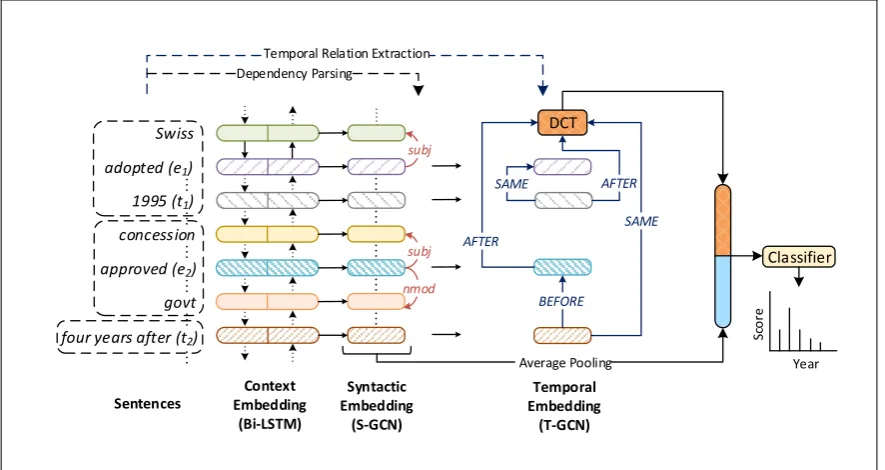
Figure 2: Overview of NeuralDater. NeuralDater exploits syntactic and temporal structure in a document to learn effective representation, which in turn are used to predict the document time. NeuralDater uses a Bi-directional LSTM (Bi-LSTM), two Graph Convolution Networks (GCN) – one over the dependency tree and the other over the document’s temporal graph – along with a softmax classifier, all trained end-to-end jointly. Please see Section4for more details.
ness (Lappas et al.,2009).
Document dating is a challenging problem which requires extensive reasoning over the tem-poral structure of the document. Let us moti-vate this through an example shown in Figure 1. In the document, four years after plays a crucial role in identifying the creation time of the docu-ment. The existing approaches give higher confi-dence for timestamp immediate to the year men-tion1995. NeuralDater exploits the syntactic and temporal structure of the document to predict the right timestamp (1999) for the document. With the exception of (Chambers,2012), all prior works on the document dating problem ignore such infor-mative temporal structure within the document.
Research in document event extraction and or-dering have made it possible to extract such tem-poral structures involving events, temtem-poral ex-pressions, and the (unknown) document date in a document (Mirza and Tonelli, 2016;Chambers et al., 2014). While methods to perform reason-ing over such structures exist (Verhagen et al.,
2007,2010;UzZaman et al.,2013;Llorens et al.,
2015;Pustejovsky et al.,2003), none of them have exploited advances in deep learning (Krizhevsky et al.,2012;Hinton et al.,2012;Goodfellow et al.,
2016). In particular, recently proposed Graph Convolution Networks (GCN) (Defferrard et al.,
2016;Kipf and Welling,2017) have emerged as a
way to learn graph representation while encoding structural information and constraints represented by the graph. We adapt GCNs for the document dating problem and make the following contribu-tions:
• We propose NeuralDater, a Graph Convolu-tion Network (GCN)-based approach for doc-ument dating. To the best of our knowledge, this is the first application of GCNs, and more broadly deep neural network-based methods, for the document dating problem.
• NeuralDater is the first document dating ap-proach which exploits syntactic as well tem-poral structure of the document, all within a principled joint model.
• Through extensive experiments on multiple real-world datasets, we demonstrate Neu-ralDater’s effectiveness over state-of-the-art baselines.
NeuralDater’s source code and datasets used in the paper are available athttp://github.
com/malllabiisc/NeuralDater.
2 Related Work
Automatic Document Dating: de Jong et al.
model. Kanhabua and Nørv˚ag(2008a) further ex-tend this work by incorporating semantic-based preprocessing and temporal entropy (Kanhabua and Nørv˚ag,2008b) based term-weighting. Cham-bers(2012) proposes a MaxEnt based discrimina-tive model trained on hand-crafted temporal fea-tures. He also proposes a model to learn proba-bilistic constraints between year mentions and the actual creation time of the document. We draw inspiration from his work for exploiting temporal reasoning for document dating. Kotsakos et al.
(2014) propose a purely statistical method which considers lexical similarity alongside burstiness (Lappas et al., 2009) of terms for dating docu-ments. To the best of our knowledge, NeuralDater, our proposed method, is the first method to utilize deep learning techniques for the document dating problem.
Event Ordering Systems: Temporal ordering of events is a vast research topic in NLP. The problem is posed as a temporal relation classifi-cation between two given temporal entities. Ma-chine Learned classifiers and well crafted linguis-tic features for this task are used in (Chambers et al., 2007; Mirza and Tonelli, 2014). D’Souza and Ng (2013) use a hybrid approach by adding 437 hand-crafted rules. Chambers and Jurafsky
(2008);Yoshikawa et al.(2009) try to classify with many more temporal constraints, while utilizing integer linear programming and Markov logic.
CAEVO, a CAscading EVent Ordering archi-tecture (Chambers et al.,2014) use sieve-based ar-chitecture (Lee et al.,2013) for temporal event or-dering for the first time. They mix multiple learn-ers according to their precision based ranks and use transitive closure for maintaining consistency of temporal graph. Mirza and Tonelli (2016) re-cently propose CATENA (CAusal and TEmporal relation extraction from NAtural language texts), the first integrated system for the temporal and causal relations extraction between pre-annotated events and time expressions. They also incorpo-rate sieve-based architecture which outperforms existing methods in temporal relation classifica-tion domain. We make use of CATENA for tem-poral graph construction in our work.
Graph Convolutional Networks (GCN): GCNs generalize Convolutional Neural Network (CNN) over graphs. GCN is introduced by (Bruna et al., 2014), and later extended by (Defferrard et al.,2016) with efficient localized filter
approx-imation in spectral domain. Kipf and Welling
(2017) propose a first-order approximation of lo-calized filters through layer-wise propagation rule. GCNs over syntactic dependency trees have been recently exploited in the field of semantic-role labeling (Marcheggiani and Titov, 2017), neural machine translation (Bastings et al.,2017a), event detection (Bastings et al., 2017b). In our work, we successfully use GCNs for document dating.
3 Background: Graph Convolution Networks (GCN)
In this section, we provide an overview of Graph Convolution Networks (GCN) (Kipf and Welling,
2017). GCN learns an embedding for each node of the graph it is applied over. We first present GCN for undirected graphs and then move onto GCN for directed graph setting.
3.1 GCN on Undirected Graph
LetG = (V,E)be an undirected graph, whereV is a set ofnvertices and E the set of edges. The input feature matrixX ∈ Rn×m whose rows are input representation of nodeu,xu ∈Rm,∀u∈ V. The output hidden representation hv ∈ Rd of a node v after a single layer of graph convolution operation can be obtained by considering only the immediate neighbors ofv. This can be formulated as:
hv =f
X
u∈N(v)
(W xu+b)
, ∀v∈ V.
Here, model parametersW ∈ Rd×m andb ∈ Rd are learned in a task-specific setting using first-order gradient optimization.N(v)refers to the set of neighbors ofv andf is any non-linear tion function. We have used ReLU as the activa-tion funcactiva-tion in this paper1.
In order to capture nodes many hops away, mul-tiple GCN layers may be stacked one on top of an-other. In particular, hkv+1, representation of node vafterkthGCN layer can be formulated as:
hkv+1=f
X
u∈N(v)
Wkhku+bk
,∀v∈ V.
wherehku is the input to thekthlayer.
3.2 GCN on Labeled and Directed Graph
In this section, we consider GCN formulation over graphs where each edge is labeled as well as di-rected. In this setting, an edge from node u to v with label l(u, v) is denoted as (u, v, l(u, v)). While a few recent works focus on GCN over di-rected graphs (Yasunaga et al., 2017; Marcheg-giani and Titov,2017), none of them consider la-beled edges. We handle both direction and label by incorporating label and direction specific filters.
Based on the assumption that the information in a directed edge need not only propagate along its direction, following (Marcheggiani and Titov,
2017) we define an updated edge setE0which
ex-pands the original setE by incorporating inverse, as well self-loop edges.
E0 =E ∪ {(v, u, l(u, v)−1)|(u, v, l(u, v))∈ E}
∪ {(u, u,>)|u∈ V)}. (1)
Here, l(u, v)−1 is the inverse edge label corre-sponding to labell(u, v), and>is a special empty relation symbol for self-loop edges. We now de-fine hkv+1 as the embedding of node v after kth GCN layer applied over the directed and labeled graph as:
hkv+1=f
X
u∈N(v)
Wlk(u,v)hku+bkl(u,v)
.
(2) We note that the parametersWlk(u,v) andbkl(u,v) in this case are edge label specific.
3.3 Incorporating Edge Importance
In many practical settings, we may not want to give equal importance to all the edges. For exam-ple, in case of automatically constructed graphs, some of the edges may be erroneous and we may want to automatically learn to discard them. Edge-wise gating may be used in a GCN to give im-portance to relevant edges and subdue the noisy ones. Bastings et al.(2017b);Marcheggiani and Titov (2017) used gating for similar reasons and obtained high performance gain. At kth layer, we compute gating value for a particular edge (u, v, l(u, v))as:
gku,v =σ
hku·wˆlk(u,v)+ ˆbkl(u,v)
,
where, σ(·) is the sigmoid function, wˆlk(u,v) and ˆbk
l(u,v) are label specific gating parameters. Thus,
gating helps to make the model robust to the noisy labels and directions of the input graphs. GCN embedding of a node while incorporating edge gating may be computed as follows.
hkv+1 =f
X
u∈N(v)
gku,v×Wlk(u,v)hku+bkl(u,v)
.
4 NeuralDater Overview
The Documents Dating problem may be cast as a multi-class classification problem (Kotsakos et al.,
2014; Chambers, 2012). In this section, we present an overview of NeuralDater, the document dating system proposed in this paper. Architec-tural overview of NeuralDater is shown in Figure
2.
NeuralDater is a deep learning-based multi-class multi-classification system. It takes in a document as input and returns its predicted date as output by exploiting the syntactic and temporal structure of document.
NeuralDater network consists of three layers which learns an embedding for the Document Cre-ation Time (DCT) node corresponding to the doc-ument. This embedding is then fed to a soft-max classifier which produces a distribution over timestamps. Following prior research (Chambers,
2012;Kotsakos et al., 2014), we work with year granularity for the experiments in this paper. We however note that NeuralDater can be trained for finer granularity with appropriate training data. The NeuralDater network is trained end-to-end us-ing trainus-ing data. We briefly present NeuralDater’s various components below. Each component is de-scribed in greater detail in subsequent sections.
• Context Embedding: In this layer, Neu-ralDater uses a Bi-directional LSTM (Bi-LSTM) to learn embedding for each token in the document. Bi-LSTMs have been shown to be quite effective in capturing local context inside token embeddings (Sutskever et al.,
2014).
• Syntactic Embedding: In this step, Neural-Dater revises token embeddings from previ-ous step by running a GCN over the depen-dency parses of sentences in the document. We refer to this GCN asSyntactic GCN or
S-GCN augments them by capturing syntactic context.
• Temporal Embedding: In this step, Neu-ralDater further refines embeddings learned by S-GCN to incorporate cues from temporal structure of event and times in the document. NeuralDater uses state-of-the-art causal and temporal relation extraction algorithm (Mirza and Tonelli, 2016) for extracting temporal graph for each document. A GCN is then run over this temporal graph to refine the embed-dings from previous layer. We refer to this GCN asTemporal GCN orT-GCN. In this step, a special DCT node is introduced whose embedding is also learned by the T-GCN.
• Classifier: Embedding of the DCT node along with average pooled embeddings learned by S-GCN are fed to a fully con-nected softmax classifier which makes the fi-nal prediction about the date of the document.
Even though the previous discussion is pre-sented in a sequential manner, the whole network is trained in a joint end-to-end manner using back-propagation.
5 NeuralDater Details
In this section, we present detailed description of various components of NeuralDater.
5.1 Context Embedding (Bi-LSTM)
Let us consider a document D with n tokens w1, w2, ..., wn. We first represent each token by ak-dimensional word embedding. For the exper-iments in this paper, we use GloVe (Pennington et al., 2014) embeddings. These token embed-dings are stacked together to get the document representation X ∈ Rn×k. We then employ a Bi-directional LSTM (Bi-LSTM) (Hochreiter and Schmidhuber,1997) on the input matrixX to ob-tain contextual embedding for each token. After stacking contextual embedding of all these tokens, we get the new document representation matrix Hcntx ∈
Rn×rcntx. In this new representation, each token is represented in a rcntx-dimensional space. Our choice of LSTMs for learning con-textual embeddings for tokens is motivated by the previous success of LSTMs in this task (Sutskever et al.,2014).
5.2 Syntactic Embedding (S-GCN)
While the Bi-LSTM is effective at capturing im-mediate local context of a token, it may not be as effective in capturing longer range dependencies among words in a sentence. For example, in Fig-ure1, we would like the embedding of token ap-provedto be directly affected bygovt, even though they are not immediate neighbors. A dependency parse may be used to capture such longer-range connections. In fact, similar features were ex-ploited by (Chambers,2012) for the document dat-ing problem. NeuralDater captures such longer-range information by using another GCN run over the syntactic structure of the document. We de-scribe this in detail below.
The context embedding, Hcntx ∈
Rn×rcntx learned in the previous step is used as input to this layer. For a given document, we first extract its syntactic dependency structure by applying the Stanford CoreNLP’s dependency parser (Manning et al.,2014) on each sentence in the document in-dividually. We now employ the Graph Convolu-tion Network (GCN) over this dependency graph using the GCN formulation presented in Section
3.2. We call this GCN the Syntactic GCN or S-GCN, as mentioned in Section4.
Since S-GCN operates over the dependency graph and uses Equation 2 for updating embed-dings, the number of parameters in S-GCN is di-rectly proportional to the number of dependency edge types. Stanford CoreNLP’s dependency parser returns 55 different dependency edge types. This large number of edge types is going to sig-nificantly over-parameterize S-GCN, thereby in-creasing the possibility of overfitting. In order to address this, we use only three edge types in S-GCN. For each edge connecting nodeswi andwj inE0 (see Equation1), we determine its new type L(wi, wj)as follows:
• L(wi, wj) =→ if (wi, wj, l(wi, wj)) ∈ E0, i.e., if the edge is an original dependency parse edge
• L(wi, wj) =←if(wi, wj, l(wi, wj)−1)∈ E0, i.e., if the edges is an inverse edge
• L(wi, wj) = >if (wi, wj,>) ∈ E0, i.e., if the edge is a self-loop withwi =wj
S-GCN now estimates embeddinghsynwi ∈ R
rsyn
for-mulation shown below.
hsynwi =f
P
wj∈N(wi)
WL(wi,wj)h
cntx
wj +bL(wi,wj)
!
Please note S-GCN’s use of the new edge types L(wi, wj) above, instead of the l(wi, wj) types used in Equation2. By stacking embeddings for all the tokens together, we get the new embedding matrix Hsyn ∈
Rn×rsyn representing the docu-ment.
AveragePooling: We obtain an embeddinghavgD for the whole document by average pooling of ev-ery token representation.
havgD = 1
n n
X
i=1
hsynwi . (3)
5.3 Temporal Embedding (T-GCN)
In this layer, NeuralDater exploits temporal struc-ture of the document to learn an embedding for the Document Creation Time (DCT) node of the doc-ument. First, we describe the construction of tem-poral graph, followed by GCN-based embedding learning over this graph.
Temporal Graph Construction: NeuralDater uses Stanford’s SUTime tagger (Chang and Man-ning, 2012) for date normalization and the event extraction classifier of (Chambers et al.,2014) for event detection. The annotated document is then passed to CATENA (Mirza and Tonelli, 2016), current state-of-the-art temporal and causal rela-tion extracrela-tion algorithm, to obtain a temporal graph for each document. Since our task is to pre-dict the creation time of a given document, we supply DCT as unknown to CATENA. We hy-pothesize that the temporal relations extracted in absence of DCT are helpful for document dating and we indeed find this to be true, as shown in Section 7. Temporal graph is a directed graph, where nodes correspond to events, time mentions, and the Document Creation Time (DCT). Edges in this graph represent causal and temporal relation-ships between them. Each edge is attributed with a label representing the type of the temporal rela-tion. CATENA outputs 9 different types of tempo-ral relations, out of which we selected five types, viz., AFTER, BEFORE,SAME, INCLUDES, and
IS INCLUDED. The remaining four types were ignored as they were substantially infrequent.
Please note that the temporal graph may involve only a small number of tokens in the document.
Datasets # Docs Start Year End Year
APW 675k 1995 2010
NYT 647k 1987 1996
Table 1: Details of datasets used. Please see Section6for details.
For example, in the temporal graph in Figure 2, there are a total of 5 nodes: two temporal expres-sion nodes (1995andfour years after), two event nodes (adoptedandapproved), and a special DCT node. This graph also consists of temporal rela-tion edges such as (four years after,approved, BE-FORE).
Temporal Graph Convolution: NeuralDater employs a GCN over the temporal graph con-structed above. We refer to this GCN as the Tem-poral GCN or T-GCN, as mentioned in Section
4. T-GCN is based on the GCN formulation pre-sented in Section 3.2. Unlike S-GCN, here we consider label and direction specific parameters as the temporal graph consists of only five types of edges.
LetnT be the number of nodes in the temporal graph. Starting withHsyn (Section5.2), T-GCN learns a rtemp-dimensional embedding for each node in the temporal graph. Stacking all these em-beddings together, we get the embedding matrix Htemp ∈
RnT×rtemp. T-GCN embeds the tempo-ral constraints induced by the tempotempo-ral graph in htempDCT ∈ Rrtemp, embedding of the DCT node of the document.
5.4 Classifier
Finally, the DCT embeddinghtempDCT and average-pooled syntactic representationhavgD (see Equation
3) of document D are concatenated and fed to a fully connected feed forward network followed by a softmax. This allows the NeuralDater to exploit context, syntactic, and temporal structure of the document to predict the final document datey.
havgD +temp = [htempDCT ; havgD ]
p(y|D) = Softmax(W ·havgD +temp+b).
6 Experimental Setup
documents of APW and 2 million documents of NYT from span of multiple years. From both sections, we randomly sample around 650k doc-uments while maintaining balance among years. Documents belonging to years with substantially fewer documents are omitted. Details of the dataset can be found in Table1. For train, test and validation splits, the dataset was randomly divided in 80:10:10 ratio.
Evaluation Criteria: Given a document, the model needs to predict the year in which the docu-ment was published. We measure performance in terms of overall accuracy of the model.
Baselines: For evaluating NeuralDater, we compared against the following methods:
• BurstySimDater Kotsakos et al. (2014): This is a purely statistical method which uses lexical similarity and term burstiness (Lappas et al.,2009) for dating documents in arbitrary length time frame. For our experiments, we took the time frame length as 1 year. Please refer to (Kotsakos et al.,2014) for more de-tails.
• MaxEnt-Time-NER: Maximum Entropy (MaxEnt) based classifier trained on hand-crafted temporal and Named Entity Recognizer (NER) based features. More details in (Chambers,2012).
• MaxEnt-Joint: Refers to MaxEnt-Time-NER combined with year mention classifier as described in (Chambers,2012).
• MaxEnt-Uni-Time: MaxEnt based discrim-inative model which takes bag-of-words rep-resentation of input document with normal-ized time expression as its features.
• CNN: A Convolution Neural Network (CNN) (LeCun et al., 1999) based text classification model proposed by (Kim,
2014), which attained state-of-the-art results in several domains.
• NeuralDater: Our proposed method, refer Section4.
Hyperparameters: By default, edge gating (Section3.3) is used in all GCNs. The parameter Krepresents the number of layers in T-GCN (Sec-tion5.3). We use 300-dimensional GloVe embed-dings and 128-dimensional hidden state for both
Method APW NYT
BurstySimDater 45.9 38.5 MaxEnt-Time+NER 52.5 42.3
MaxEnt-Joint 52.5 42.5
MaxEnt-Uni-Time 57.5 50.5
CNN 56.3 50.4
[image:7.595.328.502.63.172.2]NeuralDater 64.1 58.9
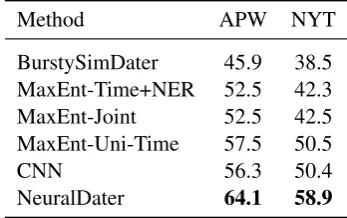
[image:7.595.307.529.247.351.2]Table 2: Accuracies of different methods on APW and NYT datasets for the document dating problem (higher is better). NeuralDater significantly outperforms all other competitive baselines. This is our main result. Please see Section7.1for more details.
Figure 3: Mean absolute deviation (in years; lower is bet-ter) between a model’s top prediction and the true year in the APW dataset. We find that NeuralDater, the proposed method, achieves the least deviation. Please see Section7.1
for details.
Method Accuracy
T-GCN 57.3
S-GCN + T-GCN(K= 1) 57.8 S-GCN + T-GCN(K= 2) 58.8 S-GCN + T-GCN(K= 3) 59.1
Bi-LSTM 58.6
Bi-LSTM + CNN 59.0
Bi-LSTM + T-GCN 60.5
Bi-LSTM + S-GCN + T-GCN (no gate) 62.7 Bi-LSTM + S-GCN + T-GCN(K= 1) 64.1 Bi-LSTM + S-GCN + T-GCN(K= 2) 63.8 Bi-LSTM + S-GCN + T-GCN(K= 3) 63.3
Table 3: Accuracies of different ablated methods on the APW dataset. Overall, we observe that incorporation of context (Bi-LSTM), syntactic structure (S-GCN) and temporal struc-ture (T-GCN) in NeuralDater achieves the best performance. Please see Section7.1for details.
GCNs and BiLSTM with 0.8 dropout. We used Adam (Kingma and Ba, 2014) with 0.001 learn-ing rate for trainlearn-ing.
7 Results
7.1 Performance Comparison
[image:7.595.312.518.424.564.2]against existing document dating systems and text classification models. The final results are sum-marized in Table 2. Overall, we find that Neu-ralDater outperforms all other methods with a significant margin on both datasets. Compared to the previous state-of-the-art in document dat-ing, BurstySimDater (Kotsakos et al., 2014), we get 19% average absolute improvement in accu-racy across both datasets. We observe only a slight gain in the performance of MaxEnt-based model (MaxEnt-Time+NER) of (Chambers,2012) on combining with temporal constraint reasoner (MaxEnt-Joint). This may be attributed to the fact that the model utilizes only year mentions in the document, thus ignoring other relevant signals which might be relevant to the task. BurstySim-Dater performs considerably better in terms of pre-cision compared to the other baselines, although it significantly underperforms in accuracy. We note that NeuralDater outperforms all these prior models both in terms of precision and accuracy. We find that even generic deep-learning based text classification models, such as CNN (Kim,2014), are quite effective for the problem. However, since such a model doesn’t give specific attention to temporal features in the document, its perfor-mance remains limited. From Figure 3, we ob-serve that NeuralDater’s top prediction achieves on average the lowest deviation from the true year.
7.2 Ablation Comparisons
For demonstrating the efficacy of GCNs and BiL-STM for the problem, we evaluate different ab-lated variants of NeuralDater on the APW dataset. Specifically, we validate the importance of us-ing syntactic and temporal GCNs and the effect of eliminating BiLSTM from the model. Over-all results are summarized in Table 3. The first block of rows in the table corresponds to the case when BiLSTM layer is excluded from Neural-Dater, while the second block denotes the case when BiLSTM is included. We also experiment with multiple stacked layers of T-GCN (denoted byK) to observe its effect on the performance of the model.
We observe that embeddings from Syntactic GCN (S-GCN) are much better than plain GloVe embeddings for T-GCN as S-GCN encodes the syntactic neighborhood information in event and time embeddings which makes them more relevant for document dating task.
[image:8.595.311.530.66.164.2]Accuracy
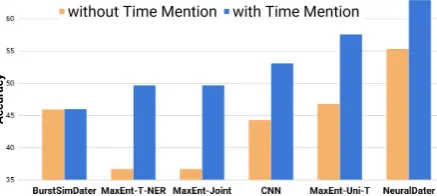
Figure 4: Evaluating performance of different methods on dating documents with and without time mentions. Please see Section7.3for details.
Overall, we observe that including BiLSTM in the model improves performance significantly. Single BiLSTM model outperforms all the mod-els listed in the first block of Table3. Also, some gain in performance is observed on increasing the number of T-GCN layers (K) in absence of BiL-STM, although the same does not follow when BiLSTM is included in the model. This observa-tion is consistent with (Marcheggiani and Titov,
2017), as multiple GCN layers become redundant in the presence of BiLSTM. We also find that elim-inating edge gating from our best model deterio-rates its overall performance.
In summary, these results validate our thesis that joint incorporation of syntactic and temporal structure of a document in NeuralDater results in improved performance.
7.3 Discussion and Error Analysis
incorporating additional signals from Knowledge Graphs about entities mentioned in the document. We also plan to utilize free text temporal expres-sion (Kuzey et al.,2016) in documents for improv-ing performance on this problem.
8 Conclusion
We propose NeuralDater, a Graph Convolutional Network (GCN) based method for document dat-ing which exploits syntactic and temporal struc-tures in the document in a principled way. To the best of our knowledge, this is the first applica-tion of deep learning techniques for the problem of document dating. Through extensive experiments on real-world datasets, we demonstrate the effec-tiveness of NeuralDater over existing state-of-the-art approaches. We are hopeful that the representa-tion learning techniques explored in this paper will inspire further development and adoption of such techniques in the temporal information processing research community.
Acknowledgements
We thank the anonymous reviewers for their con-structive comments. This work is supported in part by the Ministry of Human Resource Development (Government of India) and by a gift from Google.
References
James Allan, Ron Papka, and Victor Lavrenko. 1998. On-line new event detection and
track-ing. In Proceedings of the 21st Annual
In-ternational ACM SIGIR Conference on Research
and Development in Information Retrieval. ACM,
New York, NY, USA, SIGIR ’98, pages 37–45. https://doi.org/10.1145/290941.290954.
Joost Bastings, Ivan Titov, Wilker Aziz, Diego Marcheggiani, and Khalil Simaan. 2017a. Graph convolutional encoders for syntax-aware neural ma-chine translation. InProceedings of the 2017 Con-ference on Empirical Methods in Natural Language
Processing. Association for Computational
Lin-guistics, Copenhagen, Denmark, pages 1957–1967. https://www.aclweb.org/anthology/D17-1209.
Joost Bastings, Ivan Titov, Wilker Aziz, Diego Marcheggiani, and Khalil Sima’an. 2017b. Graph convolutional encoders for syntax-aware neural machine translation. CoRR abs/1704.04675. http://arxiv.org/abs/1704.04675.
Joan Bruna, Wojciech Zaremba, Arthur Szlam, and Yann Lecun. 2014. Spectral networks and lo-cally connected networks on graphs. In
Inter-national Conference on Learning Representations
(ICLR2014), CBLS, April 2014.
Nathanael Chambers. 2012. Labeling documents with timestamps: Learning from their time expressions. In Proceedings of the 50th An-nual Meeting of the Association for
Compu-tational Linguistics: Long Papers - Volume
1. Association for Computational Linguistics, Stroudsburg, PA, USA, ACL ’12, pages 98–106. http://dl.acm.org/citation.cfm?id=2390524.2390539.
Nathanael Chambers, Taylor Cassidy, Bill McDow-ell, and Steven Bethard. 2014. Dense event order-ing with a multi-pass architecture. Transactions of the Association of Computational Linguistics2:273– 284. http://www.aclweb.org/anthology/Q14-1022.
Nathanael Chambers and Dan Jurafsky. 2008. Jointly combining implicit constraints improves temporal ordering. InProceedings of the Conference on
Em-pirical Methods in Natural Language Processing.
Association for Computational Linguistics, Strouds-burg, PA, USA, EMNLP ’08, pages 698–706. http://dl.acm.org/citation.cfm?id=1613715.1613803.
Nathanael Chambers, Shan Wang, and Dan Ju-rafsky. 2007. Classifying temporal relations between events. In Proceedings of the 45th
Annual Meeting of the ACL on Interactive
Poster and Demonstration Sessions.
Associa-tion for Computational Linguistics, Strouds-burg, PA, USA, ACL ’07, pages 173–176. http://dl.acm.org/citation.cfm?id=1557769.1557820.
Angel X. Chang and Christopher Manning. 2012. Sutime: A library for recognizing and nor-malizing time expressions. In Proceedings of the Eighth International Conference on Language
Resources and Evaluation (LREC-2012).
Euro-pean Language Resources Association (ELRA). http://www.aclweb.org/anthology/L12-1122.
Wisam Dakka, Luis Gravano, and Panagiotis G. Ipeiro-tis. 2008. Answering general time sensitive queries.
In Proceedings of the 17th ACM Conference on
Information and Knowledge Management. ACM,
New York, NY, USA, CIKM ’08, pages 1437–1438. https://doi.org/10.1145/1458082.1458320.
Franciska M.G. de Jong, H. Rode, and Djoerd Hiem-stra. 2005a. Temporal Language Models for
the Disclosure of Historical Text, KNAW, pages
161–168. Imported from EWI/DB PMS [db-utwente:inpr:0000003683].
Franciska M.G. de Jong, H. Rode, and Djoerd Hiem-stra. 2005b. Temporal Language Models for
the Disclosure of Historical Text, KNAW, pages
161–168. Imported from EWI/DB PMS [db-utwente:inpr:0000003683].
Proceedings of the 30th International Conference
on Neural Information Processing Systems. Curran
Associates Inc., USA, NIPS’16, pages 3844–3852. http://dl.acm.org/citation.cfm?id=3157382.3157527.
Jennifer D’Souza and Vincent Ng. 2013. Classifying temporal relations with rich linguistic knowledge.
InProceedings of the 2013 Conference of the North
American Chapter of the Association for
Computa-tional Linguistics: Human Language Technologies.
Association for Computational Linguistics, pages 918–927. http://www.aclweb.org/anthology/N13-1112.
Ian Goodfellow, Yoshua Bengio, and Aaron Courville. 2016. Deep Learning. MIT Press. http://www.
deeplearningbook.org.
G. Hinton, L. Deng, D. Yu, G. E. Dahl, A. r. Mohamed, N. Jaitly, A. Senior, V. Vanhoucke, P. Nguyen, T. N. Sainath, and B. Kingsbury. 2012. Deep neural networks for acoustic modeling in speech recog-nition: The shared views of four research groups.
IEEE Signal Processing Magazine 29(6):82–97.
https://doi.org/10.1109/MSP.2012.2205597.
Sepp Hochreiter and J¨urgen Schmidhuber. 1997. Long short-term memory. Neural Comput. 9(8):1735– 1780.https://doi.org/10.1162/neco.1997.9.8.1735.
Nattiya Kanhabua and Kjetil Nørv˚ag. 2008a. Improv-ing temporal language models for determinImprov-ing time of non-timestamped documents. InProceedings of the 12th European Conference on Research and Ad-vanced Technology for Digital Libraries. Springer-Verlag, Berlin, Heidelberg, ECDL ’08, pages 358– 370.
Nattiya Kanhabua and Kjetil Nørv˚ag. 2008b. Improv-ing temporal language models for determinImprov-ing time of non-timestamped documents. In International Conference on Theory and Practice of Digital Li-braries. Springer, pages 358–370.
Yoon Kim. 2014. Convolutional neural networks for sentence classification. In Proceedings of the 2014 Conference on Empirical Methods in
Nat-ural Language Processing (EMNLP). Association
for Computational Linguistics, pages 1746–1751. https://doi.org/10.3115/v1/D14-1181.
Diederik P. Kingma and Jimmy Ba. 2014. Adam: A method for stochastic optimization. CoRR abs/1412.6980.
Thomas N. Kipf and Max Welling. 2017. Semi-supervised classification with graph convolutional networks. InInternational Conference on Learning Representations (ICLR).
Dimitrios Kotsakos, Theodoros Lappas, Dimitrios Kotzias, Dimitrios Gunopulos, Nattiya Kan-habua, and Kjetil Nørv˚ag. 2014. A burstiness-aware approach for document dating. In
Proceedings of the 37th International ACM
SIGIR Conference on Research &
Devel-opment in Information Retrieval. ACM, New
York, NY, USA, SIGIR ’14, pages 1003–1006. https://doi.org/10.1145/2600428.2609495.
Alex Krizhevsky, Ilya Sutskever, and Geoffrey E. Hinton. 2012. Imagenet classification with deep convolutional neural networks. In Proceedings of the 25th International Conference on Neural
Information Processing Systems - Volume 1. Curran
Associates Inc., USA, NIPS’12, pages 1097–1105. http://dl.acm.org/citation.cfm?id=2999134.2999257.
Erdal Kuzey, Vinay Setty, Jannik Str¨otgen, and Gerhard Weikum. 2016. As time goes by: Comprehensive tagging of textual phrases with temporal scopes. In Proceedings of the 25th
International Conference on World Wide Web.
International World Wide Web Conferences Steering Committee, Republic and Canton of Geneva, Switzerland, WWW ’16, pages 915–925. https://doi.org/10.1145/2872427.2883055.
Theodoros Lappas, Benjamin Arai, Manolis Platakis, Dimitrios Kotsakos, and Dimitrios Gunopulos. 2009. On burstiness-aware search for docu-ment sequences. In Proceedings of the 15th ACM SIGKDD International Conference on
Knowl-edge Discovery and Data Mining. ACM, New
York, NY, USA, KDD ’09, pages 477–486. https://doi.org/10.1145/1557019.1557075.
Yann LeCun, Patrick Haffner, L´eon Bottou, and Yoshua Bengio. 1999. Object recogni-tion with gradient-based learning. In Shape,
Contour and Grouping in Computer Vision.
Springer-Verlag, London, UK, UK, pages 319–. http://dl.acm.org/citation.cfm?id=646469.691875.
Heeyoung Lee, Angel Chang, Yves Peirsman, Nathanael Chambers, Mihai Surdeanu, and Dan Jurafsky. 2013. Deterministic coreference resolu-tion based on entity-centric, precision-ranked rules.
Comput. Linguist.39(4):885–916.
Xiaoyan Li and W. Bruce Croft. 2003. Time-based language models. In Proceedings of the Twelfth International Conference on
Informa-tion and Knowledge Management. ACM, New
York, NY, USA, CIKM ’03, pages 469–475. https://doi.org/10.1145/956863.956951.
D. Llid´o, R. Berlanga, and M. J. Aramburu. 2001. Extracting temporal references to assign document event-time periods*. In Heinrich C. Mayr, Jiri Lazansky, Gerald Quirchmayr, and Pavel Vogel, editors, Database and Expert Systems Applica-tions. Springer Berlin Heidelberg, Berlin, Heidel-berg, pages 62–71.
Qa tempeval-evaluating temporal information un-derstanding with question answering. In Proceed-ings of the 9th International Workshop on Semantic
Evaluation (SemEval 2015). pages 792–800.
Inderjeet Mani and George Wilson. 2000.Robust tem-poral processing of news. InProceedings of the 38th Annual Meeting on Association for Computational Linguistics. Association for Computational Linguis-tics, Stroudsburg, PA, USA, ACL ’00, pages 69–76. https://doi.org/10.3115/1075218.1075228.
Christopher D. Manning, Mihai Surdeanu, John Bauer, Jenny Finkel, Steven J. Bethard, and David McClosky. 2014. The Stanford CoreNLP natural language processing toolkit.
In Association for Computational Linguistics
(ACL) System Demonstrations. pages 55–60.
http://www.aclweb.org/anthology/P/P14/P14-5010.
Diego Marcheggiani and Ivan Titov. 2017. Encod-ing sentences with graph convolutional networks for semantic role labeling. CoRRabs/1703.04826. http://arxiv.org/abs/1703.04826.
Paramita Mirza and Sara Tonelli. 2014. Classifying temporal relations with simple features. In Proceed-ings of the 14th Conference of the European Chap-ter of the Association for Computational Linguistics. Association for Computational Linguistics, pages 308–317. https://doi.org/10.3115/v1/E14-1033.
Paramita Mirza and Sara Tonelli. 2016. Catena: Causal and temporal relation extraction from nat-ural language texts. In Proceedings of COLING 2016, the 26th International Conference on
Compu-tational Linguistics: Technical Papers. The
COL-ING 2016 Organizing Committee, pages 64–75. http://www.aclweb.org/anthology/C16-1007.
MA Olson, K Bostic, MI Seltzer, and DB Berkeley. 1999. Usenix annual technical conference, freenix track.
Robert Parker, David Graff, Junbo Kong, Ke Chen, and Kazuaki Maeda. 2011. English gigaword fifth edi-tion ldc2011t07. dvd. Philadelphia: Linguistic Data
Consortium.
Jeffrey Pennington, Richard Socher, and Christo-pher D. Manning. 2014. Glove: Global vectors for word representation. InEmpirical Methods in
Nat-ural Language Processing (EMNLP). pages 1532–
1543.http://www.aclweb.org/anthology/D14-1162.
James Pustejovsky, Patrick Hanks, Roser Sauri, An-drew See, Robert Gaizauskas, Andrea Setzer, Dragomir Radev, Beth Sundheim, David Day, Lisa Ferro, et al. 2003. The timebank corpus. InCorpus linguistics. Lancaster, UK., volume 2003, page 40.
Ilya Sutskever, Oriol Vinyals, and Quoc V. Le. 2014. Sequence to sequence learning with neural networks. In Proceedings of the 27th International Conference on Neural Information
Processing Systems - Volume 2. MIT Press,
Cam-bridge, MA, USA, NIPS’14, pages 3104–3112. http://dl.acm.org/citation.cfm?id=2969033.2969173.
Naushad UzZaman, Hector Llorens, Leon Derczyn-ski, James Allen, Marc Verhagen, and James Puste-jovsky. 2013. Semeval-2013 task 1: Tempeval-3: Evaluating time expressions, events, and temporal relations. In Second Joint Conference on Lexical and Computational Semantics (* SEM), Volume 2: Proceedings of the Seventh International Workshop
on Semantic Evaluation (SemEval 2013). volume 2,
pages 1–9.
Marc Verhagen, Robert Gaizauskas, Frank Schilder, Mark Hepple, Graham Katz, and James Pustejovsky. 2007. Semeval-2007 task 15: Tempeval temporal relation identification. InProceedings of the 4th
in-ternational workshop on semantic evaluations.
As-sociation for Computational Linguistics, pages 75– 80.
Marc Verhagen, Roser Sauri, Tommaso Caselli, and James Pustejovsky. 2010. Semeval-2010 task 13: Tempeval-2. InProceedings of the 5th international
workshop on semantic evaluation. Association for
Computational Linguistics, pages 57–62.
Xiaojun Wan. 2007. Timedtextrank: Adding the temporal dimension to multi-document
summariza-tion. In Proceedings of the 30th Annual
In-ternational ACM SIGIR Conference on Research
and Development in Information Retrieval. ACM,
New York, NY, USA, SIGIR ’07, pages 867–868. https://doi.org/10.1145/1277741.1277949.
Michihiro Yasunaga, Rui Zhang, Kshitijh Meelu, Ayush Pareek, Krishnan Srinivasan, and Dragomir R. Radev. 2017. Graph-based neural multi-document summarization. In Proceedings
of CoNLL-2017. Association for Computational
Linguistics.
Katsumasa Yoshikawa, Sebastian Riedel, Masayuki Asahara, and Yuji Matsumoto. 2009. Jointly identifying temporal relations with markov logic.
In Proceedings of the Joint Conference of the
47th Annual Meeting of the ACL and the 4th International Joint Conference on Natural
Lan-guage Processing of the AFNLP. Association