Forest-Based Neural Machine Translation
Chunpeng Ma1,3∗Akihiro Tamura2 Masao Utiyama3 Tiejun Zhao1†Eiichiro Sumita3 1Harbin Institute of Technology, Harbin, China
2Ehime University, Matsuyama, Japan
3National Institute of Information and Communications Technology, Kyoto, Japan
{cpma, tjzhao}@hit.edu.cn [email protected]
{mutiyama, eiichiro.sumita}@nict.go.jp
Abstract
Tree-based neural machine translation (NMT) approaches, although achieved im-pressive performance, suffer from a ma-jor drawback: they only use the 1-best parse tree to direct the translation, which potentially introduces translation mistakes due to parsing errors. For sta-tistical machine translation (SMT), forest-based methods have been proven to be effective for solving this problem, while for NMT this kind of approach has not been attempted. This paper proposes a forest-based NMT method that translates a linearized packed forest under a simple sequence-to-sequence framework (i.e., a forest-to-string NMT model). The BLEU score of the proposed method is higher than that of the string-to-string NMT, tree-based NMT, and forest-tree-based SMT sys-tems.
1 Introduction
NMT has witnessed promising improvements re-cently. Depending on the types of input and out-put, these efforts can be divided into three cate-gories: string-to-string systems (Sutskever et al.,
2014;Bahdanau et al., 2014); tree-to-string sys-tems (Eriguchi et al., 2016,2017); and string-to-treesystems (Aharoni and Goldberg,2017; Nade-jde et al., 2017). Compared with string-to-string systems, tree-to-string and string-to-tree systems (henceforth,tree-based systems) offer some attrac-tive features. They can use more syntactic infor-mation (Li et al.,2017), and can conveniently in-corporate prior knowledge (Zhang et al., 2017).
∗
Contribution during internship at National Institute of Information and Communications Technology.
†
Corresponding author
Because of these advantages, tree-based methods become the focus of many researches of NMT nowadays.
Based on how to represent trees, there are two main categories of tree-based NMT methods: rep-resenting trees by a tree-structured neural network (Eriguchi et al., 2016; Zaremoodi and Haffari,
2017), representing trees by linearization (Vinyals et al., 2015;Dyer et al., 2016;Ma et al., 2017). Compared with the former, the latter method has a relatively simple model structure, so that a larger corpus can be used for training and the model can be trained within reasonable time, hence is pre-ferred from the viewpoint of computation. There-fore we focus on this kind of methods in this paper. In spite of impressive performance of tree-based NMT systems, they suffer from a major draw-back: they only use the 1-best parse tree to di-rect the translation, which potentially introduces translation mistakes due to parsing errors (Quirk and Corston-Oliver,2006). For SMT, forest-based methods have employed apacked forestto address this problem (Huang,2008), which represents ex-ponentially many parse trees rather than just the 1-best one (Mi et al.,2008;Mi and Huang,2008). But for NMT, (computationally efficient) forest-based methods are still being explored1.
Because of the structural complexity of forests, the inexistence of appropriate topological or-dering, and the hyperedge-attachment nature of weights (see Section3.1for details), it is not trivial to linearize a forest. This hinders the development of forest-based NMT to some extent.
Inspired by the tree-based NMT methods based on linearization, we propose an efficient forest-based NMT approach (Section 3), which can
en-1Zaremoodi and Haffari(2017) have proposed a
forest-based NMT method forest-based on a forest-structured neural
net-work recently, but it is computationallyinefficient (see
code the syntactic information of a packed for-est on the basis of a novel weighted lineariza-tion method for a packed forest (Seclineariza-tion3.1), and can decode the linearized packed forest under the simple sequence-to-sequence framework (Section
3.2). Experiments demonstrate the effectiveness of our method (Section4).
2 Preliminaries
We first review the general sequence-to-sequence model (Section 2.1), then describe tree-based NMT systems based on linearization (Section2.2), and finally introduce the packed forest, through which exponentially many trees can be repre-sented in a compact manner (Section2.3).
2.1 Sequence-to-sequence model
Current NMT systems usually resort to a sim-ple framework, i.e., the sequence-to-sequence model (Cho et al., 2014;Sutskever et al., 2014). Given a source sequence (x0, . . . , xT), in order
to find a target sequence(y0, . . . , yT0) that max-imizes the conditional probabilityp(y0, . . . , yT0 |
x0, . . . , xT), the sequence-to-sequence model
uses one RNN to encode the source sequence into a fixed-length context vectorcand a second RNN to decode this vector and generate the target quence. Formally, the probability of the target se-quence can be calculated as follows:
p(y0, . . . ,yT0 |x0, . . . , xT)
=
T0
Y
t=0
p(yt|c, y0, . . . , yt−1), (1)
where
p(yt|c, y0, . . . , yt−1) =g(yt−1, st, c), (2)
st=f(st−1, yt−1, c), (3)
c=q(h0, . . . , hT), (4)
ht=f(et, ht−1). (5)
Here,g,f, andqare nonlinear functions;htand
st are the hidden states of the source-side RNN
and target-side RNN, respectively,cis the context vector, andetis the embedding ofxt.
Bahdanau et al.(2014) introduced an attention mechanism to deal with the issues related to long sequences (Cho et al.,2014). Instead of encoding the source sequence into a fixed vectorc, the at-tention model uses differentci-s when calculating
the target-side outputyiat time stepi:
ci =
T
X
j=0
αijhj, (6)
αij =
exp(a(si−1, hj))
PT
k=0exp(a(si−1, hk))
. (7)
The functiona(si−1, hj)can be regarded as
repre-senting the soft alignment between the target-side RNN hidden statesi−1 and the source-side RNN hidden statehj.
By changing the format of the source/target sequences, this framework can be regarded as a string-to-string NMT system (Sutskever et al.,
2014), a tree-to-string NMT system (Li et al.,
2017), or a string-to-tree NMT system (Aharoni and Goldberg,2017).
2.2 Linear-structured tree-based NMT systems
Regarding the linearization adopted for tree-to-string NMT (i.e., linearization of the source side),
Sennrich and Haddow (2016) encoded the se-quence of dependency labels and the sese-quence of words simultaneously, partially utilizing the syn-tax information, while Li et al. (2017) traversed the constituent tree of the source sentence and combined this with the word sequence, utilizing the syntax information completely.
Regarding the linearization used for string-to-tree NMT (i.e., linearization of the target side),
Nadejde et al. (2017) used a CCG supertag se-quence as the target sese-quence, whileAharoni and Goldberg (2017) applied a linearization method in a top-down manner, generating a sequence en-semble for the annotated tree in the Penn Tree-bank (Marcus et al.,1993). Wu et al.(2017) used transition actions to linearize a dependency tree, and employed the sequence-to-sequence frame-work for NMT.
It can be seen all current tree-based NMT sys-tems use only one tree for encoding or decoding. In contrast, we hope to utilize multiple trees (i.e., a forest). This is not trivial, on account of the lack of a fixed traversal order and the need for a compact representation.
2.3 Packed forest
John
S0,5
NP0,1
VP1,4
.4,5 NP2,4
NNP0,1 VBZ1,2
has
DT2,3
a dog
NN3,4
. NP2,4
S2,4
-3.9490 4.7280 5.0983 -1.3092 -6.7403 -18.1946
5.8665
[1] [2]
[3] [4] [5]
[6] [7]
[8] [9]
[10] [11]
(a) Packed forest
John
S
NP VP .
NP
NNP VBZ
has DT
a dog
NN .
(b) Correct constituent tree,score=−46.2389
John
S
NP VP .
S NNP VBZ
has
DT
a dog
NN .
NP
[image:3.595.99.489.75.293.2](c) Incorrect constituent tree,score=−58.6321
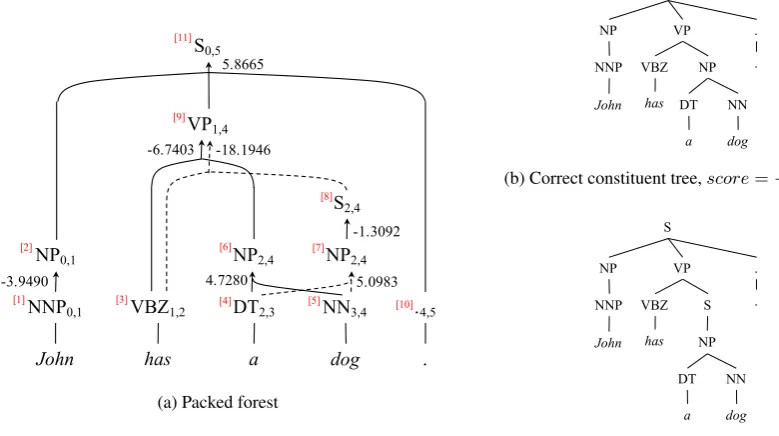
Figure 1: An example of (a) a packed forest. The numbers in the brackets located at the upper-left corner of each node in the packed forest show one correct topological ordering of the nodes. The packed forest is a compact representation of two trees: (b) the correct constituent tree, and (c) an incorrect constituent tree. Note that the terminal nodes (i.e., words in the sentence) in the packed forest are shown only for illustration, and they do not belong to the packed forest.
(Huang,2008). Figure1a shows a packed forest, which can be unpacked into two constituent trees (Figure1band Figure1c).
Formally, a packed forest is a pairhV, Ei, where
V is the set of nodes and E is the set of hy-peredges. Each v ∈ V can be represented as
Xi,j, where X is a constituent label and i, j ∈
[0, n]are indices of words, showing that the node
spans the words ranging from i (inclusive) to j
(exclusive). Here, n is the length of the in-put sentence. Each e ∈ E is a three-tuple
hhead(e), tails(e), score(e)i, where head(e) ∈
V is similar to the head node in a constituent tree,
and tails(e) ∈ V∗ is similar to the set of child
nodes in a constituent tree. score(e) ∈ Ris the logarithm of the probability that tails(e) repre-sents the tails ofhead(e)calculated by the parser. Based onscore(e), the score of a constituent tree
T can be calculated as follows:
score(T) =−λn+ X
e∈E(T)
score(e), (8)
whereE(T)is the set of hyperedges appearing in treeT, andλis a regularization coefficient for the sentence length2.
2Following the configuration of Charniak and Johnson
3 Forest-based NMT
We first propose a linearization method for the packed forest (Section3.1), then describe how to encode the linearized forest (Section3.2), which can then be translated by the conventional decoder (see Section2.1).
3.1 Forest linearization
Recently, several studies have focused on the lin-earization methods of a syntax tree, both in the area of tree-based NMT (Section 2.2) and in the area of parsing (Vinyals et al., 2015;Dyer et al.,
2016; Ma et al., 2017). Basically, these meth-ods follow a fixed traversal order (e.g., depth-first), which does not exist for the packed forest (a directed acyclic graph (DAG)). Furthermore, the weights are attached to edges of a packed forest instead of the nodes, which further increase the difficulty.
Topological ordering algorithms for DAG (Kahn,1962;Tarjan,1976) are not good solutions, because the outputted ordering is not always opti-mal for machine translation. In particular, a
topo-(2005), for all the experiments in this paper, we fixedλto
Algorithm 1Linearization of a packed forest
1: functionLINEARIZEFOREST(hV, Ei,w)
2: v←FINDROOT(V)
3: r←[]
4: EXPANDSEQ(v,r,hV, Ei,w) 5: returnr
6: functionFINDROOT(V)
7: forv∈V do
8: ifvhas no parentthen
9: returnv
10: procedureEXPANDSEQ(v,r,hV, Ei,w)
11: fore∈Edo
12: ifhead(e) =vthen
13: iftails(e)6=∅then
14: fort∈SORT(tails(e))do .Sort
tails(e)by word indices.
15: EXPANDSEQ(t,r,hV, Ei,w)
16: l←LINEARIZEEDGE(head(e),w)
17: r.append(hl, σ(0.0)i). σis the sigmoid function, i.e.,σ(x) = 1+1e−x, x∈R.
18: l←cLINEARIZEEDGES(tails(e),w)
.c is a unary operator.
19: r.append(hl, σ(score(e))i)
20: else
21: l←LINEARIZEEDGE(head(e),w)
22: r.append(hl, σ(0.0)i) 23: functionLINEARIZEEDGE(Xi,j,w) 24: returnX⊗(jk−=1iwk)
25: functionLINEARIZEEDGES(v,w) 26: return⊕v∈vLINEARIZEEDGE(v,w)
logical ordering could ignore “word sequential in-formation” and “parent-child inin-formation” in the sentences.
For example, for the packed forest in Figure1a, although “[10]→[1]→[2]→ · · · →[9]→[11]” is a valid topological ordering, theword sequential in-formationof the words (e.g., “John” should be lo-cated ahead of the period), which is fairly crucial for translation of languages with fixed pragmatic word order such as Chinese or English, is lost.
As another example, for the packed forest in Figure1a, nodes [2], [9], and [10] are all the chil-dren of node [11]. However, in the topological or-der “[1]→[2]→ · · · →[9]→[10]→[11],” node [2] is quite far from node [11], while nodes [9] and [10] are both close to node [11]. Theparent-child informationcannot be reflected in this topological order, which is not what we would expect.
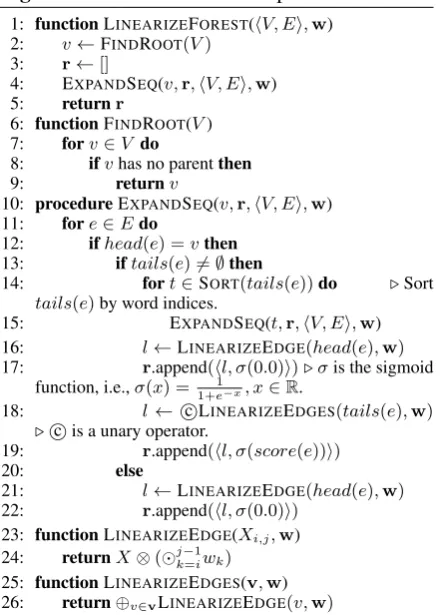
To address the above two problems, we pro-pose a novel linearization algorithm for a packed forest (Algorithm 1). The algorithm linearizes the packed forest from the root node (Line 2) to leaf nodes by calling the EXPANDSEQ procedure
(Line 15) recursively, while preserving the word order in the sentence (Line14). In this way,word sequential information is preserved. Within the
NNP⊗John/NP⊗John/cNNP⊗John/VBZ⊗has/DT⊗a/
NN⊗dog/NP⊗adog/cDT⊗a⊕NN⊗dog/NP⊗adog/
c
DT⊗a⊕NN⊗dog/S⊗adog/cNP⊗adog/
VP⊗hasadog/cVBZ⊗has⊕NP⊗adog/
c
VBZ⊗has⊕S⊗adog/.⊗./S⊗Johnhasadog./ c
[image:4.595.73.294.74.382.2]NP⊗John⊕VP⊗hasadog⊕.⊗.
Figure 2: Linearization result of the packed forest in Figure 1a
EXPANDSEQ procedure, once a hyperedge is
lin-earized (Line16), the tails are also linearized im-mediately (Line18). In this way,parent-child in-formationis preserved. Intuitively, different parts of constituent trees should be combined in differ-ent ways, therefore we define differdiffer-ent operators ( c,⊗,⊕, or) to represent the relationships be-tween different parts, so that the representations of these parts can be combined in different ways (see Section3.2 for details). Words are concate-nated by the operator “” with each other, a word and a constituent label is concatenated by the op-erator “⊗”, the linearization results of child nodes are concatenated by the operator “⊕” with each other, while the unary operator “ c” is used to in-dicate that the node is the child node of the pre-vious part. Furthermore, each token in the lin-earized sequence is related to a score, representing the confidence of the parser.
The linearization result of the packed forest in Figure 1a is shown in Figure 2. Tokens in the lin-earized sequence are separated by slashes. Each token in the sequence is composed of different types of symbols and combined by different op-erators. We can see that word sequential infor-mation is preserved. For example, “NNP⊗John” (linearization result of node [1]) is in front of “VBZ⊗has” (linearization result of node [3]), which is in front of “DT⊗a” (linearization result of node [4]). Moreover, parent-child informa-tion is also preserved. For example, “NP⊗John” (linearization result of node [2]) is followed by “ cNNP⊗John” (linearization result of node [1], the child of node [2]).
Note that our linearization method cannot fully recover packed forest. What we want to do is not to propose a fully recoverable linearization method. What we actually want to do is to en-code syntax information as much as possible, so that we can improve the performance of NMT. As will be shown in Section4, this goal is achieved.
… … …
… Decoder
Input Layer Symbol Layer Node/Operator Layer Embedding Layer Attention Layer
Score Layer Hidden Layer
Pre-Embedding Layer
(a) Score-on-Embedding (SoE)
… …
…
… Decoder
Input Layer Symbol Layer Node/Operator Layer Embedding Layer Attention Layer
Score Layer Hidden Layer
Pre-Embedding Layer
[image:5.595.71.521.62.238.2](b) Score-on-Attention (SoA)
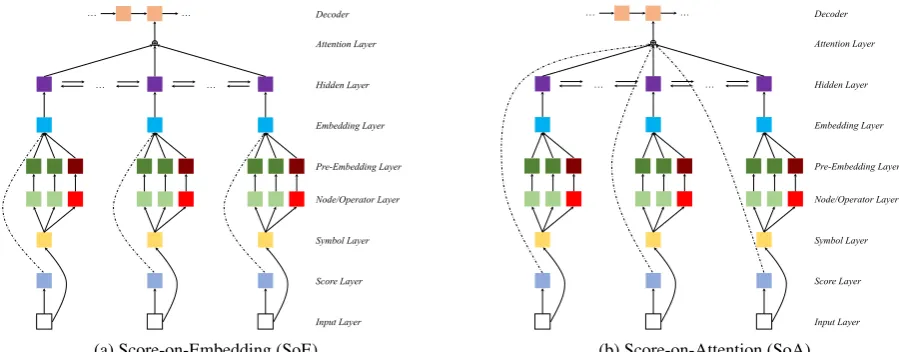
Figure 3: The framework of the forest-based NMT system.
is a weighted sequence, while all the previous studies ignored the weights during linearization. As will be shown in Section4, the weights are ac-tually important not only for the linearization of a packed forest, but also for the linearization of a single tree.
By preserving only the nodes and hyperedges in the 1-best tree and removing all others, our linearization method can be regarded as a linearization method. Compared with other tree-linearization methods, our method combines sev-eral different kinds of information within one sym-bol, retaining the parent-child information, and incorporating the confidence of the parser in the sequence. We examine whether the weights can be useful not only for linear structured tree-based NMT but also for our forest-based NMT.
Furthermore, although our method is nonre-versible for packed forests, it is renonre-versible for con-stituent trees, in that the linearization is processed exactly in the depth-first traversal order and all necessary information in the tree nodes has been encoded. As far as we know, there is no previous work on linearization of packed forests.
3.2 Encoding the linearized forest
The linearized packed forest forms the input of the encoder, which has two major differences from the input of a sequence-to-sequence NMT system. First, the input sequence of the encoder consists of two parts: the symbol sequence and the score sequence. Second, each symbol in the symbol se-quence consists of several parts (words and con-stituent labels), which are combined by certain op-erators ( c,⊗,⊕, or). Based on these
observa-tions, we propose two new frameworks, which are illustrated in Figure3.
Formally, the input layer receives the sequence
(hl0, ξ0i, . . . ,hlT, ξTi), where li denotes the i-th
symbol and ξi its score. Then, the sequence is
fed into the score layer and the symbol layer. The score and symbol layers receive the sequence and output the score sequence ξ = (ξ0, . . . , ξT) and
symbol sequence l = (l0, . . . , lT), respectively,
from the input. Any iteml∈lin the symbol layer has the form
l=o0x1o1. . . xm−1om−1xm, (9)
where eachxk(k= 1, . . . , m)is a word or a
con-stituent label,mis the total number of words and constituent labels in a symbol,o0is “ c” or empty, and each ok (k = 1, . . . , m−1)is either “⊗”,
“⊕”, or “”. Then, in the node/operator layer, the
x-s and o-s are separated and rearranged asx =
(x1, . . . , xm, o0, . . . , om−1), which is fed to the
pre-embedding layer. The pre-embedding layer generates a sequencep = (p1, . . . , pm, . . . , p2m),
which is calculated as follows:
p=Wemb[I(x)]. (10)
Here, the functionI(x)returns a list of the indices in the dictionary for all the elements in x, which consist of words, constituent labels, or operators. In addition,Wembis the embedding matrix of size
(|wword|+|wlabel|+ 4)×dword, where |wword|
and|wlabel|are the total number of words and
con-stituent labels, respectively, dword is the
thatpis a list of2mvectors, and the dimension of each vector isdword.
Because the length of the sequence of the in-put layer is T + 1, there are T + 1 different p-s in the pre-embedding layer, which we denote
by P = (p0, . . . ,pT). Depending on where the
score layer is incorporated, we propose two frame-works: Embedding (SoE) and Score-on-Attention (SoA). In SoE, thek-th element of the embedding layer is calculated as follows:
ek =ξk
X
p∈pk
p, (11)
while in SoA, thek-th element of the embedding layer is calculated as
ek=
X
p∈pk
p, (12)
wherek = 0, . . . , T. Note that ek ∈ Rdword. In
this manner, the proposed forest-to-string NMT framework is connected with the conventional sequence-to-sequence NMT framework.
After calculating the embedding vectors in the embedding layer, the hidden vectors are calculated using Equation 5. When calculating the context vectorci-s, SoE and SoA differ from each other.
For SoE, theci-s are calculated using Equation6
and7, while for SoA, theαij-s used to calculate
theci-s are determined as follows:
αij =
exp(ξja(si−1, hj))
PT
k=0exp(ξka(si−1, hk))
. (13)
Then, using the decoder of the sequence-to-sequence framework, the sentence of the target language can be generated.
4 Experiments 4.1 Setup
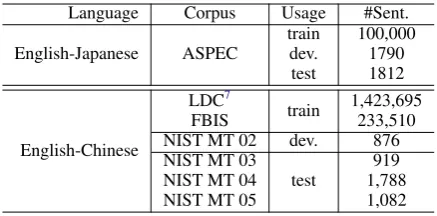
We evaluate the effectiveness of our forest-based NMT systems on to-Chinese and English-to-Japanese translation tasks3. The statistics of the corpora used in our experiments are summarized in Table1.
The packed forests of English sentences are obtained by the constituent parser proposed by
Huang(2008)4. We filtered out the sentences for
3English is commonly chosen as the target language.
We chose English as the sourcelanguage because a
high-performance forest parser is not available for other languages.
4http://web.engr.oregonstate.edu/ ˜huanlian/software/forest-reranker/ forest-charniak-v0.8.tar.bz2
Language Corpus Usage #Sent.
English-Japanese ASPEC
train 100,000
dev. 1790
test 1812
English-Chinese
LDC7
train 1,423,695
FBIS 233,510
NIST MT 02 dev. 876
NIST MT 03 test
919
NIST MT 04 1,788
[image:6.595.307.526.61.169.2]NIST MT 05 1,082
Table 1: Statistics of the corpora.
which the parser cannot generate the packed for-est successfully and the sentences longer than 80 words. For NIST datasets, we simply choose the first reference among the four English references of NIST corpora, because all of them are inde-pendent with each other, according to the docu-ments of NIST datasets. For Chinese sentences, we used Stanford segmenter5 for segmentation. For Japanese sentences, we followed the prepro-cessing steps recommended in WAT 20176.
We implemented our framework based on
nematus8 (Sennrich et al., 2017). For opti-mization, we used the Adadelta algorithm (Zeiler,
2012). In order to avoid overfitting, we used dropout (Srivastava et al.,2014) on the embedding layer and hidden layer, with the dropout probabil-ity set to 0.2. We used the gated recurrent unit (Cho et al.,2014) as the recurrent unit of RNNs, which are bi-directional, with one hidden layer.
Based on the tuning result, we set the maxi-mum length of the input sequence to 300, the hid-den layer size as 512, the dimension of word em-bedding as 620, and the batch size for training as 40. We pruned the packed forest using the algo-rithm ofHuang(2008), with a threshold of 5. If the linearization of the pruned forest is still longer than 300, then we linearize the 1-best parsing tree instead of the forest. During decoding, we used beam search, and fixed the beam size to 12. For the case of Forest (SoA), with 1 core of Tesla K80 GPU and LDC corpus as the training data, training spent about 10 days, and decoding speed is about 10 sentences per second.
5https://nlp.stanford.edu/software/ stanford-segmenter-2017-06-09.zip
6
http://lotus.kuee.kyoto-u.ac.jp/WAT/ WAT2017/baseline/dataPreparationJE.html
7
LDC2002E18, LDC2003E07, LDC2003E14, Hansards portion of LDC2004T07, LDC2004T08, and LDC2005T06
Types Systems & MT 03 MT 04 MT 05 pvalue
Configurations FBIS LDC FBIS LDC FBIS LDC
FS Mi et al.(2008) 27.10 28.21 28.67 30.09 26.57 28.36 -TN
Eriguchi et al.(2016) 29.00 29.71 30.24 31.56 28.38 30.33
-Chen et al.(2017) 28.34 29.64 30.00 31.25 28.14 29.59
-Li et al.(2017) 28.40 29.60 29.66 31.96 27.74 29.84
-FN
s2s 27.44 29.18 29.73 30.53 27.32 28.80
-1-best (No score) 28.61 29.38 30.07 31.58 28.59 30.01 <0.01
1-best (SoE) 28.78 30.65 30.36 32.22 29.31 30.16 <0.05
1-best (SoA) 29.39 30.80 30.25 32.39 29.30 30.61 <0.005
Forest (No score) 28.06 29.63 29.51 31.41 28.48 29.75 <0.01
Forest (SoE) 29.58 31.07 30.67 32.69 29.26 30.41 <0.001
[image:7.595.120.478.61.197.2]Forest (SoA) 29.63 31.35 30.31 33.14 29.87 31.23 <0.001
Table 2: English-Chinese experimental results (character-level BLEU). “FS,” “TN,” and “FN” denote forest-based SMT, tree-based NMT, and forest-based NMT systems, respectively. We performed the paired bootstrap resampling significance test (Koehn, 2004) over the NIST MT 03 to 05 corpus, with respect to the s2s baseline, and list thepvalues in the table.
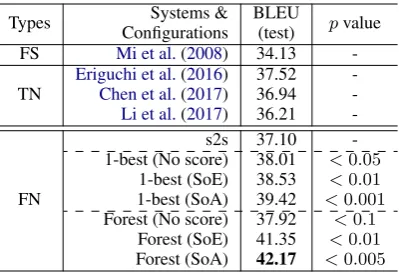
Types Systems & BLEU pvalue
Configurations (test)
FS Mi et al.(2008) 34.13 -TN
Eriguchi et al.(2016) 37.52
-Chen et al.(2017) 36.94
-Li et al.(2017) 36.21
-FN
s2s 37.10
-1-best (No score) 38.01 <0.05
1-best (SoE) 38.53 <0.01
1-best (SoA) 39.42 <0.001
Forest (No score) 37.92 <0.1
Forest (SoE) 41.35 <0.01
Forest (SoA) 42.17 <0.005
Table 3: English-Japanese experimental results (character-level BLEU).
4.2 Experimental results
Table2and3summarize the experimental results. To avoid the affect of segmentation errors, the per-formance were evaluated by character-level BLEU (Papineni et al.,2002). We compare our proposed models (i.e., Forest (SoE) and Forest (SoA)) with three types of baseline: a string-to-string model (s2s), forest-based models that do not use score se-quences (Forest (No score)), and tree-based mod-els that use the 1-best parsing tree (1-best (No score, SoE, SoA)). For the 1-best models, we pre-serve the nodes and hyperedges that are used in the 1-best constituent tree in the packed forest, and re-move all other nodes and hyperedges, yielding a pruned forest that contains only the 1-best con-stituent tree. For the “No score” configurations, we force the input score sequence to be a sequence of 1.0 with the same length as the input symbol se-quence, so that neither the embedding layer nor the attention layer are affected by the score sequence. In addition, we also perform a comparison with some state-of-the-art tree-based systems that are
publicly available, including an SMT system (Mi et al.,2008) and the NMT systems (Eriguchi et al.
(2016)9,Chen et al.(2017)10, andLi et al.(2017)). For Mi et al. (2008), we use the implementation ofcicada11. ForLi et al. (2017), we reimple-mented the “Mixed RNN Encoder” model, be-cause of its outstanding performance on the NIST MT corpus.
We can see that for both English-Chinese and English-Japanese, compared with the s2s baseline system, both the 1-best and forest-based configu-rations yield better results. This indicates syntac-tic information contained in the constituent trees or forests is indeed useful for machine translation. Specifically, we observe the following facts.
First, among the three different frameworks SoE, SoA, and No-score, the SoA framework forms the best, while the No-score framework
per-9
https://github.com/tempra28/tree2seq 10
https://github.com/howardchenhd/ Syntax-awared-NMT
[image:7.595.200.400.276.413.2][Source] In the Czech Republic , which was ravaged by serious floods last summer , the temperatures in its border region adjacent to neighboring Slovakia plunged to minus 18 degrees Celsius .
[Reference] 去年 夏季 曾 出现 严重 水患 的 捷克 共和国 , 其 邻近 斯洛伐克 的 边界 地区 气温 低 至 摄氏 零下 18 度 。
last summer ever appear serious floods of Czech Republic , its adjacent Slovakia of border region temperature decrease to Celsius minus 18 degree .
[s2s] 去年 夏天 , 捷克 地区 遭受 严重 洪灾 的 捷克 边境 地区 气温 下降 了 18 摄氏 度 。
last summer , Czech region suffer serious floods of Czech border region temperature decrease -ed 18 Celsius degree .
[1best Tree] 去年 夏天 , 遭受 特大 洪灾 的 捷克 边境 地区 的 气温 下降 了 18 摄氏 度 。
last summer , suffer serious floods of Czech border region of temperature decrease -ed 18 Celsius degree .
[Forest] 去年 夏天 发生 严重 水灾 的 捷克 共和国 , 毗邻 斯洛伐克 的 边境 地区 温度 下降 至 零下 18 度 。
last summer occur serious floods of Czech Republic , adjacent Slovakia of border region temperature decrease to minus 18 degree .
Figure 4: Chinese translation results of an English sentence.
forms the worst. This indicates that the scores of the edges in constituent trees or packed forests, which reflect the confidence of the correctness of the edges, are indeed useful. In fact, for the 1-best constituent parsing tree, the score of the edge re-flects the confidence of the parser. By using this information, the NMT system succeed to learn a better attention, paying much attention to the con-fident structure and not paying attention to the un-confident structure, which improved the transla-tion performance. This fact is ignored by previous studies on tree-based NMT. Furthermore, it is bet-ter to use the scores to modify the values of atten-tion instead of rescaling the word embeddings, be-cause modifying word embeddings carelessly may change the semantic meanings of words.
Second, compared with the cases that only using the 1-best constituent trees, using packed forests yields statistical significantly better results for the SoE and SoA frameworks. This shows the effectiveness of using more syntactic information. Compared with one constituent tree, the packed forest, which contains multiple different trees, de-scribes the syntactic structure of the sentence in different aspects, which together increase the ac-curacy of machine translation. However, without using the scores, the 1-best constituent tree is pre-ferred. This is because without using the scores, all trees in the packed forest are treated equally, which makes it easy to import noise into the en-coder.
Compared with other types of state-of-the-art systems, our systems using only the 1-best tree (1-best(SoE, SoA)) are better than the other tree-based systems. Moreover, our NMT systems using the packed forests achieve the best performance. These results also support the usefulness of the scores of the edges and packed forests in NMT.
As for the efficiency, the training time of the SoA system was slightly longer than that of the SoE system, which was about twice of the s2s baseline. The training time of the tree-based sys-tem was about 1.5 times of the baseline. For the
case of Forest (SoA), with 1 core of Tesla P100 GPU and LDC corpus as the training data, train-ing spent about 10 days, and decodtrain-ing speed was about 10 sentences per second. The reason for the relatively low efficiency is that the linearized se-quences of packed forests were much longer than word sequences, enlarging the scale of the inputs. Despite this, the training process ended within rea-sonable time.
4.3 Qualitative analysis
Figure4illustrates the translation results of an En-glish sentence using several different configura-tions: the s2s baseline, using only the 1-best tree (SoE), and using the packed forest (SoE). This is a sentence from NIST MT 03, and the training cor-pus is the LDC corcor-pus.
For the s2s case, no syntactic information is uti-lized, and therefore the output of the system is not a grammatical Chinese sentence. The attributive phrase of “Czech border region” is a complete sen-tence. However, the attributive is not allowed to be a complete sentence in Chinese.
For the case of using 1-best constituent tree, the output is a grammatical Chinese sentence. How-ever, the phrase “adjacent to neighboring Slo-vakia” is completely ignored in the translation re-sult. After analyzing the constituent tree, we found that this phrase was incorrectly parsed as an “ad-verb phrase”, so that the NMT system paid little attention to it, because of the low confidence given by the parser.
In contrast, for the case of the packed forest, we can see this phrase was not ignored and was trans-lated correctly. Actually, besides “adverb phrase”, this phrase was also correctly parsed as an “ad-jective phrase”, and covered by multiple different nodes in the forest, making it difficult for the en-coder to ignore the phrase.
causes the output sentence contains the Chinese translation of Czech twice. On the other hand, for our forest model, by using the syntax information, the decoder paid attention to the phrase “In the Czech Republic” only once, making the decoder generates the correct output.
5 Related work
Incorporating syntactic information into NMT systems is attracting widespread attention nowa-days. Compared with conventional string-to-string NMT systems, tree-based systems demonstrate a better performance with the help of constituent trees or dependency trees.
The first noteworthy study is Eriguchi et al.
(2016), which used Tree-structured LSTM (Tai et al.,2015) to encode the HPSG syntax tree of the sentence in the source-side in a bottom-up man-ner. Then, Chen et al. (2017) enhanced the en-coder with a top-down tree enen-coder.
As a simple extension ofEriguchi et al.(2016), very recently,Zaremoodi and Haffari(2017) pro-posed a forest-based NMT method by represent-ing the packed forest with a forest-structured neu-ral network. However, their method was evaluated in small-scale MT settings (each training dataset consists of under 10k parallel sentences). In con-trast, our proposed method is effective in a large-scale MT setting, and we present qualitative anal-ysis regarding the effectiveness of using forests in NMT.
Although these methods obtained good results, the tree-structured network used by the encoder made the training and decoding relatively slow, therefore restricts the scope of application.
Other attempts at encoding syntactic trees have also been proposed. Eriguchi et al.(2017) com-bined the Recurrent Neural Network Grammar (Dyer et al.,2016) with NMT systems, while Li et al. (2017) linearized the constituent tree and encoded it using RNNs. The training of these methods is fast, because of the linear structures of RNNs. However, all these syntax-based NMT sys-tems used only the 1-best parsing tree, making the systems sensitive to parsing errors.
Instead of using trees to represent syntactic in-formation, some studies use other data structures to represent the latent syntax of the input sen-tence. For example, Hashimoto and Tsuruoka
(2017) proposed translating using a latent graph. However, such systems do not enjoy the benefit of
handcrafted syntactic knowledge, because they do not use a parser trained from a large treebank with human annotations.
Compared with these related studies, our frame-work utilizes a linearized packed forest, meaning the encoder can encode exponentially many trees in an efficient manner. The experimental results demonstrated these advantages.
6 Conclusion and future work
We proposed a new NMT framework, which en-codes a packed forest for the source sentence using linear-structured neural networks, such as RNN. Compared with conventional string-to-string NMT systems and tree-to-string-to-string NMT sys-tems, our framework can utilize exponentially many linearized parsing trees during encoding, without significantly decreasing the efficiency. This represents the first attempt at using a forest under the string-to-string NMT framework. The experimental results demonstrate the effectiveness of our framework.
As future work, we plan to design some more elaborate structures to incorporate the score layer in the encoder. Further improvement in the trans-lation performance is expected to be achieved for the forest-based NMT system. We will also apply the proposed linearization method to other tasks.
Acknowledgements
We are grateful to the anonymous reviewers for their insightful comments and suggestions. We thank Lemao Liu from Tencent AI Lab for his suggestions about the experiments. We thank At-sushi Fujita whose suggestions greatly improve the readability and the logical soundness of this paper. This work was done during the intern-ship of Chunpeng Ma at NICT. Akihiro Tamura is supported by JSPS KAKENHI Grant Num-ber JP18K18110. Tiejun Zhao is supported by the National Natural Science Foundation of China (NSFC) via grant 91520204 and State High-Tech Development Plan of China (863 program) via grant 2015AA015405.
References
Dzmitry Bahdanau, Kyunghyun Cho, and Yoshua Ben-gio. 2014. Neural machine translation by jointly learning to align and translate. arXiv preprint arXiv:1409.0473.
Eugene Charniak and Mark Johnson. 2005. Coarse-to-fine n-best parsing and maxent discriminative reranking. InProceedings of the 43rd Annual Meet-ing of the Association for Computational LMeet-inguistics (ACL’05), pages 173–180.
Huadong Chen, Shujian Huang, David Chiang, and Ji-ajun Chen. 2017. Improved neural machine trans-lation with a syntax-aware encoder and decoder. In Proceedings of the 55th Annual Meeting of the As-sociation for Computational Linguistics (Volume 1: Long Papers), pages 1936–1945.
Kyunghyun Cho, Bart Van Merri¨enboer, Caglar Gul-cehre, Dzmitry Bahdanau, Fethi Bougares, Holger Schwenk, and Yoshua Bengio. 2014. Learning phrase representations using rnn encoder-decoder for statistical machine translation. arXiv preprint arXiv:1406.1078.
Chris Dyer, Adhiguna Kuncoro, Miguel Ballesteros, and Noah A Smith. 2016. Recurrent neural network grammars. arXiv preprint arXiv:1602.07776.
Akiko Eriguchi, Kazuma Hashimoto, and Yoshimasa Tsuruoka. 2016. Tree-to-sequence attentional neu-ral machine translation. InProceedings of the 54th Annual Meeting of the Association for Computa-tional Linguistics (Volume 1: Long Papers), pages 823–833.
Akiko Eriguchi, Yoshimasa Tsuruoka, and Kyunghyun Cho. 2017. Learning to parse and translate improves neural machine translation. In Proceedings of the 55th Annual Meeting of the Association for Compu-tational Linguistics (Volume 2: Short Papers), pages 72–78.
Kazuma Hashimoto and Yoshimasa Tsuruoka. 2017. Neural machine translation with source-side latent graph parsing. arXiv preprint arXiv:1702.02265.
Liang Huang. 2008. Forest reranking: Discriminative parsing with non-local features. In Proceedings of ACL-08: HLT, pages 586–594.
Arthur B Kahn. 1962. Topological sorting of large net-works. Communications of the ACM, 5(11):558– 562.
Philipp Koehn. 2004. Statistical significance tests for machine translation evaluation. In Proceedings of EMNLP 2004, pages 388–395.
Junhui Li, Deyi Xiong, Zhaopeng Tu, Muhua Zhu, Min Zhang, and Guodong Zhou. 2017. Modeling source syntax for neural machine translation. In Proceed-ings of the 55th Annual Meeting of the Association for Computational Linguistics (Volume 1: Long Pa-pers), pages 688–697.
Chunpeng Ma, Lemao Liu, Akihiro Tamura, Tiejun Zhao, and Sumita Eiichiro. 2017. Deterministic at-tention for sequence-to-sequence constituent pars-ing. InProceedings of the Thirty-First AAAI Con-ference on Artificial Intelligence, pages 3237–3243.
Mitchell P Marcus, Mary Ann Marcinkiewicz, and Beatrice Santorini. 1993. Building a large annotated corpus of english: The penn treebank. Computa-tional linguistics, 19(2):313–330.
Haitao Mi and Liang Huang. 2008. Forest-based trans-lation rule extraction. In Proceedings of the 2008 Conference on Empirical Methods in Natural Lan-guage Processing, pages 206–214.
Haitao Mi, Liang Huang, and Qun Liu. 2008. Forest-based translation. InProceedings of ACL-08: HLT, pages 192–199.
Maria Nadejde, Siva Reddy, Rico Sennrich, Tomasz Dwojak, Marcin Junczys-Dowmunt, Philipp Koehn, and Alexandra Brich. 2017. Syntax-aware neu-ral machine translation using ccg. arXiv preprint arXiv:1702.01147.
Kishore Papineni, Salim Roukos, Todd Ward, and Wei-Jing Zhu. 2002. Bleu: a method for automatic eval-uation of machine translation. In Proceedings of 40th Annual Meeting of the Association for Compu-tational Linguistics, pages 311–318.
Chris Quirk and Simon Corston-Oliver. 2006. The im-pact of parse quality on syntactically-informed sta-tistical machine translation. In Proceedings of the 2006 Conference on Empirical Methods in Natural Language Processing, pages 62–69.
Rico Sennrich, Orhan Firat, Kyunghyun Cho, Alexan-dra Birch, Barry Haddow, Julian Hitschler, Marcin Junczys-Dowmunt, Samuel L¨aubli, Antonio Valerio Miceli Barone, Jozef Mokry, and Maria Nadejde. 2017. Nematus: a toolkit for neural machine trans-lation. InProceedings of the Software Demonstra-tions of the 15th Conference of the European Chap-ter of the Association for Computational Linguistics, pages 65–68.
Rico Sennrich and Barry Haddow. 2016. Linguistic input features improve neural machine translation. arXiv preprint arXiv:1606.02892.
Nitish Srivastava, Geoffrey E Hinton, Alex Krizhevsky, Ilya Sutskever, and Ruslan Salakhutdinov. 2014. Dropout: a simple way to prevent neural networks from overfitting. Journal of machine learning re-search, 15(1):1929–1958.
Ilya Sutskever, Oriol Vinyals, and Quoc V Le. 2014. Sequence to sequence learning with neural net-works. InAdvances in neural information process-ing systems, pages 3104–3112.
from tree-structured long short-term memory net-works. In Proceedings of the 53rd Annual Meet-ing of the Association for Computational LMeet-inguistics and the 7th International Joint Conference on Natu-ral Language Processing (Volume 1: Long Papers), pages 1556–1566.
Robert Endre Tarjan. 1976. Edge-disjoint spanning trees and depth-first search. Acta Informatica, 6(2):171–185.
Oriol Vinyals, Łukasz Kaiser, Terry Koo, Slav Petrov, Ilya Sutskever, and Geoffrey Hinton. 2015. Gram-mar as a foreign language. InAdvances in Neural Information Processing Systems, pages 2773–2781.
Shuangzhi Wu, Dongdong Zhang, Nan Yang, Mu Li, and Ming Zhou. 2017. Sequence-to-dependency neural machine translation. In Proceedings of the 55th Annual Meeting of the Association for Compu-tational Linguistics (Volume 1: Long Papers), pages 698–707.
Poorya Zaremoodi and Gholamreza Haffari. 2017. In-corporating syntactic uncertainty in neural machine translation with forest-to-sequence model. arXiv preprint arXiv:1711.07019.
Matthew D Zeiler. 2012. Adadelta: an adaptive learn-ing rate method.arXiv preprint arXiv:1212.5701.