Relationship between a Firm’s Entrepreneurial Orientation
and Financial Performance
TAJEDDINI, Kayhan <http://orcid.org/0000-0002-5087-8212> and MUELLER,
Stephen
Available from Sheffield Hallam University Research Archive (SHURA) at:
http://shura.shu.ac.uk/23981/
This document is the author deposited version. You are advised to consult the
publisher's version if you wish to cite from it.
Published version
TAJEDDINI, Kayhan and MUELLER, Stephen (2018). Moderating Effect of
Environmental Dynamism on the Relationship between a Firm’s Entrepreneurial
Orientation and Financial Performance. Entrepreneurship Research Journal.
Copyright and re-use policy
See
http://shura.shu.ac.uk/information.html
A
ut
omatic
all
y
gener
at
ed
rough
by
Pr
oo
fCheck
fr
om
Ri
ver
V
alle
y
Tec
hnologies
Lt
d
Kayhan Tajeddini
1/ Stephen Mueller
2Moderating Effect of Environmental Dynamism
on the Relationship between a Firm
’
s
Entrepreneurial Orientation and Financial
Performance
1Sheffield Hallam University, Sheffield Business School, Service Sector Management, City Campus, Sheffield, United Kingdom
of Great Britain and Northern Ireland, E-mail: [email protected], [email protected]
2Department of Management, Missouri State University, Springfield, MO, USA Abstract:
The relationship between entrepreneurial orientation and firm performance has been the focus of numerous empirical studies over the past decade. The conclusions and findings reported are diverse and often conflicting. One possible explanation for mixed findings is that past studies do not take into account the dynamic nature of the industry environment. Using a sample of 192 Swiss firms from several different industries, this study examines the direct effect of entrepreneurial orientation on financial firm performance along with the moderat-ing effect of a dynamic environment on the relationship between entrepreneurial orientation and performance. Results of this study suggest that for firms competing in a highly dynamic environment, the positive effect of an entrepreneurial orientation on financial performance is enhanced.
Keywords:entrepreneurial orientation, dynamic environment, financial performance
DOI:10.1515/erj-2018-0283
Introduction
At a time when the global economy coupled with global competition is creating rapid changes and intense competition is shortening product life cycles, it is clear that traditional managerial techniques are inadequate to response properly to these changes or to rapidly changing market conditions. As a result, business organizations are compelled to include entrepreneurial spirit and innovation as an integral part of an overall strategy for business success (Tajeddini, Altinay, and Ratten, 2017; Etemad 2015). In this respect, strategic management scholars have argued that entrepreneurial activities are critically important to the survival, profitability, and growth of modern business organizations (Shan, Song, and Jua 2016).
Strategic management researchers have attempted to understand and explore the causes of business per-formance variation among multiple-business firms (Makino, Isobe, and Chan 2004). Traditionally, these factors include the inevitable constraints in internal resources (e.g. liquidity problems, knowledge, technology, skill, experience), external forces in developing alliances (Costa, Fontes, and Heitor 2004) and networking with stake-holders (Aarikka-Stenroos and Sandberg 2012) that hinder the firm’s ability to grow (Freel 2005).
Over the last past two decades, following the emergence and later development of entrepreneurial strategies and a body of entrepreneurship literature (Choi and Majumdar 2014; Etemad 2015), there has been considerable discussion among scholars to place a disproportionate concentration on the role played by strategic orientation and internal sources to improve firm performance. Strategic decisions and actions are often aimed at producing alternative forms of business success (e.g. customer loyalty, satisfaction, staff retention, market share).
An approach to strategic decision-making referred to as entrepreneurial orientation (EO) emphasizes goals. A firm with an entrepreneurial orientation engages in product market innovation, undertakes somewhat risky ventures, and is first to come up with proactive innovations (Miller and Friesen 1983). Arguably, since competi-tors, like chasing ghosts, always watch to respond to new products and services, new business models, and new markets (Tajeddini 2016), the ability to sustain competitive advantage in the long run depends heavily upon whether competitors can emulate or overcome this advantage and deliver value to the marketplace (Ahmed and Rafiq 1992).
Kayhan Tajeddiniis the corresponding author.
A
ut
omatic
all
y
gener
at
ed
rough
by
Pr
oo
fCheck
fr
om
Ri
ver
V
alle
y
Tec
hnologies
Lt
d
Wide-ranging empirical research has produced mixed results raising the question of whether en-trepreneurial orientation is always an appropriate strategic orientation or if its relationship with firm perfor-mance is multifaceted (Li, Huang, and Tsai 2009). While the quest to explore the key determinants of firm per-formance has been central to the strategic management field (Saeed, Yousafzai, and Engelen 2014; Shan, Song, and Jua 2016), insufficient attention has been given to the possible moderating effect of a dynamic environment on the relationship between entrepreneurial orientation and financial performance (van Doorn, Heyden, and Volberda 2017).
Building on prior strategic management research (e.g. Doyle and Stern 2006; Lumpkin and Dess 1996; van Doorn, Heyden, and Volberda 2017), we propose that entrepreneurial orientation is key to achieving superior financial performance across a variety industries. We also propose that a dynamic environment moderates the relationship between entrepreneurial orientation and financial performance. Using data collected from 192 Swiss firms across multiple industries, we developed and empirically tested hypotheses about the direct and interactive effects of entrepreneurial orientation and dynamic environment on a firm’s financial performance.
Background and Hypotheses Development
Entrepreneurial Orientation and Performance
Entrepreneurial strategy-making or entrepreneurial orientation has been conceptualized as an attribute of a firm supporting entrepreneurial activities associated with the growth, performance, and organizational decision-making proclivity among others (Lumpkin and Dess 1996; Núñez-Pomar et al. 2016). Entrepreneurial orientation (EO) captures the managerial philosophies to promote innovative and learning organizational be-haviors, processes, methods, and styles and to develop and implement strategic decisions which encourage such activities (Tajeddini and Mueller 2009, 2012; Li and Li 2009). In their meta-analysis, Rauch et al. (2009) conclude that entrepreneurial orientation can be observed as the strategy-making processes that key decision makers employ to enact their organizational mission, and create competitive advantages.
A number of strategic management scholars (e.g. Brettel, Chomik, and Flatten 2015; Shan, Song, and Jua 2016) have focused on refining the concept of entrepreneurial orientation and exploring its application to strat-egy formulating, firm performance, and competitive advantage. Research indicates that in firms where an en-trepreneurial orientation governs, the strategic decision makers and the culture together create a strong mo-mentum to innovation, take risking, and aggressively pursuing new business opportunities (Dess and Lumpkin 2005).
Strategic thinking in a firm with a strong entrepreneurial orientation is concentrated on achieving firm performance in the long run. Performance goals typically center on long-term and sustainable growth factors such as growth in revenue, assets, and market share over multi-year periods. An entrepreneurial orientation means that by foregoing profits in the short-run and pursuing risky investment opportunities, long-term per-formance is achieved. On the other hand, more risk-averse organizations tend to follow a slow, incremental process with a focus on short-term business performance measured by profitability and productivity. Within a strategic management paradigm, an entrepreneurial organization is characterized as a process which involves in product/service-market innovation, undertakes fairly risky projects, and is first to produce proactive new products/services, outperforming competitors (Miller and Friesen 1983). In contrast, a non-entrepreneurial or-ganization is conceived as a firm where imitation of new products and services is more preferable to innovation, risk aversion is high, and they would rather follow the market leaders and imitate their product and services instead of leading the industry (Miller and Friesen 1983). In practice, however, it can be argued that some firms in different industries may find it difficult to take financial risks to invest on innovations, be proactive and de-ploy material, and human resources to new business opportunities (Ratten and Tajeddini 2018; Steinhoff and Burgess 1993).
A
ut
omatic
all
y
gener
at
ed
rough
by
Pr
oo
fCheck
fr
om
Ri
ver
V
alle
y
Tec
hnologies
Lt
d
–performance relationship. They further affirm that it is essential for scholars to examine these indirect effects in different contexts.
Strategic thinking in a company with a strong entrepreneurial orientation is focused on achieving enhanced performance and sustainable competitive advantage in the long run. Performance goals typically center on long-term and sustainable growth factors such as growth in revenue, assets, and market share over multi-year periods. Anentrepreneurial orientationmeans that by foregoing profits in the short-run and pursuing risky in-vestment opportunities, long-term performance is achieved. On the other hand, more risk-averse firms tend to follow a slow, incremental process with a focus on short-term business performance measured by profitability and productivity. The assumption is that when top managers are able to effectively scrutinize different oppor-tunities and assess the risk associated with these opporoppor-tunities in the marketplace, their decision and activities can affect firm financial return and growth. Consistent with prior research, we argue that entrepreneurial ori-entation has a positive effect on financial performance of SMEs operating in a variety of industries. We hypoth-esize,
H1:Entrepreneurial orientation has a positive effect on financial firm performance.
The Moderating Role of Environmental Dynamism
Previous studies suggest that environment in which a firm competes, along with its structure and information processing capabilities, are important factors for growth and development (Koberg, Uhlenbruck, and Sarason 1996). As a general tenet, the contingency theory (situational approach) suggests that there is not one optimal, best, or universal strategy or structure for all firms. Contingency theory posits that firms in uncertain and tentative business environments will demonstrate different behaviors, processes, and capabilities and adjust their management styles to the varying contingencies in the environment (Burns and Stalker 1961; Collis 1994; Miller 1988; Scott 1981). This implies that contingency forces or factors dictate the formulation of the most desirable choice of strategy for firms (Ambos and Schlegelmilch 2007). According to the resource-based view, internal and external environmental factors can neutralize and/or leapfrog or dissipate the advantaged firm by a resource’s comparative advantage (Atuahene-Gima, Li, and De Luca 2006).
Dynamism of the environment refers to the speed of change and the unpredictability of change in tech-nologies, variations in customer preference, product demand (market), and product in an industry (Koberg, Uhlenbruck, and Sarason 1996; Martínez-Sánchez et al. 2011). Similarly, various factors such as a shift in an organization’s technological capabilities, diffusion and technical change, and/or new competitors may lead to high dynamism in the environment (Boyd, Dess, and Rasheed 1993; Dess and Beard 1984; Mia and Clarke 1999; Simerly and Li 2002). As a result, it may create different threats and opportunities for organizations to implement their strategies (Atuahene-Gima, Li, and De Luca 2006).
A highly dynamic environment makes it difficult for organizations to adopt older or less innovative tech-nologies to keep pace with the changing needs in industries marked by high growth (Coombs and Bierly 2006). Research shows the effect of company resources and competencies on company behavior, operations and per-formance is contingent upon environmental dynamism cues (Akgun, Keskin, and Byrne 2008). As competition heats up and market preferences become less predictable and change occurs at a faster pace, the environment becomes dynamic (Atuahene-Gima, Li, and De Luca 2006). In such an environment, products development and life cycles are shorter, new products introductions are more frequent, information becomes obsolete more swiftly, and the companies’search and coordination expenditures in strategic decisions are boosted (Atuahene-Gima, Li, and De Luca 2006). Consequently, it is more difficult and challenging for organizations (1) to assim-ilate and anticipate environmental conditions (Akgun, Keskin, and Byrne 2008), (2) to identify the potential impacts of new technological alterations on customer needs and behavior, and (3) to translate them into spe-cific and appropriate actions (Atuahene-Gima, Li, and De Luca 2006).
A component of an entrepreneurial orientation is associated with the discovery, exploration, evaluation and exploitation of resources, as well as the creation of new niches (March 1991). Such opportunity-seeking calls for continuous and adaptive learning and is more pronounced for the firms with entrepreneurial orientation due to their responsiveness to the needs and demands of their existing customers (Atuahene-Gima, Li, and De Luca 2006).
A
ut
omatic
all
y
gener
at
ed
rough
by
Pr
oo
fCheck
fr
om
Ri
ver
V
alle
y
Tec
hnologies
Lt
d
Hult, Ketchen, and Arrfelt (2007) argue that in a highly dynamic environment, market demand preferences shift quickly and unpredictably, leaving gaps that an entrepreneurial orientation strategy attempts to fill. More recently, Rauch et al. (2009) conclude that the relationship between entrepreneurial orientation and firm perfor-mance is positive although differing in magnitude, dependent on other strategic orientations and moderated by factors such as the environment. Therefore we hypothesize,
H2:environmental dynamism will moderate the relationship between entrepreneurial orientation and financial firm performance.
Methods
The sample frame was created by combining a list of 465 SMEs operating in a variety of industries in Switzer-land. This list was purchased from a leading market research/databank company and merged with a list of 1000 SMEs firms obtained from the Swiss Statistical Office. After mixing the order of the items in the questionnaire, we informed respondents that there were no right and wrong answers and that they should answer questions as forthrightly and honestly as possible.
Top managers, CEOs, marketing managers, and R&D managers were the target group of our study given their knowledge of and experience with their organizations. After pretesting the scale items with five academics, we performed a pilot study with 22 CEOs or senior executives to assess the research design’s quality. Based on the results, some minor alterations were made. We removed the 30 CEOs/senior executives whom we contacted for pre-testing from the master list. We then used the remaining firms (a total of 535 firms) for data collection.
The firms’CEOs were contacted from the list by email and telephone to inform them of the objective of the study. In order to mitigate common method bias, we requested that the top managers identify at least one or two more respondents from their companies, who were the most knowledgeable about the organization’s oper-ations and new product/service development, to fill out our surveys. The first respondent (identified as man-ager or owner) assessed firm performance and environmental dynamism. The second respondent evaluated the firm’s relationship entrepreneurial orientation and environmental dynamism (both informants responding to environmental dynamism allowed for examination of consistency within the organization). To increase the motivation of informants, explicit assurance was given that no individual responses would ever be disclosed to their organizations.
Two surveys per firm were mailed to a total of 535 firms. A follow-up call was made to the organizations and new surveys were sent. Despite our efforts and after using three reminders, 20 companies responded with only one survey. Because we needed multiple responses from each company, we eliminated single-respondent surveys from our final evaluations. As a result, a total of 192 completed pairs of survey questionnaires were received yielding a response rate of 18.5% after accounting for undeliverable surveys. In order to assure key in-formant quality, a series of 29 phone calls were made to respondents and additional mail surveys conducted. We incorporated one informant competency dimension to the survey which assessed the respondent’s knowledge to assess the firm’s relationships and firm’s performance. This qualification resulted in 192 firms remaining for analysis.
The questionnaires were completed by top managers who were CEOs or by those with an equivalent po-sition (titles such as owner, marketing manager, R&D, and operation manager). Sample was drawn from 18 different industry sectors (e.g. chemical products, watch industry, household appliances, packaged products, machinery and equipment, textiles, chocolates, construction materials). Of the 192 respondents, 16.1% were in their positions less 10 years, 22.9%−10 but less than 15 years, 29.3%−15 but less than 20 years, 22.4%−20 but less than 25 years, and 9.5% more than 25 years. The average number of years which respondents were with the firms was 16.6% (less than 5 years), 27.0% (five but less than 10 years), 31.7% (10 but less than 15 years), 14.0% (15 but less than 20 years), and 10.7% (more than 20 years).
A
ut
omatic
all
y
gener
at
ed
rough
by
Pr
oo
fCheck
fr
om
Ri
ver
V
alle
y
Tec
hnologies
Lt
d
Measures
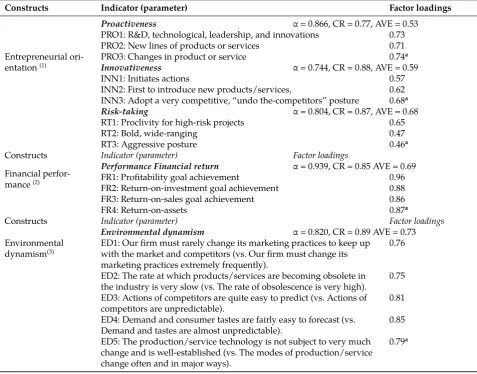
To measureentrepreneurial orientation, we adopted the original nine-item scale proposed by Covin and Slevin (1989) which had been previously developed by Khandwalla (1977), Miller and Friesen (1982), and Miller and Friesen (1983). This scale entails three components of strategic posture: innovation, proactiveness, and risk-taking. Previous researchers operationally defined entrepreneurial orientation as an aggregate measure of three dimensions (Covin and Slevin 1988; Miller and Friesen 1983; Naman and Slevin 1993; van Doorn, Heyden, and Volberda 2017). These multidimensional variable indeed reflects top management’s behavior in taking strategic decisions and operating management philosophies (Tajeddini 2015).
The first three items of this scale (e.g. willingness to favor change by developing new and unique products, services or processes and embrace innovation in order to obtain competitive advantage) evaluates the firm’s tendency toward innovation (α= 0.744); the second three items (e.g. the willingness to be proactive when com-peting with other firms) assess the firm’s proactive orientation (α= 0.866); the third three items (e.g. the will-ingness to pursue risky opportunities, taking the chance to fail and taking other business related risks) assess the firm’s risk-taking propensity (α= 0.804) (Covin and Slevin 1989; Ferreira and Azevedo 2008).
[image:6.595.58.536.383.757.2]Environmental dynamism reflects the perceived frequency of any change in management team (Chandler, Honig, and Wiklund 2005), technology, customer preferences, competitive action, regulation and suppliers (Tajeddini and Trueman 2016) as well as turnover in the marketing forces of the external and task environment (Sohi 1996). Using five opposite statements adopted from Khandwalla (1977), environmental dynamism was assessed. These statements indicate the level of change in marketing practice, rate of obsolescence of product-s/services, predictability of competitors’action, forecasting the demand and consumer tastes, and the modes of production/service change. The Cronbach’s alpha of the measure was 0.888 indicating satisfactory internal consistency (see Table 1).
Table 1:Unidimensionality and convergent validity tests.
Constructs Indicator (parameter) Factor loadings
Entrepreneurial ori-entation(1)
Proactiveness α= 0.866, CR = 0.77, AVE = 0.53
PRO1: R&D, technological, leadership, and innovations 0.73
PRO2: New lines of products or services 0.71
PRO3: Changes in product or service 0.74a
Innovativeness α= 0.744, CR = 0.88, AVE = 0.59
INN1: Initiates actions 0.57
INN2: First to introduce new products/services, 0.62
INN3: Adopt a very competitive,“undo the-competitors”posture 0.68a
Risk-taking α= 0.804, CR = 0.87, AVE = 0.68
RT1: Proclivity for high-risk projects 0.65
RT2: Bold, wide-ranging 0.47
RT3: Aggressive posture 0.46a
Constructs Indicator (parameter) Factor loadings
Financial perfor-mance(2)
Performance Financial return α= 0.939, CR = 0.85 AVE = 0.69
FR1: Profitability goal achievement 0.96
FR2: Return-on-investment goal achievement 0.88
FR3: Return-on-sales goal achievement 0.86
FR4: Return-on-assets 0.87a
Constructs Indicator (parameter) Factor loadings
Environmental dynamism(3)
Environmental dynamism α= 0.820, CR = 0.89 AVE = 0.73
ED1: Our firm must rarely change its marketing practices to keep up with the market and competitors (vs. Our firm must change its marketing practices extremely frequently).
0.76
ED2: The rate at which products/services are becoming obsolete in the industry is very slow (vs. The rate of obsolescence is very high).
0.75
ED3: Actions of competitors are quite easy to predict (vs. Actions of competitors are unpredictable).
0.81
ED4: Demand and consumer tastes are fairly easy to forecast (vs. Demand and tastes are almost unpredictable).
0.85
ED5: The production/service technology is not subject to very much change and is well-established (vs. The modes of production/service change often and in major ways).
A
ut
omatic
all
y
gener
at
ed
rough
by
Pr
oo
fCheck
fr
om
Ri
ver
V
alle
y
Tec
hnologies
Lt
d
(1)Model summary statistics:χ2
(71)= 117.271,χ2/df = 1.652,p-value = 0.17, robust CFI = 0.977, RMSEA = 0.048, Delta2 = 0.977, RMR = 0.020;aLoading fixed to 1 for identification purposes.
(2)Model summary statistics:χ2
(13)= 48.78,χ2/df = 3.09,p-value = 0.00, robust CFI = 0.98, GFI = 0.95, RMSEA = 0.08, Delta2 = 0.98, RMR = 0.02;aLoading fixed to 1 for identification purposes.
(3)Model summary statistics:χ2
(13)= 28.321,χ2/df = 2.179,p- value = 0.008, robust CFI = 0.976, GFI = 0.963, RMSEA = 0.079, Delta2 = 0.976, RMR = 0.040,aLoading fixed to 1 for identification purposes.
CR = Composite reliabilities AVE =average variance extracted
While objective measures of business performance are preferable to subjective measures (Dess and Robinson 1984; Kumar, Subramanian, and Yauger 1998), and despite our effort, we could not access any financial data (e.g. sales, profits, ROI etc.), possibly because of firms’unwillingness to divulge the hard statistical data and also the lack of interest of managers. Thus, financial firm performance was measured in terms of four achievements: (1) profitability, (2) return-on-investments, (3) return-on-sales, and (4) return-on-assets adopted from Kara, Spillan, and Deshields (2005). Each item was phrased so that respondents could assess these aspects of firm performance over the last 3 years relative to their business unit’s primary competitors’(one-much worse than my competitors; seven-much better than my competitors). The score of Cronbach’s coefficient alpha was applied to assess the reliability estimates for all multi-item constructs where a high level of reliability with a value greater than the recommended cut-off level of 0.7 (Churchill 1979).
Following an exploratory factor analysis, a confirmatory factor analysis was carried out to validate the scales (χ2= 58.62, df = 40, NFI = 0.93, TLI = 0.96, CFI = 0.98, IFI = 0.98, RMSEA = 0.05) with satisfactory validity and reliability for financial performance (α= 0.939). Composite reliabilities (CR) were computed to evaluate the degree of consistency between multiple measurements of a construct (Hair et al. 2005). Average variance extracted (AVE) was calculated to measure the convergent validity (Gerbing and Anderson 1988). The CR and AVE of financial performance (CR = 0.85 and AVE = 69%) indicate that they have exceeded their threshold levels (AVE> 0.5 and CR> 0.7) (Hair et al. 2005). In addition, as show in Table 1, all item loadings ranging from 0.85 to 0.90 are significant at the 5% significance level, showing convergent validity.
Control Variables
We included control variables to separate the impact of other forces which underpin the level of firm formation activities and might affect a firm’s performance. Seven typical control variables were utilized for this research including firm type, firm size, firm ownership, firm age, industry type and the years of experience of the re-spondent as well as the participant’s background (see Jaworski and Kohli 1993; Tajeddini 2016). Firm age is the logarithm of the number of years since the formation of the firm. Industry type is a dummy variable (1 = high-tech industries, 0 = other industries). Firm type is a dummy variable such that manufacturing firms are coded as a dummy variable“type 1”, while service and other enterprises as“type 0”. Firm size is the logarithm of the total number of employees to prevent skewness. Firm ownership is included as a dummy variable to control for potential variations between foreign (coded as 1, including both joint ventures and wholly owned subsidiaries) and domestic firms (coded as 0). The years of experience of the respondent were evaluated as the logarithm of the number of years since the respondent was working with the firm and the participant’s background (0: R&D/Engineering; 1: other) as controls.
Scale Validation
We employed two sets of statistics to test unidimensionality and convergent validity: first, the significance of the factor loadings (z-values>± 1.96 andp< 0.05), that is the estimated correlation between a specific item and the latent construct it represents (Venkatraman 1989) and second, the overall satisfactory of the proposed model in terms of its fit to the collected data employing chi square (χ2) test and adjunct fit indexes, to exceed the cut-off
point of 0.90 (Venkatraman 1989).
A
ut
omatic
all
y
gener
at
ed
rough
by
Pr
oo
fCheck
fr
om
Ri
ver
V
alle
y
Tec
hnologies
Lt
d
[image:8.595.58.542.130.373.2]variances (SHVs) between pairs of all possible scale combinations indicated that the AVEs were higher than the associated shared variance in all cases, thereby convergent validity was satisfactory.
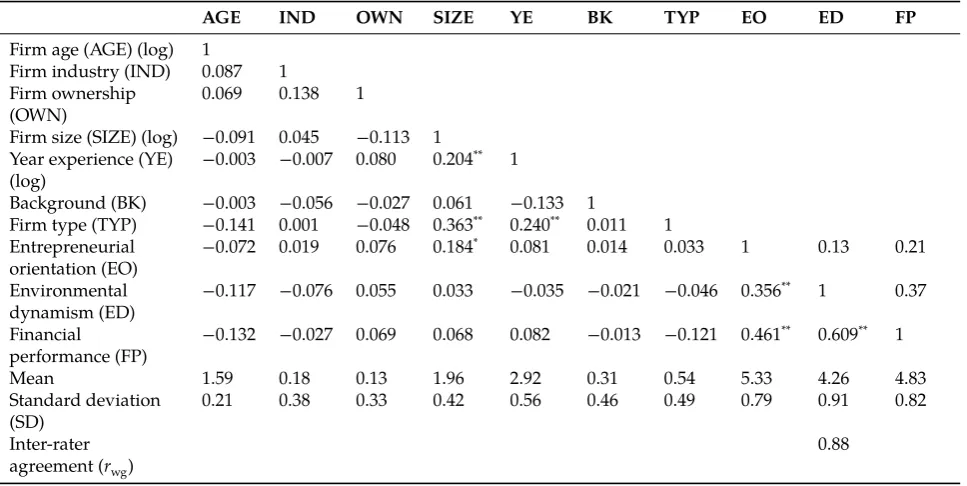
Table 2:Means, standard deviations, correlations, and shared variances (n= 192)a.
AGE IND OWN SIZE YE BK TYP EO ED FP
Firm age (AGE) (log) 1
Firm industry (IND) 0.087 1
Firm ownership (OWN)
0.069 0.138 1
Firm size (SIZE) (log) −0.091 0.045 −0.113 1 Year experience (YE)
(log)
−0.003 −0.007 0.080 0.204** 1
Background (BK) −0.003 −0.056 −0.027 0.061 −0.133 1
Firm type (TYP) −0.141 0.001 −0.048 0.363** 0.240** 0.011 1
Entrepreneurial orientation (EO)
−0.072 0.019 0.076 0.184* 0.081 0.014 0.033 1 0.13 0.21
Environmental dynamism (ED)
−0.117 −0.076 0.055 0.033 −0.035 −0.021 −0.046 0.356** 1 0.37
Financial performance (FP)
−0.132 −0.027 0.069 0.068 0.082 −0.013 −0.121 0.461** 0.609** 1
Mean 1.59 0.18 0.13 1.96 2.92 0.31 0.54 5.33 4.26 4.83
Standard deviation (SD)
0.21 0.38 0.33 0.42 0.56 0.46 0.49 0.79 0.91 0.82
Inter-rater agreement (rwg)
0.88
Furthermore, variance inflation factors along with condition index were computed to investigate the likeli-hood impact of multicollinearity in each model testing. The variance inflation factor values associated with the mean-centered predictors ranged from 1.028 to 5.076, all of which were significantly below the common cutoff threshold of 10 (Hair et al. 2010). The outcomes show that the condition indices (<21:993) are well below the critical values suggested by Hair et al. (2010), indicating that multicollinearity was not a problem in the current study and it does not influence the weights of the controls or hypothesized variables (Mason and Perreault 1991).
Common Method Variation
Despite our best proactive attempts to minimize any potential common method variation (CMV), a common method bias might occur because the data were collected from the same respondents (Podsakoff et al. 2003). To reduce possible bias, the scale items were carefully evaluated to ensure that the items were simple, specific, and concise. In addition to using a mixed order of questions (ex ante), it was guaranteed in the cover letter that the respondents’anonymity would be preserved to reduce evaluation apprehension (Chang, Witteloostuijn, and Eden 2010; Tsai and Yang 2014).
To enhance scale purification, a Harman’s ex post one-factor test was carried out to provide an additional check for common method variance (Podsakoff and Organ 1986). Our factor analysis results indicate that four factors have eigenvalues greater than 1.0, accounted for 54.58% of the total variance; and Factor 1 accounted for 19.37% of the variance. Since a single factor did not emerge and Factor 1 did not explain most of the variance, common method bias is unlikely to be a concern in our data (Liu, Luo, and Shi 2002; Podsakoff and Organ 1986; Tsai and Yang 2014).
Following the recommendation of Malhotra, Kim, and Patil (2006), we performed a CFA and tested fit in-dices. All the five variables were loaded on one factor to examine the fit of the CFA model. The CFA yieldedχ2
(198) = 734.15; RMSEA = 0.113; SRMR = 0.10; CFI = 0.678; GFI = 0.645; TLI = 0.661, indicating very poor fit. The results increase our confidence that the threat due to common method bias is minimal.
Results
A
ut
omatic
all
y
gener
at
ed
rough
by
Pr
oo
fCheck
fr
om
Ri
ver
V
alle
y
Tec
hnologies
Lt
d
dimensions of risk taking, innovativeness, and proactiveness, with each construct weighted at one-third. Like-wise, within the regression testing, ED (Hult, Ketchen, and Arrfelt 2007) were created as a summated index. Inter-rater agreement (rwg) was computed for ED construct for examination of consistency among respondents within the organizations. Therwg value associated with the aggregate measure of ED in a firm was (0.88),
substantially above the common cutoff threshold of 0.60 (Hair et al., 2010), indicating a satisfactory level of inter-rater agreement.
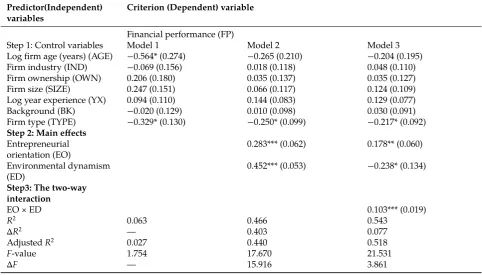
A single hierarchical moderated regression analysis would typically be used to test for interactive effects between ED and the independent study variable in predicting growth and financial returns. We established a series of three regression models, evaluated the change in the amount of variance explained (ΔR2) to test the interaction effects (Cohen et al. 2003), and conducted overall and incrementalFtests of statistical significance. We entered the control variables into the regression equation in step 1 (model 1), one predictor in step 2 (model 2), and one two-way interaction in step 3, respectively (model 3). Model 1 serves as the base model for model 2 (control variables into the regression equation), which in turn is the base for model 3. Table 3 displays results of the regression analyses (models 1 to 3).
H1predicts that EO leads to higher financial performance. As model 2 of Table 3 shows, entrepreneurial orientation had a positive and significant main effect on financial performance (Unstandardized Coefficient = 0.283,p< 0.001). This finding supports H1bconfirming the findings of prior empirical studies (e. g. Anderson et al. 2015; Zahra and Covin 1995; Wiklund 1999) and validating Choi, Lévesque, and Shepherd (2008) concep-tual argument that entrepreneurial orientation provides positive economic value for firms in terms of profit. Although not hypothesized, environmental dynamism is also found to have a strong positive effect (indepen-dent of entrepreneurial orientation) on financial performance (Unstandardized Coefficient = 452,p < 0.001) (see model 2). H2predicts that a strong entrepreneurial orientation will achieve higher levels of financial
per-formance when environmental dynamism is high than when it is low. Table 3 shows that the combined interac-tive effect of entrepreneurial orientation and environmental dynamism leads to higher financial performance (H2). This hypothesis is supported by the inclusion of an interaction term (EO × ED) which has a significant
[image:9.595.56.539.429.704.2]and positive effect on financial return performance (Unstandardized Coefficient = 0.103,p< 0.001) as shown in Table 2, models 3.
Table 3:Hierarchical moderated regression analysis (n= 192).
Predictor(Independent) variables
Criterion (Dependent) variable
Financial performance (FP)
Step 1: Control variables Model 1 Model 2 Model 3
Log firm age (years) (AGE) −0.564* (0.274) −0.265 (0.210) −0.204 (0.195)
Firm industry (IND) −0.069 (0.156) 0.018 (0.118) 0.048 (0.110)
Firm ownership (OWN) 0.206 (0.180) 0.035 (0.137) 0.035 (0.127)
Firm size (SIZE) 0.247 (0.151) 0.066 (0.117) 0.124 (0.109)
Log year experience (YX) 0.094 (0.110) 0.144 (0.083) 0.129 (0.077)
Background (BK) −0.020 (0.129) 0.010 (0.098) 0.030 (0.091)
Firm type (TYPE) −0.329* (0.130) −0.250* (0.099) −0.217* (0.092)
Step 2: Main effects
Entrepreneurial orientation (EO)
0.283*** (0.062) 0.178** (0.060)
Environmental dynamism (ED)
0.452*** (0.053) −0.238* (0.134)
Step3: The two-way interaction
EO × ED 0.103*** (0.019)
R2 0.063 0.466 0.543
ΔR2 — 0.403 0.077
AdjustedR2 0.027 0.440 0.518
F-value 1.754 17.670 21.531
ΔF — 15.916 3.861
∗p < 0.05,∗∗p < 0.01,∗∗∗p < 0.001,
ΔR2means the increase in R2from the model to the previous model.
A
ut
omatic
all
y
gener
at
ed
rough
by
Pr
oo
fCheck
fr
om
Ri
ver
V
alle
y
Tec
hnologies
Lt
d
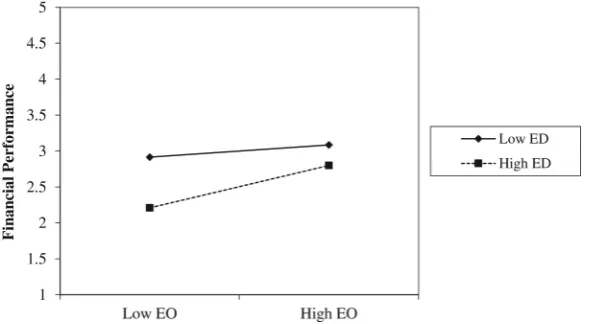
the effect of entrepreneurial orientation on financial performance was significant under high environmental dynamism (simple slope = + 0.29,t-value = 2.39,p= 0.01) and insignificant under low level of environmental dynamism (simple slope = +0.08,t-value = 0.57,ns).
[image:10.595.152.448.212.374.2]Figure 1 shows that high environmental dynamism is associated with stronger financial performance and that an increase in environmental dynamism strengthens the positive relationship between entrepreneurial orientation and financial performance. This result implies that an increase in environmental dynamism ac-tually strengthens the positive effect of entrepreneurial orientation on financial performance. This means that the strength of the relationship between entrepreneurial orientation and financial performance would be strengthen as environmental dynamism increased. Thus it is possible that companies with higher envi-ronmental dynamism are more reliant on entrepreneurial orientation as a critical avenue to increase financial performance.
Figure 1:The moderating role of ED on the EO–financial performance relationship.
Discussion and Conclusions
While the management literature suggests that firms need to pursue an EO to achieve superior performance (Baker and Sinkula 2009; Tsai and Yang 2014), a key question has remained about exactly how firms achieve high financial performance in a dynamic environment. Prior research has shown that an entrepreneurial ori-entation (e.g. Kollmann and Stöckmann 2012) can facilitate the pursuit of new opportunities which in turn result in improvements in firm business performance. However, there is a lack of thorough knowledge and un-derstanding as to whether the interaction of entrepreneurial orientation and dynamic environment facilitates superior financial performance.
The key objective of this research was to provide insights about the interaction of entrepreneurial orienta-tion and dynamic environment on financial performance. The results of our study also demonstrate the direct effect of entrepreneurial orientation on financial performance along with the merits of pursuing this strategic approach under a highly dynamic environment. In the following section we explain our study’s contribution to strategic management research and implications for management practice.
Contribution to Research
Consistent with previous research (Anderson and Eshima 2013; Rauch et al. 2009; Semrau, Ambos, and Kraus 2016), our study demonstrates that an entrepreneurial orientation positively influences business financial re-turn to create and build value for the firm and its shareholders. However, our study is novel in that we used firms from different industries to text our hypotheses by employing environmental dynamism as a moderating variable between entrepreneurial orientation and financial performance.
A
ut
omatic
all
y
gener
at
ed
rough
by
Pr
oo
fCheck
fr
om
Ri
ver
V
alle
y
Tec
hnologies
Lt
d
In addition, we found that the impact of entrepreneurial orientation on financial performance is hanced when operating in a highly dynamic environment. This result empirically supports the view that en-trepreneurial firms perform well in dynamic environments (Martínez-Sánchez et al. 2011; Menguc and Auh 2006) and in yielding desired business results. Thus being proactive (a response to opportunities) is an appro-priate mode for firms in dynamic environments or in growth-stage and in mature industries (Dess, Lumpkin, and Covin 1997; Lumpkin and Dess 2001). These findings reinforce the argument that if organizations de-part from established practices and entertain new ideas and experimentation, beat competitors to new market opportunities, and are open to risk in exploring new products, services, and markets, they are more likely to outperform their competitors in terms of financial return (Covin and Slevin 1991; De Clercq, Dimov, and Thongpapanl 2010).
Implications for Management Practice
Many strategic management theorists have viewed entrepreneurship activities as a key determinant of a firm’s ability to compete and take risks. Using empirical evidence, we found that SMEs top managers should foster and promote an entrepreneurial spirit and culture if they intend to improve their financial returns. In this regard, managers are strongly recommended to stimulate entrepreneurial spirit, build a culture of entrepreneurship, and support innovative employees. At the same time, they should pay close attention to financial returns in order to survive and satisfy the current needs of the organization.
These findings also provide insights for managers and entrepreneurs who may be contemplating the ap-plication of novel ideas to create a new product or service. When encountered with challenging and dynamic situations, managers may undervalue the costs of operating in such tough and unpleasant circumstances, and underestimate the efforts required in implementing new methods and practices. Before implementing any of the new products, services, processes and methods, a thorough understanding and assessment of the nature of the environment is vital to the success of implementing novel products, new technologies, and business process for practitioners.
Future Research
It is important to note that scholars and practitioners should take care when generalizing the findings of a study to different cultural contexts. Our study was empirically supported in the specific context of SMEs in Switzerland. However, the role of dynamism is relevant to many other manufacturing and service firms as well as industries across the globe. In addition, a cross-sectional approach was used in this study with subjective measures.
Future research should focus on triangulating perceptual measures with other measures such as expert opinion and secondary data as well as using a longitudinal temporal base to assess the impact of the variables examined herein across time. Although, we evaluated performance in terms of financial returns, it should be remembered that business performance is a multidimensional array. We suggest that future studies employ objective measures for organization performance to strengthen the research design.
References
Aarikka-Stenroos, L., and B. Sandberg. 2012.“From New-Product Development to Commercialization through Networks.”Journal of Business Research65 (2): 198–206.
Ahmed, P. K., and M. Rafiq. 1992.“Implanting Competitive Strategy: A Contingency Approach.”Jourtiat of Marketing Management8: 49–67. Aiken, L. S., and S. G. West. 1991.Multiple Regression: Testing and Interpreting Interactions. Newbury Park, CA: SAGE Publications.
Akgun, A. E., H. Keskin, and J. Byrne. 2008.“The Moderating Role of Environmental Dynamism between Firm Emotional Capability and Performance.”Journal of Organizational Change Management21 (2): 230–52.
Ambos, B., and B. B. Schlegelmilch. 2007.“Innovation and Control in the Multinational Firm: A Comparison of Political and Contingency Approaches.”Strategic Management Journal28 (5): 473–86.
Anderson, B. S., and Eshima, Y. 2013.“The Influence of Firm Age and Intangible Resources on the Relationship between Entrepreneurial Orientation and Firm Growth among Japanese SMEs.”Journal of Business Venturing28: 413–29.
Anderson, B. S., P. M. Kreiser, D. F. Kuratko, J. S. Hornsby, and Y. Eshima. 2015.“Reconceptualizing Entrepreneurial Orientation.”Strategic Management Journal36: 1579–96.
Armstrong, J. S., and T. S. Overton. 1977.“Estimating Non-Response Bias in Mail Surveys.”Journal of Marketing Research14: 396–402. Atuahene-Gima, K., H. Li, and L. M. De Luca. 2006.“The Contingent Value of Marketing Strategy Innovativeness for Product Development
A
ut
omatic
all
y
gener
at
ed
rough
by
Pr
oo
fCheck
fr
om
Ri
ver
V
alle
y
Tec
hnologies
Lt
d
Bagozzi, R. P., and Y. Yi. 1988.“On the Evaluation of Structural Equation Models.”Journal of the Academy of Marketing Science16 (1): 74–94. Bagozzi, R. P., Y. Yi, and L. W. Phillips. 1991.“Assessing Construct Validity in Organizational Research.”Administrative Science Quarterly36:
421–58.
Baker, W. E., and J. M Sinkula. 2009.“The Complementary Effects of Market Orientation and Entrepreneurial Orientation on Profitability in Small Businesses.”Journal of Small Business Management47 (4): 443–64.
Boyd, B., G. Dess, and A. Rasheed. 1993.“Divergence between Archival and Perceptual Measures of the Environment.”Academy of Manage-ment Review18: 204–26.
Brettel, M., C. Chomik, and T. C. Flatten. 2015.“How Organizational Culture Influences Innovativeness, Proactiveness, and Risk-Taking: Fos-tering Entrepreneurial Orientation in SMEs.”Journal of Small Business Management53 (4): 868–85.
Burns, T., and G. M. Stalker. 1961.The Management of Innovation. London: Tavistock.
Chandler, G. N., B. Honig, and J. Wiklund. 2005.“Antecedents, Moderators, and Performance Consequences of Membership Change in New Venture Teams.”Journal of Business Venturing20: 705–25.
Chang, S.-J., A. V. Witteloostuijn, and L Eden. 2010.“From the Editors: Common Method Variance in International Business Research.” Jour-nal of InternatioJour-nal Business Studies41 (2): 178–84.
Choi, N., and S. Majumdar. 2014.“Social Entrepreneurship as an Essentially Contested Concept: Opening a New Avenue for Systematic Fu-ture Research.”Journal of Business Venturing29: 363–76.
Choi, Y. R., M. Lévesque, and D. A. Shepherd. 2008.“When Should Entrepreneurs Expedite or Delay Opportunity Exploitation?”Journal of Business Venturing23: 333–55.
Churchill, G. A. Jr. 1979.“A Paradigm for Developing Better Measures of Marketing Constructs.”Journal of Marketing Research16 (February): 64–73.
Cohen, J., P. Cohen, S. G. West, and L. S. Aiken. 2003.Applied Multiple Regression/Correlation Analysis for the Behavioral Sciences, 3rd ed. Mahwah, NJ: Erlbaum,.
Collis, D. J. 1994.“Research Note: How Valuable are Organizational Capabilities.”Strategic Management Journal15 (x): 143–52. Coombs, J. E., and P. E. Bierly. 2006.“Measuring Technological Capability and Performance.”R&D Management36 (4): 421–38.
Costa, C., M. Fontes, and M. V. Heitor. 2004.“A Methodological Approach to the Marketing Process in the Biotechnology-Based Companies.”
Industrial Marketing Management33 (5): 403–18.
Covin, J. G., and D. P. Slevin. 1988.“The Influence of Organization Structure on the Utility of an Entrepreneurial Top Management Style.”
Journal of Management Studies25 (3): 217–34.
Covin, J. G., and D. P. Slevin. 1989.“Strategic Management of Small Firms in Hostile and Benign Environments.”Strategic Management Journal
11: 75–87.
Covin, J. G., and D. P. Slevin. 1991.“A Conceptual Model of Entrepreneurship as Firm Behavior.”Entrepreneurship Theory & Practice16 (1): 7–25. Curran, P. J., Bauer, D. J., and Willoughby, M. T. 2004.“Testing Main Effects and Interactions in Latent Curve Analysis.”Psychological Methods9
(2): 220–37.
De Clercq, D., D. Dimov, and N. Thongpapanl. 2010.“The Moderating Impact of Internal Social Exchange Processes on the Entrepreneurial Orientation–Performance Relationship.”Journal of Business Venturing25: 87–103.
Dess, G. G., and D. W. Beard. 1984.“Dimensions of Organizational Task Environment.”Administrative Science Quarterly29: 52–73. Dess, G. G., and G. T. Lumpkin. 2005.“The Role of Entrepreneurial Orientation in Stimulating Effective Corporate Entrepreneurship.”
Academy of Management Executive19 (1): 147–56.
Dess, G. G., G. T. Lumpkin, and J. G. Covin. 1997.“Entrepreneurial Strategy Making and Firm Performance: Tests of Contingency and Configu-rational Models.”Strategic Management Journal18 (9): 677–95.
Dess, G. G., and R. B. Robinson, Jr. 1984.“Measuring Organizational Performance in the Absence of Objective Measures: The Case of the Privately-Held Firm and Conglomerate Business Unit.”Strategic Management Journal5: 265–73.
Doyle, P., and P. Stern. 2006.Marketing Management and Strategy, 4th ed. London: Prentice- Hall.
Etemad, H. 2015.“Entrepreneurial Orientation-Performance Relationship in the International Context.”Journal of International Entreprenur-ship13 (1): 1–6.
Ferreira, J., and S. G. Azevedo. 2008.“Entrepreneurial Orientation (EO) and Growth of Firms: Key Lessons for Managers and Business Profes-sionals.”Problems and Perspectives in Management6 (1): 82–88.
Freel, M. S. 2005.“Patterns of Innovation and Skills in Small Firms.”Technovation25: 123–34.
Gerbing, D. W., and J. C. Anderson. 1988.“An Updated Paradigm for Scale Development Incorporating Unidimensionality and Its Assess-ment.”Journal of Marketing Research25 (2): 186–92.
Gutiérrez, P. R., M. F. Fuentes, and L. R. Ariza. 2014.“Strategic Capabilities and Performance in Women-Owned Businesses in Mexico.”Journal of Small Business Management52 (3): 541–54.
Hair, J. F., B. Black, B. Babin, R. E. Anderson, and R. L. Tatham. 2005.Multivariate Data Analysis. Saddle River, NJ: Prentice Hall.
Hair, J. F., Black, W. C., Babin, B. J., and Anderson, R. E. 2010.Multivariate Data Analysis: A Global Perspective, 7th ed. Upper Saddle River, NJ: Pearson Education, Inc.
Hernández-Perlines, F. 2016.“Entrepreneurial Orientation in Hotel Industry: Multi-Group Analysis of Quality Certification.”Journal of Busi-ness ResearchIn press.
Hult, G. T. M., Hurley, R.F. and Knight, G.A. 2004.“Innovativeness: Its Antecedents and Impact on Business Performance.”Industrial Market-ing Management33: 429–38.
Hult, G. T. M., D. J. Ketchen, and M. Arrfelt. 2007.“Strategic Supply Chain Management: Improving Performance through a Culture of Com-petitiveness and Knowledge Development.”Strategic Management Journal28 (X): 1035–52.
Jaworski, B. J., and A. K. Kohli. 1993.“Market Orientation: Antecedents and Consequences.”Journal of Marketing57 (3): 53–70.
A
ut
omatic
all
y
gener
at
ed
rough
by
Pr
oo
fCheck
fr
om
Ri
ver
V
alle
y
Tec
hnologies
Lt
d
Joshi, M. P., S. R. Das, and N. Mouri. 2015.“Antecedents of Innovativeness in Technology-Based Services (TBS): Peering into the Black Box of Entrepreneurial Orientation.”Decision Sciences46 (2): 367–402.
Kabadayi, S., N. Eyuboglu, and G. P. Thomas. 2007.“The Performance Implications of Designing Multiple Channels to Fit with Strategy and Environment.”Journal of Marketing71 (4): 195–211.
Kara, A., J. E. Spillan, and O. W. Deshields Jr. 2005.“The Effect of Market Orientation on Business Performance: A Study of Small-Sized Ser-vice Retailers Using MARKOR Scale.”Journal of Small Business Management43 (2): 105–18.
Khandwalla, P. N. 1977.The Design of Organizations. New York: Harcourt Brace Jovanovich. New York, Harcourt Brace Jovanovich.
Koberg, C., N. Uhlenbruck, and Y. Sarason. 1996.“Facilitators of Organizational Innovation: The Role of Life-Cycle Stage.”Journal of Business Venturing11: 133–49.
Kollmann, T., and C. Stöckmann. 2012.“Filling the Entrepreneurial Orientation–Performance Gap: The Mediating Effects of Exploratory and Exploitative Innovations.”Entrepreneurship: Theory and Practice38 (5): 1001–26.
Kumar, K., R. Subramanian, and C. Yauger. 1998.“Examining the Market Orientation–Performance Relationship: A Context–Specific Study.”Journal of Management24 (2): 201–33.
Li, H., and Li, J. 2009.“Top Management Team Conflict and Entrepreneurial Strategymaking in China.”Asia Pacific J. Manage26: 263–83. Li, Y. H., J. W. Huang, and M.-T. Tsai. 2009.“Entrepreneurial Orientation and Firm Performance: The Role of Knowledge Creation Process.”
Industrial Marketing Management38: 440–49.
Liu, S., X. Luo, and Y.-Z. Shi. 2002.“Integrating Customer Orientation, Corporate Entrepreneurship, and Learning Orientation in Organizations-In-Transition: An Empirical Study.”International Journal of Research in Marketing19 (X): 367–82.
Lumpkin, G. T., and G. G. Dess. 1996.“Clarifying the Entrepreneurial Orientation Construct and Linking It to Performance.”Academy of Man-agement Review21 (1): 135–72.
Lumpkin, G. T., and G. G. Dess. 2001.“Linking Two Dimensions of Entrepreneurial Orientation to Firm Performance.”Journal of Business Ven-turing16: 429–51.
Makino, S., T. Isobe, and C. M. Chan. 2004.“Does Country Matter?”Strategic Management Journal25 (10): 1027–43.
Malhotra, N. K., S. S. Kim, and A. Patil. 2006.“Common Method Variance in IS Research: A Comparison of Alternative Approaches and Re-analysis of past Research,”.”Managent Science52 (12): 1865–83.
March, J. G. 1991.“Exploration and Exploitation in Organizational Learning.”Organization Science2: 71–87.
Marlin, D., B. T. Lamont, and J. J. Hoffman. 1994.“Choice Situation, Strategy, and Performance: A Re-Examination.”Strategic Management Journal15: 229–39.
Martin, S. L., and R. G. Javalgi. 2016.“Entrepreneurial Orientation, Marketing Capabilities and Performance: The Moderating Role of Com-petitive Intensity on Latin American International New Ventures.”Journal of Business Research69: 2040–51.
Martínez-Sánchez, A., M. J. Vela-Jiménez, M. Pérez-Pérez, and P. de-Luis-Carnicer. 2011.“The Dynamics of Labour Flexibility: Relationships between Employment Type and Innovativeness.”Journal of Management Studies48 (4): 715–36.
Mason, C. H., and W. D. Perreault. 1991.“Collinearity, Power, and Interpretation of Multiple Regression Analysis.”Journal of Marketing Research
28 (3): 268–80.
Menguc, B., and S. Auh. 2006.“Creating a Firm-Level Dynamic Capability through Capitalizing on Market Orientation and Innovativeness.”
Journal Of the Academy of Marketing Science34 (1): 63–73.
Mia, L., and B. Clarke. 1999.“Market Competition, Management Accounting Systems and Business Unit Performance.”Management Account-ing Research10 (2): 137–58.
Miller, D. 1988.“Relating Porter’s Business Strategies to Environment and Structure: Analysis and Performance Implications.”Academy of Management Journal31: 280–308.
Miller, D., and P. Friesen. 1982.Strategic Management Journal3 (null): 1.
Miller, D., and P. H. Friesen. 1983.“Strategy-Making and the Environment: The Third Link.”Srategic Management Journal3 (4): 221–35. Naman, J. L., and D. P. Slevin. 1993.“Entrepreneurship and the Concept of Fit: A Model and Empirical Tests.”Strategic Management Journal14:
137–54.
Nandakumar, M. K., A. Ghobadian, and N. O’Regan. 2010.“Business-Level Strategy and Performance: The Moderating Effects of Environ-ment and Structure.”Management Decision48 (6): 907–39.
Núñez-Pomar, J., V. Prado-Gascó, V. Añó Sanz, J. Crespo Hervás, and F. CalabuigMoreno. 2016.“Does Size Matter? Entrepreneurial Orientation and Performance in Spanish Sports Firms.”Journal of Business Research69: 5336–41.
Podsakoff, P. M., S. B. MacKenzie, J.-Y. Lee, and N. P. Podsakoff. 2003.“Common Method Biases in Behavioral Research: A Critical Review of the Literature and Recommended Remedies.”Journal of Applied Psychology88 (5): 879–903.
Podsakoff, P. M., and D. W. Organ. 1986.“Self-Reports in Organizational Research: Problems and Prospects.”Journal of Management12 (2): 531–44.
Ratten, V., and Tajeddini, K. 2018.“Women’s Entrepreneurship and Internationalization: Patterns and Trends.”International Journal of Sociol-ogy and Social Policy38 (9/10).
Rauch, A., J. Wiklund, G. T. Lumpkin, and M. Frese. 2009.“Entrepreneurial Orientation and Business Performance: An Assessment of past Research and Suggestions for the Future.”Entrepreneurship Theory and Practice33 (3): 761–87.
Saeed, S., S Yousafzai, and A. Engelen. 2014.“On Cultural and Economic Contingencies of the Entrepreneurial Orientation-Performance Relationship.”Entrepreneurship Theory and Practice38 (4): 255–90.
Scott, R. W. 1981.Organizations: Rational, Natural & Open Systems. Englewood Cliffs, NJ.: Prentice-Hall, Inc.
Semrau, T., T. Ambos, and S. Kraus. 2016.“Entrepreneurial Orientation and SME Performance across Societal Cultures: An International Study.”Journal of Business Research69: 1928–32.
Shan, P., M. Song, and X. Jua. 2016.“Entrepreneurial Orientation and Performance: Is Innovation Speed a Missing Link?”Journal of Business Research69: 683–90.
A
ut
omatic
all
y
gener
at
ed
rough
by
Pr
oo
fCheck
fr
om
Ri
ver
V
alle
y
Tec
hnologies
Lt
d
Sohi, R. S. 1996.“The Effects of Environmental Dynamism and Heterogeneity on Salespeople’s Role Perceptions, Performance and Job Satis-faction.”European Journal of Marketing30 (7): 49–67.
Steinhoff, D., and Burgess, J. F. 1993.Small Business Management Fundamentals. New York-USA: McGraw-Hill, Inc.
Tajeddini, K. 2015.“Exploring the Antecedents of Effectiveness and Efficiency.”International Journal of Hospitality Management49 (7): 125–35. Tajeddini, K. 2016.“Financial Orientation, Product Innovation and Firm Performance: An Empirical Study in the Japanese SMEs.”
Interna-tional Journal of Innovation and Technology Management35 (2): 1–23.
Tajeddini, K., U. Elg, and M. Truaman. 2013.“Efficiency and Effectiveness of Small Retailers: The Role of Customer and Entrepreneurial Orien-tation.”Journal of Retailing and Consumer Services20 (6): 453–62.
Tajeddini, K., and S. Mueller. 2009.“Entrepreneurial Characteristics in Switzerland and the UK: A Comparative Study of Techno-Entrepreneurs.”Journal of International Entrepreneurship7 (1): 1–25.
Tajeddini, K., and S. L. Mueller. 2012.“Corporate Entrepreneurship in Switzerland: Evidence from a Case Study of Swiss Watch Manufactur-ers.”International Entrepreneurship and Management Journal8 (3): 355–72.
Tajeddini, K., and M. Trueman. 2016.“Environment-Strategy and Alignment in a Restricted, Transitional Economy: Empirical Research on Its Application to Iranian State-Owned Enterprises.”Long Range Planning49 (5): 570–83.
Tajeddini, K., Altinay, L., and Ratten, V. 2017.“Service Innovativeness and the Structuring of Organizations: The Moderating Roles of Learning Orientation and Inter-functional Coordination.”International Journal of Hospitality Management65 (August): 100-14.
Tsai, K.-H., and S. Y. Yang. 2014.“The Contingent Value of Firm Innovativeness for Business Performance under Environmental Turbulence.”
International Entreprenurship Management Journal10 (2): 343–66.
van Doorn, S., M. L. M. Heyden, and H. W. Volberda. 2017.“Enhancing Entrepreneurial Orientation in Dynamic Environments: The Interplay between Top Management Team Advice-Seeking and Absorptive Capacity.”Long Range Planning50, no. 2 (April): 134–44.
Venkatraman, N. 1989.“Strategic Orientation of Business Enterprises: The Construct, Dimensionality, and Measurement.”Management Sci-ence35 (8): 42–62.
Wiklund, J. 1999.“The Sustainability of the Entrepreneurial Orientation-Performance Relationship.”Entrepreneurship Theory and Practice24 (1): 39-50.