Competition, Partnership and the New Localism: The language of a contradictory localism1.
Introduction
Since the 1970s the approach to urban policy in England seems to have switched from a state centred, hierarchical approach to one based upon local partnerships competing with one another in a market for central state funds. During the 1970s and early 1980s urban regeneration was undertaken as part of a national policy (the Urban Programme) that was established by central government and administered through local authorities operating with a degree of local discretion. Cities requiring assistance were designated by government on the basis of need, and a policy programme was developed in each area by the local authority in consultation with local interest groups and under the guidance of the Department of the Environment. By the 1990s, however, a very different approach has emerged in which no areas are designated in advance and local regeneration is initiated by local partnerships which draw upon a range of local interests competing with one another in a national quasi-market for funding that combines the criterion of ‘need’ with that of ‘opportunity’.
The transition between these two positions was spurred by the election of the Conservative government in 1979, which was associated with intense political conflict between central government and urban local authorities. But at a deeper level it was no doubt conditioned by growing instability in the post-war pattern of economic development and political compromise. During the Thatcher decade local government was increasingly fragmented and responsibilities were in many cases transferred to newly established non-elected agencies (such as Urban Development Corporations and Task Forces) directly accountable to central government. The content of urban policy was refocused upon “market-orientated, property-led urban regeneration” and in so far as there was a national urban policy it was centrally controlled and sought to marginalise local authorities (Davoudi and Healey, 1995 p.79).
Subsequently, this has come to be seen as something of a transitional phase, however, and it is recognised that since 1990 the focus of national urban policy has shifted once again and in three particular respects (cf Parkinson, 1993). First, government now pursues urban regeneration through the partial reintegration of local governance under the co-ordination of local partnerships and the strategies they devise. This approach has been promoted, for instance, by the Audit Commission and representatives of the private sector, as necessary to restore cohesion to urban policy (e.g. Audit Commission 1989), and has been justified by government on the grounds that it encourages ‘local empowerment’. When the City Challenge initiative was announced in 1991, for example, it involved a more accommodating relationship to local government in the context of local partnerships. The emphasis was now upon forging “successful partnerships for the development and delivery of plans between local authorities and all those that have a stake in the area” (DoE, 1992 para 7). Secondly, the emphasis upon direct central control over local interventions through centrally appointed agencies has also given ground to a more mediated form of central control through a quasi-market for regeneration funding in which central government sets itself up as the ‘client’ organisation representing local interests and purchases regeneration schemes, from local partnerships on their behalf. A third, crucial element which came in during the 1990s is the administration of the national urban policy by newly integrated and powerful Government Offices for the Regions, and the establishment of a new Single Regeneration Budget with its own Challenge Fund to support local initiatives.
This paper examines the progress of local empowerment in contemporary English urban policy by reference to the SRB Challenge Fund. In particular, the paper contrasts the aspirations and rhetoric of this programme with the empirical reality of the first two bidding rounds (1994/5 and 1995/6). There are three main sections to the paper. The first sketches out a theoretical orientation towards the events; the second examines the competitive bidding process to determine whether, in fact, it contributes to local empowerment; the third explores the characteristics of the bidding organisations which, in this context, comprise local partnerships; the fourth section draws out the implications of the two empirical accounts, and relates these to our initial theoretical frame of reference. The paper concludes by arguing that the dynamics of the SRB Challenge Fund, and of competitive processes more generally, run counter to the expressed objective of government; the empowerment of local communities.
Empirical data for this study is drawn from DoE figures on the SRB (to which the authors have had access in rounds one and two), together with a postal survey of all English local authorities in each of the first two rounds (these surveys were sponsored by the local authority associations - AMA, ADC, ACC as they were then - and achieved response rates of and respectively). The results of these surveys are reported in full in Mawson et al 1995 and Hall et al 1996
Theoretical Framework
The new model of national urban policy as sketched out above has been accepted by most parties, including a defeated local government system, as the dominant reality of urban policy in the mid 1990s. But most policy makers acknowledge that this model is not as yet an accomplished reality, that its realisation depends not just upon the attitutde of the incoming Labour government but also upon overcoming a range of practical difficulties to be overcome that will continue despite the change in government. It is widely recognised for example, that partnership working has not as yet been fully developed. Some believe that it can never be entirely realised, whilst acknowledging that it enables local regeneration activities to be funded by an otherwise reluctant government; others consider that real partnership working is possible but will require further learning and capacity building amongst those involved. Likewise, despite the commitment to competition, questions can be raised regarding the reality of the competitive process, given the opacity of decision making on the part of central government and the policy’s openness to political manipulation. Finally, despite the government’s professed commitment to local empowerment there are doubts as to whether this can in practice be achieved by these policy instruments. In each of its key aspects the new orthodoxy in urban policy may therefore be seen as an incomplete project, as a model or image which is pursued with greater or lesser conviction by different political actors but that still acts upon reality from its virtual state.
The prevailing theoretical paradigm within contemporary analysis of the state and governance in Europe remains the regulationist approach in all its forms (e.g. Jessop 1990; Painter and Goodwin, 1995). In this context, Jessop has argued, for instance, that the Keynesian Welfare State is being displaced by the Schumpeterian Workfare State, in either a neo-liberal, neo-statist or neo-corporatist form (Jessop 1993, pp.31-33; 1994). But linking at various points with this is a different perspective deriving from the neo-Gramscian strand of political theory, as displaced through post-structuralism and social relations theory, which draws attention to the role of discourse in the constitution of political subjects and political hegemony (Laclau and Mouffe, 1985). In opposition to theories which view social and political identity as objectively pre-given, Laclau and Mouffe argue that the political identity of subjects (and their class or other characters) are constituted through discourse and discursively mediated conflicts (Mouffe, 1995). The world view and ideological stance of these subjects is composed by a kind of ‘bricolage’, linking an assorted constellation of symbolic and ideological fragments from the past together around a organising ‘hegemonic principle’ which provides the basis for an assertion of hegemonic power. This kind of approach can be taken too far, into a relativism for which there is only discourse. But it may also be viewed as developing the discursive moment of neo-Gramscian analysis to the point where it can examine the relationship - and perhaps the contradictions - between discourse at different levels, between rhetoric and reality in political practice.
In recent years efforts have been made to extend and adapt this analysis to sub-national power structures and state apparatuses. Cox and Mair, for example, have analysed urban politics in the USA in terms of "local dependence". Capital and the local state cannot escape dependence upon local resources, customers or tax payers, and so they must confront it through mutually beneficial accumulation strategies which, typically, take corporatist forms (Cox and Mair 1988:309). A pro-development coalition may emergre which will, for instance, seek to co-opt class interests behind an hegemonic project supportive of its objectives. This project may assert that class based resistance will discourage investment and employment in the locality and that sacrifices are required if this area is to compete effectively with others. Cox and Mair, thus, argue that the hegemonic project, by appealing to community loyalty displaces local class conflict into a competitive rivalry between localities (Cox and Mair 1988:318--321).
In a British context, Peck points to a contradiction in Thatcherism between the ideological centrality of business leadership in urban redevelopment, and the practical dependence of this leadership upon (central) state sponsorship and a centrally established framework of local institutions. Local business leadership is not to be understood as a spontaneous expression of the interests of local capital, but as a force that is constituted and sponsored through action by the nation state in the creation of a non-elected tier of local government. An important element of political discourse in late Thatcherism was that of "localism", and through institutional changes business leaders have been encouraged to see themselves as speaking for their city as a whole, creating a situation in which the interests of business are hegemonic (Peck 1995:30).
The concepts of ‘citizen’, ‘competition’ or ‘partnership’ may, for example, be combined and deployed together by different interests in the development and pursuit of particular hegemonic projects. At issue is “the effectiveness of these public narratives in promoting governmentalising or regularising practices” which support the associated political projects (Jessop 1995, p.4). These narratives may be at odds with each other or with subtending practices, and contradictions of this sort may lead to collapse. Thatcherite neo-liberalism took an explicitly authoritarian and centralising stance towards localities and urban governance, and the switch towards ‘partnership’ and ‘local empowerment’ in combination with ‘competition’ may perhaps be seen as an attempt to revitalise post-Thatcherite neo-liberalism by moving it in a less authoritarian direction based upon a renewal of its localist credentials (cf Peck 1995, p.25). But the success of this project will depend upon the credibility of the rhetoric that is deployed and its consistency with the emerging reality of this new pattern of governance.
The Major Government’s Urban Policy.
Both the partnership and the competition model were initially crystallised in City Challenge programme in 1991, which invited local partnerships to compete for central government funding for the regeneration of closely targeted urban areas. The themes of local empowerment, partnership and competition reached their full expression and are epitomised, however, by the Single Regeneration Budget Challenge Fund.
Regional Assistance and European Structural Funds. While the GoRs may, in practice, exercise a degree of autonomy, they are fundamentally centrally accountable, and it is important, therefore, to regard them as administrative outposts of central government (Hogwood, 1995).
The Government justifies its establishment of a competitive bidding process for City Challenge, and for SRB in the following terms:
The use of ‘competition’ carries with it the connotations of ‘business-like’, ‘dynamic’, and ‘innovative’. The term ‘partnership’ is associated popularly with the notions of ‘involvement’ and ‘equity’ between people with different skills and roles.
The ‘competitive’ rhetoric is associated in policy and guidance documents with the positive connotations of ‘dynamism’, ‘galvanising’ and ‘innovation’, as well as ‘efficiency’ and invokes a model of regeneration practice derived from capital and the private sector. In particular it serves in the context of contemporary UK urban policy to portray inter-local competition as a constructive difference in the pursuit of commitment and efficiency.
‘Partnership’ has the positive connotations of ‘involvement’ and ‘equity’ between the different and implicitly equivalent ‘sectors’ in the locality, and portrays intra-local differences as the complementarity of equivalent ‘sectors’ in forging the identity and regeneration of each locality.
The SRB Challenge Fund process: local empowerment or centralisation of power?
This section considers the extent to which power is centralised or decentralised in the new urban policy regime in England by examining two, apparently contradictory, strands of government rhetoric concerning the SRB Challenge Fund. The first strand emphasises the ideals of local empowerment and ownership of strategy implying decentralisation. The second emphasises the position of the government as purchaser in the new regeneration quasi-market; a position that, by definition, implies centralisation.
Each SRB Challenge Fund bidding round comprises an annual cycle, commencing with the publication of the DoE’s Bidding Guidance and concluding with the approval of the Delivery Plans for the successful bids (see Mawson et al, (1995) and Hall et al, (1996) for a detailed account of the bidding process). The DoE issues each GoR with a provisional Challenge Fund allocation2. The bids, submitted by local partnerships, are assessed by the GoRs which are charged with compiling a package of bids, within the financial limits of their indicative regional allocation, to be recommended to the Cabinet Committee that makes the final decision on funding. The GoRs must also recommend ‘reserve’ bids so that the centre can make funding changes within and between regions. Any advice or guidance offered by GoRs to bidders during the cycle is, therefore, considered to be without prejudice to the final outcome of the process. In round one and two, however, this caveat was academic as the Cabinet decided to endorse fully the GoRs’ recommendations. The profile of successful bids in each round was, therefore, compiled within the regions.
As noted above, one strand of the government’s rhetoric on the Challenge Fund emphasises decentralisation, local empowerment and local ownership of strategy. For example, in announcing the creation of the SRB and GoRs in 1993, John Gummer, the Secretary of State for the Environment, argued:
“The budget will mean that priorities are set locally, in the light of local needs, and not in Whitehall. It will give local authorities, businesses and local communities real influence over spending priorities ... The single budget and integrated regional offices will make government more accessible and responsive. We shall be altering the balance from the centre to the localities” (DoE, 1993).
Two years later, in his evidence to the House of Commons Environment Committee enquiry into the SRB, the Minister for Housing and Local Government, David Curry argued:
“The fundamental principle is that we really ask the partnerships to define their own priorities and their own areas of need. In other words, this is not a top-down paternalistic process; this is one where we are asking the partnerships to define where their own priorities lie ... what I do not want to do is to give some sort of pre-emptive guidance” (House of Commons, 1995b, p117).
There is, therefore, no formal national or regional strategic policy framework for the SRB Challenge Fund and bids are assessed against a check list of criteria set out in the bidding guidance3. Nevertheless, many local organisations involved in the bidding process assume that the government and GoRs have priorities regarding what is or is not acceptable in terms of the policy content of Challenge Fund bids. The evidence presented by the Training and Enterprise Council (TEC) National Council to the Environment Committee enquiry (House of Commons 1995b, p73) is fairly typical in this respect. The TECs drew attention to the second Bidding Guidance document (DoE, 1995a, p3) which lists other strategies and targets to which Challenge Fund bids may relate or complement. In addition to the criteria specified:
The national Strategy for Sustainable Development and Local Agenda 21
Single Programming Documents for European Union Structural Funds and Community Initiatives
Local economic development strategies
The White Paper “Competitiveness - Helping Business to Win”
Local housing strategies
National Targets for Education and Training
City Pride prospectuses in London, Birmingham and Manchester.
To this list one can, of course, add the existing statutory planning framework and a variety of other reference points, including the DoE’s Index of Local Conditions (DoE, 1995c). The TEC National Council argues that these objectives constitute the implicit criteria beyond those stated in the bidding guidance, against which bids will be judged; a view also held by many elected local authorities (Hall et al, 1996).
Bidders feel that there must be implicit criteria in the allocation of resources, but it is difficult to substantiate bidders' claims of a coherent national or regional policy agenda. The SRB Challenge Fund operates in the context of a plethora of (loosely) related policy envelopes, some of which have been cited above, and the ‘strategic framework’, in so far as it can be referred to as such, is no more than the sum of these (very diverse) parts. The DoE and GoRs have expressed a clear preference for partnerships to submit “comprehensive” bids; that is, proposals that address multiple objectives and incorporate a wide variety of sectoral interests (DoE, 1996). But this preference constitutes the only clearly identifiable national and regional ‘policy agenda’ in the Challenge Fund process, and otherwise the national urban policy seems to boil down to the criteria including the emphasis upon competence and effectiveness set out in the Bidding Guidance. Beyond this requirement the government claims that the lack of policy prescription on its part affords local bidding partnerships the autonomy to pursue their own policy priorities.
Another strand of the government’s rhetoric on SRB emphasises its role as ‘purchaser’ in the new competitive market for regeneration resources. In this context, and despite the emphasis upon competitive bidding, government has created a quasi-market in regeneration funding and positioned itself as a monopsonistic ‘client’ of local bidding partnerships. By consolidating so many budgets the government has in fact reduced competition on the ‘supply side’ of regeneration funding, and can withhold support from local partnerships unless and until their performance meets its requirements. The
ability of local partnerships to receive and continue to receive Challenge Fund support is, therefore, contingent upon their ability to deliver specified levels of output to the government. Thus, the Delivery Plan for each successful bid must “include as clear a statement as possible of what the government is buying with SRB funding, other public money, and at what cost” (DoE, 1995b).
It is not surprising, therefore, that the criteria upon which success or failure of bids depends has emerged as the most contentious issue relating to the competitive quasi- market process. There are two main problems. First, in the absence of a strategic policy framework, bidders must ‘second guess’ the government’s priorities Second, the processes by which the GoRs assess the bids is opaque and, therefore, misunderstood and mistrusted by bidders. Sir Jeremy Beecham, Chair of the Association of Metropolitan Authorities, in his evidence to the Environment Committee described the problem most succinctly (hence need to allow the existence of these, or to argue that people assume they exist, even though they don’t) in the following terms:
“...our reservation about the competitive element is that it is a competition without rules, that a lot of effort has to be invested by all parties, in making submissions, without any real knowledge about how these are likely to be assessed” (House of Commons, 1995b, p55)
The government, the DoE and GoRs are very clear about the criteria upon which bids are assessed. The Challenge Fund is, in their view, a competition based fundamentally on the criteria set out in the Bidding Guidance. Therefore, the first and most important criteria against which bids are assessed are outlined in the check-list in the Bidding Guidance document. In round two, this comprised the following headings:
Strategic objectives and content of bid
Area/population targeted and problems/opportunities addressed
Linkages and funding
Risk/realism
Bid priorities
Delivery structure
Forward strategy
Output monitoring
Typically, the bids are ‘scored’ against the check-list set out in the Bidding Guidance. The bids are assessed by multi-disciplinary assessment panels in the GoRs, chaired by the Regional Directors or senior colleagues and incorporating all GoR departments and a number of appropriate co-optees such as officials from the Home Office and Employment Services. The GoRs also use a common set of external reference points including English Partnerships and the Housing Corporation (these two organisations are also present in a number of bidding partnerships), as well as the existing statutory planning framework and other strategic documents. Crucially, however, it appears that the GoRs made little attempt in either bidding round to establish their own priorities within the framework set by the Bidding Guidance. Indeed, they are expressly discouraged from doing so by the DoE's guidance:
“While assessors may have a good knowledge of the local area which may assist in assessing bids, care should be taken not to judge any bids solely or predominantly on these grounds. An even and fair approach must be adopted at all times, and bids must be assessed in the context of the published criteria, i.e., the relevant Annex of the Bidding Guidance” (DoE, 1996).
financial constraint, in which the priority of local partnerships is to secure Challenge Fund at all costs, local ownership and empowerment may, in practice, be subordinated in order to comply with government requirements as expressed in informal guidance from GoRs and others. In these circumstances GoRs are in a very powerful position and local partnerships are disempowered.
In theory, a single unhypothecated regeneration budget may provides a vehicle for local empowerment and ownership of strategy. However, in practice, the competitive bidding process through which funds are allocated undermines this potential. In the context of budget reductions bidders’ first priority is to secure resources from government, so local objectives may be subordinated in order to comply with real or perceived government requirements. These manifest themselves typically in the form of the Bidding Guidance or advice from the GoRs. From the perspective of local bidders, there is an apparent ‘trade off’ between local autonomy and the need to ensure success in the competitive process. The Challenge Fund has created ambiguities and, in some cases, suspicions, through the absence of a clear strategic framework to facilitate bidders’ judgements. Far from enabling local partnerships, the lack of an expressed government policy agenda constrains them as they must make important decisions about the content of their bids in a ‘policy vacuum’. The government’s refusal to institute a formal national and/or regional policy framework reinforces its monopsonistic position in the new quasi-market for regeneration funds. The government and its GoRs are in a very strong position, whilst other non-discretionary budgets are being reduced. It is difficult to reconcile this position with the emphasis placed on decentralisation in the government’s rhetoric. The tendency for local regeneration to be resource led has been exacerbated by the SRB Challenge Fund and the notion of local empowerment has, thus, been undermined.
SRB Partnerships: local empowerment or the attenuation of local accountability?
In this section we examine the development of the partnership model of local regeneration through the SRB Challenge Fund, and compare the rhetoric of partnership as reflected in this model against the realities of partnership working in localities. The approach to urban regeneration which emerged in the early 1990s under the Major government relies upon the formation of local partnerships to take the initiative in regeneration matters. In a speech in 1991, for example, Michael Heseltine suggested that urban regeneration requires “a sense of partnership in our modern cities ... competition is the initial catalyst to the new approach” (cited in Mawson et al 1995, p.18). A note on the principles of the SRB states that “the government wants to stimulate proposals from a wide range of local players ... working in partnership ... [to] ensure that all relevant players have a real say in decision-making” (DoE 1993, p.2). Similar comments are to be found in the Bidding Guidance to round one, and Annex D was devoted entirely to the subject of ‘effective partnership’. But the reality of partnership working, especially in the context of a competitive bidding process, is rather different.
Initially, it was thought that the partnership model had been successfully realised in the first round of SRB Challenge Fund, with the creation of broad based partnerships involving a wide range of different sectors, albeit under the leadership in many cases of local authorities. But subsequent analyses identified a number of ways in which partnership working was in practice flawed. Studies of the role of different sectors identified barriers, for example, to the full involvement of private and voluntary sector bodies and suggested that this involvement was limited by the short time scale permitted for bid preparation, and the generally demanding nature of the bid process (Mawson et al 1995; NCVO 1995; Torquati 1995). The House of Commons Environment Committee focused specifically upon the workings of the partnership approach and was very critical of achievements in round one. Although it was recognised that local authorities would continue to play a leading role in partnerships, concern was expressed that they should not become ‘dominant’, and neither the Committee nor the Minister was prepared to ascribe local authorities a strategic role in the co-ordination of partnerships or bids. Particular concern was expressed regarding the level of involvement of the voluntary and private sectors, and it was argued that ways must be found of ensuring their genuine participation in the partnership: “a good partnership is a genuine partnership; one where partners adopt leading or secondary roles as appropriate but have the opportunity to contribute to all aspects of the bid” (House of Commons 1995, p.xxiii).
a separate resource drawn from the SRB to support capacity building” (DoE 1995, p.10). In round two it was acknowledged once again that local authorities or TECs would in all probability be the lead partner, but there was increased emphasis upon encouraging the involvement of all sectors in bidding partnerships and upon the reinforcement of the partnership models. The round two bidding guidance stated that “bids should harness the talents and resources of the voluntary sector ... and involve local communities, both in the preparation and implementation of bids ... all partners should have an effective say in the allocation of resources” (DoE 1995a, p.2). It was unequivocal in stating that “the government will look to ensure that there are true partnerships with real involvement of these groups” (DoE, 1995a, page 4).
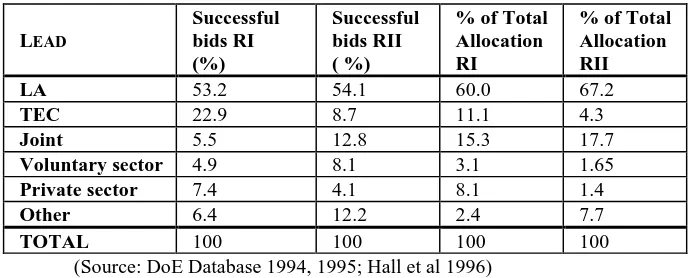
Turning to the reality of the partnership working in round one and two, this can be addressed in terms of the leadership of partnerships and of participation in these partnerships. Evidence from the Doe database shows that local authorities were the lead partner in most successful bids in both round one and round two, and in fact increased their share of bids by the second round (see table 1). Local authority led bids also received the largest allocation of SRB resources in both rounds, and increased their share of SRB funding from 60% to 67% in round two. TECs, however, played a far less significant and declining role in terms of leadership in round two, with only 8.7% of successful bids as against 22.9% in round one. Schemes lead by TECs, voluntary organisations and representatives of the private sector each received a significantly reduced allocation of challenge funds.
Table 1: Bid leadership of final and successful bids, and allocation of total Challenge Fund by lead bidder
LEAD
Successful bids RI (%)
Successful bids RII ( %)
% of Total Allocation RI
% of Total Allocation RII
LA 53.2 54.1 60.0 67.2
TEC 22.9 8.7 11.1 4.3
Joint 5.5 12.8 15.3 17.7
Voluntary sector 4.9 8.1 3.1 1.65
Private sector 7.4 4.1 8.1 1.4
Other 6.4 12.2 2.4 7.7
TOTAL 100 100 100 100
(Source: DoE Database 1994, 1995; Hall et al 1996)
The postal survey of all English local authorities undertaken by the authors and their colleagues at the University of Birmingham explored the issue of partnership further, and was supplemented by a telephone survey of a 10% random sample of successful partnerships, stratified by size of SRB award and by lead partner. This survey achieved a response rate of X%. and was undertaken in order to examine more closely the quality of partnership working in the context of the SRB Challenge Fund (Hall et al 1996).
[image:8.595.125.472.326.465.2]Table 2: Involvement of partners by bid leadership
LA TEC Private Voluntary Other Total Led
LAs 100% 88% 89% 78% 89% 100%
TEC 80% 100% 67% 53% 67% 100%
Private 86% 86% 100% 43% 57% 100%
Voluntary 71% 79% 79% 100% 57% 100%
Other 67% 71% 67% 62% 100% 100%
Joint 64% 73% 82% 91% 82% 100%
Total Involvement
86.6% 84.3% 83.1% 76.1% 83.7% 100%
(DoE Database, 1995; Hall et al 1996)
One of the most significant features to emerge from the survey of partnerships was the complex nature of the partnership organisation in round two. A typology of partnerships was proposed according the level of involvement of the member organisations4. Partnerships were classified as shell when involvement of non-leading agencies was nominal; consultative when the partnership was strongly controlled by the leader but other partners were at least consulted about the bid; participative when partners had often gained equal access to the decision making mechanisms; and finally autonomous when the partnership developed an independent identity in to which the different partners were emerged (see Hall et al 1996, p.65ff). Of the 21 partnerships that were interviewed, three were regarded as shells, thirteen as consultative, four as participative and one autonomous. Despite the effort to involve more partners, and genuine improvements in this respect since round one, the majority of the surveyed partnerships fell well short of the model of ‘genuine’ or ‘full’ partnership propagated by government, the House of Commons Committee and others. Quite often, for example, the remit and strategy of the partnership or the bid were established before other partners were involved, and sometimes an outline bid had been submitted to the government office in advance of this stage. It appears that the primary objective here was to win resources under the Challenge Fund, and that partnerships would be devised that looked good on paper, often to the point to excluding organisations that were felt to weaken the bids likelihood of success. Sometimes the Government Office for the Regions encouraged the lead partner to change the composition of the partnership as well as the nature of the bid in order to improve its chances.
Most lead partners interviewed suggested they had placed greater emphasis on the involvement of other partners in round two than round one, supporting the earlier suggestion that partnership working had improved in the second round. The evidence suggests that there has been a shift in round two towards more consultative and participative partnerships. Indeed there is some evidence to suggest the emergence of strategic partnerships in large cities, partnerships whose existence proceeds the Challenge Fund and whose remit extends beyond this to include other sources of money and other activities. It may be that in the longer term these strategic partnerships will assume a more important role and begin to approximate to the partnership model put forward by the government. However most partnerships felt that community involvement was constrained by the inadequate resources and capacity of most community organisations as compared with the onerous nature of the bidding process, and a similar constraint was faced by private sector bodies wishing to become involved.
Transparency and accountability were issues of concern amongst the partners interviewed. Whilst the financially accountable body was usually the local authority, organisational arrangements within partnerships were quite often confused, and sometimes the lines of accountability between the partnership and the accountable body were unclear. Indeed the composition of local partnerships was in many cases not publicly known, and it would be difficult for local citizens or other local organisations to determine who to approach about partnership activities. Furthermore, nearly half of the partnerships interviewed contained organisations which were themselves partnerships. The membership of partnerships was fluid, in only four out of 21 partnerships interviewed was the core membership fixed during the period of bid preparations, and in some cases key individuals had left. The whole issue of transparency and accountability is as yet unresolved in the context in local regeneration partnerships, and threatens to become a significant issue especially when local conflicts emerge.
Competition, Partnership, Empowerment: rhetoric and reality
It was suggested above that the ‘strategic-theoretical’ approach to politics and the state can be developed and extended by linking this to the analysis of discursive practices. Three significant concepts or rhetorical devices recur in the discourse surrounding contemporary English urban policy - competition, partnership and empowerment. The empirical evidence presented above has addressed each of these in their rhetorical usage, and has combined this with an examination of the practical circumstances to which they are applied in order to measure the relationship between discourse and action, between rhetoric and reality. All the elements of the competitive approach to regeneration (a competitive bidding process, bid selection and the agreement of delivery plans) are now in place, but questions remain in the minds of local partnerships as to the fairness of this process and the existence of hidden agendas and political manipulation. Likewise the partnership approach is now viewed by most participants as the primary method of developing targeted regeneration strategies, whether under the SRB Challenge Fund or under other programmes. But as yet this remains only a model, an ideal whose espousal conceals a more complex and contradictory reality. If we take the SRB Challenge Fund as our example, then a number of observations can be made regarding the discourse of ‘competition’, ‘partnership’ and ‘empowerment’.
The rhetoric of the Challenge Fund is that the unhypothecated nature of the pooled budget permits local partnerships to define their own priorities reflecting local needs, albeit in accordance with their respective interests in seeking government support. But the reality is that the four main characteristics of the Challenge Fund:
its competitive nature,
the monopsonistic position of government,
the constrained and diminishing nature of the resources, and
the refusal to set policy priorities beyond minimum “qualifying criteria”
conflict in practice with local empowerment. By switching from a ‘hierarchical’ to a ‘competitive’ mode of resources allocation, especially in a monopsonistic quasi-market, central government has strengthened its power over localities by using the ‘discipline of the market’. The monopsonistic nature of this market has been reinforced by the creation of a Single Regeneration Budget and consolidated Government Offices for the regions. The competitive bidding process tends to disempower localities especially when locally generated funds for local government (through taxation or other means) have been constrained to the point where they represent a small proportion of council income. The absence of local finance reduces local discretion and combined with the top slicing of budgets is the single biggest reason why localities have been disempowered. When the number of qualifying bids exceeds the resources available, then bidders recognise that additional criteria must be invoked to facilitate the final decision. These criteria remain unstated, may not be consistent from area to area and manifest themseleves as as informal guidance and advice from GoRs about the sort of partnership and/or bid that will be well received. It is possible that there exists a hidden agenda prepared for each bidding round by government, as bidders believe, but the most likely explanation is that priorities are formed during the bidding process in the context of previous experience and current political concerns. The disintervationist stance of central government, combined with its ostensible commitment to local empowerment, is expressed in the refusal to set national or regional policy priorities, and reliance upon a single check list. The absence of policy priorities appears to strengthen local discretion, but in the circumstances actually reinforces local dependence. Despite these connotations the structure of the competition and the opacity of the decision process actually reinforces central control.
working in round two. But the evidence suggests that this still falls well short of the aspirations of the partnership model and could well remain so.
The government is hostile to what it calls the “municipalisation” of local regeneration policy and favours the partnership approach as one way of preventing this. But for various structural reasons local authorities are increasingly the lead agency in the development of local partnerships. The onerous nature of the bidding process and the financial systems involved means that business or voluntary sector agencies are limited in their capacity to submit SRB bids. On the other hand, local authorities are generally at the centre of existing local networks and were involved in both formal and informal partnership working with many local groups prior to the Challenge Fund. They have a knowledge base, and a legitimacy, which is not readily available to other agencies and they have the administrative capacity to operate within the sort of bureaucratic environment created by the SRB. These constraints upon ‘genuine partnership’ working mean that this is likely to remain the exception rather than the rule in the context of the SRB Challenge Fund, and indeed any publicly funded local regeneration programme. Indeed the SRB Challenge Fund may be described as ‘structurally selective’ against bids led from these sectors.
This creates a problem for councils in gaining government approval, and forces them to play down their leadership role and to promote the appearance and to some extent the reality of partnership in order to avoid the wrath of Conservative Ministers. Indeed of all leading sectors local authorities offer the widest involvement to other sectors in their partnerships, and even though it may begin as a token gesture, involvement is a necessary step towards the creation of genuine partnership working. So whilst the involvement of other sectors in partnerships and in regeneration is growing, and the quality of their involvement appears to be increasing, this is due in part to the increased leadership role played by local authorities. The pursuit of partnership working, to which the government is committed, therefore seems paradoxically to depend upon extending local authority leadership, to which the government is opposed. The use of the partnership model to restructure central-local relations and to limit local authority control is therefore placing both government and local authorities in a contradictory position which makes each affirm their commitment ‘equal partnerships’ whilst in reality these bodies depend upon central and especially local government sponsorship (see Collinge and Hall, 1996). Furthermore, it appears that this reality is known to government officials as well as to local authorities, and that each has an interest in colluding in the cultivation of an image which both sides view as the only way of selling regeneration spending to a reluctant Conservative government. Whatever the reality, the appearance of partnership working is sustained as a consequence of the political dynamics of the programme through the tacit collusion of local and national officials with the Ministerial rhetoric of ‘equal partnership’.
Local partnerships, whether in the form of neo-corporatist power blocs or neo-statist bodies, are detached from their local social bases. At the same time, however, they are exposed to intense competitive pressures, emanating from central government and its regional offices, to conform to the requirements of the Challenge Fund and other such schemes. These pressures are helping to shape partnership composition as well as bid design and regeneration strategy. Furthermore, the design and practice of programmes such as SRB Challenge Fund undermines the public service ethos and replaces this with a private sector ‘business ethos’ amongst detached administrators in the public sector. The partnership model adopted here owes much more to the private sector notion of partnership than that which is familiar in the public or voluntary sectors. The net result in most places is the de-democratisation and ‘privatisation’ of local regeneration policy, in partnerships with either a local neo-corporatist or local neo-statist form, set in the context of increased central government orchestration and control.
Taken together the notions of ‘competition’ and ‘partnership’ are deployed in the context of the rhetoric of ‘local empowerment’, which provides what we might regard as the discursive ‘hegemonic principle’ underpinning nationally the pursuit of neo-corporatist or neo-statist hegemonic projects at the local level. The detachment and ‘privatisation’ of local regeneration initiatives, in the context of the SRB Challenge Fund, creates the appearance of local empowerment but the reality of local subjection to central control mediated by willing local interests. The willingness of these interests is reinforced by the pliant nature of most partnerships, which therefore helps to reinforce central government control locally. The rhetorical nature of the partnership model and its contradiction by reality is reinforced in several ways by the political dynamics of hostile and dependent relations between central and local government. Far from renewing the localist credentials of post-Thatcherite neo-liberalism, therefore, urban governance is constituting local power blocs around the local state that are increasingly amenable to central control. Here we have a centralism that is dressed up as localism. Conclusion
In this paper we have shown that the dominant discourse in contemporary UK urban policy is couched in terms of ‘competition’ and ‘partnership’. We have suggested that the term ‘competition’ has been imbued with positive associations of ‘dynamism’ and ‘innovation’, and serves in the context of contemporary UK urban policy to portray inter-local rivalry as constructive difference in the pursuit of ‘efficiency’, whilst glossing over the resource constraints and centralisation of control implied in this competition. We have also suggested that the term ‘partnership’ is imbued with positive ideas about ‘co-operation’ and ‘equity’ between different interests, portraying these intra-local differences as the complementarity of equivalent ‘sectors’ in forging the unity of each locality, whilst glossing over the anti-democratic redistribution of power that is in thereby engineered. Finally, we have indicated that ‘competition’ and ‘partnership’ are together viewed as providing the basis for ‘local empowerment’, and that the notion of local empowerment forms an important part of the government’s case for its urban policies, an ‘hegemonic principle’ which works itself out in various contexts as the localist strand of post-Thatcherism. But the practice of a policy must be amenable to its associated discourse, and there are limits to how far this practice can depart from the terms of its discourse before each looses plausibility and gives way to alternative formulations. The paper has identified fundamental contradictions between the rhetoric and reality of the current approach to urban policy as manifested in the SRB Challenge Fund, contradictions which have been expressed indirectly through the policy debates which have emerged around this programme.
References.
Collinge C, Hall S, 1997, “Hegemony and Regime in Urban Governance”, in Transforming Cities: Contested governance and new spatial divisions Eds N Jewson, S Macgregor (Routledge, London) forthcoming
Cox, K and Mair, A (1988), Locality and Community in the Politics of Local Economic Development, in Annals of the Association of American Geographers, Vol. 78, No 2, pp 307-325
Davoudi S, Healey P, 1995, “City Challenge: Sustainable process or temporary gesture?” Environment and Planning C: Government and Policy 13 79-95
DoE, 1992, “City Challenge: Bidding guidance 1993/4”, Department of the Environment, London DoE, 1993, “Press Release No. 731, November 4th: John Gummer Announces Measures to Bring a New Localism to Improved Government Services”, Department of the Environment, London
DoE, 1995a, “Bidding Guidance: A guide to bidding for resources from the Government’s Single Regeneration Budget Challenge Fund”, Department of the Environment, London
DoE, 1995b “Single Regeneration Budget: The Delivery Plan Guidance Form and Content” Department of the Environment, London
DoE, 1995c Deprivation Indices: A review of approaches and a matrix of results (HMSO, London) DoE, 1996, “Government Response to the Environment Committee First Report into the Single Regeneration Budget”, Department of the Environment, London
Hall S, Beazley M, Bentley G, Burfitt A, Collinge C, Lee P, Loftman P, Nevin B, Srbljanin A, 1996 The Single Regeneration Budget: A Review of Challenge Fund Round Two (Centre for Urban and Regional Studies, University of Birmingham, Birmingham)
Hogwood B, 1995 The Integrated Regional Offices and the Single Regeneration Budget, CLD Research Report No.15 (Commission for Local Democracy, London)
House of Commons, 1995a Environment Committee First Report: Single Regeneration Budget. Report together with proceedings of the Committee (HMSO, London)
House of Commons, 1995b Environment Committee First Report: Single Regeneration Budget. Minutes of Evidence and Appendices (HMSO, London)
Jessop, B (1983) Accumulation Strategies, State Forms and hegemonic Projects, in Kapitalistate 10/11, pp 89-112
Jessop B (1985) Nicos Poulontzas: Marxist Theory and Political Strategy (Basingstoke:Macmillan) Jessop B, (1990), Regulation theories in retrospect and prospect, in Economy and Society, vol 19, pp 153-216
Jessop B, 1994, “The Transition to Post-Fordism and the Schumpeterian Workfare State”, in Towards a Post-Fordist Welfare State Eds R Burrows, B Leader (Routledge, London)
Jessop B, 1995, “The Entrepreneurial City: Re-imaging the local state or re-designing economic governance”, paper prepared for the British Sociological Association Conference, Contested Cities, Leicester, April 10th-13th 1995
Mawson J, Beazley M, Burfitt A, Collinge C, Hall S, Loftman P, Nevin B, Srbljanin A, Tilson, B, 1995 The Single Regeneration Budget: The Stocktake (Centre for Urban and Regional Studies, University of Birmingham, Birmingham)
Mouffé C, 1995, “Post Marxism: Democracy and identity” Environment and Planning D: Society and Space 13 259-265
NCVO, 1995 A Missed Opportunity (National Council for Voluntary Organisations, London)
Painter J, Goodwin M, 1995, “Local Governance and Concrete Research: Investigating the Uneven Development of Regulation” Economy and Society 24(3) 334-356
Parkinson M, 1993, “A New Strategy for Britain’s Cities?” Policy Studies 14(2) 5-13
Peck J, 1995, “Moving and Shaking: Business elites, state localism and urban privatism” Progress in Human Geography 19(1) 16-46
Stewart M, 1994, “Between Whitehall and Town Hall: The realignment of urban regeneration policy in England” Policy and Politics 22(2) 133-145