Local productivity: The real differences across UK cities
and regions
BEATTY, Christina <http://orcid.org/0000-0003-0943-9979> and
FOTHERGILL, Stephen <http://orcid.org/0000-0002-4201-0640>
Available from Sheffield Hallam University Research Archive (SHURA) at:
http://shura.shu.ac.uk/24893/
This document is the author deposited version. You are advised to consult the
publisher's version if you wish to cite from it.
Published version
BEATTY, Christina and FOTHERGILL, Stephen (2019). Local productivity: The real
differences across UK cities and regions. Project Report. Sheffield Hallam University.
Copyright and re-use policy
ww
LOCAL PRODUCTIVITY
The real differences across UK cities
and regions
LOCAL PRODUCTIVITY
The real differences across UK cities and regions
Christina Beatty and Steve Fothergill
Centre for Regional Economic and Social Research
Sheffield Hallam University
Summary
This paper disaggregates productivity across UK cities and sub-regions. Beginning with the wide variations in output (GVA) per head, it presents a series of alternative measure of productivity culminating in a new measure of the efficiency with which goods and services are produced in different parts of the country. In doing so it adjusts for a range of factors including employment rates, commuting, industrial mix and occupational structure.
Despite a GVA per head far in excess of the UK average, London emerges as little more efficient than the rest of the country
The main regional cities, which as a group also have GVA per head above the UK average, slip below average on the estimates of efficiency
Less prosperous parts of the UK, with low GVA per head, generally catch up with the national average on estimated efficiency
Overall, the differences in efficiency across the UK appear modest
The evidence represents a serious challenge to agglomeration economics and suggests that the promotion of growth and jobs in less prosperous parts of the country is not damaging to the productivity of the UK economy as a whole.
Acknowledgements
LOCAL PRODUCTIVITY
The real differences across UK cities and regions
Introduction
‘Productivity’ has become central to contemporary debate on the performance of the UK economy. Over the course of the recovery from the financial crisis a decade ago, output has grown steadily if unspectacularly but labour productivity has remained almost stagnant. As a result, economic growth has resulted almost entirely from an increase in employment.
‘Productivity’ has also become central to debates around regional and local differences in prosperity. Whereas for many years the disparities in economic well-being across the UK would primarily have been described in terms of unemployment, increasingly it is the gaps in productivity that attract attention. It is now common to contrast the high output per head in London, for example, with the much lower levels found in parts of the North or in places such as Cornwall and West Wales & the Valleys.
But what exactly is ‘productivity’, and how should it be defined and measured at the local scale? At one end of the spectrum, GVA1 per head and its close relative GDP2 per head are well established measures of output. In the case of GDP per head, this has long been used to allocate EU regional aid to the UK and other parts of Europe. GVA and GDP per head both measure the value of production in an area in relation to its population. At the other end of the spectrum, there is productivity defined in terms of the efficiency with which any given productive task is undertaken. Efficiency is not about how much is produced but rather about how well it is produced.
Just because an area has a low GVA or GDP per head does not necessarily mean that its workforce is any less efficient than elsewhere. It could be, for example, that the area has a concentration of industries or occupations that are associated with lower output wherever they are located, or that there is a net flow of commuters to neighbouring areas so their production is recorded where they work rather than where they live. Between GVA or GDP per head and efficiency a number of important measurement issues come into play.
1
Gross Value Added. The value of goods and services produced less intermediate inputs. 2
Most economists and economic geographers understand this complexity without necessarily being able to readily quantify its effects. But in less well-informed discussion it is not
uncommon for the distinction between ‘production’ and ‘efficiency’ to become blurred. At worst, the big differences in GVA or GDP per head across the UK can quite misleadingly be interpreted as indicating that workers in some parts of the country are two or even three times more productive, more efficient or even harder working.
That there are big differences in the efficiency with which productive tasks are undertaken in different parts of the UK seems inherently unlikely. The UK is a relatively small country with education and training that does not vary widely from place to place and with plentiful flows of knowledge and technology. By and large, a supermarket, a school or a hospital, for example, will tend to be organised along much the same lines wherever it is located so it is hard to see how big differences in labour productivity might arise in these sectors or many others.
There are likely to be local clusters within manufacturing and within some services that do benefit from local advantages in terms of skills, knowledge or specialised suppliers, resulting in higher productivity in those places. It is worth remembering, however, that manufacturing now employs less than 10 per cent of the UK workforce so by itself seems unlikely to
generate the big regional and local differences in output per head that can be observed. Within manufacturing there are also strong competitive pressures on firms to stay
reasonably close to best-practice technology and organisation, the alternative being commercial failure.
In this paper we disaggregate the differences in productivity across the UK into their
component parts. Our starting point is the big variation in GVA per head and, after a number of intermediate steps, we arrive at a measure of local ‘efficiency’. At each stage the
comparison we make is with the national average so the local figures we present are all expressed as an index number where the UK = 100. We undertake this exercise at two geographical scales:
For all UK sub-regions – Local Enterprise Partnership (LEP) areas in England, NUTS 2 areas in Scotland and Wales
For each of the main regional cities in Great Britain
Definitions and methods
Gross Value Added (GVA) per head
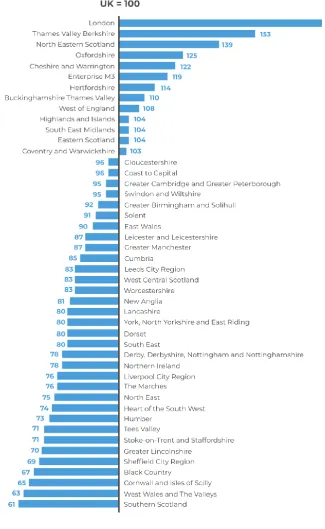
Our starting point is GVA per head – a standard statistical measure published regularly by the Office for National Statistics (ONS). We use the most up-to-date figures available at the time of writing, for 20173. GVA per head (that is, per resident) varies from 179 per cent of the UK average in London to just 65 per cent in Cornwall, 63 per cent in West Wales & the Valleys and 61 per cent in the newly-defined Southern Scotland NUTS 2 region. GVA per head should not really be confused with ‘productivity’ but it is a legitimate and useful measure of the value of economic activity that takes place in an area in relation to its resident population.
GVA per head less imputed rent
‘Imputed rent’ is an odd concept, measuring the value of housing services accruing to owner-occupiers – in effect, the rent they would have had to pay if they had not owned their property. Imputed rent is conventionally included in GVA and GDP statistics because it would be lop-sided to include only the housing services for which rent is paid, especially in international comparisons because different countries have different housing tenures. Housing tenure and costs also vary across the UK so the amount added into GVA and GDP statistics varies from place to place. Its exclusion from the figures here makes sense, however, in order to provide a measure of output more closely related to the input of labour. Figures on imputed rent, by sub-region and by city, are published by ONS4. Excluding imputed rent lowers GVA per head, relative to the UK average, in the parts of southern England where housing costs are high and a large proportion of the housing stock is owner-occupied.
GVA per 16-64 year old
This expresses GVA (excluding imputed rent) in relation to the resident working age5 population rather than in relation to the population as a whole. This is relevant because different parts of the UK have different proportions of the population above and below working age and, because most under-16 and most-over 65 don’t participate in the labour market, it makes sense to look at production in relation to the working age population. An above average proportion of over-65s in some rural and coastal areas deflates measures of GVA per head based on the population as a whole. Conversely, London’s low proportion of over-65s boosts its GVA figure. Looking at GVA in relation to the working age population adjusts for this distortion.
3The figures are for what ONS calls ‘balanced GVA’, which combines income and production measures.
4
Office for National Statistics (2019) Regional and sub-regional productivity in the UK: February 2019. 5
GVA per employed resident
Not all working-age residents are in work of course, and some over-65s do remain in
employment. Expressing GVA (excluding imputed rent) in relation to the employed resident population takes account of the differences in employment rates across the country. In practice the main working-age groups not engaged in paid employment are students (especially in university towns and cities), men and women out of the labour market on disability benefits (especially in some older industrial areas and seaside towns) and women at home with children (in most areas). The unemployed are these days a smaller group. Estimates of the employed resident population in each area come from the UK’s Annual Population Survey6.
GVA per filled job
GVA per filled job is one of two ONS measures of local productivity (the other is GVA per hour worked) and the figures here are taken directly from ONS7. The jobs are those located in the area and include the employed, self-employed, government-supported trainees and members of the armed forces. This measure adjusts for commuting because the number of jobs in each area is not necessarily the same as the number of residents in work. This is especially important in London and in the main regional cities where there are large net inflows of commuters. In the cities, GVA per head is inflated because it counts the all the production but not all the workers. Conversely, in the commuting hinterland of the cities GVA per head is lowered by the omission of commuters’ production. GVA per filled job also adjusts for double-jobbing (when some individuals hold two or more jobs).
There are nevertheless important shortcomings in GVA per filled job as a measure of productivity. Although it documents the value of production in relation to the number of jobs it does not say anything about the efficiency with which production takes place. A high GVA per filled job does not necessarily mean that the workers in that location are any more productive or efficient than workers doing the same tasks in other locations. To comment on ‘efficiency’ it is necessary to adjust for the mix of industries, the mix of occupations and hours worked.
Adjustment for industry mix
Different industries have different levels of output per head, and the mix of industries varies from place to place. Across the UK as a whole, GVA per employee in banking, finance and business services, for example, is two and a half times higher than in retailing, distribution, hotels and restaurants8. We therefore calculate what would have been each area’s GVA per job if each industry in the area had the UK average GVA per job for that industry. Economic
6
geographers will recognise this as a ‘shift-share analysis’, a well-tried and proven technique. Here we disaggregate all workplace employment into eight different industries9. We then deduct the industry effect from the GVA per filled job.
Adjustment for occupational mix
Within each industry there are also spatial divisions of labour: managers and professionals tend to be located in some places, notably London, whereas the workers undertaking routine production or delivering routine services are more prevalent elsewhere. This boosts GVA per job in the places where managers and professionals are located (because their higher pay is counted as higher output) and lowers the figures where they are a lower proportion of the workforce. To adjust for this effect we undertake a second shift-share analysis,
disaggregating the workplace employment in each area in each industry into nine occupational groups10. As a proxy for GVA per person in each occupation we use UK average gross hourly earnings of employees in each occupational group11. The impact of occupational mix is the difference between the impact of industry mix (as measured above) and the expected GVA per job in each area calculated via this second shift-share exercise.
Adjusted for hours worked (the ‘efficiency factor’)
The final adjustment is for differences between places in hours worked. The proportion of part-time jobs in London in particular is lower than the national average, boosting London’s GVA per job compared to other areas. The Office for National Statistics publishes figures on average hours worked in each area, allowing the necessary adjustment.
The resulting figure is what we have termed the ‘efficiency factor’ – the productivity of workers in each area after having adjusted for the mix of industries, the mix of occupations and hours worked. Unlike GVA per filled job, which simply counts the value of production per worker, the ‘efficiency factor’ tries to measure how well, compared to the national average, the production of goods and services is carried out in each location.
9
SIC sections A, B, D & E (Agriculture, Mining, Electricity, Gas, Water and Waste), C (Manufacturing), F (Construction), G & I (Retail, Distribution, Hotels and Restaurants), H & J (Transport and
Communications), K, L ,M, & N (Banking, Finance and Business services), O, P & Q (Public administration, Education and Health), R, S & T (Other services). Sources: Workplace employment by area, 2011 Census of Population; GVA per employee by industry 2017, ONS. Data on workplace employment by industry for later years is either subject to sampling error (APS) or omits large numbers of self-employed (Business Register and Employment Survey) and is therefore unsuitable for this exercise.
10
(1) Managers, directors and senior officials, (2) Professional occupations, (3) Associate professional and technical occupations, (4) Administrative and secretarial occupations, (5) Skilled trades
occupations, (6) Caring, leisure and other service occupations, (7) Sales and customer service occupations, (8) Process, plant and machine operatives, (9) Elementary occupations. Source: Workplace employment by area, 2011 Census of Population (Resident employment by area for Scotland owing to data availability).
11
The ‘efficiency factor’ for each area nevertheless comes with a health warning: these are estimates based on the cumulative effect of a number of calculations and inevitably subject to a margin of error. In particular, it is unlikely that the adjustments for industry and
occupation will have been able to take full account of each of these factors. Within
managerial and professional occupations, for example, the very highest paid jobs are often located in London and the simple nine-fold classification of occupations used here is unable to take this into account.
The disaggregation of local productivity
The results of applying these methods to UK sub-regions and to the main regional cities are presented in full in the appendix. Each productivity indicator in these tables expresses GVA in each area as an index of the UK average, beginning with GVA per head and progressing in steps to the ‘efficiency factor’. It is easiest to understand the findings by looking at two contrasting examples: London and West Wales & the Valleys.
Example: London
London is especially interesting because it is an extreme case. With a GVA per head of 179 per cent of the UK average it is far ahead of the next most productive sub-region (Thames Valley Berkshire at 153 per cent). Figure 1 disaggregates this very high GDP per head:
Excluding imputed rent brings down London’s figure but only to 177 per cent of the UK average
Re-basing on the working age population brings down London’s figure rather more, to 165 per cent, because the over-65s are a smaller group in London than elsewhere
GVA per employed resident makes little further difference, mainly because London’s large student population keeps its employment rate fairly close to average
GVA per filled job makes a big difference, bringing London down to 141 per cent of the UK average, because the large net inflow of commuters comes into the picture
Adjusting for the mix of industries – in particular London’s high proportion of jobs in banking, finance and business services – brings the figure down to 129 per cent
Adjusting for the occupational mix – London’s high proportion of white-collar jobs within each industry – brings down the figure to 119 per cent
Figure 1: Productivity (GVA) in London, 2017
In other words, despite a GVA per head almost 80 per cent higher than the national average, the efficiency with which goods and services are produced in London appears to be little more than 10 per cent above average. Furthermore, given the difficulty of making adequate adjustment for the concentration of the very most senior and highest-earning posts in London, this ‘efficiency factor’ is almost certainly an overestimate.
Example: West Wales & the Valleys
West Wales & the Valleys, a sub-region with a population of almost two million, is close to the other end of the spectrum with a GVA per head of just 63 per cent of the UK average – barely a third of the level in London. Figure 2 disaggregates this low figure.
Deducting imputed rent makes no difference – whilst owner-occupation is
widespread in West Wales & the Valleys, the impact is offset by low housing costs
Figure 2: Productivity in West Wales & the Valleys, 2017
GVA per employed resident is a little higher – 68 per cent of the UK average – because the area has high numbers out of paid employment, for example on disability benefits
GVA per filled job is notably higher, at 79 per cent, because large numbers commute out of West Wales & the Valleys, for example to Cardiff and Newport
Adjusting for the mix of industries raises the figure further to 87 per cent of the UK average
Adjusting for the occupational mix raises the figure even further to 92 per cent
Finally, adjusting for hours worked points to an ‘efficiency factor’ of 94 per cent
The differences between sub-regions
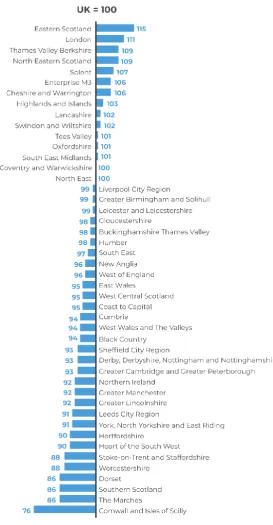
Figures 3, 4 and 5 compare all UK sub-regions on three indicators of productivity:
GVA per head
GVA per filled job
‘Efficiency factor’
In each case the sub-regions are ranked from highest to lowest but the statistics are all presented on the same scale to facilitate comparisons between the indicators.
The striking feature here is the convergence between local areas in moving from one
measure of productivity to another. The big differences across the country in GVA per head are lessened in looking at GVA per filled job and lessened still further in looking at
‘efficiency’.
In particular, after adjusting for all the influences on productivity including industry and occupational mix, the differences in efficiency across the UK – that is, how well productive tasks are undertaken – appear modest. 38 out of 46 of sub-regions are within a narrow range of plus or minus 10 per cent of the UK average. London loses its top-spot to Eastern Scotland (which includes Edinburgh) but not by a large margin. Thames Valley Berkshire, Solent, Enterprise M3, Cheshire & Warrington and North Eastern Scotland also emerge favourably on this measure but in all these cases an above-par ‘efficiency factor’ may still owe something to the difficulty of capturing the full impact of structural factors using relatively broad industrial and occupational categories.
At the other end of the spectrum, Cornwall has an ‘efficiency factor’ of just 76 per cent of the UK average. Unlike other sub-regions with a low GVA per head, the figures for Cornwall do not converge strongly towards the UK average when adjustments are made for commuting, industry and occupation. The extent to which Cornwall is adrift of other sub-regions (the next lowest are Dorset, The Marches and Southern Scotland at 86 per cent) suggests that Cornwall’s unusually high dependence on tourism may be a complicating factor which the adjustments for industry and occupation are unable to take fully into account, or simply that some of the output in this sector goes recorded. It seems unlikely that the production of goods and services in Cornwall is really so much less efficient than elsewhere in the UK.
The main regional cities
Figure 6 disaggregates productivity for Britain’s eleven main regional cities12. As a group,
they have a GVA per head of 109 per cent of the UK average.
Excluding imputed rent raises the GVA figure to 113 per cent of the UK average
Re-basing on the working age population brings the cities down again, to 105 per cent, because the over-65s make up a smaller than average share of their population
GVA per employed resident pushes the figure back up again, to 115 per cent of the UK average, because the cities have a high, economically-inactive student
population and in some cases large numbers out-of-work on benefits
GVA per filled job makes a big difference, bringing the cities down to 94 per cent of the UK average, because as in London a large net inflow of commuters comes into the picture
Adjusting for the mix of industries and for the occupational mix makes only marginal difference
[image:20.595.62.479.478.625.2] Finally, adjusting for hours worked points to an ‘efficiency factor’ in the main regional cities of just 93 per cent of the UK average
Figure 6: Productivity in the main regional cities, 2017
12
Figure 7: Productivity by city, 2017
GVA per job
GVA per filled job
Overall, these figures tell a revealing story. Although the main regional cities as a group have a GVA per head that is well above the UK average, on two other key measures of productivity – GVA per filled job (an established ONS measure) and the estimated ‘efficiency factor’ – they are actually some way below the national average.
Figure 7 presents the figures for each city for GVA per head, for GVA per filled job and for the ‘efficiency factor’, revealing substantial diversity.
Sheffield, for example, has a GVA per head of only 76 per cent of the UK average but the figure rises to 82 per cent per filled job and, after adjusting for industry, occupation and hours worked, to 92 per cent of the UK average.
Edinburgh moves in the opposite direction, from 162 per cent on GVA per head to 126 per cent per job filled and to 116 per cent on the ‘efficiency factor’. Edinburgh remains the only one of the main regional cities with an ‘efficiency factor’ above the UK average but, as with London, it is possible that the adjustment for occupational mix has failed to take full account of Edinburgh’s concentration of high-end jobs in finance, law and government.
Implications of the findings
For agglomeration economics
At first sight, the productivity figures here present a serious challenge to agglomeration economics. What they say is that although output per head in the cities, and especially in London, is well above the national average, once adjustments have been made for structural and labour market factors there is little or no evidence that the cities are any more efficient at what they do than most other locations across Britain. Even London’s impressive lead in GVA per head falls away to the extent that its productivity measured in terms of efficiency is only a little above the UK average and even some of this remaining advantage may be a statistical illusion.
Agglomeration economics, which has so dominated thinking on cities and regions in recent times, postulates that firms are more efficient if they are clustered together and that cities are therefore better locations for much economic activity. The evidence here on efficiency, from across the UK, does not support this view.
This is a startling conclusion given the big differences in GVA per head across the UK but it does not mean that agglomeration economics is entirely redundant. What remains clear is that the cities have major concentrations of jobs that draw in commuters from surrounding areas and further afield, and that in London in particular there is a concentration of high-productivity industries and high-high-productivity occupations. This has not happened by accident. In practice, some businesses need to be close to other businesses or to be in central locations where they have access to a large labour market or a large customer base and for these firms a city is a sensible location. This is agglomeration economics at work.
There are also likely to be specific sectors, hidden within the aggregate figures, in which businesses are for a range of possible reasons likely to be more efficient if they are located in a city. Equally, however, there are also likely to be other sectors for which a city would be distinctly inefficient location – activities requiring very large sites or ready access to the motorway network, such as national distribution depots, are an example.
What we can say however, on the basis of the evidence here, is that in so far as
agglomeration economies do operate it is not on the whole because the activities in cities are carried out so much more efficiently than elsewhere.
Implications for public policy
There has always been a tension in urban and regional policymaking between efficiency and equity. If the goal is to maximise economic growth – efficiency – there is a case for allowing business activity to gravitate to the places where it operates best and even for reinforcing growth in higher-performing places by public investment. If the goal is fairness to individuals and communities – equity – what is needed are policies that divert growth and jobs to less prosperous places.
In recent years in the UK the emphasis has been more on efficiency than equity. Regional economic policy since 2010, and certainly since 2015 when England’s Regional Growth Fund came to an end, is probably now weaker than at any time for more than fifty years. There is a wariness of encouraging businesses to locate in less prosperous parts of the country, a fear indeed that to be too far from London or one of the big regional cities is to opt for backwardness and inefficiency.
The evidence here does not support the view that large parts of Britain, especially the places with low GVA per head, are somehow inefficient locations. Actually, taking their economies as a whole, most places across the UK appear to share national standards of efficiency in the goods and services they produce.
Of course, not all businesses can expect to prosper in all locations. A merchant bank might not expect to flourish in Cumbria or a national distribution depot in the Highlands & Islands, but these are commercial judgements that all businesses can be expected to make. What government should have confidence in doing is in supporting growth and jobs in the parts of the UK that need them most by improving infrastructure and by supporting investment in business premises, plant & machinery, R&D and skills.
APPENDIX: Disaggregation of productivity (GVA) by sub-region, 2017, UK = 100 GVA per head less imputed rent per 16-64 year old per employed resident per filled job less industry effect less occupation effect adjusted for hours worked ('efficiency factor')
Black Country 67 68 70 78 85 89 95 94
Buckinghamshire Thames Valley 110 106 109 99 105 104 99 98
Cheshire and Warrington 122 124 128 125 109 106 106 106
Coast to Capital 96 91 93 88 97 94 92 95
Cornwall and Isles of Scilly 65 62 67 63 65 71 75 76
Coventry and Warwickshire 103 105 104 103 99 99 100 100
Cumbria 85 85 89 85 84 89 94 94
Derby, Derbyshire, Nottingham & Nottinghamshire 78 79 79 80 85 89 92 93
Dorset 80 77 83 79 81 83 84 86
Enterprise M3 119 116 120 121 111 108 103 106
Gloucestershire 96 96 99 90 96 96 96 98
Greater Birmingham and Solihull 92 94 95 101 96 97 98 99
Greater Cambridge and Greater Peterborough 95 96 99 94 91 91 92 93
Greater Lincolnshire 70 70 74 74 78 84 90 92
Greater Manchester 87 89 87 91 90 90 92 92
Heart of the South West 74 73 77 73 76 82 85 90
Hertfordshire 114 114 114 108 99 98 95 90
Humber 73 74 76 78 82 88 94 98
Lancashire 80 81 83 83 90 95 98 102
Leeds City Region 83 85 85 86 87 87 89 91
Leicester and Leicestershire 87 89 88 90 92 94 98 99
Liverpool City Region 76 77 77 82 89 94 98 99
London 179 177 165 166 141 129 119 111
New Anglia 81 81 86 83 88 90 93 96
North East 75 76 76 79 88 93 97 100
Oxfordshire 125 123 123 114 103 104 100 101
Sheffield City Region 69 70 70 73 81 86 91 93
Solent 91 90 89 89 96 100 101 107
South East 80 77 80 78 89 91 94 97
South East Midlands 104 105 105 101 102 103 104 101
Stoke-on-Trent and Staffordshire 71 72 73 71 80 85 90 88
Swindon and Wiltshire 95 96 98 91 95 95 95 102
Tees Valley 71 72 74 81 89 95 100 101
Thames Valley Berkshire 153 154 153 144 127 123 116 109
The Marches 76 75 78 74 77 80 84 86
West of England 108 109 106 101 97 96 94 96
Worcestershire 83 82 86 81 84 86 87 88
York, North Yorkshire and East Riding 80 79 82 78 79 84 85 91
West Wales and The Valleys 63 63 65 68 79 87 92 94
East Wales 90 91 92 91 89 91 94 95
North Eastern Scotland 139 142 136 132 119 115 115 109
Highlands and Islands 104 104 106 88 90 97 101 103
Eastern Scotland 104 105 102 103 111 112 113 115
Disaggregation of productivity (GVA), main regional cities, 2017, UK =100
Sources: ONS and Sheffield Hallam University
GVA per head less imputed rent per 16-64 year old per employed resident per filled job less industry effect less occupation effect adjusted for hours worked ('efficiency factor')
Leeds 109 112 108 107 94 90 88 89
Sheffield 76 78 75 81 82 87 89 92
Nottingham 108 113 102 129 80 84 85 85
Newcastle upon Tyne 115 118 109 122 91 93 92 94
Liverpool 89 93 85 97 88 93 95 95
Manchester 132 139 124 141 93 86 83 81
City of Edinburgh 162 165 149 152 126 117 113 116
Glasgow City 116 120 107 125 87 86 93 94
Cardiff 112 114 106 113 90 90 90 93
Birmingham 91 94 92 109 98 98 98 98
Bristol 115 118 108 106 91 86 82 81