Static meta-object protocols : towards efficient reflective
object-oriented languages
CLARK, Tony <http://orcid.org/0000-0003-3167-0739>
Available from Sheffield Hallam University Research Archive (SHURA) at:
http://shura.shu.ac.uk/13365/
This document is the author deposited version. You are advised to consult the
publisher's version if you wish to cite from it.
Published version
CLARK, Tony (2016). Static meta-object protocols : towards efficient reflective
object-oriented languages. In: FUENTES, Lidia, BATORY, Don and CZARMECKI,
Krzysztof, (eds.) MODULARITY Companion 2016 : Companion proceedings of the
15th International Conference on Modularity. ACM, 160-167.
Copyright and re-use policy
See
http://shura.shu.ac.uk/information.html
Sheffield Hallam University Research Archive
Static Meta-Object Protocols:
Towards Efficient Reflective Object-Oriented Languages
Tony Clark
Department of Computing Sheffield Hallam University Sheffield, South Yorks, UK
ABSTRACT
Reflection and extensibility in object-oriented programming languages can be supported by meta-object protocols (MOP) that define class-based interfaces over data representation
and execution features. MOPs are typicallydynamicin the
sense that type-based dispatching is used to select between feature implementations at run time leading to a significant difference in execution speed compared to non-MOP-based
languages. Defining a correspondingstatic-MOP would seem
to be a solution whereby type-dispatching can occur at com-pile time. Such an approach requires the integration of a static type system with a MOP. This paper introduces a new reflective and extensible language called JMF written in Java that aims to generate efficient code through the use of a static-MOP. The contribution of this paper is to char-acterise a static-MOP and to show how it integrates with a type system for JMF.
CCS Concepts
•Software and its engineering→ Reflective middle-ware; Extensible languages; Classes and objects;
Keywords
reflection; meta-object protocol; type-checking
1.
INTRODUCTION
Dynamic features including reflection [14, 10, 13] are be-coming increasingly important in programming languages in order that applications can adapt to changes in their envi-ronment [3], to support tools such as debuggers [17], and to support domain specific languages (DSLs). These
require-ments, addressed bymetaprogramming[5], would otherwise
require modification to the underlying language execution engine in order to support variation points and instrumenta-tion leading to multiple language implementainstrumenta-tions and cor-responding compatibility problems [16].
ACM ISBN 978-1-4503-2138-9. DOI:10.1145/1235
Many languages provide reflective features to support
in-trospectionandintercessionto facilitate adaptation of struc-ture and behaviour. Such feastruc-tures are often made available
via a metaobject protocol (MOP) [9] which is an interface
that gives users the ability to incrementally modify the be-haviour of a language. A MOP can be derived by analysing the key orthogonal execution mechanisms of a language.
There are several approaches to implementing a MOP that can be broadly categorised into: (a) providing access to the
language interpreter via continuation-passing, for example
[2]; (b) code-rewriting, for example [12, 7]; (c) type-based extension of language features via an interface. MOP-based reflective features are often suited to interpreted or
dynam-ically typed languages,e.g., [17], Smalltalk, CLOS, Python
[1], Lua [8].
2.
PROBLEM AND HYPOTHESIS
A MOP is a mechanism to allow the key execution features
of an OO language to be extended. Since inheritance is
an intrinsic feature of most OO languages, it makes sense
to use inheritance at the type level to define a MOP. The
particular features to be extended will differ from MOP to MOP; however, since they seem to be ubiquitous in OO languages, this paper addresses a MOP in terms of object creation, slot access and update, and message passing.
MOPs are typically used to support multiple object rep-resentation and to abstract away from the details of repre-sentation management. Consider a program that wants to mix two different types of class: those with small storage re-quirements and those with large sparsely populated storage requirements. In the first case we want to use an array and in the second case to use a hash-table. A language
support-ing MOPs might allow the followsupport-ing1:
c l a s s P o i n t metaclass A r r a y ( Int ) { n a m e s = [ ’ x ’ , ’ y ’ ];
}
c l a s s E m p l o y e e metaclass S p a r s e { n a m e : Str ;
...
s a l a r y : F l o a t ; }
In each class definition the declaration of the meta-class de-termines how object creation, slot access and update, and message passing will occur for instances of the class. For
ex-ample ifpis an instance ofPointthenstorage(p)is an array
and p.x:Int isstorage(p)[0]whereas if e is an instance of
1Since JMF and Java concrete syntax are similar, JMF
Employeethenstorage(e) is a hash-table and e.name:Str is
get(storage(e),"name").
Many MOP-based languages are dynamic in the sense that the language feature switching mechanism occurs at run-time. This is most often a result of the reflective nature of the languages resulting in types being run-time entities. Therefore in the general case it is not possible to statically determine the type of a program expression since its type may only exist at run-time. However, this is not always the case. In particular, a MOP-based language will have a de-fault MOP whose types are statically known. Since many such languages are bootstrapped, being able to efficiently compile expressions that use the default MOP ought to re-sult in a significant speed improvement.
The hypothesis of this work is that it is possible to ex-tend a standard dynamic MOP in such a way as to allow type-based static analysis of a program and consequently generate efficient code for the language features governed by the MOP. To accommodate reflection, it will not always be possible to perform static analysis, in which case the default dynamic switching mechanism can be employed.
The hypothesis is to be evaluated in the context of a new language called JMF that is a MOP-based OO language written in Java to be compiled to the JVM. If the hypoth-esis holds then the code generated on the JVM will have a similar performance profile to equivalent Java code in the case that meta-types can be statically determined.
The first step is to define a dynamic MOP for JMF and to show how the MOP can be extended with static features. This paper describes the result of taking the first step as follows: section 3.4 describes core JMF, type dispatching and and how it is implemented in Java; section 4 shows how the JMF default dynamic MOP is implemented and section 5 shows how this is extended to produce dynamic MOPs forSparseandArray; section 6 describes JMF type-checking and the associated default static MOP and section 7 extends this forSparseandArray.
3.
CORE JMF
JMF consists of a core collection of Java objects that serve the same function as the classes defined by the Java package
java.lang.reflect. Each Java object must implement an
in-terface calledObjas defined in section 3.1. This paper uses a
subset of the JMF core relating to MOP definition and use; an overview of the core is given in section 3.4. A syntax for JMF programs is necessary in order to perform static anal-ysis, this paper uses a subset both to provide examples and to define how the static MOP is defined. Section 3.2 pro-vides an example of how a simple class is defined using the JMF syntax and subsequently extended using core classes via Java.
3.1
Everything is an Object
JMF is defined as a collection of Java objects that all
implement an interface calledObj:
public interface Obj { public Obj get ( S t r i n g n a m e ) ; public Obj of () ;
public Obj s e n d ( S t r i n g name , Obj ... a r g s ) ; public Obj set ( S t r i n g name , Obj v a l u e ) ; public Obj s l o t s () ;
}
The operation of() returns the class of an object in the
same way that getClass() does in Java. The operations
get(n) and set(n,v)are used to access and update named
storage. The operationslots()returns a list containing slots
(essentially name-value pairs) of the receiver. Thesend(n,v
,...,v)operation sends a named message to the receiver.
3.2
A Simple Program
The following is an example of a JMF program that uses the default MOP:
c l a s s P o i n t { x : Int ; y : Int ; inc () : P o i n t {
x := x + 1; y := y + 1; }
}
p : P o i n t = P o i n t . new () ; p . inc () ;
Dynamic MOP dispatch is implemented using the Java
oper-ationssend,getandset. The JMF class definition forPoint
is translated to the equivalent Java program as follows:
1 Obj x = s e n d (A t t r i b u t e, " new " , s e n d ( Str ( " x " ) , Int) ;
2 Obj y = s e n d (A t t r i b u t e, " new " , Str ( " y " ) , Int) ;
3 Obj n a m e = Str ( " P o i n t " ) ;
4 Obj s u p e r s = l i s t (Obj) ;
5 Obj a t t s = l i s t ( x , y ) ;
6 Obj P o i n t = s e n d (C l a s s, " new " , name , atts , s u p e r s ) ;
7 8 s e n d ( Point , " a d d O p e r a t i o n " ,
9 Op ( " inc " , ( self , so ) - >
10 set (
11 set (
12 self ,
13 " x " ,
14 s e n d (
15 get ( self , " x " ) ,
16 " + " ,
17 Int (1) ) ) ,
18 " y " ,
19 s e n d (
20 get ( self , " y " ) ,
21 " + " ,
22 Int (1) ) ) ) ) ) ;
23 24 Obj p = s e n d ( Point , " new " ) ;
25 s e n d ( p , " inc " ) ;
The builtin operationsStrandIntare used to map between
Java values and JMF objects. The classPointis created by
sending anewmessage toClass(since no explicit meta-class
was supplied in the class definition for Point, the default
meta-class is used) supplied with the name of the new class, its attributes and the super-classes. The builtin operation
list takes any number of arguments and returns an JMF
object representing list. By default, attributes are like Java fields and inheritance is the same as Java in the case where a class has a single super-class.
Operations that are added to classes (lines 8-22) work
the same way as Java methods. Note that the operatorOp
is used to map between Java closures and JMF operations where the closure must have at least 2 arguments: the first is the receiver of the message that invokes the operation and
the second works likesuperin Java.
3.3
Dynamic Dispatch
The Java code shown above uses dynamic dispatch to de-termine the implementation of language features in terms of
Java methodssend,getandset. These have been inserted by
dispatch checks forClassin order to preventmeta-recursion
[11]. The definitions of the methods are as follows:
public s t a t i c Obj get ( Obj o , S t r i n g n ) { i f( o . of () . of () == C l a s s)
return o . get ( n ) ;
e l s e return s e n d ( o . of () , " get " ,o , Str ( n ) ) ; }
public s t a t i c Obj set ( Obj o , S t r i n g n , Obj v ) { i f( o . of () . of () == C l a s s)
return o . set ( n , v ) ;
e l s e return s e n d ( o . of () , " set " ,o , Str ( n ) , v ) ; }
public s t a t i c Obj s e n d ( Obj o , S t r i n g n , Obj ... vs ) { i f( o . of () . of () == C l a s s)
return o . s e n d ( n , vs ) ;
e l s e return s e n d ( o . of () , " s e n d " ,o , Str ( n ) , l i s t ( vs ) ) ; }
The definitions above show that the dynamic dispatch
mech-anism is fixed for objects whose meta-class isClass.
Other-wise, an appropriate message is sent to the class of the
ob-ject which must implement a suitable implementation,i.e.
a MOP.
3.4
An Overview of the JMF Core
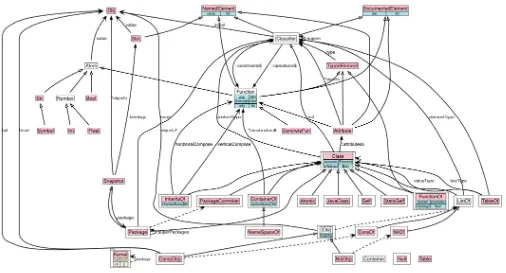
The JMF Core consists of a collection of bootstrapped
classes that are shown in figure 12. The syntax of the
dia-gram is a variation on standard class diadia-grams: boxes are classes, edges with open arrows relate sub-classes to super-classes, full edges with arrows are labelled with the name of an attribute of the source class, dashed edges relate a class with its meta-class. Note that JMF classes define addition features including operations, constraints, constructors, and daemons, that are not shown.
The following conventions are used: a class with no super-class relation inherits fromObj; a class with no explicit
meta-class is an instance of Class; attributes with simple types
are shown within the class box; classes whose name has a white background are abstract; a class that is surrounded
by a box is a meta-class; an attribute with a prefix*means
that the corresponding class is acontainerfor the elements
of the attribute type; an attribute with a prefix:: means
that the owning class is a name-space with corresponding
operations to index the values of the attribute by name;
an attribute with a suffix $ means that the owning class
transitively inherits the values of the the attribute via a
correspond operation; an attribute with a suffix means that the attribute is a specialisation of an attribute with the same name that is defined by a super-class; a package is shown
using UML-style package notation; a type[T] represents a
list of elements of typeT.
For example, the classSlotis a sub-class ofNamedElement
and therefore inherits the attribute namednameof typeStr,
and has an additional attribute namedvalueof typeObj.
The classClassis an instance of itself, is a name-space for
attributes, is a container of constructors, and inherits from
the meta-classClassifier.
The meta-classesInheritsOf,ContainerOf,NameSpaceOf,
FunctionOf, ListOf, andTableOf are all polymorphic in the
sense that they are instantiated to produce classes by
pro-viding one or more types. For exampleTableOf(String,Int)
2
The diagrams in this paper are created by a walker written in JMF that translates JMF packages to dot files that are processed by GraphViz.
is an instance ofTableOfwhose instances are tables mapping
strings to integers.
A class that inherits fromContainerOf(X)[contentName=’x
’]is shown on the diagram as the source of an edge labelled
*xwith targetX. SimilarlyNameSpaceOf(X)[contentName=’x’]
is shown using an edge-label::x. A class that inherits from
InheritsOf(X)[inheritedName=’x’]is shown with an edge
la-belx$and implicitly defines an operation namedallXin the
source class that constructs a list of all the inherited values
of the attribute namedx.
The package Kernel is an instance of the class Package
and is its own meta-package. The entire diagram shows the
contents of the packageKernel.
4.
THE DEFAULT DYNAMIC MOP
A MOP allows the programmer to extend key aspects of the language. In the case of JMF we choose to have a
dy-namic MOP that supports new, get, set, and send. The
MOP definition for new controls the representation for
in-stances of a class. This is in contrast to Java where there is
a single representation for objects generated byjava.lang.
Class.newInstance(). Having allowed a class to control the representation of its own instances, the MOP must provide
get and set in order to support state access and update.
Finally, the behaviour of a class of objects is controlled by
the MOP definition ofsend.
The default JMF MOP defines the semantics of the lan-guage and must be defined in Java. The definition involves
a Java class calledConcreteObjthat implements theObj
in-terface:
c l a s s S l o t T a b l e extends H a s h t a b l e < String , Obj > {}
c l a s s C o n c r e t e O b j implements Obj { Obj of ;
S l o t T a b l e s l o t s = new S l o t T a b l e () ;
public C o n c r e t e O b j ( Obj of ) { t h i s. of = of ; } public Obj get ( S t r i n g n ) { return s l o t s . get ( n ) ; } public Obj set ( S t r i n g name , Obj v a l u e ) {
s l o t s . put ( name , v a l u e ) ; return t h i s;
}
public Obj s e n d ( S t r i n g n , Obj ... vs ) { return s e n d C O (0 , f l a t t e n ( of ) ,this, n , vs ) ; }
public Obj of () { return of ; } }
The default representation for objects uses a hash-table to represent the slots. The implementation uses the operation
sendCOwhich is defined below.
The next step is to define an operation that creates new instances of classes that are governed by the MOP. A new
instance is created by sendingnewto a JMF class, therefore
the definition of new is owned by a meta-class. The basic
meta-class is Class and the following code is part of the
JMF bootstrap:
1 s e n d (C l a s s, " a d d O p e r a t i o n " , Op ( " new " , C l a s s _ n e w ) ) ;
2 3 s t a t i c Obj C l a s s _ n e w ( Obj type , Obj so , Obj a r g s ) {
4 Obj a t t s = s e n d ( type , " a l l A t t r i b u t e s " ) ;
5 C o n c r e t e O b j o = new C o n c r e t e O b j ( t y p e ) ;
6 for( Obj att : i t e r a t e ( a t t s ) ) {
7 Obj v a l u e = get ( get ( att , " t y p e " ) , " d e f a u l t " ) ;
8 set ( o , att . get ( " n a m e " ) . t o S t r i n g () , v a l u e ) ;
9 }
10 return s e n d ( type , " i n i t O b j " ,o , a r g s ) ;
Figure 1: The JMF Kernel
The operation added toClassin line 1 is implemented by the
Java static operationClass_new. All classes provide an
oper-ation calledallAttributesthat is the equivalent ofjava.lang
.Class.getFields(). The Java methoditerate translates a JMF list to a Java iterator and is used in line 6 to process each attribute. An attribute has a name and a type. A new slot is added to the concrete object containing the default value associated with the type (lines 7 and 8). Finally, the
class is sent aninitObj message that applies a constructor
with the appropriate arity toargsin the context of the new
objecto.
The default JMF MOP is completed by operations defined byClass:
Op ( " get " ,( c , o , n ) - > o . get ( n . t o S t r i n g () ) ) Op ( " set " ,( c , o , n , v ) - > o . set ( n . t o S t r i n g () , v ) ) Op ( " s e n d " ,( c , o , m , vs ) - > o . s e n d ( m . t o S t r i n g () , vs ) )
It remains to define the default mechanism for delivering a
message. The operatorsendCO is defined below. It is
sup-plied with an array of classescstogether with an index that
represents the current position in the array. Each JMF class is the bottom element of a lattice that has its top element as
Obj. The operatorflattenmaps a class to an array by
per-forming a depth first, left to right, lattice traversal. Such a traversal can encounter the same class multiple times, how-ever the class will occur in the resulting array only once by
ignoring all but the last occurrence. Sending a message n
to an objecto with arguments vs is handled bysendCO(0,
flatten(o.of()),o,n,vs):
1 Obj s e n d C O (int i , Obj [] cs , Obj o , S t r i n g n , Obj vs ) { 2 i f( i == cs . l e n g t h )
3 return s e n d ( o , " n o O p e r a t i o n F o u n d " ,n , vs ) ; 4 e l s e {
5 Obj op = l o o k u p O p ( cs [ i ] , n , l e n g t h ( vs ) ) ; 6 i f( op != null) {
7 Obj so = new Obj () {
8 public Obj get ( S t r i n g n ) { return o . get ( n ) ; } 9 public Obj of () { return C l a s s; }
10 public Obj s e n d ( S t r i n g n , Obj ... a r g s ) { 11 return s e n d C O ( i +1 , cs , o , n , l i s t ( a r g s ) ) ;
12 }
13 public Obj set ( S t r i n g n , Obj v ) { 14 return o . set ( n , v ) ;
15 }
16 public Obj s l o t s () { return o . s l o t s () ; }
17 };
18 return s e n d ( op , " i n v o k e " ,o , so , a r g s ) ; 19 } e l s e return s e n d C O ( i +1 , cs , o , n , vs ) ; 20 }
21 }
If the lattice is exhausted (line 2) then no operation is
de-fined. Otherwise, theith class is examined to see if it
con-tains an operation with the name n and whose arguments
matchvs. If an operation is found then it can be applied to
the arguments using the messageinvoke. The first two
ar-guments toinvokeare the target of the message and asuper
object. The super object can be used as the target of a mes-sage that will continue the current lattice traversal. Lines 7-17 create an object that performs the required behaviour of a super object.
5.
IMPLEMENTING A DYNAMIC MOP
The default JMF MOP defined above uses a hash-table for storage that is pre-populated with values for all attributes defined by a MOP-compliant class. The two classes shown
in section 2 are different: Point uses a fixed size array for
the storage andEmployeeuses a hash-table that is not
pre-populated. This section describes how these classes are sup-ported by two different MOPs.
5.1
The Sparse MOP
stor-age and populates the table incrementally unlike the default MOP defined in section 4. Figure 2 shows the desired ar-rangement for a particular sparse-class instance where only the name slot has been given a value. The meta-class named
Sparse is created by defining a class in JMF that inherits fromClass:
c l a s s S p a r s e extends C l a s s {}
The meta-class Sparsemust override thenewoperation
de-fined byClassso that new sparse-class instances implement
theObjinterface appropriately. This is done in Java:
1 s e n d ( Sparse , " a d d O p e r a t i o n " , Op ( " new " , S p a r s e _ n e w ) ) ; 2
3 public s t a t i c Obj S p a r s e _ n e w ( Obj c , Obj so , Obj a r g s ) { 4 S l o t T a b l e s t o r a g e = new S l o t T a b l e () ;
5 return new Obj () {
6 public Obj get ( S t r i n g n ) { 7 i f( s t o r a g e . c o n t a i n s K e y ( n ) ) 8 return s t o r a g e . get ( n ) ; 9 e l s e {
10 Obj att = s e n d ( c , " g e t A t t r i b u t e N a m e d " , Str ( n ) ) ; 11 return get ( a , " i n i t i a l " ) ;
12 }
13 }
14 public Obj of () { return c ; }
15 public Obj s e n d ( S t r i n g n , Obj ... vs ) { 16 i f( n . e q u a l s ( " c l e a r " ) {
17 s t o r a g e . c l e a r () ; 18 return t h i s;
19 }
20 return s e n d C O (0 , f l a t t e n ( of ) ,this, n , vs ) ;
21 }
22 public Obj set ( S t r i n g name , Obj v a l u e ) { 23 s t o r a g e . put ( name , v a l u e ) ;
24 return t h i s;
25 }
26 public Obj s l o t s () { 27 s l o t s = t h e O b j N i l ;
28 for ( S t r i n g n : s t o r a g e . k e y S e t () ) {
29 Obj s = s e n d ( Slot , " new " , Str ( n ) , s t o r a g e . get ( n ) ) ; 30 s l o t s = s e n d ( slots , " c o n s " , s ) ;
31 }
32 return s l o t s ;
33 }
34 }; 35 }
The object storage is created on line 4 as a standardSlotTable
and the new instance is created on lines 5-34. Notice how
thegetoperation checks whether the name exists in the
ta-ble and returns the initial value for the appropriate attribute type if the slot has yet to be set.
The sparse MOP implements a pseudo-operation called
clearthat is detected on line 16 and which clears the storage.
If the message is notclearthen the default message passing
MOP is used.
5.2
The Array MOP
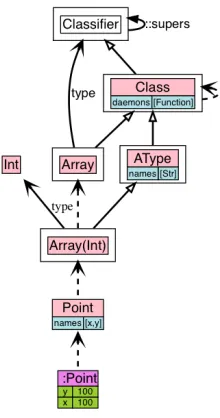
TheArrayMOP uses a Java array as object storage. Each element of the array must be of the same JMF type. A
class that conforms to the ArrayMOP declares the names
of the slots that will be associated with successive elements in the array. Figure 3 shows the desired arrangement for
[image:6.612.385.495.52.261.2]a particular point instance: the class Pointis an instance
Figure 2: The Sparse MOP
Figure 3: The Array MOP
of the meta-class Array(Int) which itself is an instance of
the meta-classArray. The rest of this section provides the
implementation in terms of JMF and Java code.
Each array class (such asPoint) must specify a collection
of names. The following class calledATypeis used as amixin:
c l a s s A T y p e extends C l a s s { n a m e s :[ Str ]; }
The meta-classArrayis used to create new array types by
supplying the type of the elements. The constructor for
Arrayis supplied with a classifiertthat types the elements
of the array. Note how thesupersare set to[AType]thereby
mixing in thenamesattribute:
c l a s s A r r a y extends C l a s s { t y p e : C l a s s i f i e r ;
A r r a y ( t : C l a s s i f i e r ) {
n a m e := ’ A r r a y ( ’ + t y p e + ’ ) ’ ; a t t r i b u t e s := [];
t y p e := t ;
s u p e r s := [ A T y p e ]; }
}
When an instance of an array type (such asPoint) is created,
the MOP must arrange for a Java array to be used for the object storage. This is achieved below by adding a
Java-defined operation callednewtoAType:
1 s e n d ( AType , " a d d O p e r a t i o n " , Op ( " new " , A T y p e _ n e w ) ) ;
2 3 public s t a t i c Obj A T y p e _ n e w ( Obj c , Obj so , Obj a r g s ) {
4 Obj [] s t o r a g e = new Obj [ l e n g t h ( get ( c , " n a m e s " ) ) ];
5 Obj t y p e = get ( c . of () , " t y p e " ) ;
6 for (int i = 0; i < s t o r a g e . l e n g t h ; i ++)
7 s t o r a g e [ i ] = get ( type , " i n i t i a l " ) ;
8 return new Obj () {
9 private int i n d e x ( S t r i n g n a m e ) {
10 int i = 0;
11 for( Obj n : i t e r a t e ( get ( c , " n a m e s " ) ) )
12 i f( n . t o S t r i n g () . e q u a l s ( n a m e ) ) return i ;
13 return -1;
14 }
15 public Obj get ( S t r i n g n a m e ) {
16 return s t o r a g e [ i n d e x ( n a m e ) ];
17 }
18 public Obj of () { return c ; }
19 public Obj s e n d ( S t r i n g n , Obj ... vs ) {
[image:6.612.43.295.169.453.2]21 }
22 public Obj set ( S t r i n g name , Obj v a l u e ) {
23 s t o r a g e [ i n d e x ( n a m e ) ] = v a l u e ;
24 return t h i s;
25 }
26 public Obj s l o t s () {
27 s l o t s = t h e O b j N i l ;
28 for ( Obj n : i t e r a t e ( get ( c , " n a m e s " ) ) ) {
29 Obj s = s e n d ( Slot , " new " ,n , s t o r a g e [ i n d e x ( n ) ]) ;
30 s l o t s = s e n d ( slots , " c o n s " , s ) ;
31 }
32 return s l o t s ;
33 }
34 };
35 }
The storage for the new object is created in line 4 and ini-tialised with values in lines 6-7. The new instance is created
on lines 8-34 as a Java object that implements theObj
in-terface.
6.
ADDING TYPES TO JMF
The previous section has defined two different dynamic MOPs using JMF. A dynamic MOP is a meta-class that
re-defines some of the operations that are provided byClass:
new, get, set, or send. Since the MOP is dynamic, there
is no scope for efficiencies that would be possible via static analysis of the JMF code. In order to achieve such efficien-cies, the MOP must be statically available and be defined in terms of the syntax of JMF and its type system. This section analyses the key parts of the JMF and an associated type-checking relation that are used to define a static MOP.
6.1
JMF Expressions and Types
JMF is a Java-like language that contains constructs for class definitions, operations, commands and expressions. The key expressions that relate to a static MOP are defined be-low:
e ::= e . n s l o t a c c e s s | e . n := e s l o t u p d a t e | e . n [ n , . . . ] ( e , . . . ) m e s s a g e p a s s i n g | ... m o r e e x p r e s s i o n s
The syntax of slot access and update are straightforward, but the syntax of message passing includes an optional se-quence of type names after the message name. This allows operations to be polymorphic. In particular it solves an issue with reflective languages whereby the type of an expression can depend upon its run-time value, for example if
opera-tionnewdefined byClassmust return a value whose type
depends upon the receiver, for example:
l e t c : C l a s s = P o i n t in c . new () . x
A question arises regarding the type of the expression c.
new() since it depends upon the run-time value of c. A
pragmatic solution is to require the programmer to supply the type when sending the message, therefore the type of
the operation newdefined by the class Classis: Λ[t]()->t
and the type is explicitly supplied:
l e t c : C l a s s = P o i n t in c . new [ P o i n t ]() . x
A JMF type t is a JMF class such as Int, Classand Obj.
Three special types are used that are created by instantiat-ing meta-classes:
FunctionOf([t,...],t) which denotes a function defined in terms of its argument types and its return type. This class is written(t,...) -> t
ListOf(t)which denotes lists whose elements are of type t. This class is written[t].
Λ[n,...]tewhich denotes a type function whose body is the
type expressionte.
A type expression is defined as follows:
te ::= c a JMF c l a s s
| n r e f e r e n c e to a n a m e d t y p e | [ te ] a l i s t t y p e
| ( te , . . . ) - > te a f u n c t i o n t y p e | Λ[ n , . . . ] te a t y p e a b s t r a c t i o n
Given a type environment ρ that maps names to types, a
type expressiontecan be mapped to a typeρ(te).
6.2
The JMF Type-Check Relation
The JMF expression type-checker relates an expressione
with a typetin the context of an environmentρthat maps
names to types: ρ`e:t. The environment contains all of
the core JMF classes and the user defined classes that are referenced by the expression. The type checker is defined by a collection of rules.
The rules are defined recursively on the structure of the expressions. The details of those rules that do not relate directly to a static MOP are not important, but consider a rule that types an if-expression:
IF-1
ρ`e:Bool, ρ`e1:t1, ρ`e2:t2 t1.inherits(t2)
ρ` if e then e1 else e2:t2
The rule states that an if-expression has a typet2when the
test expressioneis a boolean and when the consequent and
alternative expressions have typest1andt2respectively and
when t1inherits fromt2. Those rules that are relevant to
the static MOP of JMF are defined below.
Slot access is defined by a rule named GET that uses an
operation namedtypeCheckGet to calculate the type of the
slot reference:
GET
ρ`e:t t.typeCheckGet(n) = t’
ρ`e.n:t’
The default static JMF MOP for slot access is defined by
Classas follows:
t y p e C h e c k G e t ( n : Str ) : C l a s s i f i e r =
find a : A t t r i b u t e in a l l A t t r i b u t e s () when a . n a m e = n { a . t y p e
} e l s e u n d e f
Therefore the default type check behaviour fore.nselects the
attributeawith the namenfrom those defined and inherited
byt.of() where t is the type ofe. The result is the type
of the attribute a.t. If no attribute can be found with the
appropriate name then the result is undefwhich denotes a
type error.
Type checking slot update usestypeCheckSetand then
en-sures that the slot type and the value type conform:
SET
ρ`e1:t1 ρ`e2:t2
t1.typeCheckSet(n,t2) = t’ t2.inherits(t’) ρ`e1.n := e2:t’
t y p e C h e c k S e t ( n : Str , c : C l a s s i f i e r ) : C l a s s i f i e r = find a : A t t r i b u t e in a l l A t t r i b u t e s ()
when a . n a m e = n && c . i n h e r i t s ( a . t y p e ) { a . t y p e
} e l s e u n d e f
The final element of type checking is message passing which usestypeCheckSendto ensure that the argument types match. Note that we take into account the optional type arguments that can be passed to the type checker in case the type of the operation is polymorphic:
SND
ρ`e:t ρ`ei:ti
t.typeCheckSend(n,[ρ(n1),...,ρ(nk)],[t1,...,tn])=t’ ρ`e.n[n1,...,nk](e1,...,en):t’
The corresponding definition oftypeCheckSend in the class
Class must find an operation with the appropriate name and where the types of the supplied arguments match those of the operation domain. In the following definition it is
assumed that the type of the operation is of the formΛ[n1
,...nk].te:
t y p e C h e c k S e n d ( n : Str , ts , dom :[ C l a s s i f i e r ]) : C l a s s i f i e r = find o : O p e r a t i o n in a l l O p e r a t i o n s ()
when o . n a m e = n && o . a r i t y () = dom . l e n g t h () { l e t t : C l a s s i f i e r = o . g e t T y p e () . a p p l y ( ts ) in i f ∀( t1 , t2 ) ∈ dom × t . dom () . t1 . i n h e r i t s ( t2 )
then t . r a n g e () e l s e u n d e f } e l s e u n d e f
7.
IMPLEMENTING A STATIC MOP
The previous section has outlined JMF type-checking and defined the default static MOP. This section defines 3 static
MOPs: section 7.1 extends theSparse dynamic MOP;
sec-tion 7.2 extends theArraydynamic MOP; section 7.3 defines
a complete MOP as a JMF class.
7.1
Static Sparse MOP
TheSparseMOP does not need to redefinetypeCheckGet
or typeCheckSetsince the default implementation can use
the attributes. However, the pseudo-messageclearmust be
caught since it will not exist as an operation that can be detected by the default message passing MOP:
t y p e C h e c k S e n d ( n : Str , ts :[ C l a s s i f i e r ]) : C l a s s i f i e r { i f n = ’ c l e a r ’ && ts = []
then s e l f ;
e l s e super. t y p e C h e c k S e n d ( n , ts ) ; }
7.2
Static Array MOP
The AType meta-class is completed by defining the type
checking operations. The definition oftypeCheckSend does
not need redefinition and is inherited from Class. Type
checking slot access and update must be redefined since the
attributes are implicitly defined via thenamesattribute:
t y p e C h e c k G e t ( n : Str ) : C l a s s i f i e r { i f n a m e s . c o n t a i n s ( n )
then of () . t y p e ; e l s e u n d e f ; }
t y p e C h e c k S e t ( n : Str , c : C l a s s i f i e r ) : C l a s s i f i e r { i f n a m e s . c o n t a i n s ( n ) && c . i n h e r i t s ( of () . t y p e ) then s e l f ;
[image:8.612.390.482.54.275.2]e l s e u n d e f ; }
Figure 4: The Static MOP
7.3
A Self Contained JMF-Defined MOP
The previous section showed how to extend a dynamic MOP with static features in order to perform type checking.
The examples ofArrayand Sparsewere implemented using
a mixture of Java and JMF code. The JMF language is intended to be self contained and this section shows how a full MOP that defines a new form of attribute that is
equivalent tostaticin Java can be defined as a collection of
JMF classes.
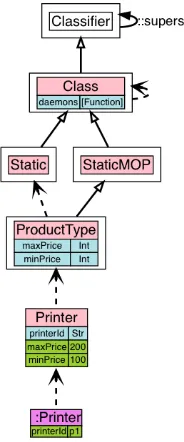
The motivation for this MOP is shown in figure 4 that
shows a printer instance with idp1. All printers are priced
in the same range so the min and max values are defined as
slots on on the class Printer and are accessible as
conven-tional slots via each instance such asp1.
In order to be a static class, ProductType is defined as
an instance of the meta-class called Static which uses the
followingmixin:
c l a s s S t a t i c M O P extends C l a s s {
t y p e C h e c k G e t ( n : Str ) : C l a s s i f i e r =
find a : A t t r i b u t e in of () . a t t r i b u t e s when a . n a m e = n { a . t y p e
} e l s e super. t y p e C h e c k G e t ( n ) ;
t y p e C h e c k S e t ( n : Str , t y p e : C l a s s i f i e r ) : C l a s s i f i e r = find a : A t t r i b u t e in of () . a t t r i b u t e s when a . n a m e = n {
i f t y p e = a . t y p e then s e l f e l s e null
} e l s e super. t y p e C h e c k S e t ( n , t y p e ) ;
get [ T ]( t a r g e t : Obj , n : Str ) : T =
find a : A t t r i b u t e in of () . a t t r i b u t e s when a . n a m e = n { get ( n )
} e l s e super. get ( target , n ) ;
set ( t a r g e t : Obj , n : Str , v a l u e : Obj ) : S e l f =
find a : A t t r i b u t e in of () . a t t r i b u t e s when a . n a m e = n { set ( n , v a l u e )
} e l s e super. set ( target , n , v a l u e ) ; }
The classStaticMOPdefines a full MOP by allowing the
slot update. The MOP is added as a mixin by the meta-class
Static:
c l a s s S t a t i c extends C l a s s {
S t a t i c ( n a m e : Str , s t a t i c A t t s :[ A t t r i b u t e ]) { s e l f . n a m e := n a m e ;
s e l f . a t t r i b u t e s := s t a t i c A t t s ; s e l f . s u p e r s := [ S t a t i c M O P ]; }
}
Given the definitions above, the meta-class ProductType is
defined as follows:
c l a s s P r o d u c t T y p e metaclass S t a t i c { m i n P r i c e : Int ;
m a x P r i c e : Int ; }
The classPrinteris an example of a product type and each
instance will have a different printer id but share the same max and min price.
c l a s s P r i n t e r metaclass P r o d u c t T y p e { p r i n t e r I d : Str ;
m i n P r i c e = 1 0 0 ; m a x P r i c e = 2 0 0 ;
P r i n t e r ( id : Str ) { p r i n t e r I d := id ; } }
p1 := P r i n t e r ( ’ p1 ’ ) ;
8.
CONCLUSION
This paper has described the separation of a MOP into a static-MOP and a dynamic-MOP. The latter is a well-known approach to providing reflection and intercession in dynamic languages. The former is a new concept that is a pre-requisite to efficient compilation based on type infor-mation. The approach is similar to that described by [6]
which introduces the idea ofexotypesfor abstracting away
from data layouts in Lua, although exotypes are not fully integrated into the bootstrap as in JMF.
The code given in this paper is taken from an implemen-tation of JMF that is based on the XMF language of the XModeler toolkit [4]. Unlike JMF, XMF is a compiled dy-namic language that has no type-checker; the motivation for developing static MOPs in JMF is based on the limitations of XMF. JMF is under development; the current snapshot is at https://github.com/TonyClark/JMF where the boot-strap is defined invalue.Obj.
Dynamic approaches to achieving efficiency in MOP-based
languages include caching andoptimistic optimisation[15].
These solutions can adapt when types are dynamically mod-ified and this provides an interesting challenge for a static-MOP based approach. One option is to index code that is statically determined in a way that can be modified if the indexing types change: this is an area for further investiga-tion.
This paper has demonstrated that static MOPs can be implemented in JMF. However, much work remains in or-der to achieve the overall aim: demonstrate that JMF can be compiled to the JVM and produce code that approxi-mates the efficiency of Java. The static MOP will need to be extended with the ability to produce code in addition to type checking, and the JMF bootstrap must be completely amenable to static analysis.
9.
REFERENCES
[1] D. Ancona, M. Ancona, A. Cuni, and N. D. Matsakis. Rpython: a step towards reconciling dynamically and
statically typed oo languages. InProceedings of the
2007 symposium on Dynamic languages, pages 53–64. ACM, 2007.
[2] K. Asai. Reflection in direct style. InACM SIGPLAN
Notices, volume 47, pages 97–106. ACM, 2011. [3] G. Chari, D. Garbervetsky, S. Marr, and S. Ducasse.
Towards fully reflective environments. InOnward!,
2015.
[4] T. Clark, P. Sammut, and J. S. Willans. Super-languages: Developing languages and
applications with XMF (second edition).CoRR,
abs/1506.03363, 2015.
[5] R. Damaˇseviˇcius and V. ˇStuikys. Taxonomy of the
fundamental concepts of metaprogramming.
Information Technology and Control, 37(2), 2015. [6] Z. DeVito, D. Ritchie, M. Fisher, A. Aiken, and
P. Hanrahan. First-class runtime generation of
high-performance types using exotypes.ACM
SIGPLAN Notices, 49(6):77–88, 2014.
[7] R. Douence and M. S¨udholt. A generic reification
technique for object-oriented reflective languages.
Higher-Order and Symbolic Computation, 14(1):7–34, 2001.
[8] R. Ierusalimschy, L. H. de Figueiredo, and W. Celes.
The evolution of lua. InProceedings of the third ACM
SIGPLAN conference on History of programming languages, pages 2–1. ACM, 2007.
[9] G. Kiczales, J. Des Rivieres, and D. G. Bobrow.The
art of the metaobject protocol. MIT press, 1991. [10] P. Maes. Concepts and experiments in computational
reflection. InACM Sigplan Notices, volume 22, pages
147–155. ACM, 1987.
[11] N. Papoulias, M. Denker, S. Ducasse, and L. Fabresse.
Reifying the reflectogram. In30th ACM/SIGAPP
Symposium On Applied Computing, 2015.
[12] B. Redmond and V. Cahill. Supporting unanticipated dynamic adaptation of application behaviour. In
ECOOP 2002?Object-Oriented Programming, pages 205–230. Springer, 2002.
[13] B. C. Smith.Reflection and semantics in a procedural
language. PhD thesis, Massachusetts Institute of Technology, Department of Electrical Engineering and Computer Science, 1982.
[14] B. C. Smith. Reflection and semantics in lisp. In
Proceedings of the 11th ACM SIGACT-SIGPLAN symposium on Principles of programming languages, pages 23–35. ACM, 1984.
[15] G. T. Sullivan. Aspect-oriented programming using
reflection and metaobject protocols.Communications
of the ACM, 44(10):95–97, 2001.
[16] E. Tanter. Reflection and open implementations. Technical report, Citeseer, 2004.
[17] T. Verwaest, C. Bruni, D. Gurtner, A. Lienhard, and O. Niestrasz. Pinocchio: bringing reflection to life with
first-class interpreters.ACM Sigplan Notices,