Evolving a regionally based mechanism for the provision of technical knowledge to SMES: Lessons for Policy
Jonathan Lean
University of Plymouth Business School, Drake Circus, Plymouth, PL4 8AA, UK.
Tel +44 (0)1752 233350, email: [email protected]
Jonathan Tucker
School of Business and Economics, University of Exeter, Exeter, EX4 4PU, UK.
Tel +44 (0)1392 263853, email: [email protected]
Abstract
This paper describes and evaluates a pilot project undertaken in the South West of
England to develop a computer-based system for facilitating effective technical
knowledge transfer to small and medium-sized enterprises (SMEs). It explores the
problem of technical knowledge transfer to SMEs focusing in particular on the policy
context of this issue. The conceptualisation, development and implementation of the
pilot project, called ‘e-volve’, are described. The failure of the project to develop
beyond the pilot period provides the focus for its evaluation. Interview data is
collected from system users to identify the main issues affecting the success of the
initiative. Key factors concerned with the development of Information Communication
Technologies (ICTs) and system membership are highlighted as are a number of
institutional and political issues impacting upon the e-volve project.
Recommendations relating to both the implementation of technical knowledge
systems and associated public policy issues are outlined.
Introduction
The innovative capability of an organisation is contingent not only upon the
competence of its human resource, its organisational culture and other internal
drivers, but also upon its ability to acquire technical knowledge from external
sources. With the progressive shortening of product life cycles throughout the
twentieth century, the need to innovate and keep pace with technological
developments has become increasingly important to the long term sustainability of
many business ventures (Nevens et al., 1990; Cooke and Mayes, 1996), as well as
to the economic well-being of regions that rely on such businesses for continued
wealth generation. Particularly in markets where competition is intense and where
technological progress is rapid, Peter Drucker’s (1985) contention that “every
business, to survive, must innovate” rings ever more true. The need to innovate
brings with it the need to acquire the knowledge required for such innovation to
occur. Innovation rarely occurs in a vacuum; rather it is sustained through the
process of knowledge transfer. Thus amongst companies wishing to maintain or
enhance their competitive position within the market-place, the need for timely and
appropriate information about available technologies is paramount. This is
particularly the case for smaller technology based firms lacking the resources and
access to the networks of their larger competitors. The purpose of this paper is to
describe and evaluate an initiative developed in the South West of England to
facilitate improved access to technical knowledge for technology-based small to
medium-sized enterprises (SMEs). Drawing upon extant literature, the paper first
describes the problem of technical knowledge transfer to SMEs before exploring the
policy context of this issue. The conceptualisation of the ‘e-volve’ project and its
preliminary evaluation of the initiative are presented along with lessons for future
policy relating to the support of technical knowledge transfer to SMEs.
Technical Knowledge Transfer to SMEs
A significant body of literature exists relating to the concept of technology transfer
and this provides a useful foundation for considering the specific policy problem
addressed through this research, i.e. the effective facilitation of technical knowledge
transfer to SMEs. Technology transfer can be defined as “the diffusion of the
complex bundle of knowledge which surrounds a level and type of technology”
(Charles and Howells, 1992). Technology transfer is not only the passing of
knowledge between ‘inventor’ and ‘innovator’. It plays a critical role in the
development of products, processes and services during both the pre-invention
phase (including basic research through to development and testing) and the
post-invention phase (the subsequent manufacture and marketing of innovations and their
diffusion). Thus it involves more than the simple transfer of a tangible product or
process technology. For instance, one important aspect of successful transfer is the
capability to commercialise new technologies. Nevens et al. (1990) argue that
companies that lack such capabilities will be ill-placed to develop a competitive
advantage over competitors and may even see their existing market position
undermined. Thus technological capability is not always enough to succeed in the
market place; the existence of the knowledge necessary to take commercial
advantage of a particular technology is also critical. Dosi (1985) identifies three
categories of technology transfer, highlighting the scope of the process in terms of
Hardware transfer - including the transfer of equipment, materials, parts or
complete systems;
Information transfer - comprising data, software, relevant documentation,
standards and specifications, licences or user guides;
Knowledge transfer – involving less tangible aspects such as an
understanding of the origins and potential effects and uses of the
technology; the competence to plan, manage and evaluate the technology
transfer process; and the ability to adapt and diffuse the technology within
the firm.
Thus amongst SMEs wishing to develop their innovative capability, a need exists to
be able to identify appropriate technologies (in terms of available hardware and
information) and also to acquire the knowledge required to make use of them to the
organisation’s best advantage. Critically, the ability of SMEs to address this
challenge differs from that of larger firms (Balazs, 1996). Within large corporations,
the scope of internal activities and the possible existence of in-house research and
development capability both provide opportunities for the internal development or
intra-firm transfer of technology and associated technical knowledge. In contrast, for
smaller firms their relative lack of resources means that in-house R&D is either
limited or impractical. As a result, SMEs are generally far more dependent on
external sources for both technology and technical advice (Rothwell, 1990; Jones et
connected than large firms in terms of their links with Universities and other public
research or advisory organisations. This may be for a variety of reasons, such as the
actual or perceived costs of collaboration, long lead times (small firms often plan only
over the short term, partly in recognition of the competitive advantage provided by
relative flexibility), poor access or information about potential technical advice
providers, and perhaps the perception of lower relevance of public sector research to
smaller firms.
When making decisions about appropriate technologies, smaller firms are also at a
clear disadvantage (Balazs, 1996). As well as suffering resource constraints that
may limit the technological options available to them, SMEs are generally less aware
of technology problems and opportunities as they are only able to draw upon the
knowledge of a limited pool of employees. Research indicates that small firms also
draw external advice from a more limited range of external sources (Masten et al.,
1995; Robertson et al., 1996) making them more susceptible to making poor
decisions when acquiring new technology. Bennett and Robson (1999) find that it is
the level of personal or institutional trust that determines where firms seek external
advice. Their study of 2,474 UK SMEs revealed that relationships with specialist
professionals, customers, suppliers and business friends were characterised by high
levels of trust and that SMEs consequently tended to limit their search for advice to
these sources. However, the study also found that whilst there were relatively low
levels of trust in public sector sources of advice, a significant proportion of firms
made use of Business Link to access advice. This would appear to suggest a
significant role for Business Link in providing a bridge to providers of technical
Higher Education Institutes (HEIs) are an important source of specialist technical
knowledge. Whilst initiatives such as the Teaching Company Scheme and latterly
Knowledge Transfer Partnerships have increased activity in this sphere, potential
obstacles to transfer need to be carefully managed. A significant obstacle governing
the effectiveness of technology transfer relates to goal divergence between
knowledge generators and knowledge recipients. Both Burgmeier (1992) and Spann
et al. (1995) highlight difficulties in HEI-firm and government agency-firm transfers
respectively. Both studies come to the same conclusion; that a lack of goal
convergence amongst the different groups involved in transfer projects is often at the
root of problems experienced. An example of this type of obstacle is highlighted by
Burgmeier (1992) who reports the following statement from an industrialist: “while we
are looking for working prototypes, our academic partner may be working towards a
paper proving the feasibility of such a prototype”. Burgmeier (1992) suggests that
such cultural differences are best resolved through open and honest communication
of individual expectations and goals. Johnson and Tilley (1999) conclude that “the
optimal solution is to find a way to match the needs of both parties”. This issue
highlights a potential role for policy intervention to assist in the definition of
technological problems or tasks and the shaping of appropriate relationships to
better facilitate the effective transfer of technical knowledge.
The nature of firm networks can also affect the success or otherwise of technical
knowledge transfers. Rogers (1983) argues that individuals are less likely to
encounter new ideas through highly inter-connected, close-knit networks because
it is weak-tie networks that are more likely to provide new knowledge or information.
However, Robertson et al. (1996), examining the case of computer-aided production
management technology in the UK manufacturing sector, find that whilst weak-tie
networks are a valuable source of technological information, knowledge diffused
through many such networks is often shaped by technology suppliers. Therefore,
information from such networks tends to reinforce supplier images of best practice
and so does not always lead to firms developing appropriate technological solutions.
Thus the nature of inter-firm and firm-supplier network interactions may act as a
barrier to the transfer of appropriate technologies to organisations. In small firms,
where the level of technological expertise required to evaluate alternative
technologies may be limited, this is likely to be a particular problem. Once again,
these difficulties indicate a role for policy in establishing mechanisms for guiding
SMEs towards appropriate technological solutions.
The Policy Context of Technical Knowledge Transfer
At both a regional and a national level, policy agendas at the start of the new
millennium highlighted the importance of the technical knowledge transfer issue.
The specific regional need for a system to facilitate knowledge transfer to SMEs in
the South West of England was based upon the following observations.
First, the development of the Regional Development Agencies (RDAs) further
emphasised the need for a regionally based solution to the problem of knowledge
transfer. The RDAs meant that new initiatives were increasingly operating on a wider
region had the potential to bring benefits in terms of the wider range of knowledge
available to draw upon in addressing business queries. However, if these benefits
were to be effectively passed on to the business user, a means of facilitating and
co-ordinating knowledge transfer between the various agencies involved had to be
developed.
A second consideration also related to aspects of emerging national government
policy at the time. An enhanced knowledge network would go some way towards
achieving the government’s stated vision of a knowledge-based economy that
encourages lifelong learning (DTI White Paper on Competitiveness, 1998). It would
also play a role in the realignment of the HE sector towards the development of
improved links with industry.
Thirdly, against a backdrop of growing competition at a global level, the need to
provide businesses with an optimal solution, rather than just an available solution,
was evident. Research on business networks suggests that the form of such
networks can have a considerable impact upon the appropriateness of knowledge.
Often, greater benefit arises from wider, loose-knit networks than smaller close-knit
networks since the scope for new ideas or solutions being developed within smaller,
more familiar networks is constrained (Rogers, 1983). Given that spatially broader
networks provide enhanced potential for providing optimal solutions, the
development of a knowledge management mechanism operating at a broad regional
Finally, and perhaps most significantly, there was an acute awareness that much of
the knowledge held by individuals providing specialist technical support to small
firms in the South West was tacit in nature. There was felt to be a strong need to
capture this understanding to avoid the potential for loss of knowledge when an
individual left his or her organisation.
The concept of a computer-based knowledge network for the provision of
technological advice to small businesses is not new. The DTI funded Supernet
system provides an example of a previous policy initiative to address the problem of
technical knowledge transfer to small firms. Established in 1994, the initiative was
conceived as a support system linking SMEs to Supernet ‘members’. These
members were research and technology focused organisations such as laboratories,
Universities and government research bodies. Working through Supernet,
Information and Technology Counsellors (ITCs) within Business Link would help to
identify the needs of businesses and locate appropriate sources of technical advice.
However, due to the low level of enquiries processed through the system, funding for
Supernet ceased in 1997, though a reduced facility was maintained by the Business
Link Network. Evaluating the system, Bessant (1999) found that the types of enquiry
generated through Supernet often did not require the specialist input of national
centres of excellence; hence queries were increasingly addressed without reference
to members. Such queries were of the type that could be dealt with by ITCs
themselves or through sources of local technological expertise. Indeed, Business
Links were increasingly seeking to develop networks of Local Service Providers
(LSPs) at the time. The subsequent movement towards a more regionally based
the needs of most SMEs, a nationally-focused model was not appropriate.
Furthermore, the low financial returns to members meant that the system was
unsustainable.
The key lesson from the experience of Supernet appears to be that, owing to the
nature of the institutional framework for supporting SMEs in the UK, regionally based
models for technical knowledge transfer are likely to have a greater chance of
success.
The E-volve System
Conceptualisation & Development of e-volve
In recognition of the need for a common, regionally based approach to managing the
provision of technical knowledge to small businesses in the South West of England,
a pilot scheme for a ‘Technical Knowledge Network’ was established during 2000 –
2001. It was formed from a pre-existing informal group called the Technology
Transfer Association (TTA), the remit of which is to support the development and
transfer of technical knowledge in Devon and Cornwall through closer cooperation
between members.
The ultimate aim of the project was to develop a mechanism through which
organisations providing business support in the South West region could gain easy
access to a managed ‘technical knowledge base’, enabling them to provide timely
and appropriate support for client SMEs. The knowledge management system that
emerged as a pilot initiative was called ‘e-volve’. Members of the network using the
Business Link, the Government Office for the South West, Local Enterprise Agencies
and Country and City Councils. The initiative allowed designated individuals from
member organisations to act as ‘Gatekeepers’ to e-volve, using it as a resource to
respond to technical queries from SMEs. The Gatekeeper-based system
acknowledged that whilst many firms use Business Link as their first port of call for
guidance, in fact a range of organisations from Universities to County Council
Economic Development Offices field queries from SMEs seeking technical advice.
E-volve aimed to ensure a consistent level of service and access to a wide pool of
technical knowledge no matter where SMEs accessed the system. All Gatekeepers
could search a data-base of queries and solutions relating to technology and
innovation issues, make requests for information from other members via an intranet
e-mail system and post solutions used by clients to the system, thus ensuring the
growth/evolution of the database for future searches. Through e-volve, Gatekeepers
would also play a critical role in identifying and articulating the nature of the technical
problem faced by an enquiring SME. It was hoped that e-volve would help to ensure
that no matter what the point of access, businesses would be relayed through to the
best possible source of information. Following a common client management
procedure would also remove the frustration suffered by SMEs when being referred
to a number of contacts before finding the most appropriate source of advice. A
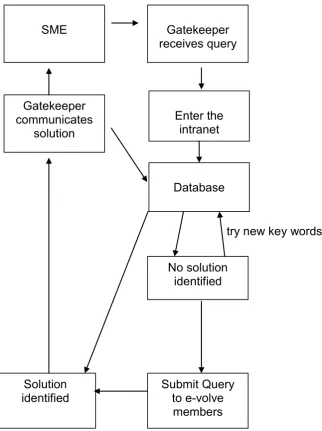
simplified version of the procedure followed by e-volve users is outlined in Figure 1.
Pilot Implementation of the e-volve System
During early 2000, with backing from the South West RDA, funding was secured
from Business Link, Konver II (EC funding for diversification in heavily
defence-dependent areas) and other sources to implement a six month pilot project. A
software development company was contracted to develop the e-volve system and
an alpha release was tested in time for a beta release in early 2001. Simultaneously,
the originating members of e-volve initiated a marketing campaign aimed at
broadening the membership of the network on a subscription basis. The purpose
was to include other appropriate organisations within the South West RDA region,
thereby expanding the knowledge base underlying both the human and database
elements of e-volve and also securing contributions to the on-going funding of the
system. Beyond the continuing costs of software and hardware improvement and
upgrading, the main on-going cost of the system was the management role
undertaken by a ‘hubmaster’ whose job was to respond to system queries and
monitor both its use and the status of queries in order to minimise overdue queries.
Following a Gatekeeper training session, e-volve was officially launched. However, a
number of issues emerged that halted the further use and development of the
system beyond its pilot period.
Evaluation of the E-volve System
The reasons for the failure to secure a future for the e-volve system were evaluated
through a series of interviews with users and originators of the pilot system. Data
was collected from discussions with two Business Link ITCs, one University member
format and each lasted 30-60 minutes. In all but two cases, interviews were
face-to-face and were recorded to facilitate subsequent analysis.
A limitation of the evaluation was that a significant proportion of the original e-volve
membership had either retired or left their jobs within the eight founding
organisations, thereby restricting the sampling frame for the research. This in itself
highlights one of the reasons for the creation of e-volve. Whilst members in some
cases acted primarily as well connected gatekeepers to a significant and diverse
knowledge base within their employing organisation (this is particularly the case for
Universities), many were themselves very knowledgeable about technological
opportunities and applications. As such, the loss of these individuals represents a
potentially significant loss to the technical knowledge base of the region. Given the
short period of the pilot project, the opportunity to capture and make explicit their
tacit knowledge was limited.
A preliminary analysis of the interview evidence indicates that from a design and
technical perspective, the system that was developed worked well. Users found it
intuitive, easy to use and functional in terms of its power and the scope of its
capabilities. The database and query system allowed users to save time in searching
for technical solutions for clients. Also the human interaction facilitated by the system
allowed problems to be more clearly shaped and defined, in turn improving the
chance of finding optimal solutions. However, an initial analysis of the interviews
highlights three key themes that help to explain the discontinuation of the e-volve
project. These relate to developments in the use of information communication
1. The Use of ICTs
All of the interviewees questioned highlighted the growth in the use of the internet,
alongside the development of more effective internet search engines, as a factor
inhibiting the progress of the e-volve project. Although by 2004 the internet has
become ubiquitous in the workplace, it was only in the late 1990s, when e-volve was
being developed, that its use became much more commonplace. Access to ever
more sophisticated search engines covering a rapidly expanding resource of
information about technical issues provided both SMEs (indirect system users) and
e-volve network members (direct system users) with what could be perceived as a
‘free’ alternative resource for accessing technical knowledge. Whilst this perception
could certainly be regarded as ill-founded, the interviewees felt that it nevertheless
constrained the demand for e-volve. The fact that the database within the system
contained very little data when the pilot was launched was certainly a limitation when
this is compared to the abundance of information available via the internet. Arguably,
the concept of an evolving database starting from a position of zero base data was
flawed and the data created through e-volve’s query system should have added to a
ready built database of technical knowledge available to users from day one.
Interestingly, three of the interviewees suggested that five years on, e-volve would
now be in greater demand. It was felt that the limitations of the internet as a resource
for identifying technical solutions had now become apparent, particularly in terms of
its shear size and the difficulty in narrowing down potential solutions towards an
optimal solution. Also, the reliability of information on the internet has become an
diagnose a technical problem or need and quickly identify the key technical
knowledge required by client firms is perhaps greater now than ever.
2. Membership Issues
In addition to the growth of the internet, some interviewees felt that the membership
composition of the e-volve network did not best serve the purpose of the project from
the outset. Most of the initial members were drawn from the membership of the TTA
and whilst all shared a common interest in issues concerning technical knowledge
certain members, such as the City and County Councils, did not deal with a large
number of technical queries. Therefore the use of e-volve by these members was
very limited. Two interviewees felt that the participation of individuals and
organisations more actively involved in innovation and the application of technology
was needed in order to provide the driving force behind the system. For example, the
South West SMART Club (members are all winners of DTI SMART funding) might
provide active input in to any similar initiative alongside ITCs and Universities.
Alternatively, other groups involved in projects financed through common funding
sources (e.g. Interreg) could be linked together through an e-volve style intranet.
This would also mean that the system would not simply be a network of technology
generators and intermediaries but would also include technology end-users. One
interviewee felt that issues of trust and confidentiality may be an obstacle to the
success of any future system of this type due to the requirement to share information
and business contacts. However, others asserted that a business culture of
collaboration had developed more strongly over the past five years within the
high-technology sector and that the trust issue associated with knowledge sharing was
Overall, the suggestions made by interviewees imply that in relation to the
membership of e-volve, the strategy should have been concerned less with breadth
and more with focus. This might have encouraged significantly greater use of the
system. However, it was perhaps the need to generate funding through subscriptions
that drove the project away from such a clear focus.
3. Institutional and Political Factors
The most immediate reason why the e-volve project was discontinued related to
funding. Although there was an objective to make e-volve self-financing through
subscription membership, it was hoped that after the pilot period, the RDA would
provide some financial and policy support towards the continued development of the
initiative. However, one interviewee identified the development of another knowledge
transfer scheme (K4B) focused on the region’s Universities as contributing to
dissipation in support for e-volve. In addition, ITCs felt that the restructuring of the
Business Links and an increased focus on short-term targets for revenue generation
within the network (see Lean et al., 1999) reduced the amount of time available to
them for more broadly focused initiatives such as e-volve. This is because the
objectives of the project, concerned as they were with the development of a
knowledge resource, were long term and inputs from members might not always
Policy Lessons and Conclusion
The e-volve initiative demonstrates that whilst the need for effective mechanisms to
support technical knowledge transfer to SMEs is great, developing and successfully
implementing systems to support knowledge transfer is very challenging, particularly
where the partners involved are drawn from a variety of organisational settings. As
was the case with Supernet, the fundamental problem affecting e-volve was the
failure to achieve sufficient critical mass in terms of use of the system to justify the
continuing costs to members and other stakeholders. The difficulty in securing
ongoing funding for any scheme with significant public sector involvement represents
a significant hurdle. This is particularly the case given that the efficacy of a
knowledge management system evolves over time, as the information contained
within networks and systems grows and develops. In other words, systems may
need time to succeed. It could however be argued that it is the cost of running such
systems, in terms of time and effort required to add to the knowledge base, that is
the major obstacle to success. Ultimately, the fact that the user organisations within
the e-volve network were not willing to contribute enough funding to enable the
continuation of the scheme suggests that the benefits of the scheme were not
perceived to exceed the costs involved in being a member.
Whilst the current evaluation of e-volve is ongoing, the preliminary results from this
study enable some important lessons to be drawn for future policy developments.
Firstly, although a key benefit of the evolve database was its ability to expand and
build its knowledge base from current queries and user interactions, the
incorporation of an existing database of information pertaining to technological
to address a significant proportion of user queries, it would almost certainly have
encouraged greater initial use of the system and might then have encouraged
members to utilise the other features of e-volve, particularly the ‘knowledge building’
query facility. A second related issue concerns the marketing of the system. Whilst a
ready-to-use database might have drawn the initial interest of new members, the
significant differentiating feature of e-volve related to the human element of the
system. Its capability to facilitate the definition and articulation of a technical
problem, generate a range of alternative solutions and then record and store these
query outcomes for future database searches remains unique. A failure to market
these benefits, particularly relative to the ‘free’ advice available through the internet,
is apparent now that we have greater awareness of the limitations of the internet as
a source of technical knowledge. Arguably however, firms and members could only
have appreciated these limitations through experiencing them over a period of time.
Therefore for e-volve, it might simply have been a case of the right system at the
wrong time.
A third lesson emerging from this study is that the success of a technical knowledge
transfer initiative requires an alignment of objectives across a range of user groups.
The development of performance targets within the Business Link network impacted
upon the e-volve project through the realignment of ITC priorities. However, whether
the context is the Business Link Network, higher education or local government,
organisational objectives are subject to fairly regular change. Whilst change is
unavoidable and often desirable, a need exists for ‘joined-up policy making’ where
initiatives span organisational boundaries. Only with the sustained involvement of
study concerns the membership of e-volve. The interview findings support the view
that the focus of membership strategies for similar initiatives should be towards
developing an active community of practice with a focus on depth of interest rather
than simply breadth. At a regional level, this might best be achieved by way of the
active involvement of technology users through cooperation with technology focused
Figure 1 - Basic E-volve Procedure
Gatekeeper receives query
Enter the intranet
Database
Solution identified
No solution identified
try new key words
Submit Query to e-volve
members SME
Gatekeeper communicates
References
Balazs, K. (1996) ‘Academic entrepreneurs and their role in ‘knowledge’ transfer’
STEEP Discussion Paper No.37, University of Sussex, UK.
Bennett, R. and Robson, P. (1999) ‘The use of external business advice by SMEs in
Britain’, Entrepreneurship and Regional Development, Vol 11, pp 155-180.
Bessant, J. (1999) ‘The rise and fall of ‘Supernet’: a case study of technology
transfer policy for smaller firms’, Research Policy, Vol 28, pp 601-614.
Burgmeier, S.T. (1992) ‘Dos and don’ts of academic-industrial collaboration: a view
from industry’ Industry and Higher Education, June, pp 75-76.
Charles, D. and Howells, J. (1992) Technology transfer in Europe - public and
private networks, Belhaven Press, London.
Cooke, I. & Mayes, P. (1996) Innovation and technology transfer, Artech House,
London.
Dosi, G. (1985) ‘Technological paradigms and technological trajectories: a
suggested interpretation of the determinants and directions of technical
change’, Research Policy, Vol 11, pp 147-162.
Drucker, P. (1985) Innovation and Entrepreneurship, Pan, London.
DTI (1998) Our competitive future: building the knowledge driven economy,
Department of Trade and Industry, London.
Johnson, D. and Tilley, F. (1999) ‘HEI and SME linkages: recommendations for the
future’, International Small Business Journal, Vol 17, No 4, pp 66-81.
Jones, G., Lanctot, A. and Teegen, H. (2000) ‘Determinants and performance
impacts of external technology acquisition’, Journal of Business Venturing, Vol
Lean, J., Down, S. and Sadler-Smith, E. (1999) ‘An examination of the developing
role of personal business advisors within Business Link’, Environment and
Planning C: Government and Policy, Vol 17, No 5, pp 609-620.
Masten, J., Hartmann, B. and Safari, A. ‘Small business strategic planning and
technology transfer: the use of publicly supported technology assistance
agencies’, Journal of Small Business Management, July , pp 26-37.
Nevens, T.M., Summe, G.L. & Uttal, B. (1990) ‘Commercializing technology: what
the best companies do’, Harvard Business Review, May-June, pp 154-163.
Robertson, M., Swan, J. and Newell, S. (1996) ‘The role of networks in the diffusion
of technological innovation’ Journal of Management Studies, Vol 33, No 3, pp
333-359.
Rogers, E.M. (1983) Diffusion of innovations, 3rd edition, Free Press, New York.
Rothwell, R. (1990) ‘External networking and innovation in small and medium-sized
manufacturing firms in Europe’ Paper presented to Network of Innovators
Workshop, May, Montreal, Canada.
Spann, M.S., Adams, M. & Souder, W.E. (1995) ‘Measures of technology transfer
effectiveness: key dimensions and differences in their use by sponsors,
developers and adopters’ IEEE Transactions on Engineering Management,