PRICE, Ilfryn and BEARD, Colin <http://orcid.org/0000-0002-3836-3072>
Available from Sheffield Hallam University Research Archive (SHURA) at:
http://shura.shu.ac.uk/6978/
This document is the author deposited version. You are advised to consult the publisher's version if you wish to cite from it.
Published version
PRICE, Ilfryn and BEARD, Colin (2013). The extended narrotype: adaptation and stasis in spatial evolution. In: EURAM Conference, Istanbul, 26-28 June 2013. (Unpublished)
Copyright and re-use policy
See http://shura.shu.ac.uk/information.html
1
The extended narrotype: adaptation and stasis in spatial evolution.
Ilfryn Price and Colin Beard, Sheffield Business School, Sheffield Hallam University, City Campus, Sheffield, South Yorkshire, S1 1WB UK
Abstract
We present the proposition that features of work spaces, in both learning spaces and offices,
might be considered as the memetic or linguistic analogue of extended phenotypes. We
demonstrate a synchronicity in theorising about, on the one hand processes of cognition and
learning, and on the other about the design of physical space in our two chosen contexts. The
actual physical expression lags the theory in both because, we argue, it reflects the narratives
of both powerful occupiers of the space and the professional departments responsible for
provision of same.
The results are compatible with, and an independent argument for, a ‘narrative ecology’
perspective on organisations. Our intention here is the theory however the results have
relevance both to accelerating learning and democratizing management. They argue for the
spatial dimension to organisational studies as a subset of research and practice in
organisational Darwinism.
Key words
2
Introduction
'First we shape our buildings then they shape us’ (Churchill , 1943)
The case, or cases, for Generalized Darwinism or Organisational Evolution still rest largely
on analogic reasoning (Toulmin, 1972; Ruse, 1986). Our purpose here is to examine an
extension of such reasoning by comparing Dawkins’s (1983) Extended Phenotype (EP) with
physical spaces in two settings, universities and offices. Using historical comparisons we
build a case for historic narratives influencing spatial expressions in both settings. In the
process we seek to add to the case (Price, 1995) that stasis is present in cultural evolution
(Distin, 2010) as much as in biotic (Eldredge and Gould, 1972; Ager, 1972; Wake, Roth &
Wake, 1983). In the process we hope to make the case for including studies of physical space
within evolutionary approaches to organizations.
We start with brief summaries of the concept of EP, and our theoretical stance on cultural
evolution then proceed by examining a synchronous ‘evolution1’ we observe in theorising
concerning processes of cognition and learning and theory and practice concerning work
spaces. Our inquiry into the two histories arose from our exploring potential lessons for
workspace practice offered by experience of spatially mediated development events (Beard
and Price, 2010). We discovered, in both, theory moving towards what might be called, in the
spirit of this conference, democratising spaces; but practice, reflecting dominant narratives,
lagging considerably.
Extended phenotypes
The language of evolution, ecology and selection is well established in organisational studies;
albeit rejected by many and differently nuanced in different communities of study (Breslin,
1
3
2011; Price, 2012a). Many metaphors from the natural sciences2 have found their way into
organisational writing either in a search for analogy or an attempt to generalise a Darwinian
approach to two complex systems, biotic and abiotic. One that has not is Dawkins’s EP
despite his remark, in a 21st anniversary discussion of the book of that name, in Biology and
Philosophy
Extended phenotypes are worthy of the name only if they are candidate adaptations for the benefit of alleles responsible for variations in them. I might admit the theoretical possibility of generalising to other kinds of replicators such as memes, in which case my ‘no’ answer might be softened. But it is enough of a problem already, getting my more hard-headed scientific colleagues to accept the extended phenotype, without arousing their active hostility by mentioning memes (which many see as simplistic) or ‘epigenetic inheritance systems’ (which some might write off as obscurantist). Dawkins (2004 377)
He was responding to various discussants of EP and specifically in the cited passage to
Laland’s (2004) suggestion that niche construction in a broad sense was an extension of EP
theory. Dawkins’s main point was that much niche construction, while it does modify the
selection environment, does not benefit the alleles responsible. Hence he argued the classic
EP, the beaver’s dam, is built for the benefit of beaver genes whereas say the production of
soil by earthworms or the microbial oxygenation of the early Proterozoic atmosphere are
by-products of evolution that, while they changed the selection environment dramatically, did
not benefit the replicators concerned. In an ontic dump (see Price, 2012a) that proved less
fecund than many of his coinings Dawkins sought to distinguish true niche construction from
mere niche changing.
Constructed structures -- beavers’ dams, termites’ nests or indeed birds’ – form a large class
of EPs though Dawkins (op cit.) was at pains to exclude coral reefs. Our purpose here thus
becomes a test of the argument, hinted at by the Churchillian quote above, that at least some
constructed cultural spaces are candidates for recognition as a cultural EP.
4
Narrative evolution
It has become conventional in organisational studies to separate research methodologies into
quantitative, usually bracketed as hypothetico-deductive, and qualitative, usually bracketed as
interpretive. The former, generations of students are told, is the method of the natural
sciences. Does that assertion always hold up? The quintessential natural science case of
Darwin’s Origin of Species can be seen (Mayr, 1991) as one long, interpretive argument
marshalling observation after observation (Ruse’s 1986 consilience) to establish the case for
the process of Natural Selection. Much, albeit not all, subsequent confirmation has remained
interpretive. The movement for generalising Darwinism to culture follows a similar path. It
remains largely interpretive even when case studies accumulate.
Within that movement are several variants on the theme of what, if anything, is selected and
the nature of the selection process (Abatecola,et al. 2013). Readers of this paper are likely to
be familiar with the broad division between the school who see ‘routines and competencies’
selected by broadly conscious human agents (Toulmin, 1982; Hull, 19883) and those who see
conventional wisdoms (Waddington, 1976), modes of thought (Weeks and Galunic, 2003) or
linguistic representations (Distin, 2010) replicated via the structures they enable. We would
broadly align with the second position viewing organisations as “intra organizational
ecologies” (sensu Weeks and Galunic) with their ‘modes of thought’ being social or
representational constructs.
As Langrish (2004) appears to have been the first recent writer to note, the concept was
anticipated by Darwin himself, not in The Origin of Species but in his later (Darwin, 1871)
5
work The Descent of Man; a volume that arguably usurps social construction and post
modernism by a century and gives them, ironically for social scientists of a certain
disposition, a ‘Darwinian’ twist. Darwin’s thesis began with humans’, innate capacity to learn
language and hence enable complex thought and the emergence of common rules of
behaviour. Price (2012a, 2012b) elaborates. What we are then testing here is whether
constructed spaces can be seen as extensions of, and contributions to the replication of
dominant narratives.4
Our historical comparison
A brief review of learning and cognition
Theorising about how adults learn has been subject to a continued quest for more ‘complete’
ideas. The early 20th century’s dominant, behaviourist view, was linked to, and associated
with, a Western approach and operant conditioning (Pavlov 1927, Skinner, 1974). That
animalistic, ethological focus gradually shifted as cognitivist theories began to surface in the
late 1950s. Major contributors included Lewin (1951) and Gagne (1974), but perhaps the
most well-known was Bloom (1956), who developed a spatial hierarchy of cognition
(higher/lower forms). Seeing the ‘human’ as unique, intelligent and rational, the cognitive
focus alluded to the computational processing of thinking, remembering, analysing and
seeking ways to explain and make sense of the world.
By the late 1960s humanist theories were emphasising personal agency and the fulfilment of
potential. Arguably the seminal text was Carl Rogers’s (1969) Freedom to Learn, which
expressed a liberating metaphor. For Rogers feelings, warmth, acceptance and the nurturing
of people were central to learning: individuals, if treated in the right way, had it within
6
themselves to work towards solutions to problems. These ideas were instrumental in the
development of learner centred methods.
Cultural and social context became increasingly recognised as important (e.g. Vygotsky,
1978) giving rise to a range of social constructivist theories, with learning seen as active and
contextualised. Learners were seen as constructing knowledge not only for themselves, as
individuals, but also through social interaction. Whilst social constructivist theories remain
influential they are now positioned among a milieu of views about human learning, as
illustrated in the unearthing of the role of hidden desires and fears by psychoanalytic theories
(Britzman, 1998); the questioning of a monolithic notion of a single intelligence (Gardner,
1983); advances in neuroscience leading to a reassessment of biological determinism
(Edelman, 1992; Damasio, 1995); and a widening recognition of the role of embodiment in
learning (Lakoff and Johnson, 1999; Sheets-Johnstone, 2009). Corporeal metaphors are
deeply embedded in descriptions of cognitive processes viz: I see what you mean; we grasp
the notion of; scratching the surface; step by step logic; support in the form of; decisions
hurried (pushed) through; pressure from. Many others have contributed to this cognitive
science, particularly a constitutional rather than causal (Shapiro, 2011) understanding of
embodied and environmentally embedded cognition (for a summary also see Clark, 2008).
The role of the senses (Abram, 1997), and specifically bodily gestures (Gallagher, 2005) and
the emotions (Illeris, 2002), all receive attention in a search for new meaning about how
humans learn. Such diverse thinking illustrates the on-going search for more integrative and
comprehensive explorations of learning within and across disciplines (Dillon, 2007), where
the connective relationship between mind, body and the environment can be further explored.
We do not claim the historical sketch as a complete picture but it appears to chart a trajectory
from ethology to ecology. Understanding of human learning shifts from animalistic simplicity,
7
that human dynamics are complex: a view often interpreted by the use ecological metaphors
(Becker, 1990: Davis & Sumara, 1997: Sterling, 2001; 2003: Siemens, 2003). A symbolic
representation of the trajectory (Figure 1) provided a convenient map against which to
consider developments in spatial designs for learning and working. Davis and Sumara (112)
explain ecological complexity, and suggest that all the contributing factors in any learning
situation are
[image:8.595.147.439.307.506.2]...intricately, ecologically, and complexly related. Both the cognizing agent and everything with which it is associated are in constant flux, each adapting to the other in the same way that the environment evolves simultaneously with the species that inhabit it.
Figure 1: A brief and simplified history of theories of cognition.
Siemens (2003) similarly employed ecological metaphors to explore complexity, suggesting
that a learning ecology is an 'open system, dynamic and interdependent, diverse, partially
self-organising, adaptive and fragile' - one which includes: 'a collection of overlapping
communities of interest; cross pollination with each other; and in constant evolution'
(Siemens, 2003 quoted in Thomas: p. 508). Siemens also argues for 'connectivism' as a
learning theory for the digital age, rooted in chaos, networks and complexity, declaring that
"learning thus defined takes place in a learning ecology that 'fosters and supports' the creation
8
might think that learning and working environment in HEIs would reflect this complex
ecology as suggested by ambitious, conceptually expanding definitions of ‘learning
environments’ as:
A sufficiently diverse and varied, physical or virtual, natural or artificial place and/or space that, wherever and whenever, can facilitate and engage people in the wide range of learning activities, through connectivity and community, cultivating and sustaining psychological, intellectual, emotional, social and political development (Beard, 2009: 184)
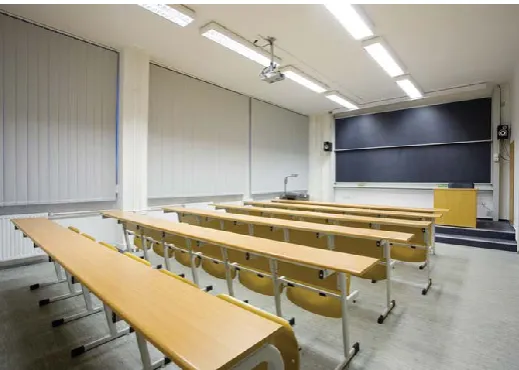
In practice however with the exception of learning centres exapted from former libraries (see
below) traditional spatial arrangements prevail in both lecture theatres and seminar rooms.
Students are seated in rows facing an instructor. The point is appreciated in pedagogic
research. The author of the following passage (Chism, 2006) could have had the image we
produce in Figure 2 in mind when she wrote:
Advances in learning theory have clear implications for the ways in which learning most likely takes place. The emphasis today is on active construction of knowledge by the learner. The importance of prior experience, the fitting of knowledge into existing schema or the establishment of new schema, and the active processing of information are all components of this model that emphasize high learner involvement. Environments that provide experience, stimulate the senses, encourage the exchange of information, and offer opportunities for rehearsal, feedback, application, and transfer are most likely to support learning.
Additionally, social constructivists point out that the social setting greatly influences learning. Picture the limitations of the standard classroom or study carrel in terms of these ideas. The decor is sterile and unstimulating; the seating arrangements rarely allow for peer-to-peer exchange; and the technology does not allow individual access to information as needed. Rather, the room supports a transmission theory whose built pedagogy says that one person will "transfer" information to others who will "take it in" at the same rate by focusing on the person at the front of the room. (p. 2.4 to 2.5)
The conceptual narrative concerning cognitive processes can be seen to have shifted. The
spatial form has not. It retains a typology that is also found in early 20th century offices such
as Lloyd-Wright’s famous Larkin Building (see below). The similarity triggered our
investigation of the history of theorising about workspace, given the BCHSE framework we
9
Figure 2 New, but essentially sterile, pedagogic space favoured by ‘efficiency’ guidelines but also by much current practice.
Working spaces: a brief history of the office
Twenty years ago Peters (1992 413), writing under the banner of Liberation Management
argued that:
space management may well be the most ignored — and most powerful —tool for inducing culture change, speeding up innovation projects, and enhancing the learning process in far-flung organizations. While we fret ceaselessly about facilities issues such as office square footage allotted to various ranks, we all but ignore the key strategic issue — the parameters of intermingling.
Becker (1990) advanced similar arguments and also independently coined (Price, 2012a) the
metaphor of 'organizational ecology' in an effort to portray the complex mix of people,
technology and physical space in the developing workplace.
Twenty years after Peters, Myerson (2012) could make the point that in the last decade more
flexible open offices have become the norm for knowledge intensive corporations. For him it
was simply a competitive necessity. In like vein Vischer (2012) identifies the flexible and
connected workspace as influential in the development of the social capital of successful
organisations. Academe has by and large resisted the trend (Price and Fortune, 2008).
Reviews of the emergence of none manual work spaces typically start with the transaction
[image:10.595.168.428.70.255.2]10
older. As special locations to conduct financial transactions they were a feature of early
financial centres such as Venice or Florence (Ferguson, 2008). Specific spaces also provided
adjuncts to administration in medieval palaces cells for learning and contemplation in
monasteries and early universities (e.g. Myerson and Ross, 2006) or centres for
administration of large pre-industrial enterprises such as British Navy (Rodger, 2004). The
last example in particular contradicts conflation of rise of management and with rise of the
mill. That said an office as an open, clerical factory did accompany the rise of industrial mills.
As noted the Larkin Building has become the oft cited archetype (Sundstrom, 1986) with its
overtones of the panopticon and the supervisor gazing down on the rows of workers arranged
as manual, and stationary, automata. It is space that easily equates with a behaviouralist, in
the Skinnerian sense, view of learning. As an aside (Figure 3) the admiralty boardroom a
century before was arguably more democratic.
Later in the century the coincidence of economic revival, construction technology and
reliable lift systems enabled the construction of taller office buildings. Managerial and
supervisory offices grew in size and evolved into finely demarcated symbols of status
captured, in what became an enduring metaphor, by the British novelist C. P. Snow (1964) as
Corridors of Power5. The post-war period also saw the rise of professionals – cognitive
workers - and their need, or demand, for their own offices.
11
Figure 3. Contrast the admiralty boardroom of 1807 and the Larkin Building 100 years later
London’s Shell Centre serves as an early example. In such locations the desk was still the
managerial or professional workstation across which paper flowed from in tray to out and on
which sat the telephone. Room size, and fittings were strictly controlled (Propst, 1968).
Those of sufficient status or power had chairs or separate tables for visitors. For the real
upper echelons the office frequently included a more informal meeting area, usually modelled
on a coffee table and easy chairs. Such spaces are interpretable as early examples of the
awareness that physical space mediates conversation (c.f. Markus and Cameron, 2002; Baker,
Jensen and Kolb, 2005)
12
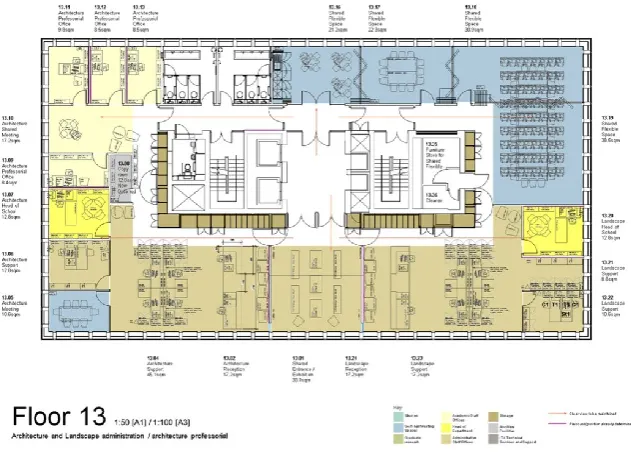
academia as Chism (op cit) remarked. Figure 4 was the result of a Google search6 for
academic offices and was the first image to appear as a plan rather than a picture. The
nuancing of office size and location is obvious. Indeed the layout has a passing resemblance
to a plan of a camp for Roman Legions (Figure 5).Alternatives to such arrangements are
strongly resisted (Price and Fortune, 2008; Price, 2009). Critical academic scholars who
interpret other spaces in terms of power (e.g. Hancock and Spicer, 2011; Baldry and Barnes,
[image:13.595.116.432.276.502.2]2012) continue to work on corridors which embody it.
Figure 4 A ‘Corridors of Power’ workspace in current academia.
6
13
Figure 5 The layout of a Roman Legionary camp (derived from a google images search)
Elsewhere there were other developments. In the same decade that Rodgers was writing
Freedom to Learn the corridor and cellular office combination was also first seriously
challenged. In 1960s Germany the pioneering consultants Wolfgang and Eberhard Schelle
promoted the Burolandschaft, or landscaped office, arguing, even then, for freer information
flow, increased openness and equality and what might now be seen as faster organisational
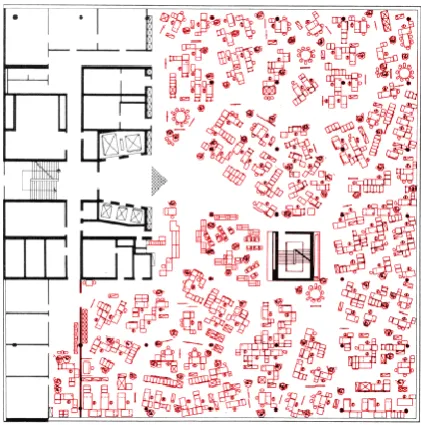
learning. Irregular arrangements of desks displaced straight lines although the rectangular
desk remained the basic work unit (Figure 6). Their concept became fashionable and reached
the USA by 1967 (Sundstrom, 1986) but, in its North American manifestations at least,
landscaped offices retained the nuancing of status by desk size and furniture (Figure 7). The
[image:14.595.185.416.88.336.2]14
Figure 6 An early 1960s burolandschaft design combining straight desks with random positioning
Figure 7 Burolandschaft interpreted for the USA. Note the chairs as indicators of hierarchy and activity at the desk. Reproduced with permission from Sundstrom (1986)
The desk remained necessary as a paper processing surface and stand for a cabled phone. It
continued to be used as a meeting table arranged to protect and place the occupant in a
dominant position vis a vis subordinates. A traditional, managerialist and hierarchical culture
did not fit easily in a freer work place. Furthermore in Europe at least employees saw
[image:15.595.192.403.70.283.2] [image:15.595.161.439.343.536.2]15
energy costs from 1973 was a cause or an excuse, the fashion rapidly failed and there was a
marked return to cellular offices. Some architects sought to resist the trend and Scandinavia,
where the sense of democracy and fairness in the work space was strong, saw the
development of the combi office (Van der Voort, 2003) in which, theoretically, every
employee had their glazed shell looking on to a common core. In practice more junior staff
were soon relegated to that core. In general however there is less recognition of the social in
office design from the period.
Perhaps in the same 1960s spirit US furniture group Herman Miller launched their action
office concept in 1968; a concept credited to their then head of design Robert Propst who
lived to see himself hailed as the father of the cubicle. An interview reported two years before
his death survives online (Propst, 1998)
"I don't even feel faintly guilty about Dilbert," Propst says from his suburban home near Redmond, Washington. "The things expressed in that comic are the very things we were trying to relieve and move beyond. It was a Dilbert world even back then. Everything we worked toward tries to express something more interesting."
"Back then" was the early Sixties, an era when offices were huge, open spaces filled with orderly rows of desks and chairs, surrounded by neat, closed-in rooms. "Those offices were devoid of the imprint of work or process," says Propst. "I call it the clean-desk syndrome. At the end of the day, ideally, you had no bodies or paper showing. It was so sterile. The CBS Building in New York was an interesting example. In there, you could not choose anything yourself, except maybe a picture of your wife or your dog."
He goes on to criticise those who picked up the concept and converted it into what it became:
The austere quality for which cubicle-filled offices are now criticized was entirely intentional. "We tried to create a low-key, unself-conscious product that was not at all fashionable," says Propst. "The Action Office was supposed to be invisible and embellished with identity and communication artefacts and whatever you needed to create individuation. We tried to escape the idea of being stylish, which is gone in five years. We wanted this to be the vehicle to carry other expressions of identity. That's why we provided tackboards and all kinds of display surfaces [....]
16
to write off the depreciation of cubicles much more quickly than that of traditional offices). "The dark side of this is that not all organizations are intelligent and progressive," Propst says. "Lots are run by crass people who can take the same kind of equipment and create hellholes. They make little bitty cubicles and stuff people in them. Barren, rat-hole places."
In terms of our B.C.H.S.E. model (Figure 1) Propst might be seen as having tried to move
toward at least the humanist if not the transactional, social constructivist dimension. The
norms of office planning and organisational culture would seem to have frustrated him. Other
attempts at more social workspaces also appeared in the 1980s. The 1985 Scandinavian
Airlines [SAS] HQ building became famous as one of the first to incorporate a ‘street’ design
widely imitated but frustrated in practice when use of the street was often perceived by staff
and managers alike as idling, as not ‘work’ (Donald 1994).
Comparisons
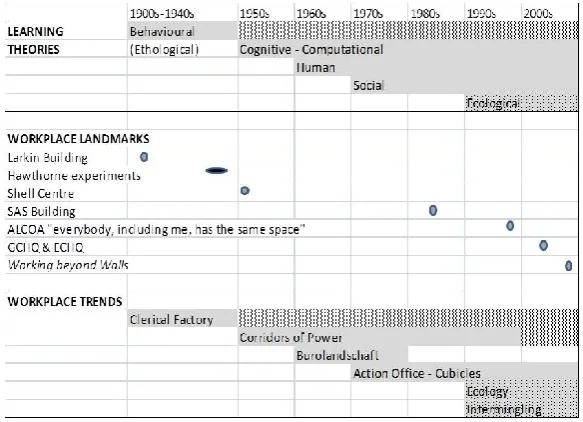
When we contrasted theories about workspace and theories of cognition we discovered the
comparison was more synchronous than we expected (Figure 8). Early twentieth century
offices were firmly behaviourist: and their design carries over in modern educational spaces,
whether lecture theatres or staff offices. Corridors of power nuanced for professional
‘knowledge workers’ appeared in the same decade as did cognitive theories of learning while
the burolandschaft movement is human centred and synchronous with Freedom to Learn.
Social learning spaces appeared in corporate offices in the 1980s and ecological metaphors
entered both literatures in the 1990s. Becker’s Organizational Ecology metaphor
conceptualized the workplace as a system in which physical design factors both shape and are
shaped by work processes, the organization’s culture, workforce demographics, and
information technologies (Becker, 2007). In practice however behaviouralist, rectinlinear
17
Figure 8 Parallel developments in theories of cognition and work space, with some ‘landmark’ buildings representing different phases.
Disussion: Extended Narrotypes?
Theory and practice
We observe in both the histories sketched above a theoretical development of ideas
concerning learning and ‘knowledge work’ from the hierarchical, and behavioural, towards
the inter-connected or ecological. Although we are unaware of literature that has made this
comparison it is perhaps not surprising. Both developments may reflect a wider zeitgeist and
or a response to overall cultural evolution. Hence, for example, the 1960s – a decade that saw
both freedom to learn and burolandschaft – were famously7 emancipatory in other walks of
life. That emancipation extended to a wave of building in universities and the foundation of
many new ones. The buildings reflected the technology and mores of the time, the era of post
war ‘corridors of power’ construction that Sundstrom (1986) has highlighted as enabled by
technological developments. In terms of the debate between Dawkins and the niche
constructionists, alluded to earlier, one might say construction technology opened a new
7
18
macro scale niche but that it was niche changing rather than niche construction
Yet despite such larger scale environmental changes actual spatial practice shows a degree of
persistence. Practice lags theory. Older spatial forms – whose earlier manifestations can be
found in at least Roman times – persist, even as the wider environment changes dramatically.
It seems that in spatial evolution, if that is what it is, there is a rendency to stasis just as there
is an the evolution of concepts.
As even Dawkins (1986: 125) has observed most of natural selection is concerned with
preventing evolutionary change rather than with driving it.Persistence in the face of changing
environments has even been argued as meaningful adaptation (Wake, Roth and Wake, 1983).
The source of such stability in organismic evolution is not hard to find. It is a logical end
point of Evolutionary Stable Strategies that systems of co-evolved entities8 act to suppress
competitors entering their niche. The spatial persistence we have observed has the hallmarks
one might expect of an evolving system.
Status and dominant narratives
Visually the professorial offices in Figure 4 or the large desks in the foreground in Figure 7
have something in common with beavers’ dams, termites’ mounds or Weaver Birds’ nests.
They are physical structures that enhance the well being and power of certain occupants. The
instructor’s lectern in Figure 2 or the supervisors’ stations in Figure 3 (far right of the floor
plan) fulfil the same purpose. If what is replicating in organisations is Waddington’s (1976)
conventional wisdom of the dominant group or Csikszentmihalyi’s (1988) similar proposition
field, the prevailing mental models of the influential individuals then the spatial arrangements
could be seen as serving, and indeed replicating, those interests. Indeed in Csikszentmihalyi’s
8
19
language they are a specific part of the domain (the symbol system of the influential
individuals). Physical space reflects, and replicates, a particular part of a dominant memeplex.
If, as outlined above, and argued by evolutionary accounts of social constructs, we consider
mental models as constructed via ‘narrative’, we arrive at spatial arrangements as benefitting
a particular narrative hence the title of this paper
As Toulmin (1972) seems to have been the first to explain in strictly evolutionary terms,
concepts face a competition to be accepted by influential individuals. Nowhere is this more
true than in the sphere of academia. The individual office allocated to the tenured individual,
or the privileged lectern in front of the lecture theatre, reflect and re-enforce the influence of
those who use them. The spatial arrangements play a part in conceptual selection. This may
not however be the only construct or narrative thus replicated. What of those who design and
provide the spaces concerned?.
Efficiency
We see, in the extended quotation from Propst above, how a narrative of efficiency and cost
minimization led to work space designs mutating back towards rectilinear cubicles, or open
grids. In one of the first comprehensive studies of new 'open', ecological, workplaces Becker
et al. (1994) distinguished cases that were primarily business driven (i.e. they were designed
to achieve a result narrated in terms of organizational goals) from those that were primarily
cost driven (i.e. they were unlikely to have happened without a narrative of reducing costs by
increasing occupation density). Becker et al. found a very significant and large, positive
difference in the average satisfaction with the result in the former as opposed to the latter and
a greater commitment to involving users in the process of workplace development versus
recquiring them to accept a template solution. They also speculated that the cost driven
solutions would prove to be less self sustaining because of a need to either correct mistakes in
20
offices) once the change was over and the cost pressure was reduced.
Efficiency and control over space remains to this day part of the dominant narrative of
Facilities Managers, as those who provide workspace have come to be known. The design
language becomes a matter of space standards and the number of workstations that can be
accommodated on a given floor plate. The result is often a ‘roman legion’ design, elements of
which are clearly present in the ‘other ranks’ space illustrated above (Figure 4)9. The
‘generals’ might have a degree of freedom. The rest are expected to be at their ‘station’. It is
hardly surprising that in spaces laid out like lines of battle territorial divisions between
departments are re-enforced and strengthened, even if the resulting failures of communication
drive a firm to terminal decline (Breslin, 2012).
Alternative narratives.
We thus interpret many modern office and teaching spaces as helping replicate two narratives,
that of influential individuals (sensu Toulmin) and that of space providers. Lest this picture
seems unduly pessimistic let us look at an alternative. Spaces where the design does manifest
modern ideas of learning can be found in many learning centres as former libraries have
come to be known. A typical modern learning centre provides its users with a variety of
spatial milieus for different forms of individual and group based study. Importantly the
choice of space is left to the same users who enjoy a spatial autonomy denied them in class
rooms, or indeed denied the occupants of cube farms and their ilk. The narrative label
‘learning centre’ is instructive. Like the libraries that they evolved from these are spaces
designed from a tradition of supporting autonomous – democratic in the terms of this
conference – learning..
21
There may be a similar counter narrative in successful modern open-plan workspaces driven
by the need to accelerate organizational learning. The UK’s Civil Service has largely
abandoned its corridors of power and the service’s then head, introducing a report on
Working without Walls (Allen et al., 2004), wrote:
My own experience, as the champion of the Treasury redevelopment project, confirms there are tangible benefits to be gained from work place and organizational change. The Treasury project illustrates vividly the way the geography of an organisation (emphasis added) can reinforce its culture and its management aims. (The Building) has promoted communication, both formal and informal and has encouraged flexible ways of working. Above all it has fostered a feeling of self confidence and presented an attractive image to the talent we need to recruit.
In an earlier, Harvard Business Review, debate on whether open space can work Vischer
(1999) cited former U.S. Treasury Secretary Paul O'Neill, stating of his time as CEO of
Alcoa: (p. 36 emphasis added)
Having successfully implemented a move to an open-design concept where everyone including me has the same work space we have seen wonderful changes in terms of culture and quality of work. The entire building is our office.
We add the emphasis because the quote illustrates two points that we believe are of great
significance to the future of learning space. Firstly there is the removal of overt physical
symbolism of power and status. Secondly there is the move away from the emphasis on
individual space and the explicit recognition that the totality of the building is there for all.
The office functions as a Library or Learning Centre rather than a series of stations for the
occupants. This second point opens up new possibilities for space trading within the existing
footprints of higher education buildings, to include greater recognition of the role of the
spatial ecology beyond the walls of the institution. It brings to the organisational workspace
the freedom of the learning centre. It does though challenge traditional narratives of ‘my
22
Acknowledgements
Price is particularly grateful to Professors Keith Alexander and John Worthington for
discussions on the history of the office and to Craig Murray of the TSK Group who alerted
him to the statement that everyone in our office has all the space. Beard would like to
acknowledge the contribution made to his thinking by many corproate sector staff who have
taken part in his experiential and experimental designs on matters of the role of the body in
learning. The subsequent discussions, set within many international contexts, have been
invaluable. We both appreciate the comments of three anonymous reviewers.
References
Abram D (1997) The Spell of the Sensuous. New York: Vintage Books.
Ager, D. (1972) The Nature of the Stratigraphical Record. London, Macmillan.
Allen T., Bell A. Graham R. Hardy B., and Swaffer F., (2004), Working without walls -An insight into the transforming government workplace. London, HMSO.
Abatecola, G. Breslin, D, Lord, A.S. and Price I. (2013) Issues in Organizational Darwinism. Discussion paper for EURAM 2013
Baker AC, Jensen PJ, and Kolb DA (2005) Conversation as Experiential Learning, Management Learning 6(4): 411–427.
Baldry C and Barnes A. (2012) The open-plan academy: space, control and the undermining of professional identity, Work Employment Society26(228-245)
Beard, C. M. (2009) Space to Learn? Learning environments in higher education, , in BUSWELL, J. and BECKET, N (eds) Enhancing Student Centred Learning in Business and Management, Hospitality, Leisure, Sport and Tourism, Newbury, Threshold Books. 179-188
Beard C.M. (2010) The Experiential Learning Toolkit: Blending Practice with Concepts, London, Kogan Page.
Beard C.M. and Price, I. (2010) Space, conversations and place: lessons and questions from organisational development International journal of facility management, 1 (2) unpaginated.
23
Beard C.M. and Price, I. (2013) Room for Improvement, Royal Society of Arts Journal, Spring, 38-41
Becker F.D. (1990) The total workplace: facilities management and the elastic organization. New York: Van Nostrand Reinhold.
Becker F.D., Quinn K. L., Rappaport A. J. and. Sims W. R.,. (1994) Implementing innovative workplaces - organizational implications of different strategies Ithaca NY: Cornell International Workplace Studies Program
Becker, F.D. (2007) Organizational Ecology and Knowledge Networks. California Management Review 49(2 Winter): 42-61.
Bloom BS (1956) Taxonomy of Educational Objectives, Handbook 1: The Cognitive Domain. New York: David McKay.
Breslin. D. (2011) Reviewing a Generalized Darwinist Approach to Studying Socio-Economic Change. International Journal of Management Reviews, 13(2) 218-235.
Breslin D. (2012) Spaces and the Coevolution of Practices within a UKMetallurgical Equipment Supplier, in In ALEXANDER, K. and PRICE, I., eds.. Managing organizational ecologies: space, management and organizations. New York, Routledge, 234-246
Britzman DP (1998). Lost Subjects, Contested Objects: Towards a Psychoanalytic Inquiry of Learning. New York: State University of New York Press.
Chism, NVN. (2006) Challenging Traditional Assumptions and Rethinking Learning Spaces, in Oblinger D (ed.) Learning Spaces, EDUCASE pp. 2.1 – 2.12 http://www.educause.edu/learningspacesch2 (accessed 13 April 2012)
Csikszentmihalyi, M., (1988). Society, culture, and person: a systems view of creativity, in. Sternberg, R. J. (Ed.) The Nature of Creativity: Contemporary Psychological Perspectives, New York: Cambridge University Press, 325–339.
Darwin, C. R. (1871). The Descent of Man, and Selection in Relation to Sex, London: John Murray.
Dawkins, R. (1983) The Extended Phenotype: The Long Reach of the gene, Oxford UK, Oxford University Press.
Dawkins, R. (1986). The Blind Watchmaker, London: Longman
Dawkins R. (2004) Extended Phenotype – But Not Too Extended. A Reply to Laland, Turner and Jablonka Biology and Philosophy 19(3)377–396, 2004.
Dillon, P. (2007) A Pedagogy of Connection and Boundary Crossings: Methodological and epistemological transactions in working across and between disciplines, a paper presented at ‘Creativity or conformity? Building Cultures of Creativity in Higher Education’, University of Wales and the Higher Education Academy, Cardiff, January 8-10.
24
Donald I (1994) Management and change in office environments. Journal of environmental psychology 14(1); 21-30.
Eldredge, N. and Gould, S.J. (1972) Punctuated Equilibrium: An Alternative to Phyletic Gradualism, in SCHOPF, T.J.M, ed. Models in Palaebiology San Francisco, Freeman Cooper 82-115.
Ferguson N (2008) The Ascent of Money: A Financial History of the World, London: Penguin.
Gagne RM (1974) Essentials of learning instruction, Hinsdale, IL: Dryden Press.
Gallagher S (2005) How the body shapes the mind, Oxford: Oxford University Press.
Gardner H (1983) Frames of Mind. The theory of multiple intelligences, New York: Basic Books.
Hancock P and Spicer A (2011) Academic architecture and the constitution of the new model worker, Culture and Organization 17(2): 91-105
Hull D. L. (1988) Science as a process:an evolutionary account of the social and conceptual development of science, Chicago, University of Chicago Press.
Illeris K. (2002) The Three Dimensions of Learning. Malabar Fl.: Krieger Publishing.
Lakoff G. and Johnson M (1999). Philosophy in the flesh. New York: Basic books.
Laland K.N. (2004) Extending the Extended Phenotype, Biology and Philosophy 19: 313– 325,
Langrish, J. Z. (2004). Darwinian Design: The Memetic Evolution of Design Ideas, Design Issues, 20(4), 4-19
Lewin K (1951) Field theory in social science. New York: Harper & Row.
Markus TA and Cameron D (2001) The Words between the Spaces: Buildings and Language. London: Routledge.
Mayr E. (1991) One Long Argument- Charles Darwin & the Genesis of Modern Evolutionary Thought, Cambridge MA Harvard University Press.
Myerson J (2012) Workspace redesign to support the ‘front end’ of innovation. In ALEXANDER, K. and PRICE, I., eds.. Managing organizational ecologies: space, management and organizations. New York, Routledge, 22-33.
Myerson J and Ross P (2006) Space to Work; New Office Design, London: Laurence King Publishing.
Pavlov I (1927) Conditioned reflexes: an investigation of the physiological activity of the cerebral cortex (translated by G.V.Anrep), London: Oxford University Press.
25
Price, I. (2012a) Organizational ecologies and declared realities In ALEXANDER, K. and PRICE, I., eds.. Managing organizational ecologies: space, management and organizations. New York, Routledge, 11-21.
Price, I. (2012b) The selfish signifier: meaning, virulence and transmissibility in a management fashion. International Journal of Organizational Analysis, 20 (3), 337-348
Price, I. and Fortune, J. (2008). Open plan and academe: pre- and post-hoc conversations. In: THEN, D. S.-S. and FINCH, E., (eds.) Proceedings of the W070 conference: healthy and creative facilities. CIB publication (315). CIB, 613-620.
Price. I. (1995) Organisational Memetics?: Organisational Learning as a Selection Process. Management Learning, 26 (3), 299-318.
Price. I., (2007) Lean assets: new language for new workplaces. California management review, 49 (2), 102-118
Price. I., (2009), Space to adapt: workplaces, creative behaviour and organizational memetics. In: RICKARDS, T., RUNCO, M.A. and MOGER, S., (eds.) The Routledge companion to creativity. London, Routledge, 46-57
Propst R (1968) The Office, a Facility Based on Change. Ann Arbor MI: Business Press
Propst R (1998) http://www.metropolismag.com/html/content_1198/no98man.htm (accessed 20 September 2011).
Rodger NAM (2004) The Command of the Ocean: A Naval History of Britain 1649-1815, London: Allen Lane.
Rogers C.R., (1969) Freedom to learn: a view of what education might become. Columbus OH: Charles E. Merrill
Ruse M. (1986) Taking Darwin Seriously:A Naturalistic Approach to Philosophy. Oxford UK, Basil Blackwell
Shapiro L (2011) Embodied Cognition. Abingdon UK: Routledge
Sheets-Johnstone M (2009) The Corporeal Turn, an interdisciplinary reader. Exeter: Imprint Academic.
Skinner B (1974) Adult behaviourism, London: Jonathan Cape.
Snow C.P’ (1964) Corridors of power, London: Macmillan.
Sterling S (2001) Sustainable Education: Re-visioning Learning and Change. Totnes: Green Books.
Sterling S. (2003) Whole systems thinking as a basis for paradigm change in education: explorations in the context of sustainability, PhD Thesis.University of Bath, UK.
26
Toulmin, S. (1972) Human understanding: The collective use and evolution of concepts. Oxford, UK: Clarendon Press.
Van der Voordt D.J.M., (2003), Costs and benefits of innovative workplace design TUDelft Centre for People and Buildings
Vischer, J.C. (1999) Case study: Can this open space work? Harvard Business Review 77(May-June), 28-36.
Vischer, J.C. (2012) Managing facilities for human capital value, In ALEXANDER, K. and PRICE, I., eds.. Managing organizational ecologies: space, management and organizations. New York, Routledge, 34-47.
Waddington, C.H. (1976) Tools for thought: how to understand and apply the latest scientific techniques of problem solving, New York: Basic Books,
Wake, D.B., Roth g. and Wake, M.H. (1983) On the Problem of Stasis in Organismal Evolution, Journal of Theoretical Biology, 101 211-224