DEARDEN, Andy <http://orcid.org/0000-0002-5706-5978> and RIZVI, Haider
Available from Sheffield Hallam University Research Archive (SHURA) at:
http://shura.shu.ac.uk/2936/
This document is the author deposited version. You are advised to consult the publisher's version if you wish to cite from it.
Published version
DEARDEN, Andy and RIZVI, Haider (2009). A deeply embedded sociotechnical strategy for designing ICT for development. International journal of sociotechnology and knowledge development, 1 (4), 52-70.
Copyright and re-use policy
See http://shura.shu.ac.uk/information.html
A deeply embedded sociotechnical strategy for
designing ICT for development
Andy Dearden & Haider Rizvi
Communication & Computing Research Centre Sheffield Hallam University, UK
Development is a social phenomenon. Information and Communication Technologies (ICT) are a technical phenomenon. Therefore, ICT for development is inescapably a socio-technical phenomenon. For this reason, ICT design efforts that frame
themselves with development objectives, require an analysis of their intervention strategies in explicitly socio-technical terms.
In this paper, we reflect on the strategies adopted by the Rural e-Services project, which has been working with a co-operative of marginal farmers in rural India to design new software and new practices using mobile camera phones to communicate with their agricultural advisors. By combining approaches from participatory
development practice and participatory methods of ICT design, the project was able to manage a sustainable socio-technical reconfiguration of the operations of the co-operative.
1. Understanding objectives:
This paper and this special issue is concerned with applications of ICT in
development settings. To discuss such topics requires an initial framing in which concepts of development and concepts of ICT can be delineated. Only with these ideas clarified, can any discussion of designing ICT with development objectives be meaningful.
1.1 Conceptions of development?
Perhaps the most common misconception of development is the idea that increases in the gross domestic product of a nation necessarily imply positive development for the people of that nation. Sen (1999) provides a comprehensive argument against this narrow conception. Sen records how the life expectancy for an African-American who has reached the age of 20, is lower than for someone of the same age in China or India, despite the large differences between these countries financial positions. Even avoiding aggregated national measures, income is still a partial measure as
A similar perspective on development with a focus on available life choices and freedom from vulnerability, is the sustainable livelihoods perspective (DfID, 2001). In this approach, the needs, opportunities and capability of a person, family, community or region are considered examining the types of resources available to them to
advance their own interests. This framework focuses on a range of types of capital, including:
• human capital (the knowledge, skills, health and labour capabilities),
• natural capital (the available natural resources such as rivers, land, trees etc.), • physical capital (tools used in building and maintaining livelihoods, including buildings, roads, water supplies, energy supplies and access to information), • social capital (human networks, social structures, connections, trust), and • financial capital.
These five types of capital are typically presented as ‘the asset pentagon’.
These assets are not employed in a vacuum. The livelihood strategies that people adopt are also supported and constrained by what the framework calls transforming structures (government, civil society, and private sector) andprocesses: (institutional arrangements, policies, legislation and cultural norms). These factors impact heavily on the terms under how different assets can be employed and the rates of return that are possible from different livelihood strategies. In the process of securing their livelihoods and in changing their situation, people both access these structures and processes, and exert influence upon these structures and processes.
This framework can be used in either planning or evaluating development
interventions. Effective interventions should examine how all these different types of capital are currently being used, and understand the ways in which structures and processes influence people’s livelihoods. Intervention then needs to discover ways for the community to secure their livelihoods in ways that build up their stock of
(different types) of capital, without dangerously depleting the other types of capital, and enable people to change the structures and processes that surround them to promote enhanced opportunities for themselves.
From a systems theoretic perspective, the core of the livelihoods framework may be understood as a system which exhibits some aspects of autopoiesis (Manturana & Valera, 1980; Winograd & Flores, 1986; Truex et al. , 1999), i.e. the system is self organising and self sustaining. When an autopoietic system encounters new artefacts, new resources, or external agents it cannot accommodate these without reconfiguring itself in ways that may result in unexpected consequences. In this reconfiguration, the new artefacts or resources, or relationships with external agents may be adapted and shaped in particular ways. By approaching peoples’ social arrangements as self organising systems, the sustainable livelihoods framework places strong emphasis on a participatory negotiation and dialogue between local communities and external agents as an essential aspect of effective development interventions.
1.2 Conceptions of ICT
new technologies and devices), and human capital (the development of new knowledge, skills and behaviours required to operate these devices, and to access available information). However, considering ICT in socio-technical terms also draws attention to the role that communications technologies can play in the accumulation and use of social capital, and to the way that new ICT arrangements may affect and be affected by organisations and their behaviours, or what the livelihoods framework describes as transforming structures and processes.
1.3 Strategies for ICT for development
Given the above, designing new ICT to support development, requires that designers consider:
• the form of new technologies including existing infrastructure such as telecommunications networks (physical capital);
• the available skills and knowledge of people to utilize these new technologies (human capital);
• the networks of social connection and trust in which people are engaged (social capital);
• how the purchase and operating costs of any new system can be met (financial capital);
• relevant aspects of natural capital such as opportunities for agriculture, potential sources of energy; and
• the organizational situations in the locality where the technology is intended to be used (the transforming structures and processes).
Further, given the recognition that the systems that affect people’s livelihoods may operate as an autopoeitic system as suggested by the sustainable livelihoods
framework, it is also necessary to consider the way that external agents engage with and interact with local people and groups in exploring all these levels. The aim of such interventions should be to work with people to envisage, create and adopt sustainable new configurations of all these elements to enhance peoples’ freedom & capabilities.
The sustainable livelihoods framework recommends that participatory approaches are “essential to establish users’ priorities and needs”. Oakley(1991) describes three distinct levels of participation that people might have in a development project, namely:
• Level 1: Participation as contribution: Here participants make a voluntary contribution to a predetermined program in return of some perceived expected benefits.
• Level 2: Participation as organisation: Here, an external development actor leads the reform or creation of a new organization through a process of participation; • Level 3: Participation as empowering and leading social inclusion: Here
participation works with the community to promote social inclusion, and aims to develop people’s own skills and abilities to manage their needs and mobilize resources for their benefit.
may confer status or be saleable), and seek to tell the external actors what they think they want to hear (Oakley, 1999; Mosse, 2001; Hildyard et al., 2001). Interventions at level two are prone to re-enforcing existing power inequalities, as the most able and powerful agents in the situation tend to be better placed to take advantage of the opportunities in the new structures and processes. On the other hand, working at Oakley’s level 3 requires that the participants are actively engaged in defining the overall goals and objectives of the participatory encounter from the very beginning.
In Dearden & Rizvi (2008a) we present a comparative review of participatory approaches in ICT design and participatory approaches to development. The review demonstrates that even if participatory design techniques such as storyboards and paper-prototyping are used, ICT projects risk operating at level 1, because many core design concepts may be determined before engaging with the community. As Törpel (2006) notes, most ‘participatory’ ICT design projects participation only begins after
initial framing decisions have been made. It might even be argued that the initial framing of a development project in terms of ICT, before engaging with a particular community, represents a premature decision that contradicts the aim of participation at level 3. Heeks (1999) describes a wide range of ways in which activities in development that claim to be participatory may involve exclusions, distortions or abuses of power, and this danger must be recognised in conducting development projects using ICT. Consequently, devising an approach to designing ICT in a development context, that is genuinely participatory, and that leads to enhanced capabilities for the people involved, is a significant methodological challenge. The goal of such methods should be to work together with local people & organisations to reconfigure the local system of livelihood assets and of the transforming structures and processes, in ways that incorporate and exploit new ICT possibilities, to enhance peoples’ freedom & capabilities. Thus, people, assets, institutions and the available ICT systems will all be adapted in the process of creating a new system configuration.
In the rest of this paper, we describe our own efforts to apply a participatory approach to designing novel ICT systems in collaboration with an agricultural co-operative in rural India.
2. Configuring the project
Design interventions do not occur in a vacuum. They are always situated. Researchers must recognise themselves, and their funders, as stakeholders within the designing activity. It is therefore helpful to begin our discussion of design strategy with the conditions under which the work was conducted.
2.1 Project aims and funding
networks of rural village co-operatives”. Thus the project began with certain explicit commitments to participatory methods. The project is multidisciplinary, including researchers in software design, ICT for development, business models in economic development, and an Indian software house specialising in solutions for the co-operative and NGO sectors.
It is important to note that the project was initially established in a highly developed country. The funding body rules also meant that funding could not be allocated
directly to organizations outside the UK. Also, the host communities were represented only by a few representatives from engaged Non-Governmental Organizations
(NGOs), and one academic from a university in a developing country. This created an immediate contradiction in the Rural e-Services project, because the beneficiaries were not actively engaged in determining our goals and plans. However, it was necessary to define some objectives to secure funding. Our solution was to define objectives around methodological questions that could be adapted to different communities with different needs. However, it was still necessary to describe some outline technology, so the project proposal refers to generic ‘e-services’ for rural co-operatives. However, in negotiating the funding, a line was inserted into the proposal which suggested that the first such service in a demonstrator system would be in microfinance.
2.2 Selecting working sites
Our first problem was to find a working site where local needs might align with our initial project objectives. This is a common problem in research projects in ICT for development, where some general ideas about how technology might be applied in development may be formulated, before engaging with a specific organisation or site. As a consequence, entry to the field is often negotiated by contact with existing organisations who are already working in the field, or transforming structures, in the terminology of the sustainable livelihoods framework. Initially, we built a relationship with a District Co-operative Central Bank (DCCB). India is divided into States. Each state is divided into Districts (typically about 20 to 30 districts per state). Each DCCB in India covers a District, and works with a large number of Primary Agricultural Co-operative Societies (PACS). Our DCCB was engaged in strong microfinance
programme and appeared to be an ideal partner for our project. However, it became clear that internal issues in the DCCB meant that our project could not be supported. We were thus forced to find new partners. Our eventual choice was to work in an area where a well reputed Indian NGO had an established presence for over 5 years, and where relatively new community organizations including microfinance organisations were currently growing.
2.3 Entry to and embedding in the field
Entry to the field is recognised as a very sensitive aspect of participatory development interventions (IDRC, 2005). The quality and strength of relationships, and the
expectations established at the start of a project are critical to the outcome and impact of the work. In an environment where the end users are not paying for the
more open, their gains will be any greater. On the other hand, previous encounters may have taught them that voicing real concerns does not necessarily lead to real needs being met. Only if a deep, trusting relationship is built at the start, can these risks be mitigated.
In this project, entry to the field began as we were short-listing and selecting sites. At this stage we described the aims of our project in general terms, such as investigating how ICT might support participatory community development, and our particular interest in microfinance self-help groups. Having selected one site, the field
researcher met with the NGO and with members of community based organisations on eleven separate occasions, over a 4 month period, before the formal ‘project establishment’ discussion was held. These meetings and visits explored the general situation of the community, the structure, problems, priorities and plans of the community and of the NGO. These meetings also allowed the researcher to be introduced to more people in the community, and to understand the roles played by key institutions and individuals. This face-to-face local contact was supported by formal contacts in the form of a letter of intent, explaining the project, from the UK based partner to the partner NGO. Only after this four month period of exploration and relationship building was a formal meeting held to discuss the precise focus around which new technology might be desirable.
Throughout the project, relationships have been managed through a locally accessible, face-to-face contact, together with demonstration of institutional commitment via letters, emails, formal visits, and occasional participation in design discussions via telephone. Although the value of the project manager’s direct input is limited by distance, such engagement helps to demonstrate commitment and maintain trust.
2.4 Establishing the software making project
In the software project establishment workshop (September 2007) we aimed to find a focus for software making that met local needs and matched with the commitments made to funders. Initially, we planned to hold this workshop in Sironj so that as many community members as possible could attend. However, on the day before the
meeting was due, we heard that the senior manager of the NGO, and the director of the District Poverty Initiative Programme (DPIP) were unable to reach Sironj in time. We had to make a difficult choice between holding the meeting in Sironj to maximise local ownership, or holding the meeting in Bhopal (the state capital) where these external partners could participate. Prior to this meeting, the project team had spent three days on site in and around Sironj, and strong relationships had already been built by the researcher over an extended period. On the other hand, the project manager had not previously met face-to-face with the senior NGO staff or the DPIP director. The relative quality of these relationships, led us to a decision to prioritise the external stakeholders at this point, and to hold the meeting at the DPIP offices in Bhopal, despite the fact that this involved an additional 3-hour journey for community participants, and restricted participation to just 5 farmers, and three NGO officers.
saw more value in improving agricultural production, and particularly in
strengthening the producers’ co-operative. We discovered that the microfinance groups were currently only able to support very modest savings in the villages, and most of the transactions were small loans within each village, with little external linkage. Accountancy systems were felt to be operating successfully, whilst the external recording was being paid for by PRADAN. As a result, there was little opportunity to generate major benefits through financial services.
A shortlist of 5 ideas was generated at the meeting, including two finance options. After the meeting, the ideas were explored and ranked. The software making group (together with advisers) examined the relative complexities of implementing each idea, exploring both technical issues, and issues relating to external partnerships. For example, one idea was the co-op reselling crop and weather insurance, but discussions with experts revealed that major insurance companies did not provide products that were suitable for the co-op members. This idea was judged to be highly complex, because it would involve negotiation with powerful commercial organisations that may not have incentives to co-operate. In parallel, a meeting of co-op members was held to discuss the relative benefit for them in the different ideas. Based on the combination of these two rankings, we selected a focus that provided the greatest benefit for the least complexity. The area selected was called an Agricultural
Information Flow System. A consequence of this decision was a need to inform and seek approval from representatives of the funding body, for the change of project focus from microfinance to agriculture. Fortunately, the funders’ representatives were supportive of our arguments and aims. In negotiating this revision, the existing
relationships and history of trust between the project team and the funders’ representatives cannot be ignored.
2.5 Engaging with transforming structures and processes
From the perspectives of the sustainable livelihoods framework, these experiences highlight the relevance of ‘transforming structures and processes’ to ICT for
development. Primary relevant structures already located in the intervention site were the NGO, the producers’ co-op, the microfinance self-help groups, and the
government District Poverty Initiative Project. Secondary structures and processes involved the private sector markets where the co-op buys inputs and sells the produce, banks, and the government legislative framework. All of these structures and
processes were relevant to the way in which activities by individual farmers and their families contribute to their livelihood. Additionally, we had to recognise the
governance and accountability within our universities and with the funding council in negotiating the change of focus from microfinance to agricultural information.
(2003) point out, organisational change around ICT is a complex, dynamic and emergent process, requiring constant sensitivity to the interests of multiple stakeholders, and flexible thought and action. To enable such sensitivity and flexibility requires that one member of the core research team should be deeply embedded in the field site, not only to support technology designing, but also to support organisational change and technology adoption.
3. Systems design and deployment
In this section, we discuss how the project moved from an initial agreement about the focus of the work to design, implement and deploy a new ICT system in the Crop producers’ company. We adopted an approach based on Extreme Programming (XP) (Beck, 2000), because of its commitment to delivering small elements of functionality on a regular basis. Other researchers in participatory design have also suggested that agile methods may be compatible with participatory projects (Johannessen &
Ellingsen, 2008). We hypothesized that the regular delivery of partial solutions in agile methods would help the participants to build up their understanding of the form of the software proposals, and to explore how their working practices could evolve to take advantage of new capabilities.
3.1 Scheduling the work
The initial decision to focus on an agricultural information flow system was taken in September 2007. In Sironj, the primary agricultural cycle at this time is to grow two main crops. Soya is planted in May / June and harvested in late September, early October (after the monsoon). Wheat is planted in November and harvested in March / April. Although there is some variation, this means that the period from September to December is very busy for farmers in Sironj. Just as Brooks (1975) identified the mythical man-month, we discovered the mythical farmer-day. During planting and harvest, farming is very labour intensive and co-op members cannot give time to secondary activities such as software design. Although the project compensated farmers for their time (using national minimum wage rates) they were only available for short discussions, in the evening, in the villages. Consequently, the main software design work was scheduled to begin in January 2008, with the aim of having the new ICT system available for the 2008 Soya season.
3.2 Developing shared vision
Whilst it was not possible to do major design work before January, some initial investigatory work and relationship building was possible between September to December. During this period, the researcher visited many of the villages to conduct investigations and discussions around the idea of an agricultural information flow system. Particularly important techniques for stimulating the discussions were:
• Transect walks. In this technique, the researcher and villagers walk around the village and surrounding area, identifying and discussing important locations in daily life. Apparently the transect walks appear very simplistic but it was a powerful tool to understand area and people and create psychological space amongst various stakeholders. Timing these walks was dependent on the researchers’ perception on the quality of relationship with people in the
villages with prior agreement with the community when they are available and have some time to spend, preferably in the mornings and evenings. After assembling to a public point such as village Chaupal, a tea shop or at somebody’s house, a group of 10-15 people walk together in the village. While having the walk there used to be discussions on the roads availability, drainage systems, ponds, bridges and other government and private services, their quality and their impact on the people. These transect walks provided opportunities for people to express on certain things which are very near to them and have immediate relevance in their lives. These also brought out the perceptions of people regarding certain aspects and highlighted conflicting issues within the community. The local power dynamics and external influences having local social impacts could very well be seen in the
discussion in such walks. These walks helped the researcher to come closer to the community and probe on various aspects, with data available, which might be of interest while having designing discussions and actual designing work as by this time people were responding more openly and frankly. It is necessary on the part on the part of the researcher to be very alert to keep the atmosphere amicable and discussion focused. It was also an opportunity for the researcher to bring people towards the discussions on the need and importance of
information – its absence and presence. This technique could be compared with using contextual inquiry (Holtzblatt & Beyer, 1998) to inform a ‘physical model’ of the design context, but it also has value in helping to build
relationships and in demonstrating that the researcher has a broad interest in people’s day-to-day lives and has time to discuss their problems.
these wells have now dried up; to medical stories about particular diseases that have afflicted the community such as dengue fever, malaria and chikangunya, all of which can be fatal. These discussions also covered their current sources of information, including radio, newspapers, government sponsored
agricultural newspaper bulletins (from a national initiative called Krishi Darshan involving radio, TV and newspaper promotion of agricultural information), word of mouth, informal exchanges in community and social gatherings, sometimes by some government functionaries. Overall, we found there was a lot of reliance and confidence in PRADAN and SCPCL as the main information provider to them on various aspects of livelihood promotion and agriculture.
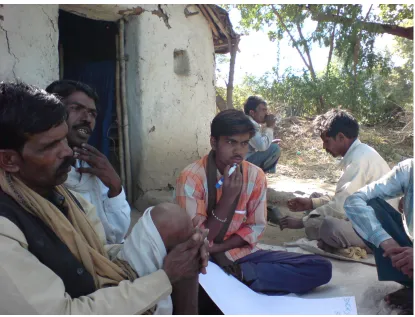
• Chapatti Diagramming. This technique was used by the researcher and participants to explore priorities about different types of information using an easily understandable metaphorThe technique uses paper circles of different sizes, which are called Chapatti, (the Indian bread) which is the main food item in central India. In an extended discussion, different types of information were mapped onto chapattis of different sizes. Large chapattis correspond to very high value information, smaller chapattis being less important. . The community members themselves made the chapattis and then sat in group to discuss their prioritisations. Figure 1 shows one diagramming session.
FIGURE 1 ABOUT HERE
• Focus group discussions. These specialized techniques were also combined with more general discussions using pen & flip-chart paper representations to discuss possible technology designs. At first some villagers were reluctant to take up the pen and write on the paper, preferring to draw diagrams in the sandy soil that could then be rubbed out, but as relationships between the researcher and villagers developed, they became more active and willing to contribute. Figure 2 shows one such discussion session.
FIGURE 2 ABOUT HERE
The researcher also spent time traveling to the villages with the agricultural advisor using contextual inquiry techniques to understand the role of the advisor in supporting agricultural information flow.
3.3 Telling users’ stories
In XP, each making cycle begins with a planning game where ‘user stories’ are written and prioritized. The stories are written in everyday language and describe interactions between a user and the technology to meet some user goal. Once the stories are sufficiently clear for both users and software makers, the makers estimate the time that will be required to implement the story, and the users prioritize the stories for implementation, given the budgetary and time constraints.
members of the research team and of the software implementation team. One concern was to ensure that the ordinary members were clear that the intention was to work on agricultural information flow, and avoid confusing this with the other concepts that had been discussed in the previous meeting. It was also important to discuss the proposed processes and cycles for software development.
During the workshop, participants worked in groups to imagine stories of their existing experience of information flow, and how they might use new technology to enhance this. Some example stories that were told are given below:
I am Pappu1 from the Kamlapur village. I sowed Soybean in 2 hectare with required quantity of seeds/bigha. It rained and only ¼ of the field germinated. It was a very dire situation and big loss. I don’t what I should have done.
I have got 1.5 hectare of land, I come from Gulabganj village and my name is Guddu. I sowed Urad (a kind of pulse) in June. In the early days the plants were not of good quality but as these grew it formed good shape but even then it didn’t give fruits/produce. I was not having any clue on this and was not having any mechanism to get timely information on this.
The results of this meeting were not in a form that the software implementers could immediately use to inform technology design. On the other hand, the high level of engagement of the community in the exercise was important in developing a shared commitment to the project as a whole.
3.4 Refining the concepts
In January, a second workshop was held, attended by a smaller group, including six directors, 11 ordinary members, the agricultural advisor plus researchers and programmers. This smaller group investigated information practices in more detail, and attempted to create detailed user stories for software design. The participants were supplied with stories from the previous workshop and asked to develop shorter and simpler stories, and identify key actors and roles. Again, the farmers found it difficult to grasp the task. The facilitators decided that it was futile to further pressurise the farmers around a task that did not make sense, rather the task was changed to be more focused and directional. The groups were rearranged and two larger groups discussed the information needs of agricultural practice, and the
problems and remedies in agriculture. In these topics, there were asked to identify the role and importance of different actors. The exercise identified a range of stakeholders and resulted in the creation of a set of personas. A key persona was that of Munna, based on the popular Hindi film character Munna Bhai, who is always helpful.
‘Munna’ would act as a contact point between the co-ops’ agricultural advisor and the members in the villages. Other key personas dealt with different farmers, the
agricultural advisor, and external experts.
Using these personas, the farmers were then able to act out user stories illustrating the kind of interactions that they hoped for. One such story is described below:
Munna is visiting Geeta’s field to monitor observe and give on site support
Geeta asking some questions, which Munna is reply as far his existing knowledge (using
pesticides and taking certain precautions)
Geeta says she has already tried those but in vain
Munna not aware of any the remedies, asking Geeta to hold for some time so that he
contact agricultural advisor
1
Munna contacted Rajesh explains the situation,
Advisor asked few more questions about the farmer/land/crop, which not aware
Munna called back to Geeta and called advisor again
Even advisor not aware of any solutions, refers to experts, they also don’t have a ready
made answer
On site visit of experts needed.
We noted in this story that the first point of contact would be the advisor in the co-op. Although the farmers were aware of external government agricultural extension services, they did not feel that these were providing the assistance that they needed. Instead, they preferred interactions with outside experts to be mediated through their own advisor. This finding is consistent with previous reports highlighting the
importance that farmers in other parts of India attach to personal and organisational trust in using advice services (Veeraraghavan et al., 2007; Srinivasan, 2007; Rajelekshmi, 2007).
Even this second meeting, over two days, was not able to generate user stories in a form that was immediately useful for software implementation. However, again it reached a few more co-op members and helped to develop a consensus about the purpose of the software.
3.5 Defining user interaction stories
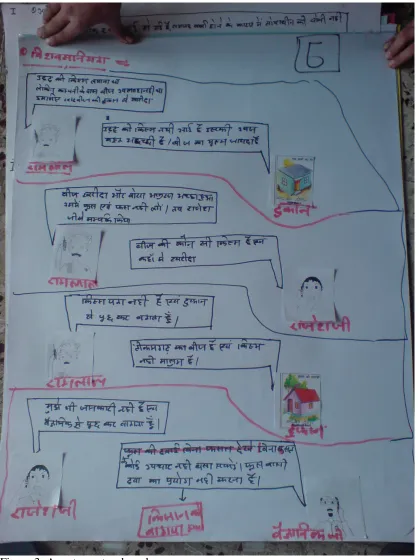
Following this second workshop, a small group drawn mainly from the directors of SCPCL, PRADAN plus two of the most active members of SCPCL met to translate the workshop stories into interaction scenarios that could be used to define software. We used a storyboarding method in this workshop. Small sketches were prepared to represent each of the personas from the previous workshop. Additionally, sketches representing relevant locations and crops were collected (e.g. village, house, field, SCPCL office etc.). These were photo-copied. The storyboards were then written as ‘cartoon strips’ where characters and locations could be represented by cutting and pasting, and the dialogue was written as ‘speech bubbles’. Figure 3 shows one such storyboard.
FIGURE 3 ABOUT HERE
Only after this stage was it possible to define software features in a way that was sufficiently precise for the software developers to begin development.
3.6 The software implementation cycles
by the planning workshop for the next cycle. However, on the first cycle, the initial delivery was not regarded as sufficiently complete to be usable in that form. As a result, this first cycle included two beta testing sessions. This gradual delivery,
together with the regular contact between the farmers and the software developers has helped to maintain the profile of the new technology project within the co-op.
The first cycle of implementation created a database for the co-op’s membership, the second implemented an interactive voice response system (IVRS) where
conversations between farmers and the advisor could be replayed by other farmers. The final two cycles concentrated on a means of sharing ‘short dialogue strips’ (SDS) which consist of a series of up to 6 photographs, and an audio track. These can be made by the Munnas in the field, and uploaded to a server using the mobile phone network (GPRS). The advisor can then watch these messages and respond with advice to the Munna, usually within 24 hours. This advice can also be appended as an audio track in the short dialogue strip that is stored on the server. This permits the
possibility of other Munnas accessing an SDS remotely using their mobile phones.
3.7 Deployment in the field
The final stage of software delivery was the recruitment of community members to act as Munnas, and the engagement of other community members to conduct a survey to populate the membership database. For the Munnas, recruitment was conducted with emphasis on younger co-op family members who had at least completed their education up to the age of 14. Selection was not an easy process. There were many people who wanted to become Munna so a selection process, consisting of a written test and a personal interview, was followed. However, it was necessary for the researcher and the CEO to work together to manage some conflicts post-selection. Five Munnas were appointed and trained to create the SDS using the mobile phones. Each Munna was given a territory of 5 villages that they were expected to cover. It was decided that the territory should not include the Munna’s home village, since this might cause some bias in the level of service offered to each village. The Munnas are expected to visit each village in their territory at least twice per week. An important issue currently is to ensure that the service provided by the Munnas is of a sufficient quality to meet farmers’ needs and to justify the salary that they receive.
3.8 Maintaining commitment from organizational leaders
When the project began field work, one person (Manju2) was both team leader for PRADAN in Sironj, and a director and Chief Executive Office (CEO) in SCPCL. Manju was an important ally in initiating and maintaining commitment to the project. However, we did not want to rely completely on Manju’s leadership. During the period of software development, Manju was offered a senior position in another organisation and left PRADAN (and SCPCL). When we discovered that Manju was planning to leave, we had to identify other sponsors within PRADAN and/or SCPCL, and obtain formal commitments to sustain the work after completion of the research project. We also realised, that there would be operational costs for the technology. In particular, in the first configuration of the system that was proposed SCPCL would need an ‘Agricultural Communication Specialist’ (ACS) – someone combining knowledge of agriculture with strong IT skills. With Manju leaving SCPCL the
2
agricultural advisor Ramu was promoted to CEO. This meant that he could not also be the ACS. However, there was no money in the research budget to pay this new
member of staff. It was necessary to persuade PRADAN and SCPCL to carry these costs. This process of negotiating agreements helped in gradually establishing more local ownership. In the new configuration, a senior manager acts as a project
champion within PRADAN, and Ramu acts as sponsor within SCPCL. Ramu will have a major influence on project outcomes, but the project has to compete with other demands on Ramu’s time and attention. The project has worked to lend support and advice to Ramu to develop his skills and confidence in his new role and to keep pace with the development taking place at the organisational level in an unobtrusive manner, whilst maintaining a back-up plan.
4. The current situation
When the first version of this paper was written for submission to the journal, the system has been in use in Sironj for 2 months during the Soya season. The five Munnas have been regularly posting 2 or 3 queries as SDS each week, as well as using the mobile phones to request verbal advice. During this time the Munnas improved their skills, particularly in obtaining higher quality photographs, making good audio recordings, and collecting background information about the farmer’s previous practices that were useful for the advisors. The advisors were dealing with between 5 to 10 queries per day and had built this into their daily routine. One was that the number of queries posted by the Munnas was quite low. It was suggested that the Munnas salary should be dependent on the number of messages posted, but this might simply generate extra messages that are not valuable for the farmers. Another option considered was to have the ACS create and distribute more general information to the Munnas, for example in the form of more detailed weather forecasts than are available from the radio, or information about agricultural innovations happening in Sironj or elsewhere. Another possibility was to for the Munnas to conduct some other functions for PRADAN in its interventions with the community, such as working as ‘postmen’ to report accounts from women’s self help group meetings to the PRADAN accountants.
Again, these concerns indicate how the ‘system’ must be understood as a complex socio-technical arrangement that involves not just financial and physical resources, but in particular the human and social resources of the Munnas and the ACS, their skills and their place within the community.
4.1 The new situation
We are currently installing the equipment and undertaking training in another location where PRADAN has developed similar co-operative agricultural interventions and is interested in how the technology could be integrated into their existing initiatives. An important distinction in the new location is that the project already has a number of ‘community mobilisation workers’ who are being paid from a government project to support interventions in the villages. These staff can thus take a role similar to the Munnas, without incurring any significant additional costs.
4.2 Mobilising assets
The experience of designing the technology and its usage within the co-operative illustrates the complex interactions of the different types of assets that need to be mobilised. Initially, our plans assumed that the primary goal was to mobilise physical resources in the form of appropriate software and hardware, and this was indeed necessary to deliver the system. However, the successful deployment of the wider socio-technical system required much attention to be paid to other asset classes.
The new system demands new practices from the Munnas and the farmers. The Munnas, the ACS or technician and the CEO required new skills to operate the technology. It is also important that the ACS and Ramu as the CEO respond promptly to queries from farmers and Munnas. The CEO and the ACS need to learn to use the database to plan the purchase of inputs such as seeds and fertilisers. Thus a range of new ‘human assets’ are being developed and mobilised through the design and deployment process.
At the same time, financial assets must be mobilised to create and maintain the system. PRADAN originally had to meet the salary costs of the ACS, and consider what how this new staff member fits with their other interventions in Sironj. In moving the technology to its new location, different cost arrangements have been considered. The producers’ co-op has to find resources for electricity supplies and office costs. In Sironj the telephone charges and the Munnas salaries were paid for by the research project, in the new location these costs can be borne by the government projects that PRADAN is engaged with, but in future years the co-op will need to find assets to meet these charges. The project has been working with PRADAN to explore alternative business models. A key element will be designing incentives so that the farmers receiving support from the Munnas make a fair contribution and reward good service, without making charges prohibitive. Discussions so far have indicated that an annual fee for the service may be preferable to a ‘pay as you go’ model, but these ideas need to be tested, and some mechanism for ensuring good service needs to be designed.
the Munnas and farmers, and seeking out external sources of knowledge that might contribute to the co-op and its members. Finally, the ACS and the CEO had to find ways to work together in collaboration. These activities are all examples of using and building up the social assets (or social capital) of the co-op as a community. In many ways, it was difficulties in aligning and mobilising these social assets, rather than any technical problems, that resulted in the eventual withdrawal of the project from Sironj. Ultimately, the goal of the activity has been to find ways for the co-op members to mobilise the local natural assets (land and rainfall) more effectively to support their livelihoods, but in doing so, all the other assets types and surrounding institutions have been implicated.
5. Reflections
It may be possible to read this paper as a recipe to guide interventions. This would be a mistake. The particular combination of techniques and activities that we used in Sironj is not a recipe. Instead, our experience should be understood as a particular response to specific conditions we encountered in one context. Other contexts are likely to require different specific techniques. Indeed, if we were to repeat the work in Sironj now, then there are aspects of the project that we might do differently. Some examples of possible changes are listed below.
• When we were conducting the story telling workshops and trying to reach a point of producing ‘user stories’ in a form that was usable for software design, we might have placed less emphasis on finding a simple representational format, such as using the cartoon storyboards. Instead, we might have focused on ensuring that the smaller group of SCPCL members and leaders were properly mandated by the larger meeting to work with the software designers on the precise detail of implementations.
• In this project, we used as our baseline the capabilities of current mobile phones and internet services, and developed software from scratch using the Symbian 60 mobile operating system and the Python programming language. This decision offers a particular degree of flexibility in how the technology can be reconfigured, but that introduces the challenge of helping the
participants to understand the levels of flexibility that are, or are not, possible. Kimaro & Titlestad (2008) argue for an approach where the scope for
adaptation of the ICT is more restricted to adapting pre-existing systems. It would be valuable to take the Sironj technology and examine the application of approach in other settings.
• During the design workshops, if resources were available, we would have added the occasional services of an experienced interaction designer to participate in workshops. The designer would support the embedded
practitioner and SCPCL in suggesting solutions, reviewing designs advanced by the technical team, and in communicating around technical issues. A key challenge throughout the project was mediating the dialogue between the software developers, the participatory practitioner and the co-op members. • Although we would still recommend delivering software in a sequence of
involved in adapting community behaviours and organizational processes can take longer than the production of new software.
The key the project’s outcomes should not be primarily attributed to the specific techniques that were used during designing, but to the overall strategy. The key elements of that strategy were:
• a deeply embedded participatory development practitioner working with the organizations and the community to integrate development of the organization, support for the capabilities of its members, and the design of the technology; • a readiness to negotiate the focus and goals of the project so that addresses the
intended beneficiaries’ understanding of their own needs and priorities, rather than imposing externally determined ideas of their best interests (which are almost always ill informed);
• incremental design and delivery of small pieces of functionality, allowing time for these to be gradually adopted and explored in the community context; • sustained effort to ensure inclusiveness and participation in the designing and
planning activities maintaining a shared purpose and vision;
• attention the human, social, physical, natural and financial assets of the community and to the structures and institutions operating in the community.
Perhaps the most important change we would make to our project would have been about the initial set up of the collaboration. When we initially formed the agreement to work in Sironj, it would have been helpful to follow up the exchange of letters with a more formal memorandum of understanding (MoU) between the research project, PRADAN and SCPCL, setting out explicit expectations and responsibilities on all parties. The NGOs had not previously worked with an ICT research project, and so (in hindsight) we should have expected differences in expectations about their role, and the project’s role. By working hard to establish very clear expectations in advance, we may hope in future to avoid some of the resource difficulties that arose after
deployment.
We now recognise that the project has been an effort in socio-technical
reconfiguration of a network of people, practices and organisations. Guiding such an activity involves close and continuous interaction with those people and organisations as much as it involves the design and development of new technical solutions.
Success or failure is critically dependent on mobilising and enabling these people and helping them to find ways of adopting and adapting ICT into their day to day
livelihood strategies. The technology must be adapted to their needs, but they also adapt their behaviours and practices to make effective use of the technology. ICT for development projects are efforts of organisational and communal change. To be effective as development interventions they need to be guided and facilitated from within the community, not by devising purely technical ‘solutions’ from outside.
6. References
K. Beck, 2000. Extreme Programming Explained, Addison-Wesley.
H. Beyer and K. Holtzblatt, 1998. Contextual Design: Defining Customer-Centered Systems. San Francisco: Morgan Kaufmann.
DfID, 2001. Department for International Development. Sustainable Livelihoods Guidance Sheets. Available from: http://www.livelihoods.org/info/info_guidancesheets.html#1
S Gardner, C. G. Ash, 2003. ICT-enabled organisations: a model for change management, Logistics Information Management 16(1), 18 – 24.
R. Heeks, 1999. The Tyranny of Participation in Information Systems: Learning from Development Projects. Working paper no. 4 in Development Informatics series, University of Manchester, ISBN: 1 9025 1820 9
N. Hildyard, P. Hegde, P. Wolvekamp, & R. Somasekhare, 2001. Pluralism, Participation and Power: Joint Forest Management in India. In, B Cooke & U Kothari (Eds.) Participation: the New Tyranny? Zed Books, London, pp. 56 - 71.
IDRC 2005. Participatory Research and Development: A sourcebook (volume 1). International Development Research Centre, Canada. Available on-line from http://www.idrc.ca
L. K. Johannessen & G. Ellingsen, 2008. Lightweight methods in heavyweight organizations. In J Simonsen, T. Robertson & D. Hakken (Eds.) Proceedings of PDC 2008. Indiana University Press, pp 11 – 20.
H. Kimaro and O. H. Titlestad, 2008. Challenges of user participation in the design of a computer based system: The possibility of participatory customisation in low income countries. Journal of Health Informatics in Developing Countries 2(1).
R. Layard, 2005. Happiness. Penguin, London.
H. Maturana and F. Varela, 1980. Autopoiesis and Cognition: the Realization of the Living. R. S. Cohen and M. W. Wartofsky (Eds.), Boston Studies in the Philosophy of Science 42. Dordecht: D. Reidel.
D. Mosse, 2001. ‘People’s Knowledge’, Participation and Patronage: Operations and Representations in Rural Development. In, B Cooke & U Kothari (Eds.) Participation: the New Tyranny?. Zed Books, London, pp. 16 – 35.
P. Oakley, 1991. Projects with People. The Practices of Participation in Rural Development. International Labour Office, Geneva.
T. Parikh, N. Patel & Y. Schwartzman, 2007. A Survey of Information Systems Reaching Small Producers in Global Agricultural Value Chains. In Proceedings of ICTD 2007, pp 334 – 344,. T. Parikh, P Javid, K. Sasikumar, K Ghosh and K. Toyama, Mobile Phones and Paper Documents: Evaluating a New Approach for Capturing Microfinance Data in Rural India, Proceedings of CHI 2006, ACM Press.
K. Rajelekshmi. E-Governance Services Through Telecenters: The Role of Human Intermediary in Issues of Trust. Information Technology and International Development 4(1) 19-35, 2007.
Y. Schwartzman and T. Parikh, Establishing Relationships for Designing Rural Information Systems, Presented at CHI 2007 Workshop on User-Centered Design and International Development (UCD4ID), April 28, 2007, San Jose, CA. Available from
http://people.ischool.berkeley.edu/~parikh/papers/schwartzman_ucd4id_2007.pdf A. Sen, 1999 Development as Freedom. Oxford University Press, Oxford.
J. Srinivasan. The role of trustworthiness in information service usage: the case of Parry information kiosks, Tamil Nadu, India. In Proceedings of ICTD 2007, p 345 – 352, 2007.
B. Törpel, 2006. The Design Game in Participatory Design and Design Education – Chances, Risks and Side Effects. In Procs of PDC 2006, ACM Press, 77 – 86.
D. P. Truex, R. Baskerville, and H. Klein, 1999. Growing systems in emergent organizations. Commun. ACM 42, 8 (Aug. 1999), 117-123
R. Veeraraghavan, N. Yasodhar & K. Toyoma, 2007.. Warana Unwired: Replacing PCs with Mobile Phones in a Rural Sugarcane Co-operative. Proceedigns of ICTD 2007, pp 89 –98.
Figure 1: A chapatti diagram workshop
[image:20.595.91.506.425.742.2]