programs in Nigeria : a capability perspective
DASUKI, Salihu, QUAYE, Ago MacGranaky and ABUBAKAR, Naima Hafiz
Available from Sheffield Hallam University Research Archive (SHURA) at:
http://shura.shu.ac.uk/17292/
This document is the author deposited version. You are advised to consult the publisher's version if you wish to cite from it.
Published version
DASUKI, Salihu, QUAYE, Ago MacGranaky and ABUBAKAR, Naima Hafiz (2017). An evaluation of information systems students internship programs in Nigeria : a capability perspective. Electronic Journal of Information Systems in Developing Countries, 83 (6), 1-19.
Copyright and re-use policy
See http://shura.shu.ac.uk/information.html
A
NE
VALUATION OFI
NFORMATIONS
YSTEMSS
TUDENTSI
NTERNSHIPP
ROGRAMS INN
IGERIA:
A
C
APABILITYP
ERSPECTIVESalihu Ibrahim Dasuki
Sheffield Hallam University United Kingdom
Ago MacGranaky Quaye
American University of Nigeria
Naima Hafiz Abubakar
American University of Nigeria
ABSTRACT
Most published research on Information Systems (IS) education in developing countries have focused on curriculum design, transfer and implementation issues. Research focusing on the evaluation of these programs and concrete analysis in terms of their long-term developmental impact have been limited. In this paper, Amartya Sen’s capability approach served as a theoretical lens for assessing the effectiveness of internship programs for IS students and their contributions to human development. We use the key elements of the capability approach to focus on the developmental impact. We based our evaluation on IS students industrial work scheme in Nigeria. Our analysis shows that, even though the scheme has been designed to further the development of student, the lack of conversion factors makes the program contextually problematic. The study concludes with some recommendations for policy makers advancing an agenda for the improvement of IS education and internships programs for students in tertiary institutions.
KEYWORDS
IS Education, Internships, Capability Approach, Developing Countries
1. INTRODUCTION
Information and Communications Technologies (ICTs) play a critical role in advancing socio-economic development and specifically the human capital development of a nation (Adedeji & Ayotunde, 2013). Governments of developing countries have adopted national policies that relate ICT-based education reform to socio-economic development (Kozma, 2005). Particularly the growth of IT industries and the more general use of ICTs for socio-economic development have resulted in the investment of IS education in universities of developing countries (Heeks, 2006). Most, if not all, Information Students (IS) degree curriculums contain an internship program where students are expected to gain work experience in the areas of information systems. The reason for the internship programs is to ensure that students are equipped effectively for prospective employment by answering to the education and training needs of industry and society (Venables & Tan, 2009). Previous studies have investigated the impact of internship experiences of IS students. These studies showed that the internship programs have helped students acquire adequate work experience and obtain career directions (Ali & Smith, 2015), and also acquire industry skills and knowledge (Bukaliya, 2012). Although a majority of these studies have been evaluated from a business and market perspective (Swanson & Tomkovick, 2011). Today, many universities in developing countries are offering internship programs as part of the requirements for graduating with information systems degree (Bass & Heeks, 2011).
have been enhanced for IS students as a result of their participation in internship programs. A Capability approach as used in this study essentially means adopting capabilities and functionings as an evaluative space for the assessment of inequality, poverty, and development. Such a perspective allows us to expose the multiplicity and complexity implied in developmental intervention, and to avoid the simplistic assumptions about the role of IS education for development. Viewing development as the expansion of human capabilities, IS students’ internship program is conceptualized as a means to achieving human development in which a whole set of conversion factors are needed to be in place. The conversion factors which have an effect on the agency freedom and wellbeing freedom of individuals is as important, if not more than ensuring the program is integrated into the IS education curriculum. These conversion factors go beyond conditions for the program to be effectively implemented and exploited. The conversion factors are conditions that enable people to do what they find valuable in their lives, with or without the internship program. Such capabilities included, for example, to be literate, to be able to be able to make choices in the lives and so on.
Within the discourse of ICT for education in development countries, there have been various attempts to operationalise the CA in order to understand the extent to which ICTs are expanding or contracting the capabilities of students. Within the IS curriculum in developing countries, internship programs are very significant and have the potentials of contributing to socio-economic development. However, to the best our knowledge, no studies has evaluated the contributions of these internships to socio-economic development. The rest of the paper is organized as follows. The next section reviews the relevant literature on the relationship between IS education and development. This is followed by a discussion on development, focusing on the concept of capabilities as the key concern of our study. We provide details of the capability approach and its application in ICT4D research. The research method, research setting and the analysis of the case are then presented. The final section concludes the paper and presents some implications for research and practice.
2. LITERATURE REVIEW
2.1. IS Education and Development
development is largely anecdotal (Wieble, 2009). Powell (2012) takes the argument further by stating that current dominant conception of internship programs within education curriculum is not the solution to Africa’s development challenges and is certain to suffer if the social, political and economic context is not taking into account.
IS education for economic development is highly implicated in our conceptualization of development (Sein & Harindranath, 2004), that is, the approach to economic development influence the design and implementation of IS student internship program within the curriculum, and unless the contextual dimensions is consistent with the notions of development, the anticipated impact might not follow. McGrath (2012) suggest a reconceptualization of the notion of development which, to various extent, critique and surpass the dominant economic frameworks in which internship programs with the IS curriculum are currently located. It is here in this reconceptualization of the notion of development and the role of IS internship programs within this notion of development that this paper is located. Even though the empirical focus of this paper is the Nigeria context, particularly IS students’ participation in the internship program, the paper is situated with the broader debate on the role this internship program plays in contributing to socio-economic development of developing countries. Furthermore, within the context of understanding the contributions of ICTs to economic development in African countries, Thompson and Walsham (2010) highlighted the lack of development focus of the majority of IS research in the African region. They argue for more research on the role of the education sector in promoting economic development using ICTs. An increase in research with a developmental focus would further provide policy directions on how IS can serve more strategic and broader developmental goals that are present in the majority of the literature on IS in developing countries.
2.2. Development Discourse
Understanding the research domain of ICT4D is incomplete without unraveling the meaning of development. The notion of development in the ICT for development literature has been highly debatable; all centered within three major discourses name modernization, dependency and human development (McGrath & Maiye, 2010). The underlying assumption in the modernisation perspective of development is that lack of economic growth is due to knowledge deficiencies. Development, understood from this perspective, highlights that in order for poorer nations to attain economic growth, they need to pursue the route already adopted by developed nations. Here technology is perceived to be a catalyst for industrialization or an industry with dominant emphasis on how technology can lead to competitiveness and productivity (Zheng, 2009). The dependency approach, on the other hand, argues that the mechanism that results in economic progress and growth of developed nations leads to the under-development of poor nations. According to Nicholson et al. (2016), these poorer nations are mostly colonies of the development nation which are subjected to technology and industrial dependency and are usually caught up in the debt trap and negative terms of trade. For example, it is often noted that IT manufacturing and offshoring are specifically done to meet the needs of developed nations at the detriment of poor nations (Sein & Harindranath, 2004). Both the modernization and dependency theories to development see innovation and industrialization as the primary means to economic development. The literature is unable to uphold that technology and industrialization indeed result in economic growth in poorer nations (Avgerou, 2003).
wider participation in politics and decision-making processes, have easier access to job opportunities and progressively improve the quality of their environment. Over the past two decades, the United Nations Development Program (UNDP) has adopted the human development approach that focuses on the expansion of human freedoms both as the primary end and the primary means of development (Sen, 1999). The human development approach sometimes referred to as the capability approach (CA) focuses on freedom concerned with the real opportunities people have to accomplish what they value. In this study, we are interested in the human development approach which focuses on the conditions under which IS student internships can be transformative in human development; the ways in which IS student internship can be converted into capabilities that will improve the freedoms of people to live better lives. Normally, the development discourse has been relatively conservative with an emphasis on outcomes that are measurable, quantifiable, and generalizable. Most research on IS in developing countries are often explicitly or implicitly driven by development agendas focusing on market and economic outcomes (Zheng, 2009). As many universities in developing countries introduce information systems degrees with internships into their curriculums, the students become contributors and beneficiaries of economic developments. Thus, we argue that IS education for development discourse requires a socio-cultural understanding of development beneficiaries. This paper adopts the view that if IS education is properly conceptualized and adapted to the cultural and local context (Rislana et al., 2016); development agendas inscribed with the curriculum can be further enhanced. The next section discusses the relationship between IS education and development.
2.3. Capability Approach and IS in Developing Countries
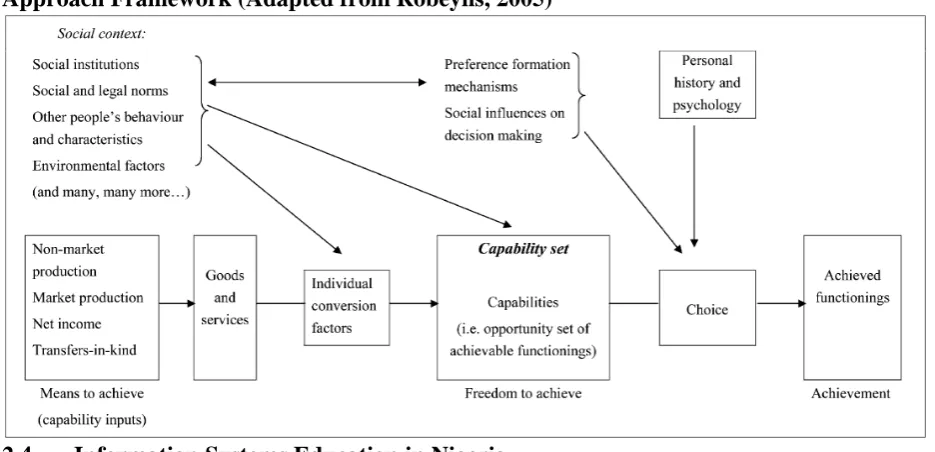
The capability approach (CA) is a broad normative framework for evaluating the social change in terms of enhancement of individual wellbeing (Sen, 1999). Sen’s CA specifically critiques the functional and opulence approaches to development that usually dominate the discourse on economic development. The CA concentrates on “human freedom” which largely refers to the effective opportunities people have to achieve wellbeing. The CA is essentially concerned with two important notions namely “functionings” and “capabilities”. In Sen’s (1999) language, “functionings” are beings and doings that people value for example being employed or literate, and “capabilities” are the freedoms people have to achieve a set of functionings. In other words, the crux of economic development should be people’s freedoms to lead the lives they value. An important aspect of the CA, which is vital to understanding the developmental impact of IS internship programs is the separation surrounding commodities (goods and services), capabilities and functionings (beings and doings). The approach values the importance of commodities in improving human wellbeing. As such, a link exists between commodities and capabilities, and in order to achieve and sustain functionings, a number of commodities are required (Alkire & Deneulin, 2009). The ability of an individual to choose amongst capabilities is influenced by conversion factors. Three categories of conversion factors are identified: personal conversion factors comprising sex, reading skills, intelligence; social conversion factors including power relations, social norms, public policies; and environmental conversion factors such as the climate, geographical location (Robeyns, 2005). Furthermore, Sen (1999) noted that achieved functionings are based on an individual’s personal choices which are influenced by various decision mechanisms. Lastly, commodities are the vital means and not end to wellbeing (Robeyns, 2005). The different concepts of the capability approach and the role that commodities have to play in enhancing capabilities as schematically shown in Figure 1.
operationalizing for development practice and research (Kleine, 2010). Sen (1999) acknowledges that CA has been intentionally underdeveloped so that it can be applicable for a wide range of purposes. Despite the criticism of CA, Coelho et al. (2015) argue that CA provides a strong theoretical lens for evaluating IS interventions. Viewing development as the expansion of human freedoms to achieve functionings, IS interventions can be regarded as a commodity or means to achieve the goal of the development process. There has been an increasing application of the CA by using this basic concept in IS in developing countries research. Researchers have made attempts to operationalize the CA to gain a better understanding of the implications of ICTs in development. Sen himself (2010) discusses the role of mobile technologies in enhancing people's freedoms across the globe. Research applying Sen’s ideas to understanding the role of IS can be classified into two groups. One group has empirically operationalized the CA. These studies have drawn on the concepts of commodities, capabilities and functioning to shed light on the values of ICT and the process of assessing them from a development perspective (see Dasuki & Abbott, 2015; Hatakka & Lagsten, 2012; Klein, 2010). The other group examined various angles in which CA can shed light on discussions about design, social justice, and equality in IS (see Oosterlaken, 2009; Zheng & Stahl, 2011; Zheng, 2009). Despite the immense potential of CA, there has been a slow uptake in it as a theoretical basis for IS in developing countries research (Coelho et al., 2015). Heeks (2009, p. 23) noted that “understanding how IS can facilitate the realization of development as freedom is a yet unfulfilled task” (p. 23). As such, this study attempts to contribute to the literature by operationalizing the CA to understand how contextual factors enables or restricts individual capabilities in IS student internship programs. The following section discusses the research methodology adopted in conducting the research.
Figure 1 A Stylised Non-Dynamic Representation of the Concepts of the Capability Approach Framework (Adapted from Robeyns, 2005)
2.4. Information Systems Education in Nigeria
[image:6.595.71.539.425.651.2]development of appropriate ICT curricula in all levels of education. At the same time, the government has identified education as a key priority area in its development process. Section 18, sub-section 1 - 3 of the 1999 constitution states inter alia: (1). Government shall direct its policy towards ensuring that there are equal and adequate educational opportunities at all levels; (2) Government shall promote science and technology; (3) Government shall strive to eradicate illiteracy and to this end, government shall as and when practicable provide: (a) Free, compulsory and universal primary education, (b) Free secondary education.
Thus Nigeria presents a good example of a developing country in which the use of ICTs in education is a top priority of the government. The promotion of science and technology in the education sector is in line with the provisions of the revised National Policy on Education (NPE, 2004), which states: (a) A greater proportion of expenditure on university education shall be devoted to science and technology; (b) Not less than 60% of places shall be allocated to science and science-related courses in the conventional universities and not less than 80% in the universities of technology (Section 55, a - b). Currently, there are 129 universities in Nigeria which include 40 federal universities, 39 states universities and 50 private universities. The federal and state universities are public universities funded solely by the government. The National Universities Commission (NUC) which was established in 1962 is the sole accreditation body that enforces uniform standard and sets admissions capacity of every university in Nigeria.
Both private and public universities in Nigeria offer Information Systems as a four-year degree program. Currently, about 99 of these universities have been accredited and approved by the Nigeria University Commission (NUC, 2012). To study Information Systems in any of the university, a student is required to have a minimum credit level passes in five subjects include Mathematics, Physics, and English to constitute the core subjects with credits in any vital science subjects in O levels or its equivalents based on the NUC’s benchmark minimum academic standards (BMAS). In the third year of the program, students are required to undertake the module “Industrial Training” which is a course within the curriculum that is designed to expose or prepare students in higher institutions studying Information systems for practical skills. These learning experiences take place in both private and public institutions.
3. METHODOLOGY
In order to analyze the benefit when operationalizing the capability approach, we analyze a case of IS students participation in an industrial experience scheme in Nigeria. A broadly interpretive approach was adopted in this study (Walsham, 2006) and was based on interviews and focus groups with students of a private university in Nigeria.
3.1. Participants
The participants from the study are undergraduates’ students of the department of Information Systems in a private university in Nigeria. These students are enrolled in a four-year degree program in Information Systems with five main concentration areas namely: Management Information Systems, Applied Networking, Software Applications Development. Database and Web Database, and Information Security and Assurance. It should be noted that the students chosen to take part in this study are students that have undertook or are undertaking the Students Industrial Work Experience Scheme (SIWES). The SIWES program was for a period of 3 months. SIWES was established by Industrial Training Fund (ITF) in 1973 to solve the problem of lack of adequate practical skills prerequisites for employment in industries for graduates of tertiary institutions in Nigeria.
policy of government (ITF, 2014). The reason for choosing students who either undertook or are currently undergoing the SIWES program was that (1) they have either used IS tools in their places of employment and education, and (2) we get access to students with different job roles and backgrounds. One of the authors of this study played the role of both a lecturer and researcher even though it could result in bias since this author was a lecturer to many of the students. However, since the questions were on the benefits of the internships to the lives and the challenges there faced when participating in the program, all participants were able to discuss with us freely without any issue. The study took place between June and July 2015 and a total of 49 students were selected. The sampling strategy adopted in this study was criterion sampling, in which each respondent met some set benchmark of importance (students must either be currently undertaking the SIWES program or must have completed the program).
3.2. Data Collection Method
Interviews were conducted with 49 of the students. The student respondents included in this research were a small, purposeful, nonrandom sample that may influence the generalizability of the results. However, the design of this study is intended to provide insights on issues that affect the individual wellbeing of students involved in the SIWES program. Out of the 49 students involved in the study, 23 were selected from students who had completed their SIWES during the Spring 2014/2015 academic year and 26 who were still undertaking the scheme during Summer 2014/2015 academic year for interviews. The 23 students were all in the 3rd year of university and the other 26 students were all in their final year of university. 31 of the students were males and 18 were females within the age range of 19 to 21 years of age. And also a focus group of the whole participant population was conducted on two different occasions. In both interviews and focus group discussions, we asked students about their experiences in the SIWES scheme and its impacts on their lives. Each interview lasted approximately between thirty minutes to one hour and was conducted within a month during the research field work. A timetable for the interview was developed with the chosen students who provided the time and location of the interview. The interviews were usually conducted in the staff lounge of the faculty. Usually, students undertaking the SIWES programs are in the university every Friday from 4 pm to 6 pm for a compulsory zero credit English language class to help improve their English communication skills. The authors’ took advantage of this class on Friday to organize a focus group with the students immediately after the class and also invited the older students who had completed their SIWES program. Two focus group sessions were organized and these sessions lasted for about one to two hours. During the focus group sessions notes were been taken by one of the authors. Participants in the study were asked probing follow-up questions on new and emerging topics as well as given opportunities to raise any other issues they considered relevant.
Commodities: which features and artefacts resulting from IS internship did students utilize to enhance their capabilities.
Capabilities: Which capabilities can be enhanced as a result of IS students participation in internship
Conversion factors: which conversion factors - personal, social and environmental - that enable and/or restrict students from transforming the internship programs and its features into capabilities.
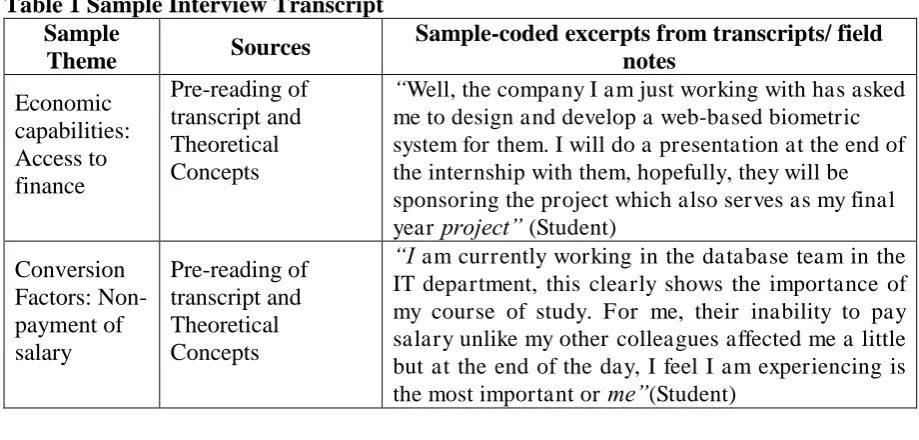
[image:9.595.70.530.447.667.2]The process began with meticulous reading and re-reading of the interview transcripts in order to gain an overview of the main themes discussed by the participants. This allowed, in the first instance, the classification of similar material and insights to be captured. Next, a set of themes were generated and mapped against the capability approach framework, but with careful consideration given to emergent topics. Also, field notes taken during observations were analyzed using codes that were the same as those used for the participants. Significant quotations and relevant themes from the transcripts are described in Table 1 to clarify the coding exercise. Thus the findings of the student as shown in the following section are reported not on an individual level but rather on grouped level. The reported results are therefore the combined capabilities and conversion factors from the student population used in the study and each entry is not applicable to all students since they all had different experiences and outcomes from participating in the SIWES program. Trustworthiness and rigor of the collected data were established via triangulation of the various sources of data (interviews and focus group). The use of triangulation allows us to cross-check information of multiple viewpoints in order to ensure authenticity and validity of findings. Also, triangulation helps us to present a more accurate and complete analysis of IS student experience in the SIWES program.
Table 1 Sample Interview Transcript Sample
Theme Sources
Sample-coded excerpts from transcripts/ field notes
Economic capabilities: Access to finance
Pre-reading of transcript and Theoretical Concepts
“Well, the company I am just working with has asked me to design and develop a web-based biometric system for them. I will do a presentation at the end of the internship with them, hopefully, they will be sponsoring the project which also serves as my final year project” (Student)
Conversion Factors: Non-payment of salary
Pre-reading of transcript and Theoretical Concepts
“I am currently working in the database team in the IT department, this clearly shows the importance of my course of study. For me, their inability to pay salary unlike my other colleagues affected me a little but at the end of the day, I feel I am experiencing is the most important or me”(Student)
4. DATA ANALYSIS AND DISCUSSION
enable or restrict the students from transforming the SIWES scheme into capabilities are presented.
4.1. Commodities
Here, we discuss the type of resources the students used during the SIWES program. The student’s resources are categorized into education resources and work resources. For educational resources, the students had to use resources such as video tutorials, eBooks, academic websites, and journal publications to learn about any new technology or increase their knowledge about existing information, software or hardware. The students use the internet to find all these materials, that is, Google, Google scholar, YouTube and other social media platforms and websites. For work reasons, the main tools were software in areas of networking, database, web programming and modeling. Hardware included laptops, desktops, servers, routers, and cables. Also, many of the students got supportive education such as training on how to go about their job roles. Also, all of them had to attend an English communication skill course which can be identified as a supportive education too.
4.2. Social Capabilities
From a social perspective, the SIWES program has several outcomes in relation to the students’ education. The SIWES program provided the students the opportunities to apply theory and practice gained during their academic context, and to appreciate the significance of their degree program. Some students noted that the internship experience is totally different from the tutorials and cannot be replaced by tutorial sessions.
“Although we were taught crimping of network cables during our networking course; In my internship I am part of the networking team of the ICT department of the National assembly, apart from crimping RJ45 cables, we have been laying fiber optic cable, setting up, testing and implementation of routers and the whole networking infrastructure of the complex, it’s an experience beyond what I have been taught at the university”
Many of the students found their SIWES experience to be an affirming one. Due to the practical experience they had gained especially in the areas of networking and programming, a lot of their juniors usually called on their help for practical classes they were having challenges. One of the students noted that the opportunity to help his classmate has boosted his confidence and made him recognize how much he could offer back to the society. As such, he developed a practice of supporting his junior classmates by offering programming workshops every Sunday evenings. Having invested a lot of him time and resources helping his fellow students, the student is now considering becoming a lecturer in future which is completely different from being an IT project manager which was his initiate idea of getting a degree in Information Systems with a concentration in project management.
“It was my experience in my internship that helped me very much for my final year project. I used the experience I gained in developing a web application using Object C to prepare for my research methods proposal. I actually did very well in the course”
One of the students just like many others discussed on the ways in which participating in the SIWES program has changed his confidence, self-respect and the respect his dad had for him. He discussed the contribution of the SIWES program to his life as helping him move “from being hopeless to hopeful”. He describes how his experience in the internship program has changed his relationship with his did which in the past had been awkward and tense to a relationship of esteem:
“Since attending the internship program, I have improved my programming skills.I now do little software development jobs…I no longer ask money from my dad..you can imagine I’m 32 and still depend on him due to my stubborn past where I had to drop out from university but since the internship experience it’s a different ball game.., he now believes in me”
Just like self-respect, their students also mentioned how participating in the program has helped them shift from completely depending on the instructors to been self-learners. During the internship when students face problems in their work roles, they learn new ways of solving these problems through self-learning by going to the internet or asking colleagues instead of asking their lecturers. The program gave students the opportunity to develop their teamwork skills, interpersonal skills and also the ability to learn how to learn.
“I was having this exception handling problem in Java, but I couldn’t call the lecturer because it will seem like I didn’t learn anything or he didn’t teach us anything. Also not to embarrass my university and myself in front of my supervisor, I had to do extensive self-learning and also relate with the other two software developers. It has really been a self-learning experience and I have made myself proud”
Students undergoing the SIWES scheme are required to attend a communication skills course at the university on Fridays. Fridays are usually working free day for students on internship. At the end of the term, these students are required to take exams for the course. By attending this course, many of the students learned to give presentations and take part in meetings with clients, colleagues, and suppliers and improve their business writing skills. The student's participation in the internship program also allowed them to move beyond the Bachelor of Science qualification which they were working towards to achieve. Many of participants having gone into their respective organizations have either met clients or colleagues who have IT certifications in areas of project management, business analysis, database management and networking. Many of the students indicated their interest in these certification courses:
4.3. Economic Capabilities
The SIWES program provided the students the opportunity to gain economic advantages. Most prevalent is for earning a salary for an extended period of time. The majority of the students discussed the financial rewards of the SIWES scheme and the associated implication of reducing overall student debt. The majority of the students were receiving about 10000-15000 Nigerian Naira which is equivalent to 61-93 US dollars stipend each month. Many students were able to pay off accumulated debt, reduce hardship and even save up for the final year as shown in this quote:
“I damaged my computer twice which my mom paid and then, later on, I mistakenly broke my laptop screen. My mom didn’t agree to pay for such anymore, but with the money I made from SIWES, I have been able to fix the screen and that’s the same laptop I am using for my final year software development” (Student)
The SIWES program also gave the student participants the opportunity to earn potential sponsorship for their final year project. Some the companies saw this as an opportunity to interface with students and explore solutions to business challenges; hence return in investment that will exceed the initial cost from an external consultant. Final year projects in the university are usually carried out during the final year stage of the student and are developed under the direction of the project supervisor and members of the sponsoring organization. Interviews and focus group sessions indicated that 8 of the student participants were being sponsored for their project.
“I am developing a hotel management system for the hotel where I did my internship. They are the ones sponsoring the project, so I can say they are my client although I get supervision from the university since it’s my graduation project but the complete solution goes to the hotel” (Student)
“Well, the company I am just working with has asked me to design and develop a web-based biometric system for them. I will do a presentation at the end of the internship with them, and hopefully, they will be sponsoring the project which also will serve as my final year project” (Student)
Many of the students also learned how to write proposals for advertised ICT jobs. Some of the participating companies are major beneficiaries’ of government contracts. Thus some of the participating students were involved in the writing of job proposals and bids for government jobs. A student puts it thus:
“During my Internship, I was informed by boss about the networking project at Ministry of Justice. I did all the write-up and proposals for tendering. However, while in school after completing the internship, I was called by my boss that we got the job, so he thanked me and took me for lunch”(Student)
of working in the Central Bank of Nigeria (CBN) and that the internship program provided him with this opportunity. According to him:
“I have always wanted to work in CBN all of my life. It so difficult been an employee there especially if you don’t know any of the directors.Now I have the opportunity to be a CBN staff for a short period because that was the organization I was sent to for internship. I was lucky to be selected though because other students were rejected due to quote”
The student speaks with pride of not only been an intern of CBN but also with pride at the job role of about been a junior software engineer. When probed about how he felt when he tells his friends he is an intern at the CBN, he stated: “I simply tell them I am a lead junior software developer at CBN”. His pride at being at being an intern at CBN was also shared by another female student was working as a webmaster at Mobil. When asked about how she feels about being an intern, she says “ I am proud of being an intern, because it's so much of learning than just been in class...Putting my fingers in new projects every day”
The students not only shared this pride alone, so did their families. According to one of the students who was an intern in her father's company, she noted that:
“I developed a hotel booking system for my dad’s hotel because he always complains of his staff stealing money by not documenting some transactions…he now brags about it, he has told all his friends and he keeps telling more. Sometimes I feel shy”
The ability of the students to move beyond the qualification of their parents was one of the reasons for this pride. The same student that developed the website for her father's hotel noted that:
“My dad told me during their time they never heard this practical experience such as the internship program and I should take advantage of the opportunities they never had during their time”
Also, many of the students were able to create a list of industry contacts and subsequent job opportunities.
“I attended the Institute of Software Practitioners of Nigeria consortium in Abuja with my job supervisor and I got the chance to meet people from HUAWEI, MTN, GLO, MTN, IBM, OMATEK and every big IT and telecommunication company in Nigeria. Some of the people I met asked me to call them or email them after my graduation”
4.4. Conversion Factors
The majority of the students revealed their desire to serve as interns in firms or organizations that pay. However, not all the students were paid any remuneration during their internship as was the case for students serving in public institutions. One of the students noted that:
“I am currently working in the database team in the IT department, this clearly shows the importance of my course of study. For me, their inability to pay salary unlike my other colleagues affected me a little but at the end of the day, I feel experience is the most important thing for me”
While the majority of the students agreed that making money shouldn’t really be their goal, they still found money to be significant in the areas of transport and feeding during the program. The Industrial Training Fund (ITF) is the public agency in charge of the SIWES program across the country. In 2013, the Director-General announced that the government was facing a shortage of funds and as such won’t be able to pay students embarking on the scheme in public institutions (DailyTimes, 2013). This director also noted that the lack of remuneration to students was due to the increasing number of students embarking on the program, which the government could not cater for (Oyeleke, 2013). Socioeconomic inequalities are exacerbated by unpaid internships since they reduce opportunities for the students working in public institutions, and they raise the question of equal access to opportunity.
Another issue that had an effect on the students SIWES program was their inability to find companies on time with some taking up to one month before they could get a company to embark on a program that is supposed to be a three-month program. Many of the students were rejected by potential employers before getting a place for SIWES. According to one such student:
“I went to four places before I was actually accepted for SIWES. Many of the companies usually told us that they either didn’t employ interns or did not have places for interns even if you told them it’s an unpaid intern. I later got a place where my father’s friend worked”
Many of the students got their workplaces through friends and families while somewhere recommended by the school. Those who were facing challenges finding places were absorbed into the IT department of the school. However, it should be noted that unemployment is one of the most critical problems facing the country. The majority of the graduates usually get employed through friends and family, a concept known as “man -know-man” or nepotism (Akingbade et al, 2010). Man-know-man is somehow considered as the norm in Nigeria and those that are unwilling to support friends and relatives are usually considered as enemies and have no place in the society (Akingbade et al, 2010).
As noted earlier, students undergoing the SIWES scheme are to attend a compulsory English course scheduled for Friday in order to improve their business communication skills. However, the compulsory English courses forced the students to undertake their SIWES program in companies located in Abuja thus depriving them opportunities of doing their internship in bigger telecommunication companies which usually had their headquarters located in Lagos, the business capital of Nigeria.
firm, where I am not really doing much. You can imagine the vast experience I would have if I had gone to a company like Google”
The English class not only deprived the students the opportunity to look for an internship outside Abuja but also deprive the students the opportunity to travel outside the Abuja market for external projects.
“Where I was working, we were supposed to travel over the weekend to monitor one of the company’s projects in Kano, because the company was implementing a university management system. But because of the Friday class, I was unable to go with the project team, I am sure I missed a lot by being absent”
Social arrangements and institutions also had an effect on the SIWES program. The main enabler or restriction was related to the infrastructure of the employers. The private organizations involved in the SIWES program all had IT departments that were properly equipped with the relevant IT infrastructures. Most students doing the internship at such institutions were involved in various ICT projects involving databases, networking, and web development and so on. However, the majority of the students who worked in the public organizations complained about the lack of infrastructures and technology tools to get hands on experience. Many of the students felt they were not gaining technological skills by working in public institutions since the majority of their workplaces were manually inclined:
“Since I started my internship, I haven’t been doing much work during my SIWES program because there is really nothing for me to do. Although I have been assigned to the IT department, I haven’t been doing much really. We only have two computers and a printer for word processing. Mostly all I do is make tea for my boss, buy newspapers or do some typing and printing...I am more of a secretary”
In Nigeria, the public sector has been characterized with inefficiency due go its inadequate funding, poor infrastructure, and the unconducive working environment. Ojo (2014) noted that the Nigerian civil service has not been able to implement ICTs effectively into its public service delivery. He argues that all their operations are manually done with limited exceptions. The use of computers, e-mail, and other ICT tools for maximum performance is still limited. Files are still being pushed from one physical tray to another when such communications could have been done via e-mail. Also, poor work supervision could be a factor affecting the students in the SIWES program. Some of the students were given job roles without proper supervision, training, and guidance:
“Immediately I started work, I was told to start using Matlab for some mathematical modeling on something the agency was doing a research on. This is not even related to my field of studies. I was never trained on this software and even my own supervisor didn’t know anything about it, he couldn’t use the computer properly. I had to spend extra hours learning the basics…I was disappointed”
certificates. Indeed, if any verification of claimed qualifications is to be undertaken in the public sector, many job positions would be left unfilled. In summary, the findings of the study showed that students that undertook their internship in the public sector were faced with more challenges than their counterparts in the private sector during their SIWES program.
Table 2: Summary of the Case Study Analysis Using Concepts of the Sen’s Capability Approach
Commodities Conversion Factors Capabilities Educational resources
Video tutorials eBooks
Academic websites Journal publications Google
Google scholar
YouTube and other social media platforms and websites
Work resources
Software Hardware
Supportive education
Personal
Literacy Interest Motivation
Social
Work support and supervision Incentives
Environmental
Availability of companies providing internship opportunities
Location
Company infrastructure and support
Job availability
Economic Capabilities
Opportunities to earn money Opportunities to earn
potential sponsorship for their final project. Opportunities to bid for
government ICT contracts Provided better career
choices.
Opportunity to pride
themselves in their job roles Opportunity to gain
competitive advantage over other graduates
Opportunity to earn money Job opportunities
Opportunities for a fulfilling job
Opportunities to plan career
Social Capabilities
Opportunities to access practical knowledge Opportunities to
improvement academic performance
Opportunities to expand knowledge and be self-confident
Opportunity to advance in higher education
Opportunities to help fellow classmates in learning. Opportunities to be
self-dependent
5. DISCUSSION
confidence. The respondents are far more than students that are simply looking for the opportunity to access the labor market and earn some income but rather an opportunity to attain self-respect, pride, dignity, and social empowerment. Using the CA as a theoretical lens, the study shows that for the students it’s not just about participating in the SIWES program, but rather the opportunities presented by the program that contributes to their freedoms to live better lives. The value of the CA in this study for understanding the contributions of SIWES program is very promising. The CA provided a more grounded, multidimensional, and contextual framework for conceptualizing and assessing the impact of internship programs which distinguishes from the dominant traditional approaches that focus on economic indications such as employment and income ratios. The CA framework does so by moving beyond the dominant focus on economic growth to human capabilities.
The shift in emphasis on human capabilities has implications for studies understanding the relation between IS internship programs and human development. Firstly, and as illustrated in the case study, the methodological implication and conceptual framework of the CA resulted in empirical evidence which critiques the dominant approaches to understanding the impact of internship programs that focus on employability as portrayed in the literature. Subsequently, the application of the CA framework draws up vital questions about the needs of IS students participating in internship programs; the extent to which their needs are been taken into consideration and lastly the contextual factors hindering the students from meeting these needs. The CA framework with its focus on individuals’ wellbeing challenges policy makers and researchers to place emphasis on the implications of internship programs on students’ freedoms to live valuable lives. The application of CA to this study opens up questions on the purpose of internship programs as a result of the shift from human resource development to the enhancement of human well-being.
Also, the CA framework highlighted the fact that rather than maximizing access to employability to IS student using the internship programs in the education sector such as the SIWES scheme, these interventions should take into account the needs of the students in order to enhance both their well-being and agency freedom In this study, the non-payment of salary to some of the students resulted in the capability deprivation of the students to earn money to support themselves. The poor infrastructures and governance gave rise to the capability deprivation of some of the students to engage themselves and acquire the relevant skills at their workplace. Lastly, the agency of the students was not properly given attention. In other words, during the design of the SIWES scheme the students were not involved, nor were their local needs properly accounted for to make it meaningful to them, For example, their needs of wanting to carry out the SIWES program in companies outside the capital territory were excluded, hence students were forced to look for companies in the capital hence depriving them opportunities to work in other companies located in other cities.
6. CONCLUSION
In this paper, the authors evaluated the development impact of the IS students industrial work experience scheme in Nigeria. The study was informed by Sen’s (1999) capability approach, which was used to highlight the conversion from commodities to capabilities. The findings of this study show that internship programs can contribute to improving the lives of students in developing countries but only if development is conceptualized in a multi-dimensional context. Following this approach to development, the contribution of the internship programs within the IS curriculum should not focus solely on getting working experience and employability but also the freedoms afforded to these students to live a fulfilled life. These central capabilities include not only the freedom to work and be employed, but also other capabilities such as social empowerment and freedom to live a life the students have reason to value. This indicates the need for more studies that explore how internship programs could improve socio-economic development. Using CA as a theoretical lens the study contributes to the growing literature on the use of CA in IS research in developing countries, particularly in the evaluation of IS developmental interventions and how contextual factors unique to developing countries such as Nigeria enable or restrict development.
This study has implications for education policies guiding internship programs in developing countries and Nigeria in particularly, of which are both geared towards temporary access to employment. The current traditional policies guiding internship programs with the IS education curriculum in developing countries assume that increase in access to employment and income will ultimately reduce poverty. However, this assumption is problematic, as having employment does not necessary mean having a sustainable income or livelihood. The CA, on the other hand, broadens up this discussion by shifting attention to the focus of income and employability to the degree to which the IS internship programs were enhancing or depriving the freedoms of students live a valuable life, many of which have been a highlight in this study.
Finally, for Nigeria to achieve success in the students’ SIWES scheme, there is the need to shift beyond the introduction of the program for merely gaining work experience to pay attention to the cultural, institutional, social and political context, which should serve to enhance people’s freedom to participate in social, political and economic activities. In suggesting the potential for future research, the limitation of this study is recognized as follows: it was limited to only a single focused case study and was undertaken under time limitations. However, this provides scope for a longitudinal study on the basis of the current results to provide more insights on developmental issues concerning student participation in industrial work scheme programs.
7. REFERENCES
Adedeji, O.S. & Campbell, O.A. (2013). The Role of Higher Education in Human Capital Development.
Akingbade, A.O., Navarra, D.D. & Georgiadou, Y. (2010). The Impact of Abuja Geographic Information Systems on Corrupt Practices in Land Administration in the Federal Capital Territory of Nigeria. In Proceedings of the Workshop of the International Federation for Information Processing.
Ali, A. & Smith, D. (2015). An Internship Program at a Computer Science Department - Theoretical Foundation and Overall Coordination. Issues in Informing Science &
Information Technology, 12, 1-10.
Avgerou, C. (2003). The Link Between ICT and Economic Growth in the Discourse of Development. In Korpela, M., Montealegre, R. & Poulymenakou, A. (Eds.). Organisational Information Systems in the Context of Globalization (373-386). Boston: Springer.
Bass, J.M. & Heeks, R. (2011). Changing Computing Curricula in Africa Universities: Evaluating Progress and Challenges via Design-Reality Gap Analysis. The Electronic Journal of Information Systems in Developing Countries, 48, 5, 1-39.
Bukaliya, R. (2012). The Potential Benefits and Challenges of Internship Programmes in an ODL Institution: A Case for the Zimbabwe Open University. International Journal on New Trends in Education and Their Implications, 3, 1, Article 13.
Coelho, T.R., Segatto, A.P. & Frega, J.R. (2015). Analysing ICT and Development from the Perspective of the Capabilities Approach: A Study in South Brazil. The Electronic Journal of Information Systems in Developing Countries, 67, 2, 1-14.
DailyTimes. (2013). FG May Scrap Paying Allowances to IT Students.
https://www.africanewshub.com/news/367556-fg-may-scrap-paying-allowances-to-it-students
Dasuki, S. & Abbott, P. (2015). A Socio-Technical Analysis of ICT Investments in Developing Countries: A Capability Perspective. The Electronic Journal of Information Systems in Developing Countries, 67, 6, 1-29.
Devereux, S. (2001). Sen's Entitlement Approach: Critiques and Counter-Critiques. Oxford Develoment Studies, 29, 3, 245-263.
Hatakka, M. & Lagsten, J. (2012). The Capability Approach as a Tool for Development Evaluation - Analyzing Student's Use of Internet Resources. Information Technology for Development, 18, 1, 23-41.
Heeks, R. (2006). Health Information Systems: Failure, Success and Improvisation. International Journal of Medical Informatics, 75, 2, 125-137.
Heeks, R. (2009). The ICT4D 2.0 Manifesto: Where Next for ICTs and International Development? (Development Informatics Working Paper No. 42). University of Manchester.
Heikki, T., Helena, K, Sue, B., Joao Alvaro, C., Brian, D., Jun, S., Bernard, T. & Mark, T. (2016). MSIS 2016: Global Competency Model for Graduate Degree Programs in Information Systems. https://www.utwente.nl/en/bit/about/MSIS-2016-ACM-AIS-curriculum.pdf
Kleine, D. (2010). ICT4WHAT? - Using the Choice Framework to Operationalise the Capability Approach to Development. Journal of International Development, 22, 5, 674-692.
Kozma, R.B. (2005). National Policies that Connect ICT-Based Education Reform to Economic and Social Development. Human Technology, 1, 2, 117-156.
McGrath, K. & Maiye, A. (2010). The Role of Institutions in ICT Innovation: Learning from Interventions in a Nigerian e-Government Initiative. Information Technology for Development, 16, 4, 260-278.
McGrath, S. (2011). Where to Now for Vocational Education and Training in Africa? International Journal of Training Research, 9, 1-2, 35-48.
McGrath, S. (2012). Vocational Education and Training for Development: A Policy in Need of a Theory? International Journal of Educational Development, 32, 5, 623-631. Nicholson, B., Nugroho, Y. & Rangaswamy, N. (2016). Social Media for Development:
NPE. (2004). National Policy on Education.
http://wbgfiles.worldbank.org/documents/hdn/ed/saber/supporting_doc/AFR/Nigeria/ TCH/National%20Policy%20on%20Education.pdf
NPFIT. (2012). Nigeria Information Communication Technology (ICT) Policy.
http://www.commtech.gov.ng/downloads/National_ICT_Policy_DRAFT_090112.pdf NUC. (2012). List of Approved Universities and Accredited Programs.
http://www.nuc.edu.ng/nucsite/File/Approved_Accredited%20Programmes%20of%2 0Nigerian%20Universities-Listed%20by%20University.pdf
Ojo, J. (2014). Nigeria Civil Service at 60. http://www.punchng.com/opinion/nigerian-civil-service-at-60/
Oosterlaken, I. (2009). Design for Development: A Capability Approach. Design Issues, 25, 4, 91-102.
Oyeleke, S. (2013). FG owes students on industrial training N11bn - ITF.
http://www.punchng.com/news/fg-owes-students-on-industrial-training-n11bn-itf/ Powell, L. (2012). Reimagining the Purpose of VET - Expanding the Capability to Aspire in
South African Further Education and Training Students. International Journal of Educational Development, 32, 5, 643-653.
Rislana, K., Good, A., Adams, C. & Scott, P. (2016). The Role of ICT Education and Trainings in Poverty Reduction and Economic Empowerment: A Case Study of Jigawa State Government ICT4D Intervention. In Proceedings of 16th European Conference on e-Government (177-186). Reading: Academic Conferences and Publishing International Limited.
Robeyns, I. (2005). The Capability Approach: Theoretical Survey. Journal of Human Development and Capabilities, 6, 1, 93-117.
Schambach, T.P. & Dirks, J. (2002). Student Perceptions of Internship Experiences. In Proceedings of the International Academy for Information Management (IAIM) Annual Conference: International Conference on Informatics Education Research (ICIER)
Sein, M.K. & Harindranath. G. (2004). Conceptualizing the ICT Artifact: Toward Understanding the Role of ICT in National Development. The Information Society, 20, 1, 5-24.
Sen, A. (1999). Development As Freedom. Oxford: Oxford University Press.
Sen, A. (2010). The Mobile and the World. Information Technologies & International Development, 6, 1-3.
Suleiman, S. (2008). Why the Public Sector Is Inefficient.
http://www.gamji.com/article8000/NEWS8589.htm
Swanson, S.R. & Tomkovick, C. (2011). Perspectives from Marketing Internship Providers. Marketing Education Review, 21, 2, 163-176.
Thompson, M. & Walsham, G. (2010). ICT Research in Africa: Need for a Strategic Developmental Focus. Information Technology and Development, 16, 2, 112-127. Venables, A. & Tan, G. (2009). Realizing Learning in the Workplace in an Undergraduate IT
Program. Journal of Information Technology Education: Innovations in Practice, 8, 17-26.
Walsham, G. (2006). Doing Interpretive Research. European Journal of Information Systems, 15, 3, 320-330.
Zheng, Y. (2009). Different Spaces for e-Development: What Can We Learn from the Capability Approach? Information Technology for Development, 15, 2, 66-82.