Serial Acquisition of DS-CDMA Signals in Multipath
Fading Mobile Channels
Lie-Liang Yang, Member, IEEE, and Lajos Hanzo, Senior Member, IEEE
Abstract—This paper compares the mean acquisition time (MAT) performance of two serial search acquisition schemes over frequency-selective multipath Rayleigh fading channels. Both the conventional cell-by-cell detection and the novel joint two-cell de-tection are characterized. In contrast to the majority of published results considering only one correct timing state ( 1 cell) in the uncertainty region of the pseudonoise (PN) sequence, this paper analyzes the MAT performance of the serial search acquisition schemes with multiple timing states in the uncertainty region. The MAT performance comparison between the conventional cell-by-cell detection and the joint two-cell detection shows that the latter can achieve an improved acquisition performance at almost the same complexity.
Index Terms—Acquisition, direct-sequence code-division mul-tiple-access, mean acquisition time, multipath fading channel, pseudonoise.
I. INTRODUCTION
P
SEUDONOISE (PN) code synchronization is the nec-essary first step in the receiver of direct-sequence code-division multiple-access (DS-CDMA) systems, since data demodulation becomes possible only after the code synchro-nization is performed. Code synchrosynchro-nization is usually achieved in two steps: 1) acquisition for coarse code alignment and 2) tracking for fine alignment [1]. Acquisition methods can be broadly classified as serial search methods [2]–[9] and parallel search methods [3], [10]–[14], which have been extensively treated in the literature. In a serial search scheme, each possible code phase of a given roster position in the uncertainty region is tested one at a time, while in a parallel search strategy, many, if not all, of the possible code phases are tested simultaneously. The focus of this paper is on serial search acquisition.In a practical PN sequence acquisition system, usually there exist multiple in-phase states ( cells) in the uncertainty re-gion, since the search step size is usually lower than the chip du-ration and the dispersive fading-induced delay spread is higher than the chip duration of the PN sequence. However, despite the existence of multiple cells in almost any practical PN code acquisition system, the majority of published results concerning the mean acquisition time (MAT) have been derived from the assumption that there is one and only one cell in the uncer-tainty region [1]–[7], [9]–[14]. The performance of the
acquisi-Manuscript received October 29, 1998; revised August 2, 2000. This work was supported by EPSRC, U.K.; the Commission of the European Communities, Brussels, Belgium; and the Royal Society of British.
The authors are with the Department of Electronics and Computer Sci-ence, University of Southampton, Southampton SO17 1BJ, U.K. (e-mail: [email protected]).
Publisher Item Identifier S 0018-9545(01)03219-4.
tion system with multiple cells has received comparatively little attention in the literature.
Hence, our goal in this paper is to quantify the performance of serial search acquisition systems under the hypothesis that there are multiple cells in the uncertainty region of the PN sequence. Specifically, we assume that the search step size is 2, where is the chip duration. Hence, each resolvable path of the received signal contributes two cells. The acquisition process of the serial search mode under the multiple -cell hypothesis can be described using the so-called equivalent cir-cular state diagram [2], [4], [17], which will be detailed in the context of Fig. 2. By extending the result of [17] in this paper, a generalized equation is derived for computing the MAT of a serial search system under the multiple -cell hypothesis. In our analysis, two detection schemes are considered. The first is the conventional cell-by-cell detection [5], in which each cell is tested independently; the second is the novel joint two-cell de-tection [15], [16], in which two adjacent cells are tested jointly. The MAT performance of the serial search scheme using both of the above detection approaches is investigated over a fre-quency-selective multipath Rayleigh fading medium. Note that the analysis presented is applicable to the mobile-to-base station link of a DS-CDMA system utilizing binary phase-shift keying (BPSK) spreading.
The remainder of this paper is organized as follows. In Sec-tion II, we describe the search and detecSec-tion modes proposed. Then, the asymptotic MAT is derived in Section III. The system and channel models are given in Sections IV and V. In Sec-tion VI, the test statistics of the decision variables are analyzed, while in Section VII we derive the overall miss probability and the false alarm probability, which are defined in Section III. Nu-merical results are given in Section VIII. Our concluding re-marks are given in Section IX. Let us now consider the search and detection modes concerned in this paper.
II. SEARCH ANDDETECTIONMODES
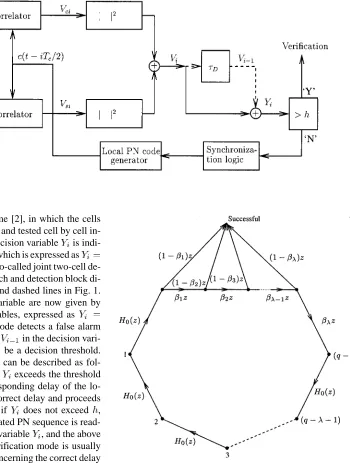
The block diagram of the serial search mode and the detection mode is shown in Fig. 1. The received signal is first down-con-verted into in-phase and quadrature components. Two - correlators perform correlation between the locally gener-ated PN code 2 and the as well as the baseband signals in Fig. 1. This product is integrated over the interval of s, where represents the integral dwell time and is an integer. The outputs of the - correlators are then squared and summed to give an output variable, which is de-noted by in Fig. 1.
In this paper, two detection modes having a similar imple-mentation complexity will be characterized. The first is the
Fig. 1. Acquisition block diagram.
ventional cell-by-cell detection scheme [2], in which the cells in the uncertainty region are searched and tested cell by cell in-dependently. The generation of the decision variable is indi-cated by the continuous line in Fig. 1, which is expressed as
. The second detection mode is the so-called joint two-cell de-tection scheme [15], in which the search and dede-tection block di-agram includes both the continuous and dashed lines in Fig. 1. The statistics of the final decision variable are now given by the sum of two adjacent output variables, expressed as
. However, if the search mode detects a false alarm during the detection of , the term in the decision vari-able is set to zero. Let in Fig. 1 be a decision threshold. Then, the search and detection mode can be described as fol-lows. Whenever the decision variable exceeds the threshold , the system assumes that the corresponding delay of the lo-cally generated PN sequence is the correct delay and proceeds to the verification mode. Otherwise, if does not exceed , the relative phase of the locally generated PN sequence is read-justed in order to update the decision variable , and the above process is repeated. Note that the verification mode is usually used to confirm a stronger decision concerning the correct delay assumed by the search mode [10], an issue not analyzed in this paper.
Since each cell is classified as one of the two states—cor-rect phase (in-phase) of and incorrect phase of , the first search mode with conventional cell-by-cell detection can be de-scribed as a two-state Markov process [5] owing to each deci-sion variable being decided by one cell. The second search mode with joint two-cell detection can be described as a four-state random Markov process [15] owing to the final decision vari-able now being decided by two cells. Let us now derive a gener-alized equation for computing the MAT of the above schemes.
III. ASYMPTOTICMEANACQUISITIONTIME
Holmes and Chen [5], as well as Polydoros and Weber [2], have given the equations for computing the MAT of a serial search code acquisition system in both exact and asymptotic forms under the single -cell and double -cell hypotheses in the uncertainty region. However, due to the finite search step
Fig. 2. Equivalent circular state diagram for a serial search code-acquisition system with multiple timing hypotheses.
size and due to receiving multiple delayed replicas of the trans-mitted PN sequences in a dispersive multipath fading environ-ment, the actual situation is that there may exist more than two states, hence satisfying the multiple -cell hypothesis. There-fore, in this section, we extend the result of [17] in order to de-rive a generalized asymptotic equation for the MAT, which in-cludes the asymptotic expressions of [2], [5] as special cases.
which includes cells and cells. Let represent the false-alarm probability associated with an cell, i.e., the probability that an cell provides a correlator output in excess of , hence resulting in an incorrect hypothesis and leading to an unsynchronized condition. Let represent the “penalty time” associated with noticing that there is a false alarm and with reentering the search mode. Then, following the philos-ophy of [17] and assuming that we commence the search any-where outside the correct states, the transfer function assuming equal prior probability of each state can be expressed as
(1)
where and include all paths leading to successful detection or miss, respectively. In (1), and can be expressed as
with
Let , which represents the overall miss prob-ability of a search over the full uncertainty region. Then in (1) is given by . The MAT can be ex-pressed as (2) [5], shown at the bottom of the page.
In order to obtain the asymptotic form of the MAT for , we divide both sides of (2) by the total number of states and then compute its limit with respect to , yielding
(3)
Consequently, if the total number of states is significantly higher than the number of cells, i.e., , then the MAT can be approximated by
(4)
Equation (4) is a generalized expression for computing the asymptotic MAT of the serial search acquisition system with single or multiple adjacent cells. For example, when there are two cells in the uncertainty region, then the overall miss
probability of , where
and represent the detection probabilities of the first
and second cells, respectively. Upon substituting these con-ditions into (4), the asymptotic MAT for a serial search acquisi-tion system having two cells can be expressed as
(5)
which represents the asymptotic result given in [2, eq. (20)], when uniform distribution of the two cells over the entire uncertainty region is assumed.
IV. THETRANSMITTEDSIGNALS
The communication model under consideration consists of simultaneous transmitters, which includes data trans-mission users (who have finished acquisition) and one initial synchronization user [whose PN sequence is being acquired by the base station (BS)]. We assume that the first user is the ini-tial synchronization user, whose performance is to be evalu-ated. Each user is assigned a unique CDMA sequence, which spreads the data sequence. Again, in this contribution, random sequences having a common chip rate of 1 are considered. The processing gain is given by , and 1 is the information bit rate. Let denote a binary
se-quence, where assumes values of 1 and 1 with equal
probability, and let denote
the spreading sequence of the th user, where for and zero otherwise. The data waveform
consists of a sequence of mutually in-dependent rectangular pulses of duration and of amplitudes
1 or 1 with equal probability.
The transmitted signal for the th user is expressed as
(6)
where
transmitted power of the th signal; common carrier frequency;
phase introduced by the th modulator, which is mod-eled as a random variable uniformly distributed over [0,2 ).
In many DS-CDMA systems [2]–[10], the transmitter aids the initial synchronization by transmitting the phase-coded carrier signal without data modulation at the beginning of each trans-mission. Hence, in our analysis, we assume for simplicity that no data modulation is imposed on the initial synchronization signals.
V. THECHANNELMODEL
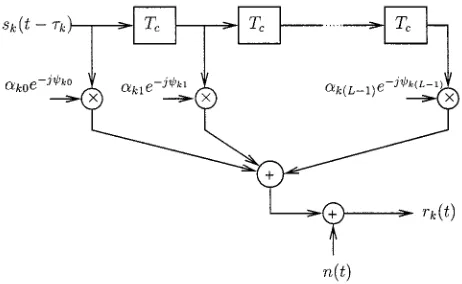
A widely accepted model for a frequency-selective multipath fading channel is a finite-length tapped delay line with a tap
Fig. 3. Tapped delay line model of the frequency-selective channel.
spacing of one chip [18], as shown in Fig. 3, where the tap weights are assumed to be independent identically dis-tributed (i.i.d.) Rayleigh random variables with a probability density function (pdf) given by [18]
(7)
where , and the phases are assumed i.i.d. random variables uniformly distributed in [0,2 ). Furthermore, we assume that the fading amplitude is constant during an ob-servation interval but changes from one interval to another inde-pendently. Then, when signals in the form of (6) are transmitted over the multipath Rayleigh fading channels of Fig. 3, the re-ceived signal can be expressed as
(8)
where is the relative time delay associated with an asyn-chronous transmission scheme;
represents the i.i.d. random variables uniformly distributed in [0,2 ); and represents the additive white Gaussian noise (AWGN) with a double-sided power spectral density of 2. Note that since the 1 interfering users are engaged in data transmission, we assume that their signals are ideally power-controlled and the average received power of each interfering signal is expressed as . However, for the initial synchroniza-tion user, it is unrealistic to invoke near-ideal power control be-fore successful code acquisition. It can only rely on open-loop power control according to the estimation of the channel state. Hence, the average received power of the initial synchronization user at the BS is usually different from that of the data transmis-sion users. This power is expressed in (8) as .
VI. TESTSTATISTICS OF THEDECISIONVARIABLE
In this section, we derive the statistics of the decision vari-ables for the serial search acquisition system using either con-ventional cell-by-cell detection or joint two-cell detection in
the context of the noncoherent acquisition system over a fre-quency-selective multipath Rayleigh fading channel. In deriving the expressions of the statistics, we adopt the following assump-tions.
1) The search step size is 2. 2) All samples are independent.
3) such that the mean value of the correlation between the received and the locally generated PN se-quences is zero when they are out of phase.
4) The self-interference of the desired signal due to multi-path transmission and the multiple-access interference in-flicted by the 1 data transmission users can be mod-eled as additive Gaussian noise.
Referring to Fig. 1, the correlator output of the in-phase branch gives the desired signal component, the multiple-ac-cess interference, and the Gaussian noise from of (8). can be expressed as
(9)
where is the signal component due to the user-of-interest, which represents the desired signal component or the self-in-terference depending on whether the received and the locally generated PN sequences are in-phase or out of phase. can be expressed as
(10)
if , where was defined in (8)
and is a random variable uniformly distributed in [ ]. In (10), represents the partial autocorrelation function defined as
(11)
Note that since a noncoherent acquisition system can acquire only one path of the multipath signal at any time, the other 1 path signals of the reference user inflict self-interference to the in-phase path. Moreover, if the locally generated sequence is out of phase with any of the path signals of the reference user, all path signals of the user-of-interest constitute self-interference.
distributed random variable over [0, ), the multiple-access interference term can be expressed as
(12)
where and represents the partial cross correlation between the sequence of the th user and the locally generated sequence, which is defined as
(13)
Finally, the noise term due to the presence of the AWGN can be expressed as
(14)
The correlator output of the quadrature branch can be obtained from the in-phase component if we replace by
in (10) and (12) and replace by in (14).
A. Gaussian Approximation
Recall that the spreading sequences of the system are mod-eled as random binary sequences of equiprobable 1 s. There-fore, it can be shown that the terms of and are asymp-totically Gaussian due to the central limit theorem [19], [20] as the number of users increases. In our analysis, we employ the Gaussian approximation and model the self-interference due to multipath dispersion of the user-of-interest, the multiple-access interference due to the 1 data transmission users, and the thermal noise as additive Gaussian noise. Consequently, in (10), if and is uniformly distributed in [0, 2] as well as if and is uniformly distributed in 2 , two adja-cent cells associated with one resolvable path are obtained. The mean value corresponding to these two cells in terms of
can be expressed as [15]
(15)
Otherwise, if , then represents the self-interfer-ence, which can be approximated as a Gaussian random variable with zero mean and variance expressed as
(16)
where .
The multiple-access interference term, due to the th inter-fering user given by (12), can be approximated as a Gaussian random variable with zero mean and variance of
(17)
Finally, the thermal noise term given by (14) is a Gaussian random variable with zero mean and variance
(18)
where represents the signal-to-noise ratio (SNR) per chip, that is, the SNR/chip.
Consequently, assuming that an cell is being tested, ac-cording to (9) the normalized variance of can be expressed as
Var (19)
If we assume that an cell is being tested, all paths from the user-of-interest constitute interference, and consequently, the variance of can be computed by (19) if we replace the ( 1) term by . However, we assume for simplicity that the variance of under the hypothesis is the same as that given by (19). The statistics of the quadrature-phase component can also be obtained according to the above method, resulting in
(20)
and the normalized variance of is Var Var .
B. Conditional Probability Density Function
We have derived the statistics of the correlator’s outputs, and , for the in-phase branch and the quadrature branch, respectively, which are approximately Gaussian random pro-cesses. Hence, for the conventional cell-by-cell detection, the decision variable represents either an state or an state. Given the Gaussian nature of and , and assuming that constitutes an sample, then , for a given , obeys the noncentral chi-square distribution with two degrees of freedom. Its pdf can be expressed according to [18, Eq. (2-1-121)] as
(21)
where
(22)
is the zeroth-order modified Bessel function of the first kind defined in [18], and is the normalized noncentral metric, given by
When constitutes an sample, is central chi-square distributed with two degrees of freedom. Its pdf can be ex-pressed according to [18, eq. (2-1-110)] as
(24)
For the search mode using joint two-cell detection, we have . Hence,
has four states, namely, and
. Consequently, when and constitute two independent samples from the same multipath component, obeys the noncentral chi-square distribution with four degrees of freedom. Its pdf can be expressed according to [18, eq. (2-1-121)] as
(25)
where is the first-order modified Bessel function of the first kind and the noncentral parameter 2 is contributed by two samples from the same path, where is given by (23). If and constitute two independent samples from two different propagation paths, the pdf of can be expressed according to [18, Eq. (2-1-121)] as
(26)
where the noncentral parameter is contributed by two inde-pendent paths and given by
(27)
When constitutes an sample and an sample, or conversely, an sample and an sample, the pdf of can be computed by straightforward convolution of the pdfs of and , which results in
(28)
Finally, assuming that and constitute two sam-ples, the pdf of is the central chi-square distribution with four degrees of freedom, which can be expressed according to [18, Eq. (2-1-110)] as
(29)
Above, we have derived the statistics of the decision variables under different hypotheses. Let us now derive the overall miss probability and the false-alarm probability.
VII. MISSPROBABILITY ANDFALSE-ALARMPROBABILITY
In this section, we first derive the overall miss probability for the serial search in conjunction with conventional cell-by-cell detection or joint two-cell detection under the condition of given instantaneous fading attenuation of the dispersive paths, namely, for . Then, the average probabilities are de-rived by averaging the corresponding conditional probabilities over the dynamic range of . Let us first con-sider the conventional cell-by-cell detection.
A. Conventional Cell-by-Cell Detection
For the conventional cell-by-cell detection, each cell as-sociated with different propagation paths has the same statis-tics, and similarly, each cell related to different paths has the same statistics. Their statistics can be described by (21) and (24), respectively. Hence, the detection probability of an cell for a certain value of is formulated as
(30)
where is given by (21). Furthermore,
is the normalized threshold, represents Marcum’s function as defined in [18, eq. (2-1-122)], and
(31)
with being the conditional SNR per path over the -chip integration dwell time conditioned on the instantaneous fading parameter , where is expressed as
(32)
and is the average SNR per path over chips.
The detection probability given in (30) is conditioned on the SNR of per path integrated over chips, and con-sequently through (31) conditioned on the distribution of , representing the th fading diversity path amplitude. The (un-conditional) average detection probability of an sample can be computed by averaging (30) over the range of . Since is Rayleigh-distributed with its pdf given by (7), the pdf of in (31) can be readily expressed with the aid of (7) as
(33)
Finally, using the result of the Appendix, we can obtain the average detection probability of an sample by setting
and in (65), resulting in
We have assumed that the statistics of different propagation paths of the desired signal are independent and that there are paths, where each path is associated with two cells. Hence, the -path sequences of the user-of-interest presented to the re-ceiver can be modeled as a sequence with a total uncertainty region of 2( 1), where is the uncertainty region of the transmitted sequence, while the 2( 1) term is a consequence of the -path channel spreading due to the multipath fading. Furthermore, since each of the paths is associated with two cells, there is a total of 2 cells. Therefore, the overall miss probability defined in Section III can be expressed as
(35)
where is given by (34).
The false-alarm probability is defined the probability that the output decision variable under the hypothesis exceeds the threshold . This can be expressed as
(36)
With the aid of our results generated so far, we can now eval-uate the MAT performance of the serial search mode using conventional cell-by-cell detection by substituting the overall miss probability of (35) as well as the false-alarm probability of (36) and the other related parameters into (4).
B. Joint Two-Cell Detection
Since the th sample is either or , for the joint two-cell detection the decision variable , which is de-rived from , has four possible phase states, i.e., and . Furthermore, the two adjacent 2-spaced samples and in Fig. 1 can be the samples from the same propagation path or from two different paths.
Let states and represent the correct states, while represent the incorrect state. We assume that the acquisition process terminates and successfully proceeds to the tracking process if the two adjacent samples belong to or and the corresponding output decision variable
exceeds the threshold in Fig. 1. Similarly, a false alarm occurs if the two adjacent samples belong to and the corresponding output decision variable exceeds the detection threshold .
For the joint two-cell detection scenario, we commence by considering the false-alarm probability. Assuming that the cur-rent detection is only influenced by the previous two cells, and that the correlation with the other cells can be neglected, then it can be shown that the false-alarm probability at the th incor-rect state can be written as
(37)
Let us assume that the serial search acquisition process is a sta-tionary stochastic process. Then, we have
. Replacing by in the above
equation, we obtain
(38)
where is given by (36). The second term in the numerator of (38) can be expressed as
(39)
Upon using the corresponding pdfs in the above equation, we can simplify it to
(40)
The second term in the denominator of (38) can be expressed as
(41)
Upon substituting (36), (40), and (41) into (38), finally, the false alarm probability can be expressed as
(42)
Let us assume that there are resolvable paths at the base station. As we discussed in the context of the conventional cell-by-cell detection scenario, the frequency-selective faded sequence of the user-of-interest presents itself to the BS as a sequence with a total of 2( 1) cells in the uncertainty region. For joint two-cell detection, the frequency-selective faded sequence can be approximated as a sequence with a total of 2( 1) number of states and 2 1 correct states. The 2 1 number of correct states include one , one number of states associated with two samples from the same path, and 1 number of
states associated with two samples from two different paths. Consequently, the overall miss probability of the serial search mode can be expressed as
where represents an sample, while the other vari-ables in the above equation represent samples.
represents the sum of two samples from the
( 1)th and th paths, represents two
samples from the th path, and represents the average over the fading parameters.
However, for the search mode using joint two-cell detection, due to the correlation between two adjacent decision vari-ables, i.e., between and , it is arduous to derive the closed-form expression of the overall miss probability. Hence, here we aim to derive its lower and upper bound. The lower bound of the overall miss probability is derived by ignoring the dependence between the two adjacent decision variables, yielding
(44)
where the terms taking the form of represent the related average miss probabilities of the correct states. The relevant terms in (44) can be obtained by determining the related detection probabilities first as follows. If is an sample and is an sample, which corresponds to the first term of (44), or conversely, is an sample and is an sample, which corresponds to the last term of (44), then the detection probability conditioned on the fading amplitude of path can be expressed as
(45)
where is given by (28),
repre-sents Marcum’s function defined by [18, Eq. (2-1-122) ], is the normalized threshold as we defined previously, and is defined in (31).
The unconditional detection probability of state or can be obtained by averaging (45) over the range of , which can be inferred from (65) of the Appendix by setting
and , yielding
(46)
Similarly, if and are two samples from the same path, a situation that corresponds to the second term of (44), then the conditional detection probability for can be expressed as
(47)
where is given by (25), while is given by (31). The unconditional detection probability can be similarly computed from (65) of the Appendix by setting
and , which results in
(48)
If and are two samples from two different paths, a scenario that corresponds to the third term of (44), then the detection probability conditioned on and can be expressed as
(49)
where is given by (25), while is given by
(50)
Since and are two i.i.d. Rayleigh random variables, the pdf of can be derived using (63) of the Appendix with
, which can be expressed as
(51)
The unconditional detection probability can be obtained by averaging (49) using (51) in the valid range of , which can also be obtained from (65) of the Appendix by setting
and , yielding
(52)
Consequently, with the aid of (46), (48), and (52), the overall miss probability of the serial search mode using joint two-cell detection obeys
(53)
The upper bound of the overall miss probability for the joint two-cell detection can be achieved if we set and in
of (43) equal to zero for , i.e.,
(54)
terms for are mutually independent, (54) can be written as
(55)
where is the probability that the decision variable does not exceed the threshold of . Since , where and represent two samples from the same path, can be expressed as
(56)
where is given by (25), while is given by (31). The corresponding unconditional detection miss proba-bility can be computed with the aid of (65) in the Appendix by
setting and , which results in
(57)
for .
Substituting (57) into (55), finally, the overall miss proba-bility of the serial search scheme using joint two-cell detection is given by
(58)
Finally, the lower bound and upper bound MAT of the serial search mode using joint two-cell detection can be evaluated by substituting (42) and (53) as well as (58) and the other related parameters in (4). Let us now evaluate the performance of the schemes studied.
VIII. NUMERICALRESULTS ANDCOMPARISONS
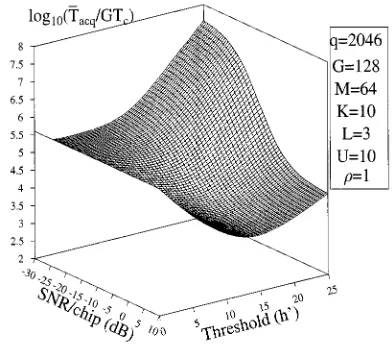
[image:9.612.328.524.293.465.2]In this section, the MAT performance of the serial search scheme using conventional cell-by-cell detection and joint two-cell detection was evaluated and compared. As an ap-plication for the serial search using the above two detection schemes, we consider a periodic PN sequence of length 1023. Consequently, , which determines the length of the uncertainty region for the serial search mode, is 2046, since the search step size is 2. For convenience, we consider the normalized MAT, which is derived from the MAT given by (4) divided by the bit duration of , when different overall miss prob-abilities and different false alarm probprob-abilities are considered. The associated parameters are shown at the top of the figures. Note that three different SNRs are used in our analysis, namely,
[image:9.612.54.288.444.512.2]Fig. 4. MAT versus SNR/chip and normalized thresholdh performance for the serial search scheme using conventional cell-by-cell detection computed from (4), (35), and (36).
Fig. 5. MAT versus SNR/chip and normalized thresholdh performance for the serial search scheme using joint two-cell detection computed from (4), (42), and (53).
SNR/chip, SNR per chips, i.e., the energy over the integral dwell time ( s) to noise ratio, and the SNR/bit.
Figs. 4 and 5 show the normalized MAT performance versus the normalized threshold and the SNR/chip for the serial search modes using conventional cell-by-cell detection (Fig. 4) and joint two-cell detection (Fig. 5) (lower bound), respectively. It is clear from Figs. 4 and 5 that an inappropriate choice of the detection threshold can lead to severe increase of the MAT, but the sensitivity of the MAT to the threshold decreases as the SNR/chip increases. For any given SNR/chip value, there exists an optimal choice of the threshold , which minimizes the MAT. In addition, for any given normalized threshold , the MAT decreases as the SNR/chip increases, and finally reaches a residual value, which is essentially due to the false-alarm probability and the associated “penalty” time incurred before reverting back to the search mode. This value can be computed from (4) by setting , resulting in
.
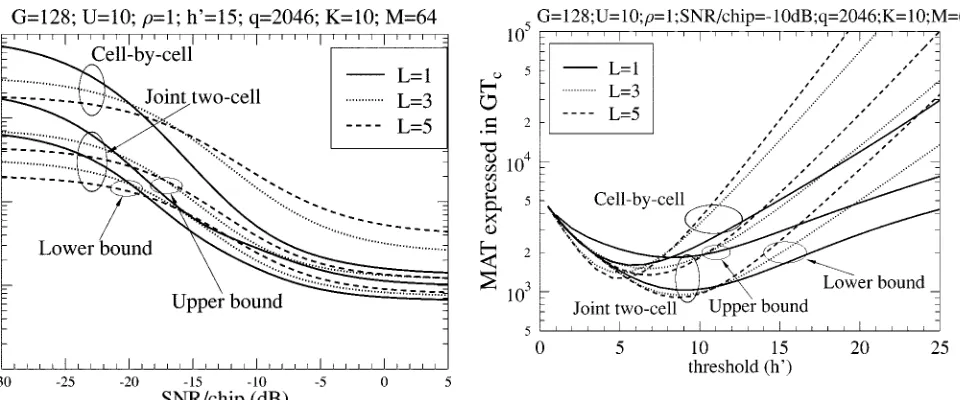
Fig. 6. MAT expressed in bit durations, i.e.,T = GT versus SNR/chip performance for the serial search scheme using conventional cell-by-cell detection and joint two-cell detection computed from (4), (35), (36), (42), (53), and (58).
[image:10.612.45.304.59.265.2]joint two-cell detection parameterized with the number of resolvable paths. From the results we notice that for low SNR/chip values, an increased number of resolvable paths can decrease the MAT. However, for high SNR/chip values, a high number of resolvable paths increases the MAT above the crossover zone near 17 dB. If we assume that a practical acquisition system operates at an average SNR/bit in the range of 5–20 dB, which implies that the average SNR/chip is in the range of 16 to 1 dB, then it can be concluded that for this type of acquisition system a high number of resolvable paths associated with severe dispersion will degrade the MAT per-formance. From the results, we find that the MAT performance of the joint two-cell detection is about an order of magnitude better than that of the conventional cell-by-cell detection. Moreover, the MAT performance of joint two-cell detection is more robust to the variation in the number of resolvable paths for a given threshold and for a given SNR/chip than that of the conventional cell-by-cell detection.
Fig. 7 presents the MAT performance of the above two detec-tion methods against the normalized threshold . For any given number of resolvable paths at the BS, and for a given SNR/chip, there is an optimal choice of the threshold , which leads to the minimum MAT. At the optimal value of , we notice that for the conventional cell-by-cell detection or joint two-cell detection the MAT performance is improved, although not dramatically, when the number of resolvable paths increases. However, if the value of the threshold is set inappropriately, especially when it is set above its optimum value, the MAT will significantly in-crease, as the number of resolvable paths increases. However, as we noticed in Fig. 6, the MAT performance of joint two-cell detection improves more significantly and becomes also more robust to the number of resolvable paths in a wide range of the normalized threshold from about 7 to 25 than that of conven-tional cell-by-cell detection assuming a given number of resolv-able paths at the BS.
[image:10.612.300.546.59.248.2]Fig. 7. MAT expressed in bit durations, i.e.,T = GT versus the normalized threshold h performance for the serial search scheme using conventional cell-by-cell detection and joint two-cell detection computed from (4), (35), (36), (42), (53), and (58).
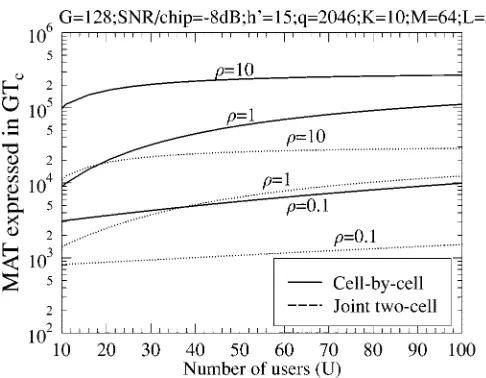
Fig. 8. MAT expressed in bit durations, i.e.,T = GT versus the number of users U performance for the serial search scheme using conventional cell-by-cell detection and joint two-cell detection computed from (4), (35), (36), (42), (53), and (58).
The effect of the number of active users on the MAT per-formance of both conventional cell-by-cell detection and joint two-cell detection is shown in Fig. 8. As expected, the MAT using both detection schemes increases when the number of ac-tive users increases.
[image:10.612.304.550.305.503.2]Fig. 9. MAT expressed in bit durations, i.e.,T = GT versus SNR/chip performance for the serial search scheme using conventional cell-by-cell detection and joint two-cell detection computed from (4), (35), (36), (42), (53), and (58).
Fig. 10. MAT expressed in bit durations, i.e.,T = GT versus the number of users U performance for the serial search scheme using conventional cell-by-cell detection and joint two-cell detection computed from (4), (35), (36), (42), and (53) parameterized by, the ratio of the interfering user’s power to that of the user-of-interest.
change of the power of the user-of-interest than that of the con-ventional cell-by-cell detection. However, from a system ca-pacity point of view, increasing the power of the initial synchro-nization users implies increasing the interference inflicted upon the data transmission users, which consequently decreases the capacity of the system. Hence, in DS-CDMA systems, an in-crease in the initial synchronization user’s transmitted power in order to aid acquisition should consider the tradeoffs between the MAT and the system capacity.
IX. CONCLUDINGREMARKS
A DS-CDMA serial search acquisition system using con-ventional cell-by-cell detection or joint two-cell detection has been proposed and characterized. A generalized asymptotic expression for computing the MAT in terms of the overall
miss probability and the false-alarm probability has been derived. The MAT performance of the serial search system using conventional cell-by-cell detection and that of using joint two-cell detection has been estimated and compared when a frequency-selective multipath fading channel is considered. The analysis presented has utilized practical assumptions and is applicable to the mobile-to-base-station link of a mobile DS-CDMA communication system using BPSK modulation. The effects of multiple-access interference, the number of resolvable paths, and the received power of the initial syn-chronization user have been investigated. From the results, we conclude that the MAT performance of the serial search acquisition system using joint two-cell detection is more robust to multiple-access interference, to the detection threshold, to the number of resolvable paths, and to the received power of the user-of-interest than that of conventional cell-by-cell detection. Moreover, the MAT performance of joint two-cell detection is found to be better than that of conventional cell-by-cell detection. This is because joint two-cell detection is capable of efficiently combine the energy of two adjacent correct phase samples for making decisions. Our approach can be extended to using the sum of the adjacent 2 samples for detection if we assume that resolvable paths can be obtained at the receiver, which is the subject of our future research.
APPENDIX
In this Appendix, we evaluate the integral
(59)
which is often invoked in the main body of this paper.
is the generalized Marcum -function, which is defined as [18]
(60)
where is the th order modified Bassel function of the first kind defined as [18]
(61)
In (59) is a random variable, which is defined as
(62)
where the are statistically independent, identically distributed zero-mean Gaussian random variables. The pdf of is given by [18]
[image:11.612.40.283.314.503.2]Assuming that is a positive integer and substituting (60), (61), and (63) into (59), we obtain the integral in the form of
(64)
Upon evaluating the integrals of (64), we finally simplify the integral of (59) to
(65)
ACKNOWLEDGMENT
The constructive critique of the anonymous reviewers is gratefully acknowledged.
REFERENCES
[1] R. E. Ziemer and R. L. Peterson, Digital Communications and Spread
Spectrum Systems. New York: Macmillan, 1985.
[2] A. Polydoros and C. L. Weber, “A unified approach to serial search spread-spectrum code acquisition—Part I: General theory,” IEEE Trans.
Commun., vol. COM-32, pp. 542–549, May 1984.
[3] D. V. Sarwate, “Acquisition of direct-sequence spread-spectrum sig-nals,” in Wireless Communication—TDMA versus CDMA, S. G. Glisic and P. A. Leppanen, Eds. Norwell, MA: Kluwer, 1997, pp. 121–145. [4] A. Polydoros and M. K. Simon, “Generalized serial search code
acqui-sition—The equivalent circular state diagram approach,” IEEE Trans.
Commun., vol. COM-32, pp. 1260–1268, Dec. 1984.
[5] J. K. Holmes and C. C. Chen, “Acquisition time performance of PN spread-spectrum,” IEEE Trans. Commun., vol. COM-25, pp. 778–783, Aug. 1977.
[6] W. R. Braun, “Performance analysis for the expanding search PN acqui-sition algorithm,” IEEE Trans. Commun., vol. COM-30, pp. 424–435, Mar. 1982.
[7] Y. T. Su, “Rapid code acquisition algorithms employing PN matched filters,” IEEE Trans. Commun., vol. 36, pp. 724–733, May 1988. [8] B. B. Ibrahim and A. H. Aghvami, “Direct sequence spread spectrum
matched filter acquisition in frequency-selective Rayleigh fading channel,” IEEE J. Select. Areas Commun., vol. 12, pp. 885–890, June 1994.
[9] H. Moon and S. Kim, “Performance of double dwell acquisition with continuous integration detector in DS-CDMA system,” in Proc. IEEE
VTC’98, Ottawa, ON, Canada, 1998, pp. 2507–2511.
[10] A. Polydoros and C. L. Weber, “A unified approach to serial search spread-spectrum code acquisition—Part II: A matched-filter receiver,”
IEEE Trans. Commun., vol. COM-32, pp. 550–560, May 1984.
[11] U. Cheng, “Performance of a class of parallel spread-spectrum code acquisition schemes in the presence of data modulation,” IEEE Trans.
Commun., vol. 36, pp. 596–604, May 1988.
[12] E. S. Sourour and S. C. Gupta, “Direct-sequence spread-spectrum par-allel acquisition in a fading mobile channel,” IEEE Trans. Commun., vol. 38, pp. 992–998, July 1990.
[13] , “Direct-sequence spread-spectrum parallel acquisition in nonse-lective and frequency-senonse-lective Rician fading channel,” IEEE J. Select.
Areas Commun., vol. 10, pp. 535–544, Apr. 1992.
[14] R. R. Rick and L. B. Milstein, “Parallel acquisition in mobile DS-CDMA systems,” IEEE Trans. Commun., vol. 45, pp. 1466–1476, Nov. 1997. [15] L. L. Yang and J. Simsa, “Performance evaluation of spread-spectrum
code acquisition system using four-state Markov process,” in Proc. IEEE
Symp. ISSSTA’98, Sun City, South Africa, Sept. 1998, pp. 848–852.
[16] L. L. Yang and L. Hanzo, “Serial acquisition techniques for DS-CDMA signals in frequency-selective multi-user mobile channels,” in Proc.
IEEE VTC’99, May 1999, pp. 2398–2402.
[17] A. J. Viterbi, CDMA: Principles of Spread Spectrum
Communica-tion. Reading, MA: Addison-Wesley, 1995.
[18] J. G. Proakis, Digital Communications, 3rd ed. New York: McGraw-Hill, 1995.
[19] V. M. Jovanovic and E. S. Sousa, “Analysis of noncoherent correlation in DS/BPSK spread spectrum acquisition,” IEEE Trans. Commun., vol. 43, no. 2/3/4, pp. 565–573, Feb./Mar./Apr. 1995.
[20] L. B. Milstein, T. S. Rappaport, and R. Barghouti, “Performance evalu-ation for cellular CDMA,” IEEE J. Select. Areas Commun., vol. 10, pp. 680–689, May 1992.
Lie-Liang Yang (M’98) received the B.Eng. degree in communication
engi-neering from Shanghai TieDao University, Shanghai, China, in 1988 and the M.S. and Ph.D. degrees in communications and electronics from Northern Jiao-tong University, Beijing, China, in 1991 and 1997, respectively.
From 1991 to 1993, he was a Lecturer with the Department of Electrical Engineering, East-China Jiaotong University. From 1993 to 1997, he was with the Modern Communications Research Institute, Northern Jiaotong University. From June 1997 to December 1997, he was a Visiting Scientist of the Insti-tute of Radio Engineering and Electronics, Academy of Sciences of the Czech Republic. Since December 1997, he has been with the Communication Group, Department of Electronics and Computer Science, University of Southampton, U.K. He has been involved in researching various error-correction coding, mod-ulation schemes, synchronization, and CDMA systems for future generations of wireless mobile communication systems. He has published about 50 papers in journals and conference proceedings.
Dr. Yang received the Royal Society Sino-British Fellowship in 1997.
Lajos Hanzo (M’91–SM’92) received the Masters degree (Dipl. Ing.) in
elec-tronics and the Ph.D. degree, both from the Technical University of Budapest, Hungary, in 1976 and 1983, respectively.