Paper ID #16717
Experiences of Integrating UAVs into the Curriculum through
Multidisci-plinary Engineering Projects
Prof. Ciaran McGoldrick, Trinity College, Dublin
Prof. Ciaran Mc Goldrick is a lecturer in the School of Computer Science and Statistics in Trinity College Dublin, Ireland. Since 2015 he is also a Visiting Professor at UCLA. His research interests encompass wireless networking, constrained communications, security, robotics and computer science and engineer-ing education, and he has published widely in these areas This research is supported by both National and European H2020 funding awards. Prof. Mc Goldrick is widely experienced in the formation and develop-ment of undergraduate and postgraduate programmes and syllabi at National level, and is regularly called upon to assess and validate existing postgraduate programmes.
Ms. Smita Shivaram, Trinity College, Dublin
I am Smita Shivaram, a student of the M.Sc in Mobile and Ubiquitous Computing course at Trinity College Dublin. I have finished my bachelors degree in Computer Science from VIT University, India. My interests include hardware and software programming, gaming and virtual reality applications.
Prof. Meriel Huggard, Bucknell Univeristy and Trinity, College Dublin
Dr. Meriel Huggard has been a tenured faculty member in Trinity College Dublin, Ireland since 2000. For the 2015/16 academic year she is on leave of absence and is a visiting associate professor in Electrical and Computer Engineering at Bucknell University, PA. She teaches courses in computer science, com-puter engineering and mathematics. She obtained her B.A. (Mod) in theoretical physics and her Ph.D. in computer science education from Trinity College Dublin. She is an IEEE senior member, an ACM senior member and a member of ASEE. Her research interests extend from wireless networking, including the internet of things and constrained communications, through computer science and engineering education, and she continues to publish in these areas. Her research is supported by both national and European H2020 funding awards. She is widely experienced in curriculum development at both undergraduate and postgraduate level and she has served on curriculum development committees at a national level.
c
Experiences of Integrating UAVs into the Curriculum through
Multidisciplinary Engineering Projects
Abstract
The content and means of delivery of many electronic and computer engineering courses has evolved radically over the past decade due to the rise in the availability of affordable, open-source programmable microcontrollers and accessible wireless communication devices. Many
engineering modules have been extended to more closely integrate the underlying technologies and systems with modern engineering practice.
One of the more exciting additions to the range of inexpensive robotic technologies is unmanned aerial vehicles (UAVs), or drones. Drones have a wide range of real-world applications and the full potential of these devices has yet to be explored by either industry or educators.
Drones have an enormous capacity to engage students and facilitate classroom learning. Drones offer a challenging platform for existing engineering design modules where students face challenges in electronics, control, programming and project management.
However, one of the challenges facing educators is how to integrate drones within their courses in a meaningful way; so that UAVs are not viewed as mere toys, but as devices that have a credible role to play in the solution of real world problems. In this paper we describe how UAVs have been included across multidisciplinary projects where students work on real world problems that span a broad range of engineering disciplines. The projects draw on the capabilities of UAVs: the ability to sense objects in their surroundings, to plot and maintain an accurate course, to make on-the-fly adjustments based on environmental data, to use computer vision to interpret data gathered by the on-board camera etc.
Introduction
The past decade has seen the advent of affordable, open-source programmable, microcontrollers and accessible wireless communication devices. These have led to a radical evolution in the goals, content and delivery mechanisms for many electronic and computer engineering
courses1 2 3.
The technological advances of the past decade have given rise to the commoditization of
unmanned aerial vehicles (UAVs) or drones. Despite public fears over the intrusiveness of drone technology, they have a wide range of real-world applications and have rapidly gained traction with both industry and educators4. The diffusion of this technology has followed the standard innovation cycle – early adoptors pushed the limitations and boundaries of the technology, this gave rise to a reduction in both the cost and size of UAVs as commercialization attracted large scale volume manufacturers with global scale and distribution capabilities.
Drones offer an enormous potential for meaningful student engagement in learning. This has lead many to develop new classroom learning paradigms that incorporate UAVs4 5 6. Educators find themselves facing the challenge of integrating drones with existing courses in electronics, control, programming and project management. In particular, they must not only deal with the new
technical challenges presented by UAVs but they must, by necessity, create a safe environment in which students can gain hands on experience with the technology7.
In this paper we reflect on the challenges encountered when evolving existing hands-on and experiential learning tasks towards a UAV use-case and deployment scenario. The scenario is challenging - that of automated monitoring and detection of potential failure modes in the rotating blades of an operational wind turbine. Reliable and robust automated control of a drone in flight around a moving blade of an operational turbine is extremely difficult and comprises a wide diversity of technical and conceptual challenges that encompass different disciplines. In this work we identify and expound upon some of the technical challenges facing those who wish to
implement or extend existing practical and laboratory tasks, at both the undergraduate and postgraduate level, to incorporate challenging, state-of-the-art drone use-cases and deployment scenarios. We focus on the challenges faced by students and document representative solutions produced in integrated dynamic control, image processing, machine vision, volumetric modelling, remote sensing and machine learning. It is important to note that the work, as described in this article, can be largely performed and validated in academic settings independently of UAV availability and deployment. This has proven increasingly important as regulatory authorities impose ever more stringent constraints on the circumstances, locations and devices with which outputs can be validated.
Consequently this paper, in addition to identifying the technical constraints that bound any such endeavor and describing how they may be addressed, also contributes in the broader context of experiential learning, ethical awareness and the development and reinforcement of responsible professional practice.
solve different facets of the challenge; and iii) presentation and articulation of our experiences and reflections, and those of our students, in pursuit of an overall solution. The paper concludes with some observations on best practice for managing the incorporation of industrial drone use-cases within the curriculum.
Unmanned Aerial Vehicles
Drones are remotely controlled, autonomous aerial vehicles. While they are reusable, their range is often limited by the power source or battery used. Public attention was first drawn to the existence and uses of drones just over a decade ago due to their use by the military in battle and conflict scenarios. In recent times UAVs have been attracting attention for their wide range of industrial and civilian applications. Some have referred to the advent of wide scale domestic drone deployments as being akin to a “flying Internet” in terms of the green-field opportunities it presents to innovators and entrepreneurs alike.
[image:4.612.236.377.368.476.2]The range of use-case scenarios for drones is continuously being extended; for example, to include search and rescue, commercial delivery, conservation and surveying. It is clear that drones will have a marked impact on many future workplaces and, consequently, on the skill sets that educators should be targeting for their students.
Figure 1: An Unmanned Aerial Vehicle8.
Over the past decade the variety of commercially produced UAVs available for purchase has grown exponentially. These range in cost from c.$40 to tens of thousands of dollars. Despite their widely varying cost, these UAVs have many common features in terms of the available on-board equipment e.g. gps, cameras and the wireless communications protocols used e.g. WiFi. Two UAVs that have been successfully used in educational settings9 10 11 are the Parrot AR.Drone 2.012
and DJI Phantom 2 Vision8. These UAVs are relatively low in cost, communicate using WiFi and are equipped with cameras. The use of WiFi not only allows the drones to transmit images, it also enables users to control them using hand-held mobile devices. The SDK provided with both these UAVs13 14 allows them to be controlled using simple API commands. Each UAV can fly
UAVs in the Classroom
Many have recognized the potential uses of drones within the classroom; however, there has been little work on how they can be successfully integrated within the existing curriculum. It can be argued that this may be related to concerns about safety, security, privacy and liability. However, drones have been successfully incorporated into existing outreach activities to encourage students to pursue careers in science and engineering by many5 15 11. This makes arguments about safety and security difficult to support. One possible reason for the slow uptake of UAVs within the wider curriculum may be because they are perceived to be “toys”15. This may lead people to
overlook their potential to revolutionize the computer engineering curriculum16.
Reports on the successful integration of UAVs into the curriculum often focus on single classes or one day events. For example, Nitschke et al. developed a one day contest for students on taught M.Sc. and undergraduate courses9. In their work they detail an interdisciplinary design
competition where students use open-source libraries to develop a program to autonomously guide a drone from a start point to a final destination. Visual markers help the UAV navigate its way along the course. It was observed that students taking part in the competition developed a deeper understanding of the potential uses and limitations of UAVs. It was also noted that there was a steep learning curve associated with the drones used.
The use of UAVs to develop teaching materials for a single freshman class was detailed by Yokokawa et al. It was found that the teaching materials created were successful in motivating students to learn more about image processing and control engineering11.
A “lab-escape” challenge involving drones was explored by Eriksen, Ming and Dodds17. A
previously mapped room was used for this challenge. The drone was placed at a random location within the room and had to determine its location and proceed to the exit. A prototype was developed using a UAV12 and a Microsoft Kinect sensor; however, the study did not extend to the
actual deployment of drones in a classroom setting.
Winterfeldt and Hahne described how drones were integrated into an application design module taken by a group of 17 M.Sc. students6. The students had to design an application to make use of
several input devices, e.g. a gamepad or a smart phone, to control the UAV. The course was split into 12 three-hour units so that student engagement with the UAV technology was more
protracted than in the settings discussed above. It was found that the application-based learning approach adopted engaged students and improved performance on the course. The study did not explore how the approach used could be scaled for use beyond a small group setting.
In7 the authors reflect on the challenges encountered when integrating drone technology into an existing project-based freshman design module. The objective was to introduce the drone as a relatively seamless extension of an existing problem set for a design project involving an
Autonomous Vehicles in Computer Engineering Design
It is broadly accepted that engineering design needs to be incorporated across the curriculum18 19,
and in a more coherent and integrated fashion than as a single capstone module that meets the core requirements of accrediting bodies20. Thus many institutions now more broadly incorporate
design aspects across the undergraduate computer engineering curriculum. A primary intent of many of these design modules is that they foster and instill the lifelong learning skills expected of graduates. The incorporation of elements of creative thinking, active learning, collaborative learning, teamwork, conflict resolution, decision making and communication are commonly found in such offerings. The technologies, task and professional skills development elements of such design modules are explicitly chosen to be of direct benefit to all students, regardless of their specialism. For example, computer engineering design courses may also incorporate elements of mechanical and electrical engineering21. Pedagogically, these modules are viewed as contributing significantly to a range of professional accreditation goals, both nationally and in line with
Washington Accord22outcomes.
Many design modules have focused on the development of small autonomous vehicles that are designed to carry out a specific task e.g. to sumo wrestle or maze solve23 24or to emulate real
world infrastructures e.g. an urban light rail system21. By contrast, others have focused on simulation e.g. of the motion control of a UAV25or mobility26. The autonomous vehicles safely navigate their way through their surroundings using a variety of sensors. In addition, they estimate their direction of motion and their position using visual tracking systems. The tracking approaches adopted may be broadly categorized as marker and marker-less methods27.
Marker-based systems follow a known pattern or image e.g. a straight white line on a black background; by contrast, marker-less systems navigate through their environment using Simultaneous Localisation and Mapping (SLAM) techniques.
This work builds on the authors’ extensive experience in developing, operating and delivering design courses such as these, and extends the metaphor to hierarchically incorporate graduate level attainment goals and assessment modalities. Thus the tasks described hereafter will resonate with the device control, actuation, image recognition and processing, and remote sensing
activities already embedded in both the literature and the classroom. Moreover we provide scope for the implementation and deployment of more advanced concepts, such as volumetric modelling and analysis, automated dynamic control, and machine learning within the same system and framework.
Monitoring the Structural Health of Wind Turbines
As the industry has matured, turbine sizes have increased significantly and many offshore and onshore wind farms have been constructed. Thus, it is crucial to ensure their safety as damage to the structure of the blade or failure can result in heavy monetary loss, environmental destruction and in some cases, even death. Unscheduled maintenance of turbines is extremely expensive, and may reduce the efficiency of wind farms due to unexpected downtime. Maintenance can be corrective or preventive28. Structural health monitoring is a key element to the efficient operation
of a wind farm as it can estimate each turbine’s operational capacity, calculate blade fatigue29 30 and allow for the scheduling of maintenance to prevent unnecessary downtime.
Wind turbines are more susceptible to damage and failure compared to other civil structures because of acceleration fatigue caused by moving parts, and exposure to natural elements such as strong winds, rain, moisture in air and lightning31. During their 20 year life span most
commercial wind turbines operate for about 120,000 hours. Maintenance costs are comparatively low for new wind turbines but drastically increase as the turbine ages. The biggest wind turbine manufacturers such as GE, Vesta, Gamesa and Enercon32estimate that approximately 1.5% to 2%
of the wind turbine cost is spent on its annual maintenance33.
Using a UAV for Structural Health Monitoring of Wind Turbines
In this section we describe the high level task that we require students to engage with, decompose it into a subset of complementary facets, and relate those to specific Engineering and Computer Science domains and associated educational concepts at both undergraduate and postgraduate levels, and then present specific learning and developmental opportunities.
Students perform a functional analysis of the objectives of the UAV-based structural health monitoring system in order to reveal and identify various hardware and software
requirements.
Some of these requirements can be determined at the outset whilst others are derived and adduced by students during the process of research and design. One such initial expression of system requirements is now provided:
1. In order to construct a 3D model of the wind turbine blade, several different views, i.e. 2D images of the blade are required. When combined, these images must span the entire length, breadth and height of the blade.
2. A suitable pattern must be determined for the drone such that the images captured by the camera mounted on the drone satisfies the criteria specified in the first requirement.
3. The system must account for sudden gusts of wind and wake effects which may cause unpredictable displacement of the drone from its expected position.
4. The proof-of-concept system must be constructed using commercial, easily-available technology in order to demonstrate the economical feasibility and ease of implementation of the suggested approach.
evaluated beforehand.
6. The 3D model generated should possess sufficient detail such that strain or deformation in the blade is accurately detected and localized.
7. The 3D model should be generated from the set of 2D images in real-time.
8. As the system encompasses a range of technologies, it must be possible to integrate these technologies to obtain an end-to-end flow with minimal amount of human intervention.
[image:8.612.165.449.217.336.2]An example of a student abstraction of the system is represented in Figure 2.
Figure 2: Student Abstraction of the System
It is clear that the solution path proposed above involves elements of image capture and
processing, dynamic system control, volumetric modelling analysis and real-time processing and analysis. At undergraduate level the wind turbine blade can be considered stopped, such that the drone can fly a series of linear flight paths in assembling visual image sets. At postgraduate level the wind turbine is considered as operational such that the UAV must maintain a dynamic flight path with associated UAV control, and the imaging data gathered for volumetic modelling can be visual or acquired from other damage detection techniques e.g. ultrasonic.
Architectural Design Challenges and Student Decisions in Action
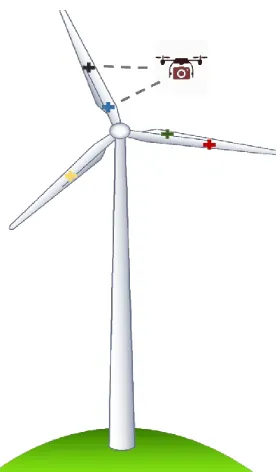
Having regard for the aforementioned requirements, the students must develop a suitable system architecture. The system must satisfy a diverse range of requirements. The drones position and trajectory must be accurately known at all times. Drones commonly have onboard gps but its precision is inadequate for the proposed use-case. The drone may be equipped with LIDAR ranging technology, but this precludes use of the system by all but the most expensive of UAV platforms. Low cost ultrasonic transducers provide an attractive hardware option, with potential concomitant benefits for defect detection. The most widely exploitable solution is to use the UAVs onboard camera to detect reference marks on the blade surface (see Figure 3) and also the blade edges and shape and, combined with knowledge of the camera’s characteristics, to compute the range, orientation and trajectory of the UAV.
Figure 3: Positioning the UAV using reference marks on the Blade
This is used to provide a reference flight path to the drone, but is subject to local updating by the drone in flight in response to perturbations such as wind and wake effects.
In flight the drone may assemble a 3D volumetric model by onboard processing of the captured images. However for our purposes the captured images are treated as transmitted back to a base controller (PC) for assembly into a 3D model for subsequent analysis and processing.
Representative Student Solution
For the students’ work described in this paper, the system consists of two key modules, which are further divided into components.
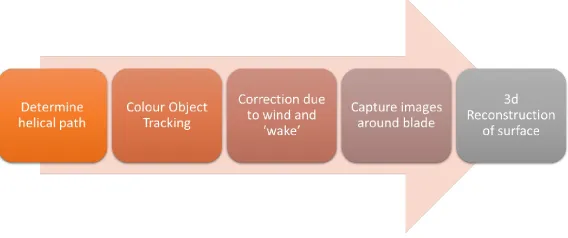
The first module incorporates a learning algorithm which is responsible for the following functions:
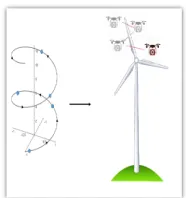
• Determining a suitable path around the turbine blade using a mathematical model. See Figure 4.
• Using a tracking algorithm to obtain expected positions of the drone at different times.
• Determining position correction equations to account for wind gusts and unexpected drone movement.
• Flying the drone using corrected equation around the turbine blade and capture images as required to construct an accurate 3D model.
(a) Required Coordinate Systems (b) Helical Flight Path
Figure 4: Positioning and Flying the UAV
Figure 5: Learning algorithm
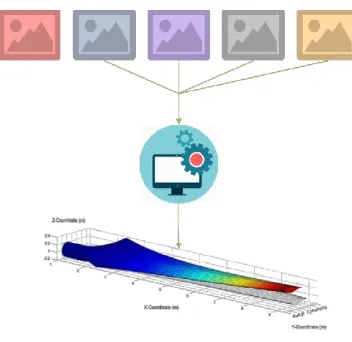
The second module of the system uses computer vision and image processing concepts to
construct a 3D model from the 2D images captured above. The functions of this module are listed below:
• For each image, identify feature keypoints that can be matched in and across other images.
• Locate and align the identified keypoints with keypoints in neighbouring images and perform 3D stitching when a match occurs.
It is clear from the above student description that the image processing, system control, learning algorithmics and volumetric modelling are substantially co-dependent in this task. A student example of a blade image construction is given in Figure 6.
Fostering Student Learning
This work was initially conceived as a multidisciplinary team project that built upon the students’ prior experience of engineering design. It was envisaged that the practical problem solving nature of the tasks involved, coupled with industry oriented experiential learning would lend itself to increased student engagement and achievement. However, the remit quickly moved beyond that of capstone engineering design, as the UAVs proved to be a popular motivational tool.
[image:10.612.168.445.241.356.2]Figure 6: Constructing the 3D Image of the Blade
range of students, from freshmen undergraduates to those engaged on structured Ph.D. programs. Successful outcomes were achieved for individual components of the system e.g. demonstrating a spiral flight path, image processing to construct an image of the 3-d surface of a blade etc.
The real-world nature of the problems to be addressed meant that students were required to develop the necessary skills to carry out independent research, building upon the theoretical material they encounter in more traditional courses. The faculty members worked closely with the students, acting as mentors and providing appropriate research advice, feedback and guidance to the students and ensuring that all engaged fully with the assigned tasks.
Students were encouraged to draw upon their prior knowledge, including techniques and methods they had mastered in other courses. Their mentors pointed them towards a small number of appropriate resources e.g. research articles, text books, research groups active in the domains of interest. Students were then prompted to independently seek additional sources of relevant information in order to build up their prior knowledge before starting developmental work.
Elements of peer and collaborative learning were used to help students develop an understanding of the research process. Reciprocal peer learning involves individuals learning from, and with, each other. For many students it plays an integral part of their formal academic learning34. The
real-world setting of the problem made it easier for students to discuss their learning needs with peers across the University e.g. Computer Engineering students drew upon the skills and
knowledge of peers majoring in other branches of Engineering, Science and Mathematics.
The methods used for the integration of UAVs within the curriculum relate to a non-traditional learning environment. Evaluation focused on the quality of the learning and the student
UAVs and the Law
There has been extensive media coverage of the military applications of drones for well over a decade35 36. By contrast, an exploration of the wider potential civilian and academic uses of UAVs only began in much more recent times4.
Policy makers have taken a proactive stance in relation to the development of the law and policy needed to enable the wide scale deployment of UAVs. For example, the European Commission has developed a comprehensive policy framework to enable development of the commercial drones market while safeguarding the public interest37.
Aviation regulators, such as the U.S. Federal Aviation Administration (FAA) and the European Aviation Safety Agency (EASA) have also taken steps to regulate UAVs. The FAA has drawn up regulations for the use of UAVs in public airspace4, while the EASA has developed a new regulatory approach for safely operating UAVs38. These standards aim to address wider public
concerns about the operation of drones; including security, safety, data protection, privacy, insurance and liability.
Google, Amazon and other multi-nationals have led the international demand for changes in the law and in policy in relation to the civilian use of UAVs. Their calls have backed up those already made by collective bodies such as the Small UAV Coalition (www.smalluavcoalition.org).
Academics seeking to explore the full potential of these devices for both research and educational purposes have also voiced their demands for regulatory change.
Implementation Constraints
In late 2015 many countries begun to introduce ordinances to regulate the use of drones. For example, in the US drones that weigh more than 0.55 lbs (250 g) and less than 55 lbs (25 kg) must be registered with the FAA39. Similarly, legislation has begun to take effect in Europe e.g. in
Ireland all drones over 1kg (2.2 lbs) must be registered with the Irish Aviation Authority40.
Restrictions have also been placed on the operation of drones e.g. recreational users in the USA and Ireland are restricted to flying their drones at no more than 400 ft (122m). In the USA, those wishing to use drones for academic purposes must obtain a Certificate of Authorization (CoA) from the FAA39. Similarly, in Ireland those wishing to obtain specific permission from the IAA to
operate drones, must first attend a drone safety training course and produce an acceptable procedures manual40.
The advent of these stricter regulatory regimes has meant that the structural testing and validation of the solutions produced by the students has been impeded. While the DJI Phantom 2 was the target platform used by the students, regulatory constraints have precluded its use for broader testing and deployment across the wider student populace.
an upright vertical position and at a speed no greater than that needed to safely traverse the blade. Such a system would not allow for interactive manual control apart from the use of an override button that causes the UAV to fly to safe location and land. Future work includes an exploration of how the systems outlined above can be fully tested within the prevailing legal constraints. It also provides opportunities for students to explore legal and ethical issues surrounding the use of this technology. Notwithstanding the new regulations, the anticipated learning and developmental goals for including UAVs across the curriculum have been achieved.
Discussion
The integration of UAVs across the curriculum has led students to develop higher order learning skills such as organising, discarding, discussing, negotiating, interpreting, refinement and problem-solving.
By adjusting the scope and nature of the tasks involved, students at all levels have found a way to engage with a real world application of UAVs. For example, undergraduate tasks have focused on flying the drone along a stationary blade; while postgraduates have explored how this can be extended to capture an accurate image of a moving blade. While the underlying challenge
remains the same, the addition of the motion of the blade means that all facets of the task become some orders of magnitude harder than before.
Students had a unique hands-on experience of drone technology that they not only found easy to engage with but that also fostered the skills needed to the transition from undergraduate study to the professional workplace or postgraduate research.
References
1. R.L. Traylor, D. Heer, and T.S. Fiez. Using an integrated platform for learning trade; to reinvent engineering education. Education, IEEE Transactions on, 46(4):409–419, Nov 2003. ISSN 0018-9359. doi:
10.1109/TE.2003.818749.
2. M. Shuman, D. Heer, and T.S. Fiez. A manipulative rich approach to first year electrical engineering education. In38th Frontiers in Education Conference, pages F1D–10–F1D–15, Oct 2008. doi: 10.1109/FIE.2008.4720435.
3. M. Huggard and C. McGoldrick. Incentivising students to pursue computer science programmes. InFrontiers in Education Conference, 36th Annual, pages 3–8, Oct 2006. doi: 10.1109/FIE.2006.322678.
4. Libby V. Morris. On or coming to your campus soon: Drones. Innovative Higher Ed., 40(3):187–188, 2015. ISSN 0742-5627. doi: 10.1007/s10755-015-9323-x. URL
http://dx.doi.org/10.1007/s10755-015-9323-x.
6. G. Winterfeldt and C. Hahne. Controlling quad-copters a project-based approach in the teaching of application design. InGlobal Engineering Education Conference (EDUCON), 2014 IEEE, pages 961–968, April 2014. doi: 10.1109/EDUCON.2014.6826216.
7. Meriel Huggard and Ciar´an Mc Goldrick. Droning on: Reflections on integrating uav technology into a computer engineering design laboratory. InProceedings of the 47th ACM Technical Symposium on Computing Science Education, pages 504–509. ACM, 2016.
8. PHANTOM 2 User Manual.
http://www.mshtools.com/ardrone/ARDrone4 Developer Guide.pdf, 2015. Accessed: 2016-01-20.
9. C. Nitschke, Y. Minami, M. Hiromoto, H. Ohshima, and T. Sato. A quadrocopter automatic control contest as an example of interdisciplinary design education. In14th Int. Conf. onControl, Automation and Systems (ICCAS), pages 678–685, Oct 2014. doi: 10.1109/ICCAS.2014.6987866.
10. I. Deaconu and A. Voinescu. Mobile gateway for wireless sensor networks utilizing drones. In13th RoEduNet Conference: 8th RENAM Joint Event, pages 1–5, Sept 2014. doi: 10.1109/RoEduNet-RENAM.2014.6955319.
11. S.A. Rahok Yokokawa, H. Oneda, S. Osawa, and K. Ozaki. Development of a teaching material that can
motivate students to learn control engineering and image processing. In17th Int. Conf. on Comput. Sci. and Eng. (CSE), pages 413–419, Dec 2014. doi: 10.1109/CSE.2014.104.
12. The Navigation and Control Technology Inside the AR.Drone Micro UAV, Milano, Italy, 2011.
13. AR.Drone 2.0 Developer Guide.
http://www.mshtools.com/ardrone/ARDrone4 Developer Guide.pdf, 2012. Accessed: 2016-01-20.
14. DJI Developer API Doc.https://dev.dji.com/api doc, 2015. Accessed: 2016-01-20.
15. J. Burg, V. P. Pauca, W. Turkett, E. Fulp, S.S. Cho, P. Santago, D. Ca nas, and H. D. Gage. Engaging non-traditional students in computer science through socially-inspired learning and sustained mentoring. In Proc. 46th ACM SIGCSE, pages 639–644, 2015. ISBN 978-1-4503-2966-8. doi: 10.1145/2676723.2677266. URLhttp://doi.acm.org/10.1145/2676723.2677266.
16. J.E. Froyd, P.C. Wankat, and K.A. Smith. Five major shifts in 100 years of engineering education.Proc. IEEE, 100:1344–1360, May 2012. ISSN 0018-9219. doi: 10.1109/JPROC.2012.2190167.
17. Christopher Eriksen, Kristina Ming, and Zachary Dodds. Accessible aerial robotics. J. Comput. Sci. Coll., 29(4): 218–227, April 2014. ISSN 1937-4771. URL
http://dl.acm.org/citation.cfm?id=2591468.2591504.
18. Clive L Dym, Alice M Agogino, Ozgur Eris, Daniel D Frey, and Larry J Leifer. Engineering design thinking, teaching, and learning. J. Eng. Ed., 94(1):103–120, 2005.
19. Christine Charyton. Creative engineering design: The meaning of creativity and innovation in engineering. In Creativity and Innovation Among Science and Art, pages 135–152. Springer, 2015.
20. N.A. Kartam. Integrating design into a civil engineering education. Int. J. Eng. Ed., (2):130–135, 1998.
21. M. Huggard, F. Boland, and C. Mc Goldrick. Using cooperative learning to enhance critical reflection. In Frontiers in Education Conference (FIE), 2014 IEEE, pages 1–8, Oct 2014. doi: 10.1109/FIE.2014.7044301.
22. Washington Accord, 2012. [Online]. Available:http://www.washingtonaccord.org/.
23. C. McGoldrick and M. Huggard. Peer learning with lego mindstorms. InFrontiers in Education, 2004. FIE 2004. 34th Annual, pages S2F–24–9 Vol. 3, Oct 2004. doi: 10.1109/FIE.2004.1408740.
24. C. F. Panadero, J.V. Rom´an, and C. D. Kloos. Impact of learning experiences using lego mindstormsR in
25. Huu-Khoa Tran, Juing-Shian Chiou, and Shou-Tao Peng. Design genetic algorithm optimization education software based fuzzy controller for a tricopter fly path planning. Eurasia Journal of Mathematics, Science & Technology Education, 12(5):1303–1312, 2016.
26. Clay Stevens, Colin Lyons, Ronny Hendrych, Ricardo Simon Carbajo, Meriel Huggard, and Ciaran Mc Goldrick. Simulating mobility in wsns: Bridging the gap between ns-2 and tossim 2. x. InDistributed Simulation and Real Time Applications, 2009. DS-RT’09. 13th IEEE/ACM International Symposium on, pages 247–250. IEEE, 2009.
27. Francisco Bonin-Font, Alberto Ortiz, and Gabriel Oliver. Visual navigation for mobile robots: A survey. J. Intell. Robotics Syst., 53(3):263–296, November 2008. ISSN 0921-0296. doi: 10.1007/s10846-008-9235-4. URLhttp://dx.doi.org/10.1007/s10846-008-9235-4.
28. Fausto Pedro Garc´ıa M´arquez, Andrew Mark Tobias, Jes´us Mar´ıa Pinar P´erez, and Mayorkinos Papaelias. Condition monitoring of wind turbines: Techniques and methods. Renewable Energy, 46:169–178, 2012.
29. Esther Simon Carbajo, Ricardo Simon Carbajo, Ciar´an Mc Goldrick, and Biswajit Basu. Asdah: An automated structural change detection algorithm based on the hilbert–huang transform.Mechanical Systems and Signal Processing, 47(1–2):78 – 93, 2014. ISSN 0888-3270. doi: http://dx.doi.org/10.1016/j.ymssp.2013.06.010. URL http://www.sciencedirect.com/science/article/pii/S0888327013002938.{MSSP} Special Issue on the Identification of Time Varying Structures and Systems.
30. Ricardo Simon Carbajo, Andrea Staino, Kevin P Ryan, Biswajit Basu, and Ciar´an Mc Goldrick. Characterisation of wireless sensor platforms for vibration monitoring of wind turbine blades.Irish Signals and Systems
Conference, 2011.
31. Anindya Ghoshal, Mannur J. Sundaresan, Mark J. Schulz, and P. Frank Pai. Structural health monitoring techniques for wind turbine blades. Journal of Wind Engineering and Industrial Aerodynamics, 85(3):309 – 324, 2000. ISSN 0167-6105. doi: http://dx.doi.org/10.1016/S0167-6105(99)00132-4. URL
http://www.sciencedirect.com/science/article/pii/S0167610599001324.
32. Kevin Smead. Top 10 Wind Energy Suppliers. Energy Digital, pages 41 – 47, November 2014.
33. Operational and Maintenance Costs for Wind Turbines.
http://www.windmeasurementinternational.com/wind-turbines/om-turbines.php , 2015. Accessed: 2016-01-24.
34. Cynthia R Haller, Victoria J Gallagher, Tracey L Weldon, and Richard M Felder. Dynamics of peer education in cooperative learning workgroups.Journal of Engineering Education, 89(3):285–293, 2000.
35. Tyler Wall and Torin Monahan. Surveillance and violence from afar: The politics of drones and liminal security-scapes. Theoretical Criminology, 15(3):239–254, 2011. doi: 10.1177/1362480610396650. URL http://tcr.sagepub.com/content/15/3/239.abstract.
36. Tim Padgett. Drones join the war against drugs.Time Magazine, June 2009.
37. A new era for aviation - Opening the aviation market to the civil use of RPAS in a safe and sustainable manner. Communication from the Commission to the European Parliament and the Council, 2014.
38. Gregory S. McNeal. Amazon and Google Delivery Drones Will Likely Fly in Europe First.Forbes, March 2015.
39. Federal Aviation Authority. Unmanned Aircraft Systems.https://www.faa.gov/uas/, 2015. Accessed: 2016-01-20.