STATISTTCAL PACIiET ASSIGNhIENT hIULTIPLE ACCESS FOR IVIRELESS
ASYNCHRONOUS TRANSFER MODE SYSTEMS
J. Brecht,
L.
Hanzo
Dept. of Electr. and Comp. Sc., Univ. of Southampton, SO17
l B J ,
UK.
Te1: $44-703-593 125, Fax: $44-703-593 045
Email: [email protected]
http://nrww-rnobile.ecs.soton.ac.uk
ABSTRACT
Statistical Packet Assignment Multiple Access
(SPAMA) is proposed, based on a statistical allocation of bandwidth resources to terminals which share a slotted, framed channel. The statistical nature of the centralized slot assign- ment scheme allows an accurate matching of bitrate requirements for different multimedia ser- vices with a minimal amount of signalling, while maintaining a throughput of up to 93%.
1. INTRODUCTION
In this contribution a novel multiple access scheme is Proposed, which we refer to as the Statistical Packet Assignment Multiple access (SPAMA) protocol. The new scheme attempts to achieve an efficient and simple bandwidth allocation for multi-rate users in high-rate Systems, such as wireless Asynchronous Transfer Mode
(ATM) extensions [I]. The basic ~rinciple of SPAMA
accrues from a non-deterministic bandwidth assignment, performed by the base station on the basis of knowing only the average rate a certain service requires. A time division duplex (TDD) system is assumed, where the base station broadcasts packetized information in the downlink channel, whereas geographically dispersed ter- minals transmit packets to the base station in the up- link slots, according to slot allocations of the considered medium access (MAC) protocol [2]. Section 2 outlines the SPAMA algorithm, while Section 3..characterises its
Performance, before concluding in section 4.
2. THE SPAMA ALGORITHM
At the end of each TDD-frame, assuming that all up- link slots for the following frame are initialized as avail-
able, slot assignments are ~erformed by the base sta-
tion according to the SPAMA algorithm. We firstly de-
SUBMITTED TO ACTS SUMMIT'97, AALBORG, DEN-
MARK
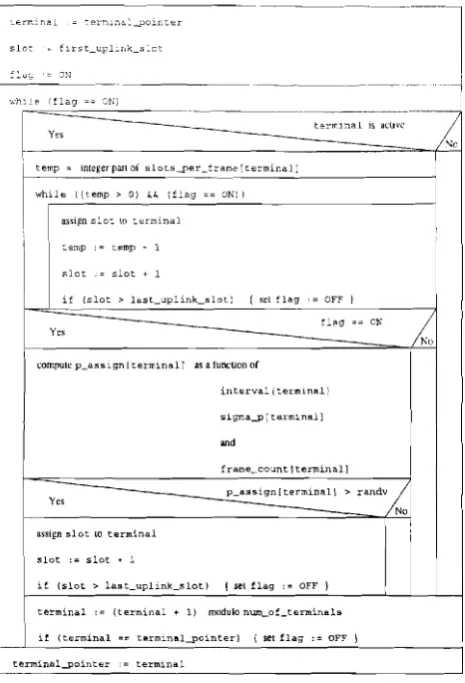
scribe the general principle of the algorit,hm and then describe its detailed implementation, as it is displayed in Figure 2.
The new approach of the SPAMA algorithm is its non-deterministic assignment of slots according to the average rate of a certain service. Assuming that an active spurt of the service has an average bitrate of Rs and that the assignment of one slot per frame cor- responds to a virtual channel of bitrate Rvc, the re- quired number of slots per TDD-frame is calculated as
x s = Rs/ R v c . Note that an active spurt is a trans-
mission phase, which is long in comparison to the frame
duration, i.e. usually one or more seconds, such as a
talk spurt in speech transmission or a whole call in
a service without silent gaps. Given xs, the inter-
val js (expressed in terms of the number of frames), in which the considered service needs to transmit one packet, equals l / x s . In previous approaches, such as all Packet Reservation Multiple Access (PRMA) based
[3:1 [4] access schemes, these requirements had to be
translated into integer expressions, allowing the users to occupy only an integer number of slot,s per frame on the average. These translations always implied com- plex algorithms and a suboptimal bandwidth alloca- tion. In the SPAMA algorithm, however, the proposed statistical assignment allows us to meet 'non-integer' slot allocation needs. Namely, since only integer num-
bers of slots can be assigned, an assignment of
xs
slotsper frame can be interpreted as an assignment of one
slot with a probability of p~ = x s . For example, in
a framed wireless ATM system, such as that represen-
ted by the parameters in Table 1, a one slot per frame
virtual channel provides a bitrate of Rvc = 963.264
kbps. Considering a speech service in accordance with
the GSM standard 151, that is an FEC-coded source-
rate of
Rs
= 22.8 kbps during a talkspurt, the numberof slots required per frame is calulated as:
Rs
- - 22.8 kbpsss = - = 23.694.
lop3
. (I)Rvc 962.264 kbps
with a probability of P A = ss = 0.02369 or to an
assignment of one slot in Is = 42.205 frames. Note
that slot assignments with a probability of p ~ in each frame lead to a high variance in the assignment inter- val duration, that is in ternis of the number of slots between two assignments, which implies a n inefficient bandwidth allocation. This is due to potential prema- ture assignment of slots that cannot be used by a ter- minal, because it does not have a ready-to-send packet in its buffer. In order to avoid this problem, we do
not base the slot allocation regime of the SPAMA al-
gorithm on the computed assignment probabilities for each frame, but on the cumulated assignment probab- ility for each interval fs. In our example above a slot should be assigned with a cumulated probability of one
in
fs
= 42.205 frames, i.e. with a cumulated probabil-ity of u p = 42142.205 = 0.995 in an interval of Is = 42
frames. In other words, it is necessary to guarantee
a n assignment of one slot in 42 frames with a cumu-
lated probability of up = 0.995. The distribution of
the per-frame assignment probabilities in each frame
of the interval Is can theoretically be chosen without
any restrictions, knowing of course that the choice will significant1 y influence the system's performance. In or- der to avoid the above mentioned early assignments of slots, the per-frame assignment probabilities have to in- crease with the number of frames elapsed since the last
assignment. In a first approach, we assume a simple
assignment probability growth function:
where n is the number of elapsed frames since the last assignment and the parameter k , defining the constant
q k , remains to be chosen in order to obtain a good sys- tem performance. For reasons of simplicity, we assume a n integer value for k and then express the cunlulated probability constraint given by:
which yields the constant q k as
Still keeping k as a parameter, we obtain the per-frame assignment probability as a function of the number of
frames n elapsed since the last assignment by inserting
Equation 4 in Equation 2 , yielding,
Eqiia.tion .j defines explicitly the assignment probability
growt,h function. Thc assumption of an i~it~egcr value
for k allows us to express the denominator of E~~~~~~~
5 in a simpler form, for example, for
k
= 1,3,5 and 7,we have:
Is (Is
+
1)n= 1 2
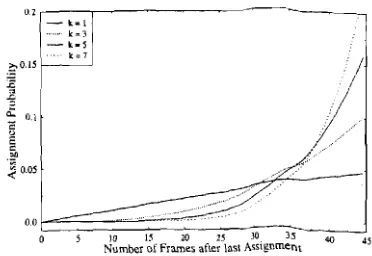
Referring to the example introduced above, we use Equa- tion 5 and obtain the assignment Probabilities as dis-
played in Figure 1.
.:
/.
4 L
5
0.1C
z
.
...-
2 0.05
0 0
i
0 5 10 5 10 5 10. 3s
Number of Frames lssl A~S1~"ment
"
45Figure 1: Assignment probability growth function for
our example, a, = 0.995 and Is = 42.
Once the base station has calculated the assign- ment probabilities p~ for each of the different rate ser-
vices supported, a binary random decision based on p ~ 4
defines, whether the service is granted a slot assignment
in the current frame. This computation is performed once a frame and then communicated to all terminals in the broadcast cell at the beginning of the followiIlg frame, so that each terrninal is informed as to the slots
it can use for transmitting packets Note t h a t if a ser-
vice needs more tha8n one slot per frame> i.r. zs
>
1.0.it is assigned a riu~rlber of S!O~S, corresponding t o the
integer part of
xs
in each frame. In Order t,o cater forthe 'non-integer' fraction, the algorithm is applied a,s
described above.
In order to give a more detailed description of the
proI)osed SPA4R$I-4 algorithm. its S a ~ s i - S h n e i d ~ r ~ ; ~ dia-
[image:2.553.307.493.281.409.2]((temp > 0 ) hh (flag = = ON)!
asn!Fn 510: to r r r n ~ n a l
1
i f (slot r last-uplink-slot! ( scl flag . = OFF 11
-
Y C S Pframe countlteminall 1
_Z p_snslgn[terrninall s randv
Y C S
No
I
( a s s i p slot 10 terminal
I
l
l
1 1 if (terminal == t e r m m a 1 ~ a i n t e r l 1 re1 flao : = OFF I 1
Slot : = Slot
.
1r f (sloi s last-uplink-slot) ( sel flag : = OFF )
1 terninalsointer = terminal 1
[image:3.550.3.236.68.410.2]I
Figure 2: Core part of the SPAMA algorithm, display-
ing one assignment cycle.
terminal : = !terminal + 1) modulo numof-cerm;nals
terminal is only involved in one service, the interval Is and the cumulated probability a, are denoted by interval [terminal] and sigma-p [terminal] can be calculated for each terminal as described above. All terminals are supposed to be cyclically numbered, so that the terms previous and next terminal can be used. At the beginning of each assignment cycle, the variable terminal is set to the terminal which is next to the one considered last in the preceding assignm'ent cycle. Each assignment cycle starts in the first uplink slot, slot :=f irst-uplink-slot and ends, if either all up-
link slots have been assigned, corresponding to (slot
>
last-uplink-slot) in Figure 2, or all terminalshave been served, satisfying the condition (terminal
--
-- terminal-pointer). For a specific terminal, in a first step, the integer part of the required number of slots-per-f rame [terminal.] is assigned, if necessary, as reflected by the Figure. Then the assignment prob-
ability p-assign [terminal] is computed, as described
above, and a slot assignment is performed according to
the binary random decision if (p-assign[terminall
>
randv), where randv is randomly chosen from a setof uniformly distributed numbers in the interval (0.1).
Then the next terr~linal is considered. ,4t the end of the
assignrrlent cycle of a rertain frame, terminal-pointer
is set to the terminal. which is next to the onc con-
sidered last. which is represented by terminal-pointer
:= terminal in Figure 2.
For call set up, a terminal has to signal the average bitrate of the service it is going to require. In a first ap- proach, each terrninal contends with an initialization- packet, containing the necessary information. Assuni-
ing 64 slots per frame and 15 speech, 15 video users,
as in the simulations below, it proved to be sufficient to guarantee one contention slot in every second frame. At the end of a call, another signalling packet is trans- mitted to the base station, this time in an assigned slot, indicating that assignnients are no longer necessary.
Applying the assignment algorithm described above, not all uplink slots are necessarily used. In order to keep the average packet delay low, these slots could be assigned to users whose packets already exceeded a certain delay. In a first approach, minimizing the signalling amount, we assume that terminals indicate 'ageing' packets by using a one bit flag in the packet- header they are sending. If this bit is set to one and not all slots have been used in the current assignment cycle, the terminal gets a n assignment for a number of slots depending on its average bitrate, which is already known t o the base station. Both the time after which a packet is considered as 'ageing' and the relation between the average bit rate and the number of assigned slots will be identified according to our simulation results. Performance figures for the SPAMA algorithm are given in the next Section.
3. PERFORMANCE OF THE SPAMA PROTOCOL
Having presented the structure of the SPAMA algorithm, we now characterize its performance. In a first set of simulations, we examine the influence of the assignment probability growth function, which was presented in
Equation 5. The throughput performance determined
by the access protocol's efficiency is then examined by varying the number of uplink slots for a given traffic load.
For our simulations, we assume a frame length of
N = 64 slots, where each slot carries SN = 384 bits of
payload, as for the ATM standard [7]. Let Us and
Uv
denote the number of speech and video users present in the system. Their source rates are referred t o as
Rss and Rsv, where Rss is fixed a t 22.8 kbps, ac-
cording to the GSM standard [ 5 ] . The video source
model emulates a n H.263 encoder [8] [9]. The channel
Definition Notation Unit Value
ChanneI Rate
Frame Duration
Slot Duration Speech Source Rate
Video Source Rate (target) Range of Video Rate Gross Slot Size
Net Slot Size Slots per Frame
Maximum Speech Delay Maximum Video Delay
Number of Speech Users Number of Video Users Ageing Packet Constraint
Mbps
msec. msec.
k bps Mbps
Mbps
bit bit
sec. sec.
sec.
Table 1: SPAMA parameters for a 34 Mbps WATM
system
interface, i.e. ATM cells comprising (384
+
40) bitsare transmitted at that bitrate in both directions. The remaining bits of the 1024-bit packets in each slot are required for FEC coding, for the packet header and for the quasi-periodic extension necessary in OFDM mod- ulation techniques [lo]. For both speech and video ser- vices, a maximum delay of 30 ms is tolerated, before a packet is dropped. All simulations are carried out for 15 speech and 15 video users. We refrain from simulating a constant rate data service in these initial simulations in order to create a randomistic worst-case scenario for the SPAMA algorithm. Specifically, since the proto- col's efficiency increases with a decreasing variance of the average rate, a constant rate service implies good system performance. The span of time after which a packet is considered as 'ageing', triggering additional slot assignments, as mentioned above, is set t o 15 ms. If any packet in the buffer of a terminal is older than 15 ms, then the additional request bit is transmitted to the base stations in the overhead of the following packet the terminal is sending. In simulations, this span of time proved t o yield good performances for dif- ferent sets of parameters. The number of additionally assigned slots for ageing packets is limited by the num- ber of slots, which is still available in the frame after the standard assignment cycle. In order t o prevent low-
lo-' 1 I
I 3 1 1 7 Paramerer k
0 - S p e c h Service Thmughput : 0.93
Figure 3: Delay induced packet dropping and delay
performance versus exponent k of the assignment prob-
ability growth function.
lo=
- Speech Service
0 ---- Video Service
10'
- I - Smech Service I .9 I
1
j6(Y2%) 35(85LZ1 lP(87qI ,331908) 12(93%l 3liYjn, iri(P7'ir ?YILVRI, i
Number 11l Uplink S l o a (~hroughput)
/
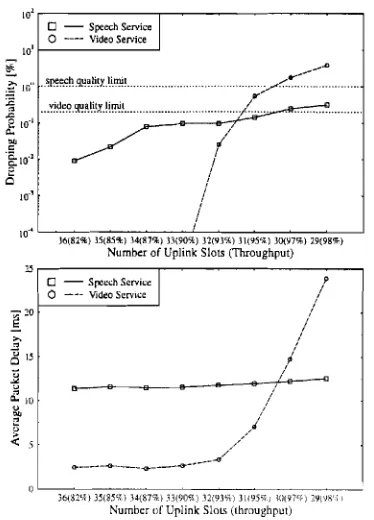
rate users with only a few ageing packets in the buffer Figllre 4: Delay induced packet dropping and delay
get assignments for many 'lots, the number of performance as a function of the number of uplink slots.
additionally allocated slots per termina,l corresponds to The numbers in brackets display the mcasrlred through-
5% of the average bitrate for tlie corisidrrrd service. -111
put,
system parameters are summarized i11 Table 1.
lo'
16,828) 15(854t) 1407%) 13,do;) ~?(YIR) 3 1 ( & x ) 3~(474-) 29~d84~)
[image:4.574.9.254.12.240.2] [image:4.574.278.465.347.607.2]TTe lion- esail~iile the influence of' the assignrilelit probability gram-th functioil on the delay performance. Figure 1 displays the function give11 in Equat,ion 5 for
different ~.alues of k . For increasing exponents, the
growth function has a very high positive gradient froin a certain number of frames onwards and then it is re- set to zero after the assignment. In order t o model a strongly impulse-like growth function, hereafter re-
ferred t o with index i, we fix the assignment probab-
ility in frame (Is - 1) at 0.25 and from frame Is on
at 0.75, meeting the cumulated assig~inierit probabil- ity constraint. This choice gives an approximation of Equation 5 for high exponents k. Figure 3 show per-
formance results for growth functions with k = 1 , 3 , 5 , 7
and the aforementioned i-function. As observed in Fig- ure 3, the delay and dropping performances for the low- rate speech service increase for increasing values of k,
k
5
7, but both the speech dropping and delay curvessuggest significantly reduced performances for the pre- viously introduced impulse-like i-function. The high- rate video service, however, remains nearly unaffected. Note that even for a throughput around 93%, both the speech and video services show dropping characteristics better than the required quality limits.
In the next set of simulations, the throughput per- formance of the SPAMA protocol is evaluated. In or- der t o vary the traffic load in small equidistant steps without changing the one-to-one proportion of speech and video users, the number of uplink slots, i.e. the available channel bandwidth, will be varied while main- taining a constant number of 15 video and 15 speech users. Results for these simulations are displayed in Figure 4. For a throughput up t o 90%, the video packet dropping rate is virtually zero and the speech dropping rate is at least a factor ten better than the required quality limit of 1%. Considering delay per- formances, the video packet delay is very low at less than 4 ms and with approximately 12 ms, the average speech packet delay is still less than half the allowed delay of 30 ms. Throughput values can rise up to 93% without infringing the imposed quality limits. For a higher traffic load, although the packet loss probability is not acceptable for video users, the system still shows a stable behaviour, with an only gradually increasing dropping probability.
4. C O N C L U S I O N S
In conclusion, Statistical Packet Assignment Multiple Access (SPAMA) is an algorithm of comparatively low complexity, which yields remarkably good performance results in the form we have proposed and studied. In addition, due to the central control of all slot assign- ments, SPAMA based medium access shows stable be- haviour even in overloaded scenarios. Its throughput
The financial support of the follo~ving organisatio~is is gratefully acknowledged: Motorola ECID, Swindon, UK; European Community, Brussels, Belgium; Engin- eering and Physical Sciences Research Council, Swin- don, UK; Mobile Virtual Centre of Excellence. UK.
[I.]
A. Acampora, "Wireless ATM: A Perspective onIssues and Prospects," IEEE Personal Communic- ations, pp. 8-17, Aug. 1996.
[2] F. Delli Priscoli, "Adaptive Parameter Computa- tion in a PRMA, TDD Based Medium Access Con- trol for ATM Wireless Networks," in 1996 IEEE Global Telecommunications Conference, Globecom 96, Conference Record, pp. 1779-1783, Nov. 1996.
[3] David J . Goodman and Sherry X. Wei, "Efficiency of Packet Reservation Multiple Access," IEEE Transactions, on Vehicular Technology, vol. 40, pp. 170-176, Feb. 1991.
[4] J . Brecht, L. Hanzo, M. Del Buono, "Multi-Frame Packet Reservation Multiple Access for Variable- rate Multimedia Users," Submitted to Proc. of PIMRC '97, Helsinki, Finland, 1-4 Sept. 1997.
[5] Group Speciale Mobile (GSM), Recommendation GSM, Apr. 1988.
[6] V. Claus, ed., Duden zur Informatik. Mannheim: Dudenverlag, 1993.
[7] M. Schwartz, Broadband Integrated Networks. Prentice Hall. 1996.
[8] M. Del Buono, L. Hanzo, P. Cherriman,
"Oscillation-Scaled Histogram-Based Markov
Modelling of Video Codecs," Submitted to Proc. of PIMRC '97, Helsinki, Finland, 1-4 Sept. 1997.
[9] J . Brecht, M. del Buono, L. Hanzo, "Multi- frame Packet Reservation Multiple Access Using Oscillation-scaled Histogram-based Markov Mod- elling of Video Codecs," Submitted to Image Com- munications, Elsevier, 1997.