Building a Secure Environment for Client-Side
Ecommerce Payment System Using Encryption
System
Akinyede Rapahel Olufemi, Alese Boniface Kayode,
Adewale Olumide Sunday
Abstract- Client-side computer, network connection between client and merchant web site’s server, web site’s server and software that allow it to run properly have become the target of attackers. Literature has shown that client-side network of the system has become the target of the attackers, this is because it involves buying, and selling and fund transfer by customers, merchants and financial institutions. Unfortunately, many of the researches that have been done in this area have not provided the required solutions. Hence, the purpose of this paper is to develop a client-side network security that safeguards information stored on the system from individuals that attempt to gain unauthorized access to data. Architecture of the system is designed by using advanced encryption system –AES encryption/decryption algorithm. The symmetric key cryptosystem can protect transaction data such as account numbers, amount and other payment information from alterations. The system uses the most common method of authentication which is user name and password.
Index Terms: Internet, AES, payment system, goods and services.
I. INTROUCTION
he most widely used applications, such as instant messaging, email, shopping carts, database programs, security techniques (encryption) and other programs that allows the web to run properly are usually the target of the attackers [1].
Normally at the design stage of any system development, security concerns should be a point of discussion so that it can be addressed properly [2,3] but unfortunately, oftentimes it is not a primary focus when new systems architecture is being developed because of its complexity [2,4].
The purpose of client side security is to safeguard information stored on a system from individuals and malware that attempt to gain unsanctioned access to data. Protection from this type of unauthorized intrusion must be handled by both software and hardware [5, 6].
As a result, we designed and implemented a client/server database for secure client-side e - Commerce payment system.
Manuscript received August 29, 2013; revised on October 11, 2013 R. O. Akinyede is with the Federal University of Technology, Akure, Nigeria, e-mail: [email protected] +2348034702718
B. K. Alese is with the Federal University of Technology, Akure, Nigeria, e-mail: [email protected], +2348034540465
O. S. Adewale is with the Federal University of Technology, Akure, Nigeria, e-mail: [email protected], +2348033616386
We made use of MySQL relational database management system (RDBMS) program to serve as a tool for storing and maintenance of data. This will enable users who want to input large amount of information and perform calculations at the same time [7, 8]. However, in e-payment system, server stores records of every transaction.
II. OVERVIEW OF THE SYSTEM
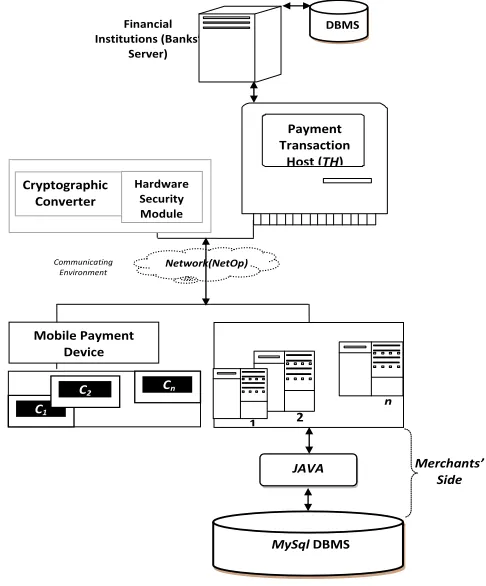
[image:1.612.342.585.338.631.2]The system was divided into three (3) parts, namely: the merchant server-side scripting, customer-side scripting and payment transaction host-side scripting (figure 1).
Fig 1: Diagram showing the merchant server-side scripting, customer-side scripting and payment transaction host-customer-side scripting of the designed secure client-side ecommerce payment system.
Merchant server-side scripting: It is a web server technology in which a customer's request is fulfilled by running a script directly on the merchant web server to generate dynamic web pages. The system provides
T
Communicating Environment
(CE)
Merchants’ Side Network(NetOp)
Merchants n
2 1
MySql DBMS
JAVA
Mobile Payment Device
Customers
C1
C2 Cn
Payment Transaction
Host (TH)
Financial Institutions (Banks’
Server)
DBMS
Cryptographic Converter
interactive web sites that interface to databases and other data stores.
Customer-side scripting: It is different from merchant server-side scripting in that it allows scripts to run by viewing web browser, usually in JavaScript. The system, which is a client/server architecture in design has three (3) main parts, namely: client module, server module and transaction host module.
Client module: The purpose of this module is to pass request made by client to server.
Server module: It stores all transaction information in a set of data files.
Transaction host module: It processes transactions and transfers fund appropriately.
Payment transaction host-side scripting: It deals with fund transfer.
Figure 1 is secured for clients {i.e. the customers and merchants} because security was considered at the design stage for the needs of the network. The proposed security was AES encryption/decryption scheme.
III. THE PROPOSED SYSTEM PROTOCOL
DATAFLOW DIAGRAM
A.Client registration: The proposed protocol introduces a preliminary registration process in order to prevent eavesdropping; and this is important because from experience, we discovered that some merchants are dishonest while lots are incompetent at protecting customers’ sensitive data; as a result, we must develop a system that will be able to ensure customers’ confidentiality.
Fig 2: Data Flow Diagram that checks whether the Customer has registered or not
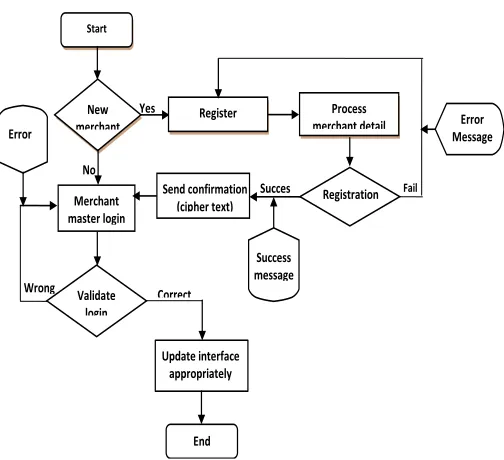
Fig 3: Data Flow Diagram that checks whether the Merchant has registered or not
It was also observed that some fraudsters might want to supply either invalid credit card number or claim refund from their banks without cause. Since there is no way merchantcan be protected against these set of fraudsters that present themselves as customers, the system provides protection through the initial registration.
According to the design, customers and merchants must register with a certificate authority (CA) before they can transact with each other. Figures 2 and 3 show the data flow diagram that checks whether a customer or merchant has registered or not respectively.
[image:2.612.318.570.46.276.2]The system design consists of customers, merchant and financial institution. The components of the client module are category, good items, purchase details, sales details and merchant. Figure 4 shows entity relationship diagram for merchant shop details.
Figure 4: Entity relationship diagram for merchant shop details. Category
Goods
Purchases details
Sales details User
Yes
Correct
Update interface appropriately
End Error
message
Wrong No
Merchant master login
Start
New merchant
Validate login
Succes s
Success message Send confirmation
(cipher text) Register customer
Process merchant detail
Fail
Error Message
Registration
Yes
Correct
Update interface appropriately
End Error
messag e
Wrong No
Customer master login
Start
New customer
Validate login
Succes s
Success message Send confirmation
(cipher text) Register customer
Process Customer detail
Fail
Error Message
[image:2.612.45.306.476.689.2] [image:2.612.353.522.536.638.2]B. Purchase request process: Having registered, the customer will logon to the merchant’s site and make a purchase request by sending to merchant his goods ordered information and the payment instructions. The merchant processes the order and starts the payment phase by forwarding the payment instructions to payment transaction host. Note that the proposed system will keep the customer's PIN (Personal Identification Number) secret; merchant cannot simply take this number, as done in telephone credit card transactions, and settle directly with the Issuer[9, 10]. The dataflow diagram for viewing purchase details at the customer’s side is as shown in figure 5. In the same manner, figure 6 shows the dataflow for encrypting customer’s payment information by cryptographic converter.
C. Client interface for client module: The interface links the clients to the server. For example, it takes all inputs from the clients, and passes them to the server’s database system. The clients use the interface to determine what goes into the server. It was created by a click on the client menu.
D Payment Authorisation Process: The merchant will receive the encrypted payment information from the customer and send it to the payment transaction host, which would, in conjunction with the Issuer, check the correctness of the payment information before sending it to the Acquirer, who sends it to the customer for authorisation.
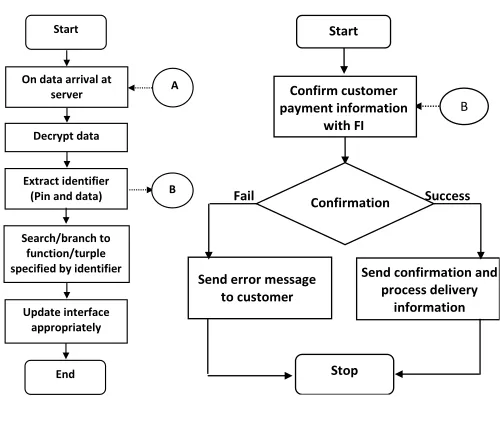
E Payment Capture Process: Here, the merchant sends payment requests to payment transaction host and then payment transaction host checks that everything is correct before responding to merchant’s requests. Finally, the actual funds transfer from issuer to acquirer and confirmation of payment with the financial institution will follow immediately (see Figs 7 and 8).
III. IMPLEMENTATION
[image:3.612.60.275.52.251.2]The layout of the user interface application is designed to be as user friendly as possible. When the user opens the software, the title form and welcome page will appear as shown in Figure 9.
Click on anywhere on the Screen, then a Register to Begin Page form will appear. This will allow the registration of both the customer and merchant so that they can Login into the system. This is the first step for customer registration. The customer clicks on register new user and supplies his details including the information on the credit card that he wants to use with Certificate Authority (CA).
Fi g 9: Welcome Page screen
Fig 8: Flow diagram of the customer’s information confirmation.
Fig 7: Data flow diagram for decrypting customer’s input information Fig 6: Data Flow Diagram for
Encrypting the Customer’s payment information by the Cryptographic Converter detail. Fig 5:Data Flow Diagram for
Viewing Purchase Details at the Customer’s side
Start
Make list of item(s) to buy
Process customer request
Generate invoice for request
Yes End No Accept
Fail Error message A Start
Input customer payment information (PIN)
Encrypt payment information
Send information to server
Send mail to FI to pay merchant
Success
End Send confirmation of payment and purchase detail
Mail sending
Decrypt data
Extract identifier (Pin and data)
Search/branch to function/turple specified by identifier
Update interface appropriately
Start
End On data arrival at
server
B A
Success Fail
B
Send confirmation and process delivery
information Send error message
to customer
Confirm customer payment information
with FI Start
[image:3.612.312.562.72.286.2] [image:3.612.391.494.592.724.2]A. System login process
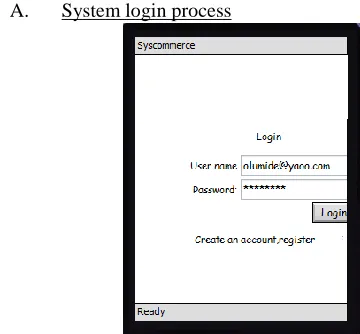
Fig 10: System login page screen
The system through CA will reply with a registration form, which customer completes and returns, together with the signing key that customer wants to register. The system would process the customer details for registration and send confirmation in form of cipher text. If the registration fails, an error messages would be displayed; and the system would prompt the customer to go through the process again. Then, CA checks that the credit card is valid and releases the signature certificate for customer who stores it for future use. All this information (such as credit card details) must be protected, but in case of merchant, he does not supply any credit card details as his form does not request for it. After that, when an OK button is clicked, a login page form will appear.
The user will log-in and the system will decrypt the encrypted user name and password from the http request and matches the details of user from database (e.g. validation). If authentication is successful, the system will display a message box with user session that informs the user that he can use the system. Otherwise, the system will display a message box that informs the user to go through the process again.
B. Secure client-side ecommerce payment system A Click will request the customer to enter his user name and password. If the entry is successful, a login welcome page is displayed and customer will be allowed access to the system. The detailed security analysis of the login authentication is hereby presented.
Login authentication.
When user (U), which can either be the customer or merchant wants to access the CA, he carries out the following steps.
a. U submits the computed ID, yId and Id and generates random number a, such that a [1, n − 1].
b. Calculates Qi = qiP and then pi = h(Qi), X = qiKpub_ib
and g = h(ID||Id||pi||Ti)
c. Select random number a, calculates Qi = qiP and then pi
= h(Qi), X = qiKpub_ib and g = h(ID||Id||pi||Ti).
d. U computes the hashed password Y = yId, dynamic identity dID = pi H(IDi) encrypted and sends message
to CA server
e. Decrypt pi H(IDi)
f. Verify both certificate & signature
g. Verification phase.
h. Authentication of Server and CA –After receiving
message item number (d) under login phase, and in other to ensure mutual authentication, CA runs the following
i. U chooses a random number y [1, n − 1], calculates Qi = qiP. U computes the shared secret
key SS1 = xi1 Kpub_ib.
j. U computes Authi = h (Idi|| SS1|| Qi|| Ti) and sends
Authi, Idi, SS1, Qi, Ti to U.
k. With the aid of the public key parameters mentioned under registration phase, U computes the public key, Kpub of CA.
l. After receiving the Authi message in (d), U
computes QU = qUP and the long term secret key
SS2 = sUKpub_i. Then, U verifies the received Authi
message. If the verification result is wrong, the protocol will be terminated. Otherwise, the protocol will be continued.
m. U computes and extracts H(IDi)
and verifies if H(IDi) in U’s database. If the
verification result is wrong, the protocol will be terminated. Otherwise, the protocol will be continued.
n. U computes gi = h(ID||Id||pi||Ti) and verifies its
validity. If the verification result is wrong, the protocol will be terminated. Otherwise, the protocol will be continued.
o. U selects a random number qU [1, n − 1],
calculates QU = qUP. U also computes the shared
secret key TB1 = h(ID||Id||pi||Ti) and AuthU = h (Idi||
SSs|| Qi|| QU|| Ti). Note that TB1, QU and U are
temporary keys known as secret that is shared with user Ui.
p. U sends the output of QU, TB1, and AuthU to CA.
q. CA computes the outputs of AuthU and TB1 and
verifies its validity. If the verification result is wrong, the protocol will be terminated. Otherwise, the protocol will authenticate U.
r. Authentication of Server and User (U) –After
receiving message item number (p) under
Authentication of Server and CA, then the
authentication of server S and user U would follow. s. CAi chooses a random number y [1, n − 1],
calculates Ri = h (TBi || Qi) and sends Ri, and Qi, to
Ui.
t. Ui computes and also
u. Ui compares with , and verifies the validity
[image:4.612.52.232.51.218.2]the and to CA and continue. Otherwise, the protocol will terminate.
v. CAi then computes = (Ri||Qj) and compares it
with either or . If = , then Ui is assured and the session keys for Ui and
CA will be stored in the database. Otherwise, the protocol will terminate.
C. User interface
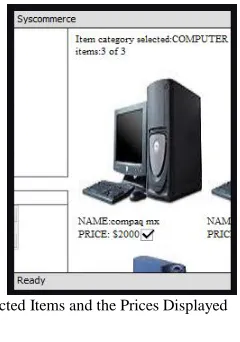
The user has two interfaces: the merchant interface and customer interface. The merchant interface is used to upload and display available items for shopping. When the customer chooses the desired merchant, the items that are available in his store will be displayed. Then, the customer can select the needed items from the item list and add them to the cart. For example, when an item is selected from item list, the system displays item ID, item price, and the required quantity is filled by customer. Other items can be selected. When icon “Add Item” is clicked, item ID, item name, price, quantity (Qty) and cost can be seen on the table. The purchase total amount is shown under the table. After pressing “OK” button, the purchasing goods quantity will be added to the remaining goods or items (see figure 11). Payment will be initiated as follows:
Payment Initialization
is correct THEN
M processes the order and starts the payment phase by forwarding the payment instructions to TH (payment
Transaction Host). Note that the TH will obtain transaction
[image:5.612.96.216.536.707.2]data via the network and processes the payment transaction on behalf of a financial institution FI that holds the account of the customer C for the payment method selected.
Fig 11: Selected Items and the Prices Displayed
V CONCLUSION
Despite the numbers of client-side ecommerce payment system that have been proposed in the past, not many of them
are practicable or implementable. As a result, this paper has suggested a secure client-side ecommerce payment system in mobile environment that takes clients as principal players. The security applied is based on symmetric cryptographic technique and the system will not only reduce the computation cost of all engaging participants but also satisfies the five transaction security properties.
REFERENCES
[1] D. Khusial and R. McKegney, e-Commerce security: Attacks and preventive strategies. Published in 2005. Retrieved in from http://www.ibm.com/developerworks/websphere/library/techarticles/050 4_mckegney/0504_mckegney.html
[2] D. N. Chorafas, Management risk. Published in 2004 http://site.ebrary.com/lib/strathmore/Doc?id=10076986
[3] R. Kevin, Internet Security Threats And Protection Methods. Published in 2010. www.krio.me/internet-security-threats-and-protection-methods [4] K. Allen, and R. Krio, Enterprise Security Risk and Evaluation.
Published in 2008 http://www.krio.me/enterprise-security-risk-and-evaluation/
[5] http://www.krio.me/internet-security-threats-and-protection-methods/ (accessed 22/8/2013)
[6] Z. B Omariba, N. B. Masese and G. Wanyembi, Security and Privacy of Electronic Banking. IJCSI International Journal of Computer Science Issues, Vol. 9, Issue 4, No 3, July 2012 ISSN (Online): 1694-0814 www.IJCSI.org
[7] C. J. Date, An introduction to Database System, ISBN 0-201-824582,Seventh Edition, The System Programming Series, Addison-Wesley Publishing Company,1994
[8] H. P. Pyae, Design and Implementation of Secure Electronic Payment System (Client). Design and Implementation of Secure Electronic Payment System (Client). World Academy of Science, Engineering and Technology, 2008.
[9] D. O. Mahony, M. Peirce, and H. Tewari, Electronic payment systems. The Artech House computer science library. Artech House. 1997 http://www.springerlink.com/content/b2w26822h2252757/